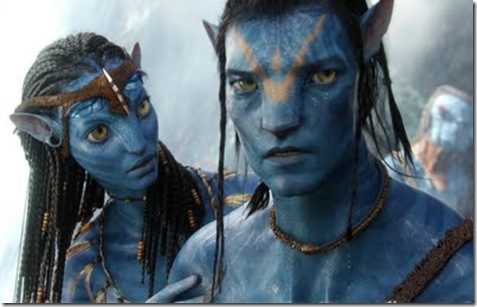
I have seen it twice now, both times in 3D. The following contains spoilers.
1. Its technical prowess is undeniable. For all the hype, I do think that Cameron has revolutionized the action movie. Note that I do not say films in general. 3D will help action, and to a lesser extent, horror and children’s, films, but I doubt it will add much to dramas or comedies. Consider if you think the Godfather, Airplane!, Schindler’s List, or Casablanca would be much better in 3D. I don’t really think so. On the other hand, think of the chariot race in Ben-Hur in 3D. Now that would be something! So I think we should give credit to Cameron for his revolution. But we should also realize that its best impact will be limited in scope. This revolution is not on par with the transfer from silent to spoken films in the 30s, but rather more on the level with the move from frontal stereo to surround sound that began in the 80s.
2. Cameron also deserves credit for integrating 3D in a non-gimmicky way. Back in the 80s, 3D was tried, but it was always cheesy. Third films in bad series showed up with titles like Jaws 3-D or Friday the 13th 3-D, but usually the only thing 3D was a gimmick like a spear flying straight out at the screen. To Cameron’s credit, his 3D is integrated throughout to generate a richer, more immersive environment for the viewer. In that way, he has matured the technology, which is now over 30 years old. That too is major feat, especially given the decadence of CGI in the last decade or so. CGI is now so ubiquitous, that it enables laziness. Cameron has helped return CGI to an exciting enhancement to a movie, rather than a replacement for it (300, Star Wars prequels, Matrix sequels). Cameron’s visual advance in technique rivals the the size of the steps forward made by Star Wars (1977), Terminator 2, and Jurassic Park. Visually, this film is the most important advance since Return of the King.
3. But the story… It is so politically correct postcolonial/environmental, that you just writhe in its painful predictability (kinda like Kingdom of Heaven with its blessedly pleasant Muslims and wretchedly imperialist Christians – yawn.) Indeed, in my second viewer, I found myself rooting for the “Sky People” just to upset the all-too-comfortable and easy PC moralism of it all. And there is no doubt that the bad-guy mercenary is the most enjoyable character in the movie. In the same way Lawrence Olivier or Darth Vader were the most fun to watch in Spartacus and Star Wars, here you can’t help but love the watching the bad guy marine drink coffee in his ship (hah! ripped straight out of Apocalypse Now), while his machines wipes out the beautiful, harmonious, nature-loving, athletic Californians, I mean, Ewoks, I mean Navi! I wish they had made him a smoker too.
If you make a farce of tragedy, it becomes comedy. The Navi are so wonderful, that you kinda want to see them get smacked around. You’re not as muscular and virile and beautiful as they are; you’re sitting in that theater right now with a half-gallon of popcorn in one hand and a 64-ounce gulper of Jolt cola in the other. And how come they don’t commit human sacrifice like the Aztecs? The point is that if your story simply recites platitudes with no moral complexity, then its easy to ignore. Hollywood usually does this from the right actually. Usually Hollywood movies are unthinking vehicles for US patriotism (Michael Bay, Rambo, e.g.), but movies like Avatar and Kingdom of Heaven show you just how easy it is for the left too. By contrast, consider a difficult movie like Apocalypto, whose moral categories are all mixed up for the viewer and is consequently a richer, more challenging intellectual experience.
4. The best political reviews I read of the film are here, here, and here. Cameron deserves all the criticism IMO, from both right and left. Ironically, both the left and the right are correct about the film. Most of the political commentary I have read on the film is excellent – rapidly deconstructing its facile morality and easy ‘white messiah’ storyline, which is just ripped-off from Dances with Wolves and the Last Samurai.
5. Conservatives found it a simplistic story of PC platitudes: nature=good, technology=bad; white people=destructive rationalists, native peoples=harmonious pantheists; fossil fuels=bad, crying after the hunt=good. The blue people are a hodge-podge of the Vietnamese, Native Americans, and the Ewoks; the bad guys are a cross between Blackwater and Caterpillar; and Cameron even gives you throwaway references to the GWoT with dialogue about shock-and-awe or martyrdom. Too easy!
6. The left finds it a white man’s guilt trip, only without much of pain of actually being like the oppressed indigenous people. So the main character can find how good and wholesome and nature-loving the natives are, and he can play at being one of them. But if it gets too weird, he can always go back and get his legs fixed. So he can pretend he is a native, in order to assuage his guilt for destroying the Amazon, I mean Endor, I mean Pandora!, but he doesn’t actually really want to be oppressed like real Native Americans, so he can always head back to his white body. This is the fantasy of a rich white man living an highly technologized culture about what it might be like to give all that up. The reality of course would be if Cameron moved onto a contemporary US Indian reservation and confronted the problems of cultural dislocation, alcoholism, and poverty. But who wants that? Better to fantasize about riding dragons and hooking up with the hot native babe. Ridiculous.
7. Avatar is strange film to review given the wildly unbalanced mix of revolutionary style and banal substance. On the upside, I think it is the most important film of 2009, although obviously not the best. Everyone should see it. It’s the most important step-forward in visual presentation since Lord of the Rings, if not Jurassic Park, and 3D is coming to home theater this year. I do agree with Cameron that this is the future of visual entertainment (look for it in video games too soon), albeit for only for certain genres of film. On the downside, Avatar proves once again the long-standing rule that no amount of razzle-dazzle can cover an abysmal story. For all the money Transformers 2 or Phantom Menace made, I don’t know anyone who really likes them. By contrast think how great were Hitchcock’s one-room drama Rope or Linklater’s let’s-just-walk-around-Paris couplet Before Sunrise and Before Sunset. I think the latter cost maybe a million dollars, but I’d rather re-watch that than Avatar.










 Robert E Kelly