Six-Party Talks as a Game Theoretic ‘Stag-Hunt’ (1): N Korea is the Stag

stag_hunt

Last week, I suggested that South Korea demonstrate ‘strategic restraint’ vis-a-vis NK if the North truly sank that SK destroyer. Not only are the South’s tactical response options terrible, but there is benefit here to be captured if the South’s restraint is marketed to China as a concession in exchange for more pressure on the North. For all of NK’s reputed autarky, it is in fact highly dependent on Chinese aid and trade, both licit and illicit. Without Chinese fuel oil, the lights in the North would go out; without the imports of booze, dollars, and pornography, the life of the Korean elite would be far less pampered. China cannot force the NK to change, but it can dramatically raise the costs of its continued intransigence.

All this is well-known but could be helpfully formalized in our research. In fact, I am surprised how little game theory (GT) I see applied to NK at the conferences here in Asia, given how obvious its utility is to the bargaining and brinksmanship endemic in NK foreign policy.

The stag-hunt (SH) is the best GT model or ‘game’ by which to map Northeast Asia’s security dilemma. We use GT all the time in IR but usually the prisoner’s dilemma (PD). (If you have no idea what I am talking about, start here for GT in IR; the Wikipedia write-ups, linked for the SH and PD, are actually quite good too.) The PD is cooperation came – how do you get the players to cooperate when there are high incentives to cheat on each other. The stag-hunt is better understood as a coordination game – how do you get the players to coordinate a common strategy to get the big pay-off, the stag.

Here is the basic schematic: a group of hunters can probably bag a big stag if they work together. They can weave a net around the stag that is likely to catch him. However, the hunters will also see the occasional rabbit bounce by. If one of the hunters goes for a rabbit, the stag will escape through the hole created and the other hunters will lose the stag almost certainly. Formally put, the stag is a big pay-off, and there is a good probability of successfully catching it if the hunters all coordinate. Conversely, the rabbit is a sure thing, but a much smaller, payoff. So the trick is to convince all the hunters to coordinate and not take the easy rabbit by cheating or ‘defecting’ on the other hunters.

So apply this to the Six Party Talks: The Hunters (players of the game) are the 5 parties besides NK: Japan, US, SK, Russia, and China. The Stag is North Korea, or more specifically change by the NK regime. The NK stag knows that if the 5 hunters can’t cooperate, it can escape. And it is widely noted that this is exactly what NK has done for decades. NK’s foreign-policy methodology since the 50s has been twisting and turning to prevent domination. Since the end of the Cold War, this has meant a constant ‘divide-to-survive’ effort aimed at the other 5 parties to prevent their coalescence into a united front against the DPRK. (I even wrote a book chapter about this, in galleys here.)

So the trick then is to build a common front among NK’s hunters to insure that they won’t defect or cheat and go for the rabbit. The rabbit in the NK case would be NK concessions to one party, but not the others: for example, abductee returns to Japan, family reunions for SK, mineral exploration rights for China, etc. These piecemeal, now-one-but-not-the-other concessions are all designed to keep the other 5 players off-balance and disunited. To date this has worked spectacularly well, even though the 5 hunters all know they are getting shamelessly manipulated.

The big problem to date for the hunters’ coordination is that China sees a lot of gain from taking the rabbit. The Chinese rabbit is in fact so juicy, it probably outweighs the tasty stag. The Chinese rabbit is a route of influence into the Korean Peninsula through North Korea’s continued existence. The big stag – change in NK to be a better international citizen in Northeast Asia – is of much greater value to SK and Japan, followed by the US, than it is to China. So long as China perceives a utility from NK as a buffer against SK, Japan, and the US, it is likely to continue to defect on 5 party cooperation, as it did last year, and take the rabbit of propping up NK in order to influence Korean events.

Part two is here.
Republican SotU Response: Vote for Me because I Read the Bible and my All-American Sons Love Football – Bleh…

alg_bob_mcdonnell

Part one of this post, on Obama’s State of the Union address, is here.

If Obama’s speech seemed tired and rather boring, I must say I found the Republican Response simply atrocious – Vote for me because my all-American sons love sports just like you! It was Palinism; i.e., decadent, late Bushism.

The Democrats cheering at just about every line was sycophantic and annoying. Just saying flim-flam like, ‘I want America to be the best at future technologies,’ got Obama mawkishly long applause, and after awhile it got really tiresome. Agreed.

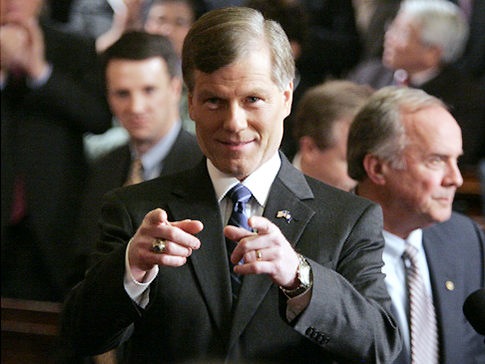
But the GOP response was downright disastrous. Here the applause really was scripted as syncophantic. What is it with the GOP and her0-worship? Ech! They even hooted and ho-yahed for McDonnell. And did you catch the unbelievably ‘diverse’ cast of worshippers behind the governor –  a soldier, a black,a policeman, an Asian, an old woman? This is supposed to be the contemporary GOP? Of white protestant tea partiers in Virginia of all places? Good lord. I laughed out loud the first time they panned the backstop audience.

It all reminded me of the GOP 2004 convention, a) with its painfully overchoreographed image of diversity for a party whose voter base is overwhelmingly white, born-again protestant, and b) the hero-worship of W as just a regular good ole boy who rose to greatness by his wholesome American gut values. Only in Virginia, this guv made sure to tell us his beaming daughter served in Iraq, and his snappy young sons like Sportscenter. Hah! What unbelievably smarmy crap! Do Americans really fall that?

If you thought Bobby Jindal was bad last year, at least he didn’t ask his family to perform the family-values  swimsuit competition for the religious right: ‘the Scriptures say families and America are great, so vote for me!’

The riposte captured all the banality and policy bankruptcy of the current GOP. The US economy nearly melted down, and there is wide consensus that massive government intervention scarcely averted another Depression. Yet the GOP response told us only that government is going to stifle America. That’s it?! When corporate and private spending is down all over the place, and the only big source of demand in the economy right now is government? That is your answer? Government is the problem when the only reason unemployment isn’t worse is government? C’mon. How can I take this seriously as policy?

On foreign policy, McDonnell was just as bad. He could only complain that we mirandized Umar Farouk Abdulmutallab. I take it to mean that we should torture the hell out of him or otherwise deny him any rights. When did torture become a litmus-test for status as a conservative?! Creepy

I was once again struck by the utter failure of the GOP to respond seriously to Obama’s election and the scope of the financial crisis. This is still the GOP of the W years. Governor McDonnell told us nothing we haven’t heard before, and he did it in the worst Rovian fashion – a highly controlled, hyper-scripted environment filled with sycophantic, awestruck faces, the shameless exploitation of his family, an even more shameless diversity ploy, Bible citations – excuse me, ‘Scripture,’ the recitation of same points again and again, now matter what the topic of discussion, and a bullying tough guy approach on foreign policy. They should have just let Palin do the response; she really believes W was one of America’s greatest presidents ever.

If Obama came across as exasperated or tired, McDonnell broadcasted unreconstructed Bushism. Stick with the former until the GOP can finally figure out how to move on.

_____

Finally I must add one professorial, intellectual barb to the whole proceedings:  it was remarkably, staggeringly shallow at almost all times for anyone with a serious knowledge about or education in the big issues in American life. I spent 2-3 hours watching the State of the Union, the GOP response, and some of the punditry on CNN. I was amazed at how little genuine expertise, technical detail, or serious, apartisan/non-spin, cost-benefit analyses of policy choices were included. It was almost all just campaign spin (how will this or that play in the red states?; speaking of, will Maitlin and Carville please finally go away?!), agonizingly cheese-y anecdotes (tell the woman making brake fluid in Des Moines that America has lost its edge), inspirational vacuities (America’s promise for the future), and shameless partisan positioning (my daughter went to Iraq, and my handlers made sure to place a black and Asian behind me – look! don’t miss ‘em!).

What junk! I mean really. How unbelievably insulting. Can’t our public officials treat us as reflective, deliberative voters, instead of dupes who think you’re great because you quote the Bible? How gratingly, offensively shallow. Grrr. WE ARE NOT CHILDREN.

If you have any kind of serious education in politics and economics, this was 3 hours of your life wasted. You learned almost nothing serious about the coming year’s policy debates – other than unintended signals that the GOP is lost in time, Obama doesn’t know what to do with health care, and no one is serious about the deficit.

Most of my day is spent reading technical work in political science and economics, so I imagine this is why it seemed so jarringly childish and evasive of serious issues. But honestly, if you had read even a few articles in the Economist or Financial Times about US politics, you would have learned more. I could have given a better talk than any of those guys, and in less time. This is why we have the democratic legitimacy crisis Obama mentioned. If you treat the population like idiots, they become disaffected.

Obama’s State of the Yawn-nion

state_union_a_0127_thumb

My thoughts on the Republican response are here.

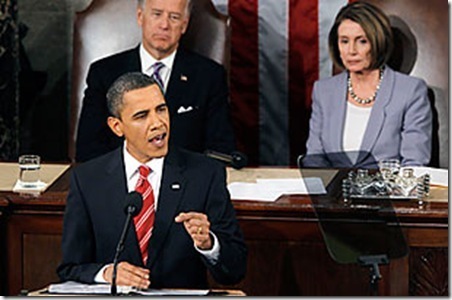
Interpreting the State of the Union (SotU) address is kremlinology on par with deciphering what the North Korean regime really thinks, what Sarah Palin’s honest policy preferences are, or what Paris Hilton fans actually see in her. American politics is not my academic area, but I worked for Congress for a bit and teach US politics regularly (almost all political science professors do). So here are a few take-aways…

1. SotUs as a tonic for US democracy’s legitimacy crisis.

SotUs are of course more about the drama and symbolism of the US Constitution in all its majesty. Just about everyone of any significance manages to show up – all 3 branches in their entirety, plus the Joint Chiefs of Staff, the cabinet, the First Lady and all the top staff of those assorted figures. As an object lesson to the citizenry this is helpful, as you get a chance (only once a year unfortunately) to see all the people who are representing you, crafting decisions in your name, and spending your money. In fact, this is rather healthy as exercise of democratic practice. John Q Citizen gets a chance to see his government in action and its trappings of glory (or not). Obama mentioned the crisis of legitimacy of American government (the idea that Americans unheathily loathe their government for its extreme partisanship, constant gridlock, and chronic capture  by special interests). Seeing the full retinue of government doing its thing on national TV for all to watch is a good antidote to that. Foreign Addendum: It is also an excellent ‘teaching moment’ for foreigners who a) find the US government unbelievably disaggregated and complex, and/or b) live in an authoritarian society.

2. The speech seemed listless and grab-baggy, or maybe just down-to-earth after W.

I didn’t leave with any one overriding idea. Bush 2 had three really memorable SotUs with easy-to-take-away one-liners: 2002 (axis of evil), 2003 (African yellowcake), 2005 (the US world-historic mission to spread freedom). Obama did not scale to those heights. Instead, it was a mish-mash of ideas and small-beer policy proposals, none of which really gripped me (more tax credits to make the tax code yet more indecipherable – bleh).

My guess is that the lawyer in him is wary of Bush-style extravagance. And it is true that Bush’s rhetorical flights were indeed memorable, but mostly because they were terrifying – a global long war for freedom and wildly unsubstantiated charges about Iraq, jihadism, etc. It is evidently Obama’s style to dial down expectations. But nevertheless, it drifted, and it felt tired. Like the Afghan surge speech in December, it didn’t rouse or convince me of much of anything. It glided through a series of topics without much serious discussion, and there was no central theme.

3. Another chance at serious debt/deficit discussion was passed up.

The ‘spending freeze’ has gotten much press, but honestly, it’s a gimmick. If the prez leaves out Social Security, Medicare, Medicaid and Defense (plus interest on the debt), he is left with less than 20% of the entire budget to ‘freeze.’ This is not serious. Forcing the FBI to hire one less secretary or pushing HHS to use fewer paperclips is pleasant but meaningless budgetarily. For decades presidents have tried to find budget savings in ‘waste, fraud and abuse’ (Reagan’s preferred locution), but to no avail. Clinton closed the budget primarily by keeping the big 1990 tax hike of Bush 1 and then pushing through his own in 1993. He also controlled the government’s size and used pay-as-you-go to force Congress to fund any new spending. W dropped all this and just borrowed while cutting taxes. The only way Obama can get the budget back in line is with a tax increase, unless he will go after the programs he excluded from his spending freeze. Particularly Defense needs to go on a diet.

In fact, Obama suggested a flippantness about the looming fiscal disaster when he deployed the disturbingly casual locution, ‘and while we’re at it, let’s cut this other tax too!’ Sure! Why not just chop all sorts of taxes? Wth difference does it make? When are we going to talk seriously in the US about the need to a tax hike as the only realistic way to balance the budget? One of the biggest idiot lines of the Bush presidency was when he said we could reduce the deficit without raising taxes. If you want to have functioning government, you can’t just keep voting yourself tax cuts and spending expansions. Otherwise you’ll look like California. In fact, in the 15 minutes or so devoted to the budget deficit, the only serious proposal was the restoration of ‘pay-as-you-go.’

4. Foreign policy’s a throw-away.

For all the folks who claim the US is an empire, we sure are an introverted one judging by this talk. Foreign policy got less than 10 minutes, despite the ongoing GWoT that is in fact in increasing under Obama. About the only thing useful was the oblique hint that Obama will push for more trade (cleverly repackaged for the speech as ‘more exports’) with Korea and Latin America. But even this too has obvious problems, as just about everyone today is trying to export more as a route out of the crisis. If Obama thinks that he can pull the US into a current account surplus, he’s dreaming. Most of America’s big trading partners (Germany, Japan, India, Korea, China, Taiwan) run a surplus on the back on the voracious American consumer. Understandably, Obama now wants them to return the favor (his ‘National Export Initiative’), but if he thinks mercantilists in the Asia are going to suddenly import more, forget it. If there is one thing I’ve learned living in Asia, it’s that governments out here are like the Spanish Habsburgs on trade. They’d rather brutally punish their own citizens through higher and higher trade barriers than tolerate any serious trade deficits with the US. Is this unfair to Americans? Absolutely. But it is also how they play the game here, so forget some export promoted US recovery with Asians buying our stuff.

Beyond this, Obama gave us nothing new on the Middle East or NK – just more ‘I’m tough’ schtick to keep the right-wing blogosphere from exploding.

Korean Political Science Association 2009 Biannual Meeting: “American Dual Containment in Asia”

The KPSA had its biannual meeting from August 20 to 22. Unlike the APSA, the KPSA meets only every two years, because of its size. It was a pretty good conference, but the papers generally feel short of APSA standards. This is the first one I attended. A few thoughts:

1. Just about all the attendees – Korean and foreign – got their PhD in the US. The elite universities in Korea are filled with people who got their PhDs in the US. I rarely meet people who attended those schools, only people who work at them. This speaks volumes about the very high quality of US education vis-a-vis the rest of the world. It also suggests graduate education is a major export sector of the US economy, but no one ever seems to conceptualize it that way.

2. Most of the papers were heavily focused on policy analysis and the day-to-day of Korean and regional politics. In this way, it didn’t feel like political science often to me, but like public policy. I guess this is ok, but it allows a lot of room for sheer opinionating and bloviating. But then again, many have complained that US political science is so theoretical and methodological that regular people can’t access it, it has become irrelevant to politics, and it is just another academic world unto itself. That’s true too. My feelings on this are mixed.

3. IR was vastly overrepresented among the political science subfields (theory, comparative, domestic [Korean], IR). At APSA, US politics’ seminars outweigh all the other sections combined. Not here. I think IR was a majority of the panels. I bet this reflects, 1. the general stasis of Korean domestic politics (interrupted by outbursts of violence on the streets or in the National Assembly), and 2. the immense international pressures on a small country like Korea, especially one surrounded by such large powers. It is a luxury of US politics that our internal politics feels so autonomous. As a superpower with good geography, we don’t have to pay attention to foreign opinion much. (Obama’s use of external anti-Americanism as a campaign tool was quite extraordinary.) Korea does not have that luxury, and the PS reflects that.

4. The geographic focus was solely on NE Asia. I didn’t see a single paper about another area. I find this a growing and disturbing trend here, especially when the state slogans are Global Korea, Dynamic Korea, Korea Rising, etc. I almost never meet anyone who knows anything about the ME, Africa, Latin America, or South Asia. In the context of topics like terrorism, religion, or development, one would need some exposure to these areas. But then again, I almost never see work by Korean academics on topics that are not immediately germane to NE Asia. I suppose this East Asiacentrism is forgivable given how small Korea is, but it speaks poorly of Korea and Korean political science that it seems so disinterested in the rest of the world (US excepted). I have met Korean IR political scientists who didn’t know the capital of Canada or that Iran is Shiite. Yikes!

5. About 40% of the participants were foreign – mostly Chinese and Americans, plus a few Japanese and Europeans. This tells me two things. One, there just aren’t that many political scientists in Korea. Two, they believe in recruiting foreign participation, even if the work proffered is pretty poor, because it serves the larger goal of Korea promotion.

6. The Biannual Meeting was used as another venue to, well, propagandize the Korean miracle. Speaker after speaker, both in the panels and in the general sessions like the dinner speakers, told us again and again how Korea grew from nothing to become the world’s 13th largest economy and a global ‘player.’ (I am so sick of hearing that last word.) There were a few government officials invited to speak as well, and they too went through this. It almost feels like a requirement from any serious personage in Korea, particularly when they speak to foreigners. The English language press here is filled with this story too. This incessant Koreaphoria suggests two things to me. a) They are nervous that their gains are tenuous, because they were so rapid. So perhaps telling the tale again and again, and telling foreigners too, and then expecting the foreigners to echo back the same story (and we are expected to repeat this party line), psychologically reinforces the solidity of the miracle on the Han. b) Koreans are extreme nationalists. Such constant self-celebration eventual begins to suggest arrogance and egomania. I try to be tolerant and simply smile as I hear the story told a million different ways. I try to understand why the story is so often repeated (because it feels so unreal, especially after the first 3/4 of the 20th C was so hard on Korea). But at some point, you just have to give in and say it is an example of the intense nationalism so many scholars have noted to exist outside the West. I am unaccustomed to this. My own feelings about the US hardly mirror the intensity of Korean feelings for Korea. It makes me uncomfortable.

7. The panels were far too short and too crowded. I am not sure how to interpret this. A very cynical friend said the answer is the image-consciousness of Korea. It is more important to list the panel and be able to mention it on your CV or in an TV interview, than to actually have it be a substantive process. So you cram as many people into as many panels as possible. Inevitably the panels are too short (75 minutes) and too crowded (1 panel leader, 4 presenters, 2 discussants). This is certainly what happened to my panel. A 20 minute presentation was chopped in half, and I got no meaningful feedback or discussion.

8. My presentation, what there was of it, argued that the US will ally with India in the near future. India is the only country that is also facing China and Islamism, and is democratic too. Here is my abstract, and the relevant graph on US alliance picks:

US grand strategy after 9/11 has turned from post-containment drift to preemption. But the costs are high – suspicion of American power, hedging by traditional allies, expensive, go-it-alone ventures like Iraq. Tried-and-true containment better reflects American values. While forward in the world, containment is also defensive. It reassures skittish partners and reflects liberal, anti-imperial US preferences. In Asia, containment could hold the line against radical Islam and Chinese nationalism without encouraging a global backlash. Democratic India shares these same two challengers with the US; it is the likely pivot in a US-backed neo-containment architecture in Asia.