
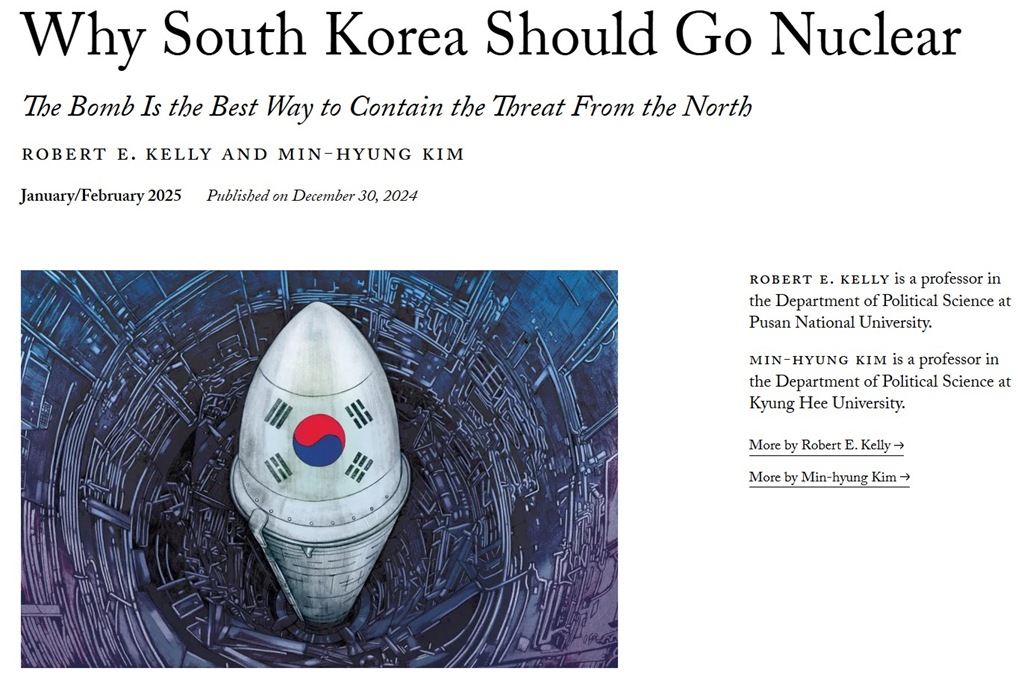
 This post is the original version of an article I published this month in Foreign Affairs on potential South Korean nuclearization with my friend Kim Min-Hyung. I think the editing made the essay more readable, but some topics I wanted to elaborate got edited out.
Specifically, US hesitation against fully and robustly supporting Ukraine against Russia – because of Russia’s nuclear threats – is a model for what will happen to South Korea in a second Korean war, especially when Trump is POTUS.
We have known for years that the Biden administration has repeatedly held back on aid, discouraged certain Ukrainian military actions, balked at giving certain weapons systems, and so on for fear of Russian nuclear ‘red lines.’ Here is yet another example from the last few days. Apparently, the Biden team got Russia out of an even bigger defeat around Kherson in 2022 for fear of a Russian nuclear response. Russia’s nuclear threats have worked well, and they aren’t even as credible as North Korea’s!
A lot people think the Russians are just bluffing, but the Biden team has been super cautious anyway. So in a Korean contingency, where NK nuclear threats are even more credible, our behavior in Ukraine suggests we will respond even more cautiously. Our Ukraine behavior strongly suggests we will slowroll aid to SK and try to avoid full involvement for fear of nuclear escalation.
NK nuclear escalation threats are more credible than Russia’s or China’s, because NK is far more vulnerable to collapse after just a single significant conventional defeat than they are. NK’s military is conventionally obsolete; NK lacks strategic depth; its economy is a shambles; its state is sclerotic and shallow. One big defeat at the DMZ, and it’s all over for NK and the Kims who will be lynched by their own people. Russia by contrast does not face regime collapse and an existential leadership crisis if it loses badly conventionally in Ukraine; nor does China face immediate implosion if it loses in a war over Taiwan. But NK and its ruling family do face immediate existential risk if they lose even one battle at the DMZ. So NK has to threaten nuclear use immediately, and it has to use those weapons if its bluff is called. It can’t issue vague, maybe-sorta threats like Putin has for the last 3 years.
So if Russian not-so-credible threat have successfully gotten the US and NATO to slow-roll aid to Ukraine, imagine how much more successful they will be in Korea where NK’s nuclear threats are far more credible because nuclear escalation is its only chance to survive?
If NK will go nuclear almost certainly, will the US risk nuclear strikes on US targets for a distant, medium-sized ally of mid-range importance to US national security? Probably not – because that also describes Ukraine. Like SK, Ukraine is an exposed, mid-sized ally of middling importance to US security under direct nuclear threat. In both cases, a victory by the US partner would be good, but its loss would not be a huge loss for the US either. It would be more important for regional locals. Specifically, SK’s defeat/destruction by NK (or China) is more important to Japan, India, and Australia than to the US, just as Ukraine’s is more important to Europe than to the US.
Now, you say that SK is a treaty ally of the US, but Ukraine is not. So the US will be willing to risk nuclear war for SK, but not for Ukraine. I find this fantastical thinking. US alliance commitments are credible in conventional scenarios in Korea, but would they really be in a contingency where NK would launch a nuclear weapon against Guam, Hawaii, or even CONUS? Are alliance commitments automatic in nuclear escalation scenarios? I doubt that. De Gaulle realized this point 65 years ago. Maybe Biden would act on the US alliance commitment to SK despite high nuclear risk, but Trump very obviously won’t. In fact, I doubt Trump would even fight conventionally for SK.
Then you object that SK is not a mid-sized partner like Ukraine which could be lost, but a major ally because we need it against China. This would be so if SKs wanted to come with us on great power competition with China. But they don’t, especially not the SK left which is about to take the presidency when impeached conservative president Yoon is removed in the next few months.
So if you don’t think the US is going to risk highly like nuclear escalation for you; and you face a frightening nuclear opponent who routinely threatens you with nuclear devastation; and your alliance patron is about to be governed by an irresponsible, autocrat-admiring con-man, what should you do?
If you think about potential SK nuclearization that way, it’s not too hard to figure out why SK opinion tilts towards nukes.
The original, pre-edited version of my essay follows the jump:
A major debate is occurring in South Korea (ROK, Republic of Korea) over the development of nuclear weapons. Before 2017, the ROK nuclear discussion was limited to the political fringe. But two negative shifts since then have revived the issue: North Korea can range the United States mainland with an intercontinental ballistic missile (ICBM), dramatically raising the potential costs of US participation in peninsular contingencies; and Donald Trump became president, leveling serious American abandonment threats at South Korea for the first time in decades. Resolving these challenges will likely require South Korea to build its own nuclear weapons.
Both of these problems have worsened in the intervening years. North Korea’s nuclear and missile arsenal is growing; its weapons are becoming more powerful; and its threshold for nuclear weapons use is low. In any future Korean conflict, Pyongyang will almost certainly threaten nuclear strikes against American targets to deter US involvement, as America’s alliance commitment to South Korea requires. Those nuclear threats raise tough questions about how fully the US will meet that alliance commitment. (In the Ukraine war, Washington has not run a similar risk; Russian nuclear threats have successfully limited US support for Kyiv.) In America, Trump has so deeply remade the Republican party that any successor will likely share his disdain for US allies and commitments.
These accelerating trends have, unsurprisingly, accelerated ROK nuclear interest. Today, 71% of South Koreans support indigenous nuclearization. ROK elites are more divided, but the country’s foreign policy community – think-tanks, national security intellectuals, major op-ed pages – supports nuclearization more than at any time since indigenous nuclear weapons were first considered in the 1970s. That community is now engaged in extensive track II discussions with its American counterpart on this issue.
The US strongly opposes ROK nuclearization. It tried to allay Seoul’s fears with a recent joint statement – 2023’s ‘Washington Declaration.’ That reasserted US security commitments to South Korea, while reaffirming South Korean participation in the Nonproliferation Treaty (NPT). NPT membership prevents ROK nuclearization. But the declaration did not shift ROK public opinion nor slow elite drift toward nuclear options. US opposition is also unchanged. Track II discussions have suggested that the US might sanction South Korea to prevent its nuclearization. Indeed, American opposition is likely the primary reason South Korea is still in the NPT. An alliance collision looms.
This brewing confrontation is unnecessary. ROK nuclearization would be far less traumatic than Washington, especially the US nonproliferation community, thinks. The proliferation downsides are exaggerated; the local deterrence benefits, including to America itself, are underappreciated; and US liberal values – the very ideological commitments which distinguish US alliances – imply toleration of democratic partners’ national security choices, even when America dislikes them.
ROK nuclearization would significantly mitigate the credibility and abandonment problems plaguing the alliance. Trumpist threats would not matter were Seoul more strategically self-sufficient. ROK nukes would calm and normalize the alliance, reducing the obsessive anxiety about US commitment generated by ROK nuclear security dependence on America. A more independent South Korea would, in turn, reduce America’s need to follow every shift in North Korean nuclear behavior. The US could focus on what matters most for it in East Asia – great power competition with China – while medium power South Korea could focus on the smaller North Korean problem. Much as British and French nukes give Washington some room to leave European security to Europeans, ROK nukes would reduce the American need to participate in the details of Korean security to focus on the bigger picture. Washington should not obstruct the ROK debate or, worse, coerce Seoul to inhibit nuclearization.
Why South Korea Seeks Nuclear Weapons
ROK pronuclear advocates make five main arguments:
First, North Korea’s nuclear and missile capabilities have grown substantially since current supreme leader Kim Jong-Un took over in 2011. Under his leadership, Pyongyang has conducted four of its six nuclear tests. It has test-fired multiple ICBMs which can reach the US mainland. Pyongyang now seeks to lighten and improve its reentry vehicles, for which it may receive technological assistance from Russia as part of the two countries’ 2024 alignment. Pyongyang has also tested many short- and medium-range missiles, which would blanket South Korea in a conflict. It seeks hypersonic missiles too. To improve the survivability of its nuclear forces, Pyongyang has announced its intention to put them on submarines. And it is integrating tactical nuclear weapons into its army, including front-line units. This full-spectrum build-out, coupled to North Korea’s conventional military weakness, strongly suggests that Pyongyang would use nukes in a conflict.
North Korean strategy reflects these capabilities improvements. North Korea now routinely, almost casually, threatens to nuke South Korea and America. In September 2022, it promulgated a ‘law’ permitting the preemptive use of nuclear weapons, even in the early stages of a crisis. The new law also states that North Korea’s nuclear status is “irreversible,” and that there will be “absolutely no denuclearization, no negotiation, and no bargaining chip to trade” away its nuclear weapons.
ROK counter-nuclearization would relieve this widening gap. Seoul could deter Pyongyang without need of a third party. Inter-Korean nuclear parity would also inhibit nuclear compellence, in which Pyongyang would use nuclear asymmetry to bully Seoul for gains in crises, such as disputes over the Yellow Sea maritime border.
Second, Seoul’s doubts about the credibility of US alliance commitments have grown with North Korea’s rapid nuclear and missile advance. North Korea has demonstrated an ability to range the US homeland with an ICBM. This raises the classic dilemma of extended nuclear deterrence: would the US risk its own cities for foreigners? In 1961, French President Charles de Gaulle famously asked US President John Kennedy if he would ‘trade New York for Paris.’ Kennedy ducked the question. Today, South Korean newspapers ask the same thing. Even if a US president wanted to wager ‘San Francisco for Seoul,’ would Congress and US public opinion tolerate that for what would otherwise be a regional conflict? A 2024 poll from the Seoul-based Asan Institute found only 46.8% of South Koreans believe that Washington would risk nuclear strikes on the US homeland on South Korea’s behalf.
Crucial for this debate is the near-certainty that North Korea would use nuclear weapons in a conflict, including striking US Pacific targets, such as Guam, and even the continental US, if America joined the war per its alliance commitment to South Korea. Unlike other nuclear autocracies (the USSR, Russia, and China), North Korea is weak but for its nukes. It is badly outclassed conventionally. It lacks strategic depth. Its population is small and underfed. Allied airpower would threaten its nuclear forces immediately. Its economy can barely feed its people, much less sustain a war. A single major conventional defeat would provoke an existential regime crisis. (By contrast, the Russian and Chinese dictatorships probably have the state strength and domestic depth to survive defeat in Ukraine or Taiwan.) Because of its weakness, ironically, North Korea will almost certainly use nuclear weapons first and early. That makes the extended deterrence dilemma – will the US risk its cities for its allies? – far more intense in Korea than in Cold War Europe.
The Washington Declaration sought to alleviate this with a US-ROK ‘Nuclear Consultative Group,’ which brings Seoul into US nuclear planning for east Asia. The US also agreed to step up rotation of ‘strategic assets’ through South Korea as a sign of both reassurance and deterrence. These steps are welcome. But they do not address the core problem – the North’s spiraling, unchecked nuclear and missile program. So long as its threat to the US homeland worsens, questions about US commitment credibility will worsen. Indeed, ROK public opinion was unmoved by the Declaration, and elite response was tepid. The demand for local deterrence has not receded.
Third, South Korea is a democracy, and public support for nuclearization is robust and persistent. Over sixty separate surveys since 2010 have returned support exceeding 50%, with that figure usually exceeding 70% since 2017. For instance, in a widely-reported 2021 Chicago Council of Global Affairs poll, 71% of South Korean respondents favored nuclearization. Strikingly, support was robust regardless of potential negative consequences such as international sanctions (including by America and China) or a US troop withdrawal (which changed only 11% of supporters’ views). Other polls by South Korean think-tanks have found similar levels of support: 70.2% in a 2022 Asan Institute poll, including a 63.6% willingness to violate the NPT if necessary; 76.6% in a 2023 Gallup Korea poll; 70.9% in another Asan poll in 2024. External, mostly American, opposition is the big impediment to ROK nuclearization at this point. The domestic debate is nearly conclusive.
Fourth, ROK nuclear weapons would be a hedge against US abandonment. Trump denigrated the US-ROK alliance as no US president ever has. During his presidency, he openly spoke of abandonment, saying, for example, that he would ‘blow up’ the alliance if re-elected. He clearly preferred North Korea’s dictator to South Korea’s elected president. He repeatedly described US alliances as protection rackets for which clients must pay. Trump, obviously, is unlikely to risk San Francisco for Seoul. Even if he were defeated in 2024, Trump has so re-made the GOP that his successor will likely share his ‘America First’ ideology, including its rejection of binding alliance commitments. The hawkish, forward internationalism of the pre-Trump GOP has faded before a new isolationism, unilateralism, and transactionalism. If South Korea must reckon with alliance disregard and abandonment threats whenever the now-‘trumpized’ GOP holds the US presidency, then its nuclear interest is an understandable reaction to the swings of American domestic politics.
Fifth, South Korea has become inordinately dependent on a foreign power – America – for its security. North Korea’s nuclear weapons and regular threats to use them make South Korea highly dependent on the US nuclear umbrella. That, in turn, makes South Korea uncomfortably subject to whims of America’s foreign policy debate. It is unsurprising that a sovereign state would resist existential dependence on another country, a problem exacerbated by Trump’s abandonment threats. The US would certainly not tolerate such nuclear inferiority or foreign dependence in its own national security.
American Exaggerates the Costs and Misses the Benefits
Despite these arguments, America opposes ROK nuclearization. Nonproliferation is so deeply woven into US foreign policy that America has obliquely threatened to sanction South Korea if it takes this step. But Washington is missing the obvious strategic benefits of allies assuming greater responsibility for their own security, as well as the hypocrisy of threatening a close, liberal ally while claiming to lead a ‘liberal international order.’
US concerns cluster mostly around proliferation. But they are so generic that they apply to any would-be nuclearizer or nuclear weapons state (NWS), including America itself. The most common nonproliferation objection is that no further countries anywhere should nuclearize. Instead, all should seek denuclearization. This impulse motivates campaigns for ‘global zero’ and the Treaty on the Prohibition of Nuclear Weapons. This ideal is admirable, but the onus of first movement obviously lies with the NWSs themselves. For them to retain their weapons while demanding that non-NWSs abstain – no matter their security concerns – is ‘nuclear discrimination.’ India cited precisely this rationale when it went nuclear. As South Koreans often ask, if the US does not want South Korea to have nuclear weapons, why does it have so many itself?
A second proliferation concern is that ROK nuclearization would bring down the NPT. But there is no evidence for that contention, only speculation. Further, the logic is weak. North Korea withdrew from the NPT, and it did not collapse. South Korea would withdraw legally, according to the NPT’s de-accession protocol, and its exit rationale is so obvious and defensible, that it is hard to imagine the NPT unravelling as a result. Since a 1992 inter-Korean declaration to denuclearize the peninsula, Seoul has sought that goal in good faith. It has met constant mendacity and deception from Pyongyang. North Korea’s nuclear and missile programs have been sanctioned by the UN Security Council nine times, but Pyongyang has marched on nonetheless, often with tacit Chinese and Russian complicity. Any country facing such an unforgiving neighborhood would reconsider its NPT participation. Post-NPT South Korea would not be a rogue nuclearizer, sprinting in secret toward a disruptive weapon. Instead, its program would be a public, justifiable response to an intensifying, well-established threat which the NPT cannot remedy. Finally, if the NPT is robust and valuable, then one medium power’s legal departure for justifiable reasons should not bring it down. Conversely, if the NPT is so brittle that South Korea alone can overturn it, then it was never that effective anyway.
A third nonproliferation concern is reactive nuclearization (a ‘cascade’). ROK nuclearization might catalyze others’ nuclearization. This is possible but unlikely. Since 1945, only nine countries have nuclearized, which suggests that the falling domino logic of nuclear cascading is weak. Specifically in northeast Asia, there is no potential cascade among the region’s autocracies (North Korea, China, and Russia), because they already have nukes. The only reasonable candidates, therefore, are Taiwan and Japan, and there is no obvious reason why ROK nuclearization would motivate their counter-nuclearization. Both are democracies and US partners. Taiwan’s nuclear debate – indeed, almost its entire foreign policy – is structured by its fraught relationships with China and the US. It is unclear why ROK nuclearization would suddenly overthrow that. Occasionally, Japanese-Korean historical tension is cited as a reason for a Japanese cascade. But if North Korean nuclearization did not motivate Japanese nuclearization over the last eighteen years, it seems highly unlikely that South Korean nuclearization would suddenly do so.
A fourth proliferation concern turns on safety. Nonproliferation analysts worry that new NWSs might store or maintain their weapons improperly, proliferate them, poorly control them, and so on. These concerns are legitimate, but once again, they are not particular to South Korea. These fears apply to all NWSs or potential NWSs, and in the South Korean case, they are not convincing. No one seriously believes, for example, that Seoul would launch a first-strike. South Korea command-and-control would be robust. The country is an established democracy with its military firmly under civilian authority. Nor would safety be a concern. South Korea has properly managed a civilian nuclear power industry for decades. Proliferation, loss, and loose control of technologies are similarly unlikely. The sort of safety and control issues the nonproliferation community fears in North Korea or Pakistan, for example, are dubious in the South Korean case.
A final, adjacent argument, mostly from South Korean progressives, is that North Korea would double down on its nuclear and missile programs if South Korea went nuclear. ROK nuclearization would end any possibility of an inter-Korean deal. This argument may have been persuasive a decade ago, but it no longer is. It should be very clear at this point that North Korean nuclear decisions have little to do with South Korean choices. Pyongyang has brazenly exploited decades of ROK nuclear restraint to build its own nukes and then threaten South Korea with them. It is unrealistic to think that just a little more ROK nuclear restraint might suddenly change the North’s nuclear behavior. Indeed, at this point, North Korea is more likely to negotiate on nuclear weapons if South Korea threatens to build them too. Pyongyang – and its Chinese patron – have had decades to deal in good faith on peninsular denuclearization. They have not done so. There is almost certainly no imminent, inter-Korean deal which would be abruptly derailed by ROK nuclearization.
If the US counter-arguments are weak, Washington is surprisingly reticent to see the value of ROK nuclearization. Most obviously, a local ROK deterrent gets the US off the hook for direct, immediate involvement in a probable nuclear scenario. If South Korea cannot have its own nuclear weapons, then it must look to the US for coverage. That pulls the US deeply into ROK security – not only into Seoul’s face-off with dangerous, nuclearized North Korea, but also, somewhat, with China. More than ever before, this alliance commitment exposes the US homeland to nuclear retaliation. It is in America’s interest, obviously, to reduce that risk.
This does not mean that the US should abandon South Korea or end the alliance if it nuclearizes. Rather, ROK nuclear weapons would function like British or French nukes – as supplemental, regional deterrence within the US larger alliance network. Nuclearized regional US allies can act more on their own, carry more of their own risk, and reduce American exposure to every twist and turn of their security environments.
By contrast, keeping South Korea dependent on US nuclear coverage worsens ROK strategic dependence as the North Korean threat worsens. This directly contradicts America’s long-standing demand that US allies do more and stop ‘free-riding.’ By taking its nuclear security into its own hands, Seoul is doing precisely that. Yet the US response has been to reject this step toward strategic maturity and self-responsibility.
This illustrates the core problem of the US nonproliferation agenda vis-a-vis US partners. If those partners are not permitted to make strategic choices without US permission, then they will likely free-ride. It is contradictory to expect US allies to have large defense budgets and capable militaries but no independent, strategic thinking. Strategically infantilized allies – like Germany, for example – are likely to have poorly capable militaries as well. Conversely, capable partners – like France or India, for example – will likely have their own doctrine and strategy. The US wants the impossible: capable, big spending allies who will do Washington’s bidding.
The US should not want that. Allied strategic maturity is not only in America’s interest but also reflects its values. The US aspires to liberal hegemony, to lead a ‘liberal international order.’ Like other hegemons, America is powerful and can bully its weaker partners. The USSR exploited such asymmetry in the Cold War east bloc, and many fear China will do the same in its neighborhood. Unlike these authoritarian great powers though, the US claims to be different. Its liberal values ostensibly constrain its behavior, particularly in its relations with liberal democratic allies.
South Korea is such a state. If it seeks nuclear weapons despite American dissuasion efforts, stated US liberal values imply accommodation of that step. The Washington Declaration was such a dissuasion effort, as are US-ROK track II nuclear dialogues. But these efforts have not yielded much. ROK public support remains robust, and its foreign policy community is tilting toward nuclear options. Worse, the problems driving ROK nuclear interest – North Korea’s spiraling arsenal, and post-Trump American unreliability – persist. So South Korea’s nuclear interest will persist. Indeed, it will grow as the North Korean program does.
Eventually, the US will have to choose: either coerce South Korea to block its nuclearization, or accommodate. The US has coerced nuclear-curious allies before, most notably West Germany over its Cold War effort to build its own bomb. But US threats fired deep acrimony with Bonn and clearly violated the liberal values NATO sought to uphold. To similarly coerce South Korea would violate US liberal values too – precisely those values which President Joseph Biden claims distinguish democracy from autocracy, the US from China. If the US bullies South Korea with sanctions threats – despite Seoul’s obvious security fears and friendly, liberal democratic politics – that would diminish the crucial ideological distinction between America and China in their intensifying competition. Asian states traditionally wary of American domination, such as Indonesia or India, will take notice, and Beijing will tout US hypocrisy.
South Korea’s Nuclear Options
Should the US choose to accommodate, several nuclear options short of full ROK nuclearization exist. All would be an improvement over the present, although none would respond as fully to the North Korean nuclear threat as a completed indigenous deterrent.
First, the US might place its own tactical nuclear weapons in South Korea. Several think-tanks have suggested that as means to cool ROK public interest in indigenous nuclearization. Forward stationing of American nukes would, hopefully, signal intensified US commitment to ROK security. But US command over these weapons would be retained, so their command-and-control would still be subject to the extended deterrence and abandonment problems raised above. ROK public opinion seems to grasp this; a 2022 Chicago Council on Global Affairs survey found that only 9% of South Koreans support this option over local nuclearization.
A second option discussed is ‘nuclear-sharing,’ in which South Korea would have access to US warheads under specifically-defined wartime circumstances. But North Korea and China might not abide that fine distinction; they might perceive ROK use of American nuclear weapons as American nuclear use. And they would almost certainly threaten to reject that distinction to deter the US president from releasing American warheads to South Korea, despite any agreement. This is just the alliance de-coupling problem, created by North Korean ICBMs, in a different form. Ultimately, this option is only a little better than the redeployment of US tactical nukes. Both options would provoke the region’s autocracies – as would ROK nuclearization, of course – but without the corresponding benefits of improved local deterrence and less dependence on questionable American commitments.
A third alternative is ‘nuclear latency,’ a compromise position growing in popularity among ROK pronuclear elites. South Korea would possess the capability to quicky build nuclear weapons without actually doing so. Reducing Seoul’s ‘breakout time’ would not violate the NPT, which might allay US critics. But there is a catch-22 problem. If South Korea’s breakout time is too long, then latency does not provide the desired local deterrent effect. If Seoul’s breakout time is very short, then it is nuclearization in all but name, which will provoke the expected international backlash without capturing the full security benefits for South Korea. Still, it is the best alternative short of indigenous nuclearization and a possible compromise with the hesitant Americans.
The alternative to these complicated, not-quite-nuclearization options is to simply build the small number of survivable nuclear weapons necessary to achieve local deterrence. This would restore inter-Korean military parity. It would improve ROK strategic independence and reduce its constant anxiety over every shift in American foreign policy. It would relieve the US from an immediate commitment to a conflict likely to escalate toward nuclear use. It would block North Korea from trying to use nuclear asymmetry as a compellence tactic to win crisis gains from South Korea.
Both Washington and Seoul would be at greater ease. Their relationship would be more balanced, equal, and mature. The US, which worries about commitment overstretch and cheap-riding allies, could play a smaller role in Korean security. Indeed, the loss of US paramountcy over South Korea – not unconvincing proliferation fears – is likely the real reason for US opposition to ROK nuclearization. Nuclearized partners – such as Israel, France, and India – are more difficult for America to control.
South Korea’s arsenal would be small, which again suggests there need not be an alliance crisis unless the US insists on it. Because North Korea is small and weak, Seoul likely needs no more than one hundred warheads of its own to deter Pyongyang and to block compellence threats. (Israel, by comparison, also has about one hundred). Fighters capable of delivering those warheads, and hardened shelters to protect them, already exist. Eventually, ROK warheads would go undersea to improve survivability. South Korea already has the necessary missiles and submarines (the Hyunmoo and KSS-III classes respectively).
South Korea does not need much else. It does not need heavy bombers, ICBMs, high-yield warheads, a huge stockpile, and so on. It need not replicate the full-spectrum arsenals of the great powers. Its inventory would be akin to those of France, Britain, or Israel. The South Korean mission would be focused on North Korea, filling in the gap of an eroding US commitment.
South Korea’s autocratic neighbors would object, but they have been bad-faith partners regarding ROK security for decades. China and Russia had years to push North Korea over its build-up. They choose not to. Russia aligned openly with North Korea in 2024, and North Korea routinely states its willingness to nuke South Korea. China is less openly belligerent, and it could sanction South Korea, given the dense Sino-South Korean trade relationship. But the ROK government has already started encouraging South Korean firms to operate elsewhere, because Beijing has previously used geoeconomic leverage against Seoul. De-coupling from China over nuclearization would only accelerate a separation trend already begun and which is in South Korea’s long-term interest anyway.
In the end, the most potent objection still comes from the Americans. As South Korea’s primary security partner, biggest export market, and long-time political patron, the US wields an informal veto. To date, it has tried to dissuade South Korea, reassure it, and vaguely threaten it. This has not worked, and none of these moves address the core problems – North Korea’s relentless march toward weapons of mass destruction, and post-Trump US unreliability. Rather than compel South Korea to remain asymmetrically disarmed in such circumstances –circumstances America itself would not tolerate – the US should stand aside and let its ally find its own way.
 Robert E Kelly
Pingback: North Korea Can Nuke the U.S. Mainland. Will America Still Defend South Korea? - National Security Journal
Pingback: China’s North Korea Gamble: Live With a Nuclear Kim, Risk a Nuclear South Korea - National Security Journal
Pingback: Trump is Incentivizing Allied Nuclearization | Robert E Kelly