

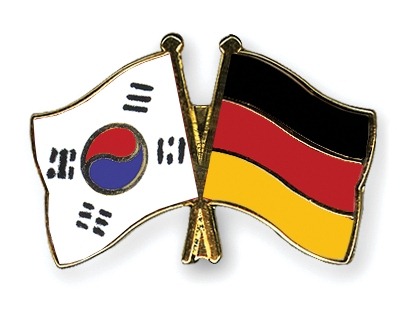
This is the last of a three part post elaborating the often-made parallel between German and Korean unification. Please start with part one and part two.
More Differences in the International Environment between German and Korean unifications:
c. China’s interest is much higher in NK than the USSR’s was in EG. NK borders China; EG was two time-zones away from Moscow. China’s interest in the terms of a final settlement are much more direct. Gorbachev was basically trying to sell EG for desperately needed cash; for China, Korea is a more existential issue. NK is a buffer between democratic SK, Japan, and the US. Hence, China is much more likely to stick its nose into Korean unity talks, and to push for its own terms. Those terms will probably include a ban on US forces north of the current DMZ, and possibly an exit of SK from the US alliance altogether, in exchange for Chinese acquiescence on unification: Korean ‘finlandisation’ (an outcome of which Japan might secretly approve too).
d. SK can’t buy unity from China as West Germany did from USSR. WG was an economic powerhouse by the 1980s – in the OECD and G-7, second biggest donor to the UN, etc. WG could simply write a huge check to Moscow, and the USSR was so desperate that it took the money and abandoned Honecker. SK is simply not there. Yes, it’s in the OECD and G-20, but its still lists itself as a developing country at the WTO, and it is still decades away from German levels of affluence. Nor do the Chinese need the money. China will play a much harder game than the Soviets were able to 20 years ago.
e. SK has no supportive environment of allies or revolutions, like NATO and the Velvet Revolutions of 1989, which could add momentum to unification. Beyond the US, SK has no real allies. Russia is an unpredictable faux-‘partner’ at best. Because of all the bad history, the Japanese don’t really like the idea of a united, wealthy Korea which is growing faster than them, right on their doorstep. Taiwan is also a divided country, but it is in the NK/EG role as the smaller and weaker of the two. So there is nothing like a local NATO of friends to provide group moral cover for unification efforts, nor can there be any regional momentum for NK change, as the other revolutions like in Eastern Europe provided to East Germans in 1989/90. The are no nearby states similar to NK to catalyze NK change, unless one imagines Chinese democratization, which is a huge leap. As we see in the ME today, revolutions can synergize each other, but there is no region here to provide a wave to wash into NK. Koreans will have to do this themselves.
Conclusions:
Altogether this means that hurdles to and burdens of unification are much higher here:
There are more NKs than EGs, and they are poorer as well.
There are fewer SKs than WGs, and they are poorer also.
SK’s state strength/capacity is lower than WG’s, while NK is a catastrophe by even EG standards.
So: fewer people with less money in a weaker system will support more people with less money from a worse system.
That domestic arithmetic is brutal, and if that weren’t bad enough, the international balance of forces is worse now than in 1989 too:
Today, the external patron (US) of the free Korean half is weakening, while the external patron of the communist half (China) is strengthening. The opposite was true of the US and WG, and the USSR and EG, in 1989.
Today’s northern patron (China) is trying to push further into the continent (Asia), while yesterday’s eastern patron (USSR) was looking for an exit (from central Europe).
There is no regional encouragement, revolutionary wave, democracy zeitgeist, or whatever to push this thing along in NE Asia.
The incentives for China to meddle – because of the greater importance of NK to China, than of EG to the USSR -, and the greater ease of such meddling – because the US and SK today are weaker than the US and WG were then, while China is much stronger today than the USSR was then -, mean Chinese intervention is highly likely. It will try hard to structure any final settlement. A major policy question for SK is therefore likely to be, will it dump the US alliance if that is what’s necessary to get China out of the peninsula? Will SK exchange ‘finlandization’ for unity? I think the answer is, and should be, yes.
The only alternative I see to this is a unification process that goes so badly off the rails, is so destructive, disorganized, and chaotic, that China would want to stay out it from sheer concern to avoid a quagmire. In other words, the more chaotic the end-game turns out to be, the more likely it will be a Korean-only affair. This is unfortunate; no one wants Korean unity to be a Hurricane Katrina-style national meltdown that requires heavy western and Japanese support – which might not even be available. because of the accelerating sovereign debt crisis. But reunification chaos seems like the only way to keep the Chinese out, because the balance of forces I sketched in the post are so much worse for Korean today than they were for Germany in 1989/90.


 Robert E Kelly
