Think You Can Do Grand Strategy in Asia? (It’s Really Hard Actually…)


Regular readers will know that I part-time consult for a geopolitical consulting firm called Wikistrat, and this competition is a cool idea, especially for the IR types who likely read a blog like this. Graduate students especially should sign up for it. (And if you think you can hack it as an analyst, and you have some decent credentials, contact them. Good analysts are always in demand.)

It’s great practice for big thinking, as if you’re Clausewitz or Spykman or something, but always remember the well-know adage: “Amateurs talk about strategy, professionals talk about logistics.” Before you argue that China should fix Africa or the US should fix the Middle East, remember to figure out how to pay for it, and to plan your way to that outcome (i.e., avoid America’s mistakes in Iraq). For my own version of US grand strategy in Asia, read this.

I will be a supporting judge in the competition too, so please bring your good ideas so that I can repackage them as my own. Anyway, give it a spin; the blurb is below:

“Wikistrat is gearing up for an exciting International Grand Strategy Competition.

Select teams representing leading academic institutions from around the world are invited to participate in the first ever wiki-based grand strategy competition. Managed by Dr. Thomas PM Barnett, this competition will provide participants with the opportunity to test their skills with global counterparts and network within that community. Participants can demonstrate their capacity for strategic thought to agencies, institutions and firms seeking to recruit up-and-coming analytic talent.

We are currently reviewing applications by groups representing top Universities and Think Tanks worldwide. There are still open spots available for this exciting event.

To nominate a team, or to see if you institute has been invited, contact us HERE.

Participation is free, and winner team will get a $10,000 prize.

Some of the issues we will cover in the Competition include (Download the full PDF OUTLINE):

1. Global Energy Security

2. Global Economic “Rebalancing” Process

3. Salafi Jihadist Terrorism

4. Inevitable Sino-American Special Relationship

5. Southwest Asia Nuclear Proliferation

Some of the Scenarios explored will include:

1. Major Biological Terror Attack

2. “2.0 Revolutions” in Arab World

3. + Additional Surprise Shocks”

The EU has Sewn Up the IMF Race Already? …. plus some media

christine-lagarde-imf-600

I published an op-ed in the Korea Times last week on the IMF managing director (MD) race. For readers outside of Korea, the KT is a mid-level paper here in Korea, sort of like the Plain Dealer from my hometown Cleveland. The biggest paper in Korea’s landscape is the conservative Chosun Ilbo. The KT is smaller, and because it is written only in English, it has a substantial foreign readership beyond Korea. My op-ed is based on this post last week.

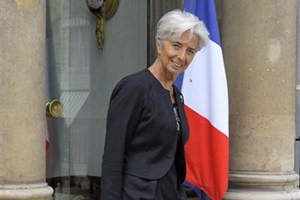
I am amazed at how quickly the replacement for Dominique Strauss-Kahn (DSK) is emerging as a European once again  – the French Finance Minister, Christine Lagarde (above). The Europeans seem to be moving lightning fast on this, before Asians or developing states can get their act together and congeal around one or two non-European alternatives. As I noted in the op-ed, there is no functional reason for the IMF MD to be a European. It has simply been precedent, justifiable so long as Europe was the second major pole in the global economy with the US. Well now there is a third, in East Asia, what Barnett calls the ‘New Core’ (the North Atlantic being the Old Core). Surely it’s time to give the new Core a shot at running one of the big international economic organizations of the world?

The EU has driven its economy into a ditch in the last few years, so I see no ‘competence’ reason why a European finance minister would be better than a Japanese or Singaporean banker, e.g. Nor have the last three European MDs of the IMF been very good. Horst Koehler (2000-04) and Rodriego de Rato (2004-07) were placeholding non-leaders who took the MD-ship in order to springboard into higher office back home. And of course, DSK just globally embarrassed the institution in a manner that basically epitomizes its critics’ worst fears. The narrative of a powerful wealthy white man assaulting an black immigrant female maid is straight out of the antiglobalization movement’s nightmare imagery. So there is no particularly history of ‘quality leadership’ from the EU to justify its sinecure either. In fact, quite given how bad the last three MDs in a row have been, it would be a good idea to drop the EU for a round or two.

So where is substance to the argument that somehow Europeans are somehow entitled to the MD-ship? There is none. It’s bogus. The real claim is tribal – the EU wants the position, because it bolsters Europe’s otherwise declining claim to global leadership and relevance. The EU is like a child running around the adult table waving its hands demanding attention. As Martin Wolf noted on this issue, if the IMF can’t change to accept new realities (the rise of  the rest, especially Asia and the BRICS), then unfairly excluded states will simply walk away from the institution. Asia has already flirted with this because it felt so high-handedly treated in the Asian Financial Crisis (AFC).

Finally, the argument that the IMF should have a European leader right now because the IMF will be working so much in Europe in the near-future, is so specious as to be nearly racist. I find this almost revolting. Back when the AFC hit (1997-98) and westerners were dispensing painful but necessary advice to Asia, no one in the West worried about white bankers dispensing hard medicine to Asians. To say, today, that German Chancellor Angela Merkel won’t trust anyone to run the IMF unless it’s a European she knows,  is so ridiculous, hypocritical, self-serving, and borderline racist, that it really should shock the non-western IMF members into some pretty harsh language in response. If the EU wants to run its economy over a cliff, that’s its own choice. But the EU has no special claim to line up the globe’s resources (through the IMF) to bail out foolish German bondholders badly exposed in Greece, Spain and Ireland. For a counter-example, ask if California, with its own nasty budget crunch, is getting a bail-out from the IMF? No; Americans will wrestle through that on their own, and the EU should too on Greece and the other euro-miscreants.

I find the sheer, bald-faced selfishness and parochialism of this just shocking, especially given how often the EU preens about the importance of multilateralism and international institutions, in obvious contradistinction to ‘mercantilist’ Asians and ‘cowboy unilateralist’ Americans. So here is a golden chance for the EU to really improve global governance, to make it fairer and more democratic. But no, they’d rather insist on tribal privileges. Bleh.

Does it need to be restated that the IMF is a global institution, not a European regional one? The IMF does have other lending responsibilities, and most of its non-European borrowers are vastly poorer than Greece or Ireland. The EU has huge resources compared to the many LDCs (less developed countries) of Africa, but I guess the IMF is really supposed to be a global slush fund for the euro mess.

As best I can tell, Lagarde is pretty competent, and may do a good job. I certainly hope so, and her first trip as MD should be to non-European borrowers, especially in Africa, to prove her credibility. But there is no substantive argument from her resume to set her apart. Try here and here for a nice run-down of all the good non-western candidates who won’t be considered, because Merkel couldn’t care less about global governance and multilateralism when her campaign contributors’ South European bond-holdings are about to be ‘hair cut.’ It’s all just tribalism and selfishness. The real European claim is narcissism – put off succumbing to the new global reality where Asian economies are easily as influential as the old Core’s.

Read this and this as well on this issue.

If Strauss-Kahn Resigns, How about an Asian to run the IMF this Time?

ap_dominique_strauss_kahn_jef_110516_main

I have no particular intelligence on the details of the Dominique Strauss-Kahn (DSK) case. I would only say what everyone would agree to: He should be investigated properly with due process and the assumption of innocence. (That we even need to say this in the US is now, unfortunately, necessary given the US flirtation with extra-judicial methods because of the war on terror.) That he was fleeing the US for his home country when he was arrested does not bode well; this is why he was denied bail. If he is found innocent, then he perhaps can stay on the job, unless this incident comes to be seen in a pattern of irresponsibility, even if formal guilt is not found. DSK was rebuked for an affair with an IMF staffer a few years ago, so perhaps this will tip him out, even if he is found innocent.

But any decision to retain him as IMF managing director (MD) should be based on the evidence, not because he has helped revive the IMF’s fortunes after a tough decade (because of heavy criticism of the IMF’s handling of the Asian Financial Crisis and globalization generally), nor because he has helped so much in the recent debt crisis, especially in Europe. I agree with both of those assessments, but they don’t really change the issue of whether or not he is personally responsible enough to complete his duties. It is also worth noting that infidelity is not a crime (DSK is married). The real issue is whether he tried to rape his alleged victim or not. If he did, he should obviously go. But the important distinction here is with the Clinton impeachment. If DSK’s wife can live with his libertinism, as Hillary Clinton was able to, then that is ultimately a personal issue. There is no need to import the ‘politics of personal destruction’ into the IMF. It is also worth noting that French politicians get far more leeway on personal indiscretions that US politicians. France’s longest serving modern president, Francois Mitterrand, had a love-child out of wedlock who was revealed after his death. Perhaps DSK never quite escaped that more tolerant expectation set.

My own sense is that, even if found innocent because it turns into ‘he-said-she-said,’ it will be hard for him to stay on. The images of him in handcuffs, being pulled off a plane, standing sullenly in a court will make it hard to keep him. Paul Wolfowitz too was forced out of the World Bank presidency several years back for a similar, less egregious, personal affair. My guess is that DSK will have to go too.

For my own previous writing on the Fund, broadly sympathetic to its role, try here or here.

The issue of his replacement brings up a long-standing dispute over the leadership of the Bank and Fund. Precedent says the Europeans pick the IMF MD, and the US picks the World Bank president. This logic was based on the, previously reasonably accurate, claim that the North Atlantic represented the core of the world economy. Of course, it was more than this; prestige has always played a huge role, particularly for the Europeans. Having the IMF sinecure helped buttress Europe’s self-image as important central to global governance.

But you hardly need to be an economist to know that Europe’s role, relative to that of the US and Asia, has been in decline for awhile. Decolonization generally reduced Europe’s global footprint. Decades of slow growth and declining military spending has vaulted the US past the EU in the transatlantic partnership. The seemingly endless inability of the Europeans to put the EU into good working order – the euro mess, the constitutional-institutional rube goldberg structure of the EU itself, the continuing inability of outsiders to know who ‘speaks’ for Europe – cripples an EU global role. Just about everyone outside Europe thinks that the EU should have one EU seat on the UN Security Council, not two for Britain and France. Henry Kissinger famously quipped that he did not know whom to call if he wanted to talk to Europe, and that question is still unresolved. And of course, the rise of Asia has relatively squeezed the EU more than the US. I was at a conference last year where I made this point, and the EU speaker could at best only respond that the EU was a ‘foreign aid superpower.’ If that is all you got, it is time to step aside and allow the ‘New Core,’ Asia, to have a crack at the top-table of world politics. And last year, when I was at an IMF conference in Korea, Asian questioners did in fact ask DSK this, and he was response was, yes, the MD after him should be an Asian.

Everyone knows that Asia’s weight in the global economy has grown dramatically in the last several decades. The IMF’s own voting quotas have been re-ordered to reflect this. Chinese, Japanese, and Indians have already been pretty high up in the managerial order in both the Bank and the Fund.

My own sense is that a Japanese banker would be an excellent choice. Japan is the most open and mature of the Asian economies. The Bank of Japan has been downright heroic in its battle against deflation for years now; it is vastly more serious about Japan’s economic problems that Japan’s politicians. The BoJ has tremendous skills on issues that dog IMF debtors, like government debt, the money supply, or slow growth. A Chinese might be a more controversial choice, one the US and EU might veto, because China is highly interventionist and still a formally communist country. If China would object to a Japanese, likely out of sheerly nationalist resentment, then what about a Korean, Indian or Singaporean?

In short, Asia’s time to run one of the two Bretton Woods Institutions has arrived. Europe’s economic claim to that leadership role is now much-reduced. The euro is a mess; EU economies are carrying huge debt burdens; the EU remains unable to find a common voice despite decades of waiting and endless speculation; and the last few Europeans to run the IMF have been been pretty meager – Rodrigo De Rato lasted just three years (2004-07) and used the position to jockey for political position at home in Spain; before him, Horst Koehler (2000-04) did the same.

In fact, the only argument to keep a European one more time, is based on Europe’s weakness, not its strength; that is, because the IMF’s most important work in the next few years will be in Europe, it should have a European. But this strikes me as too clever by half and yet another gimmick to keep Asia from its clearly-earned place to run these institutions occasionally. By any reasonable criteria, Asia is qualified – probably more qualified actually given Europe’s economic state today – to take the MD-ship. The inevitable arguments to be heard in the next few weeks about Europe’s ‘weight’ in the global economy will just be mask the real,  tribal and prestige-driven desire to hang onto the last shreds of influence in an increasingly ‘post-atlantic’ world.

Egyptian Revolution (2): The Egyptian Army’s Moral Superiority to China

imagesFor

For part 1 of my thoughts on the Egyptian revolution, go here.

4. China shot its own people; Egypt has not. Much of the analysis has focused on possible parallels with Iran 1979. But another more recent parallel, especially relevant to this website, is Tiananmen Square 1989. In their moment of crisis, the Chinese turned their guns on themselves, and the PLA (People’s Liberation Army) will be forever stained by the blood of its own citizens en masse. This strikes me as major moment in the evolution of dictatorships. All dictatorships suffer from legitimacy problems, of course, but none want to openly rely on naked force. Militaries are usually the hidden albeit central prop in dictatorships, but they don’t actually want to do the dirty work themselves. That is for the paramilitary thugs and secret police. No officer wants to think the primary enemy of the a state’s military is its own people, not some foreign enemy. Their dignitary and right to rule is based on the whole idea that thy are defending the people, not massacring them; in fact this is the myth of 1952 Free Officers coup in Egypt itself. Hence the call by a dictator in dire straits to shoot the citizenry is a rubicon for any army that cannot be uncrossed. In 1989, the eastern European militaries balked; in China, the PLA did not. My sense is that the social costs to the PLA were lower though, because China is so big. The CCP purposefully brought in rural PLA units for whom Beijing was like another planet. But in small countries like Poland 1989 or Egypt today, army repression in the capital would immediately be felt and transmitted everywhere. So hear, hear to the Egyptian military (I can’t believe I just wrote that sentence). For all its corruption, despotism, and insulation, it still did the right thing when the chips were down. Did anyone imagine even a month ago that we’d be speaking of the moral superiority of the Egyptian military to the PLA?

5. Beyond this evident parallel to Beijing 1989, this is whole things isn’t really that relevant out here. The news media coverage has been thin. The current El Nina cold snap in Northeast Asia has gotten more press time regionally than that Egypt. Not surprisingly the Chinese haven’t discussed Egypt much, but I am disappointed the the Korean and Japanese press seems so disinterested. Initial Korean media coverage focused on the possible loss of ME export markets (groan). From this I would draw two conclusions. First, for all the talk about a flat world, cultural hurdles still matter a lot. The parties caught up in the war on terror (the West, Israel, the Arab/Muslim ME) are riveted by this, but East Asian’s just aren’t, sadly. My experience in East Asia is that locals don’t really care much about the developing world. It’s far away, the languages and religions seem unintelligible, and the societies look backward, especially to East Asians obsessed with development. East Asians worry a lot about the US, and some about Europe, but there is tremendous ignorance of places like Latin America or Africa. Second, I think this disinterest is as much political as it is cultural. Newly wealthy places like Korea or China demonstrate their earned, rightful place in the OECD through an almost purposeful disdain for the third world. Koreans love to demonstrate how worldly they are by spending a year in the US or West; I’ve never met a student or teacher who thought a year a in developing country would be vastly more interesting. (It is.) So Barnett’s ‘new core’ flaunts its new status by forgetting its roots in the third world: disinterest as a mark of superiority.

6. A comment about the commentary: Frank Rich is right that far too few people have any idea what to say on Egypt because so much of the commentary is really about the US (or Israel). This Amero-centrism is why so many are saying the US should do this or that: the working assumption is that that US guides the world and can easily direct events. This is no longer true, so the mountain of US, rather than Egypt, -focused commentary creates unrealistic expectations that we can direct this thing.

Rich also makes the excellent observation that if Americans could actually watch al Jazeera, they might actually learn something about Egypt itself. Instead the mainstream commentary has revealed the embarrassingly nativist ignorance of much of the punditocracy on anything beyond US borders. In general I was very pleased to see how well academics requited themselves in the blogosphere on this; I think especially Walt, Mead, Cole and the Duck of Minerva have been super.

But if you read the op-ed pages, you got recycled banality and the usual suspects: Friedman gave you his typical, ‘this-is-a-defining-moment-in-the-ME’ schtick; Bush neocons desperate for rehabilitation strove to take credit and somehow blame Obama for…what exactly?; Palin blithered; Parker told us that the big story was really about the US media and Cohen that it was about Israel; Colbert King forgot the rest of the world exists; and Beck, well, you already know – just watch the loopy video from part 1. Score yet another point for blogging.

Without the informed blogging voices of people who actually know something about Egypt and revolutions, you really wouldn’t learn much about the events at all. You’d have just gotten an endless series of stories from a royalist, uncosmopolitan press in which Washington was the real story, because that’s all the pundits know how to talk aboutDouthat, for example – and whom I think is a pretty good writer usually – clearly had nothing to say, so he just gave up and wrote about Obama yet again under the guise of Egypt. How easy; this is how the press for a nation of untraveled monolinguists infatuated with their own power evolves. Its all about us. By contrast, here is an example of a non-expert, trained in traditional Washington self-obsession, who nonetheless tried. 

__________________________

ADDENDA:

The Japan Security Watch (JSW) blog of the New Pacific Institute has taken to cross-posting some of my stuff.  JSW is a good review of Japan, and a nice a compliment to my over-focus on Korea and China. They do on a lot on the nuts-and-bolts of hardware and deployment. Mil-Tech junkies on Asia will love it. JSW and I are working on some cooperation in the future. I want to thank them and commend readers to take a look at their good website.

BusanHaps, the big expat newspaper for Busan, SK, has also reposted some of my stuff. I want to thank them too and commend their site. Busan readers almost certainly know it already, but non-local readers will find it a good window on the way expats live here.

Finally, I want to point out that a published version of my remarks on North Korean shelling of Yeonpyeong Island is now available here (RINSA 15) from the Korean National Defense University (KNDU). If you really want to get into the details of SK defense against N, KNDU is the place to go. I want to thank them for soliciting me and thank readers for all the helpful comments that went into the final product.

That South Korean Commando Raid against the Somali Pirates

I couldn’t find any actual video of the assault so here is a decent news vid about it


Here is a Korean news blurb about the anti-pirate raid, and here is some quick analysis. As you might imagine, the Korean media has trumpeted this, and the Korean President Myung-Bak Lee, who ordered the assault, took a lot of deserved credit. At the risk of sounding like a shill, I must say I continue to be very impressed by Lee’s presidency. He is a good example of the kind of conservative I want to vote for but simply cannot find in the US anymore (where its all Christianity and tea party paranoia). Lee is tough, professional, fiscally balanced, not terribly ideological, business-focused, comfortable with science, tolerant of Korea’s growing diversity, but still on the right side of most of the big foreign policy issues like China, NK, Afghanistan, etc. Yes, he is prone to autocratic outbursts, but no more so than W’s constitution-bending. In any case, he is vast improvement over the accommodationist SK left which seems to think the US is a greater threat to SK than NK or China (no, that is not a joke). So hear, hear, President Lee, for giving the pirates the shellacking they deserve.

Here are a few more thoughts on the raid.

1. In a way, the raid helps justify the on-going, much maligned, dismal, I-want-it-to-go-away-as-much-as-you-do war on terror. No, the pirates are not terrorists, nor are they islamists as far as we can tell. But they do demonstrate the fundamental international political problem behind the GWoT – state failure. To be more specific, failed/failing states create wild west zones on the planet (Somalia, central Africa, parts of central and southeast Asia and Caribbean basin) that open room for all sorts of nasties to set up shop. All sorts of asymmetric threats are enabled by the absence of law in state-less spaces, and they morph in unexpected ways that pull in players one wouldn’t expect (the US goes to Afghanistan, and SK goes to the Gulf of Aden). If the Middle East were governed better, it is unlikely 9/11 would have happened. Indeed, many of the problems we associate with the GWoT – piracy, trafficking, mass human rights violations, drug cartels, generalized social chaos (like in Children of Men) – are broadly attributable to the lack of robust, functioning, reasonably legitimate states in central Eurasia and Africa. This is really what Iraq and Afghanistan are all about – trying to fashion somewhat modern states that can locally control/contain/enervate violent, frequently atavistic, non-state actors like al Qaeda or the Lord’s Resistance Army. And state-less spaces create threats we don’t really anticipate or think about much. IR theory and security studies is mostly about states. Irregular forces like militias, terrorists, pirates don’t have the cachet that worrying about the Chinese navy does. But clearly we do need some general global strategy for cleaning up what Thomas Barnett calls the ‘Gap.’

2. I was quite impressed by the SK military’s prowess, and this may be the biggest unanticipated story. Usually the security discussion of East Asia revolves around the big guys – China, Japan, India. When Korea gets mentioned, the usual line is NK-as-psycho, with SK as a hapless victim. SK is somewhat responsible for this. The SK electorate is quite pacifist (certainly compared to the US), and SK’s extreme exposure to NK means they can’t respond the way Israel does when it is provoked. But far from peninsular restrictions, the SK military was able to show its stuff and they did a super job. I don’t think people realize just how large, professionalized, and modern the SK military actually is (600k conscripts and a $30 billion annual budget). Given the sort of budgetary pressures Europe’s decaying great powers are facing, and the likely post-Yeonpyeong defense build-up in SK, SK is now almost certainly in the top 10 of the world’s most efficacious militaries, as bizarre as that may seem, and it is giving Japan a run for its money. Japan is bigger of course and has a great deal of latent military power, but its defense budget  has been just 1% of GDP/year for decades, its debt burden is crushing, and it hasn’t fought on any combat missions at all since WWII. Yet here is tiny Korea projecting coherent, efficacious force all the way into the Gulf of Aden. Not bad…

3. The larger story must be the growing depth and reach of Asian economies. Indian Ocean sea-lines of communication (SLOC) are pretty important for Asia’s economies, and the piracy fight tells us two things.

a. Asia’s economies are now so big and prosperous that pirates can make a living off of them. Can you imagine anyone preying on Indian Ocean shipping as a profession 40 years ago? Indian Ocean SLOCs, connecting East Asia with the Middle East and Europe, now clearly rival those focused on the US in the Atlantic and Pacific – yet another mark of the gravity shift from West and East.

b. East Asia’s economies are now rich and confident enough to project power pretty far from their shores. Of course the US Navy is dominant, but East Asia has the money now to buy bigger and better ships, while US military cuts are almost a certainty, and the US navy is an obvious budget-cutting target as the costs of the GWoT have fallen mostly on the Army and Marines. So here is yet another example of that more equal world in which the US will move in the future. If East Asian economic interests and the military force to protect them now extend all the way to Africa, that pretty clearly pushes the US back in the Indian Ocean and raises the obvious question of when the US will move back in the Pacific too.

2011 Asia Predictions (1): East Asia

Watch this if you haven’t seen it yet. It’s pretty scary.


Last year, I put up 2010 predictions for Asia and Korea. Last week, I evaluated those predictions. This week come my 2011 predictions. It’s a fun exercise, if only to see how bad you blow it 12 months from now…

1. China will back off.

Why: It has been widely noted that China seemed to suddenly get aggressive last year. They got to bullying about the South China Sea, and their behavior over the island conflict with Japan seemed extreme to almost everybody. (The video above comes from a Japanese YouTube contributor; I tried to find one that is less ideologically questionable, but generally, there is agreement now that the Chinese fisherman purposefully rammed the Japanese coast guard, per the vid above. It is worth noting that Chinese fishermen also do the same thing to the SK coastguard – only the Koreans don’t make such a big deal out of it.) But my sense is still that the Chinese aren’t foolish enough to provoke real local balancing against them – at least not yet while they are still comparatively weak. China has invested a lot over the last few decades to prevent this possibility.While I do think medium-term balancing against China is likely, I also think the Chinese think about this a lot and want to avoid it as long as possible. Events like the video above tell me that China has a big bureaucracy with multiple factions struggling to control foreign policy in a system where the chain of command is blurry and civilian control is disputed – common problems in dictatorships . My guess is last year’s belligerence was a mix of free-lancing by tougher elements to prove a point but not a conscious strategy shift toward provocation. China’s not really the ‘responsible stakeholder’ we want it to be, but I don’t think they are openly reckless suddenly either. They are likely to pull back this year toward conciliation – at least until they are stronger.

2. North Korea won’t pull any big stunts this year.

Why: Last year NK pulled some of its most foolish, dangerous tricks in years. And it got what it wanted. The whole world is once again paying attention to its noxious tin-pot dictatorship. China gave it cover, twice!, and more cash. It once again made SK look weak, vulnerable, and confused, right after the nice G-20 raised SK’s global profile. (What better way to play the spoiler of an event that made Korea look modern and normal?) Intelligent western analysts went on record saying stupid things that sound awfully close to appeasement. SK caved and once again called for the 6 Party Talks; this opens the door, yet again, for the North to play the other 5 parties off each other for gain. Not bad for a broke, dysfunctional gangster-state. So there isn’t much more to be gotten from raising the temperature further, and the costs for them are rising. The DPRK doesn’t really want to provoke a war, and SK attitudes seem to be hardening on responses. NK gimmicked its way into most of what it wants, so I anticipate calm for a while – at least until some other regime crisis (famine, currency collapse, Kim Jong-Il’s death) pushes another KPA outburst for attention and money.

3. Nothing much interesting will happen in South Korea or Japan

Why: Korea seems pretty pleased with itself as it is and should be. Inflation, unemployment, debt, deficit, tax rates, and poverty are all low. (If you are a Westerner and that sentence makes you gasp in envy, it should. Korea’s macroeconomics are miraculous). It has little reason for any major domestic shifts, while in foreign affairs it is increasingly a status quo power. That means that while it is de jure, in the constitution, committed to ending the intra-Korean stalemate, de facto, the SK population doesn’t really want to sacrifice too much for that goal anymore. They just want to be a rich trading state and for NK to go away. So expect more of the same muddling along on the NK issue, crisis-by-crisis. There are no big reasons for Korea to do anything really new this year (notwithstanding that external events might force something of course.) Japan is the opposite; it desperately needs to change. But it can’t, because its population is terrified of confronting the enormity of its troubles, and its corrupted political class is trapped in decades of merry-go-round immobilism. I see no willingness to address the spiraling debt, the overprotected sectors like retail, ag, or construction, the history and territory issues with the neighbors, or broken political system. Hugging the US alliance tight allows these issues to be pushed off indefinitely, and I see nothing to suggest Japan will finally grow-up this year. Stasis, functional and dysfunctional respectively, will be the rule on both sides of the Korea Strait in 2011.

Asia’s Improved IMF Quotas — Wake Up! It’s not that Boring…

images

Here is a subject that could put anyone to sleep but is probably the best thing to come from the otherwise poor G-20 summit last week. The voting shares of the IMF were reweighted to reflect Asia’s expanding size in the global economy. Here is good write-up; for Asian self-congratulation, try this. This puts it in context for Korea.

The quota represents the percentage of control that a state has over IMF decisions. Big decisions are made by the IMF’s Board of Governors, the national representatives who collectively control the institution. On the Board, each country receives a weighted vote whose size (quota) is roughly in line with its national percentage of global GDP, crossed against the importance of exports to national GDP (its ‘openness,’ in IMF-speak). (The voting formula is ridiculously arcane for non-experts. There are endless proposals to reform it. Here it is in the words of the IMF itself.) In short, the bigger your quota, the more sway you have in IMF decisions (about loans, the creation of Special Drawing Rights, IMF responsibilities for the global economy, etc.). The biggest quotas, inevitably, belong to the US, Japan, and the Europeans. However, given Asia’s expansion of the last few decades, pressure is rising to re-weight the votes to Asia’s favor. In practice, that means giving China a bigger voice at the expense of the Europeans, who are resisting quite selfishly it must be said, for all their talk about cooperative global governance and multilateralism. US and Japanese shares will be scarcely affected. Korea’s share will reweighted a little bit as well (1.4% to 1.8%).

For Korea and other emergent economies’ share to get even bigger, they would need explosive growth like China’s, as well as a major demographic expansion. Neither will happen realistically. Globally speaking, Korea is just too small to have a much bigger quota, although a 0.4% jump is 30% quota expansion, which is actually pretty good. The really big quota fight is between China and the EU, with India coming down the pike as well. In short, global economic institutions are adjusting, albeit painfully, to the rise of Asia. The increasing equality of wealth between Asia, Europe, and North America means that the voting weights of each of those regions are slowly equilibrating.

States are sensitive about quota size, because it is a zero-sum game. If Korea gains .04%, that means some other state loses 0.4%. Hence the Fund can never be made large enough to make all feel confortable. Instead, control of the Fund will always be relative – if I have 0.0001 percent, then you do not have it. While global GDP expansion is positive sum, Board control of the IMF (and World Bank) Board is not. And inevitably, the size of a national quota is interpreted as a general sign of global clout and importance. One can see that in the Europeans’ strenuous efforts to delay and obfuscate the re-weighting, for they will lose in that process. It is like the veto rights of the permanent 5 members of the UN Security Council. That is widely considered as a signal of their great prestige, and even though the French and British empires are long gone, it is unrealistic to think that they will give up their P-5 status.

So Korea’s quota increase is good for Korea, in a small way, and it is just, insofar as Korea has grown more rapidly than the EU in the last few decades. But it is not really that important, because 1. Korea’s relations with the IMF are quite chilly anyway, and 2. Korea is simply too small economically and demographically at the global level. More interesting would be Korea’s ‘quota’ in the emerging Chiang Mai Initiative, which is like a local Asian version of the IMF.

Generally, we should be pleased that the IMF was able to evolve like this. The more it looks like the actual world economy, the more it can meaningfully intervene. Contrast that with the UN Security Council, frozen in time (1945), with three veto-wielding ‘great powers’ (Russia, France, and Britain) that are no ‘greater’ than a lot of other countries now. Unable to adapt – again, primarily because of European selfishness (France and Britain will not a agree to consolidate their veto into one for the EU) – the Security Council is sliding into irrelevance. If the IMF – the supposed global tyrant – can adapt, how about the UN?

Asian Myopia on the Imbalances – Deficit Importers will Revolt in Time…

Suominenfig1

This week, I explained the issue of imbalances in my classes, as well as the general failure of the Seoul G-20. For all the talk of Korean ‘leadership’ at the G-20, it fizzled. Instead of leading by example to actually push through a deal, Korea ethnocentrically took the G-20 as an opportunity to grandstand to the world that “Koreans are great.” So self-congratulatory G-20 concerts took the place of any real leadership on the most obvious thing Korea could have done – finish the US-Korea free trade agreement (FTA) – to help unwind those imbalances. Instead, President Lee choose to sink the FTA at the behest of rabidly protectionist, consumer-punishing Korean auto and agricultural interests. So, with no help from Korea’s ‘world leadership,’ global imbalances have worsened this year.

So let’s go over this once again – with economic logic in the place of raw nationalism.

1. In a closed system, like world trade, some one needs to buy stuff. Everyone cannot export; everyone cannot run a permanent trade surplus; it is mathematically impossible. We cannot export to the moon or God. There must be global demand somewhere, and for much of the last two decades, the US was that anchor – so much so that we even re-packaged the business term  ‘buyer of last resort’ to apply to the US. So, as my students protested, it is true that the US government and consumers, as well as many EU countries, went wild in the last decade with their credit cards and created their own debt problems. But it is also true that without their demand, Asia and the Germans would have nowhere to export to. Now that the US and many other places are deeply in debt, it is obviously time to return the favor. The old exporters should become new importers in order to restore some balance to the system. ‘Diffuse reciprocity’ in trade is a basic requirement, in order that no one feels too much like they are being rooked by the other side. Without rough balancing over time, political disruption ensues (think Greece this year). This threatens the whole system in the long-term. Why is the Korean media too myopic to not see that?

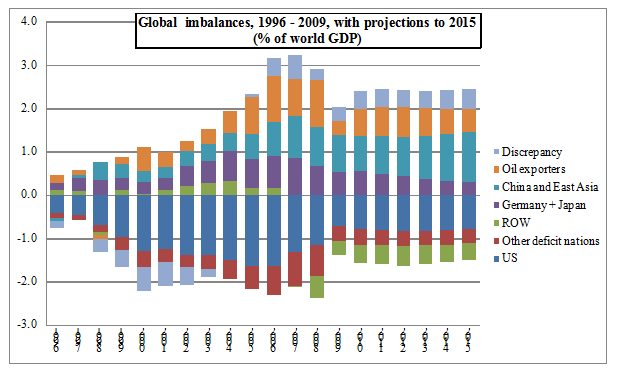
2. The near permanent trade surpluses (above graph) in Asia are not, NOT, natural. It is mathematically all but impossible that a free-trade environment would return a situation where Korea, Japan, China and Germany would run 30 years of trade surpluses while the US ran corresponding deficits in the hundreds of billions USD. Why is this nearly impossible? Because the currency of such super-exporters would go up and up as their exports went up and up. In laymen’s terms, if the whole world wants to buy your stuff (Japanese cars, Korean TVs, Chinese everything), then the whole world needs more and more of your currency to buy all those amazing exports. So all those foreigners buying your stuff exchange their currencies for your currency. All this bidding to buy your currency (so they can buy your exports) means that the price of your currency goes up and up. So if you are permanently exporting more than importing, your currency should be permanently rocketing to the moon as foreigners scramble to buy it. Of course this has not happened. If you look at east Asian currencies, they all are pretty soft against the dollar, frequently moving downward. This is mathematically impossible to square with a permanent trade surplus. The only possible explanation is currency interventions to keep their currencies undervalued. In other words, cheating. And this is in fact well documented. China’s currency is pegged at a ridiculously low value to the dollar (estimates rage around 40-50% undervaluation!), and the Koreans and Japanese regularly ‘sterilize’ their currencies’ appreciation through massive dollar purchases. The Korean central bank’s euphemism for such raw mercantilism is ‘fine-tuning.’

3. Trade must be a two-way street in the medium-term, or the permanent deficit countries will eventually revolt. Here the Korean media is totally unhelpful with its nationalist and short-termist thinking that Korea’s success requires a surplus. This is also logically incorrect. There is no especial value to piling up dollars. Foreign currency cannot be spent in another country, so why stockpile hundreds of billions of dollars, or in China’s case, trillions, of someone else’s currency? If you don’t spend it back by importing, then at some point your export targets run out of money. And this is precisely what has happened in the great recession. The importers of yore are broke, and they need some of their dollars recycled back as export sales. But if you politically refuse to countenance a trade deficit by buying imports from your trade partners, then eventually you anger them: you are trade manipulator, and you provoke trade conflicts. Japan learned this the hard way. Its currency and trade gaming lead to two US backlashes – first when the US broke the Bretton Woods system and inflated in the 1970s, and then again the 1980s with the Plaza Accord. And this is what the Fed’s current quantitative easing is today. The US, unable to convince the surplus countries (esp. China) to import for the collective good of the system, is going to force them to do so, or they will see the value of their dollar reserves evaporate in inflation. Quantitative easing is a declaration of war by the Fed on the People’s Bank of China. This is extremely risky for everyone, as it throws the dollar’s reliability in the air, but it shows you just how head-in-the-sand obstinate the surplus countries are. In order to maintain short-term trade surpluses, they risk the inflation of the very currency they have stockpiled.

It’s the 1930s All Over Again…

currency

The increasing drift toward a ‘currency war’ should worry just about everyone. And it is remarkable given that we already went through this in the 1930s – a collective disaster for all involved, and which everyone realized afterwards was a huge error. Yet here are on the cusp of another round of beggar-thy-neighbor devaluation rounds as everyone seeks to export their way out of the recession.

In case you don’t know the history, start here. Just about everyone learns this story in Econ 101, but here is the quick version: The Great Depression struck in 1929, and everyone panicked. In that sort of adverse environment, everyone starts to save. This is individually rational, as savings represent a hedge against suddenly increased uncertainty about the future. You see that same thing today in the US as Americans are suddenly saving again to pay off their housing and credit card debt in order to get financially sounder. Unfortunately, as people save, they are not spending, and their spending ultimately creates jobs. When you buy stuff at Walmart, a whole slew of people got their jobs to bring you whatever it is that you just bought. This is the well-known paradox of thrift: while it is rational for you the individual to save ask a hedge against the future, if everyone does that, then our collective future gets that much worse because all that missing consumer spending (demand) eventually creates unemployment (less need for supply). Again, this is what is happening today in the US. As Americans retrench on their spending very suddenly and sharply (household savings rates have jumped something like 5% in 24 months), you get a consequent drop in the need for supply. That in turn means you don’t need so many workers to make that supply anymore, so people get fired. US unemployment has therefore suddenly spiked as savings rates spiked.

One good way out of this recessionary trap (high savings –> high unemployment –> worsening economy –> even more fear about the future –> more savings) is to export to others. If others buy your stuff, then you keep all the employment (to supply the foreigners’ demand), but your own consumer can still continue to save. It is a tempting way out that squares the mathematical circle in which, in a closed economy, savings must equal unemployment. But with exports, you can have your cake and eat it too; ie, the economists’ expression ‘export your way out of a recession.’ Now, a good way to make your exports cheaper is for your currency to be cheap against other currencies. Then your stuff is cheaper for foreigners to buy. It is therefore tempting for governments in recession to intervene artificially in currency markets to keep their currencies cheap, indeed maybe even undervalued (China today). Because a cheaper currency means cheaper exports means a quicker route out of recession. And in the 1930s, everybody tried to do this. But just like the paradox of thrift, if everyone tries to cheapen their currency, then no one’s currency becomes cheaper, and very quickly you can get a cycle of government-forced exchange rate devaluations across the board as everyone tries to get a price advantage over everyone else. We call this ‘beggar-thy-neighbor.’

It is now universally acknowledged by just about everyone (except Marxists I suppose) that this was a disaster that lengthened the Great Depression considerably. This intellectual consensus lies behind the creation of the IMF, and the IMF museum (next to the lobby in the Fund building) walks the visitor through this in excellent detail.

And now we are doing it all over again.

So much for learning from history and all that…

This time it is mostly Asians to blame. China, SK, and Japan all intervene regularly (‘fine-tuning’ they call it in SK) to keep their currencies lower than the market would otherwise say. China of course is the worst, and it is leading to some genuinely desperate policy ideas on what to do.

This leads me to two conclusions. First, it is evidence that global governance (GG) continues to fail. The G-20 squabbling over exchange rates so perfectly fits what we know states shouldn’t do, yet they are doing it anyway. This – along with the astonishing, ‘I-don’t-give-a-damn-what-the-world-thinks’ Bush unilateralism – tells me that GG was a dream of the 1990s that is fading fast. Second it tells me that the only answer is cultural change in Asian attitudes toward imports. For decades, a trade surplus (and if necessary, an undervalued currency) were not just natural outcomes of market processes, but an explicit statist-developmental goal wrapped in nationalism. A trade surplus is a mark of national pride and success in the world, and if Asian consumers must be punished with high prices and higher savings to get it, then so be it. In Korea, I see this ‘imports-are-bad’ everyday; contrast that with the American love of cheap Chinese stuff at Walmart. Given that barrier to Asian rebalancing is a cultural one – getting Asians to accept imports without mercantilist-nationalist distaste – that rebalancing is likely to take a long time. Culture changes slowly.

Asia’s ‘Culture of Export’ (1): Persistent, Politicized Asian Imbalancing

export_ship

Part 2 is here.

In my IPE class this week, we discussed the issue of global imbalances. (If you have no idea what this means, start reading Martin Wolf at the Financial Times.) I argued that it will take awhile to ‘unwind’ them, because Asians have acquired a cultural habit of saving and exporting. Imports are suspect, and a trade surplus has become a downright obsessive national goal out here rather than a natural, occasional imbalance in trade. Now this would be a laudable goal if East Asian states were highly indebted poor states, as in Africa and Latin America, but East Asia is sitting on close to $4 trillion in US debt stocks from two decades of single-minded stockpiling. If China didn’t run a trade surplus in a given year, it would provoke an existential political crisis in the Chinese Communist Party. This is just how deeply mercantilist Asia is. Korea’s trade balance is reported every month in the news, and it is frequently the leading story. The reporter’s spin is always congratulatory and nationalistic. The trade surplus is always reported as a major national-political goal, not a technical economic outcome. In Japan in the last month, the BOJ intervened to keep the yen down at the behest of major exporters, and it is threatening to do so again this week. There is your ‘culture of export.’ East Asians are politically opposed to running trade deficits. Trade surpluses are not economic outcomes; they are nationalistic, highly managed, artificially and purposefully-created political outcomes. This is a massive cultural hurdle to righting the global economy.

Asians desperately want the old system of high exports and high savings to continue, but it can’t because traditional global importers are leveraged to this hilt. But I genuinely believe Asia’s mercantilist elites will put their hands in the sand on this and simply refuse to play ball seriously in the medium-term and so prolong global unemployment. Exporting in Asia is not just a regular economic activity on par with consumption or government spending. Export has acquired a near-mythic status as a mark of national greatness and power. This is wildly mercantilist and unsustainable, but that won’t prevent Asian elites from trying anyway and dragging the globe into a long ‘savings glut’ recession.

In liberal trade theory, current account surpluses are natural outcomes of an unforeseen change in the desirability of a country’s exports. One year, a country’s exports may be suddenly very desirous. Recall that the first Playstation 3s were resold on Ebay for $1000+, so Japan got an export surge. This is ok, because when you exports surge, your currency, if it is floating, should surge too. Your stronger currency reflects that your stuff is in greater demand than you are demanding others’ stuff. The following year, as your stuff becomes more expensive due to your appreciated currency, your net exports over imports, your current account surplus, should recede. Broadly, your imports and exports should tend toward equilibrium, because the world is a closed system. So everybody is happy, because in the long-run, there should be – in fact, mathematically, there must be – equilibrium.

But this healthy process of circulating trade and currency got all gummed up in the last 15 years or so, and this is why the Great Recession is so brutal. In short, East Asia (and Germany) are big net exporters, and the US and peripheral Europe are big importers. If the exporters don’t buy stuff from the importers though – ‘recyle’ the importers’ currency back to them by buying stuff from them – then the importers eventually run out of money. This is ‘natural.’ Previous importers should pendle back to export, and vice versa. But that is not at all what happened.

Instead, running out money didn’t stop the Americans (or the Greeks) in the last decade. When the money ran out, we just borrowed more – and from the exporters. The average American burned through all his savings by around 2005 and went into debt; the US government of course was in debt too. So everyone was borrowing more and more, and Asian states, unwilling to import more, were super-willing to lend their savings back to Americans so that they could keep on buying. (The same thing happened within the euro-zone between the German exporter and the southern European importers.) Hence the ‘imbalance’ – importers piled up more and more debt borrowed from the exporters, and the exporters piled up more and more savings by lending and re-lending their profits back to the importers.

We piled up debt to buy more, while they lent us our own money back to us so we could keep buying. This bizarre, predatory symbiosis is why Ferguson coined the expression ‘Chimerica,’ and its unsustainability has now become evident for all to see. Resembling a ponzi-scheme by 2008, it all collapsed.

The big problem is that if the pre-Great Recession super exporters (above all, China) don’t start spending, not saving their foreign currency, then global consumer demand will collapse, because the erstwhile importers’ demand is much reduced. Indebted and overleveraged, the former consumers are now saving again. The problem is that all that US (particularly) consumption before created global demand which created jobs. Now that US demand has contracted dramatically. Without demand from consumers to buy stuff, companies don’t need as many laborers to make stuff, so they start firing people – unemployment.

So in brief, US demand imploded under debt, but Asians don’t really really want to substitute for that demand. They don’t want to go shopping, or rather their governments don’t want them to go to shopping, because the governments are trapped in a Spanish Habsburg mindset that they MUST run trade surpluses all the time. Getting Asian consumers, especially the Chinese, into the malls is the globe’s best hope for a fast recovery, but the cultural blowback from 40 years telling citizens to save as a national mission is a huge obstacle, as is the Chinese government’s adamant, infuriating refusal to encourage its citizens to shop.

Part 2 will be a case study of Korean mercantilism.