Asia 21, or the IMF Comes Crawling Back to Asia…

md_lee

1. For an organization regularly accused of wrecking the world, the July IMF-Korea get-together was a lark. 13 years ago in the Asian Financial Crisis (AFC), the Fund pummeled emerging Asia with all sorts of tough but necessary reforms. And Korea, for an OECD economy, took a hell of beating at the time and never forgave the Fund. Never ones to admit they were wrong, Korean elites steadfastly refuse to recognize that the Fund’s advice was necessary and was the reason Korea bounced back so fast from what at the time observers thought was going to be a regional meltdown. And now, as the world’s money flows into Asia in the coming decades, the IMF has had to come crawling back. The irony of course is that Fund advice why the AFC lasted so briefly and why Asia returned to growth so quickly.

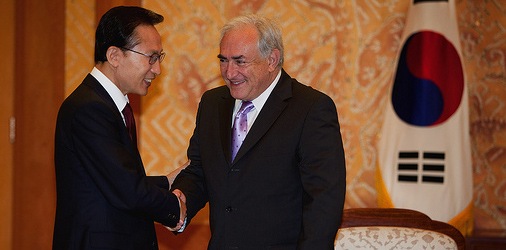
But no one EVER thanks the Fund, and now, with the Western powers traditionally supporting the Fund all bankrupt, the Fund desperately needs Asia. So after a 13 year mexican stand-off over the Fund’s AFC advice, the Fund has finally blinked. It has come back to ask to be let back in. For Korea this was a moment of triumph. Not one Korean speaker missed the opportunity to dredge up the old grievances, and not one IMF speaker had the professional courage to defend the Fund. Even Managing Director Strauss-Kahn (right above) didn’t have the backbone to defend the rescue package that saved Korea from default and an Argentine-style depression. Instead the MD told sob-stories about how the IMF refused to loan money to countries which included cuts in children’s services in their programs. See how nice the IMF is now! 15 years ago they were killing babies, now they are saving them from faceless bureaucrats. Make sure to blast-fax that to all the NGOs and the New York Times. Bleh. Strauss-Kahn has otherwise been a good MD after the last two forgettables. But he sounded so craven it was embarrassing.

But I suppose he had no choice. Asians so loathe the Fund that they are brink of building their own local version of it – the Chiang Mai Initiative (CMI). 13 years ago the IMF was able to sink this idea, because Asia was broke and the US was the ‘indispensible nation.’ Now, the world’s cash is in Asia, and its debtors are in the West. The Fund can’t play so hard, and CMI represents a genuine threat to institutional relevance. Hence the peace offering at Asia 21.

2. The conference didn’t say too much you wouldn’t already know from reading the (required) FT and Economist, but at least Asians seem to be realizing the West won’t import as it did before and that the US stimulus was essentially sterilized by cuts in local, state, and consumer spending. This is progress. Two years ago, when the crisis started, the first instinct was to ignore the depth of the crisis in Asia’s major export markets and just wait for things to return to the 2000s status quo: massive overconsumption (and debt) in the US and much of the EU, coupled with a huge run-up in dollars reserves in Asia. Smart observers like Martin Wolf have been arguing since the start that an Asian buying binge is the fastest, safest way out of the crisis, but Asian elites would have none of that. Now at least, I had the impression that they realizing that the wild imbalances of the post-AFC pseudo-expansion are risky to even to them. But I still didn’t see a commitment to reverse the current account surpluses, only to lessen them somewhat. Not even this Great Recession can dent the Asian reflex for mercantilism.

3. There was a great deal of fear that Greece might spiral into a sovereign debt crisis throughout the OECD, and much hand-wringing about how the West could be moved toward structurally lower fiscal deficits. As a political scientist though, I found the answers to the latter curiously technocratic and formal. None of the speakers note what seems to me the obvious, cultural, answer – generational expectations. In the EU, the biggest problem for balance is not corruption, better tax-collecing, the Common Agricultural Program; it is the mindset that the work is ‘oppressive’ beyond 35 hours a week and 55 years of age. It is cultural or socio-political expectations that are the real limits on fiscal seriousness. A ‘social-democratized’ population taught that generous government is a right has made it all but impossible to get Europeans to live within their means. In the US, the primary problem with balance is analogous: an anti-tax commitment on the right that borders on paranoia. I can’t think of any serious economist who believes the US can balance its budget in the medium-term without tax increases – the deficit is now $1 trillion, so please tell me how to fix that without more tax revenue? – but taxes have achieved a totemic significance on the right that makes them nearly impossible to raise despite the obvious mathematical case for them.

By contrast, it seems that Asian populations are willing to pay their taxes and accept less social welfare redistribution. We say that the West needs to learn to live within its means, Asia has some good examples of that. South Koreans want low taxes and lots of goodies like anyone else, but I have never seen, in the press or my students or colleagues here, the suicidal drive to spend without taxing that has become the curse of the contemporary West.

4. A quick tip to the IMF guys at these big conferences: maybe you shouldn’t clique up so much and be unfriendly to everyone else; that is why people think you are a big conspiracy. I defend the IMF all the time, but really, the IMF does bring some of the conspiracy thinking on itself. A little people skills would go a long way – how about not giving the impression that the rest of us are wasting your time? I have been to many conferences with IMF types (I wrote my dissertation on the Fund), and again and again I have seen them tie-up together in little knots, where they whisper (yes, whisper) among themselves, and generally not talk with the others as much. Not only is it the royal blow-off to the rest of us, it creates among the suspicious the perception of a disinterested priesthood. I guess global domination means they don’t have time to talk with some lowly political scientist. Hah!

The Chiang-Mai Initiative is Freaking Out the IMF

 imf-logo

For some basic details on the IMF’s relevance in this post-Great Recession world, try here. Or read the IMF’s own publication, Finance & Development, which obsessively navel-gazes over the IMF’s own role.

So last month, I was a selectee for an internal IMF research project on its continuing relevance in Asia. Yikes! That should set off alarm bells. Neither the cover letter nor the interviewer mentioned the Chiang-Mai Initiative (CMI), but it was clear as day if you know about Asian attitudes toward the IMF. In short they loathe it. In fact, they loathe it so much, they want to build their own local version. After the Asian financial crisis (AFC), Japan proposed an “Asian Monetary Fund” (AMF), which the US shot down. At the time, the US was the indispensible nation at the end of history. What all that ‘America-is-awesome’ rhetoric really meant was that we were the uncontested hegemon with our fiscus in order, so we could push the Washington Consensus pretty hard. Today though, the US is a mess, and Asia is feeling its oats. So here we are again.

It was pretty easy to see from the questions that the IMF is really nervous about this. CMI is basically the AMF warmed over, although no one wants to come out and say so. Asians want it, because when the AFC hit, the IMF conditions on the bail-outs were tough. But unsurprisingly they were necessary – really necessary actually. Asian economies are far too export-dependent, mercantilist, corrupt, and oligarchic, and the Fund helped somewhat loosen the death-grip of politically-connected conglomerates on the economies out here. As usual, the Fund was demonized for providing good advice that was necessary. One reason why the AFC was so short, and the region’s economies bounced back so fast, was the IMF’s necessary pain. But no one ever thanks the Fund. It’s far easier to blame it for domestic political point-scoring.

So this time, the Asians are going to create their own currency pool, with their own Asian rules – whatever that means. In a way, one could see as part of the Great Recession-inspired fantasy of ‘de-coupling.’ (Tell me how you decouple from globalization and not fall behind lightning fast?) But they say, Asia should look inward, with its own rules and such. The irony, of course, is that conflict has already erupted between the likely lenders (China and Japan) and the likely borrowers (ASEAN) over what the rules over the loans should be. It’s the clash over conditionality all over again – except far more demur and behind-closed-doors, because of ‘ASEAN Way’ sensitivities that Asian countries should not publically criticize each other (lest that open the door for Western lecturing and preening). Asian leaders love the CMI for the distance it creates from the West and the Fund, but the fight over rules-set will mirror those of the Fund. The other big benefit for Asia, or rather for its elites, is that an neo-AMF/CMI will be far kinder toward ‘state-capitalism’ – all the rage now, as it is supposedly superior to liberal economics. The CMI will provide bail-outs and conditionality which push Southeast ASEAN borrowers to modernize as Northeast Asian donors have – directed state investment, aggressive mercantilism, (semi-)closed politics.

This is unfortunate to my mind for two reasons:

1. Obviously, propping up authoritarians capitalism has an anti-democratic ring to it. The last thing, politically, that Southeast Asia needs is more cheerleading to concentrate political-economic power in a small, almost-closed elite. Insofar as the Fund promotes economic neoliberalism, there has always been an oblique pressure to openly politically therefore as well. This will now be lost, as the CMI is certain to follow the ‘ASEAN Way’ of no political commentary.

2. If you bracket this political concerns, there are clear economic worries. A CMI fractures the global financial system, just as the proliferation of free trade areas in Asia is fracturing the WTO universal trade system, and Chinese pressure increasingly threatens to regionalize the Internet. This year’s ‘multilateralization’ of the CMI means it is now a genuine systemic-institutional threat to the Fund. This is almost certainly the proximate cause of the worried IMF survey on its relevance.

So I felt bad for the Fund (who EVER says that?) All the questions from the interviewer were about the Fund’s continuing relevance, what its role in Asia should be, and perhaps most telling, should it have a role? That inspired real discomfort.  I can only imagine what interviewer heard from Koreans – who feel they were turned upside down by the IMF even though the bail-out probably prevented street rioting – and Indonesians- where the AFC did end in street rioting and government collapse. The prime minister of Malaysia at the time even said the AFC was caused by ‘Jewish speculators.’

I should only add in the Fund’s defense that when I talk with Koreans and other Asians, most have no good sense of what the IMF should do differently, because most have no grasp of what it actually does. All will tell you that it should reform, but like most of the anti-globalization protestors, their ideas are vague or indicate that they don’t understand the, albeit highly technical, IMF. (I even wrote my dissertation on this topic.) Most seem to think that the bailouts should come cost- and change-free, but all that does it move the costs somewhere else – to the OECD taxpayers providing the Fund’s bailout resources – nor does it help clear up the problems that created the crisis in the first place. The great irony is that although Asians loathe the Fund, they actually learned the appropriate lessons from it in 1997 and were much better able to withstand the next crisis in 2008, the Great Recession. Pity the Fund. It does its job pretty well, but everyone hates it anyway

“Somebody’s Got To Stand Up to the Experts,” or Why US R&D Outsources to Asia

garden 

Now that I have worked in Asian education for awhile, one question I field again and again from Americans concerns why Asians seem to test so much better than non-Asian Americans. (How much better?: “an Asian American student must score a whopping 450 points higher on the combined math and verbal sections of the SAT to have the same chance of being admitted as an African American applicant.”) But the difficulties of Asian education – conformism, authoritarianism, rote-learning – are well-known and should close the gap, right? Increasingly, I think the culture in which the system is nested matters, and here too much of the US is downright wacky: Christian paranoia increasingly makes it hard for US teachers to do their job.

Nothing channels your standard issue, Bush-era Christianist lunacy like the title quotation from the 2010 Texas school board’s resistance to evolution in state textbooks: "somebody’s got to stand up to experts." Hah! That’s just classic: an educator saying, ‘Boy, all the readin’ and writin’ done wrecked yoh mind…’ Here’s the link. So we have an educator warning against too much education, insofar as deep education makes one an feared ‘expert’ in some area, like, oh, biology or physics. The irony of an educator declaiming ‘too much’ education is so rich, it would be comic if it weren’t so disturbing…

It’s the decline of western civilization here, folks. You wanna know why biotech jobs flee to Singapore and South Korea? You wanna know Asians outscore Americans time and again in science?

Well, if you treat science as an Islamo-liberal conspiracy to hide Obama’s Kenyan communist plot to impose evolution through Nazi-health care on God-fearing patriots rooted in the good earth of the heartland, then there you go. You think the Chinese or Indians are having science-stunting debates in which elected officials, not licensed experts, decide what ‘science’ is? They’d laugh you out of the room over here if you tried that.

Or how about the picture above, available here from the Creation ‘Museum’ in Kentucky? (Sorry, but  I had to put museum in quotes. I visited it last year – at $20 a ticket! – and it’s basically US Protestant creationism. They couldn’t even be ecumenical enough to include Catholics. What a hoot!) Anyway, the above pic is a recreation of the Garden of Eden. Find on the bottom, about one-third in from left, a penguin. Yes, I couldn’t believe that either when I first saw it in the museum, and it sure takes guts to even include the ‘Garden of Eden penguin’ in the museum’s advertising. Penguins were running around Mesopotamia 6000 years ago; it’s all about the ideology, baby!

If that doesn’t answer your question about US decline, I don’t know what will…

More on Asian Multiculturalism: 5 Masters Theses to be Written

rman6645l 


If you don’t know anything about this topic, start here.  This is outside my normal area of interest – foreign relations – but I double majored in political theory in grad school, and PNU just had this big multiculturalism (MC)conference, so its on my mind. On MC specifically in Korea, my previous thoughts are here and here.

1. Northeast Asians (NEA – Chinese, Koreans, Japanese) strike me as quite nationalistic, and nationalism up here is still tied up in right-Hegelian, 19th century notions of blood and soil. In China, the Han race is the focus of the government’s newfound, post-communist nationalism. In Korea, it is only the racial unity of minjeok that has helped keep Korea independent all these centuries. In Japan, the Yamato race is so important that even ethnic Koreans living there for generations can’t get citizenship and there’s no immigration despite a contracting population. MC in NEA faces huge political opposition that the already existing multiculturalism of South and Southeast Asia (SEA) don’t face.

2. SEA is where the real action is on this question, and it is not all clear to me that it has been really successful. In the discussion of last week’s conference, I warned the other participants to look at the ethnic conflict that can come from multiculturalism – Malaysia, Indonesia, the Philippines. Japan saw this and decided to risk a general social decline from ageing and low births, rather than to chance renewal through immigration, because it might lead to ethnic conflict. Really successful MC is rare outside the 4 classic immigration countries (US, Canada, Australia, NZ), and SEA’s MC is more often associated with separatism and ethnic violence than with growth and social harmony.

3. I wonder sometimes how much MC is just an academic fad that Asian countries are mimicking, because they feel like it shows how modern they are if they worry about the same things that western intellectuals and societies do. I have a very deep suspicion that emulation from a desire for foreign respect plays a big role, because the central foreign policy goal for Asian elites is to be accepted by Western elites as equals. In order to be equals, they have to look like and act like equals. As the post-modernists would say, equality with the West will be created by performing as the West does. So Asian mimicry of the MC discourse of western political has nothing to do with functional utility of MC in Asia, and everything to do with capturing respect by acting as already respected  actors do. Besides the cloned MC discourse in Asia, here are two other examples of this emulation phenomenon:

3.a. Western clothes and music, for example, carry much of their cachet in Asia, because they signal modernity in cultures with long, old, highly conservative patriarchal traditions: in the New York and LA Asians see on TV, white people wear designer clothes and go to clubs (think Sex and the City or Friends). Hence if Asians do that too, they are also modern.

3.b. The Asian regionalism discourse in Asian IR is wholly abjured from the empirical reality of persistent Asian nationalism and talk-shop regional organizations. Asian organizations are many but shallow; they don’t actually integrate their members. Yet Asian elites talk about the integration of Asia, even though there is really no evidence for that. ASEAN is 2/3 the age of the EU, but has done maybe 10% of the integration work that the EU has done. Instead, the real explanation for the Asian regionalism discourse in Asian IR is mimicry out a desire to look modern: if the Europeans are regionalizing, and they keep telling us about it, then this is an important ‘modern’ or ‘civilized’ discourse we need to elaborate too, even if it is wholly fanciful and unempirical. (The same thing happened in Africa; the African Union cloned the EU explicitly to make Africa look more like European and hence ‘modern’ or ‘civilized.’ But like Asian regionalism, the AU has gone nowhere, because African citizens don’t actually want it.)

4. I am not convinced that Asians, especially in NEA, really want this. NEA states are in an interesting pre-MC position. That is, Japan, Korea and China (less so) have essentially ethnically homogenous populations that feel that they are a unique people represented by their own national states. MC, by contrast, assumes a universal-generic, non-ethnic state which umpires among different cultures doing their own thing; Canada is the best model of this. So a good question is whether NE Asians want that. The academic discourse may say they should (otherwise they are racist), or that it will happen whether they want it to or not. But that is scholasticism and elitist arrogance. There is a critical democratic choice question that MC routinely avoids in claiming, simply, that MC is inevitable. The better question is whether citizens want their countries to multiculturalize. And I think the answer to that is pretty obviously ‘no’ in most places. I dare say most French would – if offered the choice strictly on its own merits – prefer a France without its Muslim population; Americans would likely say the same thing about the illegal Hispanic population. Hence for ‘pure’ Asian states, the question is whether their demos actually want to open the doors when so many other countries have come to regret it.

5. The big difference between the US debate on immigration and the of Asia (and Europe) is over legality. The US shows its far greater willingness to multiculturalize insofar as it willingly accepts lots of legal immigrants ever year. It strikes me as amazing that resistance to illegal immigration would be read as racism, but that is how far along the US is on the MC route. By contrast Asians are still debating the value of legal immigration. Illegal immigration is not tolerated and punished swiftly with uncontroversial, widely-accepted deportation.

Why do Asian Legislators Punch Each Other?

GNP firehoses DP over KORUS

One of the most amusing aspects of democracy in Asia is the brawling that regularly breaks out in its parliaments. Taiwan and South Korea are the worst. A recent story in Foreign Policy captured this; money quote: “a Taiwanese minister proposed that legislators be made to take a breathalyzer test before entering debate.” Hah!!

And here are a few You Tube vids that will make you laugh. Be sure not to miss the Taiwanese legislator who gets a trash can put on his head. Great stuff.

TAIWAN


SOUTH KOREA


A good question though is why this happens. We all giggle about it when we teach out here, but still it is a good empirical question that no one answers. So after so discussion with my PNU colleagues in public administration and political science, here are three hypotheses. Some enterprising grad students should test them and write this paper.

1. Institutions: Asian legislature are institutionally weak, so who cares what they do?

2. Culture: Confucianism’s strong stress on social harmony means that politics is understood as a one-shot, zero-sum game. Democracy allows losers to come back and play the game another day. Confucian desires to present public harmony mean that losers perceive their defeat to be permanent, hence they fight to the bitter end.

3. Utility: Opposition riots help discredit the government. The Taiwanese Democratic Progressive Party apparently used to stage its brawls as tool to embarrass the Kuomintang.


To Koreans’ credit, when I went to the Korean Political Science Association conference in August 2009, two of the highlight speakers addressed this issue. Korean political science seems genuinely and increasingly concerned the Korean democratization seems to be stagnating. Korean parties do not appear to be maturing into stable, serious alternatives. Nor does Korean political culture seem to be moving beyond parliamentary brawling and corruption as fast as Koreans would like.

2010 Asian Security Predictions

FASI

This is always a useful exercise, if only to see how wrong you are next year. So let me go on record.

These are in no particular order.

1. There will be some kind of power-sharing deal in Iran before the end of the year.

Why: Andrew Sullivan’s superb coverage suggests to me that the regime is increasingly facing a mobilized population pushing for something like a color revolution. Given the the regime is divided too – which is a strong hallmark that it may lose the gathering contest – it seems highly unlikely the troika dictatorship of Ahmedinijad & cronies, the clerics, and the Basij can survive entirely intact. The won’t be swinging from the lamposts, but look for something shaky and transitional like Zimbabwe’s messy on-again-off-again coalition government.

2. Israel will not bomb Iran.

Why: I have always found this possibility wildly overrated. The logistics are atrocious, the military value is mixed at best (b/c Iran has de-concentrated its nuclear program, unlike Iraq’s Osarik), the Americans oppose it, the Palestinians will go ballistic, it would save the mullahs from the own currently rebelling people.

3. Japan will disappoint everyone in Asia by doing more of the same – more moral confusion over WWII guilt and wasteful government spending that does nothing meaningful to reverse its decline.

Why: The DJP did not really get elected to change things, but more to make the status quo work again. The Japanese growth model was great until 1988, and then the Japanese locomotive just went off the rails. But I’ve seen no evidence of the socio-cultural revolution in attitudes toward consumption, education style, the construction industry, lifetime employment, government debt, etc. that means the Japanese public actually wants to reform Japanese social structures.  In fact, Hatoyama wants to roll back the one big change of the LDP in the last 20 years – the privatization of postal service cum government slush fund. On education, e.g., various Japanese figures have said for decades that the Asian mandarin system of memorization is rigorous and suffocating. (Koreans say the same.) But nothing has happened.

As for the apology tour everyone in Asia wants from Hatoyama? Forget it. Again, there is no public opinion data from Japan that suggests that Japanese really want a Willy Brandt-style Asienpolitik to heal wounds with China and Korea. East Asians still retain 19th C notions of race, and the Japanese are still tempted by the rightist spin on WWII that it saved Asia from white imperialism and brought modernity to Korea, China, and SE Asia. If Japan really apologizes – particularly to Koreans on whom they look down as weaker and backward – then a central myth in the conservative pantheon of Japanese race and history will shatter. The Japanese elderly and conservatives are not even close accepting this normative shift; there’d be riots in the streets.

4. North Korea won’t change at all.

Why: If there is one thing we all seem to expect all the time, but never happens, it’s this. Everyone has predicted the implosion of North since the early 1990s. The end of Soviet aid, the Chinese recognition of SK, the death of Kim Il Sung, the weakness of the playboy son Kim Jong Il, the famine, the placement on the axis of evil, Jong Il’s stroke – all were supposed to bring the much-prophesied end.

I see only one faint shred of evidence of movement –the pushback on the currency reform of December 2009. The regime sought to reign in private markets – emergent as an alternate food source after the 1990s famine – by dramatically shrinking the money supply. There has been resistance, especially in the Chinese border regions. But that Kim felt that he could simply roll back 10 years of under-the-radar marketization suggests how strongly the regime feels it is entrenched.

5. The US drawdown from Iraq will be softened, hedged and qualified to be a lot smaller than Obama seemed to promise.

Why: If there is one thing post-Saddam Iraq has always needed, its more US troops, not less. I agree that we seem to have turned a corner there. But Thomas Ricks seems worried, and I think he scoped Iraq’s problems better than anyone, including DoD under Bush. We are supposed to leave by August 31, 2010, but are they taking down those mega-bases we put up? Are the contractors pulling up stakes? If more contractors simply fill the US hole, isn’t that cheating? A fairer way to put it is that the US will be there in a different capacity – training, protecting, arming, flying, fighting (semi-publicly and less though) – kinda like the way we stayed in Vietnam even after Nixon and Laird declared Vietnamization. So, I will agree that US combat troops will shrink somewhat, but the US presence will stay massive, and I bet that combat troops will hang on for awhile under various escape-hatch provisions about ‘conditions on the ground’ and what not.

Happy New Year


AsianSecurity Blog needed a break these last few weeks. Blogging well is a lot harder than I originally thought. And given the topics covered – nukes, North Korean repression, terrorism – it can be fairly depressing too. It is tough to come up with something smart and creative 2 or 3 times a week. Looking back at the last 9 months, I have written a book’s length worth of posts. For any of you thinking about graduate school or other sustained professional writing careers, serious blogging is good way to accustom yourself to serious, regular writing.

See you all next year. Enjoy the goofy vid. It’s a lighter take on the one of the worst aspects of security in Asia.

Lessons for Asia from the Collapse of Eastern European Communism

OLYMPUS DIGITAL CAMERA

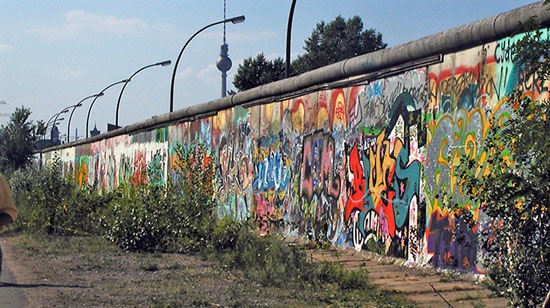
So this month is the 20 year anniversary of the Berlin Wall’s collapse. Most of the retrospective focus, naturally, on Europe. But here are a few thoughts for Asia:

1. National unification with communist basket-cases is ridiculously expensive. Germany has dumped a staggering 1.2 trillion euros into East Germany, but the east is still only 9% of GDP with 20% of the population. The South Koreans are downright freaked out by these sorts of numbers. The Korean situation is worse than the German one. The GDR was a more functional economy than the DPRK is today, and its people far less brutalized and abused. West Germany was a wealthier and more politically mature country than South Korea is today. So the costs (economic and social) to the South will be higher than they were to the West, at the same time that the South’s ability to pay for and manage (political capacity) them is lower than the West’s.

2. Have no illusions about just how bad communist governance really is. Before the Wall came down, all sorts of western liberals, neo-marxists, social democrats,etc. hemmed and hawed about the economic and human rights performance of the communist bloc. We constantly heard hopeful rhetoric about how Yugoslavia was a possible model, that East Germany was an ‘advanced’ economy, that the Czechs/Poles/Hungarians were putting a ‘human face’ on socialism, that communism might somehow turn a corner and become what Western academics wanted it to be. Open sympathy with the egalitarianism of communist theory lead far too many otherwise intelligent leftists to constantly forgive Soviet-style governance, to indulge the Koestler-esque notion that the bloodbaths and privation were just ‘transition steps,’ and give credence to shallow excuse-notions like ‘real existing socialism.’ (This willful leftist blindness about the East Bloc also helped birth US neo-conservatism.)

In the end, it was pretty much as right-wing Cold Warriors feared though – lots of repression, lots of misery, an ‘egalitarianism’ of brutalizing poverty side-by-side with a pampered, hidden elite, plus an ecological catastrophe to boot. When the Wall came down, the captive populations sprinted as fast as they could to the West. No one wanted socialism, a ‘third way’ for East Germany, or the foggy notions of communist equality so dear to the western left.

And the same will happen when NK, Vietnam, and China begin to unravel. When NK opens finally, the inside will look much, MUCH worse than we ever thought, and defenders like Bruce Cumings will be ashamed they ever defended the camps, family executions, forced labor and all the rest.

3. Autocracies can learn. China has very clearly learned from the Soviet implosion, as Kim Jong Il did from Ceausescu. This is critical in explaining why the PRC and DPRK keep hanging up, despite the 1990s optimism they would implode. This runs counter to the conventional wisdom that autocracies don’t adjust well because information flows are highly politicized and communication tightly controlled and regulated. (In other words, bad news does not make it up the food chain, and dogmatic elites don’t want to hear it anyway.) Azar Gat even thinks that China is the new model for IT-age autocracy.

4. Communist autocracies collapse rapidly. This lesson is most applicable to NK, as China is not really communist anymore and is reasonably stable. And Vietnam too is trying the China path, albeit more haltingly. But the DPRK is hanging tough on confucian stalinism, with all the explosive potential that suggests when the change finally does come. South Koreans frequently talk of a gradual reunification, a slow integration in which a North/South Korea federation would be like China and Hong Kong – 2 systems, 1 country. I find this highly unlikely. Stumbling reform like China or Russia in the 90s is likely insofar as radical change can be demonized as a foreign/western plot. But in Korea, the nationalist card will be neutered, because unhappy North Koreans will simply look at SK and say, why can’t we live that way?

This is what happened in East Germany in 1989/90. East Germans had little time for western stability notions of gradual integration, or GDR intellectuals’ notions that a reformed East Germany could somehow find a third way between capitalism and communism. Quite the opposite. East Germans rushed to unity as fast as possible to get all those things so long denied and so tantalizing close – legally protected freedoms like human rights and travel, and nice products like telephones and good quality cars. Once unleashed, the nationalist passion was impossible to stop. The momentum for unity in 1989/90 rolled a like snowball going downhill. It got bigger and faster, and no one could stop it without massive, illegitimate intervention. Helmut Kohl had historic insight and audacity to ride this tiger rather than fight it.

Korea would do well to prepare for unity on such fast-moving, erratic terms. The Kim NK regime is so illegitimate, so hated, so obviously awful and unsuccessful, that it is extremely likely that change will produce an explosion of popular desire, first in the North and then throughout the peninsula, for rapid unification regardless of the economic or diplomatic costs. In fact, South Koreans should welcome this likely explosive popular enthusiasm, because its intense nationalism and tremendous speed will help deter the Chinese from seriously intervening to slow or otherwise structure Korean unification.

Under-Institutionalization in Asia

Asean

This is an article proposal for the Asian Studies Conference Japan. A friend works there; its a good outfit. You should take a look.

Proposal: “It is a commonplace in research on international security and economics in Asia to call for greater, thicker institutionalization similar to the Organization for Security and Cooperation in Europe or the European Union. Not just East Asia, but most of the continent is comparatively poorly institutionalized. The Six Party talks on North Korea collapsed rather than evolve into a hoped-for ‘Northeast Asian Concert.’ The Association of South East Asian Nations is weak, having failed to coordinate well against either the Asian Financial Crisis or the Great Recession. ASEAN spin-offs like the ASEAN Regional Forum or Asia-Pacific Economic Cooperation (APEC) have done little. In South Asia, the South Asian Association for Regional Cooperation has essentially been sidelined by, rather than help to alleviate, the Indo-Pakistan competition. In the Middle East, the Gulf Cooperation Council is a self-protection club for monarchs, not a multilateral forum for dispute resolution or integration. This paper investigates today why even Africa is today even more institutionalized than Asia, especially East Asia. Repeated calls for thicker institutions fail for reasons local elites are loathe to admit. Deep divisions over territory, religion, ideology, and memory divide states across Asia. Territorial issues like Dokdo/Takeshima, Kashmir, or the West Bank are similar across the continent. Historical issues like the conflicts over Japanese colonialism or Israeli behavior are similar as well.  Accelerating democratization will only worsen these divides as entrepreneurial politicians fire populism for electoral and legitimacy gain. Despite regular academic calls to institutionalize Asian security, this – much less security communities as we see in Europe and the Western Hemisphere – is unlikely.”

I could cut out the bit on SE Asia, South Asia, and the Middle East, and only focus on NE Asia. But it strikes me that security institutionalization across ALL of Asia is pretty bad.

I am pretty pessimistic on institutionalization out here. Those who say that Asia’s future is Europe’s past seem right to me. East Asians just don’t seem ready to really build a serious multilateral forum. They just don’t like each other enough. It is pretty politically incorrect to say that, but things like the EU, NAFTA, or the OSCE require a modicum of good will and shared values among the participants. Simply trading for greater profit is not enough. SK and Japan, and Taiwan and China trade, but they still loathe each other. As long as my Korean students tell me they are ready to go to war over Dokdo (!) and they watch Japanobic movies like this, then you can forget an Asian or East Asian Union. South Asia too isn’t ready; the Indo-Pakistan conflict – including its talibanic addendum in Afghanistan – paralyzes everything. And it hardly needs to be said that regional integration is utopian in the ME.

It took the Europeans 3-4 centuries of bloody brutal conflict before they agreed to seek security through integration and cooperation rather than domination. You’d think after Asia’s violent 20th century, they would have learned that too. I guess not. As another western scholar out here said to me in extreme irony, ‘they’re just one more good war away.’ Sad but true, perhaps?

A ‘Confucian Long Peace’ among East Asian States (2): Probably Not…

east_asia

(For part one of this post, click here.)

1. I am skeptical, because shared cultural bases have rarely stopped conflict in other areas. Instead, they often seem to encourage it, as various states claim leadership of the cultural space as a whole. Every Continental would-be hegemon from Charles V to Hitler said they were ‘uniting Europe.’ Further, we usually save our worst fury and anger for dissenting insiders, not outsiders. So Plutarch and Thucydides both noted somewhere that the ancient Greeks, despite their shared culture, were far more zealous in destroying each other than uniting against their common foes, the Persian, Macedonians, and Romans. Hedley Bull and the EU framers argue that European ideals and perhaps Christianity provide a shared cultural base for a ‘European society,’ but Christendom hardly stopped the Europeans from fighting bitterly to dominate each other, particularly over which form of Latin Christianity was right. Today, the Arab state system shows the same problems. Supposedly united by common language, culture, and religion, the Arab states have vied brutally against each other, frequently recruiting outsiders like the US or USSR to help them defeat local rivals.

Now, one can argue that Confucianism has special or unique war-reducing or –dampening properties, but that needs a lot of research and detailed process tracing rooted in specific examples of conflict averted by appeals to shared values. A far simpler answer is to say that China was a regional unipole (i.e., huge, when others were small), and therefore war against it was pointless. IR strongly believes this logic explains the current global Long Peace; war against the US unipole today is fruitless. So why not simply apply the logic to the regional level? Chinese preponderance made war in classical Confucian Asia less likely, because China’s opponents never stood a chance and so never tried. Following that causal logic, we should speak of a Chinese hegemonic peace, not a cultural Confucian peace.

2. The idea of a Confucian long peace stumps IR, because we aren’t really sure what to do with ‘culture’ as an explanation for outcomes. In fact, social science in general dislikes ‘culture,’ because it feels like a cop-out reason when you’ve got nothing else. If you can’t explain something otherwise, say it is ‘just their culture.’ So if I don’t know why Russians like vodka, the Irish like Guiness, and the Koreans like soju, then it is just ‘cultural preference.’ But that is awfully soft. It does not actually tell me much; it provides no account of mechanisms and choices. Besides, lots of so-called cultural artifacts actually have functional roots. For example, the Jewish and Islamic prohibitions on pork are rooted in the possibility of contracting trichinosis from flesh that might quickly sour and rot in the sun of the ME. Social science prefers such rationalist explanations. Actor X does Y, because there is some tangible material benefit. Maybe Confucian Asia will bandwagon with China for cultural reasons, but the causal map for this behavior feels soft, especially in contrast the explanatory clarity of the regional unipolarity thesis.

For examples of culture’s softness, look at the other three systems I noted with multiple states functioning within a shared culture (Greeks, Christian Europeans, and Arabs). They did not enjoy any war-reducing affects from common culture. In fact, the evidence from psychology points the other way: we tend to save our harshest opprobrium and violence for lapsed insiders (national traitors, religious heretics) than outsiders who are comfortably relegated as ‘barbarians.’ This was Plutarch and Thucydides’ tragic insight, e.g., on the ancient Greeks.

3. If there was a Confucian peace, I don’t think it is coming back. Kang does. He thinks China’s EA neighbors will accept some amount of Chinese hierarchy; that is why they are not balancing against China now. I don’t buy it. Koreans and Japanese strike me as way too nationalistic today to accept that. If anything, the Koreans and Japanese look down on the Chinese as culturally inferior. Koreans will tell you that the Chinese will eat anything (scorpions, beetles) and that Korea should ‘mediate’ China to the West. Sizeable chunks of Japan still think its imperialism liberated Asia from the West and brought modernity. EA states today are just way too nationalized now. Just like the nationalization and de-arabization of contemporary ME states that sets them against each other despite shared culture, EA states may share a vague Confucian background unity, but vague is all it is. EA is far from the level of cultural sharing and trust that undergird a project like the EU. And remember that the Europeans had to destroy each other for 400 years before they decided to live with each other. If no one is balancing against China today, as Kang says, then, 1. they can avoid it, because the US is still around to reassure everyone, and 2, they are certainly hedging against China, if not openly balancing it. No one in Asia is openly running with China, not even NK. This nationalization of EA states is why Samuel Huntington’s proposed Confucian civilizational bloc never really ignited local opinion here; it was based on the Sinco-centric past, which although attractive perhaps as a route to peace today, no longer exists. Asians will have to do the hard work of forging institutions to build trust; culture is not enough…