
TV Review: The Best Pop Culture Translation of the War on Terror is… Battlestar Galactica?!

bsgemblem

It’s Christmas week, so here is something lighter than usual…

And yes, you read that title right.

Lots of people get their beliefs about big issues from pop-culture, a social fact wildly underappreciated in social science. Witness the stunning impact of “24” on US popular attitudes to terrorism. And of all the shows and movies I have seen about the GWoT since 9/11, none of them capture the tensions as well as the new Battlestar Galatica. This is not a replacement for actually reading something, but it was political TV entertainment with brain, and that strikes me as awful rare. I just watched it on DVD. The show really flies off the rails midway through season 3, but the first few seasons are much sharper than I expected regarding the GWoT.

In the show, a human people from a far away planet are being pursued across space by a mechanical race (the Cylons) which they created but who then turned on them. The creators used this plot, which was so bad in the first show in 1978, to build an extended metaphor about the US in the War on Terrorism. I found this remarkably clever, particularly given American science fiction’s preference for silly CGI space alien stories like Avatar. Here are a few good parallels:

1. The humans repeatedly face extreme and realistic trade-offs that result in mass fatalities. Usually GWoT movies and TV soft pedal ethically awkward choices by establishing one character as the bad guy, whose death will wrap up the morality of the story easily (see the bloodthirsty Christian prince in Kingdom of Heaven or the sleazy bad guys of 24). In BSG, some humans are sacrificed for the good of the greater number. Civilians are left behind to die; soldiers shoot civilians; defenseless enemies are butchered. No one leaves the show morally excused or pure and therefore easy for US viewers to identify this.

2. The torture debate runs throughout the show. Cylon prisoners are abused, beaten, even raped. And even more realistically, sometimes torture is shown to work, sometimes not. And in one episode, a prisoner released from torture promptly kills her guard – very believable and very uncomfortable punishment for doign the right thing. The Cylons too torture their prisoners. It’s blood and pain all around, which pretty much sums up the US flirtation with torture as a tool of national policy.

3. The shows nicely demonstrates the tension between civil and military command during wartime. At two points, there are military putsches and martial law – basically Chalmers Johnson’s fear about the direction of the Bush presidency.

4. Lots of decisions are made under conditions of extremely poor information. The show abounds in the moral dilemmas of ‘what if’ scenarios that leave more bodies behind. At one point, the civilian president and military second-in-command decide to assassinate the military first-in-command, because she is promoting torture and military dictatorship.

5. The show also channels the GWoT paranoia about sleeper cells. The Cylons have agents that look exactly look humans. This captures exactly the fear of Muslims in the West who seem just like us until something like the London bombing or Ft. Hood shooting happens. Inevitably after these things happen, neighbors always say, ‘they seemed like such nice young men, so normal.’ The show makes strong use of the paranoia this creates, and it shows the splits and divisions among the humans that such paranoia creates.

6. The most obvious parallel, which is probably overdone by the producers, is to make the Cylons crusading monotheists and the humans polytheists. It is almost too easy to see the Cylons as Islamic jihadis. But again, the show gets good intellectual mileage out of the issue of religious tolerance, and the show has multiple characters who invoke God to justify extreme behavior.

7. The show also displays well the long-term stress that constant war places on democracy. The humans slowly become more regimented. Their democracy is constantly under threat of military intervention justified as wartime necessity. The soldiers are constantly tempted by jingoism and strut. The parallels to barracks democracies like Israel and South Korea are rich, and arguably the show was warning against the drift of the Bush administration.

8. There are lots of subtle digs at the Bush people. One leadership character prefers a standing desk and authorizes torture – nice a Donald Rumsfeld reference. The president of the humans undergoes a religious conversion.

9. The show does have flaws. Like too much science fiction, the core audience is young male, so the show abounds in ridiculously out-of-place sexy women. The CGI is mixed. The show has the same military obsession with people in uniform that so much US TV and film has. Like so many US war films, there is a great deal of macho military posturing, saluting, and barking, but at least there is some critical perspective. But this adulation of the military values also reflects the Bush-era GWoT.

This is vastly superior to 24 and other GWoT junk like Stealth or Lord of the Rings 3. The moral dilemmas are sharply defined, the choices available are usually bad, and the ‘right’ moral choice is rarely clearly apparent. The same kinds of cost-benefit analyses under stress and poor information that characterize political decision-making during war are regularly displayed. I found this a breadth of fresh air after laboring through the action-movie and easy morality idiocy of 24.

The US Conservative Meltdown in One Sentence

250px-Sarah_Palin_portrait

So yes, we all know that Palin is a balloonhead. Even the conservative-realist Foreign Policy gave thanks on Thanksgiving that Palin has no access to US foreign policy making. I have given up reading the reviews. I don’t think anything could seriously convince me to read the book.

But Sam Tannenhaus really captures how Palin both channels and reflects the larger problem of right’s increasing abdication of seriousness about government altogether:

“On the campaign trail she discovered a power greater than public office: the power of celebrity,” writes Matthew Continetti, an editor at The Weekly Standard and the author of “The Persecution of Sarah Palin,” a book that combines besotted advocacy with an assault on the liberal media that “tried to bring down a rising star.”

“Greater than public office”: this phrase distills an emerging doctrine on the right, as its long-standing distrust of federal bureaucrats and costly programs careers off into full-scale repudiation of governance itself.


Yes, the logical end point of tea-parties, Fox News, the ‘Palin-as-serious-contender’ fantasy, the ‘Obama-as-Hitler’ trope, Rush, Beck, and all the rest of the 2009 conservative implosion is the growing recognition by the rest of the country that the right is not only unfit to rule, but increasingly unable to.

(Tannenhaus’ good book on recent US conservatism is here.)

No More ‘Realignment’ Talk – US Politics is actually quite Competitive

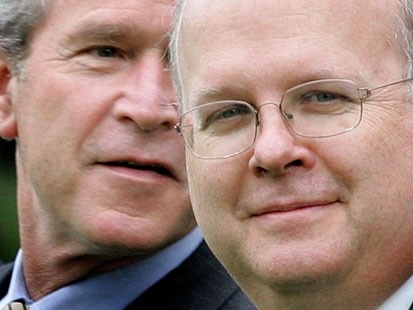
KARLROVE

American politicos and pundits love to see a ‘realignment’ in almost every election. After 2002 and especially 2004, Rove told us all about a ‘rolling realignment’ toward the GOP. Bush was building a durable Republican majority, based on a populist, Christian-Jacksonian mobilization and the ‘Ownership Society.’ Values voters were energized, and the GOP base was bigger than the Democrats’. Rove was the ‘Architect.’ What a load of bunk that turned out to be…

And then last year, the Democrats made the same sorts of claims about 2006 and 2008. Obama told people his election was the beginning of a new era. Instead of activist Christians realigning US politics to the right, now it was the growing nonwhite population and the youth who would give Obama a reliable center-left coalition. Michael Lind particularly makes these sorts of arguments a lot. Now Krauthammer tells us this was also a fantasy.

Previous pseudo-realignments occurred in 1988 and 1994. Bush 41’s election supposedly gave the GOP a ‘lock’ (remember that one?) on the White House, and then Gingrich was going to ‘revolutionize’ Congress’ role.  Both the lock and the revolution ended just 4 years later.

All this strikes me as overheated punditry trying to reach for some ‘Bigger Story’ in every election. Most journalists and academics like to deal in big ideas and structures. Who wants to say that candidate X won because heavy November snow in swing-state Ohio drove down candidate Y’s turnout? There is a lot more randomness than we probably want to admit. Yes, there are big structures in US electoral politics, but there are also clearly a lot of local effects. Kerry probably should have won in 2004, given the Iraq mess and the closeness of the 2000 election, but he was an awful candidate. The so-called transformational presidencies of Reagan and Obama were hardly massive landslide elections; in August of 1980 and 2008, both elections were a dead-heat. Gulf War victor Bush 1 should have beat a weak, second-tier governor in 92, but out came Perot to throw the whole thing up the air.

The point of these examples is to suggest that while there are big structural forces that persistently shape elections (unshakeable black support for the Democrats, e.g.), a lot more of the electorate is in play than we admit, especially in retrospect when we desperately want to find ‘Big Explanations’ and ‘Important Trends.’ Further, it is quite healthy actually that the electorate is so competitive. Polarization of the voters into two sharply divided and political consistent voting blocs is a recipe to divide the country against itself – as we saw with the Red-Blue divide of 2002-2006.

I think the search for realignments in every election comes from two journalistic desires. First, journalists probably want to think their work is tapping into something big and important. Who wants to write about how a sex scandal or loopy political family member cost someone an election? It is far more exciting to say things like the end of the Cold War, globalization, ‘postracialism,’ etc. drove an election outcome. Journalists probably want to be purveyors of big ideas and make a philosophic, rather simple day-to-day, contribution. Hence every election is scrutinized with a desire to find a big meaning. Then you can write books like this or this. This is probably a worthy instinct, but I have the sneaking suspicion it is rooted in a journalistic craving for academic/philosophic prestige (to be a public intellectual), particularly against academics, who professionally deal in big ideas and like to disparage bad social science as ‘journalism.’

Second, I think the realignment schtick helps create a comforting sense of predictability about US politics, and also justifies why we listen to journalists to begin with. This makes the exciting but clearly erratic US democracy feel more certain when we talk about it, and more importantly, ‘experts’ need that predictability if they are going to be experts. Cookie Roberts is already the flakiest commentator on TV, but no one would ever listen to her if she did not have the pseudo-certainties that come from these biannual ‘big explanations.’

Of course, there are big explanations, and the work of EJ Dionne and M Lind is actually quite good. But my sense is the realignments are usually of certain subgroups who don’t represent enough of the electorate to make elections really predictable. We know, e.g., that something like 1/3 of voters make up their minds on election day, and that name-recognition drives a huge amount of the House vote. But certainly specific blocs of voters have realigned. Civil rights is an obvious example. It drove blacks permanently to the Democrats, and rural white Southerners to the GOP. But simultaneously other groups have de-aligned in the last 50 years, and this gets a lot less attention. Jews and Catholics are good examples. Both were mainstays of the FDR coalition, but now they are so much in play that it is probably oxymoronic to speak of a Jewish or Catholic vote. Neither Israel nor abortion has created a meaningful GOP ‘capture’ of these groups. Women too are hardly a Democratic bloc; feminism has only at best a weak appeal.

So instead of trying to find a Bush- or Obama-driven realignment in the last 10 years, why not note that both had success in battleground states, and that the number of swing-states is actually fairly large now? And how about also mentioning how this is healthy for the republic? It keeps politicians on their toes and forces them to reach out to different communities and build bridges. This is good.

Ft. Hood, the Unpursued Possibility of Mini-Terror, and the Failure of al Qaeda in America

r3205516650

I have been teaching terrorism since 2003, and again and again, I have asked where is the mini-terror campaign against American infrastructure and civilians?

Al Qaeda has a well-known penchant for mega-terror. 9/11 is an obvious example, as was the attempted sinking of the USS Cole in 2000. Other foiled plots included wild efforts to blow up multiple hijacked planes over the ocean, and this year’s more varied mega-efforts.

Yet this has always struck me as strategically foolish for al Qaeda after 9/11. Post-9/11, the US is pursuing al Qaeda all over the place. Institutional security, hardening of civilian infrastructure,and homeland defense are all vastly improved. It is much harder to hijack a plane or blow up a building now. Mega-plots are hard to organize. They are complex and expensive. They require more staff, more preparation, etc. With so many moving parts, it is easier to catch and unravel them, especially given the long build-up time necessary and the greater western vigilance post 9/11. The 9/11 plot was a one-off opportunity; its very completion eliminated such an opportunity for future plotters by insuring a major subsequent security beef-up. It benefitted from the low scrutiny and attention given to terrorism pre-9/11. Insofar as it permanently heightened western awareness of suspicious activity, it has become significantly harder to pull off mega-terror since then, at least in the west.

Given this western police awareness and sensitivity to big plots, why doesn’t AQAM (al Qaeda and associated movements) pursue mini-terror, like Fort Hood or the Virginia Tech shootings? Terrorism is well-known as an asymmetric tactic, so if western agencies are keyed into mega-plots, why not adjust and go the low route?

A mini-terror campaign would focus on the softest of western civilian infrastructure, as it does in Israel – malls, shops, buses, restaurants, etc. The sustained mini-terror campaigns of Hamas and Palestinian Islamic Jihad were brutally successful at destabilizing Israeli society in the 1990s, as the Bader-Meinhof gang was in the Germany in the 70s. If I were an enterprising young terrorist looking to make my mark (think Abu Musab al Zarqawi), I would take these urban war tactics right to the US. Consider:

1.  how easy it is to enter the US illegally; something like a million people a year do it.

2. how easy it is to buy a gun, legally or not, in the US.

3. how many people Nidal Hasan (Ft. Hood) and Seung-Hui Cho (Virginia Tech) killed and wounded simply with pistols.

4. how many old people, children, and pregnant women go to your nearest shopping mall, and how obese the guards look.

5. the crippling, popular paranoia 2 or 3 such mall massacres would create in the US (imagine the Fox News response!).

This scenario seems so blindingly obvious to me, it cries out for explanation why it is NOT happened: three or four OBL-wannabes slip across the Mexican-US border, paying the vast human smuggling networks operating in northern Mexico to get them over. They then hit a gun show in Texas, because gun show gun sales require no background check. They then head off the nearest shopping mall. Learning from Cho, they chain or block the ground-level exits. They then walk in and start shooting. In 20 minutes they could kill 100+ unsuspecting, unprepared, slow-moving people. A few of these massacres would then create a massive populist outcry to treat US Muslims as we did the Japanese during WWII. And this is exactly what AQAM wants – the clash of civilizations right in the heartland of the infidel.

Given that this has never happened, especially when it would be so easy, a serious research project is waiting to be written. The answer is not simply that US Muslims are well-integrated. That did not prevent the 9/11 hijackers from penetrating the US, nor did it stop Hasan this month. I think a better answer is that of John Mueller – that the Islamic terrorist threat may in fact be wildly overblown. If it is this easy to kill so many Americans and stir up mass islamophobia, then the only reason it hasn’t happened is because there a lot fewer radical Islamist suicide killers than we think. This a guess though; this question needs a real researched answer.

Time for Indecision on Afghanistan

afghanistan-map

The growing pressure for a ‘big’ decision on Afghanistan is misguided. The neo-cons and other hawkish elements are raising the temperature on this unnecessarily by suggesting that Obama must go all in soon, or the Democrats will be responsible for losing another war. Slow down there, Tom Clancy. There is a case for muddling through also, not just leaving or going all in.

There is growing evidence that a big rush to judgment and commitment on Afghanistan is unnecessary. (Read Fred Kaplan’s last few columns.) I found this article by AJ Rossmiller most persuasive against the fallacy that Obama has to make One BIG Momentous Decision that will determine his whole first term. Rossmiller wisely suggests that there is actually no big need to ramp up huge forces there right now, with all the costs and commitments that come with a build-up. Muddling through is working pretty well.

It seems to me that the push to have one big decision is really a rhetorical strategy by Afghan surge supporters. By talking this way, they seek to create the view that if O doesn’t make a huge choice RIGHT NOW, all could be lost. This framing of the decision is designed to push him into the surge, by making it look like he is giving up if he doesn’t pile in. Better to lock in Obama on Afghanistan now, early, before he learns too much and starts to hedge.

The model for such a decision-making approach is Kennedy and the Bay of Pigs, and LBJ on Vietnam after Pleiku. A new, unsure president gets pushed into a big war-making effort by a collection of advisors with deep stakes in the military-industrial approach to conflict. As a Salon blogger put it, LBJ probably should have listened to Norman Mailer (!) instead of Bundy or McNamara. I wouldn’t go that far, but the point is that these ‘strategic reviews’ recycle the usual suspects. Even better is Greenwald’s powerful column that the ‘foreign policy community’ as an industry has a vested interest in imperial overstretch and war as a tool of conflict resolution. I particularly like Greenwald’s identification that whenever you ring up Rand or the Kagans, the answer is more military action. Hah! Money quote:

As Foreign Policy‘s Marc Lynch notes:

“The ‘strategic review’ brought together a dozen smart (mostly) think-tankers with little expertise in Afghanistan but a general track record of supporting calls for more troops and a new counter-insurgency strategy.  They set up shop in Afghanistan for a month working in close coordination with Gen. McChrystal, and emerged with a well-written, closely argued warning that the situation is dire and a call for more troops and a new counter-insurgency strategy. Shocking.”

The link he provides is to this list of think tank ’experts’ who worked on McChrystal’s review, including the standard group of America’s war-justifying theorists:  the Kagans, a Brookings representative, Anthony Cordesman, someone from Rand, etc. etc.  What would a group of people like that ever recommend other than continued and escalated war?  It’s what they do.  You wind them up and they spout theories to justify war.  That’s the function of America’s Foreign Policy Community.

The model for going ‘all in’ of course is the Bush surge in Iraq. But there was hardly a decision-making ‘process’ with W, understood as a careful weighing of options and competing views. You knew W would not leave, but double-down instead: Iraq was the signature issue of his presidency in by 2007; he was obsessed with machismo and mistook bulheadedness for toughness; and no arguments were going to dissuade Bush, because the ‘decider’ was a ‘gut player,’ not a listener. There was no real debate; W blew off the Iraq Study Group and rolled the dice. Nor do we know if it was the surge that helped stabilize Iraq. A lot suggests it was the change in strategy from warfighting to COIN, as well as the the shady and mundane pay-off of Sunni insurgents. In short, it may not have been Bush’s heroic insight into the war, but simply handing bags of $100 bills to Sunni gunmen that helped quiet Iraq.

Six weeks ago, I argued to give McChrystal a chance on COIN in Afghanistan. I am not arguing now for the offshore CT approach, but rather for a little more muddling through. I still think we should stay in Afghanistan with a heavier footprint than VP Biden would like. But my concern here is to avoid pushing Obama into one great, over-heated ‘ALL OR NOTHING!’ decision. Framing the decision that way basically blackmails him into making the choice those framing the debate this way want him to make, ie, the big build-up.

‘Birthers’ and the Requirement of Documentation

2009-07-24-obamabirthcertificate-thumb One of the great disappointments of my time in the US this summer was the silliness and extremism of the Republican reaction to Obama’s defeat. Instead of playing a constructive role as an opposition party, it is descending into lunacy – G Beck called Obama a racist; health means enforced abortion; Palin declared Obamacare ‘downright evil.’ This is bad for the GOP and, in the medium-term, for the country also.

Instead of taking its big defeats in 2006 and 08 as cause for a major rethink, the party and the conservative movement seem to have concluded that further movement to the right is the answer. This is also bad for the country, in that the medium-term implosion of the opposition party in a two-party system removes a critical check & balance from the system. Perhaps the most idiotic, self-destructive reaction is the birther movement. A plurality of Republicans believe Obama is not a citizen.

About the only thing I can think of to defend the birther position is that proper documentation is a broad problem in the US. There is no national ID card. SS cards do not come with a picture on it. State driver’s licenses implicitly function as our nationwide ID, but they differ widely across the 50 states, SS numbers can be removed, religiously devout are sometimes permitted to cover their faces, and many people simply do not have one. Finally, of course, document fraud is growing problem, because 20 million illegal immigrants live in the US creating massive demand for a black market in faked paperwork.

My sense is that improving US systems of ID is the meaningful take away from the birther controversy; the rest is bizarro conspiracy theory flim-flam. So, yes, Obama should have a birth certificate to prove he is a US citizen, but so should every other candidate for political office in the US. Indeed, it seems to me quite natural that anyone declaring candidacy for an office in the US should be required to show proper ID. I certainly hope that is required! I am always amazed that when I voted in the US, that I was not required to show any form of ID; I would always bring my driver’s license just in case.

That is probably the real lesson from the birther flap. It is born of the confusion over proper ID in the US and the huge presence of illegals in country. Yes, it channels the long history of rightist paranoia in US history. But it also says that the US should probably have a national ID card as most countries do. That card would be required for most public functions – voting, candidacy, driving, court appearances, etc.

Finally, in a rich irony, it is the right that has long blocked a national ID scheme. Exactly the kinds of righties who make up the birthers – radical libertarians, militia types, NRA members – are also the most vehement opponents of a national ID card, because it is seen as a step toward tyranny and government tracking of weapons ownership. So you can’t say Obama lacks his paperwork, when you think too much paperwork is the beginning of world government.

Korean ID addendum: Korea goes too far the other way with an ID card. When you buy stuff on the internet from Korean analogues to Amazon, you need to punch in your national ID. So if you order a book or movie from the internet, it is tagged to your national ID number with an e-vendor. Kinda creepy…

Will that ‘Groundbreaking’ Japanese Election Actually Change Much?

183px-Democratic_Party_of_Japan_svg I have not said anything about the most important event in Asia in the last month, because I am still stumped as to just what meaningful changes the Democratic Party of Japan (DPJ) intends to initiate. It has been a month now since the election, and I am pretty disappointed at how little ‘change we can believe in’ is forthcoming given Japan’s truly catastrophic fiscal condition.

All the talk about how this election is making Japan more democratic is correct. It is clearly healthy for Japan’s Liberal Democratic Party (LDP) to be out of power – and for awhile. Korea’s democracy jumped forward when opposition leader Kim Dae Jung got elected president (1998), and Mexico’s democracy improved when the Party of Institutional Revolution (PRI) lost the presidency for the first time (2000). Japan’s party system is now fuller and more serious. But this is an institutional, long-term improvement.

I am more curious about what policy changes the DJP will pursue, and my Japanese colleagues out here can’t quite tell me. I keep asking at the conferences I go to, and I keep hearing macro-level stuff – Japan will be more democratic, more accountable, etc. That is correct, of course, but I don’t actually see that much room for policy change, because what change Japan does need is pretty painful and not what the electorate wants.

So, the DJP says they will pursue a foreign policy more independent of the US. Lame. Grumpy American allies always talk like this, and it is possible, but unlikely. France and Germany speak this way every few years, but never really do much. SK President Roh (2003-2008) campaigned on anti-Americanism and flirted with China for a little bit. But ultimately, the US guarantee of SK sovereignty against China’s looming hugeness pushed SK back to the US. Japan is stronger than SK, but what kind of independent Japanese foreign policy is conceivable? Japan, for all its money and strength, is conspicuously lacking in friends. It has a long-standing territorial dispute with Russia that has blocked serious relations since WWII. The two Koreas and China are convinced that militarism is lurking in the Japanese psyche and want post-Holocaust German-style apologies for Japan’s wartime behavior. But the Japanese just can’t see to fully apologize and really mean it. So if they want to leave the US orbit, fine. But where will they go? Do they really want to stand against China (plus the unhappy Koreas and loose-cannon Russia) alone in the future? I doubt it. Just like France felt compelled to rejoin NATO’s military integration despite all of Jacques Chirac’s Iraq War anti-Americanism, Japan will come back after some populist-nationalist noises for a year or so.

Domestically the DJP says they want help for farmers and the poor and provide more money for childcare, worker protection, etc. All these are nice social democratic goals (sorta like Obama). Everyone likes to help the poor, and if childcare assistance will get Japan’s birthrate up, that would be excellent. But there is no money for this. Japan’s debt is absolutely out-of-control. It is at 175% of GDP now – that is roughly a $8.75 trillion debt on a $5 trillion economy. (US debt is $9T on a $15T economy.) Here is a 2001 description that captures just how bad it is in some detail. Money quotes: “Japan’s Runaway Debt Train” and “Japan’s Public Spending Orgy.”

Most foreign IPE (international political economy) observers say what really needs to happen is an assault on the bureaucracy that really runs Japan under the hood of its parlor-game politics. Yet the LDP under Koizumi could not do this, and the DJP has scarcely talked about it.

So while the election is good for long-term democratic institutionalization, I still see the same wishful thinking as under the LDP – more public money (except for families now instead of construction companies), more subsidization of wildly expensive and inefficient Japanese famers, no moves to tame the bureaucracy and open the economy, and most importantly, no serious plan to get the staggering deficit and debt down. Instead its just more red ink – just this time from leftist-populists instead of business-conservatives. Meet the new boss, same as the old boss. Bleh…

UPDATE (Oct. 1, 2009): I feel vindicated in my assessment.

US Right-Wing Meltdown Watch: “I’m so American I don’t want the President Talking to my Kids!”

(I must credit a friend for coming up with that title.)

I am getting really nervous about what is happening to the American Right. The paranoia is getting really, really bad – Death Panels, Obama the racist non-citizen, Hitlerian healthcare. Now Obama is feeding “Marxist propaganda” to the nation’s schoolchildren?! Does anyone really believe that? WTH is happening to US conservatives? He’s black with a funny name so he’s a Muslim socialist Nazi whatever? How did we possibly get to this point?

And this is starting to leak out to the rest of the world now, you know. South Koreans heard about that guy who brought a legal firearm to a health care townhall, and it’s downright embarrassing to try to try explain it: ‘well you know, that’s the way we are; those wacky Americans.’ The ‘Obama is Hitler’ riff from the summer is also starting to filter downstream.

You can’t talk like this and expect people to take US superpowerdom seriously. If we are going to lead, and not just be some sallow, pathetic, self-involved empire-in-decline (like 1914 Austro-Hungary), we gotta clean up this kinda stuff. Don’t conservatives see this? They love American empire and dominance more than anyone, yet their post-Bush rhetoric tells the world we aren’t fit to lead, or at least, they aren’t fit to lead the US. Most rich countries have state health care; they think it’s kinda weird we don’t. That doesn’t mean we have to have it, but it does mean when opponents flip out and say ObamaCare is the beginning of the Fourth Reich, they think we’re bananas. Last week some guy got his finger bitten off at a health care townhall?! C’mon! Please! I have to explain you people to Asians out here, and it’s killing me!

Democratic systems need healthy coherent opposition parties. Especially in a 2-party system, a functional, serious opposition is a crucial check & balance. But the US conservative freak-out just goes on and on, even after 8 months of Obama’s presidency. Andrew Sullivan argued in The Conservative Soul that the GOP was at risk of becoming the first religious party in US history. In similar manner, one might say it is becoming a regional party, as it contracts to a Southern rump. Christianist rural paranoia has replaced reflective seriousness.

And stories like this are exactly why the GOP continues to contract. Does the Fox News right really believe the POTUS should not speak to the nation’s children? Isn’t that going wildly overboard? And besides, isn’t it kinda cool that the president wants to talk to kids? Isn’t that good for citizenship? And when he says he is asking for their help, doesn’t that have a ‘we’re-all-in-this-together,’ ‘ask-not-what-your-country-can-do-for-you’ vibe to it? Isn’t that a GOOD thing? Besides he’s the POTUS. Doesn’t he have the right to to speak to the citizenry, including the next generation? He did get elected; he is the PRESIDENT, right?

Oh, I forgot… he’s not a citizen, so of course he shouldn’t talk to the children! How nicely one conspiracy theory dovetails into another to create that FNC echo chamber.

*Sigh* I am running out of things to say on this. It’s just too weird. Go read Richard Hofstader’s classic The Paranoid Style in American Politics. You’ll learn about all the other wackjobs in the history of the American right – like Father Coughlin who thought the New Deal meant FDR was in league with Stalin. How nice.

Russian Imperial Paranoia Update – Putin Thinks He’s Rambo!


Ah, the entertaining hysteria of Russian imperial decline. A few months ago, it was Stalin battling aliens to save the world. Today, it is another machoismo photo-op by the Pootie-Poot (George W Bush’s nickname for Putin). Now he’s shirtless in Siberia. Cuttin’ brush just like W! I bet the ladies just love this sorta stuff…

I’ve written before about the psychology of resentful post-imperial Russia. Vice-President Biden basically nailed it this summer when he said the Russians were suffering from a severe postimperial “hangover,” and Philip Stevens at the FT gets it right too, that endless, tiresome Russian bitterness has made it friendless. Another FT op-ed basically tells you why 20 years after the USSR, eastern Europeans still want NATO as a bulwark against Russian neo-imperialism.

Old glories die hard – although ‘glory’ hardly defines gray, dingy Soviet imperialism – and in Russia’s case the ‘hangover’ has been more severe than normal because the fall from imperial greatness happened so fast – less than 5 years. This rapid fall followed by a consequently more extreme nationalist reaction characterized Weimar Germany too, so this is pretty worrisome actually. At least Britain had a long time to retrench from empire, so Britain’s public and elites could slowly adjust to its declining power. Even Enoch Powell, who loathed the Americans during WWII for their secret intention to break up the Empire by releasing India, came to advocate no further British commitments east of the Suez.

By contrast no figure in Russian political life speaks this way. It is competitive, macho, one-upsmanship in foreign policy. Bullying and bitterness are the order of the day, and national ideology is Weimar-esque resentment. Even as Russia is depopulating, the strut and overconfidence insecure powers require in IR now dominates Russian foreign policy. This is the route to national suicide, and given how unhelpful Russia has been for 15 years on everything from NK to Chechnya to Iran, I guess we should be ‘happy’ they’re on this kamikaze course. Still, they are one of the great cultures on the planet, having produced Dostoyevsky, Shostakovich and the rest, so it is disturbing and tragic to watch them destroy themselves. Sad…

Thoughts on Miguk-land after 1 Year

I went back to the US this summer to see my family. The culture shock was, predictably, deeper than when I returned to the US while I lived in Europe in the 1990s. The cultural gap between Korea and the US is deeper than that between Europe and the US. So I feel like I noticed more this time. So here are a couple of thoughts.

1. Americans are really fat. I struggle with junk food as much as anyone, but my fellows citizens seem to be just giving up. Koreans are the slimmest people in the OECD (or at least, that’s what they tell me, and they look it), and the difference with Americans is really apparent. My girlfriend came home with me, and she was routinely shocked by the sheer girth of so many of us. We both picked up on it almost immediately as we entered the airport. A news report I saw said that 40% of Americans are obese now, not just overweight. A doctor friend said this is evolving into a ticking time bomb. In about 30 years, when all these people hit 60, the public health burden will be staggering – on top of all the other entitlement/health care problems already. The IR scholar in my can’t help but think this is bad in the long term for US power. As hegemons age they are supposed to become more sluggish and complacent, and they US population is certainly showing that. How can you lead when half your people struggle to get off the sofa? My only consolation is that Europeans and Asians especially smoke a lot. That is their own public health drain. Is it macabre to suggest that US tobacco exports to China aid long-term US power?

2. Fox News and the American Right is even more insane now than I have read about. I made a point to watch Glenn Beck, O’Reilly and Hannity while I have was home. One of the most important consequences of the GOP’s defeat last year is the opportunity for a post-Bush reconstruction. When parties suffer from major defeats like the GOP in 2006 and 2008, or the Labour Party from 1979 to 1997, it calls for a serious philosophical rethink. Labor did this and successfully modernized itself (i.e., dropped socialism after Thatcher and the end of the Cold War) under Blair. But the GOP seems to want to drive itself further and further into the wilderness. The lesson the GOP has drawn from the defeat of Bushism is that it was not pure and conservative enough. Instead of tracking to the center, the GOP is vearing even further to the right to purify itself. Instead of coming to terms with the major social changes brought on by Obama, his postracial challenge, and the Great Recession, the GOP would rather recite dated, toxic bromides. So Glenn Beck is saying Obama is a racist; Palin calls ObamaCare ‘evil’ and says it includes ‘Death Panels’ (i.e., end-of-life consultations); and the bloggers are claiming he is not a US citizen. Are you serious? This is the state of conservative commentary at a time of massive government expansion? Even the WSJ’s op-ed page is staggeringly uncreative. If this persists, serious middle class professional people will abandon the GOP. These kind of people voted for for Bush because they thought Clinton was sleazy and then to fight the GWoT. But if the GOP becomes regularly indentified with managerial ineptitude in government (Iraq, Katrina, ‘evil’ healthcare), then serious professionals will vote for Democrats. I consider myself in this group. I voted and worked consistently for Republicans in the 90s, since W’s election, I have drifted further and further. And if Fox News and talk radio become the ideological organs of the post-Bush right, then I will never go back.

3. The Great Recession is far more noticeable in the US than Korea. First, it is in the news a lot more at home. Second, people talk about it a lot more in the US. My parents and friends at home made regular reference to it in conversation, but friends and colleagues here rarely do. Third, one can see all those ‘house for sale’ signs all over the place. The real estate market in Korea does not work this way, so this very obvious and public marker of the GR is not evident. Koreans mostly live in high-rises, as I do. In general the GR has been lighter and shorter out here than at home. No one talks about 10% unemployment here; they’d be rioting in the streets (be sure to look at the picture).

4. American food is not that bad after all. Food is an important part of Korean identity, and Koreans occasionally cite as healthier and tastier than US food when they need something to throwback at an American in a conversation. And indeed, the American food in Korea is awful; its almost universally junk food chains like Burger King. So I had forgotten how good some American food is – deli sandwiches, microbrews, summer BBQ chicken. Korean food is certainly healthier on average than US food. I accept that, and I don’t care much. (Koreans do; they are nationalist about food, along with almost everything else). Unfortunately the American food that is exported is almost always the worst fast food, like KFC or McDonald’s. My sister laughed out loud when I told her that even Popeye’s Chicken is in Korea. This is unfortunate, because it gives the impression that most US cuisine is that sort of greasy, salty junk. But my family, friends, and colleagues in the US rarely ate fast food; most Americans seem to be aware of how bad it is for you; and there are a lot of non-fast food restaurants in the US. So the Cheesecake Factory, e.g., is unfortunately not in Korea, and I have never seen a proper (Jewish) deli here either. I always thought one could make a fortune in Korea if one opened a good western restaurant.