In part 1, I tried to offer some comparative national cases (France, Israel, US) by which non-Koreans can get a handle on Korea. Today, I thought it would be useful to use some conceptual, rather than national, benchmarks. I can think of at least four sociological conflicts through which Korea is moving simultaneously, and hence make it such a boisterous place to live:
Category Archives: Domestic Politics
Korean National Identity (1): Comparisons to Israel, France, and the US
Part two is here.
I get lots of questions from Western readers about this or that aspect of Korea in comparison. We don’t really know about Korea too much, but Americans often use it as an example for some larger political point they want to make. Here are a just few examples: 1) Obama: SK is kicking our butt on education and tech; 2) Obama: SK is an example of a country that modernized but didn’t westernize; 3) Michael Crichton and Amy Chua: SKs and other East Asians are work robots who will take over America and cost your kids a job; 4) John Bolton: Long-suffering SK gives us an excuse to stomp on NK.
Of these, I really think only the second is valid. A few years here can rebut the others without too much trouble:
1) Korea has huge educational problems that Americans don’t really know about. After taking insanely difficult tests in high school in order to place into a good universities, Korean college students often slack and party as a ‘reward.’ Too much of university here is about building the informal social network that will carry you through your professional life and not actually clamping down to do the work. Korean students are also not the readers that college education demands, which is why they often struggle in US graduate programs. And far too much of K-12 is focused on rote memorization, so plagiarism is a huge problem. Also, in case you ever wonder why Korea is so wired (which Koreans love to brag about), recall that Koreans live in very dense urban clusters, frequently in high rises. These are very cheap to wire, compared to the far more diffused American population and the high expense of the US ‘last mile.’ (That said, my broadband here is awesome and is about to get even better.)
3) As for Crichton and Chua, gimme a break. America’s inability to balance its budget, control its imperial temptations in the developing world, fix its K-12 schooling mess, reduce hyper-inequality and high crime, etc. are the reasons for US ‘decline.’ Asians like the Japanese, Koreans, or Singaporeans don’t have some magical growth formula. I will agree that East Asians are better ‘socially disciplined’ (crime here is mercifully low), but not the way Amy Chua’s ridiculously racist domestic fascism would have you think. I’ve been here close to 4 years, and I have never seen anything like what Chua describes in the Korean side of my family. As for the ‘Asians-as-work-robots’ idea so popular in the US in the 80s and 90s, once you’ve experienced the East Asian post-work business culture of hard drinking and debauchery, you know that’s bunk too. I have seen enough Korean ‘salary men’ lean out taxi windows on Friday night to vomit while the driver waits complacently to know that the whole ‘Asian values’ schtick is a fraud.
4) Bolton: I resent the way neo-cons manipulate SK unhappiness about national division to suit pre-existing ideological preferences for regime change and US military activism. This is cloying, pretended sympathy in service to American, not Korean, goals; that’s extreme bad faith. I have noted before that SK want nothing to do with ‘Axis-of-Evil’ talk.
Given this mediocre record of popular comparison, here are a few comparative classifications of SK with countries western audiences might recognize better. Compare and contrast is a basic social science method. And comparative politics in political science is always looking for similarities among states on which to build generalization. So here are the ones that have leapt out to me:
1. Like Israel, Korea is a barracks democracy striving for international normalcy. Both are democracies but under long-term siege. Both would like to join the global economy, get rich and be normal, but can’t. Both struggle to maintain civil liberties in an threatening environment with inevitable slippage. Korea, for example, blocks internet access to NK websites; in Israel, Israeli Arabs can’t join the military. Both are trapped in partial or incomplete states. Korea is half a country, and Israel’s borders are up for debate. Both are too militarized for a democracy, but still, they are doing a really good job balancing a huge military role in society with democratic freedoms. By comparison, look at simlarly over-militarized democracies like Indonesia, Pakistan, or Turkey.
2. a. Like France, Korea has aloof, farily corrupted political class in a too-cozy, corporatist relationship with business. Both also have weak political parties and weak legislatures. So voting doesn’t really make much difference; political participation looks for other avenues. As a result, both have a vibrant street protest tradition. Working for serious change within the system feels pointless because of an entrenched, circulating elite, toothless opposition, close party-state relationship, and a bureaucracy rather insulated from popular pressure. So when Koreans and French are most angry, they turn to extra-parliamentary means. They march on the streets. Immobilist, scandal-ridden politics channels real political grievance onto the streets.
b. Also like France, Korea is extremely centralized on the national capital. Seoul dominates Korean life, vacuuming up talent, wealth, and prestige from around the country. The goal of just about everyone is to go ‘up’ to Seoul, whether for school, the best jobs, or the best cultural life. You even see it among the expats. Even we foreigners in Busan say we wish we had a Seoul gig! And, as Paris does to the provinces, the rest of Korea is impoverished by this.
c. Finally, both Korea and France are semi-presidential systems. Both have a tradition of a megalomanical ‘father of the nation’ who created a super-presidential post above ‘grubby’ politics. In France, de Gaulle directed the ship of state from a constitution he set up for his own personal benefit as the living embodiment of France. In SK, Park Chung-Hee did the same thing. In both countries though, political institutions are weaker than you’d think because of their ‘great man’ origins. Eventually a succession must occur – no one lives forever – and both France and SK have struggled to tame the office of the president and build more routinized, democratic institutions open to the public. To date, France has succeeded better. Korea remains a very presidentialized semi-presidential system. Ironically, that may help Korea, because the rise of the prime minister in French semi-presidentialism has effectively created a bifurcated executive, particularly when the PM and president have different party affiliations. In Korea, the reduction of the PM to essentially the first cabinet minister has helped unify its executive.
3. The cultural gap between the West and East Asia is wider than the between the West and Latin America, Russia, or even the Middle East. In terms of food, music, religion, and language, the differences are far greater. So it is therefore all the more surprising how Americanized Korea is. English is everywhere – in the schools, on street signs, music, TV. Its institutions, especially military ones, are heavily patterned on the US; until 1981, the Korean version of the CIA was even called – the KCIA! Today there is still the K-FDA. Koreans watch lots of American TV and film. They eat our fast food and junk food (and are getting heavier for it). And they are beginning to pick up the American culture wars. They fight increasingly over stuff like abortion and the death penalty as we do. Korean evangelicals (yes, they are here too) even say that God has a special mission for the US no less! (Now that really is brainwashing.) My own personal guess for why Korea is so Americanized, is that if Korea can close the cultural distance between it and the US, the US is more likely to honor its alliance commitment and fight for SK. In other words, cultural Americanization is a national security strategy to reduce the ‘otherness’ of Korea to average Joe American, in order that he will agree to fight here. Kinda smart if you think about it.
Don’t push any of these analogies too far, but Obama mentioned Korea five times in the 2011 State of the Union, so I thought this might help.
Continue to part two.
Foreign Policy of the GOP Debate (2): the Creepy Relish for Violence
This is the second GOP national security debate, from November 22.
Part one of my thoughts on the foreign policy discussion in the Republican primary is here.
4. At least Gingrich, Romney, Santorum, and Huntsman know what they are talking about. If the primary was just about foreign policy, the race would narrow fast. Huntsman is obviously the only one talking as if he would run the country’s foreign policy as an institution in the real world, rather than a Rambo movie. I do wish he would get some traction. I’d love to give him a shot. Gingrich, while I do think he’s brilliant (I know, I know – most people think he’s a charlatan), has morphed into a disturbing superhawk on Iran and the faux ‘due process’ of the drone war even though I think he knows better. (Full Disclosure: I worked for the GOP in Congress during Gingrich’s Speakership.) Romney sounds increasingly like what the Japanese, Indians, Koreans, and Australians want us to be – containers of China. I still think this should be their job first, if containment must happen, and Huntsman was right to warn him off. Santorum shocked me the most. His answer on Pakistanis loose nukes was downright intelligent, especially from the guy most famous for saying this. Hm. Not quite sure what to make of that…
5. Ron Paul is my new … gah, I can’t say it, please help … hero in the primary, at least on foreign policy professionalism. While his ‘let-em-die-without-healthcare’ creepiness, loathing for the Fed, and love of the gold standard (?!) terrifies me on domestic policy, his foreign policy answers were, to be perfectly honest, the most consonant with the rule of law, and the legal and moral constraints the president does and should face – despite his isolationism which I don’t care for. He stuck to the Constitution and insisted that the Congress, not the prez, declare war. (Thank god someone still says that after Korea, Vietnam, Iraq 1, and Iraq 2). He rejected the legality of hellfiring Awlaki (a US citizen). He defined waterboarding as torture (that is just how low the bar is now, good god). And he argued against striking Iran, which would almost certainly chain-gang us into yet another horrible conflict in the ME. Throughout the debates, he has rejected empire, rejected GWoT legal games, spoken regularly of our growing inability to pay for all these wars, bases, and other exertions, and counseled legal and financial restraint in the face of the Republican adulation of the imperial presidency, which even Obama has expanded (sooo disappointing that). Here’s Sullivan on Paul’s foreign policy importance as well.
6. ‘I will consult with my generals’ is becoming the biggest dodge of tough questions in the race, and it gets used so often, that it’s making me wonder if GOP questions the supremacy of civilian authority. Why don’t we just nominate David Patraeus instead? Indeed, if you listen carefully to the debates, the attitude toward the military is almost sycophantic (note how the armed forces are used as a touchstone), which reinforces my growing suspicion that the GOP equates American greatness overseas with the use of force. Contrast that with the extreme niggardliness of the contenders on foreign aid (Perry’s zero-based budgeting). So we might occupy your country or fly drones over it, but we wouldn’t dare build you a functioning sanitation system. What a terrible signal to send the rest of the world!
The locution ‘our men and women in uniform’ has a become an applause line, a throw-away pander to the red-meat Tea Partiers, conveniently shoe-horned in to defend almost any possible position – waterboarding, killing Iranian scientists, intervening in Pakistan, whatever. Yes, we support the military, and yes, we should provide it with the resources needed when tasked with missions. But we are more than a nation of armies, indeed, we are/should be an open, relaxed democracy FIRST. I would much prefer that the the primary face of our global image be the Peace Corps than men with guns. What is it with the GOP and uniforms and firearms? Didn’t we learn anything from the insurgency in Iraq? I would much rather that foreigners think of America as a place of great artists, musicians, entrepreneurs, poets, etc. than the regular diet of militarization on tap with the GOP since 9/11. Did anyone else notice in the emailed-in question about opposing torture, that the questioner felt obliged to say he was a veteran in order to have the moral standing necessary to question GOP dogma? ‘Service guarantees citizenship!’
7. And there is yet another sycophancy – toward Israel. Again, the pandering was almost embarrassing. The candidates seemed to fall all over themselves to proclaim fealty to even the most maximal positions on Israel, the Palestinians, and Iran. Again, yes, we want Israel to survive and be prosperous and all that. But we are two different states; our interests don’t always align, and the current Israeli administration is surely the most irresponsible and needlessly aggressive in a long time. But here, Israel is the 51st tea partier state.
8. And then, worst of all, there is – there had to be I guess in this primary season of ideological purity – the bloodlust – the relish in the use of force and pain. This more than anything else has scared me. The cheering and clapping from the audience has goaded the candidates to ‘outhawk’ each other; in fact, that is probably too generous – ‘out-brutality’ each other is more accurate. Bachman has her nuclear war. Paul would let people die if no charities came forward to help with medical bills. Perry came off almost bloodthirsty on the Texas death penalty and yet again on waterboarding (“I’ll be for it until the day I die”). Does Perry, previously a somewhat normal guv, really want to be remembered this way? As the ‘guy who loves the death penalty and waterboarding’? (This is what I mean by the Tea Party audience members goading these guys into extremism; Perry is clearly being pushed by this race into rashly saying lunatic things about the Fed, Israel, wateboarding, etc.) But for Paul and Huntsman, the rest endorsed waterboarding and ‘enhanced interrogation techniques’ too. On Israel, Iran, and Pakistan, the pressure to reach further and further to extremes is so obvious. Even Huntsman, desperate to look ‘tough’ on anything, said he send special forces into Pakistan to chase loose nukes, after even Santorum (!) said that was a bad idea.
There must be a limit. What would the GOP reject? Can the president use drone strikes inside the US? Should he use nuclear weapons in the GWoT? I think it would really help the rule of law if the moderators could tie down the candidates to some framework, but the audience won’t have it. Its too late. The Tea Party understands the GWoT in the Jack Bauer way – the rule of law is for lawyers and sissies; real men carry guns and inflict righteous pain even if its illegal. Terrifying.
Let’s Get Ready to Ruuuumble!!!!! — Korean Style over the US Trade Deal VIDEO UPDATE: Tear Gas (!); Deal Passed
My original post is below, but the Korea-US Free Trade Area vote came up on the afternoon of the 22nd. The ruling Grand National Party pushed it through (thank god – because imports here are ridiculously overpriced and NTB’d).
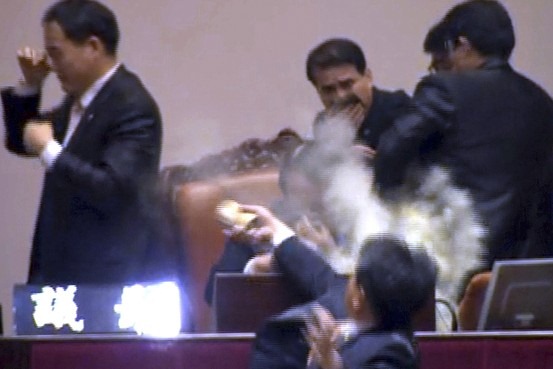
But the opposition tried to block with what must be a new tactic in the history of legislative rioting – tear gas! Wow. Who saw that coming? In my original post, you’ll see that I expected hair pulling and chair-throwing, but not this. As Otter would say, ‘it’s a new low.’ For all my disdain of the modern American right at home, I still can’t understand the SK left. The Democratic Party here strikes as me so unbelievably immature – leaving aside the DP’s inability to see NK as more threatening than the US to SK sovereignty, why would an obviously trade-dependent state like Korea, where the trade surplus is reported on religiously every month, reject an FTA? And what is with all the rioting? These brawls happen now at least once a year. (Read this on the Korean case for the FTA, which is much stronger than for the US.)
But still the video is pretty hysterical. Enjoy with your Thanksgiving turkey:
————————- ORIGINAL POST FROM YESTERDAY BELOW ————–
The opposition Democratic Party is getting ready to physically block the Korus FTA legislation from floor consideration in the National Assembly this week. Read this. Time to riot! Just check youtube in a few days for flying chairs, fire extinguishers, and hair-pulling. Awesome.
If you’ve never seen an Asian parliament riot, you’ve missed one of the great pleasures of life in Asia. The above is a nice vid, from South Korea. But the Taiwanese have the best ones. Rumor has it they have breathalyzer tests before the biggest Taiwanese debates. Hah! I love it. Just type ‘parliament fight south korea’ or ‘taiwan’ into youtube and watch them for awhile. They’re hysterical. Here are a few. For my speculation on why these ridiculously embarrassing meltdowns happen, read this.
And now We Killed Awlaki’s Son, again a US Citizen, again without Due Process…
In the last two weeks, I got pulled into another round of the endless debate on the role of US forces in Korea, so I missed this yet further depressing story of the US government flirting with extra-judicial, not-really-very-oversighted killings in the field of Americans.
I worried a few weeks ago that the killing over Alwaki, a US citizen, without due process, had crossed yet another, and to my mind, major civil liberties threshold in the history of the war on terror.
And here we are again. As usual, Greenwald has all the depressing details that we would all rather not discuss. Among other things, he was an American. He was only 16. He was killed by accident. The government first tried to spin the boy as an older AQ fighter, but the most basic journalistic digging uncovered that as bogus. Wow. This is just appalling.
We really need to have the moral courage to say this to our own government. (I thought this is why we voted for Obama?) I used to really support the GWoT, and I concur that Islamism is clear challenge to Western liberalism that we must defeat, but this is just awful. If the government can just do this to multiple US citizens abroad, then doesn’t that set a terrible, terrible precedent? So who is beyond the pale, and what is the process (please tell us!) for making these sort of ‘hit-list’ determinations? The government didn’t even apologize or admit any regret as far as I know – for an accidental killing of a US, teenaged citizen. This can’t just go on and on like this. There must be some limit.
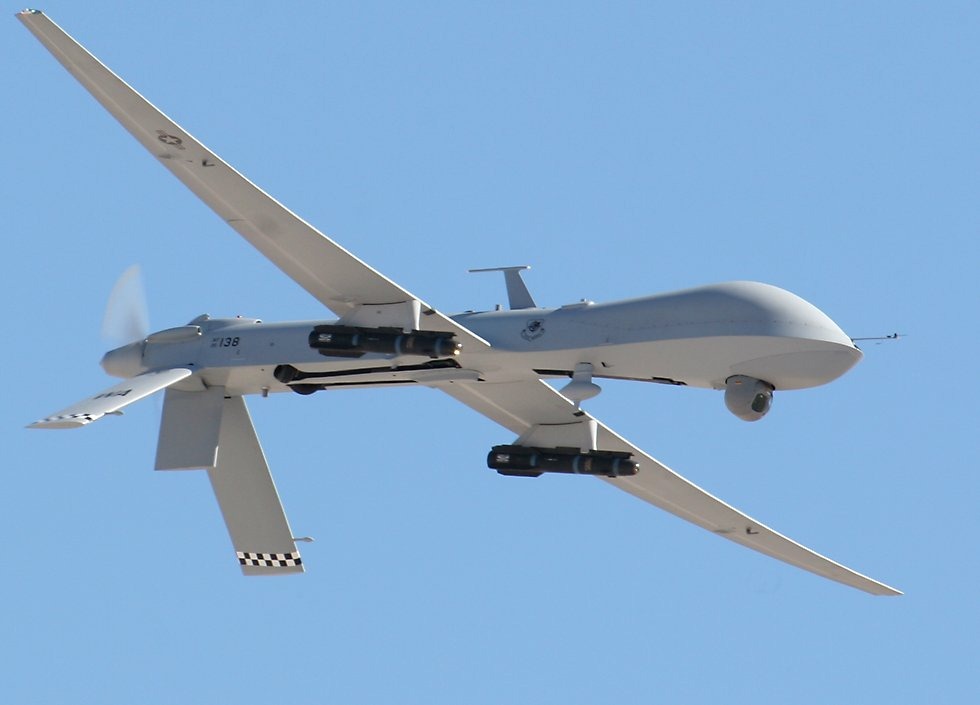
Note the problem is not the use of drones per se. Drones are simply a tool, and to the extent they limit the personal exposure of US forces, that is a good thing. However, it seem increasingly likely that, because drones limit US ‘transaction costs’ (i.e., the likelihood of US combat fatalities), drones tempt the administration to use forces in ways and places that would otherwise be politically impossible because of the possibility of US casualties. Unfortunately, this just reinforces the instincts of the imperial presidency unleashed by the war on terrorism. Certainly, the unregretted, accidental killing of a 16-year American should be proof of that.
Transformers 3 (1): “We will Kill them all in the name of Freedom” – Yikes!
“In the name of freedom, we will kill them all!”
– Optimus Prime (the protagonist in the clip above) updates the Bush Doctrine after a decade of war
Part 2 of this post is here.
I missed this over the summer, but the blu-ray just came out, and it’s a nasty, harsh, rah-rah militaristic mess. I won’t bother with the story. You already saw it and know how ridiculous it was. (Try here if you don’t.) I’ll only note that great actors like Malkovich, McDormand, Turturro, and Nemoy are complicit now in the militarization of American cinema, as is Buzz Aldrin (sooo embarrassing that was – wow). The Asian racism and gay jokes are a just as offensive (and painfully unfunny) as the black racism of the second one. And the new ‘Bay girl’ is even worse than Megan Fox, who at least had a grittiness. This one is just living plastic and skin-cream. Bay never misses a chance to promote emotionally debilitating lookism to young girls. (Even Bay’s female corpses must be hot. That must take a sexism award somewhere.)
No one captures the ups-and-downs for popular consumption of current American attitudes toward war as well as Michael Bay. Bay’s films obviously carry the moral weight and approval of the American Right. This is most clear when he guiltlessly references signature moments in US history like the collapse of the Trade Towers, the moon landing, or Challenger explosion. More leftish action directors like James Cameron or George Lucas would be relentlessly criticized were they to do that. Consider the Right’s response to Avatar and Star Wars III, compared to Transformers. But ‘America’s director,’ just like ‘America’s newsroom,’ can do this, because he is reliably nationalistic and pro-military. As Time put it, Bay has become the “CEO of Hollywood’s military-entertainment complex.”
As a result of Bay’s signature position as the filmic voice of the US populist-militarist right, no movies better capture the US emotional arc regarding the war on terror than his Transformers trilogy. As Americans have become more and more frustrated by an unwinnable war, more tolerant of brutality like torture, and less compromising, so has Bay. The films have become progressively more jingoistic, bitter, macho-sexist, and cruel. This is entertainment for the Tea-Party. In this most recent installment, there are even four battlefield-executions (!) in this Steven Spielberg (!) production based on a line of toys and aimed at young boys. But I guess that’s good stuff in the GOP primary these days.
The antagonists (the Decepticons) are nastier than usual, but the protagonists (the Autobots) are extraordinarily brutal for mainstream heroes, and Bay revels in it. The usual story about how the Decepticons are ‘evil’ is thrown in to provide a moral fig-leaf for the Autobots’ violence, but it’s a sham. Bay really wants to show us a vengeful bloodbath (the last hour), and here is where the Tea-Partier frustration and anger at the confusion over the GWoT’s course is most obvious. The film, like current the Tea Party-influenced GOP primary season, is filled with a deeply disturbing bloodlust for brutality. This is not a fun action film for the comfortable, amiable America of the 1990s (like Bay’s Armageddon). This is war carnage for a bitter America desensitized to vengeance and brutality after a decade of torture, confusion, wounded veterans, ‘ingratitude’ from Iraqis and Afghans at being ‘liberated,’ sky-rocketing costs, and global condemnation. T3 is wish-fulfillment for the people who hoo-rahed at OBL’s death: if only we could just go and kick the s— out of all them.
The Decepticons execute an Autobot made up to look like an old-man by shooting him in the back of the head. This came off so harsh, that a woman sitting next to me gasped and looked at her rather shocked boyfriend. When a Decepticon fighter crashes, the Autobots dismember the pilot alive to the jokingly-delivered line, ‘this is going to hurt.’ Holy c—! Sadism is hilarious? Kids are supposed to find that line humorous? At the end, Optimus Prime – remember, this is main good guy – kills one bad guy (Megatron), who had actually just assisted him, by hatcheting him unsuspectingly in the back of the head and them pulling out his entire brain stem, complete with arterial spray. Next the chief bad guy is dispatched after he is badly wounded and crawling on the ground begging for mercy. Nevertheless, Optimus Prime shot-guns him in the back at close range. Twice. And the camera lingers on his pained face as he’s being shot. Wow. WTH happened to Michael Bay (and Steven Spielberg)? Does Bay really expect us to endorse this kind of brutality as entertainment? Both antagonists are in morally compromised positions, yet the hero effectively executes them?! Are we supposed to cheer on the Autobots (allied with the US military in the film) when they brazenly disregard the rules of engagement (which makes liberal states’ use of force more trustworthy) and just execute people?
Cheering & Whistling for Executions: Republican Primary goes Talibanic
I try not to be too openly partisan on this website, but I worry a lot about the course of US conservatism, especially after 9/11 and because I am a registered Republican. And this was genuinely horrifying. Just watch. This is from the Republican primary debate on September 7 and should tell you why a vote for against the GOP is practically a moral requirement, at least until the Tea Party fury fades. Someone vote for Huntsman please…
The best piece I have seen on that debate is this. Also, from deep in the military-industrial complex comes this from a friend:
“After watching Wednesday’s GOP debate, I think Rick Perry will probably win the nomination. I think Mitt Romney is actually underrated as a general election candidate – he’s smart and he stays on message, he looks presidential, and I’m certain the Tea Party will give him wide latitude to moderate after the nomination if that’s what it takes to win the election. People say all the time that the Tea Party won’t support him – I disagree. They’re as hive-minded as the rest of the ‘conservative’ (i.e., radical reactionary) movement. They’ll line up behind any plausible candidate with an effective general election narrative regardless of past sins, if he or she demonstrates a present willingness to their bidding.
When it comes to the nomination, what Rick Perry says doesn’t matter as much as how he says it. I’ve never actually heard the guy talk before until the debate. I was expecting more rootin’, tootin’ Yosemite Sam unpredictability than Perry showed, and the left should be little nervous. The left’s ‘Bush-without-the-brains’ narrative for Perry isn’t going to hold. I think George Bush was slow and incurious and frequently kind of goofy, and he sounded like it when he talked. But the right loves decisive alpha males and Bush claimed to be one, even if as a manager he was weak, passive, and indecisive. But despite some stumbles (which will probably dissipate with experience) Perry doesn’t sound like a moron. I think he is a lot like Bush (I mean that in the worst possible way), but reading him from your gut, the guy projected decisive alpha-maleness without the moronic, verbal lost-in-the-woods dead ends and cliffhangers that afflicted Bush and made watching him speak such a nerve-wracking experience. (ed.: I love that last line.) And Rick Perry has none of Bush’s fundamental goofiness.
In the general election I think Perry’s attacks on Social Security as ponzi scheme will cost him but…maybe not. The line that those on or approaching SS have nothing to worry about may actually work. People our age really don’t believe SS will be there, and selfish, aging boomers will absolutely love the thought of pigging out on the remains of SS while it’s being eliminated for the rest of us. Tell the average narcissistic boomer that SS will be there for him, and screw the rest of us, and he’ll be perfectly satisfied with the arrangement. Younger voters probably won’t care or even bother to show up, and a lot of those who do see SS as a poor investment vehicle rather than as social insurance will welcome its “restructuring”. The proper Dem response should be, “Just wait – they’ll take it away from everybody the second they get the chance” and then let the GOP scramble to promise it won’t. But Dems are far too weak and inept to go on offense like that.
My prediction for the general: The analytical and fundamentally decent Obama is compelled to qualify and explain his thoughtfully crafted policy positions, vs. a Perry unrestrained by rational thought or character or policy ideas. In politics, any time you’re explaining anything you’ve already lost. Perry doesn’t explain himself, much like Bush, and both benefitted from this because it concealed the vacuity of their ideas.
Perry will lean forward, stay on offense, and lie without hesitation. Obama will stay on defense and complain about the lies and continue trying to prove how reasonable and decent he is, which swing voters don’t give two tosses about.
So I can see Perry pulling this off. Obama is superior and preferable in every way but the one that matters right now because of the nation’s current malaise – that gut feeling swing voters will have about who’s packing more testosterone. Dems never, ever learn that strut as important as policy to governing, and that policy has almost nothing to do with winning elections. There were hints in Obama’s jobs speech that he may shelve the tweedy jacket and start going on offense – which is great! – but that’s not naturally in his character.
With Perry, it is. There was a great shot of Perry grabbing Ron Paul by the arm and poking a finger in his face during one of the debate commercials. That’s the real Perry, and the GOP is in thrall to that kind of tough-guy strutting. Just look at the body language in those pictures! A lot of voters are going to love that.
BTW, I also thought the bloodlust on display with the applause over Perry’s 234 executions was repulsive and frightening, and his gosh-no response to the question about his discomfort over dishing out so much death (well deserved or not) could have been delivered just as easily by George Bush.”
For more GOP ‘cheering for death,’ came this from the second debate. What is with the bloolust?!
_________
NB: On a different point, East Asianists should not miss this from the ‘rising China’ debate.
9/11 a Decade later (2): Flirting with Empire
Part 1 of this post is here.
Terrorism is the weapon of the weak; terrifying your enemies is a lot less satisfying than actually defeating them. If OBL had an army, no doubt he would have invaded NYC. But terrorists have limited force, so much of their impact depends on how the target responds. Hence, in my previous 9/11 post I argued that the largest change came not from 9/11’s actual material impact, but from the US over-response. The most obvious elements of that would be the freedom-eroding homeland security clampdown, the badly misguided Iraq War, and the catastrophic budgetary consequences of a ‘military,’ rather than law-enforcement response to 9/11. Why GWoT (global war on terror) defenders and Bush partisans are so proud of that last claim strikes me as bizarre given the growing consensus that the GWoT has really lost it way and became much too expensive.
1. The idea that ‘9/11 changed everything’ was a self-fulfilling prophecy made so by America’s (specifically the Bush administration’s) reaction to it. It didn’t need to be this way. Ten year’s out now from 9/11 it should be apparent to everyone how little 9/11 actually changed, except for the changes that we wrought. The mantra ‘9/11 changed everything’ morphed into a blank check. It started as a defensible justification for an assertive foreign policy – on terror, in central Asia – plus better border control (long needed anyway because of out-of-control illegal immigration). But increasingly it turned into a fig leaf for something akin to a barracks state at home and semi-imperialism abroad – the Patriot Act, warrantless wiretaps, rendition, torture, indefinite detention, the Iraq War, exotic and probably illegal drone warfare, spiraling national security spending, etc.
Remember too that in the wake of 9/11 we were told relentlessly how vulnerable we were and how we should expect a progression of attacks against the US. No matter what you think of Michael Moore, he captures well the paranoia and wild over-speculation of this period in Fahrenheit 9/11. My favorite in the film is the Fox News report on pen-bombs. Did we really believe that sort of stuff in 2002ff? I remember teaching international security courses in those years with students writing endless papers about terrorist attacks on dams, bridges, ports, airports, even theme parks. I was at OSU, and we actually debated in class the economic impact on Ohio of barbed wire and armed guard patrols at King’s Island and Cedar Point. One student wrote that we should use nuclear weapons in Iraq; another that we should put SAMs on top of the Sears Tower in Chicago. I remember the students and I gaming out how easy it would be for a few terrorists to attack a shopping mall, based on the Columbine school assault and Sang-Hui Cho’s Virginia Tech massacre. My syllabi from that time describe terrorism as the ‘central national security threat to the US for a generation’ and approvingly cite Rumsfeld’s moniker, ‘the long war.’
Yet none of this happened. There was no wave of attacks. Muslim-Americans did not turn out to be a fifth column as loopy righties like Frank Gaffney or Rod Parsley insisted. For all the vulnerabilities – the easy-to-penetrate border with Mexico, the obese security guards at your local stadium, the hundreds of power plants with minimal security, the terrifying scenarios of 24 or Die Hard 4 – nothing like 9/11, no mega-terror, happened again. Yes, the Bush crowd will argue that that is because of the counter-measures put in place by the Bush administration, but there is no empirical evidence to support that statement and much missing evidence that demolishes it. Specifically, as I argued in the last post, 6M Americans live overseas – soft targets in expat clubs and bars all over the world that are easy targets of opportunity. Yet nothing happened to them. Nor have we yet seen any meaningful, independent study on serious plots foiled by DHS to actually verify that we needed the Iraq War, the Patriot Act, torture, Guantanamo, etc, in order to achieve reasonable security. Perfect security is impossible, and do we really want to try to torture our way to the ‘one percent doctrine’? As early as 2006, we knew this was overblown.
But the bureaucratic incentives for threat inflation are obvious. No one wants to say we can let our guard down, and then have the next attack happen on her watch. So we get one report after another about how we need to harden this or that part of American life; in the end we look likea garrison state. Here is a nice example of how even when a report finds little to worry about, the authors can still encourage more ‘vigilance,’ more money, and more hysteria. Does it even matter anymore to remind people once again that you are more likely to get hit by lightning than die in a terrorist incident?
2. The GWoT turned out to be a spectacular error that probably didn’t do much a far narrower and less hysterical counter-terror (CT) effort could have done. Fairly quickly it turned into a global counterinsurgency that CT advocates have bemoaned ever since as far too expensive, intrusive, and corroding of the US military. As the Atlantic notes, a lot of the martial, ‘kill-em-all,’ Jack Bauer posturing of the early GWoT days not only didn’t work, but in fact backfired. I agree with the conventional wisdom that Afghanistan was a war of necessity, and Iraq a war of choice. Early I supported both, but it is pretty obvious now that Iraq was not worth it. Far too many people died – mostly Iraqis who’d made no choice to be put in the firing line – to justify the modest improvements in Iraqi governance. On top of that, the US military got badly run-down, America’s global image cratered, and the country went bankrupt.
There is no doubt that Iraq is a better place, but the US forced this on Iraq (unlike in Libya), and we did so in such an inept way (‘fiasco’) that our staggering mis-execution of the whole operation invalidates the arguably defensible principle behind the war. That is, the basic neo-con idea that the Middle East needed a hammer strike to break up the horrible nexus of authoritarianism, religious medievalism, terrorism, oil corruption and social alienation that gave birth to 9/11 is actually a good argument. It may be true, and certainly looked that way ten years ago, long before Arab Spring. So I don’t buy any of this ‘neo-con cabal, they did it for Israel’ schtick. This was supposed to be a demonstration strike against the Arabs to warn them that their local pathologies were morphing into global problems and would no longer be tolerated by the West.
But the execution of that hammer strike in the heart of a dysfunctional ME was so awful, so catastrophically badly managed, that it invalidated the whole premise by suggesting the US is simply incapable of acting properly on that otherwise arguable neo-con logic. And the rhetoric surrounding it, particularly the wild hype of WMD ‘mushroom clouds’ and then Bush’s grandiosely frightening second inaugural, made the US look like a liar and then a revisionist imperialist. This is why I supported the Iraq war until around 2007/08, at which point it became painfully obvious that we had no idea what we were doing there – despite the good arguments for the war – and that hundreds of thousands of innocent Iraqis were paying their price of our incompetence. (This is yet another reason why my support of the Libya R2P operation has never endorsed ground forces; it’s just not something we can do.) On of all that, we were morphing into a semi-empire under the globalist pressure of neoconservatism, so a vote for Obama became a necessity.
3. Finally, the GWoT has become ridiculously, astonishingly expensive. This sounds callous, of course. As we remember 9/11, we feel that we should do anything we can to kick these people in the head, and I am as glad as anyone that OBL is dead. But of course there are opportunity costs; there must be. That is how scarce resources, i.e. everyday life, work. The GWoT has contributed substantially to the US budget crisis, which will, connecting the relevant dots in the GOP’s preferred language, leave us ‘less safe’ in the future because we can’t spend the money we may need on security later on. Stiglitz has famously argued that the Iraq conflict will total around $3T when it’s all over. Worse, the Bush administration borrowed to pay for it, and actually cut taxes just as the GWoT’s costs began to spiral. This is inexcusable, and has substantially accelerated the global power shift from the US to China, because it is China that funds much of the US’ debt. By 2020, I guess most Americans will regret that we ever launched the GWoT and chose a ‘military’ path, instead of learning from Britain’s CT struggle with the IRA or Israel’s (earlier) quiet ‘sub-war’ response to Arab terror. It didn’t have to be this way…
Here is part one if you missed it.
My Expatriate Tax Day Horror Story: Expats Can’t E-File! Hah! – 2011 UPDATE
Writing about Libya so much can be depressing (although if you haven’t read this yet, you really need to). So here is a bit of humor for a change. In 2.5 years of blooging, this re-posted entry below has proven to be one of my most read links. So on this tax day, when you are suffering from repeated robo-rejections from the hideous, dysfunctional, infuriating IRS e-submission system, I sympathize. The ‘error codes’ absolutely make my blood boil. They’re a perfect instance of eveything we hate in government – haughty, soulless, uninformative, disinterested, time-consuming – it’s like a federal, e-version of going to the DMV. Here is a brief 2011 update (I still couldn’t e-file myself):
a. I think I know how the IRS will fill the massive US budget hole – taxing foreign spouses! Hah! What a great gimmick! Yes, Uncle Sam is so rapacious and desperate for cash now that my wife, with no US address, income, citizenship, property, or assets of any kind, still needs to file a 1040. Can you imagine being a foreigner and reading the 1040, much less the guidebook for it, and understanding your obligations when you sign it? That’s just laughably surreal. Most Americans can’t make heads or tails of it. Good lord….Ridiculous.
b. Despite falling under the foreign earned income tax exclusion and having no US accounts, income, etc., I still couldn’t figure out the form tangle and had to fall back yet again on a tax-preparer, even though I am not supposed to even pay US taxes(!). Such a simple process failure just screams tax reform, which both Obama and Ryan thankfully seem to support. Paying $200 a third party in order to not pay the first party has ‘disintermediation’ wirtten all over it.
——– REPOSTED FROM TAX DAY 2010 —————
Most people loathe the Internal Revenue Service (IRS) for the wrong reason. We all need to pay taxes. Taxes are, as the IRS’ building declares, the price of civilization. And that’s true. If you like roads, bridges, ports, military security…basically any public good you can think of, then we need the IRS.
The real reasons you should resent the IRS are actually reasons to loathe Congress. Recall that Congress makes the tax law. Those reasons are:
1. Philosophical: Democratic theory demands that laws be understandable and hence ‘follow-able’ by the general public. You know the speed limit, because you see the road signs and you passed a driving test that insures you can read the road signs. Even if you break minor laws – jay-walking, e.g. – you still know that you are cheating and that you are culpable. The problem with the IRS/tax code is that it is NOT understandable. In fact the tax code is so indecipherable that a staggering 89% of Americans must hire a third party to do it for them. So the tax code fails a basic democracy test: can the general populace know and follow the law as ‘regular Joe’ citizens? Clearly not.
2. Pragmatic: The IRS is absolutely awful at the implementation of the tax code. The forms are long, abstruse, and unreadable. Look at the length of just the directions book for the basic 1040 form. 175 pages! Wth is gonna read all that lawyer-y, jargon-y c—? Well, no one of course. So 9 out of 10 of us pay a transaction fee to have someone else obey the law on our behalf.
Ah, but you say, ‘Kelly, you don’t live in the US, you have no fancy stock portfolio, and you have a low paying academic job (hah!), so doing your taxes can’t be that hard for you.’ *Sigh* You’d think so, but even expats must get a tax attorney. I don’t know one American in Korea who does his taxes himself. Imagine that: how awful is the tax code when I still can’t do my taxes myself, despite a foreign residence and no US income at all?!
Below is the cut-and-paste of the IRS’ soulless-robotic rejection of my effort at e-filing. Note ‘error codes’ – a nice faceless government term sure to enrage the tea-partiers even more – 0022 and 0016. Hah! How can I provide a US state and zip, when I don’t live in the US! LOL.
Think about that. The most obvious constituency to efile – expatriates – can’t, because the IRS computer program refuses to accept foreign addresses on the 1040. And yes, even my tax attorney in the US couldn’t make it work. She had to email me the return, which I then had to snail-mail back to the IRS in the US. :))
On top of that, I could not use the EZ forms. I had to use the complete ones…
You gotta love the government. If you ran a business this way, you’d have been eliminated long ago.
Dear Free File Taxpayer: #2
The IRS has rejected your federal return. This means that your return has not been filed.
Here’s the reason for the rejection:
Error Code 0010: This is a general reject condition relating to the data that is in the Form and Field indicated.
Error Code 0022: The state abbreviation is invalid. The state abbreviation must meet these conditions to be valid: the state abbreviation must be consistent with the standard state abbreviations issued by the Post Office; and the state abbreviation cannot be blank, it must be entered.
Error Code 0016: The ZIP code is invalid. The ZIP code must meet these conditions to be valid: must be within the valid range for that state; cannot end with ’00’ with the exception of 20500 (the White House ZIP code); must be in this format ‘nnnnn-nnnn’ or ‘nnnnn’; and the ZIP code cannot be blank, it must be entered.
Error Code 0457: On Form 2555, the total of max. housing and foreign earned income exclusions (Line 43) from all Forms 2555 must equal housing/foreign earned income exclusion amount on the Other Income Statement (Line 21) multiplied by negative 1 (x-1).
Error Code 0463: On Form 2555 or 2555EZ, Taxpayer foreign street address and city must be completed. Country Code must have an entry with a country code.
Next steps:
Sign into your Free File return at www.freefilefillableforms.com/FFA/FreeFileForms.htm to fix this problem and e-file again, or print the return to file by mail.
You can get more information about handling rejected returns in the FAQs found at https://www.freefilefillableforms.com/FFA/FAQ.htm)
To track your return status, go to https://www.freefilefillableforms.com/FFA/CheckStatus.htm
This email was generated from an automatic system, which is not monitored for responses.
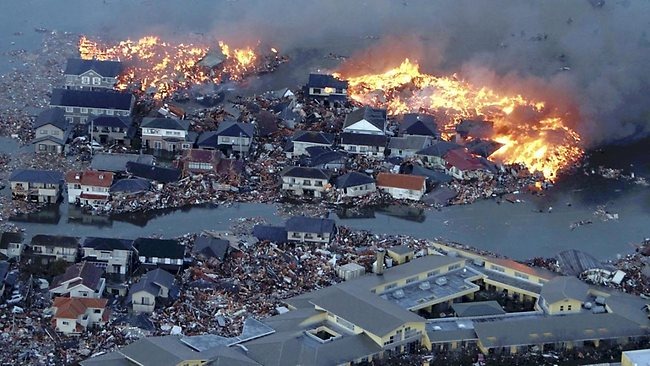
What the Japan Tsunami Tells Us about International Politics
For as awful as natural disasters are, they also act as lightning flashes to illuminate the hidden landscape of states’ weaknesses and capabilities. As ‘acts of god,’ natural disasters represent a uniquely blameless test of state seriousness and capacity (and of genuine international solidarity). Unlike man-made catastrophes such as 9/11 or Srebrenica, this cannot be blame on foreign machinations, ignored/manipulated for political calculations, or otherwise geopolitically spun. Not even Koreans, who are arguably the people most alienated from the Japanese on the planet, are ‘happy’ about this or calling it retribution or anything like that.
So this earthquake was a major test of the response capacity of the Japanese state (and of the functioning of global governance on things like nuclear-oversight or disaster-relief assistance), and we can honestly say that Japan has performed remarkably well. The quake was an staggering 9.0 on a 10 point scale (the Richter scale), and news reports are calling this the worst quake in Japan’s history. Yet the death-toll is still under 5000. Despite the sadness of these deaths, we should recognize how astonishingly low that is and credit that directly to the seriousness and functionality of the Japanese state. Events like this cast into extreme clarity: the difference between the ‘First World’ and the rest; why, for all the talk about the ‘second world rising,’ places like South Asia, the Middle East, Africa, Latin America, and even China, have a such long way to go, and why they export, not import, people; and just how badly governed so much of the world really is, and how that dysfunction borders on criminal negligence when really serious disaster strikes. Remember how many people died in far less powerful events in Pakistan or Haiti recently.This is not meant to be OECD triumphalism, but yet another wake-up call regarding the atrocious government of far too many places. Japan should make Haitian and Pakistani elites hang their heads in shame.
Here are a few applaudable illustrations of truly serious, responsible government:
1. Japan called International Atomic Energy Agency immediately after the earthquake about its nuclear reactors. It has cooperated properly and publicly with IAEA. It has noted the problems in the media, while responding properly with cautions where necessary. This is what real governments, who actual govern rather than tyrannize, pilfer, or exploit, do. Imagine how Iran or NK, or maybe even China and India, – all hyper-nationalist, corrupt governments with super-secret nuclear programs – would have responded. They would have told no one until the questions became unbearable. Conspiracy theories about outside intervention would have been floated. IAEA regulations would have been openly rejected as a pretext for western espionage, etc. The consequence would be a re-run of the post-Chernobyl hysteria, because no one knew the details or trusted the source. By contrast, Japan did its duty, and the world trusts them. Well done.
2 Japanese emergency responders got out there quickly. Within a few hours, bulldozers were already on scene. Just like the rapid New Zealand response a few weeks ago, this was a good demonstration of what political science calls state capacity. The Japanese state is not faux-structure on paperthat really exists to serve some megalomaniac ‘president-for-life’ like Gadhafi. It is highly modern, efficient, rational, focused entity that can fairly rapidly process information, redirect resources, and otherwise flexibly respond to shocks. Given the 9.0 Richter measure, I am amazed how rapidly and coherently Japan is responding. Had this happened in Cambodia or Mozambique, the entire state might have collapsed. Even the Americans really blew it on the far-less-catastrophic Hurricane Katrina. Again, well done.
3. The Japanese trained a lot for this and are a disciplined, serious, but not therefore terrorized, population. What most strikes me about the videos coming out of this is just how calm everyone seems. The CNN reporters in the first few hours seemed almost desperate to find scenes of hysteria – one guy saying on a cell-vid, ‘the building is going to collapse!’, got re-played again and again. By contrast, look at the American response to 2003 power outage in northeast; people treated it like the apocalypse. Or far worse, look at how the NK state has ‘disciplined’ its people to “arduously march” through its recurrent famines, or how the USSR militarized its entire population and economy to fight WWIII. If the Department of Homeland Security (DHS) in the US actually did its job, this is how Americans would respond to terror alerts, instead of neuroses about duck tape and safe rooms. Japan has just shown the US how intelligent grown-ups respond to real threats. We could only dream that DHS was so professional.
4. Japan didn’t blame this on God’s unhappiness about abortion, gays, or modern decadence; Mossad, the United States, China, Korea, etc, ad nauseaum. Again, try to imagine how NK would have responded: a US-SK-Jpn plot to control the earth’s crust!; or the Taliban: it’s Allah’s punishment for not beating our women harder; or Fox News: Jesus’ response to gays in the military. Don’t believe me? Jerry Falwell blamed US homosexuals for 9/11, or read this about how Israeli intelligence is responsible for shark attacks in Egypt – because, you know, Spielberg is a Jew and directed Jaws... Despite huge destruction, Japan’s response to the massive event has been serious, normal, and measured. Hear, hear.
5. Japan prepared for this by listening to scientists and experts and not just blowing the money on pork for reelection, or just conveniently forgetting about legislative hearings that demonstrated real threats. America is once again an instructive counter-example (*sigh*, wouldn’t it be nice if we could get this stuff right?). Post-Katrina, we all found out how much the New Orleans and Louisiana had been warned. Mayor Nagin was a balloon head with absolutely no idea what to do, despite governing a coastal city eight feet below sea-level (!) with known exposure to hurricanes – which is obviously why he got re-elected – wth!?, but then W got re-elected post-Iraq… Anyway, then came heckuva-job-Brownie. Or how about the audits of DHS which show that homeland security money still follows legislative pork not appraised terror threats? This sort of stuff should tell you why the far less powerful Katrina Hurricane lead to the travesty at the Superdome, while Japan is pushing through with minimal panic. Serious people from a focused government spent big money on empirically demonstrated problems. I guess we forgot that in the war on terror.
Japan just showed how serious, professional, responsible, secular government can construct a real, responsive state apparatus that can help citizens in even very extreme circumstances and genuinely resolves serious collective action and public goods problems. Superb. Truly remarkable. In the midst of this tragedy, we should be in awe of the world-class response. This is a real ‘all-hazard’ response. The world – and especially DHS! – should take note.
If you want to donate to assist Japanese recovery, go here.
_________
WACK-JOB ADDENDUM: At least one nutter has come out to proclaim this the Lord’s vengeance for those heathen Shintoists. I’m sure somewhere Pat Robertson is unhappy that he missed this chance. Appalling.