Would it just be Easier to Pay-Off our Middle Eastern Opponents?

generation-kill

I recently watched Generation Kill, the HBO miniseries on the invasion of Iraq. It is quite good, particularly on the huge uncertainty generated by the fog of war, and the consequent overuse of violence to protect oneself from that uncertainty. At one point in the miniseries, a town is being hit by Tomahawk cruise missiles, and a soldier makes the interesting remark that with all the money put into just a few of those Tomahawks, they probably could have just bought off the local Fedayeen or Republican Guard units, or bought off enough locals to kill or arrest them. It is an interesting notion, and once I can’t say has ever received scholarly treatment in IR or strategic theory. Here is another good master’s thesis waiting to be written.

Instead of killing these people, can we just throw money at them? Fred Kaplan asks this question, and so does Michael Semple. Both are dubious. But I am not so sure, especially given the huge costs of Westerners trying to coerce the Taliban, ex-Baathists, and other various alienated Muslim/Arab elements around the Middle East. The obvious retort is that money does not buy allegiance, only temporary quiet. Money does not ensure ideological affinity or loyalty; it does not make its recipient a liberal committed to the democratic processes or central governments of Iraq, Afghanistan, Pakistan, Yemen, Somalia, etc. This is so, but consider the following counterpoints:

1. The US military, as the soldiers in Generation Kill pointed out, is an extremely expensive machine. The just-released 2011 US defense budget is $700+B. That is a staggering sum of money. The cost of using such an expensive force is high too. US equipment is super-expensive, given increasing computerization and integration (the ‘networked battlefield’). It will cost another mint to replace and bring back up to par US military stocks around the world when the GWoT ends (someday, we hope). What the US military spends in the GWoT every day certainly out-costs what bribery would cost by at least an order of magnitude (billions vs millions).

2. Shooting people instead of buying them has huge costs too. As we have learned by now, we are never going to kill every terrorist on the planet. We cannot kill our way to victory. Worse, in tribalized cultures like the ME, for every person we kill, there is a brother, son, uncle, friend who gets pulled into a blood oath to avenge that death. We have created spirals of ‘accidental guerillas’ through less-than-ideal discrimination in the use of force (another point Generation Kill demonstrates very well). Every unnecessary or partially necessary combat fatality creates a high possibility of more and more irregular combatants joining up for revenge. We might stanch the inflow of new recruits if we kill fewer and buy off more. Indeed, many people, Kaplan included, have noted that funding the Sunni gunmen to fight against al Qaeda in Iraq was the turning point in Iraq, not Bush’s surge. We also used bags of money in in Afghanistan in late 2001. So there is some evidence that this might work.

3. Isn’t paying off people morally superior to coercing, much less shooting, them? I am aware of course that the die-hards of al Qaeda and other Salafist groups cannot be bought. But there are many others who might be ‘buyable.’  I think a morally superior use of American power would be to purchase their temporary quietude than to hunt them.

4. You might object that simply buying them just delays the fighting. When the money drys up, then they will go back into the bush. Maybe, but

A) Buying them off, even temporarily, buys the government time to reach out and reconcile them. It gives exactly the ‘breather’ to the Iraqi or Afghan central government that Bush claimed they needed to get on their feet. But instead of the US military coercing a pause in violence, the dollars buy it. But in the end, the effect is the same. And if the Iraqi or Afghan governments can’t use that pause to get their acts together, then no amount of US killing will help them in the medium-term. Whether you choose policing/coercing or buying, you still get the same outcome (the pause), which our ME client-friends must then use (but they will likely squander).

B) Buying them indefinitely is still probably cheaper than a medium- to long-term US commitment, like the new Afghan surge Obama just announced in December. Everyone seems terrified that the US will be in the Middle East for decades, as it is in Germany, Korea, and Japan. Ok, so instead of hotly disputed withdrawal deadlines – which get flim-flammed anyway by ‘conditions on the ground’ which warrant that trainers, pilots,  the CIA, etc. to stay behind after the withdrawal date – why not substitute pay-offs for awhile? I realize it is hardly ideal. It’s US-funded local graft. But consider the alternative.

These are just some initial thoughts. As I said, this is a wholly under-researched question, probably because it feels morally uncomfortable, shady, or sleazy. It reeks of corruption. And it surely does, but given the alternatives, particularly the use of US force, I think the moral equation is overbalanced in its favor actually. But this needs more serious investigation.

Why Does North Korea Ritualistically Provoke South Korea?

_47192629_n_s_korea_nl_226

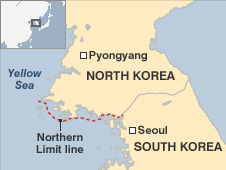
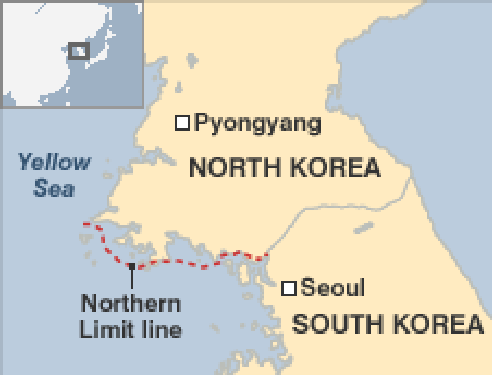
In the last few weeks, North Korea once again threw out a wild, unpredicted military tantrum. Now it has decided to start shelling the weakly agreed-upon sea border, the Northern Line Limit, in the Yellow Sea. For the details, try here or read my radio transcript below.

Less interesting than the details of the latest provocation – these things are terribly formulaic, to the point of ritual – is the IR theory question why. As I note in the transcript below, these gimmicks never work. In fact they usually backfire. Instead of frightening the SK citizenry or elites, these incidents usually stiffen the spine, because they look like bullying, and fairly crude at that. Further, NK truculence always serves to re-gel any possible rifts between SK, the US and Japan. In the same way that the Soviet invasion of Afghanistan reenergized NATO after the ‘alliance politics’ of the 70s, NK provocations routinely evince thicker and more explicit commitments by the US to defend SK.

Assuming the North Koreans aren’t stupid, the obvious question is why? I can think of two reasons, with a hat-tip on number 2 to Bryan Myers of Dongseo University in Busan, with whom I have discussed this at length. As always, this is a good IR master’s thesis-in-waiting.

1. Kim Jong Il is not fully in control of the NK military (the KPA) anymore.

This would not be a great surprise to anyone. Dictatorships are almost always heavily reliant on the military, and North Korea more than most. Indeed, it is hard to think of many truly civilian dictatorships. Most communist dictatorships slide into militarism, and even the Islamic semi-dictatorships of the Middle East usually have deep roots in the military. In the case of NK, this is even more extreme. When Kim the elder passed, so did communist party/civilian rule. Kim the younger immediately began placating the military as a means to neutralize the greatest threat to his shaky authority. In the mid-90s, NK declared a ‘military-first’ policy, whereby the military would have first claim on national resources. In the current NK constitution, Kim Jong Il rules as the chairman of the National Defense Committee, not as the civilian president. So extreme has this militarization become, that Bryan calls the DPRK a ‘national defense state,’ not a stalinist one.

So in such an environment, it is not hard to imagine the KPA high brass insisting on regular displays of their cool toys as means of justifying their insanely large budget, and otherwise trying to impress everyone, Kim Jong Il included, of the KPA’s inordinate influence over peninsular affairs.


2. NK faces a permanent legitimacy crisis which must be regularly ‘abated’ through external confrontation.

Clandestine traffic from China over the Yalu river has introduced far greater awareness of the wider world to North Koreans over the last 15 years. It was the non-response of the regime to the late 90s famine that drove the  Chinese connection originally, and now cell phones and VHS have illicitly gotten in. Indeed, the regime has lost so much of its information control, that is longer tries to claim that it is wealthier than SK. So if East Germany collapsed, if it gave up after 45 years of trying (and failing), why does NK hang on? How does NK legitimize itself when a prosperous, happier Korean national analogue is right next door?

By claiming that SK is an American colony and/or subject to ongoing Japanese control. Hence Myer’s description of NK as a ‘national defense state.’ It is defending the nation, where SK has sold out. To maintain this narrative however, regular tensions with the South, the US and Japan are necessary. Hence outbursts like last November’s North-South naval clash in the Yellow Sea, and now this artillery barrage.

The most gloomy part of this logic is that it predicts that NK will never surrender its nukes, and that it will continue to regularly, indeed, ritualistically, provoke SK.

_________________________________________________________________

TRANSCRIPT – DR. ROBERT E. KELLY, PUSAN NATIONAL UNIVERSITY

BUSAN E-FM: “MORNING WAVE”

MONDAYS, 8 AM

February 8, 2010

Professor Kelly comes to us each Monday to talk about big issues in Korean foreign affairs. And this week we are going to discuss North Korea’s recent artillery firing into the East Sea. Hi, Dr. Kelly.

REK:

Hi, Petra. Thanks for having me

Petra:

Thanks for being with us again today.

REK:

It’s my pleasure.

Petra:

So in the last few weeks, the North Korean military fired artillery shells into the East Sea. Why? What purpose does this serve?

REK:

Well, as usual, the North Korea government gave us no clear reasoning about this. The stated purpose was practice firing, but no one believes that. More likely, is saber rattling in the current North-South negotiations over pay at the Kaesong industrial park. If the artillery fire scares the South somewhat, perhaps it will make a better deal with the North over the salaries at Kaesong.

Petra:

That seems like a fairly crude negotiating stratagem.

REK:

Yes, it is. This sort of military posturing is a commonplace from North Korea. Far more interesting is that it does not really work, yet the North keeps doing it.

Petra:

Why doesn’t it work?

REK:

Well, the South Korean government and citizenry are simply inured to this now. For decades the North has acted like this to extract better deals from the South, but the South has never really given in to this. Southerners are just use to this by now, and they ignore it. Indeed, one can read the North’s nuclear program the same way. It is an elaborate and expensive tool for North Korea to club South Korea, the US and Japan into giving more aid.

Petra:

But this doesn’t work well…

REK:

No not really. The response of South Korea, and by extension Japan and the US, to these sorts of provocations is to stand firm and in fact to stand more closely together. In this way, it is rather foolish. Every time NK tries to bully South Korea and its allies, it backfires. It causes the opposite response. So Robert Gates, the US Secretary of Defense, pledged last year, the most public commitment ever that the US will use nuclear force to protect South Korea, because last year, the North’s rhetoric and behavior was so aggressive.

Remember too, that when South Korea has reached out to North Korea, it has been because of internal change in South Korea; that is, South Koreans the voted for left-leaning Presidents Kim and Roh, and they tried the sunshine policy. If North Korea really wants South Korea to help, you would think they would want to facilitate the election of more such presidents. But events like last week’s artillery barrage serve the opposite. They justify the hawkish, conservative vision of North Korea of the current Lee administration.

Petra:

So why do they do it then?

REK:

Good question. I have two educated guesses on this. First, the civilian government in North Korea can’t fully control the military. Second, these sorts of provocations of the South serve internal North Korean political purposes.

Petra:

Can you explain that a little more?

REK:

Sure. In the last 15 years, the North Korean military has increasingly dominated the government as a whole. The declaration of the ‘military first’ song-gun policy was the end of communism or Stalinism in North Korea, and the most obvious marker that North Korea was evolving into a military dictatorship. Recall that Kim Jong-Il’s title in the North Korean constitution is the Chairman of the National Defense Committee, not president. Kim Il-Sung is the eternal president of North Korea. Kim the younger rules from a military post. So it seems possible that the military was free-lancing last week with these artillery tests. Making trouble like this in inter-Korean relations is a good way for the military to make known its authority over North Korea.

Petra:

Ok. You also suggested there might be a domestic political purpose.

REK:

Yes. The regime suffers from a permanent legitimacy crisis. South Korea is wealthier, healthier, happier, etc. Most North Koreans have learned this in the last 20 years from information filtering in from China. The regime can no longer hide how far behind it is in the inter-Korean race. So an obvious question for any North Korean, is why North Korea still exists, long after the Soviet Union and East Germany are gone.

The regime’s answer to that problem is to manufacture a regular series of external crises. So long as the US, South Korea, and Japan are implacable foes intent on destroying North Korea, then the government can justify to its own people why it persists. This is why things like the artillery shelling last week or the naval skirmish last year in the same area, happen. The North cannot ‘win’ these sorts of stand-offs, but they do serve a domestic political need.

Petra:

So what is it about the East Sea that creates these sorts of problems so much anyway?

REK:

Good question. The East Sea, or in its international title, the Yellow Sea, is a good place for such North Korean shows, because the border there is so imprecise. After the Korean war, there was no formal border commission, on either land or sea. Remember that the war didn’t really cease, it just stopped temporarily. As we all know, this temporary border on land hardened into the demilitarized zone. But on land that was easy insofar as one could easily see where the battle lines between North and South were.

Petra:

But on the seas, no one really knew.

REK:

That’s right. It was just wide open. So the US and South Korea simply declared a de facto border that we call the Northern Limit Line. And in fact, it is drawn awfully close to North Korean islands. When we drew the line, it basically cut north immediately from land. It does, arguably, discriminate against North Korea. One can understand why the North rejects. But it also reflected the balance of seapower in the area in 1953. The US navy controlled the Yellow Sea, so the NLL also correctly reflects the geopolitical realities from the time. It is also worth mentioning that there is a annual crab harvest in the area. So every year, fishing boats from either side wander over the line. All in all, it is a messy, disputed area, so it is ideal for North Korean provocations whenever one is needed.

Petra:

So we should expect more of these sorts of provocations and clashes?

REK:

Yes, I think so. The NLL area is ripe for miscommunication, especially given the fishing traffic. Serious naval clashes have happened there three times in the past. Last November was the most recent. North Korea claimed that last week’s shelling was an annual exercise, so we might expect it again next spring. But honestly, I cannot recall that something like this happened last year, so I am not sure how ‘annual’ it really is. As so often with North Korea, it is murky. But I think you are right that we can expect fairly regular low-level conflict there indefinitely.

Petra:

Ok. Sounds gloomy. Thanks again for coming professor. We’ll see you again next week.

Korea’s Post-American Alliance Choices (1): India?

200x


This will be an occasional series. The US is entering a period of decline. Its ability and willingness to meet its alliance commitment to South Korea is waning. So Korea is, quietly, beginning to poke around in Asia. It is setting up preferential trade areas where possible, signing up whomever it can for ‘strategic partnerships,’ and generally branching out in the region. This serves both its desire to be a more regional player (rather than be permanently trapped in its peninsular ghetto with NK) and its growing need for friends beyond the US. The US has neither the money nor the domestic will to fight another Korean war. So it makes sense for Korea to look around, even if no one will admit that that is what it is doing.

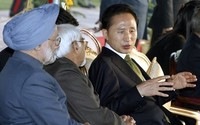
On Monday, I spoke on the radio about this. Last week, the president of Korea had a state visit to India. India is a good choice for several reasons. Like Korea, India is

1. a liberal democracy with a lot of religious diversity.

2. worried about China’s rise.

3. an American ally.

4. Bonus: India is not Japan.

While more common than in the past, stable democracy is still hard to find in Asia. It makes sense for Korea and India to hang together. Of course, the closest democracy to Korea is Japan, but the mutual loathing is so severe, that Japan is a last ditch alliance choice for Korea. Further, both have a good tradition of internal tolerance based on their religious diversity. Everyone knows of India’s of course, but Korea too is one of the most religious fragmented states in Asia (sizeable minorities of Catholics, Buddhists, born-again protestants, and agnostics, with no dominant bloc).

This commonality of values is complemented by a commonality of interests, or rather an interest: China. Both are edgy about its quick rise (no surprise there), and both continue to hedge it and ally with the US in order to do so.

The downsides though are high. India is far away. It does not have the two-ocean fleet necessary to project serious power into Northeast Asia, and it is still losing the race with China.

__________________________________________________________________

TRANSCRIPT – DR. ROBERT E. KELLY, PUSAN NATIONAL UNIVERSITY

BUSAN E-FM: “MORNING WAVE”

MONDAYS, 8 AM

February 1, 2010

Petra:

So President Lee went off to India last week. What happened? Why is this important?

REK:

Two reasons. First, Korean has a trade relationship with India. Second, Korea is slowly poking around Asia for other friends and possible partners.

Petra:

Ok. Is Korea’s trade with India significant?

REK:

Middling. Korea is India’s 9th biggest trading partner. That is ok. But there are 1.3 billion Indians, and they are getting wealthier. So it makes sense for Korea to try to push into this market. This is similar to the growth of China. As China and India both develop and get wealthier, their huge internal markets will attract interest from around the world.

Petra:

So if this was basically a trade mission, why did President Lee go?

REK:

Well, it was more than that. President Lee was a guest of honor for India’s big national holiday. It was an official state visit. Such trips fit President Lee’s style of diplomacy. First, the president has increasingly used his position to act as a salesman for Korea industry. You may recall his earlier bout of commercial diplomacy in the United Arab Emirates regarding Korean-designed nuclear power plants. Second, the pursuit of trade agreements has grown into a major Korean foreign policy tool in the last decade or two.

Petra:

Can you explain that a little more?

REK:

Sure. The bedrock of Korean foreign policy is the security alliance with the United States. But increasingly Korea has looked for an autonomous economic foreign policy. And Korea’s chosen manner of reaching out, especially in Asia, is trade deals. Korea has sought all sorts of preferential and free trade areas, and President Lee has made this a regular focus of his trips abroad.

Petra:

Has it been successful? I thought Korea belonged to the World Trade Organization which organizes global trade rules.

REK:

That’s true. But the WTO is stuck right now. The current round of trade negotiation, begun in Doha in Qatar in the Middle East, has been bogged down for years. With the Doha round frozen, Korea has turned to bilateral and regional trade deals in its foreign policy. This trip to India, as well as the recent sale of nuclear reactors in the Middle East is a part of this process.

Petra:

So the WTO is stuck, and President Lee is trying to push Korean exports on his own on these trips?

REK:

Yes, that’s right. In international relations, we call this commercial diplomacy, and President Lee is getting quite good at it. The big prize, an FTA with the US, is still out of reach though.

Petra:

Ok. Let’s stay with India. You said something about Korea looking for other friends and partners. What does that mean?

REK:

Well Korea is a tight neighborhood. It is surrounded by three big countries – Russia, Japan, and China – who have traditionally bullied or informally dominated the Korean peninsula. Korea’s political geography, or geopolitics, is quite poor; it is encircled. This is the great benefit of the US alliance. The US is too far away from Korea to dominate it, but the US alliance does help Korea prevent itself from being dominated by others. As long as US troops are in Korea, Korea can push back any encroachment by China, Japan or Russia.

Petra:

So what does this have to do with India?

REK:

Well, the US is in trouble now. The US deficit is gigantic. The US public debt is too. The US is fighting two hot wars in the Middle East, and several clandestine conflicts there as well. It is eight and a half years now since 9/11, and Americans are exhausted with all these wars and conflict.

Petra:

Does that include Korea?

REK:

Not really, but Americans certainly don’t want to get pulled into a big conflict here. As most Koreans know, the US military footprint in Korea is shrinking, and the US will officially relinquish wartime authority of the Korean military in 2012. In short, the US is increasingly looking for ways to lower the costs of the Korean alliance.

Petra:

So Korea is shopping for other friends?

REK:

Probably, quietly. I certainly would be. The US looks at Korea, and it sees a wealthy modern country that it believes should be able to defend itself without much US assistance. So Korea is wise to begin to think about friends and possible allies beyond simply the US.

Petra:

So can India be an ally to Korea?

REK:

Maybe. India has some definitely upsides for Korea. Like Korea, India is a democracy. Democracy in Asia is still somewhat rare, so Indo-Korean cooperation on security makes good sense. India also worries a lot about China’s rapid growth. India has an ongoing border dispute with China, much as the two Koreas and China do over the ancient Koguryeo role’s in history. So there is a community of values between India and Korea – liberalism, democracy, religious tolerance – as well as a community of interests – careful observation and response to China’s rise. Finally, both Korea and India are American allies.

Petra:

So how is the Korean government proceeding?

REK:

Well President Lee and the Indian prime minister agreed to upgrade Indo-Korean ties to a ‘strategic partnership.’ That implies that the two see each other as more than just trading partners or friends. President Lee pursued the same approach with US President Obama in the summer 2009. But for observers, it is hard to know the details of this new partnership. There will be regular meetings between officials of the two countries’ ministries, but it is hard to know how serious this will be.

Petra:

So there is no Indo-Korean alliance in the offing?

REK:

Probably not. Better to see this another sign that Korea is aware that the US is in trouble because of the long war on terrorism and the huge financial burden of the crisis. Korea is wise to start poking around for new friends, if not trade partners, and India is a good choice.

Petra:

Thank you coming again, Professor.

Should the US Pull Out of South Korea (2): No

USFK

(Part one of this post, in favor of leaving, is here.)

US SecDef Gates recently reaffirmed in very strong language the US commitment to Korean security. This served as a catalyst to extensive discussions among my colleagues about the value of the US commitment to SK. This is part 2 of the debate. My own thinking tilts toward the opinions in this post.

So here is why we should stay:

1. If we leave, everyone in Asia will read it as a sign that we are weak and that we are leaving Asia generally. Yes, this is the credibility argument straight out of the Vietnam, Iraq, and Afghanistan debates. But the world sees US power today as wavering; we are the tottering giant, especially in Asia. If we leave during the GWoT, that image will be confirmed, and the Chinese will push hard in Asia. A US departure will touch off an arms race as regional uncertainty rises. Asia is not where Europe or Latin America are in terms of regional amity. The US presence is more needed in this region, and it earns the US the friendship of the local democracies. It is hard to see how a spiraling arms race, as Japan and China openly start competing for regional leadership, plus perhaps India and China, would help the US. The US could very well be pulled back in later. A US departure from Korea (and Japan next?) will be read as a clear victory for China in the Sino-US regional competition.

2. It also means that the US will lose SK as an ally, because without the troops, they’ll feel, rightfully, that the US abandoned them. It would be nice to assure SK security without the ground forces, but US infantry on the ground (the USFK logo above) sends a much greater signal of commitment than air and sea power. SK will slide into China’s orbit if the US leaves. It’s already edging that way now. If America bails, it loses them. It is correct that SK no longer needs us to win a second Korean war though. So after unification, US retrenchment from Asia would be more possible and likely. But if America sticks with the Koreans through these difficult times, it will have them as good allies long into the future. Consider how loyal Kuwait and Germany are to the US because of historical goodwill. When Korea finally does unify – and it will happen as the post-Cold War North is in a permanent economic and legitimacy crisis – the Koreans will be deeply grateful if the US is here, or deeply resentful, and likely very pro-Chinese, if the US is not.

3. Unless the US demobilizes the troops of USFK, it must to rebase them somewhere else. That will require money, construction, hassle, etc. So long as the Koreans are paying for them – and they are, somewhat – and so long as they have Korean popular assent – and they do (USFK is not hated as US forces in Iraq are, e.g.) – then why withdraw them? They are not seen as occupiers; their establishments are already in place; the locals do not mind (too much) their presence.

4. Finally, DoD is restructuring USFK so that the bulk of any warfighting will fall of the ROKA. The primary US contribution to a second Korean war will be airpower. The ROKN already outguns the NK navy significantly, and the US ground presence here (28.5k) is too small to be really meaningful against the NK army (1.1 million). In other words, the costs to the US military in lives and dollars is shrinking. The US is dumping most of the burden on the locals, and Koreans generally seem to accept that this is really their responsibility.


So rather than leave, the US should continue to push South Koreans to pay a lot more under the USFK Status of Forces Agreement. This is renegotiated every 2 or 3 years, and SK’s portion of the burden has regularly. Right now, as best I can determine, SK pay about 47% of the (USFK) bill. For an OECD economy, that is low. So we could probably squeeze them for more, as Walt would recommend, but I don’t think we should leave.

Should the US Pull Out of South Korea? (1): Yes

 korea_beef_protest(1)

(See Part 2, in oppostion of withdrawal, here.)

Last month US SecDef Gates pledged the most formal statement yet of US “extended deterrence” to South Korea in history. Extended deterrence is an IR theory term. A country deters aggression against itself by a powerful military. A strong military drives up the costs of conquering a country, and so it deters aggression. During the Cold War, the US extended its deterrence to its weak and exposed allies. Countries like West Germany and South Korea could not withstand a communist onslaught alone, so the US pledged to defend them by extending its security umbrella. Such ‘collective security’ made everyone safer against the communists. In Korea, this has always included the use of nuclear weapons, as Gates made clear again  week.

The US Forces in Korea (USFK) total about 28,500 men. The are stationed north of Seoul by the DMZ, although they are being slowly withdrawn south of the DMZ to Pyeongtaek. Elsewhere, I have argued that this shift implies a loosening of the US commitment to SK. And lots of smart people – Bruce Cumings, Selig Harrison, and Brian Myers – have argued that the US should leave SK altogether. Chalmers Johnson said the US refusal to withdraw from Asian bases after the Cold War helped convince him the US had become an empire.

So here is the debate as I see it. Here are the reasons to leave:

1. In terms of raw US national interest, the value of the Korean alliance has decline dramatically. The Cold War is over, so the original rationale of US extended deterrence here is gone. Even if NK invaded SK and won, i.e., if the peninsula were reunified on communist terms, it would not matter that much to US security. Japan and China would still be around to balance/contain a communist united Korea. This is essentially the retrenchment argument. The Soviets were a genuine global threat that required a global US response. No one in world politics today poses such a threat – not China, NK, or Islamism. The US is a very secure great power – safe behind two oceans, a large nuclear arsenal, and the world’s most capable conventional military. Walt makes this argument regularly at Foreign Policy.

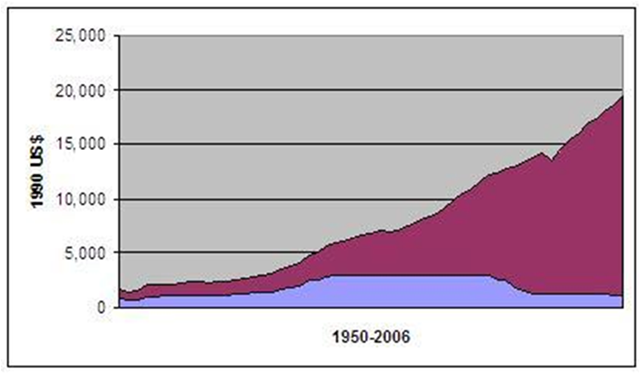
2. A more ‘moral,’ or altruistic approach would grapple with the social fact of South Korea’s long-term friendship with the US. It has stood by us for a long time as a reliable ally. It is a friend. It has participated in the coalitions of the willing in both Iraq and Afghanistan, even though it didn’t really want to go. Compared the to Europeans, the Koreans take their alliance commitment to the US very seriously. But even by this reckoning, we could arguably leave SK without great loss. SK has clearly won the intra-Korean competition. NK would lose a war with SK, even without US help. In a presentation I saw last moth in a conference at Changwon National University, my friend James Strohmaier of Pukyong National University presented this powerful graph of per capita GDP in the North and South. SK is purple; NK is blue. Obviously the race is over:

image

NK’s military, while large, is badly behind the South in technology. No one I have heard here thinks NK could win, even with the use of its nukes. So if SK can win this thing all by itself, what is the point of the US staying?

Is American Global Primacy Just Too Expensive?

200px-Flag_of_the_United_States_svg

One of the reasons I started a blog was because I get pulled into some excellent email chains that deserve to see the light of day. Here is a nice debate between me and a good friend (whose IR background is more law; mine is security and political economy). He thinks the costs of US empire’/dominance/unipolarity are too high to the US, and that we should start pushing burdens onto the allies more – an idea as old as the Nixon Doctrine. I agree in principle, but in practice, the allies won’t do it, the world will slide into multipolarity, and become more dangerous I think.

Friend:

An Empire At Risk. I share all of Niall Ferguson’s concerns, but he is focused, at least in this article, on a military decline as the ultimate effect of our profligate ways.  I say – so what?  I would like to see a US that spends less on the military and is less focused on policing the world. Let’s hear it for Germany, Sweden, Norway, Japan, etc. – countries that direct their resources toward their people and not an extravagant defense establishment and adventurism. In the world today, the US has had to invent a global enemy – ‘terrorism’ or a boogie man China – to justify its fantastically large military. Security today is not as the Neo-Realists traditionally portray. The great powers are not likely to return to the days of the 1930s any time soon.

Me:

Ferguson is always a good read, although ten years ago he said the US was the “colossus” bestriding the world as the new Rome. That didn’t work out too well…

You’re right that the US military needs to go on a diet. After 9/11, the military got everything they wanted including lots of c— we don’t need (F-22s, missile defense, Future Combat System). But the larger point is correct. The ultimate backstop of the liberal global economy is the US military. The more powerful the US is, the less it makes sense to compete against it. Unipolarity encourages bandwagoning and hedging at worst, not open balancing. If the French, Russians and Chinese get their wish for multipolarity, watch security dilemmas in places like northeast Asia, the Middle East, and Central Asia move into defection spirals of arms-racing. Unipolarity correlates well with systemic peace, and a liberal unipole is even better. Switzerland can claim the moral highground of neutralism and abdication, and no one cares. If the US does it, the world will change.

Friend:

We have two basic disagreements.  First, I don’t share your concern about SD and spiraling arms races.  I am a believer in Jervis’ security community, though there are areas outside of it, a great power war is highly unlikely. Peripheral wars have gone on, are going on now  – even with ‘unipolarity’ – and will go on regardless of US military might. Moreover, it is rather speculative that US unipolarity will prevent the consequences you describe as the number of cases of unipolarity is quite small.

Regardless, and second, the problem with maintaining unipolarity is someone has to pay for it.  Why is it the burden of US citizens to maintain this blessed (if often fractured) liberal economic world order of peace and prosperity?  The British are sending an extra 500 troops to Afghanistan and they are one of the better allies there. Everyone knows the current US fiscal deficit is unstainable so, to fund unipolarity, Americans must give up public health insurance, infrastructure investment, and basic government funded research, fight inflation, suffer a depreciating dollar, yada yada, while the rest of the developed world has social safety nets and high-speed trains. If the world becomes more complicated without US unipolarity, if other liberal, peace-loving democracies must step up in a multipolar world, that’s fine. Americans deserve to have their wealth spent on their needs (cancer research comes to mind. Cancer touches everyone of us and will probably kill you and me. Compare what has been spent on that to just one year of defense spending – it’s shocking). 

Me:

1. You don’t think that the regional security dilemmas in places like Northeast Asia or the Middle East would inflame if the US retrenched? I can’t agree. If the US leaves the ME, Israel and Iran will be at blows. In Asia, China and Japan, and India and Pakistan and China would start racing furiously. I think even the Chinese think so, judging by what I have heard from Chinese scholars at conferences out here. Unipolarity has strong causal effects for peace.

2. Here I agree with you partially. But the US DID afford hegemony for awhile. Not even Vietnam broke US power: http://asiansecurityblog.wordpress.com/2009/04/09/careful-with-that-decline-of-the-west-riff-weve-heard-it-before/. In fact, under Clinton, the budget was balanced, the debt was declining, the US was respected, and our foreign policy requirements were reasonable. Sullivan called the 1990s a ‘silver age’ for the US in his book the Conservative Soul. The real problem is that Bush misread unipolarity as omnipotence. Bush and his buddies wrecked US power through conscious choice. It was not the structure of unipolarity itself that bankrupted the US; it was W. Try here.

Friend:

I don’t believe in US isolationism.  Of course, complete disengagement from Asia and the ME would be destabilizing.   Multipolarity is not isolationism. The US should remain a balancer and diplomatic force.

But, I don’t think NE Asia countries would race furiously even with a large US draw down.  I think here we differ because my view is more informed by commercial liberalism and the waning of war among developed countries as a cost-effective or even plausible solution to problems (constructivism).  Though it doesn’t surprise me that Chinese scholars would promote the idea of a spiraling arms race and war if the US draws down – of course the party line is let the US carry our security water while we build our economy.  There view is that the US presence makes every feel OK while China grows.

Sub-Asia and the ME are different, I agree. 

As I mentioned, there are areas outside of the ‘security community,’  but I am not that concerned about arms races there.  India and Pakistan have been racing and warring for years and the world survived without a great power holocaust. Nuclear weapons provide a certain stability there, as does US even- handedness in arms sales to Pakistan and India. Stability can also come from balancing. 

The ME also has a long history of localized arms races and wars and while it has been tense and economically destabilizing at times, we have managed (until recently) without US  military entrenchment there.  The US has balanced through its support of Israel and relationships with ‘moderate’ ME powers.  The prospect of a war in the middle east are less than they ever were (unless the governments of moderate powers topple to extremists) and that is largely because of war exhaustion and peace efforts going back to camp David. Iran is a problem but do you really think a middle east war will result?

I know the world is a dangerous place but I not worried about regional powers balancing themselves – I prefer it because of cost issues for the US. The US should remain engaged and a balancer but not the balancer. If wars break out, that is bad but it’s not like the last 20 years of US unipolarity have been peace and prosperity.  Before Iraq and Afghanistan, there were the Balkans.

I can only say here that today is not the 1960s or even the 1990s.  You know that US economic preeminence, allowing it to afford lots of guns and butter, was an a rare confluence of factors. Those factors have largely receded and are rapidly diminishing.  The 1990s was an economic bubble as we learned in 2000.  Moreover, your domestic agenda (and maybe Sllivan’s) is apparently smaller than mine.  Clinton may have balanced the budget  but he didn’t deliver health care, infrastructure investment, ya da ya da.  (In fact, Clinton, for all his talents and opportunities, was a waste of space.)  So, I don’t view the 1990s as an example of our ability to do it all.  The 1960s is a better case but not a realistic one today. The price of unipolarity: http://www.msnbc.msn.com/id/34263381/ns/us_news-life.”

Obama’s Pragmatism toward North Korea

NK Flag

Yesterday, I participated on a panel at the South Korean Institute for National Security Strategy. The conference was entitled “Prospects for the Situation of the Korean Peninsula and the North Korean Nuclear Issue in 2010.” I think I have been to this conference already about 10 times already in the last 18 months, but if you lived next to the last and weirdest stalinist slave state, with nukes now to boot, you’d probably go over and over the topic endlessly too. My session was entitled “The US and China’s Policy toward the Korean Peninsula and North Korean Issues.” I was a discussant for Brian Myers’ paper “On the New Pragmatism of America’s North Korea Policy.” Brian teaches at Dongseo University here in Busan, and I find his work on NK increasingly persuasive. Here is his most recent intelligent op-ed in the New York Times. Here is the Korean news story on the conference; I looked like I just got punch or something…

Here are my comments on his paper:

“My read of this paper is that is broadly correct. I agree with Brian that NK is highly unlikely to ever surrender its nuclear weapons, because they are central to regime legitimacy. They are more than simply a tool of security or extortion; they are central to the regime’s raison d’etre after the collapse of communism and the decisive NK defeat in the intra-Korean competition in the last 20 years. With the global effort for communism over and defeated, and with South Korea’s obvious success, a self-evident question is why NK even exists anymore. If the East Germans gave up in the wake of communism’s failure and West Germany’s success, why does not NK also? Brian correctly notes that regime ideology has changed more openly toward militaristic nationalism, perhaps even semi-fascism, to compensate, and nuclear weapons are central to the overt nationalist/racialist mission of defending Korea against Yankee imperialism.

I have a few further comments.

1. Brian makes the intelligent observation that although President Obama has moved beyond ideology, various opponents of the United States have not. While this seems fairly obvious to the rest of the world, it comes as a surprise in Washington. The assumption of unipolarity and American dominance is so accepted by the US that the only change needed to bring change to the world is change in Washington. That is astonishing American arrogance, and speaks especially to the ridiculous expectations raised by Obama’s character – expectations which the president did a lot to build as a candidate by constantly referring to his election as the ‘start of a new era’ in history. Only Americans talk that way about the US, and Brian is right to point out that expert opinion about NK is usually in fact expert opinion about the US.

2. Brian makes the argument that Pyongyang means what it says. Northern ideology is a serious exposition of regime beliefs, not a cynical ploy. This is a controversial position, because most NK watchers, as Brian notes, believe the opposite. NK ideology is perceived as so bizarre and so obviously fraudulent – NK has never been self-reliant, e.g., despites decades of juche – that it cannot be taken seriously. As Brian notes, diplomats like Madeline Albright and journalists like Selig Harrison all act on this implicit belief.

Brian is right however to point out that dictatorships – especially right-wing ones – usually mean what they say. Hitler, Mussolini, Franco, Osama bin Laden, the mullah theocrats in Iran, various clerical fascists in Latin America, and the Taliban have all told the whole how they see it and what they wanted to change. Brian’s claim is that NK is doing the same, and that we should listen actively. In IR theory, we refer to this position as ‘second-image.’ In other words, regime beliefs overwhelm international structural pressures to determine a state’s foreign policy. That sounds correct to me and better fits the empirical record of the Kim regime than the cynical approach. Particularly the move toward song-gun, recent crackdown on marketization, and the extraordinary efforts to build and hold nuclear weapons suggest that Brian’s read is more accurate.

3. Brian’s most serious criticism is of the Western and South Korean expert or ‘epistemic community’ on NK itself. He unpacks a series of the reigning assumptions of NK kremlinology and argues that they are wrong, in some cases very badly. He also asserts that the NK has used access to it as a manner of bribery of would-be experts in the West. This is the most explosive argument of the paper, as it implies that well-known NK watchers such as Bruce Cumings or Selig Harrison have been coopted, deceived by pleasantries from Kim Jong Il, or othwerwise pull their punches in order to insure their visa. This is a pretty serious charge, but it seems like a fair concern. It is certainly a good idea from Pyongyang’s point of view. If visas and access can be used a marketing tools, why not? The USSR and Kmer Rouge did the same thing, and certainly Bruce Cumings book – North Korea: Another Country – feels awfully generous to a regime we know has killed hundreds of thousands, if not millions, of its own people in its history. By inviting experts from the West and telling them what they want to hear – that regime ideology is bunk, that the North really just wants a deal, etc – NK sows enormous uncertainty in the West between its public and private statements. But this is hardly surprising, as keeping its various opponents uncertain and confused a long-standing tactic of the regime. If Brian is correct that the regime has no concern to negotiate in bad faith, then hoodwinking experts with access and pseudo-off the record commentary makes perfect sense.

If that is the most controversial argument, I think the most rich is Brian’s argument that NK is a racist-nationalist-militarist regime. Deciphering the true ideology of NK is something of a cottage industry in the social sciences. Bruce Cumings has famously argued that NK is a neo-Confucian dictatorship. IR theorists tend to see it as the last bastion of Cold War stalinism. Neo-conservatives generally see it as a gangster/terrorist/rogue state. And Brian argues that NK is something approaching native Korean fascism. Elsewhere Brian has written that NK is extraordinarily ethnocentric, that even during the Cold War its socialist-internationalist allies perceived little internationalism at all. This ‘ontology’ of NK is a crucial debate. It would help the scholarly and policy community enormously if the expert community on NK could resolve this internal ideology question.”

More Troops – What a Surprise… Do the Kagans EVER Say Anything Else?

logo

Am I the only one who finds that the Kagans are relentlessly, almost ideologically, committed to US build-ups overseas, and the regular use of military power and military-related tools generally? I just read the WaPo op-ed from last week. It tells me nothing I haven’t heard from them whether on C-Span, Lehrer, or from their various websites/think-tanks for years. Certainly, Afghanistan may be worth the build-up they counsel. My own thoughts are deeply divided, so it’s not obvious that they are wrong in the op-ed. Nor are they incorrect that military leverage is the ultimate backbone for the exercise of national power. I agree there too. And I know they are a lot smarter, better travelled, and have better access than me. So I do read them usually.

But increasingly I don’t feel like I need to. I already know their answer – more soldiers, and more ‘will’ or ‘backbone.’ As Greenwald has said, these guys seems like robots. They always seem to suggest that more US force is the answer. If Russia misbehaves, we should threaten it implicitly and let southeastern Europe into NATO. On China, belligerence is the obvious way to save Taiwan. Iran should be bombed. Iraq was a great idea. Etc, etc.

It can’t be this easy. There are other tools of national power and influence – diplomacy, aid, sanctions – and these are wildly underfunded. (Compare the DoD and State budgets; the former is funded by 25-30x the latter. And forget about USAID.) I realize that soft power or whatever you want to call it is ‘soft.’ It doesn’t work too well. But counsels to war or war-like build-ups/advisors/military aid, etc, have their own massive costs that I never seem to hear about that from them or other ‘neo-cons’ (if that is where the Kagans lie). Walt has a nice 2- piece on the huge costs this sort of counsel implicitly carries. You can’t just war and war – it guts democratic freedoms at home, turns you into an imperialist abroad (whether you want to be or not), and breaks the domestic fiscus. (Not to mention that your country becomes responsible for a great deal of death and destruction, regardless of the cause it serves.) Do the Kagans ever blink for a moment when they read about the trillion dollar deficits for the next decade? I am sure they do. They are pretty bright. But is their answer simply to reflexively demand domestic program cuts to prop-up defense spending at the $6-700 billion level indefinitely? Again it just can’t be that easy.

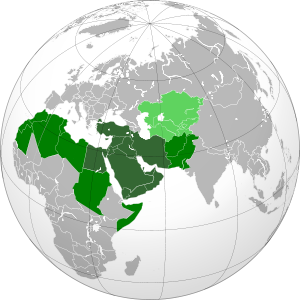
Does the US Need a Long-Term Exit from the Middle East?: 3. When is it Ok to Lose a War?

300px-Middle_East_(orthographic_projection)_svg

For part one, on Afghanistan, try here; for part two, on Iran, try here.

The budget deficit for FY 2009 (which ended on September 30, 2009) was $1.42 trillion. I can hardly think of a better reason to ask the question in the title of this post. For comparison purposes, the US economy is about $14.5 trillion and its national debt is $12 trillion. South Korea’s GDP is about $900 billion. So the US borrowed 150% of the entire output of the world’s 13th largest economy. If that is not imperial decline, I don’t know what is. The day after I read that statistic, I told my Korean students they should start thinking about a post-American Korean alliance framework. The odds against us are lengthening fast.

A few months ago, the US general in Afghanistan said we are losing there. And that seems to be the general consensus. This happened in Iraq too from 2004 – 2007, and in Vietnam after Tet. In the Iraqi case we pulled off something like a miracle with the surge and tribal awakening against al Qaeda. Although the best authority on Iraq says we are worse there than we think, at least we aren’t calling it the ‘forever war’ or a ‘fiasco’ anymore. In Vietnam of course, things went less well. Despite the changes at the top (Clark Clifford, Creighton Abrams, then the Nixon administration), we could not pull the South back from the brink, and by 1975, we had effectively lost.

So my question is why would a great power like the US give up, one possible option in the current greater ME mess? Clearly the US has huge resources, greater than North Vietnam & the VC, al Qaeda in Iraq, or the Taliban. (Remember that the Iraq Study Group recommended in the fall of 2006 that we gradually withdraw – effectively giving up. Nor is it likely that we are willing to plunge back into Iraq in huge force if things go badly in the next 2 years, during the final withdrawal.) And we have seen other great powers give up and leave/lose before too: the USSR in Afghanistan, France in Algeria, and lots of the postcolonial struggles. This is a great dissertation waiting to be written. Here are a few thoughts, all directly relevant to the medium-term US presence in the GME.

1. Wars, like any other enterprise, involve a cost-benefit analysis. Sullivan makes quite clear just how high the costs of the GWoT really are, and how little we have accomplished. It is painful reading. But by any reasonable assessment, the costs of the ME to the US are skyrocketing and look only to increase for all sorts of reasons (continuing Israeli intransigence, Iran’s nuclear sprint, the $1 trillion price tag on McChrystal’s plan). The unprecedented size of the budget deficit, and level of borrowing necessary to continue the ME wars, makes the cost-benefit question far more relevant than I have seen in the Afghanistan surge debate in the last few months. Too much of the debate has focused on Obama’s backbone or channeled ‘Americans-don’t-lose-wars’ nationalism. Far too little focuses on the extreme lack of resources.

2. We learned from Vietnam that losing a war isn’t so bad after all. All the predictions of the 1970s about coming of multipolarity, the end of the Cold War, the rise of the third world, and American decline were wrong. The US has tremendous power reserves. A strategic retrenchment will not diminish them. Most of the world will still expect US military power to dominate major power crises; most of the world will still value US market access above all trading relationships. Leaving the ME is not the fall of the Roman Empire.

3. Extended wars are domestically destabilizing and liberalism-reducing. This is a brutally obvious lesson from democracies in extended wars or standoffs. Israel and South Korea have done reasonably well in reconciling the nationalism and militarism demanded in such competitions, with the liberalism and social tolerance we expect from democracies. But the nominal, might-have-been democracies of Pakistan and South Vietnam were simply destroyed by unrelenting external confrontation.

4. Small wars that become big endanger other, more critical international commitments. Here is another Vietnam lesson. The drain of Vietnam began to seriously endanger America’s more central needs in Western Europe and Northeast Asia; this is major reason why we gave up. Today, the 3 trillion dollar GWoT is sapping America’s ability to hold the line in places of much greater importance. While Europe is not threatened (Russia somewhat in the east), East Asia is witnessing a major power shift.  It’s hard to argue that Asia’s rise is not of far greater importance to the US than the enduring primitivism of ME. The US is not balancing China right now, but it is awful nervous about the future of Chinese power, and  you can be sure the Chinese relish watching the US lose its bearings (torture) in the ME.

Does the US Need a Long-Term Exit from the Middle East?: 2. Iran

iran flag


In my last post, I suggested that maybe Afghanistan is a bridge too far. More generally after 8 years of the GWoT, I am starting to think the GWoT more generally is going that way too. I know it is vital for US security, but the costs are really starting to scare me, encouraging the isolationist hidden in every American: if they don’t want our help in Eurasia, fine – let them kill each other as they wish.

A friend went to hear a Council on Foreign Relations speaker on Iran – inevitably an ex-national security type. The speaker said we are leaving Israel in the wind to deal with Iran, and that the likelihood of an Israeli strike is rising faster than most people think. Here was my response.

“She sounds to me like your standard neo-con hawk actually – mixing analysis with policy preferences, trying to scare the hell out of the West with frightening scenarios that imply if only the US was tough and committed, this would not have happened. I think she reads the Kagans too much.

A few points:

1. Nuclear proliferation is inevitable. It’s already underway in Asia seriously. The US can’t bomb, sanction, invade all these places. We better find a way to live with this, instead of saying every time a proliferator is on the cusp that we should consider military force. That’s a recipe for forever war as the costs of nuclearization continue to come down.

2. Israel’s security is not America’s security. If they want to start a war with Iran, then that’s their issue. The US informal security guarantee to Israel cannot mean that we get chain-ganged into every conflict it wants to fight.

3. I think the likelihood of an Israeli strike is wildly overrated. They’re not stupid, and they know they are deeply isolated on this one. Israeli hawks are probably bluffing to encourage the US and UN to move more meaningfully on Iran. It’s the Richard Nixon ‘madman’ theory all over again: if Israel acts wild and erratic enough, maybe others will be spooked into doing something.

4. Iran with nukes is more dangerous, but let the locals balance/contain it first. It should not be our affair firstly.

5. We don’t really have much choice. Iran is genuinely committed to nuclearization, and Americans are unwilling to use serious force to stop that. So all we can really do is watch from the sidelines. Our hands are tied by a US public opinion that has been deeply anti-interventionist after Afghanistan and Iraq.”

Asked if I had suddenly become a dove on the GWoT:

“I don’t know. Maybe. But I think more that I am really beginning to worry about the costs of the war on terror. It goes on and on, and the US is bankrupt now, seriously, and really overstretched. We just cannot afford this stuff much longer – we’re becoming like Britain in the 30s or the USSR in the 80s. I can see the enthusiasm out here in the Chinese scholars I meet. They are relishing watching American fritter away its power running around the caves and deserts of the ME. Israel is our friend and should be, but the ME is becoming a sinkhole for US power. We desperately need Israel to find peace with its neighbors, or to cut it loose, because its exceptionalism is becoming just too expensive for the US now. We need to start seriously telling the Israelis that American support is not a blank check. If the Jewish religious right wants an apocalyptic war over the territories, and  to bomb Iran…, well, that’s just a bridge too far. Right now Iraq and Afghanistan are enough. Do we really need to risk a regional war between Israel and the US on one side, and Muslims on the other?  Increasingly, I am thinking we need a long-term out from the ME. It’s bankrupting the US. I don’t know. My thinking on the ME is in real flux; maybe because I am watching Asians get rich and strong while we are stumbling. The trend lines are just not good. The ME just seems so intractable, and it is becoming such a huge drain on the US.”

To the charge I might abandon Israel:

“Well, I am watching Asians get rich while we are hunting ghosts in the ME. The Chinese love this. They are watching the world’s only superpower blow its lead and fritter away its power in a probably vain effort to bring peace to the ME. It is becoming increasingly apparent that this is a fool’s errand. You must be thinking the same…”