Ahh, the Navel-Gazing Pakistani Military: One More Reason to Be Out the Door of South Asia…

pakistan-war-games-2010-4-18-11-12-9

Thomas Barnett is a good blogger and his strategy work, especially the Pentagon’s New Map, is solid, if not exactly IR theory. I think Barnett sees himself more like Halford Mackinder or Robert Kaplan than Kenneth Waltz or Robert Keohane. In any case, his books are worth your time in that ‘not-quite-IR-but-still-important’ category (which also includes books like the Lexus and the Oliver Tree, Guns, Germs, and Steel, and The Best and the Brightest).

He absolutely nails it in regard to Pakistan here. We shovel mountains of money to the Pakis so they can scare the hell out of America’s emergent ally in Asia through this month’s huge military exercise right on India’s border (pic above). I noted last year as well the Pakistani military’s propensity to read the GWoT as just another way to bilk the US into paying for it never-ending anti-Indian build-up. Why are we running with these people?…

These shenanigans just reinforce my growing sense that we need to get out of the middle of the Asian landmass.

How to Respond if North Korea really Sank that SK Destroyer: ‘Sell’ Southern Strategic Restraint to China for Pressure on the North

15214047

The sinking of a South Korean vessel, the Cheonan, has dominated the news here for weeks. Increasingly it looks like an external explosion caused the ship to break in two and sink rapidly. Suspicion is high that the only external force strong enough to sink a modern reinforced warship would have to a be a (presumably NK) mine or torpedo.

Predictably the conservative SK press has started the drumbeat for an aggressive response, including possible military action. President Lee of course is painted into a corner. A wholly unprovoked attack like this screams for blood, and the South Korean right is virulently anti-communist. If Lee does nothing, he’ll be hammered in the media and by his rivals within the governing party.

I sense a decisive moment building, akin to Austro-Hungary’s 1914 debate on how to respond to Archduke Ferdinand’s assassination, or Bush’s post-9/11 reckoning. Here is a moment rich and justified in the aggressive rhetoric so beloved by conservatives the world over; try to imagine how Fox News would respond if the ship had been American. This could easily slide into nationalist hysteria and escalation. 9/11 too raised America’s temperature and pushed the US government to aggressive action in the Middle East. Only a few years later did it become apparent how much the US overreacted. I fear the same here. As Andrei Lankov (one of the best NK experts – read him if you don’t) notes, Lee doesn’t really have much room to do anything against the North that is significantly punishing, yet won’t cause a NK escalatory response, and then a dangerous tit-for tat downward spiral. I think the Korean Foreign Ministry sees this too.

In brief, the problems with any military response are:

1. North Koreans will suffer the costs of any retaliation, not the KPA/KWP elite likely responsible for the attack.

2. NK is heavily ‘bunkered’ and hardened. Any military response would likely be from the air and would require multiple sorties. This means more chances for accidents, shootdowns, and other ‘kinetic’ interactions that could lead to a spiral of violence.

3. Realistically, the US would have to political approve of SK action; this is unlikely.

4. The North is already so deprived and impoverished, it is hard to find a juicy target that would both hurt but not lead the KPA to call for war. (This is what would happen if the nuclear sites were bombed, so scratch that idea.)

5. My friend Brian Myers has convinced me that NK is such a paranoid, ‘national-defense state,’ that any attack is likely to provoke an escalated armed response. The KPA derives it prestige and legitimacy from its ability to defend the country – indeed this built into the constitution now as as the “military-first” policy – so it would be existentially important for it to hit back.

Hence it is extremely likely that any SK strike would be immediately countered and escalated. This is not like Israeli airstrikes in Lebanon or Syria. The North will almost certainly pursue escalation dominance into a quickening and widening cycle of hits and counter-hits. This is not a game the South really wants to play, especially given Seoul’s extreme exposure to North Korean artillery. So swallowing its anger out of sheer fear of escalation is my prediction of SK’s response.

So what to do? How about going to China and telling them, ‘we will hold off on a response in the interest of stability, but you really need to get serious with the pressure. No more bail-outs and trips to Beijing for the Northern elite.’ China doesn’t want a tit-for-tat, degenerative North-South spiral anymore than anyone else. Perhaps the South can use this to really push the Chinese hard on finally cutting off NK.

To be sure, the road to Pyongyang doesn’t go through Beijing. North Korea coldly plays China for gain as much as it does the US, Japan, and South Korea. But I have always thought that if NK ever faced a truly united front of the other 5 parties of the Six Party Talks (China, US, SK, Japan and Russia), the DPRK might finally be cornered. In this way, the relevant Six Party game theory is the stag-hunt. If only the 5 can coordinate and not defect on each other (NK’s constant goal), the can catch the big stag – change in NK. Strategic restraint on the Cheonan sinking might be a way to convince China to finally stop defecting over North Korea.

Is It Moral to Find Humor in North Korea’s Bizarreness?

kimjong2

kimjong5

kimjong7


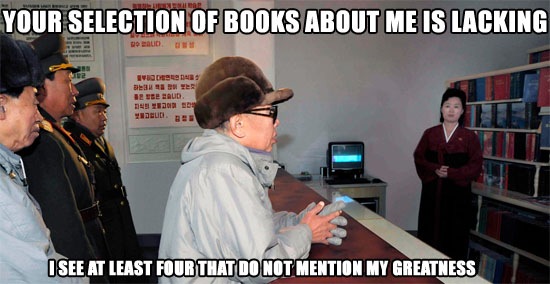
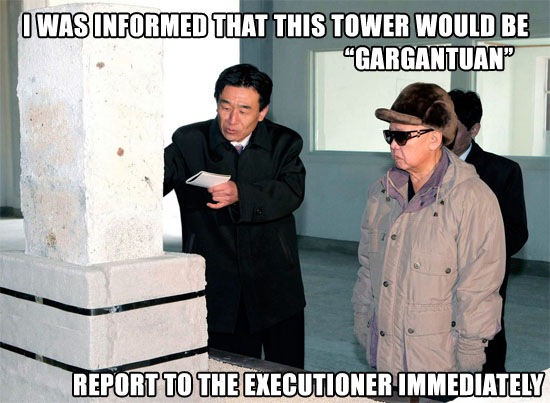
I never really know how to answer this question. Among IR and foreign policy types, the DPRK is just as easily a punch-line over drinks after a long conference as it is a topic of that same conference. Andrew Sullivan equivocates on the question here.

I found these pictures, with the appended humorous dialogue, here. Remember that Kim declared long hair bad for socialism. The NK media also claims Kim Jong Il can manipulate time. So when it gets this wacky, it’s fairly hysterical. It’s hard not to laugh, right?

On the other hand, you can in fact imagine that the captions above to the third picture are accurate. The regime is that arbitrary and brutal.

My sense is that it is within the bounds of ethics to laugh at communist kitsch after the regimes have collapsed or at loopy Chavez-types who aren’t too destructive  – yet. But North Korea is probably too far. Comments would be appreciated.

If you want even more North Korean surreality to tempt your ethics with humor, try here for the genuinely bizarre subculture fetishizing the pretty but robotic North Korea traffic cops. Yes, it’s that weird. See if you can avoid laughing…

For my other writing on how opaque and bizarre NK is, try here, here and here.

The New Bible… for International Relations Theory

6a00d83451b8e569e20115709f0ae0970c

The Koran, Talmud, Analects, and KKV have just been replaced as holy writ. Wow. You’ve never seen anything like this before. Save yourself a pile of money and application headaches for grad school. Just read this instead: http://www.isacompendium.com/public/. It is a crushing $3,000, 4,000 pages , and 12 hardback volumes!

Thankfully, if you belong to the International Studies Association, you can read the articles for free. Even more important, the articles tell you at the bottom how to cite them as e-articles. So thank God you don’t have to try to track down a paper copy of the set to get the page numbers. I can’t imagine if anyone is actually going to buy it.

I perused the index – a lengthy reading project in itself. This is basically an IR grad education in a can. Really. If you entered your first year of grad school, and read nothing but this all year, you’d get an ast0nishing education. I think it would be absolutely thrilling to just read this cover to cover as one’s first step into serious IR. It looks that rich, comprehensive, and well-written.

PS: if you want the short-version of IR in a can, try here. It’s excellent too.

‘Hurt Locker’ Backlash, Part 2: A Response to Rodger Payne

image_mini

The Duck of Minerva is one of the better international relations theory (IR) blog out there. You should read it if you don’t already. Its name is a riff on Hegel’s famous comment that the “owl of Minerva” only flies at night; i.e., wisdom only comes in hindsight, or more specifically that philosophy can only understand an age or civilization as it passes away. I don’t quite get the joke behind the title ‘duck of minerva,’ but whatever – it’s quality IR blogging.

Rodger Payne had a post two days ago on the continuing IR back-and-forth over The Hurt Locker (HL). Payne links to the relevant other IR posts on the film, including my own. Payne notes that I and others have found many problems with the film’s much-celebrated ‘realism.’ My own sense is that the lead character, Staff Sergeant William James, probably would have gotten himself or his associates killed a lot earlier through his overt recklesness. That, and the bizarrely out-of-place and unbelievable desert-sniper sequence, do a lot to reduce the film’s credibility as a portrait of the Iraq War. Michael Kamber summarizes.

Payne counters that, while Kamber and I are correct, that’s beside the point.  HL’s strength as an IR film is as a metaphor for US foreign policy more generally since the end of the Cold War, and especially in the Middle East. Money quotes:

The U.S. too has a long and mostly successful military record — and it too has been incredibly lucky. Like James, the U.S. returned to Iraq after a successful first effort in 1990-91… To its critics, the U.S. too is a reckless showboat, willing to take incredible risks with other peoples’ lives, even as it claims to be “saving” them.

In political debates, Americans focus on U.S. forces, casualties, and experiences. Few consider the implications for Iraqis and the wider Middle East… The FUBAR narrative works pretty well to explain the actual U.S. experience in Iraq. The lead character’s addiction to war, recklessness, luck, inexplicable behavior, and need to “save the day” reflect an unsavory, but nonetheless viable, portrayal of American identity.

1. Ok. I don’t really disagree with any of that, but I think it is a reach, a generous overreading that sorta lets the film off the hook. Is Bigelow really giving us the arc of the erratic, poorly-planned Operation Iraqi Freedom in the story of one soldier? Do we really think Bigelow had something this profound in mind? Francis Ford Coppola did when he made Apocalypse Now. He went to Cannes and famously said “We had access to too much money, too much equipment, and little by little we went insane.” That’s going for the big view. But Bigelow’s schtick has been that this is the first realistic film portrait of the Iraq, and that is how it has been received. The problem, as I argue, and Payne admits, is that it’s not that. I certainly agree that the US use of force has drifted toward recklessness since the end of the Cold War, and Payne is dead-on that US audiences love cowboy-style swaggering heroes, but the film is so pointedly apolitical, that it is hard to see James’ swagger as America’s. Maybe, but I just don’t see that in the film itself…

2. Given the film’s ‘reality problem,’ in round 1 I suggested that one alternative is to read the film as a memoir of battlefield stress for the US warfighter in the GWoT. The film goes out of its way to suggest that James is motivated by the narcotic effect of combat, so I think this better fits the small-scale of the film than Payne’s ‘big think’ approach. The problem with my interpretation is that Bigelow unfortunately does not develop this much beyond the initial thought. So we see James at home, bored with his alienated ex-wife. This is supposed to suggest that James misses the thrill-ride (!) of Iraq. But lots of us have had relationships and family lives that go bad, so this was rather weak. Much more convincing would have been imagery of James as an addictive personality. Scenes showing him struggling with drugs or alcohol would have really shoved the ‘psychology’ interpretation of HL forward, because you could see James substituting one thrill (Iraq) for another (booze, perhaps). Instead, Bigelow lets herself wander into a series of unconnected vignettes, like the sniper story, while the audience waits and waits for a theme to hold it all together.

3. HL’s rise is function of ‘intelligence guilt’ over the success of Avatar, plus the American desire to finally have a good GWoT film, not its inherent quality. It is fascinating how this film has grown from an indie joint into a Best Pic taker, and now faces a growing pushback from foreign policy types.

Initially almost nobody saw HL. It grossed a measly $12.7M. Avatar made more than that just here in Korea; its global total is now a staggering $2.2+B. HL was neither in theaters nor DVD here; I had to import it. So if it can’t make it to the world’s 13th biggest economy, did anyone see it beyond the US, Canada and Western Europe? Do we have any idea what Arabs/Iraqis particularly thought of it? Audience attendance is no great mark of quality, but still, without the critical buzz of the last two months generating an anti-Avatar Best Pic vibe, we wouldn’t even be talking about this film. Remember that it was originally released in Italy in October 2008, and for the next 14 months, almost no one saw it. Christopher Orr summarizes.

We all knew that Avatar was shallow, but we swooned for its astonishing GCI, arguably the biggest visual leap since Star Wars. But when the hangover hit in the month before the Oscars, the Academy needed something to suggest we weren’t so fluffy. Nobody wanted Cameron to take two Best Pics for childish stories wrapped in pretty colors. So, given 2009’s poor Best Picture choices, HL became the default anti-Avatar. Call it penance for giving the 1997 Best Pic to Cameron’s Titanic instead of the far more deserving LA Confidential; snubbing the King of the World this time buffs the Academy’s credibility. So HL rolled through the awards season, culminating in the Oscar that will insure it shows up on lots of IR syllabi in the future.

But now that the film is on our radar, the serious critical work is coming in, and the verdict, as this thread, indicates, is a lot more mixed. The irony is that a good Iraq pic does already exist – Generation Kill. Where is that much better, more accurate portrait in this whole debate?

The ‘Hurt Locker’ Should Not Be Best Picture

untitled

I have seen The Hurt Locker twice on blu-ray. For part 2 of the Hurt Locker debate, try here.

The Hurt Locker got 97% on RottenTomatoes.com, and it has a acquired an indie, anti-Avatar panache for this weekend’s Oscars. But honestly, I don’t really think it is that good. Instead, I think its elevation tells you more about our general desire to find a good GWoT movie after so many bad ones, and the need to balance out the Avatar behemoth. We all know that Avatar is fairly shallow, but we were so wowed by the FX that we secretly saw it more than once. So Hurt Locker is our ‘smart film’ penance. But I just don’t buy it that is some amazing war film, as the hype says:

1. In the history of war films, it is hardly as good as titans like Apocalypse Now or Platoon. Hurt Locker is more in that mid-range quality area of films like Casualties of War or We Were Soldiers. Vietnam, tragically, brought out the best in US war film, probably because we lost. Defeat ‘permitted’ or opened the moral door to investigate all kinds of issues about battlefield conduct that just don’t show up in the usual celebratory, ‘America-is-awesome’ war film. Your standard issue western or WWII film portrays the US as the hero without a hint of irony; ever noticed that there is still no movie about the 1945 Dresden bombing raid? You learn nothing you didn’t learn in the self-congratulatory US history book you read in grammar school. By contrast, most Vietnam films struggle with moral questions of how and why the US is fighting. Hurt Locker explicitly ducks this avenue, and therefore is not as intellectually rich as the best US war film, certainly not to the level of best picture. If Apocalypse Now, Saving Private Ryan, or Full Metal Jacket can’t take best picture, then the only reason Hurt Locker might get the nod is because the competition this year is so weak.

2. The Hurt Locker doesn’t really tell you much about the Iraq War. In fact, a lot of knowledge is assumed – IEDs, the Green Zone, the term ‘haji,’ the playing cards with Saddam’s lieutenants on them. So again, it strikes me as strange that this is supposed to be the best Iraq movie out there. You don’t actually learn that much about Iraq. As Vikash Yadav points out, the Iraqis are just the ‘other’ floating around in the background. And frequently, you don’t even know where the protagonists are. The long sequence in the desert with the enemy sniper was gripping but was fairly inexplicable – what were they doing by themselves in some random patch of desert? Brian Mockenhaupt makes this point well too. As a portrayal of the Iraq war, it has some fairly obvious flaws – why doesn’t the showboating lead character get reprimanded?, why don’t they just call in an air strike during the sniper stand-off if they are really trapped there for 6 hours?, what is with the lead character running around off-base in the middle of the night, etc? I would rank Generation Kill as the best portrayal of the Iraq War yet. (The obvious response is the Generation Kill is 8 hours; the Hurt Locker is 2. So Generation Kill can do a lot more and show you a lot more. Agreed; but still, I found 2 hours of Generation Kill much more convincing than the 2 hours of Hurt Locker.)

3. Another take is to suggest that the film is really about the psychology of the warfighter. Some get scared; some just muddle through; others love it. This is more convincing; the literature on battlefield stress suggests people react in all sorts of unpredictable, frequently lunatic ways when they are subject to military violence. So it is entirely possible that characters with a semi-death wish like the film’s protagonist would pop-up. But its also hard to believe the highly professionalized, highly bureaucratic US Army would not weed out such types fairly quickly. Certainly in the film, the lead character fairly quickly becomes a danger to himself and those around him. So is the film really about the possibility of  combat as a narcotic? That seems more likely and is psychologically richer. War films rarely risk showing warriors enjoying war, so Bigelow deserves props for that gutsy angle. But this psychological aspect is never properly developed; the main character is simply reckless and remains so, as well  as lucky, throughout.

4. One critical angle I reject is Yadav’s assertion that the film is orientalist, because the Arabs are portrayed as vague and shady. You could reverse this and say that the film is trying to capture the war from the American soldier’s point of view, especially if you accept that the film is not really about Iraq, but about the contemporary US warfighter. The average GI there clearly doesn’t speak Arabic or know the culture, so I actually  found the ‘othering’ of the Iraqis a powerful narrative device. It shows you the cultural isolation, fear, and easy possibility of misperception by the Americans there. It is an reflexive response to read this as just racism; I think Bigelow is a better director than that. Similarly, Yadav argues that  ‘portrayals’ of women and others could have been better, but this is easily dismissed. You can only do so much in 2 hours, and it is a constant intellectual failure of identity politics that any minority or out-groups must always be ‘portrayed’ well in the western media. For example, you might just as well make the same critique of US officers in the film – they only have a few minutes and don’t come off too well, but no one would seriously suggest the film is a group slur on the US officer corps.

5. As has been widely noted, GWoT movies have generally been poor (Stop-Loss, Body of Lies), jingoistic (Stealth), or ridiculous (Avatar, as Cameron’s self-described analogy). Hurt Locker feels far more believable than any other film to date, although top-notch still goes to Generation Kill. The notion of war as a drug is an creative one in the war film genre (although Ernst Juenger first showed us this problem in his classic Storm of Steel). And if you take the film as a battlefield stress-response memoir, than many criticisms, such as orientalism, fade easily. As a film, it is certainly worthy of your time, but I think the only reason it is a Best Pic nom is, because 2009 was a fairly weak year. If District 9 can be a Best Picture candidate, then the bar is pretty low. (D9 was good, very fun, and smart for an action movie, but really, best picture?)

Hurt Locker may get the tap, because the Academy blew it the last time James Cameron released a super-epic. The vastly superior LA Confidential got trounced by Titanic in the 1998 awards. This is one of the worst Academy decisions in my lifetime, and clearly not one that stands the test of time. The irony is that this time, unlike last time, Cameron probably deserves it. The competition this year is far weaker than LA Confidential, and Avatar is much more seminal because of its revolutionary effects. For all its glitz, Titanic’s FX were still conventional, and the story was even more mind-numbingly childish than Avatar. This time, the story is better, but the 3D FX are a massive step forward, arguably justifying the Best Picture award, especially given the weak competition. If an LA Confidential or There Will be Blood were around this year, I think the calculus might be different. But Hurt Locker is just not strong enough to overcome the major visual breakthrough Avatar’s 3D represents. (For my Avatar review, go here.)

Kim Yu-Nationalism, Or How Middle Powers Assert Themselves in Global Politics

2010022700174_0

Nothing verifies the claims of my last two posts about the jingoism and politicization of world sport as much as the national euphoria here that greeted Yuna Kim’s Olympics victory last week. Koreans reacted to her medal the same way Americans did to the US hockey’s team 1980 victory – it became a banner symbol of national greatness in world society. Kim has become not an image of skating beauty, but rather the latest capture of an unrelated event to serve Korea’s near obsessive effort to be noted in the world politics. This is how states reinforce themselves in the era of globalization, and this is how middle powers tell the world to pay attention to them.

Here are just a few headlines, to remind you that her victory is not just a gold medal, but a “world historic event,” as one Korean put it to me:

Yuna Becomes ‘Golden Queen’: Kim Yu-na’s Olympic triumph cements her status as the megastar of figure skating and the sport’s most transcendent personality since Germany’s Katarina Witt.”

Beyond Perfection: Fascinating the world with dazzling performance”

Kim Yu-na: Figure skating queen aids Korea’s Olympic dreams”

Olympic favorite Kim Yu-na delighted fans around the world

Korea Energized by Figure Skater’s Olympic Debut: Korea is ablaze with excitement”

This sort of purple rhetoric should convince anyone of the way the state instrumenatlizes sports for nationalist assertion. Kim is a fine athlete obviously. But the far more interesting story for a political scientist is the way her victory was ‘captured’ for the interest of state and nation. Indeed so fanatical have Koreans become about Kim, that she now practices mostly in Canada  in order to avoid the cult of personality that has grown up around her.

Maybe I’m Huntington’s flimsy de-nationalized globalist, but I can’t help but find this sort of adulation extremely discomforting, and not just as  foreigner living here. Aren’t modern, liberal states supposed to outgrow this sort of clannishness? Aren’t cults of personality, uncritical coverage of national ‘heroes,’ and jingoistic assertions of the ‘world’s joy’ over an athlete (?!) a sign of political immaturity and hard-edged nationalism, the sort of thing we associate with dictatorships banking on nationalism as a legitimizing ideology?

My sense is that if Korea really wants to be taken by the rest of the world as a serious, perhaps even leading, member of the G20, this sort of nationalism will need to fade. Like much of East Asia, Korea is torn between a deeply held nationalist narrative of its uniqueness (frequently drifting into racial blood-and-soil narratives of the minjok), and the desire to be cosmopolitan and open to world of globalization (‘Global Korea‘). (China too has the struggle, between the CCP’s growing racialization of Han ethnicity, and the need for Walmart and more FDI.) Yuna Kim embodies both of these trends, as she is both instrumentalized for Korean national purposes (carrying the flag everywhere, eg), yet also reasonbly fluent in English. It is not clear to me which way Koreans want to go.

‘Andrew Sullivan is an Anti-Semite,’ or the Israel Lobby is in a Panic

s27047206493_935571_5560 clear

In the last few weeks, the literary editor of the New Republic, Leon Wieseltier, accused Andrew Sullivan of being an anti-Semite for his changing, increasingly tough views on Israel. For original post, go here; for Sullivan’s response, here; Greenwald, as usual, gave the most insightful read of the whole thing. Also, Cole, Chait, and Mead.

1. My sense of Sullivan’s work – from reading his blog irregularly, his essays at the Atlantic, and his book Conservative Soul – is that the charge is ridiculous. Sullivan is as thoughtful a writer as they come. I can’t think of anyone who has so openly showed, through his blog, the humanist thinking process day-by-day. Unlike academics who strive to present iron-clad work as if they’d thought of every angle, Sullivan has basically thrown open his brain so the whole world can watch him think. He routinely retracts, modifies, and apologizes when he makes mistakes or reconsiders. In this way, he is wonderfully honest – head and shoulders above the partisan hackery of most of American punditry. The blog is essentially the organic thinking process of classical liberal, with a touch of conservative sadness, muddling through tough questions, as we all do, only for the whole world to watch in print. It is a fascinating process, occasionally mundane or humorous, frequently engaging, but prejudiced? Hardly. That violates the very spirit of thinking-out-loud behind his blog that has made it so popular.

2. Wieseltier’s piece is pretty shoddy. It is a collection of extrapolations, slippery allegations, and ad hominem shots. Name-dropping Niebuhr and Auden was pretentious and served no point. I would not have accepted this from a graduate student. You can’t write this way unless you have an assured platform. Wieseltier is a like PhD who just got tenure – ‘now I’ll say anything  I want.’ If he weren’t an editor of one the best intellectual-policy magazines in the US, no one would have read this essay. It is telling that most of the debate has either sided openly with Sullivan or suggested that Wieseltier overreached or overreacted.

3. The real story, as Greenwald and Walt have also suggested, is the growing panic of Israel’s deep supporters in the US. The ground is shifting against Israel, particularly because of its continuing hard-right insistence on retaining the West Bank. The current prime minister, B Netanyahu, has clearly deepened the rift with the US by his open recalcitrance on the settlements. Much of the credit for this shift on Israel is due to Walt and Mearsheimer’s book and the subsequent flood of discussion it unleashed and legitimized. (They too enjoyed the institutional power of saying whatever they want; tenure in top 10 schools gives you that kind of space.) Walt’s blogging, relentless, measured and intelligent, has kept up the pressure. Increasingly it has become clear that the biggest obstacle for peace is now the Israeli religious right, not Hamas or Hezbollah. The fundamentalist-zionist Orthodox have now pulled Israel’s otherwise modern, liberal population into a semi-imperialist venture that increasingly smacks of permanent apartheid for the Palestinians. There is simply no way the US can support this; Israel’s friends in the US know this, and they are panicking. The consensus of elite opinion on Israel is swinging against them, and anti-semitism charges against the likes of Jimmy Carter, Walt, Mearsheimer, and now Sullivan, tells you more about the changing American debate on Israel, than it does about these writers.

3. I find the charge of anti-semitism thrown at intelligent writers like these inappropriate, because it is a prejudice we associate with crass, vulgar, unrefined thinking. That is, we assume the racism and other bigotry reflects a lack of thoughtful thoroughness. So ‘X is an islamophobe after 9/11, because he has no idea about Islam, but still makes snap judgments based on minimal information.’ Yet clearly, Sullivan, Walt and the rest do in fact know a great deal about Israel, Judaism, and the associated issues. They have a long, substantial body of work over many years demonstrating, rich nuanced thinking on all sorts of topics. Their work, not just on Israel, but on lots of topics, is not a collection of from-the-hip prejudice, but usually pretty well-thought out. That’s why people read them to begin with. (Remember that Mein Kampf was a publishing failure originally; before reading it was coerced, the normal German saw right through it for the bigotry and poor thinking it was.)

Certainly ‘smart’ people can be racist or anti-semitic, but I bet the proportion is lower. Why? Presumably, all the reading, traveling, and reflection we associate with intelligence leaves some sort of intellectual mark. This is why we send our children to school to begin with. Presumably it humanizes the thinker to the circumstances of other people, encourages one to try to see the world through others’ eyes, and expands one’s sense of self. Consider Walt. He is the chairman of the finest political science program on the planet. Do you really believe the people who vetted him throughout the long institutional path to this height somehow missed his latent anti-semitism? Hundreds, maybe thousands, of professors, students, and administrators somehow missed this roaring prejudice? Is it possible? Sure. Probable? That question answers itself. So leave the racism charges for uneducated boors like Timothy McVeigh; it’s just a gimmick to stifle debate of things you don’t like.

The Olympics are a Moral Equivalent of War

2010021700635_1

William James wrote a great essay in 1906 entitled the “Moral Equivalent of War.” (That I never read it or even heard it discussed in my graduate training is but the latest example on this blog of how myopic, unhistorical, and excessively ‘scientistic’ IR has become.) I’ve always thought it provided a good key to explain the nationalism suffusing world sports, especially the sheer jingoism of the Olympics.

The Olympics provides a way for nation-states to engage in all the nationalist passion and competition the human dark side craves, yet in a way that does not involve mass-killing and property destruction. It is therefore James’ moral analogue or equivalent to international conflict or war. The Olympics allow us to reenact global conflict in zero-sum environments, but safely. Indeed, this is probably the great social benefit of the Olympics: they are a safety valve for nationalist furor to be channeled into neutral non-malign outcomes, but for the occasional soccer riot. Far from a being a global event that celebrates our common humanity, the Olympics is a good example of the state’s and its citizens’ resistance to globalization. The deeply-rooted nationalist passion of most people is easily on display; how often do you see supposedly mild Canadians drunkenly screaming and waving their flag? So forget that ‘we-are-the-world’ blather from the opening ceremonies. Let’s get to some serious national a— kicking.

War in the modern world has become ridiculously destructive and expensive. Nuclear weapons especially have made war nearly unthinkable among the biggest nuclear weapons states. This is excellent of course; nukes seem to be having a wholly unanticipated pacifying effect. But human bloodlust needs to be sated somehow. A moral equivalent of the ‘value’ of war is needed: defeat of an enemy, tales of courage and heroism, the exhilaration of triumph in a zero-sum competition for high stakes, the desire for mass rallying around distinct in-group symbols, an unashamed outlet for bigotry and prejudice, the lionization of physical beauty and strength, the unambiguous assertion and celebration of in-group superiority. There is a reason why the best movie ever made about sport was a by a fascist enamored of male virility filming an Olympics.

The Olympics is a great source for all those dark sides of world politics, and you don’t really need to look hard to see this. Consider the picture above. I saw some Korean iceskater the other day take a victory lap with a taeguki wrapped around his shoulders, and Koreans in the room with me were clapping and cheering. But the best know example is the US hockey team’s defeat of the Soviet team in 1980. Americans went bonkers, because everyone read it as some (bogus) triumph in the Cold War. Just in case your overweening sense of American awesomeness ever flags, you can watch this (unbelievably schmaltzy tripe) to remind yourself why America is the most amazing place ever.

Or consider the introduction of the teams on day 1. Did anyone else notice that when the Iranian team was introduced that the applause level dropped suddenly? Wasn’t it obvious how the introduction of those players of ‘global’ sport came under the moniker of national titles? What better way to reifiy and reinforce the state in an era of challenge by globalization. Even our athletes are national tools; they’re our athletes.

So please, spare me the multicultural fluff about the Native Americans in Canada, how the Olympics is ‘for love of the game’, your ‘appreciation’ for the success of other countries’ athletes, how you really do pay attention to curling beyond the two-week period it became your favorite sport. At least be honest that you want to see the Jamaican bobsledders crash and that you chest tingles when your flag goes up.

The Politicization of the Olympics

olympics

Honestly, I have never understood the appeal, much less the fanaticism, of professional athletics. To quote Ian Malcolm from the Jurassic Park (the novel), grown men swatting balls is not serious as a career, nor particularly entertaining. I certainly understand that there is something admirable in watching highly trained people perform their expertise, but MDs, PhDs, and soldiers are all highly trained too. At least what they do with all those long years of training is socially meaningful (health care, education, national defense). Beyond entertainment, it is not clear if there is any benign social purpose professional athletics serves. Note further, that its malign social impacts are well-known: corruption of US collegiate education, dead-end hopes with squandered education for millions of poor kids dreaming to be Michael Jordan, a huge diversion of social attention away from meaningful social questions to the ‘sports page,’ families and teen health ignored so athletes can spend 6 hours a day in the gym. I admire the old British tradition of the ranking amateur with a proportional view of athletics as part of physical health. How all this stuff can be a career genuinely baffles me.

As for the viewer, I think we watch not just for the entertainment of competition, but also for darker reasons. First, there is definitely freak-show curiosity. There is something deeply creepy about Barry Bond’s biceps being larger than your thighs, or those misshapen teen athletes who sacrifice their menstrual cycle to become Olympic gymnasts. That is why we respond so lightly to doping and steroids; we kinda want to see what these aliens will look like. Part of us is curious to see the East German women’s swim team with hairy chests or Mark MacGuire’s robo-body perform, even though we all know he cheated. I also think we find a dark pleasure in watching people with unique abilities purchased a terrible cost. Watching skiers fly into moguls at 100 mph or boxers get the hell beat out of them is part of the bloodsport of it all. You didn’t turn away when those lugers crashed, did you?

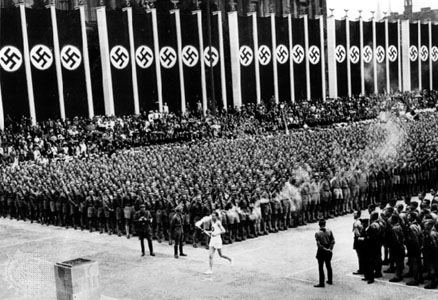
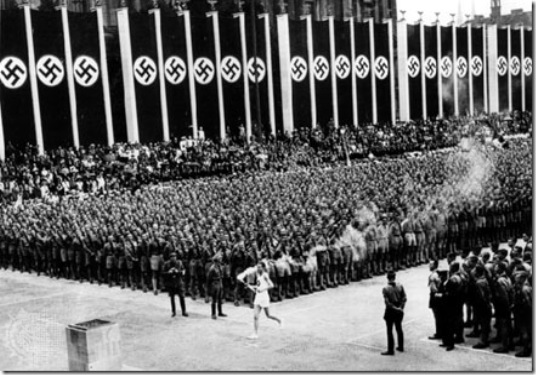
Nor is there any doubt that professional athletics, especially across borders, gets deeply politicized and nationalized. Today on the radio I talked about how South Korea has used the Olympics as a wedge against North Korea for decades. There is a long tradition of politicizing the Olympics that goes back at least to Hitler’s perversion of the games in 1936 into a demonstration of Aryan physico-racial superiority.

_________________________________________________________________

TRANSCRIPT – DR. ROBERT E. KELLY, PUSAN NATIONAL UNIVERSITY

BUSAN E-FM: “MORNING WAVE”

MONDAYS, 8 AM

February 22, 2010


Petra:

Hello everyone and welcome to …..

Right now we have our weekly foreign affairs expert for some commentary on Korea and Northeast Asia. Dr. Robert Kelly teaches in the Political Science and Diplomacy Department at Pusan National University. He’s been living in Korea about 18 months now, and his area of expertise is the international relations of East Asia. If you wish to contact him, please see his website at http://www.AsianSecurityBlog.WordPress.com.

Professor Kelly comes to us each Monday to talk about big issues in Korean foreign affairs. And this week we are going to discuss the two Koreas at the Olympics. Hi, Dr. Kelly.

REK:

Hi, Petra. Thanks for having me

Petra:


Thanks for being with us again today.

REK:


It’s my pleasure.

Petra: 

This seems like a lighter topic than usual. Why are the Olympics important for the inter-Korean relationship?

REK:

It is a lighter topic. We can’t always discuss trade or border conflicts in the Yellow Sea. But it is also true that countries take their international tensions into world sports. You can learn a surprising amount about the workings of the global economy or nation-state competition by watching the Olympics.

Petra: 

How is that? Aren’t they just athletes?

REK:

Well, yes and no. The Olympics is supposed to be apolitical, but they are very clearly not. The International Olympic Committee has been riddled with corruption for years. Countries are regularly caught trying to bribe the committee members to vote for their cities. Host countries routinely use the Olympics to display their modernity, prestige, economic growth, etc., to a global audience. Or countries that are competing with each other in more serious global arenas, like security or ideology, frequently seek to win medals at Olympics as a marker of national greatness or triumph in the larger international contest. In fact, athletes frequently allow themselves to be used in this manner. Korean athletes, for example, routinely carry the Taeguki in their victory laps. This is unnecessary, of course, and violates the Olympic spirit, but it is a hypocrisy that most countries demand from their athletes. In the Korean case, carrying the Taegukgi is a way to prove to the world that South Korea, not North Korea, is the real Korea.

Petra:

I never thought of that Olympics as so politicized…

REK:

Well sure. Let me just give you a few examples. In 1936, the Nazis used the Berlin Olympics to show the world that Germany had recovered from the devastation of World War I, that fascism was the wave of the future, that Germany was racially clean and hence physical superior. It was consequently a huge embarrassment when an American black, Jesse Owens, defeated German athletes. In 1980, before professional athletes were allowed in the Olympics, the US hockey team, composed of mostly amateurs from college teams, played the highly professionalized Soviet team and won. Americans took this as a huge underdog victory in the Cold War, and there is even a movie about it. More recently, Greece used the 2004 Olympics to prove that it was a modern European country that rightfully belonged in the European Union and the euro currency zone. Today we know how wrong that is, as Greek debt is now threatening to destroy the euro. In 2008, China used the Olympics to prove that it was rich, modern, intimidating, and a great power. And all Koreans, of course, will recall how South Korea used the ’88 Olympics as a world-wide coming out party or fashion show for the Korean economic miracle. Indeed, so highly politicized were the Seoul Olympics that North Korea engaged in terrorism to stop them. Kim Il Sung knew, correctly, that a successful Olympics in South Korea would be a significant defeat for North Korea in the inter-Korean competition.

Petra:

Yes, of course. And the 88 Olympics did presage the North Korea’s very difficult problems of the 1990s. It really did mark the beginning of South Korea’s victory in that competition. So what about today?

REK:

Well the Olympics today are relevant for South Korea as a continuing global marker of North Korea’s defeat and humiliation. The North Korean team is small, poorly-trained, and their performance has been weak. North and South Korean athletes did compete against each other in a few events, with the Northern athletes easily trumped. With no medals, no one in the global viewing audience will see the North Korean flag raised, nor hear the North Korean national hymn. By contrast, South Korea is wealthy and populous enough to field a major team. Yuna Kim of course will get lots of publicity, and other South Korean athletes will win here and there. So the monolithic image of Koreans in this global forum will be of South Koreans

Petra:

It sounds tough for the North.

REK:

Yes it is. Very clearly. Which is probably why the North declared last week yet another round of military exercise in the Yellow Sea, and yet more zones of military exclusion that will provoke the South Korean navy. Rocket tests are troublesome way to remind South Koreans and the world that Yuna Kim is not really that important.

Petra:

And South Korea has been trying to get another Olympics too, hasn’t it?

REK:

Yes. South Korea has come pretty close in the last few years to winning another Olympics. And it seems likely that it will get one again reasonably soon. This would be yet another humiliation for the North. Two Olympics in a row in the South, and none in the North. You can imagine the torrent of bellicose Northern rhetoric that another Southern Olympics would bring.

Petra:

This is somewhat cynical view of the Olympics as a tool of countries to show off and compete with each other. What happened to the idea of global sport something all people can enjoy, regardless of the nationality or citizenship?

REK:

Well, there is some of that. When the classical Greek city-states started the Olympics, they really did see them this way. But today, they really aren’t. The Olympics have become about much more than the sports – particularly money and nationalism. I would blame a few things. First, the Cold War. The East-West competition for decades all but insured that just about every Olympics would be highly politicized. The importance of Yuna Kim today as a triumphant South Korean athlete, fits exactly that Cold War context. Second, I blame television. TV has turned the Olympics into a global bonanza for countries – and companies – to strut their stuff. In the same way that TV and money have corrupted American college athletics, they have also corrupted the Olympics. Consider all the advertising revenue Yuna Kim will earn from her Olympic performance. She is clearly doing this more than just love of skating. Finally, I blame the host countries. Hosts as diverse as the Soviet Union, Greece, the Nazis, the Chinese communists, or South Korea have all sought the Olympics for primarily political purposes, and used the Olympics as such. Just recall how intimidating and subtly threatening the Beijing Olympics seemed; the whole vibe of Beijing 2008 was China rising. I even went to a political science conference last year on this topic! Even the mild-mannered Canadians used the opening Vancouver ceremonies as a celebration of Canadian nationalism, not a global sport community.

Petra:

So the Olympics are a nationalist backlash against globalization? It’s a global sporting event in which the athletes wear their national colors?

REK:

I think so. Certainly, Koreans don’t treat the Olympics as just a global sporting event. My impression from Korea’s coverage of the Olympics is that it is highly nationalized and politicized.

Petra:

Ok. How depressing. Thank you professor for coming once again. See you next week.