If Libya Becomes Rwanda or Bosnia, We’ll Have to Intervene…

libya

Like most of you – from Robert Gates down to just about every Westerner with memories of Iraq (and who can forget?) – I am super-wary of intervening in Libya: yet another conflict in a Muslim land, more white Christians killing brown Muslims, more US overstretch, an obvious threat of mission creep, the Iraq-style possibility that Al-Qaeda will come to fight us there in the chaos, etc. It could easily become a quagmire, a nightmare, yet another Afghanistan, etc. And regular readers of this blog will know that I think the US is badly overstretched, probably needs to get out of the ME, desperately needs to balance its budget with some defense cuts, and more generally should play a less ‘imperial’ role in the world. My own hope, like just about everyone else, is that the Libyan rebels can pull this off on their own and that Gadhafi might realize his time is up like Mubarak or Ben Ali (Tunisia).

However, in the last few days it increasingly looks like Gadhafi might not only hang on, but win. We don’t know of course yet, but we need to start thinking about what to do, if anything, in the case of a Gadhafi victory. It seems very likely that if Gadhafi retakes the east, he will butcher his opponents en masse. I don’t want to go in there anymore than anyone else, but we could be looking at massacre of thousands, maybe even tens of thousands of people. Not only would the leadership elites – the Libyan National Council, the new town mayors and councils, the military and old regime guys who flipped, etc. – be wiped out brutally (imagine the torture, family killings, Gestapo tactics to come). But given that something like half the country has thrown in with the rebels, one can imagine a massive crackdown reaching deep into regular society. Think of bakers who gave their product away to support local rebels, or school principals who allowed their buildings to be used for meetings, or police officers who looked the other way as the revolt first gathered strength. Given the sheer nation-wide scale of the revolt, the post-Gadhafi victory purges could be downright ghastly – like Bosnia or Rwanda.

Yes, we have seen purges before – the PLA killed perhaps 5000 at Tiananmen Square, the Burmese junta killed perhaps 3000 in 1988, Mugabe did the same in Matabeleland in the early 80s – and did nothing. But Gadhafi could be on the verge of something yet more awful – plumbing the depths of brutality we associate with Milosevic or ‘Hutu Power’ in Rwanda. The revolt’s failure could generate extermination death-tolls we haven’t seen in 20 years anywhere. (And if you think it can’t get worse, I suppose we should be ‘grateful’ that Gadhafi is not Himmler or Pol Pot.)

My sense is then that we would just have to do something. Does anyone anywhere honestly defend the West’s realpolitik behavior toward Rwanda anymore – its too far away, would likely be a quagmire, we don’t know anything about the locals, we could be there forever? All this is true, but in the face of 800,000 dead, aren’t we ashamed? We feel no moral obligation? (If you still feel that way, go watch Hotel Rwanda again, followed by Schindler’s List, then get a morality transplant.) What is the point of NATO, Obama, human rights, etc. if we permit Rwanda, part 2? Why not just close the State Department, UN, etc. altogether?

The intellectual cover to intervene could be provided by the notion of “responsibility to protect” (R2P). And if the Chinese and Russians don’t like it, well, in the face of mass atrocities on this scale, then to h— with them. We went into Kosovo in 1999 on the basis of NATO, regardless of Sino-Russian callous, self-serving flim-flam about ‘non-interference.’ Not trying to stop butchery approaching genocidal levels, right on NATO’s doorstep no less, is a total moral abdication. This is beyond ‘realism;’ this will be an obvious, catastrophic moral failure that will rightfully haunt us all. This is a chance to stop a second Rwanda – probably the most awful event in human history since Pol Pot. I just can’t imagine that we should do nothing.

All this said, yes, we must limit our exposure. This is not Bushism – freeing the world from tyranny forever, democratic invasions, American empire, etc. This is a (very minimal) human rights-based argument in order to prevent the very worst. (This is hardly my area of expertise though; read this for a much better case.) My own sense is that the 1999 Kosovo air campaign (bombing without without ground forces) – which limited NATO exposure and helped the Kosovo Liberation Army even the odds – would be a preliminary model. Nor is this a call for immediate intervention. Maybe the rebels can still win, and it looks like we still have time to wait and see. The best outcome of all would be a rebel victory without NATO involvement. But if Gadhafi wins and a huge bloodbath ensues, we must do something…


Joining the Wikistrat Family


I am happy to announce today that I am partnering with the international politics and economics consulting firm Wikistrat. Wikistrat provides geopolitical analysis, some of it at cost, but it is a good site for readers of this blog. Its foci and temperament are close to mine, so I am pleased to be an affiliate. I encourage you to take a look. Readers will find it more digestible and less theoretical than my writing here, as it is meant for policy-makers and corporate clients (i.e., regular people). So, mercifully, it is not formal IR theory. I will join the Wikistrat family of blogs and analysts that includes most notably Thomas Barnett.

Close readers will note that I cite Barnett probably around once a month here and that he is on my blogroll. I find him an excellent analyst especially of globalization, the US military, and China. His book The Pentagon’s New Map is an well-known interpretation the relationship between globalization and conflict after the Cold War. It has enough IR theory to satisfy the academic in you, while enough policy-relevance that laymen could read it too. Very nice. It was one of those books, like the The End of History or the World is Flat, that caught the zeitgeist well and gets cited all the time (including critically). I can comfortably recommend that book to to any reader of this website. I taught it in class, and the ‘core-gap’ map has become pretty famous.

Barnett is also a big China guy, so readers of this website will find his work and the material of the site generally useful. I am more worried about China’s rise than Barnett, who is most definitely of the ‘peaceful rise’ school. To mind the peaceful risers had a rough year last year, but Barnett is dead-on that the US air force and navy are almost certainly hyping the China threat for institutional-financial reasons, i.e., the Army and the Marines are carrying the costs of the GWoT, which means that the Navy and Air Force should carry the brunt of the coming US defense cuts. In any case, Asian security readers should be tuned into Barnett through Wikistrat.

FULL DISCLOSURE: Besides being a Wikistrat blog affiliate, I am a partner analyst as well, so this is a relationship I believe in. It should be said though that I do receive a small commission if readers click through on the Wikistrat advertisement on this website and then sign-up for its for-pay services. However, there is NO editorial control exerted. The Wiki folks are professional and committed enough to respect and solicit independent input.

American Dual Containment in Asia

pet-containment-pen

Last month I published an article in Geopolitics entitled “American Dual Containment in Asia.” In brief, I argued that a double containment of both Islamic fundamentalism and of China is the likely US strategy in Asia in the coming decades. The containment of salafism in the Middle East is bound to be hard and violent (as it already is), because Al Qaeda and associated movements are so genuinely revolutionary and dangerous. The containment of China is likely to be soft until the Chinese decide just how much they wish to challenge the reigning liberal democratic order. In the last year, many seem to fear that China is ramping up in this direction. Hence my prediction that India will be a pivot in this containment line. It is a unique ally for the US, because it is worried about both China and Islamic fundamentalism, and because it is democratic. In this way, it is unique among American alliance choices. Here is abstract:

“US grand strategy after 9/11 turned from post-containment drift to preemption. But the costs are high – suspicion of American power, hedging by traditional allies, expensive, go-it-alone ventures like Iraq. Tried-and-true containment better reflects American values. While forward in the world, containment is also defensive. It reassures skittish partners and reflects liberal, anti-imperial US preferences. In Asia, containment would deter the primary contemporary challengers of US power – radical Islam and Chinese nationalism – without encouraging a Bush-style global backlash. In a reductive analysis of US alliance choices, this article predicts a medium-term Indo-American alliance. India uniquely shares both US liberal democratic values and the same two challengers; it is the likely pivot in a US-backed neo-containment architecture in Asia.”

Here are the relevant graphs that, I hope, make the argument clearer:

Graph 1. Contemporary Revisionists to the ‘American System’


Power

High

Low

Commitment


High

(Revolutionary)


Islamist-Jihadist Networks,

Iran ?

Low

(Dissatisfied)

China ?

Rogues (Cuba, North Korea, Venezuela)


The good news above is that just about everyone accepts the international status quo – roughly, the liberal international political economy led by the US (what Ikenberry calls “the American system”). While al Qaeda is clearly a scary revisionist – i.e., the they want to dramatically rewrite the international order by refounding the caliphate, e.g. – they are also pretty weak. The only powerful revisionist is China, and no one knows yet just how much she seeks to change things. This is good for the US, insofar as it backstops the international order, and it is also good for the many states in Asia and Europe that function within that order. Although the internal challenges to the liberal order are growing (i.e, the Great Recession), there is currently no powerful and revolutionary external challenger like the Nazis or USSR were.


 Graph 2. Contemporary US Alliance Picks


Competitors

Values


China

Islamist-

Jihadist

Networks

Great Britain/NATO


         X

               X

Russia

          X

          X


Japan/East Asia

          X


                X

Israel/Arab clients


           X

               X?

India

          X

           X

               X


This graph tries to reductively explain the appeal of India as an alliance partner. It uniquely shares the both the geopolitical interests of the US in Asia; that is, it is worried about both Islamism and China. And it shares our liberal democratic values. Russia is an obvious point on shared interests – the ultimate driver of alliances of course – but it is so erratic and semi-dictatorial, that is still distasteful despite the ‘reset.’

The most controversial part of this analysis is certainly my open claim that China will be a target of US soft containment, and maybe hard in the future. I should say here that I do not want this. I am very aware of the self-fulfilling prophecy problem; i.e., if we openly come out and say China is an enemy or threat, then by doing so, we make it into one. And certainly articles like mine are exactly what the Chinese declaim – a not-so-secret effort by US analysts to keep China down and such. And see Barnett on why I am completely wrong, if not dangerous, about China. But as an empirical prediction, I do think it holds. China’s growth and current values (populist nationalism, deep historical grievance, residual communism) are just too rapidly destabilizing, and I think Barnett doesn’t give nearly the necessary attention to the security dilemma problems China creates on its periphery. (IMO, Barnett overfocuses on China and G-2 coziness, while missing the nervousness in places like Korea, Japan, Singapore, and Indonesia.)   For my own writing on why I think the ‘China threat’ school is likely to win this debate, try here.

Finally, I should say in fairness that my own perception of China-as-threat has declined somewhat, in part because I visited the place. This strikes me as natural; closeness and exposure frequently breed understanding, and I like to think that all the nice Chinese scholars and hospitality I experience were in fact real. But the liberal values of academics exposed to new ideas and travel as a professional requirement hardly apply to populations and elites, especially those as nationalist as China and the US. The misperception likelihood is huge here; remember the Bush 2 administration came in ready to take on China until 9/11 happened. This will likely reassert itself as American dependence on Chinese financing grows and as the GWoT (hopefully) winds down. (Another problem here is the peer-review process. Articles take years to between the first inspired write-up and the end-point of publication. Reviewers send you back to the drawing board, and the pipeline effect means that even after final acceptance you may wait a year or more to see it in print.)

Chalmers Johnson, RIP — Wikileaks & NK

Chalmers_Johnson

First, Chalmers Johnson has died. This happened in late November, but the Yeonpyeong shelling captured the attention of my blogging. But given how important he was to the study of East Asia in political science, this should be mentioned here. This is very sad for our field. Two years ago, when Samuel Huntington died, I felt the same way. These guys are what we all aspire to in political science. I can’t think of one thing I have written in my career that I would recommend over an article by someone like Johnson or Huntington. Every time I whine about Asian mercantilism, Johnson’s work is in the back of mind (as is Robert Wade’s). I read Johnson’s Asian political economy stuff in grad school, and I see it living in Asia all the time. That is what our field is supposed to produce – these sorts of durable, well-researched insights that make our world a little more understandable. Very nice, and a genuine loss. (This is why we have political science, by the way.)

To be sure, Johnson jumped the rails in the 2000s with Bush and the Iraq War. I read the Blowback trilogy after the Iraq invasion. The first one is the best, but by the time he gets to the last book and starts musing about a military takeover of the US, you’re wondering if this is the same guy who wrote path-breaking research on Asia. Johnson was in good company though. Lots of other good left-wing foreign policy writers were pushed over the edge by W also; Chomsky and Bacevich spring to mind. Read Michael Lind’s useful deconstruction of how the foreign policy left kinda lost its head over W. But still, I think this stuff is quite valuable. It is a useful check on US neo-con fantasies that unipolarity and American exceptionalism mean rules don’t apply as much to the US as to others. It is hard in retrospect to think the Bush presidency wasn’t a disaster for the US, and Johnson, corrected for overstatement, will tell you why on foreign policy. (For an example, of lefty criticism that maintained better perspective on the Bush years, try here.)

2. Living in Asia means I missed the full coverage of the Wikileaks flap. My sense generally is that they don’t tell us too much we didn’t already know. I think Carpenter gets it about right here, and Yadav gives an excellent IR take here. I would only add 2 things:

A. Occasional random revelations like this might actually serve a foreign policy purpose. They remind others in world politics that for all our diplomatic niceties, we can see right through them and know they are flim-flaming us. This brings a certain (inappropriate to be sure) pressure on these guys to get their act together. It is kinda nice to see the Russians reminded that we are under no illusions about Putin’s closet semi-dictatorship, or for the N Koreans to know that we are thinking about a world beyond their nasty, civilian-murdering slave state, or for Robert Mugabe to know that we basically think he’s bonkers. Secretary of State Clinton is absolutely correct that this stuff should not have been leaked, but didn’t anyone else find it refreshing to hear US diplomats speaking honestly and insightfully? Wasn’t it pleasing to hear US officials trenchantly blow off the world’s buffoons? I was pretty impressed actually at the quality of their off-the-cuff analyses, and pleased to see my tax payers dollars contributing to this work.

B. I worry about the long-term build-up of secrecy in the US government under the cloak of national security. Lefty writers like Johnson or Bacevich will even tell you we live in a National Security State now. A healthy democracy requires openness and transparency. Over time, stuff really should get declassified. It is the property, in the end, of the taxpayers and the voters, because it is our government. Assange himself seems to be drifting toward toward some bizarre hexagonal conspiracy theory stuff, but I am sympathetic to the general notion that the US is too secretive and that the presumptive prejudice in the US bureaucracy should be for declassification unless otherwise demonstrable and clear national security grounds can be established. An Economist blogger captures my concerns pretty well, and of course, the Bush administration, once again *sigh*, is responsible for much of the recent fear of secret government in the US. Greenwald, as usual, nails the hypocrisy of those defending spiralling classification.

3. This is unrelated, but if you haven’t read this description of the 30 worst pundits-turned-hacks in the US, you should. It is a great dissection of everything wrong with journalism masquerading as social science, too frequently in the service of ideology. It is left-biased, but so what. It is punchy, trenchant, humorous, and good warning to everyone with a blog (me too) to do you homework and not just recycle your prejudices. It illustrates one of the great benefits of the Internet – independent bloggers and others can fact check and hit back in real-time. It makes me worry that maybe I recycle stuff here…

Hu, Obama, and the Chinese-Confucian Hankering for Status Recognition

0120hu01_G_20110120061748

Everyone and their mother has commented on Hu’s trip to Washington this week. I would only add a few points.

1. I kinda wonder why Hu even wanted to come. Consider all the things the US wants to talk to China about that Hu has zero-interest in discussing: democracy, human rights, Liu Xiaobo (the 2010 Nobel Peace prize winner) and press freedom, the non-float of the yuan, the forced partnerships between foreign MNCs and Chinese companies to informally coerce technology transfer, hacking, Tibet, IPR/piracy, NK, Taiwan, the South China Sea, etc, etc… You don’t need to be a sinologist to know that the Chinese Communist party (CCP) isn’t going to change on this stuff for awhile, and certainly not at the behest of foreigners. Nor does it really even want to talk about this stuff at all; hence the Chinese recitation/dodge that almost every point of contention is an ‘internal Chinese affair.’ The tide is running in China’s direction macroeconomically, meaning China doesn’t have to listen to us. So why bother to show up at all?

2. My answer is prestige. Gordon Chang pretty much nailed it for Hu himself. China’s government is a bureaucratic monster even worse than the US government. Not only is China four times the size of the US demographically – thereby requiring more people in government – but the CCP and PLA (military) are heavily involved in politics and industry, making the beast yet larger. The only possible way that Hu can try to guide this sprawling, confused, self-contradictory Titanic of a ship-of-state is through his own stature. And what better way to buttress that than through pictures with the leader of the world’s only superpower. Dictators have no means of ascertaining their domestic legitimacy, and therefore seek parallel legitimacy abroad which can be ‘reflected’ back home. So if the president of the world’s superpower is sitting next to your repressive nasty, then it must be ok to be repressive and your guy isn’t as bad as you thought.

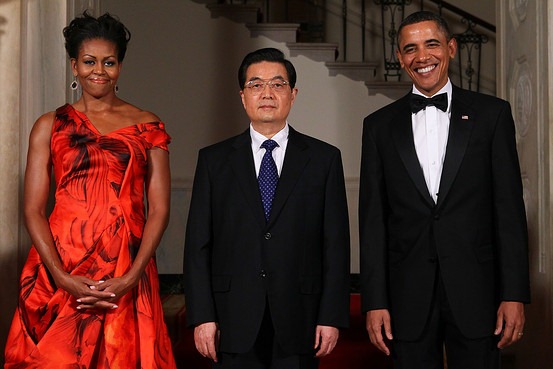
3. But it’s more than just Hu’s tough spot back home. China’s elites deeply hanker for US recognition. China’s national ideology is grievance and nationalism – the 100 years of humiliation. When you visit Tiananmen Square, there is a huge video screen playing regular imagery of this post-1989 ‘China is awesome’ motif. Communism is dead; ‘getting rich is glorious’ is hardly bracing or communitarian enough to bind a billion people together; democracy is not a option. So a Weimar-style nationalism of grievance and national shame is the substitute (even if Chinese academics think it is bunk, as was my experience in China). So China’s got a big chip on its shoulder and satisfying this thirst for status is the reason for all the pomp and fuss of the visit, for the Rovian levels of choreography that left nothing to spontaneity (as with the 2008 Olympics), for the Chinese insistence that it be a ‘state visit’ with Obama in a tux, for the meeting with Congress, for the empty banalities of Hu’s actual comments, etc. Process, not substance, was the whole point – a process wherein the US looks like an equal to China, not a superior, wherein the leader of the only superpower bows and toasts to a Chinese, wherein ceremonialism, flags, uniformed soldiers saluting, endless fussing about who sits where, and lofty rhetoric go unsullied by real work or substance.

4. So you say, what was the whole point then?Process for its own sake sounds like a huge waste of money all around, and giving the Chinese something for nothing. This is true, but the US is now so dependent on Chinese Treasury purchases that playing China’s reindeer games is a worthwhile tradeoff to get more of their money, at least until we get our fiscal house in order. That’s the US benefit. And for the Chinese?

Atmospherics count for a lot in Asia. Asian media is more self-congratulatory, more statist, and more concerned with image and rank of their leaders aboard. This is why ASEAN meetings, an endless, do-nothing merry-go-round of photo-ops and ceremony, still happen. Little is achieved; ASEAN is 2/3 the age of the EU but has done maybe 10% of the work. Yet still it meets, because process – with consequent coverage on CNN and pictures in the Economist or New York Times – is a goal itself.  A few years ago, when President Lee of Korea met George Bush for golf, Lee drove the golf cart around. To Americans, it looked like two buddies having fun, and this was exactly the sort of downhome, buddy-buddy stuff W liked in diplomacy. But Koreans took it as Lee chauffeuring George Bush around and got miffed that it was some kind of snub by the white guy. This was between allies, and the Americans had no idea the pic would be received that way. In fact, Lee looks like he’s having a pretty good time – all the more demonstration of Asian tetchiness on perceptions of rank and social hierarchy. For China then, this is even worse, because the media is wholly state-directed and even more jingoistic than Korea.

The root of this is Asia is Confucianism. Western traditions of equality and individualism are imports here. The long cultural tradition is hierarchy, in which a junior recognizes the moral/intellectual superiority of a senior (and increasingly today, greater wealth implies the higher ranking position). Social disruption stems from the junior’s unwillingness to recognize his place (yes, just like in Plato). Hence, the endless Chinese usage ‘harmonious society’: China’s population is supposed to recognize the moral/developmental excellence of the CCP and follow its learned orders, not protest for human rights or democracy. Applied internationally, this Confucian schematic of rank and dominance layers a further moral sheen onto the realpolitik division of the world into great, medium and small powers. For a long time, the West (and whites, to be very honest) was perceived as the senior, even if the British imperialists and American administrators who embodied this, did not know it. But with EA’s recent growth, it is time, deliciously, to rebalance the hierarchy. Hence Obama has to give a state dinner to an Asian, and W should be the one driving the car. There is a lot more going in this visit than China’s growth; Western fetes of Asian leaders serve a deep, local cultural/racial desire to see Asians in place of the Confucian master/senior in interstate relationships.

5. More generally, everyone likes recognition, and recognition flows downhill. That is, stature is imparted by those ‘above’ you. Hence the president of Korea likes golfing with W, because it makes Korea look like a great power, while the US gains little prestige from the visit. For China, the only possible state than can confer rank on it is the US. Getting US peer recognition is central to the ‘we’ve-been-stepped-on-by-foreigners’ narrative of the CCP. Rising powers particularly care a lot about recognition of their ‘place in the sun’ by the old guard.

6. Also: I was pretty pleased to see the western media give Hu a hard time on human rights. The US media was made a fool of by the Bush administration. Here was a chance to get its integrity back. Well done.

Yeonpyeong Shelling Summation (3): Responses

ny_times_yeonpyeong

Part one is here; part two is here.

Last week, I noted that I was drafting an interpretation of the NK shelling of Yeonpyeong island on November 24 for the Korean National Defense University. I am grateful for the many comments on received. My posting this week will represent my full thinking after three weeks of posting and comments and will be submitted for publication early next week. I would appreciate comments and thoughts no later than Monday. Thank you.

_____________________

3. Responses

SK lacks good short-term responses to incidents such as Yeonpyeong or the Cheonan. But it can develop a medium-term strategy to slowly throttle NK in a long-term Cold War-style stalemate.

3.1. Bad Short-term Choices

The Yeonpyeong shelling may be shifting the SK debate over responses to provocations. The new defense minister speaks of loosened rules of engagement (RoE). Proposals include lowering the threshold of NK misbehavior required to permit counter-fire, enhancing the amount of counter-fire force beyond proportionality, permitting greater on-site commander authority to return fire, expanding target packages to include NK sites beyond the immediate crisis zone, and using air power. This feels emotionally satisfying in the heat of the moment, because N and SK are engaged in an acute stand-off, in which both sides perceive strong, zero-sum material and prestige losses at the expense of the other. NK perceives SK status gains (point 2.2 above) at its expense and hits back; SK perceives the North to destroy its assets with impunity and presses to counter-strike yet harder. This is a classic tit-for-tat spiral, akin to Israel’s relations with the Arab states, that could easily degenerate toward war. Looser post-Yeonpyeong RoE are a misjudgment for three reasons.

First, SK is extraordinarily vulnerable to conventional Northern retaliation. One-half of SK’s population lives within 50 miles of the Demilitarized Zone (DMZ) in its enormous, high-density northwestern urban agglomeration. The Incheon-Seoul-Gyeonggi corridor contains approximately 25 million people in just 5% of SK’s land space. Many live in apartment towers dozens of stories high, very vulnerable, in the manner of the World Trade Center, to catastrophic collapse if hit by military fire. NK has stationed thousands of rockets and artillery at the closest point on the DMZ to hold this population hostage. Further, the SK government and economy are centered here. Hypercentralization and extreme exposure of the ‘Seoul-Republic’ has stayed SK’s hand in the past and likely will in the future. The risk is enormous.

Second, NK faces strong ideological and bureaucratic pressures to hit back in tit-for-tat spirals (point 2.3 above). NK is dependent on military bravado as legitimation in its ‘military-first’ polity. Expanding tit-for-tat counterforce beyond the immediate crisis time and space risks challenging the ‘manhood’ of the KPA in a system where that is absolutely central for regime identity. Openly challenging the KPA over its ability to defend the North is tantamount to asking for them to hit back, and yet harder. Counterforce also reinforces the Northern ideology, which is dependent on the domestic perception of SK as major national security threat. SK responses, however justified, feed this last remaining ideological prop of the regime.

Third, any extended, kinetic interaction between North and South will certainly generate compounding externalities of collateral damage, accidents, and misperception. Particularly in combination – Yeonpyeong local commanders calling for airstrikes on the NK mainland? – looser RoE could easily result in new incidents quickly spinning out of control. Once a tit-for-tat spiral begins, it would be increasingly difficult to halt as sunk costs mount; NK particularly may not have the command-and-control necessary to reign in the KPA once unleashed. As the accidents and misfire in the fog of war accumulate, events, not policy, would drive further escalation. A clear example is the Cuban downing of an American U2 during the Cuban Missile Crisis; local command authority nearly sparked a conflagration.

1.2. Medium-term Stalemate

With short-term options closed because of extreme exposure and escalatory insecurity, SK can improve its medium-term position to ‘win’ this long-term stalemate. By win, I understand the collapse of the North and re-unification on Southern terms, roughly modeled on German unification. Hawkish alternatives to the right, including aggressive RoE or invasion, are far too risky; the leftist, normalization alternative – permanent acceptance of the status quo of NK’s existence – is immoral, as it abandons the NK population to unending misery. Currently SK ‘muddles through,’ regularly managing NK on the short-term, crisis-by-crisis. But three medium-term policy shifts could improve SK’s long-term position of strength, with the goal of gradually pressuring NK toward collapse, much as the USSR eventually imploded under relentless allied pressure.

First, SK should de-centralize. The seat of government should move to Daejeon or Busan, far from the frontline. West Germany placed its capital far from its frontline for analogous flexibility and security. Government subsidies for residence and commerce outside of Gyeonggi could encourage a de-densification of the northwestern city-hostage, thereby untying the SK military’s hands after incidents like the Yeonpyeong. There are solid regional equity reasons for decentralization as well, but the national security benefit would dramatically tilt the intra-Korean stalemate in SK’s favor. A ‘hardening’ of northwestern SK through depopulation, improved architecture, civil defense drilling and bomb shelters, would lower the risks of escalation (point 3.1 above).

Second, Korea should expand its defense spending. 2.7% of GDP is rather low given the chronic threat NK, and it would gradually expand SK’s response options in tandem with decentralization. Specifically, SK should expand the navy, as many of these incidents occur in the Yellow Sea, and invest in the ‘networked battlefield’ technologies (C4ISR: command, control, communications, computers, intelligence, surveillance and reconnaissance) for which it leans so heavily on the US and the lack of which so clearly hampered the counterfire from Yeonpyeong. Offensive systems, most clearly armor, although controversial, would also signal to the North, that SK conventional deterrence is not simply defense-in-depth.

Third, neither of these suggestions is realizable without a much deeper electoral commitment to ‘win’ a long-term stalemate, rather than the current SK malaise to simply manage NK crisis-by-crisis and then ignore it otherwise. SK is constitutionally committed to reunification, but, like West German youth by the 1980s or the Irish today, SK younger generations are maturing with little knowledge of NK, growing fear of reunification’s costs, and increasing diffidence to the whole tangle. SK is slowly becoming a de facto status quo power in peninsular affairs; if NK can hang on long enough, South Koreans may not want unification anyway.

Active political leadership is required to prevent this drift. A national consensus to win, not just manage, would improve SK’s position of strength in what is already a test of wills and commitment. In the short-term, deterring NK’s regular, ideologically desperate provocations requires national sacrifice for decentralization and military expansion. In the long-term, a national consensus to end, not just manage-and-forget, the Northern regime would sustain these sacrifices. A grinding, expensive, and long Cold War-style stalemate in which NK is slowly throttled into collapse by relentless Southern power – on the US cold war model of slowly competing the USSR into oblivion – is the safest and most humane way to end the brutality under which North Koreans live.

Yeonpyeong Shelling Summation (2): More Causes in Hindsight

300px-Yeonpyeong_shelling

Part 1 is here. Part 3 is here.

Last week, I noted that I was drafting an interpretation of the NK shelling of Yeonpyeong island on November 24 for the Korean National Defense University. I am grateful for the many comments on received. My posting this week will represent my full thinking after three weeks of posting and comments and will be submitted for publication early next week. I would appreciate comments and thoughts no later than Monday. Thank you.

_________

More Causes

2.3. Long-Term/Structural: NK’s Permanent Legitimacy Crisis

NK faces a permanent legitimacy crisis in the wake of communism’s collapse. During the Cold War, Korea’s division could be explained, like Germany’s, by competing visions of economic justice (socialism vs capitalism). And indeed, Kim Il-Sung likely believed in socialism. But the son clearly does not; the Cold War is over; East Germany is gone. North Korean citizens increasingly know this. The post-famine explosion of private trading across the Chinese border has brought new information to the NK citizenry through (illegal) cell phones and SK VHS tapes (after-market resales due to the 1990s global switch to DVD). North Koreans now know that SK is wealthier; that Germany has unified; that USSR is gone. Indeed, the regime no longer speaks of communism or even juche much. So the obvious question for a people with no previous history of division, with substantially worse living conditions than the other national alternative, and ruled by an elite formally committed to unification is why NK cannot go as East Germany did. This existential problem ultimately destroyed East Germany after the Wall opening; its elites could find no answer and simply gave up. In Korea, unification on Southern terms would almost certainly result in a truth-and-reconciliation process given extreme Northern despotism. Post-unification courts would likely imprison or even execute senior KWP, KPA, and Kim family officials. (SK still retains the death penalty, likely for exactly this purpose.) NK elites do not want to go the way of Mussolini, Ceauşescu, or Saddam Hussein.

With communism a dead letter and unification blocked for elite security reasons, the only possible justification for the existence of separate, poorer, unhappier, unhealthier NK is that SK is a revanchist puppet of the imperialist US. NK’s last-ditch, post-communist ideology against the Southern and American ‘aggressors’ is now the ‘military-first’ policy, in which NK is reconceived as a national defense state protecting Korean national integrity. As such tension with SK is existentially required. NK must have a permanent oppositional relationship with the South, otherwise, why does it still exist? This is the structural cause of Sunshine Policy’s failure, despite heroic efforts and good-faith bargaining by SK’s liberal administrations. Normalization is simply impossible for the regime if it is to continue as it is. So even if SK does not provoke the North, then North must do so anyway; ergo, the long list of incidents in point 1 above. Something must justify deprivation, national division, and military privileges to the disconsolate, long-suffering Northern population, and ‘national defense’ incidents like the Cheonan or Yeonpyeong serve this purpose. This is why Yeonpyeong is nothing new and why something like it will happen again; it is in the structure of the regime.

2.4. Permissive: China’s Cost-Benefit Calculus

China continues to calculate that an erratic, nuclearized NK is preferable to unification on Southern terms. A peninsula-wide version of SK is the only realistic unity scenario given NK’s extreme backwardness – decrepit, corrupt NK probably could not even manage the whole peninsula – and SK’s demonstrated unwillingness to sacrifice democracy for unity. China’s continued subsidization for NK’s economy is well-known and has only become more crucial as events like the famines, failed currency reform, UN sanctions, expensive nuclear program, and continued resistance to Chinese-style reforms have effectively devastated the NK economy, all the more ironic for its autarkic claims of juche. (The CIA estimates NK’s GDP at just $42 billion for 24 million people.) China’s refusal to endorse the Security Council reprimand of NK over the Cheonan signaled that when pushed, it will choose North over South.

This opens the door for continued NK intransigence and provocation. Given NK’s extreme asymmetric dependence on China, it is highly unlikely that NK would openly cross its benefactor. One can only speculate what if any Chinese red-line warnings on provocations were given to Kim Jong-Il on his recent trips to Beijing. Yeonpyeong probably did not cross that line, as the Chinese response has been widely regarded as tepid and insufficient.

China is formally committed to Korea unification – ideologically required for its own claims to Taiwan. Yet Chinese scholars openly speak of NK as a buffer, hence instrumentalizing NK to Chinese foreign policy. China fears a ‘southernized’ peninsula – a unified, populous, wealthy, nationalist, democratic, American-allied Republic of Korea on its border. The NK buffer keeps SK and its American and Japanese allies one step further away. NK antics also serve to keep these three Chinese semi-rivals off-balance and confused in northeast Asia. Further, Manchuria contains millions of Korean-Chinese whose potential ethic nationalism China does not wish stirred by emotional, globally-evocative imagery of Korean unity.

Yeonpyeong Shelling Summation (1): Context and Causes in Hindsight – UPDATED: More in the Comments


Yeonpyeong-island_1768397i

Last week, I noted that I was drafting an interpretation of the NK shelling of Yeonpyeong island on November 24 for the Korean National Defense University. I am grateful for the many comments on received. My posting this week will represent my full thinking after three weeks of posting and comments and will be submitted for publication early next week. I would appreciate comments and thoughts no later than Monday. Thank you.

Part 2 is here; part 3 is here

ABSTRACT

I identify four likely causes for the recent North Korean (NK) shelling of Yeonpyeong Island and argue nonetheless for a policy of retaliatory restraint. Two short-term causes are, 1. the regime’s domestic need to bolster the non-existent military credentials of Kim Jong-Un in order to ensure a successful transition in a hyper-militarized political system, and 2. to embarrass South Korea (SK) after the successful hosting of the G-20, which implicitly contrasted with NK’s worsening dysfunction and poverty. A third, structural cause is the regime’s permanent, post-Cold War legitimacy crisis – NK’s existential requirement for regular tension with SK in order to explain its continued existence as a separate poorer, unhealthier, unhappier Korean state despite the collapse of communism and, especially, of East Germany. A fourth, ‘permissive’ cause is China’s continuing refusal to leverage its influence over NK in order to indefinitely prevent the emergence of a unified, populous, wealthy, nationalist, democratic, American-allied Republic of Korea on its border. Unfortunately, SK’s post-Yeonpyeong responses are tightly constrained by the extreme vulnerability of South Korea’s enormous northwestern (Incheon-Seoul-Gyeonggi) urban agglomeration. 50% of SK’s population lives within 50 miles of the Demilitarized Zone; escalatory, kinetic tit-for-tat scenarios from loosened rules of engagement place them in tremendous jeopardy. I counsel short-term restraint coupled with a medium-term decentralization of SK out of the northwest, significant military expansion, and refocused government effort to build genuine popular, not merely formal-constitutional, commitment to win a grinding Cold War-style stalemate eventuating in NK’s collapse (akin to America’s slow reduction of the USSR).

_____________________________

1. Context: Nothing New

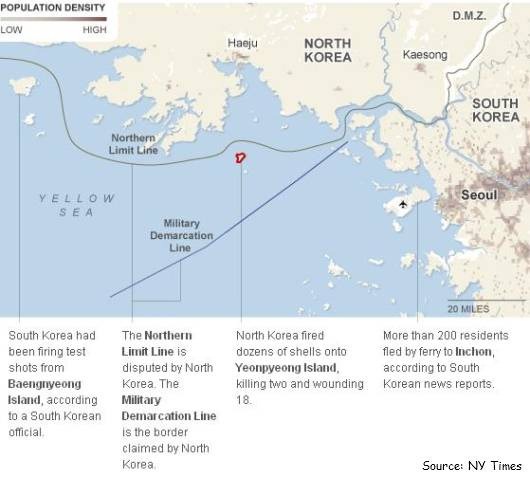
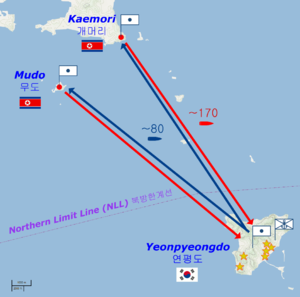
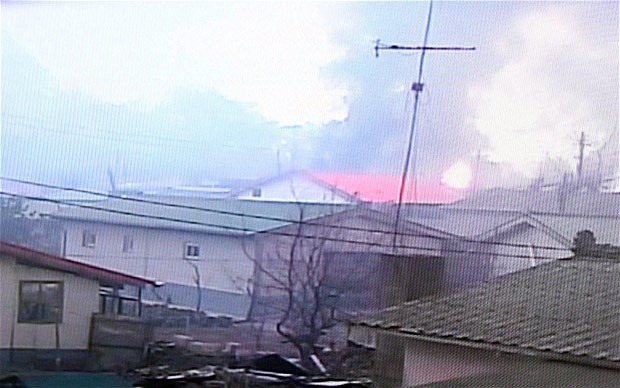
North Korea (NK) has a long history of provocations against South (SK), in which context the Yeonpyeong shelling is better understood as neither unique nor a step toward war. Much of the media commentary has exaggerated the escalatory potential of this crisis, generating a clear possibility for a self-fulfilling prophecy. That is, hyperbolic commentary that SK ‘honor’ is at stake in the ‘worst crisis since the war’ raises pressure on SK elites to respond with sterner measures, thereby worsening the very crisis they seek to de-escalate. Indeed, given that more casualties were suffered in the Cheonan incident (46) than Yeonpyeong (4), and that NK knew more clearly that a surprise-attack sinking would kill more South Koreans than the more random artillery fire against Yeonpyeong, NK is far more culpable for the earlier attack. SK rage this time is disproportionate to NK’s track record of such behavior.

A few incidents are worth recalling which diminish the uniqueness of the Yeonpyeong shelling and therefore mitigate the calls for looser rules of engagement (RoE): the 1968 attempt to assassinate Park Chung-hee, the 1976 tree-cutting incident, the 1983 cabinet bombing, the 1987 KAL 858 bombing, the Yellow Sea skirmishes of 1999, 2002, and 2009, and the 2010 Cheonan sinking. None of these incidents led to war; many were far worse than Yeonpyeong; despite humiliation, post-hoc restraint was ultimately the safest course given SK vulnerability (point 3.1 below).

2. Four Causes

Causal attribution of NK behavior is classic kremlinology, subject to large information failures due to NK secrecy and disinformation. My reasoning below is historical (previous NK behavior as indicators of the future) and analogical (how other late stalinist systems and aging dictatorships generally behave). I posit four causes:

2.1. Short Term 1: The Kim Family Transition

Since NK’s mid-1990s move toward ‘military-first’ politics, military prowess, whether genuine or manufactured, has become central to legitimizing rule in NK’s increasingly militarized polity. Kim Jong-Il rules not as president or prime minister, but as the chairman of the National Defense Commission (NDC). The North Korean People’s Army (KPA) is increasingly the central prop in a regime notably lacking a justifying ideology in the wake of the collapse of communism (point 2.3 below). Military factionalization is common in aging communist systems, and dictatorships generally, and the next Kim, Jong-Un, desperately requires military credentials to hold the rickety, corrupt system together when his father passes. Jong-Un has never served in the KPA, and his youth conflicts with traditional Korean norms of authority, in which age and experience legitimate hierarchy. To compensate, he was promoted to four-star general this fall and placed on the NDC last year. Manufacturing crisis like Yeonpyeong burnishes his minimal credentials further, and the Korean Central News Agency (KCNA) has hyped him as an artillery expert, suggesting a clear tie to the recent shelling. The leadership transition is likely to be more unstable this second time, as the Jong-Un is far less groomed and known in the relevant bureaucracies (KPA and the North Korean Workers Party [KWP]), and the economy is yet worse than in 1994.

2.1. Short Term 2: The G-20

Elites in both Koreas face a unique legitimacy problem, insofar as a second Korean political alternative exists for a people with a clear history of national unity. As with the previous divisions of Germany, Vietnam, and Yemen, both Koreas explicitly compete to be ‘the’ Korea and delegitimize the other. An important SK tactic in this competition has been to host major international functions such as sporting events, trade associations, and leadership conferences which bolster its global reputation as the ‘real’ Korea. This strategy has succeeded. NK is quite aware of the legitimacy threat it poses, and it has responded angrily, most notably in 1987, when it attempted to dissuade SK from holding the 1988 Olympics by bombing KAL 858. The long-term NK planning for the Yeonpyeong shelling indicates premeditation yet again (invalidating the KCNA claim that it was a response to local SK drills). The shelling clearly dampens the SK global afterglow of successfully hosting the G-20 the previous fortnight. SK regarded both 1988 and 2010 a global coming out. The 1988 Olympics showed that a previously poor underdeveloped country torn apart by war had bounced back through an economic miracle (two decades of double-digit GDP growth) and was wealthy and stable enough to hold a major international event. The contrast with brutalized, still poor NK was obvious.  In 2010, the Seoul G-20 was also regarded in SK as proof of Korea’s rank in the elite G-20. And now, NK is even poorer and worse off than in 1988. The comparison is quite stark. Some pique of NK responsive anger was likely in order to signal that the KPA is still the central force to be reckoned with in peninsular affairs.

The New, Looser SK Rules of Engagement – One Scary Step Closer to War – UPDATED: Comments Requested

20101206_110134_101206-koreadm

The new SK defense minister, Kwan-Jin Kim

UPDATE: I’ve been commissioned by the Korean National Defense University to draft an initial assessment of the Yeonpeyong incident and possible options. I would welcome serious reader responses to the whole mess. My previous writings on it are here, here, here and here, plus below. My sense broadly is that there are no good short-term options (see below), and that, because of extreme population vulnerability and public disinterest, SK must suffer these sorts of humiliations until it seriously reconfigures local defense around throttling NK in a long-grind Cold War-style stalemate (“hanging tough” in Gaddis’s famous expression). That means decentralization, bigger defense budgets; lots of investment in command-and-control, intelligence (including satellites), and the networked battlefield; and far greater domestic popular commitment to a long-term victory over NK in place of the current, tacit acceptance of the status quo. To my left, I reject accepting the status quo as immoral, because it dooms the long-suffering North Koreans to perpetual brutalization, and to my right, well, God forbid this sort of outburst become policy…

UPDATE II: Contrary to my argument below (point 4), there is data to suggest that South Korean more broadly want counter-strikes. But the title of that article is more aggressive than the actual report, so read it carefully. Nor is it clear to me that South Koreans would support the escalation spiral that might ensure; i.e., if NK hits, and SK then hits back harder, and then NK hits back harder still, then should SK keep going? Fire and counter-fire in a limited time and space (like Yeonpyeong, which counter-shelling I supported), is different from the likely degenerative spiral that would ensue with airstrikes and some of the tougher countermeasures under discussion.

_________

I got a number of comments and emails asking for my opinion on the new SK rules of engagement (RoE) post-Yeonpyeong.  I got some criticism for being too sanguine and dismissive of the whole thing. The new rules are emerging now; the new defense minister is in-post now only one week. For some early write-ups on the new rules, try here, here, and here. For a discussion of the RoE on Yellow Sea naval clashes, try here. I’ve also caught some of the debate on TV. In general, the drift seems to be to lower the threshold for permitting counterfire (less NK aggression necessary before return-fire is permitted), enhance the amount of force used in counterfire (beyond proportionality), permit greater on-site commander authority to shoot back, open up strike-back packages to include NK targets beyond the immediate crisis zone, and use air power.

My initial response is that all this is too risky, particularly in combination (Yeonpyeong local commanders calling for airstrikes on the NK mainland, anyone?).  It brings SK closer to war the next time a provocation happens, which it most certainly will. NK is dependent on military bravado as a legitimation in its ‘military-first’ polity. Expanding tit-for-tat combat beyond the immediate crisis time and space risks challenging the ‘manhood’ of the North Korean People’s Army (KPA) in a system where that is absolutely central for regime identity. Openly challenging the KPA over its ability to defend the North is tantamount to asking for them to hit-back, and yet harder. Strike-backs also reinforce the regime ideology, which is dependent on the domestic perception of SK as major national security threat. SK responses, however justified, feed this last remaining ideological prop of the regime. Finally, SK is so vulnerable to an escalating tit-for-tat spiral of strike and counter-strike, that I just don’t think it is worth the risk, even if it is humiliating. Restraint not only demonstrates SK’s seriousness to the rest of the world, especially China, but is, quite honestly, more in SK’s medium-term national interests than the short-term ideological satisfactions of shooting back.

1. I have discussed in detail elsewhere the extreme vulnerability of SK’s population centers to NK. As such, if loosened RoE lead to a serious, degenerative spiral (escalating strike and counter-strikes) pushing toward war, the likelihood of disaster for the South is huge. If SK can move some of its population away from the DMZ, so that likely civilian casualties from a serious flare-up diminish, then I would consider looser RoE. But SK has painted itself into this corner by allowing so many people to live so close to NK. Almost any national humiliation like the Cheonan or Yeonpyeong is preferable now to risking hundreds of thousands of lives in a NK shelling of Kyeonggi province.

2. NK faces a permanent legitimacy crisis. During the Cold War, Korea’s division could be explained, like Germany’s, by competing visions of economic justice (socialism vs capitalism). And indeed, I believe Kim Il-Sung actually believed in socialism. But the son clearly does not; the Cold War is over; East Germany is gone. Hence the only possible justification for the existence of separate, poorer, unhappier, unhealthier NK is that SK is a revanchist puppet of the imperialist US. This is why NK gins up these sorts of incidents to begin with; the regime existentially requires tension with SK. So if the looser RoE bring expanded attacks, or even bombing, with its instant memories of devastating US airpower from the war, then you just play into the regime’s hands. You give it yet more reason to explain itself to (and clamp down on) its otherwise disconsolate citizenry. In short, restraint is the best long-term answer in the ideological stalemate.

3. NK’s regime ideology against the Southern and American aggressors is now the ‘military-first’ policy, in which NK is reconceived as a ‘national defense state.’ Socialism went out the door in the 1990s constitutional revisions; it was a deadletter anyway with the end of the Cold War. In this increasingly militarized system, military prowess (real or manufactured) is legitimation for rule in politics. Hence, the wide belief among analysts, that the Cheonan and Yeonpyeong incidents were to burnish the empty CV of the next Kim, Jong-un. If we accept this hyper-militarization, then any tit-for-tat sequence from looser RoE would generate enormous ideological and bureaucratic pressure in the North for escalating ‘tats.’ The KPA, to justify its dominance and generous budgetary privileges, requires ‘victory’ in these sorts of flare-ups. It is highly unlikely to turn-away from a fight, instead hitting back each time, and probably harder too. In short, I gravely doubt that NK has the ability to control a serious tit-for-tat spiral. The outcome is a much greater likelihood of war.

4. Do South Koreans even support these loose RoE? The media line seems to be that South Koreans are ‘outraged’ that the military can’t seem to protect SK. Ok, but please show me the public opinion data that says that South Koreans therefore endorse more aggressive escalatory responses, including the hugely risky proposal for airstrikes. The two don’t necessarily connect. A few angry older Koreans demonstrating in Seoul, while enough to convince the neo-cons, is hardly a show of support for the new risks Minister Kim wants. In my own dealings with Koreans at work and in private, I see a lot of fear and concern about where this is going. Myers calls the SK electorate ‘pacificist,’ and that is my experience too.

5. The looser RoEs create more possibilities for accidents that could spin out of control, and then events, not policy, would drive, further escalation. Remember that the everyone was terrified in the Cuban Missile Crisis that local Soviet commanders in Cuba might have authority to use battlefield nuclear weapons (they did, in fact), or that local commanders might slip the noose and force one side’s hand by a provocation, as almost happened when the Cubans shot down an American U2 on October 27, 1962. We assume and hope that SK’s new expanded counter-force would be both limited and decisive in order to halt escalation, but what if it isn’t? What if one of those ‘amazing’ F-15Ks gets shot down? Then we have SK pilots behind enemy lines on the run, sure to be executed if they get caught. This would create yet further pressure for escalation. Or what if a local commander with new counter-fire authority shoots back at mainland NK with artillery and kills civilians by accident (SK artillery fire wasn’t that accurate in the Yeonpyeong incident)? Then what? You’ve given NK yet another excuse for its very existence (bloodthirsty SKs), as well as justification for them to shoot back yet again.

6. Another provocation is almost certain, so looser RoEs are basically a prediction of the future. It is almost certain NK will do something dangerous yet again. Per point 3 above, tension with the South is ideologically required, so try to imagine NK sinking a SK fishing boat in the Yellow Sea in the next few years. I dare say when the current unhappiness passes, South Koreans will think twice about whether they think airstrikes and all the ‘kinetic’ risks thereby entailed are really worth it. Honestly, the answer is no. That is why this time too, for all the unhappiness, there is no summer 1914 war fever here. It is just too risky, far too risky, in fact to challenge NK into some kind of Cuban Missile Crisis style stand-off. Until SK reconfigures itself to win a long-term stalemate through a major military build-up, then it will be very vulnerable to Northern asymmetric strikes and, ultimately, wisely, too fearful to respond. It may seem ‘wimpy’ to neocons Iraq warriors in DC think-tanks, but it is the smart thing to do. The risks are just too great.

Another Laugh-Riot Asian IR Video, on the Currency War

And you thought economics was the dismal science…


It is Thanksgiving week, so here is something light. If you aren’t watching Charlie Brown Thanksgiving, get to it. See you next week.

(Should you actually want to ruin your holiday with serious reading on this issue, my previous thoughts are here, here and here.)

Hat-tip to Daniel Nexon on Duck of Minerva for this one.

This is great, yet another clever inside joke for the field. Here a few thoughts:

1. This is yet more evidence that IR needs some kind of serious treatment of alternative media presentations of what we do. Movies, video games, and now videos like this or the Chinese professor ad, all bolster my growing belief that we are missing something by not seriously examining media and IR. Reading – what IR-types do all day, cause its all we did in grad school – is obviously competing with lots of other sources of information in our digital age. Anyone who has taught undergrads for more than a few months knows that they don’t like doing the reading, but they love digital media. In the same way we now teach more and more IR film courses, we more generally need to adapt our pedagogy to the multifarious ways our students absorb information. NB: This is not an argument to dumb-down the field with video; it is a pedagogical concern. IR grad programs will still be the chilling, totalist, never-exercise, read-all-day, live-on-cigarettes-and-microwavable-food boot camp for you brain.

2. I am impressed how much knowledge of detail the authors of the video assume. Insofar as this is meant for a general audience, that reflects a fair amount of economic literacy in your average Joe viewer. Consider all this insider jargon: ‘capitalism with Chinese characteristics,’  DoT Secretary Geithner is only referred to as ‘Timmy G,’ ‘reserve currency,’ ‘currency manipulator,’ the list of Chinese premiers, the joke that GM means ‘government motors,’ Argentina’s 2002 default/meltdown, ‘buyer of last resort,’ ‘dollar denomination.’ That is a nice compliment to how much about econ the general public has learned since the Great Recession broke.

3. Great jokes: Uncle Sam dances and fires a machine gun in the air as Obama wears ‘USA No. 1’ bling. Somehow they managed to build a rhyme with ‘capitalism with Chinese characteristics.’ Did anyone else notice that the Chinese panda looked like Panda from Tekken? Obama’s dog died from lead in the Chinese dog food, complete with a green cloud around the dog. Adding the macarena dance from the 1990s was superb. I am embarrassed to admit that I thought the macarena was pretty cool dances moves back in the 1990s golden age…