Pyongyang isn’t ‘Laid-Back & Leafy’; or What Parag Khanna didn’t Learn in NK (5)

North Korea 2012 056

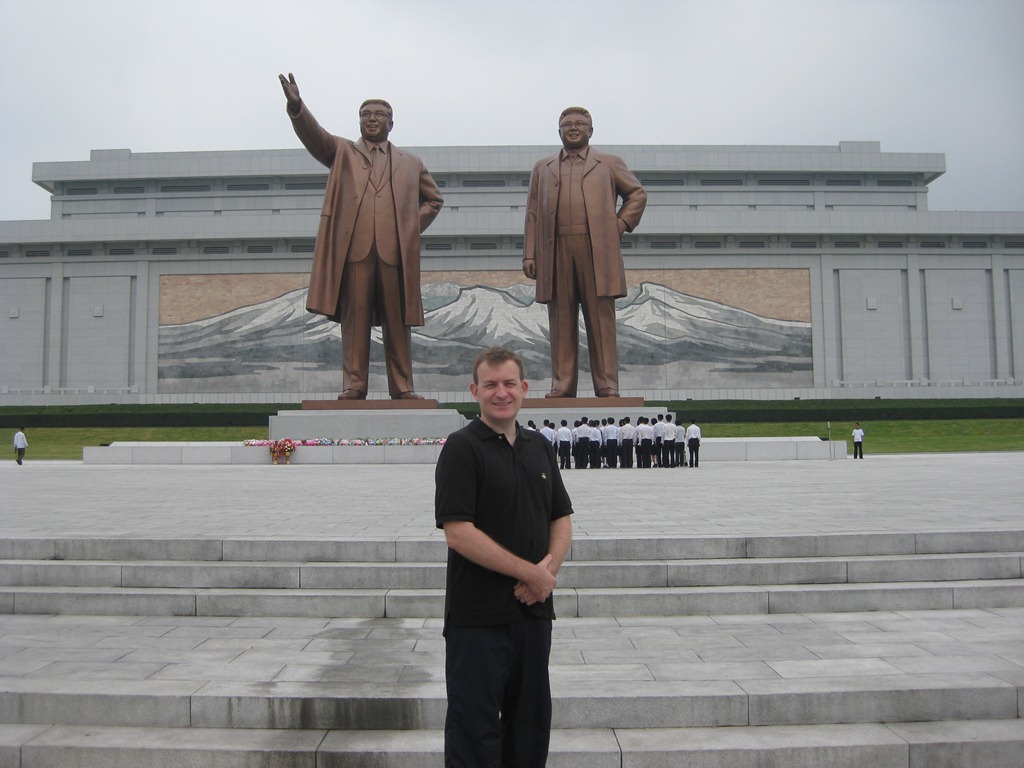
I know what you’re thinking – how many more d— pictures of this guy and Kim Il Sung (left, KJI right) do I have to look at? Well…too bad! They go on and on and on…

In the last two weeks I rolled out a series of impressions from my trip to North Korea (one, two, three, four). Apparently Parag Khanna went to NK at the same time I did (last month) and simultaneously put up his impressions at CNN-GPS, making for an interesting comparison of views this week. (You don’t have to go to the Khanna link, as I have reprinted the piece after the break, with some response comments.)

Dan Nexon and Dan Drezner both noted the coincidence (favorably, I am happy to say), and the blogosphere reaction to the Khanna piece has been pretty negative (look at the piece’ comments and then this, which is genuinely disturbing). I also thought the piece was too puffy and far too pleasant-toned for a place like NK.

I am amazed Khanna didn’t talk up the personality cult, as this is easily what any even mildly politically astute observer would catch, especially in Pyongyang which is ground-zero for the KIS cult. The guides practically beat you over the head with it at every turn. (NB: I tried make this point, about the blindingly obvious KIS cult, by posting a comment to the article on CNN. It failed moderation, twice. Come on, CNN. Really? Why censor me when other commenters are accusing Khanna of being paid by NK? Lame.)

Anyway, all this surprises me, because Khanna seems like a pretty good scholar. I thought Second World was pretty good and cited it in my tangle over Russia and the BRICS earlier this year. More generally, he’s probably a pretty bright guy, and it doesn’t take much political sophistication to see that the NK tour-guides were steering us toward certain images, impressions, ‘heroic’ sites and tales, etc., so that we would leave NK and write something as complimentary as Khanna just did. Khanna didn’t see that? Really? How?

Continue reading

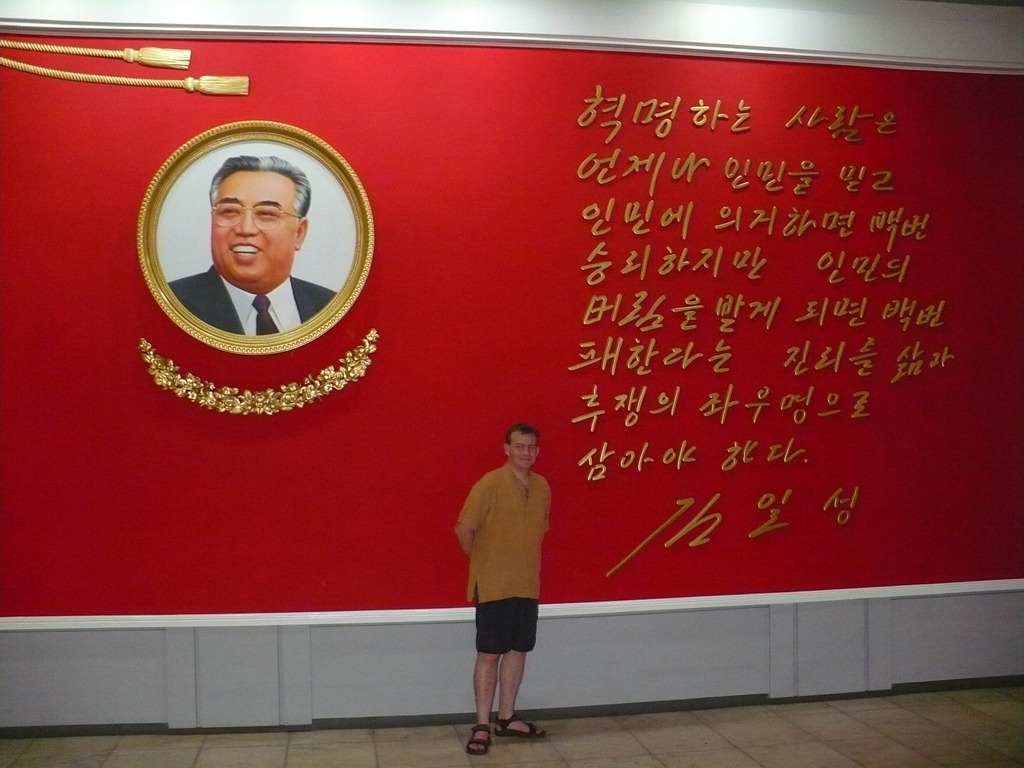
“Kim Il Sung will always be with Us,” or what I learned in NK (4)

067

This is my final post about my trip to NK; here is one, two, and three. The post title comes from a remark a local guide made to me, and that is standard KIS image in the pic.

7. The Korean People’s Army is pretty much everywhere.

This is easily the most militarized state I’ve ever been in. Soldiers and other uniformed military are everywhere, and units of KPA were doing all sorts of even banal things, like going to the Pyongyang fun fair, together en bloc. Guards carried automatic weapons openly in public with disturbing frequency. And the KPA was pretty clearly a captive, exploited labor force. Again and again we saw KPA young men fixing roads, constructing buildings, working in the fields, felling trees, and doing all sorts of things with little connection to actual soldiering – and doing all these dirty tasks in uniform, looking very uncomfortable and overheated. Guides regularly told us about a ‘heroic, glorious’ KPA work brigade that built that or this, but all I could think of was how miserable those young men looked making bricks or hoeing a field in the August heat while in a uniform wholly unsuited for the job and probably getting paid zippo. This wasn’t the army – it was impressed labor in a workers’ state. Ironically, if there’s any one thing East Asia has in abundance, it’s construction companies; SK, Japan, and China love building white elephants. What a shame then to waste your 20s as semi-enslaved labor building a crappy highway for the KPA that no one will use anyway, because no one owns a car.

Continue reading

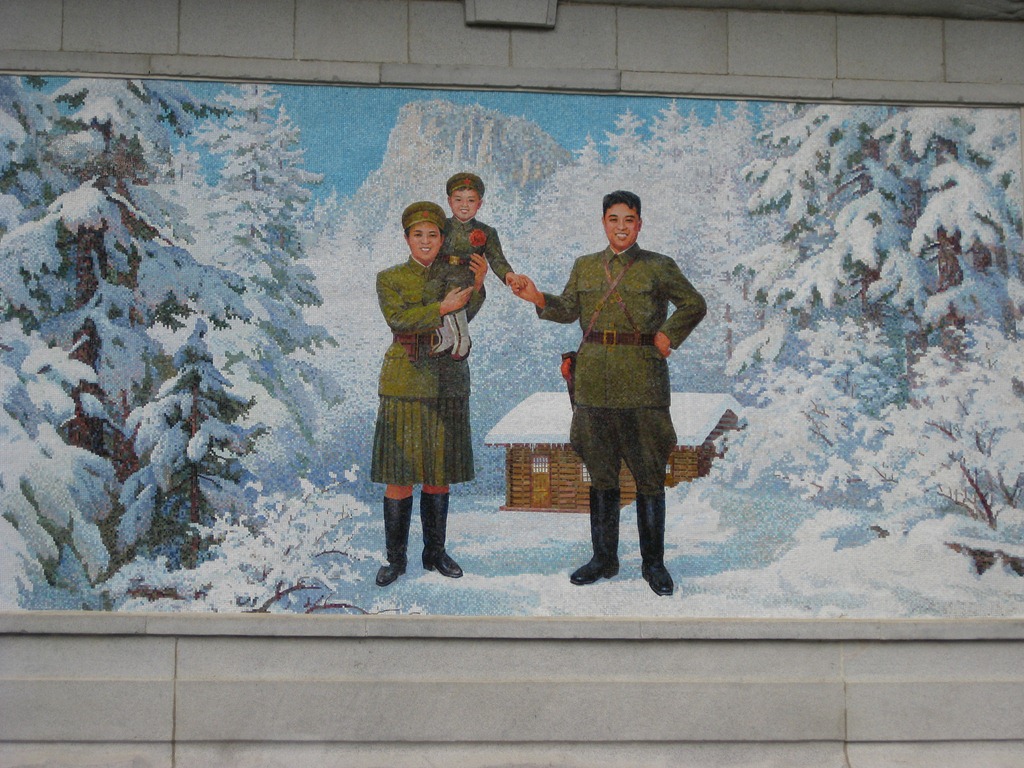
“Kim Jong Il was Born on Mt. Paekdu,” or what I learned in NK (3)

North Korea 2012 349

There is KJI in the middle – he was even born in uniform!

Mt. Paektu is the mythical founding location of the Korean race. Actually, KJI was probably born in the USSR during the war.

Here are parts one and two of this series.

5. Pyongyang the Potemkin Village?

The usual line is that Pyongyang is a potemkin village compared to the rest of the country. I can’t say, but I think so. Unfortunately, we only saw the capital, Nampo, and the Mt. Paektu area. And what we saw was quite controlled of course. We were told at certain points that we were not allowed to photograph out the bus windows. But honestly, I didn’t see any extreme poverty. I certainly didn’t see anything like what I saw in southern Africa or India. There was nothing like the gigantic slum-and-shack ‘city’ around Mumbai that is a terribly depressing shock the first time you see it.

My impression instead was that almost everything, beyond the most important government buildings in the elite district around Kim Il Sung Square, was run-down – the sort of crappy, broken down socialist world of faceless, concrete block ‘living units’ portrayed in A Clockwork Orange. Just as Alex lived in “’Municipal Flat Block 18A, Linear North,” so do most North Koreans. In our hotel, there was even restaurant no. 1, no. 2., no. 3, and no. 4. Apparently the Presidium of the Fourth Committee for Ideology in Quadrant B12 decided in the Eighth Five Year plan that restaurants in NK must be as bland as possible…

Continue reading

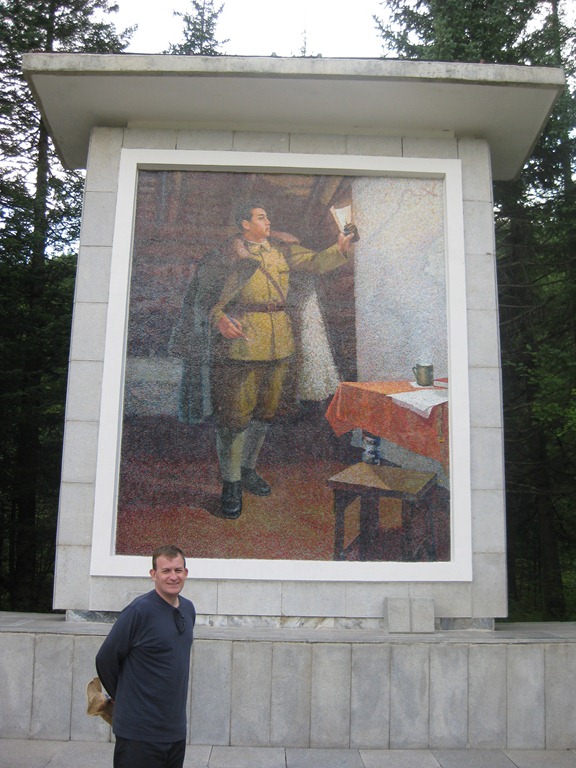
“Of course the Americans Started the War,” or what I learned in NK (2)

North Korea 2012 358

I have 50 more analogous pics of me with KIS murals, statures, pictures, busts…

I went to NK this summer. In my first post, I noted how NK should probably be re-named Kim-land. Here are some more impressions:

1.a. Kim Jong Un was not so emphasized.

In passing, it is worth noting that KJU was not stressed that much. At the Arirang games, portraits of KIS and KJI were put up, but not KJU. Nor did we see any images of him at all. No portraits or murals. There were a few slogans using his names, but no imagery anywhere. We were told that is because of his modesty. He does not want to so glorified while he is still alive. I don’t buy that for a moment. Maybe it suggests he is still getting a hold of the state? Not quite sure what to make of it.

Continue reading

“Against Dogmatic Bourgeois Flunkeyism,” or what I learned in NK (1)

North Korea 2012 382

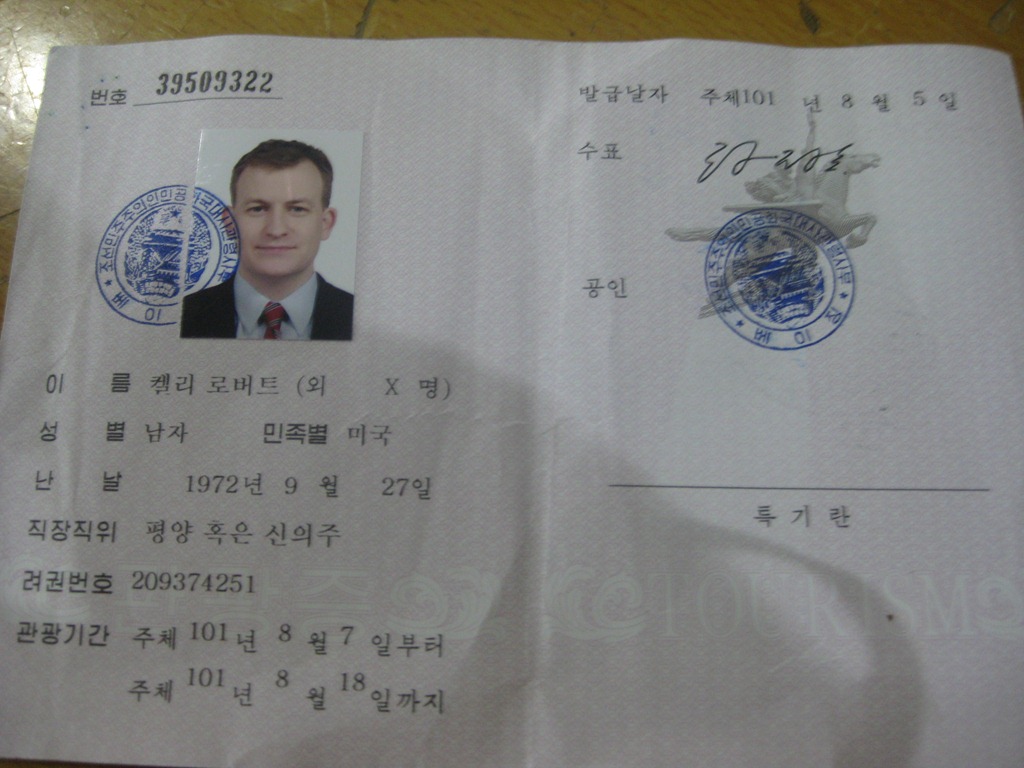
My North Korean visa

In August, I visited North Korea for the first time. It was the most unique travelling experience I’ve ever had. I’d certainly recommend it to political scientists and Asia experts, but it wasn’t anything close to a ‘vacation’ or break or anything like that. (Yes, some of the sites marketing tours of NK actually call it that.)

At a bookstore devoted to the works of Kim Il Sung and Kim Jong Il, I stumbled across an essay, from the latter if I remember correctly, about social scientists’ commitment to the revolution and juche. It included the title line – that we must avoid ‘flunkeyism’ toward ‘bourgeois’ forms. We are supposed to contribute to revolution, not critique too much, and not ‘ape’ western ideas.

(I love that sort of over-the-top Marxist writing – I remember the first time I read Maoists decrying ‘capitalist roaders’ and their ‘imperialist running dogs.’ I couldn’t even figure out wth that meant until I got to college. Who doesn’t miss the Cold War? But wait – perhaps Kim Jong Il is wired into the ‘poverty of social science theory’ debate and knows about the flunkeyism endemic to grad school?! A-hah! He knows! He is the great leader! He sees all!)

So here some thoughts that presumably demonstrate my flunkeyist failings:

1. It really is Kim-land

There is an endless debate over the ‘real’ nature of NK – is it a gangster state? A neo-Confucian kingdom? A typical stalinist half of a country divided by the Cold War? Semi-fascist? Presumably the answer is some mix of all that, but what really struck me in-country was the personality cult. Back in April Kim Jong Un referred to NK as “Kim Il Sung nation,” and that is certainly what they showed us. The Kims, especially KIS, were all over the place – statues, placards, and their names on one institution after another.

Continue reading

Guest Post: Dave Kang – “Confucian North Korea”

I am on break for the summer, but I am happy to open this space to a good friend and excellent scholar on international relations theory and Asia – David C. Kang, a professor of international relations and business at the University of Southern California and director of its Korean Studies Institute. Regular readers will know that I cite Dave’s stuff a lot. If you aren’t reading him, you should be: here is his Amazon page.

Confucian North Korea

clip_image002

Figure 1. Korean Worker’s Party symbol

It is easy to caricature North Korea as a “bizarre” “land of no smiles” full of brainwashed robots. In the past few years, North Korea has become somewhat prominent in popular culture either as a salacious joke or a freak show of a country. (And yes, I refuse to give you too many links to articles I think are misinformed caricatures). The trope of North Korea as a nation of automatons, grimly marching through each day is very powerful.

It is absolutely true that the regime itself is horrific and reprehensible, and engages in systematic human rights abuses. Indeed, the people of North Korea are the most direct victims of the ruling regime. I am totally for regime change, or a regime that modifies its ways and introduces economic and social reforms that improve the lives of its people. However, wishful thinking has gotten us nowhere, and rather than simply sit back and laugh at North Korea or call it names, perhaps we might explore why the regime has survived as long as it has.

In addition to extensive repression and selective bribery, what is widely overlooked is that the North Korean dictatorship is built on deeply traditional Korean cultural and Confucian roots. In fact, the best way to understand both the regime and its people is to remember that North Koreans are Koreans more than anything else. Far more insightful than any other description such as “communist monarchy,” North Korea is identifiably Korean, and there is a coherent internal logic in much of its way of life. As a result, the regime is more stable and enduring than commonly thought. (The arguments I make here have been made much more cogently by Bruce Cumings and Suk-Young Kim, among others).

Take a look at picture at the top of this page, which is a photo of the official emblem of the Korean Worker’s Party. Although the hammer and sickle are easily recognizable as signs of all Communist Parties from the Soviets to the Chinese Communist Party and others (Figure 2),

Figure 2. Flag of the Chinese Communist Party

clip_image004

North Korea is unique in that there are actually three symbols. What is that middle symbol in Figure 1?

1. Candle?

No. Wrong. C-

2. Paintbrush?

Warmer. What kind of paintbrush?

3. A calligraphy brush they used in olden times to write Chinese characters?

Yes!

It is a Confucian scholar’s brush – perhaps the most direct and vivid symbol of traditional learning, culture, and scholar-elite rule in Korea since the 9th century Silla dynasty first introduced an examination system for selecting government officials.

This is pretty remarkable. The Communist Party everywhere has stood for an utter rejection of the past and tradition as feudal and oppressive, and the basic message from Stalin to Mao has been to destroy the past and totally rebuild society. Yet the North Korean regime, rather than attempting to erase the past, has grafted itself onto traditional Korean traits, and reached back to some of the most traditional iconography possible: a hierarchic and elitist symbol of education, with all the other Confucian connotations that go with it: a ruler who embodies both the country and the “mandate of heaven,” an emphasis on centralized political control, and a clear set of hierarchical relationships that create harmony.

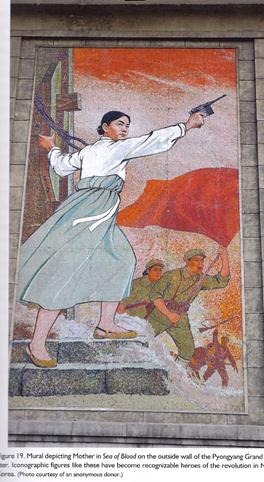
What about the role of women? Figure 3 is prominently displayed in Pyongyang, and depicts a generic and heroic “Mother,” fighting against the Japanese.

Figure 3. “Mother” in Sea of Blood

clip_image006

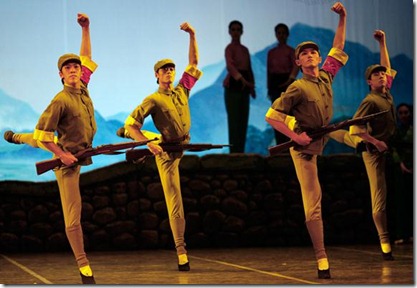
What is interesting about that painting? As with the KWP symbol, it might strike the viewer as somewhat odd that she is wearing traditional Korean women’s dress (“hanbok,”or “choseonot as they call it in North Korea). Compare this with the standard depictions of revolutionary Communist women from China or the Soviet Union – they are all in drab “Mao jackets” that reject and depart from any traditional and feudalistic tendencies (Figure 4).

Figure 4. Chinese revolutionary women
clip_image008

But in North Korea women have been presented with an image that emphasizes their Koreanness – a traditional dress that is far more common in Pyongyang and North Korea than in South Korea. The regime explicitly is telling North Korean women that they are a link to a way of life that is Korean, and the way they dress is the most obvious manifestation of that link.

What about the “cult of personality” and the rise of the grandson? Surely that’s bizarre, right? Not really, in a traditional Korean context. The Confucian emphasis on family places the father as the head of the family. Kim Il-Sung simply placed himself as father of the country, and grafted an authoritarian state onto the existing social and cultural roots. Leadership by a powerful family makes sense in a Korean context. Korea is a clannish country, and the family is the basic building block of social, political, and economic life.

The best way to understand the role of families is by comparison with contemporary South Korea. The foundation of Korean life in both North and South is the clan. For example, most major business conglomerates are family-run, and often the grandson of the founder is now in charge. This is the case even of the biggest companies in Korea. In addition, it may appear to outsiders that Korea is a country with only three last names (Kim, Park, and Lee, hahaha). But all those Kims are actually divided up into dozens of different clans, each connected to a hometown, each with extensive family lineage records, and each vividly distinctive to other Koreans. Thus, there is Kimhae Kim, Seoul Kim, Kyongju Kim, etc. So powerful was the clannish nature of Korea that until 1998, members of the same clan could not legally marry, even if they were separated by tens of generations. Similarly, Kathy Moon has recently argued that the blather over Kim Jong-un’s marriage is mostly misguided: “For Koreans on both sides of the 38th parallel…Unless one is married (and with children), one is not fully an adult. In both Koreas and in dynastic cultures, those pieces are supposed to come in the same box, to be pieced together into a coherent puzzle.” Thus, within a Korean cultural context, multigenerational leadership in North Korea and family as the building block of society is common sense.

Why does this matter? Because the story the North Korean regime tells itself and its people is aimed at domestic audiences, not at international audiences. They are telling a story that — however warped and corrupted — resonates deeply and instinctively with Koreans: North Korean are the true Koreans, and are the only ones remaining true to the essence of being Korean. South Koreans have been corrupted and forgotten who they are. The Kim family is leading the fight against external oppressors such as Japan and America. If the people must endure some hardship in order to maintain a Korean way of life, that’s a small price to pay.

This is one reason I tend to think an Arab Spring or uprising is not likely. Questions of imminent demise overlook the fact that North Korean dictatorship has grafted itself onto deeply traditional Korean culture roots. As a result, the regime is much more stable than some may think. For some people of North Korea, conditions may become so horrific that they choose to try and leave. But far more remain, and they remain not because they are brainwashed and not only because of repression. Many stay because North Korea is their home, where they grew up, where their family and friends live, and it is what makes sense to them.

Why N Korea Gets Away with its Stunts: a Response to Jennifer Lind

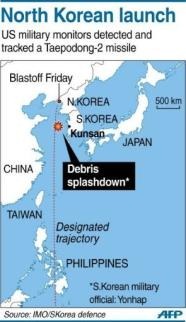
NKl trajectory

Jennifer Lind has a good piece up on Foreign Affairs this week on why NK seems to regularly get away with with hijinks like last week’s rocket test (which directly contravenes UN Resolution 1874). She notes, correctly, that NK has been pulling unanswered, wild stunts like this for years – shootouts in the Yellow Sea, nuclear tests, kidnappings, etc. Further, the US particularly tends to hit back when hit. Indeed, looking at the GWoT, America’s problem is over-reaction rather than passivity. If we look at the Israelis, it’s similar. They have a well-established reputation of hitting back, hard, when provoked. So why don’t the democracies of the Six Party Talks (Korea, Japan, US) do the same here? They easily out weigh NK.

Her argument is that NK manages to deter counter-strikes through a bizarre mixture of the ‘madman theory’ (what will the loopy, hard-drinking, megalomaniacal Kim family do next? so let’s just not provoke them), regional fear of what would follow a NK implosion (après moi le déluge), and traditional nuclear deterrence (if Saddam and Gaddafi had nukes, they’d still be alive, so we’ll never give them up!).

None of that is wrong, but I think she’s missing the big factor – SK domestic politics. Lots of countries and other international actors do wacky, crazy stuff; the question is whether the target wants to counterstrike and risk escalation. So it is SK ultimately (not the US or Japan) that decides whether or not to hit back. And SK doesn’t want to, because 1) South Korean population centers are extremely vulnerable to Northern aggression, and 2) South Koreans just don’t care that much about NK anymore.

Continue reading

Kim Jong Un’s Ascent (2): Rocket Launch as a Sign of a Power Struggle?

KJU

Here is part one, where I argued that Kim’s rise scrambles our conventional wisdom on NK, opening a lot of unexpected room, at least early in his tenure, to try to deal. The cold war stand-off in Korea is now so bad, that there is little to lose in trying to talk with him, and it would seem like a huge missed opportunity to simply blow him off as identically awful to his father. For my regular argument that negotiating with Kim Jong Il was impossible, try here and here (or if you’d rather just read about the ridiculous Homefront video game, try this).

Continue reading

Kim Jong Un’s Ascent (1): A Unique Negotiating Opportunity

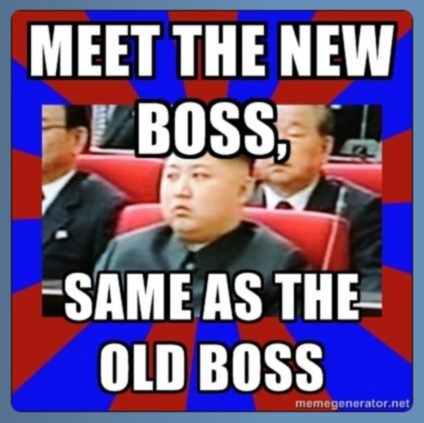
Kim-Jong-un-Meme-GeneratorOr maybe not…

The following short piece for the Korean National Defense University was written after the Leap Day Deal, but before the rocket launch announcement. In the interim, the US has decided to cancel the leap day deal, which is entirely understandable, but a mistake nonetheless I think. NK’s elite has to do something for Kim Il Sung’s 100th birthday this month (the cause of the launch); the regime depends on these sorts of shows. But this is a lot more tame than other possible hijinks, like another clash in the Yellow Sea, could be. Kim Jong Un might be signaling us from within the almost certain, post-Jong Il quiet power struggle now gripping the Pyongyang. For a similar and, I think, persuasive argument, try this. My full text at KNDU can be found here.

Kim Jong Il’s death is more than just the passing of a chief executive; given North Korea’s (NK) hyperpersonalization, it is transformational. As such, Kim Jong Un’s ascent offers a unique opportunity to try engagement once again with NK. It may fail, as it has so often before, but the very fluid new circumstances make it worth a major effort. NK is such a dangerous country and the cold war standoff with SK so severe now, that to pass up this rare window would be a tremendous missed opportunity.

Continue reading

Seoul 2012 Nuclear Security Summit

K-schmaltz! : where’s Dr. Strangelove when you need him to bomb Arirang back to the stone age?


This week is the big nuclear security summit in Seoul, with something like 60 attending countries and over 40 heads of state or government. Bobby McGill from Busan Haps magazine here in town asked me for a brief write-up; this is the re-print. Here are the issues as I see them from Korean IR and the local media. For full-blown think-tankery on the summit, try here.

1. Obama’s personal commitment to de-nuclearization: I can’t think of any president since Reagan who seems as personally offended by nuclear weapons as Obama. Back in the day, Reagan watched ‘The Day After,’ ‘Wargames’ and other nuclear war movies and came to dramatically oppose mutually assured destruction as it had underpinned US policy since flexible response. This helped Reagan achieve the first nuclear stockpile  reduction in history (the Strategic Arms Reduction Treaty – a point anti-New Start neocons conveniently forget). But Obama is going beyond that, talking about ‘global zero’ – the complete elimination of all nuclear weapons everywhere. Wow. This is why there have been two of these summits in three years, but nothing like this under Bush. To be honest, I don’t think the complete elimination of the American nuclear deterrent is probably not a good idea (although we can go pretty low); nuclear weapons are the ultimate guarantor of US sovereignty and democracy, and many US allies, like SK, rely on our extended deterrence. In any case, Obama’s personal interest in this issue is a major driver for this thing.

Continue reading