The Impact of Arab Spring on North Korea (1): When in Doubt, Repress

arab-spring1

Part 2 is here.

The following is a brief analysis of what NK will ‘learn’ from Arab Spring. The good people at the Korea National Defense University asked for a quick, non-jargony write-up. I have previously written for KNDU’s Research in National Security Affairs (RINSA) notes here (no. 70), about NK’s shelling of Yeonpyeong island last year. Northeast Asia security wonks would like RINSA.

Comments would be appreciated, as this will be published in the next few weeks. For my previous writing on Arab Spring, go here.

ABSTRACT

NK will draw six lessons from Arab Spring: 1. Quash protest as quickly as possible. 2. Give the military everything it wants. 3. Return to post-colonial ideology. 4. Find new nuclear proliferation clients. 5. Cleave to China, as the moral cover of fellow autocracies fades. 6. Do not give up the nuclear weapons – ever. In short – dig in your heel, clamp down harder, don’t change.

The Arab Spring revolts present a frightening prospect to any dictatorship. As the world’s most orwellian and repressive – Human Rights Watch has given NK its lowest score for almost forty consecutive years – the DPRK will clearly draw lessons from these events. Six ‘tips’ for NK stand out:

1. Quash protest as quickly as possible. Precisely because the Arab revolts drag on and on, they have held world attention long enough to force a major debate on the premises of Western policy in the Middle East (ME). The longer revolts continue, the harder it becomes for outsiders to ignore them and the louder calls for external intervention become. This ‘CNN effect’ – in which a steady stream of horrific images from conflict or other catastrophe raises hard, increasingly unavoidable moral questions about external intervention – precipitated US pressure on Mubarak, the French turn-around on Tunisia, NATO bombing in Libya, and a possible future intervention in Syria. The best way to keep outsiders out is absolute control. Tiananmen Square (1989), Burma’s Saffron Revolution (2007) and Iran’s Green Revolution (2009) were definitively crushed, while Mubarak tried to negotiate. Chinese overreaction to the proposed ‘jasmine revolution’ is the likely NK response to any civil protest, only yet harsher.

2. Give the military everything it wants. ‘People power’ does not undo dictatorships, splits in the regime, particularly the security services, do. Mubarak lost when the military split over the repression; Yemen and Libya’s rebels have strengthened as the militaries fractured. Son-gun was prescient in its blatant effort to buy off the KPA, even as it bankrupts the DRPK budget.

3. Return to post-colonial ideology. The growing global normative acceptance of the ‘responsibility to protect’ (R2P), the intellectual justification for external human rights-motivated intervention, narrows NK’s ideological space. R2P, for which even China and Russia voted in the UN, raises the ‘audience costs’ of the NK dictatorship. It posits that a legitimate government must meet a minimum threshold of good behavior toward its own people to preclude external intervention: some governments are so bad, they forfeit the right to rule. To date this has been used to justify interventions in Libya, Kosovo, Bosnia, and Somalia; it also impacted the debate on Darfur, Ivory Coast’s recent internal conflict, and a possible future intervention in Syria. This is an important breach of the long-standing norm of mutual, sovereign non-interference, behind which NK and most dictatorships hide.

No case more clearly meets the R2P benchmark than NK with its man-made famines, concentration camps, and extreme privation. The DPRK needs an intellectual response to this challenge, and anti-colonial nationalism is a good choice. Decolonization stirs strong feelings in the global South, the region most likely to confront R2P-motivated interventions. Qaddafi portrays the NATO bombing campaign as Western neocolonialism, with good effect in the African Union, which has repeatedly called for a NATO halt. A vigorous argument to global public opinion that SK is a US puppet bent on globalist exploitation of the peninsula would be a persuasive postcolonial counter to the ‘human rights imperialism’ critics fear in R2P. Further, ideological committed security forces, like Iran’s Basij, are less likely to split with the regime, so propagandizing the KPA complements ‘tip’ 2 above.
Continue to Part 2.

The US Drawdown & National Debt Debate: AfPak, Korea, etc

Afghanistan rocket

I’ve been thinking a lot recently about the scale of US commitments and how to reduce them so as to not bankrupt the US in the medium-term. I have gotten a fair amount of criticism that I don’t know what I am talking about, US warfighters are superlative, US forces in various places like Korea or Afghanistan augment US national security, pull-outs jeopardize our credibility, etc. Ok. I am learning like the rest of us on this. I agree that US commitments are sticky, and I have little doubt that US servicemen are professional enough to win conflicts in places like Korea and AfPak (Afghanistan & Pakistan), so long as we have the resources to stay.

Further, I will admit that a ‘post-American’ world is a little unnerving. I say this not as an American who likes ‘empire’ (I don’t), but more generally because I still do think, even post-Iraq, that US involvement generally makes the world a better place. The dollar and US engagement help keep the world economy open, and US force can sometimes be the last line against truly awful acts that shame the conscience. This is why I supported the Libya intervention, and this is why I hope the US can keep forces in Korea. A retrenched, bankrupted, and sullen America worries more than just Americans. To clarify to my critics, my concern is whether the US can support allies around the world, not if it should. I don’t want US Forces in Korea (USFK) to leave any more than anyone else. I can think of few more valuable uses of US force than to help defend a democracy against the last worst stalinist despotism on earth. I just wonder whether we can afford it.

I think we need to be a lot more honest about the huge defense cuts that will be required to balance the US budget. The US deficit ($1.5 trillion) is a staggering 10% of GDP and 35% of the budget; publicly-debt ($9T) is at 60% of US GDP ($15T); and the integrated national security budget (DoD, Veterans, relevant parts of Homeland Security and Energy) exceeds $1T. You hardly need to be an economist to think that this is unsustainable and smacks of imperial overstretch. For an expert run-down on the US budget mess, try here.

This gap could of course be filled with tax increases, but a central GOP policy commitment since roughly the Ford administration has been ‘no new taxes.’ Unless this changes dramatically – and the recent Ryan budget proposal showed no GOP movement on tax increases – this means that most of the $1.5T hole must be filled with spending cuts. My own sense is that allowing the Bush 2001 and 2003 tax cuts to sunset, as is current statute, plus tax reform and a carbon tax, could in fact generate a lot of new revenue at tolerable and intelligent levels of pain. This would reduce some of the pressure to cut defense (and all other US government programming). But without such new taxes, the $1.5T hole calls for huge cuts, and the axe would inevitably land on defense too, including US bases and commitments overseas.

I am genuinely agnostic on whether this is a good idea. Part of me thinks that wealthy US allies, especially Japan and Germany, free-ride. They should spend more so that we can spend less. But others have retorted that encouraging wealthy Asian allies like Korea and Japan to spend more could trigger an arms race in Asia that might also go nuclear. Barnett has a nice post on how Asian elites are aware of this and worry about a weak US. (On the other hand, there is not actually a lot of empirical evidence that denuclearization brings peace.)

In response to my commenters at Busan Haps on a US withdrawal from Korea, I wrote:

“America’s economic problems will likely compel the rebalancing all of you are thinking about. Importantly, even if the US wanted to stay and provide ‘extended deterrence’ as we have for 60 years, the dollars are not there for it.

Whether or not we should go is a different question. My sense is that Korea does actually try harder than many US allies. Korea spends 2.7% of GDP on defense. Germany and Japan spend around just 1%. The US spends close to 6%. But like Germany and Japan, Korea is now wealthy enough to spend a lot more. This raises the free-riding question you all worry about.

If Korea really wants USFK to stay no matter what, then the most likely way is for Korea to pay for ALL of the expense of USFK here. Right Korea and the US split the bill roughly so far as I can tell.

But I find great resistance to this thinking. My sense is that within the Beltway, there is strong elite consensus for the US remain committed around the world. ‘Empire’ seems to be a knack or a habit Americans have grown into. We like being a globally present superpower but are increasingly unable to afford it and unwilling to pay the taxes for it.

The question then is what do we do now? Cut entitlements (Medicare, Medicaid, Social Security) to make room for defense? Do we raise taxes enormously for all these things? Are do we retrench from our global posture so we spend less money?

Finally, there is a model for retrenchment. Britain slowly retreated from its empire in the 1950s and 60s. In some places it went very badly – South Asia and southern Africa especially. But this slowly brought British commitments back into line with British resources. The alternative for the US is to change nothing and risk an imperial crack-up – something like the USSR in 1989 or Austro-Hungary in 1914. That is my worry.”

Here are two good recent articles from the Wall Street Journal by Leslie Gelb and Max Boot on whether or not we can drawdown from Afghanistan and Pakistan (AfPak) post-bin Laden. I lean toward Gelb, but I think Boot makes some good points. Particularly, Boot notes that a US presence in Afghanistan made it possible to get OBL, because US forces were proximate. But Boot still sidesteps the debt issue. Both Beinart and the US JSC chairman call the debt the biggest threat to US national security. I am inclined to agree…

Why Nuclear Deterrence Doesn’t Matter that Much in Korea

nuclear-explosion

Last week we had a good speaker at PNU on US extended deterrence in Korea. Much of the discussion focused on nuclear weapons. NK has them obviously, and speculation on NK capabilities is endless. So not surprisingly, SKs are increasingly thinking that they should have them too. While it seems straight-forward to say the North has them, therefore the South should have them too, I think this is inaccurate– and not because America doesn’t want SK to have nukes. Koreans bristle at this, as many states in the world do, because they feel that the Non-Proliferation Treaty (NPT) constitutes nuclear discrimination: the haves (including the US) get to keep their nukes while the have-nots stay de-nuclear on the vague promise that the haves will build down to zero. Needless to say, the NPT haves have done little on this, leading to regular cries of hypocrisy (although Obama seems to genuinely want ‘global zero’). So last decade, India openly decried this logic and went nuclear despite the nuclear haves’ resistance.

But nuclear weapons for SK would not actually serve SK security much regarding NK, because any nuclear use by NK on SK would immediately trigger a SK invasion of the North. It is hard to imagine SK absorbing a nuclear strike without this finally forcing Seoul’s hand to invade NK and end the long stalemate. A nuclear strike would be so devastating that no other possible retaliation – airstikes, port-mining, more sanctions, etc – would be countenanced. An invasion is practically a 100% probability in response to a NK first-strike on the south. While the initial reason for the retaliation would be to suppress NK nuclear capabilities and force regime change, in reality it would quickly to turn into a war of national unification – a second Korean war to finally close the rift. Every analyst I’ve ever heard or read thinks that SK would win such a war – even without US, Japanese, or UN help. It would be a harder slog alone of course, but it is still quite likely.

So, after the SK victory, SK would then be stuck rebuilding NK, including cleaning-up blast zones in the NK from the US or South’s own nuclear strikes. As such, SK is unlikely to ever launch in the first place. There is no point in creating mass devastation one must fix a short time later. More formally stated, a SK second-strike is irrelevant, because a NK first-strike would change SK’s preferences toward from defense and deterrence to irredentism. A NK first-strike would end SK hesitation and confusion on NK and push it openly toward intra-Korean ‘imperialism,’ i.e., irredentism and unity.

Note the difference between N and SK, and the US and USSR. Neither the US nor the USSR had any compunction about nuking each other’s homeland, because neither expected to bear the clean-up costs. The same might be argued for the Indo-Pakistani nuclear competition today. But Korea is different. SK would not nuke NK in response to a first-strike and then just walk away. A NK first-strike – given the special ‘divided nation’ status of the peninsula – would push SK into the long-awaited, much-speculated-upon Second Korean War. And this time there would be a pretty clear winner who would then have to pay for all the reconstruction. So it would be better to have, say, 5 blast-zones in the south, than another 5 in the north too.

The only possible alternative I can see to this is SK nuclear use on the North if SK was actually losing the unification war. If NK launched a first-strike that devastated multiple SK cities and threw the military into disarray, then SK might consider a ‘counter-force’ nuclear strike on the NK People’s Army in order to slow them down and buy the Southern military time to re-organize and win the war. NATO considered similar such counter-force strikes during the Cold War. If the Red Army was rolling through Western Europe on the way to victory, NATO reserved the right to ‘first-use’ against military assets to stem the Soviet tide. But even these strikes would be very limited in Korea – likely low-yield battlefield nuclear weapons. The idea of nuking NK cities – ‘counter-value’ city-busting – is likely off the table due to the massive reconstruction costs that Seoul would have to carry for such strikes a short time later.

Beyond that SK nuclear weapons might be construed against China, Russia, and Japan – the first two of whom are nuclear. De Gaulle famously said French nukes pointed ‘360 degrees.’ And the initial aim of the French nuclear program was as much Germany as the Soviet Union. After three German invasions in 70 years, the French military wanted the ultimate guarantee of French sovereignty that nuclear weapons would give. SK might think the same way regarding Japan, the former colonizer (a surprising number of Koreans still think Japan has imperial designs on Korea). And of course, SK lives next the Chinese goliath. Should the US alliance with Korea crumble, SK might seek nukes to hedge China.

But little of this is discussed in the Korean media, where most of the nuclear discussion focuses on NK. But I just can’t see SK actually nuking NK.

US Alliance Commitment to Korea in the Age of Austerity: Big Cuts Loom

csis

So this week my university hosted a forum on the Korean-American alliance with Ralph Cossa and others from the Center for Strategic and International Studies. CSIS is the kind of center that anyone reading this blog would find useful, and Cossa is a great Asia hand. (For starters, try his chapter in this.)

The forum was informative, but too much of it passed what seems to me the growing mismatch between US alliance commitments around the world and US capabilities to meet them, what Paul Kennedy famously called ‘imperial overstretch.’ Most of the speakers reaffirmed the US commitment in direct, unambiguous terms – an expected response given NK’s exceptionally bad behavior last year. But to my mind analysts need to be more forthright admitting the great trouble the US will likely have defending Korea.

I have written on this before; consider the following data points of US ‘partial abandonment’ of SK:

1. US Forces in Korea (USFK) are now just 28,500 servicemen, the smallest number they have been in the history of the force. A large minority, so far as I can tell, are air and naval staff, not infantry. In short, the ground war – the hard, brutal slog of 1950-53 – will be born mostly by the SK army this time.

2. US tactical nuclear weapons were removed from Korea 20 years ago, after the Cold War. Given NK’s nuclear program, ROK elites have been hinting for the last few years that they might like to see them come back or at least discuss it. The US has rejected this.

3. The Combined Forces Command (CFC) is still scheduled to be abolished. CFC places wartime authority in Korea over both US and Korean forces in the hands of a US general. This is widely viewed in Korea as a signal of US commitment to SK defense. Originally it was to be abolished in 2012. Abolition has been moved to 2015, because of recent NK behavior, but CFC is still scheduled to go. The Koreans too have made noises about retaining this, but the US has held firm that it too will go.

4. US public opinion surveys from the Chicago Council of Global Affairs (2008, 2010) only find the 40-45% of American actually want to fight in SK if a war comes: “Americans also show an inclination to take a hands-off approach to confrontations between North and South Korea.” This should not surprise anyone, given the American exhaustion from the war on terror. Consider the Libya intervention (which I supported, to be transparent). This was mostly an inside-the-Beltway affairs (the ‘professor’s war’); US public opinion support for it is tepid. As a result, US involvement is very light. Obama is badly constrained by huge US public reticence to fight yet another big war – which is most certainly what a Korean conflict would be. Libya is far more likely to be the US model in Korea should another war break-out here, rather than a re-run of what happened 60 years ago.

5. USFK is being relocated away from the demilitarized zone to a city south of Seoul – Pyeongtaek. This strikes me as a critical data point, and one that Koreans most definitely worry about. Seoul is the obvious target in any serious war, so USFK’s placement between the KPA (NK People’s Army) and our ally’s capital signaled strong American commitment to SK, both reassuring SK and deterring NK. USFK, even when it was larger, was never enough to stop the 1.2 million-man KPA on the ground. Its role was basically a symbolic trip-wire. That is by stationing US forces in the likely combat zone, any combat would immediately pull in US soldiers, and likely result in battlefield casualties as well. Any US fatalities would have a catalytic effect on US public opinion regarding participation in an otherwise unwanted war. Emotionally provocative images of dead American servicemen would enrage America pubic opinion and so reinforce the US commitment to fight. The trip-wire ensured that the US would be ‘chain-ganged’ into any war in a ‘country far away about which we know little.’ People find this morally objectionable – and it is  – but that does not make it inaccurate.  Indeed NATO did the same during the Cold War. Multinational units were stationed along the West German border with East Germany and Czechoslovakia. If the Red Army crossed the line, initial casualties would be spread around the alliance in order to insure that all allies would have skin in the game. This would help ensure that allies in NATO’s backyard would stick to their commitment to fight. While I doubt that USFK planners are so callous as to open reason this way, it is clearly the case that US forces south of Seoul reduce American exposure, eliminate the immediate trip-wire/chain-gang effect, and give the White House ‘wiggle room’ it did not have before.

6. But even if all of the above were irrelevant, the real elephant in the room that casts doubt on all US alliance commitments (not just Korea) is the crushing national deficit and debt. The US is now borrowing $1.5 trillion per annum. This is the largest peacetime borrowing in US history (and only matched once – in WWII). It represents a staggering 10% of GDP. America’s publicly-held debt is now $9 trillion. These budget constraints will place major limits on any US use of force in the future. Again, the current Libya campaign should be seen as a model for what US war in the age of austerity will look like – hesitation, buck-passing to allies and international organizations, ‘leading from behind,’ no ‘boots on the ground,’ cost-efficient airpower, etc. The only way to close that massive $1.5T gap is to either cut spending or raise taxes (or inflate it away, I suppose – but who wants a re-run of the 1970s?). So long as the GOP remains firmly opposed to tax hikes, then spending must be cut. And no really believes $1.5T in cuts can be found without huge defense cuts. Social Security, Medicare, Medicaid (together: SS/M/M), Defense, plus interest on the debt, compose 80% of the budget. Interest payments cannot be cut obviously; we can’t just unilaterally stiff $9T of bondholders. Nor is there much saving to be found in the remaining 20% of ‘discretionary spending.’ That leaves just the ‘big four,’ as the Simpson-Bowles deficit reduction commission called them: Defense and SS/M/M. This is an absolutely classic example of the guns-vs-butter trade off. We can have a big defense budget or big entitlements (SS, Medicare, Medicaid), but we can’t have both. Consider that the entire US national security budget (Defense, Veterans Affairs, and the relevant parts of the Homeland Security and Energy Departments) costs about $1T. That means you could cut all US national security spending and still not balance the budget. Indeed, half a trillion dollars in deficit spending would still be left over. Just 5 or 6 years ago, when the Bush administration was running 4-500 billion dollar budget deficits, people fretted that such numbers were enormous. Now that would be progress. This budgetary mathematic all but mandates major US retrenchment, unless Americans are willing to dramatically lessen their entitlement expectations to make room for defense. And to no one’s surprise except the hawks I suppose, Americans do actually favor major defense cuts in order to save SS/M/M. Americans, if they must choose, want checks for grandma more than they want aircraft carriers. This is why Michael Mullen, the US Joint Chiefs of Staff Chairman, argued recently that the US budget deficit is now the single biggest threat to US national security. And the Sustainable Defense Task Force, organized by several members of Congress, does in fact recommend US cuts in Korea. (Read Kaplan at Slate.com for superb analysis on the approaching critical mass regarding defense spending.) The likelihood of major cuts in places where American really don’t want to be (Iraq, Afghanistan, Pakistan, Libya) and places American believe can afford their own defense (Western Europe, Japan, Korea) means that it is very likely that US forces will not be in these places in, say, 10-15 years. The money just isn’t there anymore…

In short, America’s accelerating sovereign debt crisis, much reduced force structure in Korea, and low public opinion support for more interventions, badly constrain our ability to meet our alliance commitments here, and many other places. This doesn’t mean we should get out; this is no personal endorsement one way or the other. But it does mean that probability of major US assistance on which Korea has built its security for two generations is diminishing fast. We need to be honest about that. Call it the end of empire, retrenchment, imperial overstretch, whatever; but US allies need to recognize this. The days of free-riding are just about over.

“Homefront” Video Game: ‘I Pledge Allegiance to Kim Jong-Eun’ – Hah!

Yes, it’s ‘Red Dawn’ all over again, only yet more ridiculous


What blog from Korea on security issues would be complete without some discussion of Homefront, the new video game from THQ on a North Korean invasion of the United States. H/t to Koehler for catching this hysterical vid. Unfortunately THQ has not released the game Korea – why not? South Koreans are stridently anti-communist and terrified of the North. I can imagine this game selling truckloads here… Oh well.

The debate is heating up on this, so here is my contribution, limited albeit by my inability to get the game here.

1. The game is hyped as written by the writer of Red Dawn, John Milius. Milius also co-wrote Apocalypse Now, which he originally intended to end with a massive race war in which Colonel Kurtz (Brando) was to have lines like ‘isn’t it great to be a white man in the jungle with a gun?’. (Don’t believe me? Go watch Hearts of Darkness, the documentary on the making of Apocalypse Now to see Milius and director Francis Ford Coppola discussing this, as well as Milius’ creepy Wehrmacht fetish. Coppola openly [thankfully!] rejects the notion of some macho white fascist ending.)

Milius is exactly the sort of rightie that IR types love loathe in public, but secretly we get a total laugh out of wack-job entertainment like this. This is what world politics looks like in the fetid mind of a cold warrior NRA member who reads too many histories of World War II, Hitler, and Waffen-SS. In Red Dawn, the USSR invades the US on the ground by crossing the Bering Strait (!), because you know how well developed Arctic sea lanes are for moving millions of soldiers and huge amounts of supplies. Further, the intense cold weather of Alaska and the Yukon, plus the heights of the Rocky Mountains, plus the minimal road-network and infrastructure of the Pacific Northwest are clearly no hindrance to a massive armored invasion. Hah! If that is not enough glorious paranoia for you, Cuba and Nicaragua invade the US from Mexico added by Hispanic illegal immigrants who acted as saboteurs. (Yes, it is that ridiculous.) Finally, the US rebels against Soviet occupation include the captain of the football team, whose gets his arms from friends who are NRA members, and the nerdy school president turns out to be a commie traitor. So, yes, that jock who used to bully you in high school was actually a patriot ready to defend America and football, while the dorks who did their homework were wimpy red sell-outs. Ah, the ideology, the wild delusions of right-wing paranoia, and closet admiration for the Wehrmacht. You gotta love it… if it weren’t so d— frightening. The film so completely captures 80s right-wing themes and paranoias, I know lots of IR professors who actually teach it.

2. I can only imagine the even more insane script for Homefront. Here is the official trailer:

Did you know that North Korea’s navy can sail across the Pacific to amphibiously assault the US? Me neither…

This is so thoroughly ridiculous, it hardly bears comment (just read Foster-Carter). I would only add two observations:

a. Movies and games like this tell the world the US is genuinely obsessed with war and militarism. Yes, it is just a game, but US film and videogame producers make lots of this sort of stuff that endlessly celebrates American power and a—kicking; just in the last few years: 24, Transformers 1 & 2, Terminator 4, Call of Duty. You wonder why people think we are a nasty, militaristic empire, well this is a pretty obvious place to start. Even our pop culture is suffused with this sort of military posturing and machismo. Just this year we have a Red Dawn remake coming, the Marine Corps recruiting vid Battle: Los Angeles, and yet another Transformers epic. Yes, the world is dangerous; yes, we have to defend ourselves; I love explosions and aliens as much as any male movie viewer; and I guess this is the sort of entertainment we get after ten years of the war on terror; but Hollywood is practically an adjunct of the military-industrial complex. How about a more nuanced portrait of force?

b. It is very noticeable how so many of these films and games take place on US soil – terrorists infiltrators, foreign invasions, alien landings (don’t miss Chuck Norris’ uber-cheese Invasion USA). The reason should be pretty obvious – if the Americans are defending their home, then all the moral problems of the use of US force disappear and the heroes can be as vicious as they want without worrying about the moral consequences. All the real-world agonizing about how American force sometimes kills the innocent (however unintended) in foreign places where maybe we should not be (Afghanistan, Iraq, Pakistan, Libya), falls away.

So the righties like Milius or Michael Bay who come up with this stuff can show Americans as heroes, even though they are mercilessly mowing down the bad guys. Want to execute Geneva Convention-certified POWs (Red Dawn)? Sure, it’s ok, because “we live here.” Want to blow the head-off a defeated, wounded enemy (Transformers 2)? No big deal; they’re ‘evil.’ What to perform a vivisection (!) on a wounded opponent (Battle: Los Angeles)? Sure; this isn’t Abu Ghraib (though did anyone else think that in watching B:LA?); these alien SOBs invaded America, so do whatever you want. There are no namby-pamby liberal college professors and NGO activists around to moan that we kill too many civilians, seek imperial domination, war for oil, blah, blah, blah. Instead the dialogue can recite macho, posturing cliches about never giving up, defending our homes, and a—-kicking victory. This is the no-holds-barred, no-moral-errors-admissable, American-wars-are-always-right image of US force that neo-cons and Fox News so desperately want to legitimate. Placing these events on US soil opens the door for behavior we should find grossly illegitimate – and do when we do it in far away places. But in an invasion, the American defenders occupy the (easy) moral high ground, and therefore we can reveal in militarism and killing without moral anxiety. It’s all so callous and grotesque as to be morally outrageous, and it panders to the worst ‘Jacksonian,’ US-force-as-conflict-resolver instinct in US democracy, but then we live in the Fox News, post-torture era.

Korean-German Unification Parallels (3): Differences & Conclusions

Flag-Pins-South-Korea-Germany

This is the last of a three part post elaborating the often-made parallel between German and Korean unification. Please start with part one and part two.

More Differences in the International Environment between German and Korean unifications:

c. China’s interest is much higher in NK than the USSR’s was in EG. NK borders China; EG was two time-zones away from Moscow. China’s interest in the terms of a final settlement are much more direct. Gorbachev was basically trying to sell EG for desperately needed cash; for China, Korea is a more existential issue. NK is a buffer between democratic SK, Japan, and the US. Hence, China is much more likely to stick its nose into Korean unity talks, and to push for its own terms. Those terms will probably include a ban on US forces north of the current DMZ, and possibly an exit of SK from the US alliance altogether, in exchange for Chinese acquiescence on unification: Korean ‘finlandisation’ (an outcome of which Japan might secretly approve too).

d. SK can’t buy unity from China as West Germany did from USSR. WG was an economic powerhouse by the 1980s – in the OECD and G-7, second biggest donor to the UN, etc. WG could simply  write a huge check to Moscow, and the USSR was so desperate that it took the money and abandoned Honecker. SK is simply not there. Yes, it’s in the OECD and G-20, but its still lists itself as a developing country at the WTO, and it is still decades away from German levels of affluence. Nor do the Chinese need the money. China will play a much harder game than the Soviets were able to 20 years ago.

e. SK has no supportive environment of allies or revolutions, like NATO and the Velvet Revolutions of 1989, which could add momentum to unification. Beyond the US, SK has no real allies. Russia is an unpredictable faux-‘partner’ at best. Because of all the bad history, the Japanese don’t really like the idea of a united, wealthy Korea which is growing faster than them, right on their doorstep. Taiwan is also a divided country, but it is in the NK/EG role as the smaller and weaker of the two. So there is nothing like a local NATO of friends to provide group moral cover for unification efforts, nor can there be any regional momentum for NK change, as the other revolutions like in Eastern Europe provided to East Germans in 1989/90. The are no nearby states similar to NK to catalyze NK change, unless one imagines Chinese democratization, which is a huge leap. As we see in the ME today, revolutions can synergize each other, but there is no region here to provide a wave to wash into NK. Koreans will have to do this themselves.

Conclusions:

Altogether this means that hurdles to and burdens of unification are much higher here:

 There are more NKs than EGs, and they are poorer as well.

There are fewer SKs than WGs, and they are poorer also.

SK’s state strength/capacity is lower than WG’s, while NK is a catastrophe by even EG standards.

So: fewer people with less money in a weaker system will support more people with less money from a worse system.

That domestic arithmetic is brutal, and if that weren’t bad enough, the international balance of forces is worse now than in 1989 too:

Today, the external patron (US) of the free Korean half is weakening, while the external patron of the communist half (China) is strengthening. The opposite was true of the US and WG, and the USSR and EG, in 1989.

Today’s northern patron (China) is trying to push further into the continent (Asia), while yesterday’s eastern patron (USSR) was looking for an exit (from central Europe).

There is no regional encouragement, revolutionary wave, democracy zeitgeist, or whatever to push this thing along in NE Asia.


The incentives for China to meddle – because of the greater importance of NK to China, than of EG to the USSR -, and the greater ease of   such meddling – because the US and SK today are weaker than the US and WG were then, while China is much stronger today than the USSR was then -, mean Chinese intervention is highly likely. It will try hard to structure any final settlement. A major policy question for SK is therefore likely to be, will it dump the US alliance if that is what’s necessary to get China out of the peninsula? Will SK exchange ‘finlandization’ for unity? I think the answer is, and should be, yes.

The only alternative I see to this is a unification process that goes so badly off the rails, is so destructive, disorganized, and chaotic, that China would want to stay out it from sheer concern to avoid a quagmire. In other words, the more chaotic the end-game turns out to be, the more likely it will be a Korean-only affair. This is unfortunate; no one wants Korean unity to be a Hurricane Katrina-style national meltdown that requires heavy western and Japanese support – which might not even be available. because of the accelerating sovereign debt crisis. But reunification chaos seems like the only way to keep the Chinese out, because the balance of forces I sketched in the post are so much worse for Korean today than they were for Germany in 1989/90.

Korean-German Unification Parallels (2): Differences

east_germany_flag_thumb1

old East German quip: what does GDR (German Democratic Republic) really mean? German District of Russia…


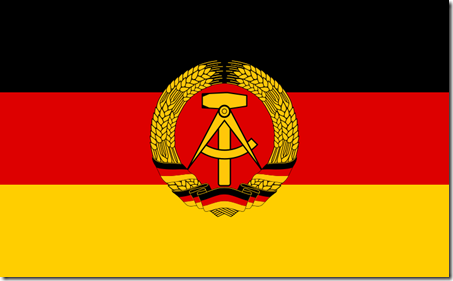
This is part two of a post exploring the similarities and differences of German unification (1989/90) with Korea’s probable future one. Part one explored the similarities of the two cases; Part three presents my conclusions. Here are the differences between these unifications:


Differences:

3.  Domestic

a. EG was much wealthier than NK is now. EG was the ‘leading’ economic performer of the east bloc. The USSR realized how central the German competition was to the overall Cold War competition, so EG was heavily subsidized. NK was never as important, because the cold war contest was never as stark in Asia as it was in Europe, so NK never got such big handouts. NK’s GDP/capita today is a crushing $1700; EG’s in 1989 was $10,000.

b. NK is not just a dictatorship; it is an Orwellian nightmare, more stalinist than even the Soviet Union or Albania ever were. East Germany was bad but never plumbed the depths of repression and madness like NK.  One of our faculty at my university works with NK defectors, and he notes how many of them have psychological trauma from life in NK. Fixing NK will not just be a huge pile of money; we know that. It is also going to require something akin to nation-wide psychiatric care for millions of mentally brutalized Winston Smiths. This will be an event unheard of in the annals of mental health; read here and here.

c. On just about every other benchmark conceivable, NK is worse off than EG: environmental management, infrastructure, labor productivity, health care, education, technology, etc, etc. The per person cost of Korean unification is likely to much higher, because NK is so much further behind in almost every way than EG was. Estimates of Korean unification could begin with these figures: in 20 years, WG has transferred $1.2 trillion euros to the roughly 16 million people of EG at the time of unification. Note than NK has more people (23 M) than east Germany, and those people are significantly poorer per person too ($10k vs 1.7k per capita). So that means the 1.2T euros figure is likely too low for the NK case. Note also that West Germany had around 60 M people in 1989; SK has 49 M today. WG’s 1989 GDP per capita was $25,000; in SK today, it is around $19,500. The arithmetic is punishing.

d. EG and Soviets did a good job deceiving the world that EG really was modern and advanced, just like the West. This is one reason why the WG government granted 1:1 currency convertibility to the GDR mark: almost everyone thought EG would have some reasonably competitive industries and sectors. Yet when WG finally got in there – when the West finally pulled the lid off –  almost everything was badly behind or unusable: the phone system had to be completely replaced, EG cars were a polluting environmental nightmare, laborers had no idea how to use computers or even basic office devices like photocopiers, infrastructure around the country still had World War II battle damage (that is no joke, I saw it), etc. So it’s likely that NK is much worse than we think it is. Even Bruce Cumings has admitted this. Yes, try to imagine that: NK, our customary endpoint of geopolitical awfulness, is probably hiding much worse than we know now. Once we see the NK gulags up close, I think we are going to see Nazi-style atrocities even the Taliban wouldn’t have tried.

e. SK is less politically prepared to carry the enormous stresses of unification – and not just the financial burden. The SK political system is flimsier than WG. Corruption is more regular; its parties are shallow and change names quickly; political unresponsiveness drives a street-protest culture and brawling in the National Assembly. For a state that came out of dictatorship less than a generation ago, SK is doing pretty well, but it clearly does not have the state capacity WG did in 1989, while it faces (points a & c above) a comparatively greater burden. Indeed, this is my greatest fear – the burdens of unification will simply overwhelm SK’s still maturing democracy and leave NK in some kind of semi-annexed limbo like the West Bank.

4. International

a. In 1989, the US was at peak of its postwar relative power. The USSR was in decline; China was still far off. This is the era of the ‘unipolar moment’ and the ‘end of history.’ Today the balance of forces is very different. The US is much weaker. Many think the US is in decline. All this makes it harder and harder for the US to support SK in any contest with China or NK over unification. It is likely that SK will have to do more of the work on its own, compared to the heavy intervention by the Bush 41 administration to support the WG position. The weakened American position means it will be easier for China to dictate its terms for unification (such as no US forces north of the current DMZ, or perhaps even no US forces at all).

b. In 1989, the USSR was a mess; today China is not. The GDR’s patron was imploding. It could no longer afford the contest with the US. The Soviet Union was trying to geopolitically retrench and to re-starts its moribund economy with perestroika and glasnost. The Soviets were getting desperate, and the east bloc – subsidized as it was – had become an albatross. Gorbachev was fumbling to control all the forces unleashed. China is the opposite. It is not overextended, but rather just beginning the international expansion that flows from its rising strength. It is feeling its oats and ready to give the US a run for its money in Asia at least. Tiananmen Square demonstrated a non-Gorbachevian willingness to roll out the tanks to maintain the one-party state, and there is no serious liberalizing force, in part because the Chinese population is being bought off with growth. So China is much more capable of carrying the NK albatross and ready to push its interests into Korea not pull out per Gorby.

Go to part three.

Korean-German Unification Parallels (1): Similarities

KIM_IL_SUNG_mit_HONECKER

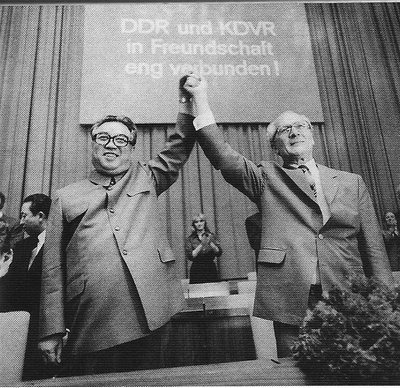
Kim Il Sung and Erich Honecker: *sigh*, don’t you miss the golden days? —- no, me neither

(the placard reads: ‘GDR and DPRK tightly bound in friendship’ – for tyranny and poorly-made men’s wear)

Here is part two and part three.

Last week I ve participated in a scenario to map out possible futures of Kim Jong Il’s sudden death. My best guess is in my previous post – a military dictatorship with Kim III (Jong-Un) as a familial, yet much reduced, figurehead. But one idea that is always floating around in the background is that major regime junctures in the North might lead to break down and then unification. President Lee has taken recently to saying that SK should prepare for imminent unification, and one of my favorite NK experts thinks unification is likely in the next five years.  Does anyone else think this is likely, and why so (in the comments below, please)? I don’t see that actually.

Nevertheless, the most obvious parallel for trying to map Korean unification will work is the German case in 1989/90. I have written about this before, but the following compare and contrast is more complete. For Asian readers in search of a good walk-through of Germany’s experience with division, here is a good place to start.(FYI: I lived in Germany for 4 years in the early 90s and speak German. I recall debating this stuff a lot.)

Similarities  between the German and Korean divisions:

1. Domestic

a. Both nations were divided artificially. Both sides believe the ‘2 states, 1 people’ outcome is temporary. All 4 states face a permanent constitutional legitimacy crisis, because the obvious question is why these separated states exist at all. As such, all states divided by the Cold War were intensely competitive with the other. Outracing each other economically, militarily,  even at the Olympics, became central to proving who was the ‘real’ Korea, Germany, Vietnam, China, etc. Mutual coexistence is basically impossible; each has a limited time window to race the other into international legitimacy. As one or the other pulls away in global opinion – as it becomes ‘the’ Korea or ‘the’ Germany in places like airports or hotel signage, popular movies, CNN, etc. –  it will become ever harder to justify maintaining the division.

b. NK and EG (East Germany) are both communist with all the attendant problems of 20th century ‘real existing socialism.’ They are domestically illegitimate outside their own elites. Those elites are a corrupted ‘red bourgeoisie’ for whom regime ideology became a figleaf for oligarchy and luxury. Neither can produce anything close to the quality and quantity of goods necessary to keep their populations happy – populations further disenchanted by what they see on the other side. Both have a nasty secret police. They are both noticeably poorer than the westernized competitor, and this creates unending pressure on the government to change. All these factors create a disconsolate citizenry that would push out the regime if given the chance. Hence, any manner of internal democratization or liberalization would end the regime as we know it. In the end, both communist half-states had to seal off their borders to prevent exodus; they are national prisons.

c. Underperformance vis the westernized competitor slowly takes its toll internationally. The competitions led to hyper-militarization in the communist half, which only worsens the performance gap between both sides.  Perhaps the best marker of the communist failure after a few decades was that West Germany simply became Germany and South Korea just Korea. To indicate the communist half in everyday speech, one had to affix the directional adjective, the implication being that EG and NK were somehow dead-ends of history. By the 1980s, both NK and EG had effectively lost the race of point 1a above; SK and WG became Korea and Germany.

d. The westernized, ‘Free World’ half of the nation is a wealthy, functioning democracy that has otherwise joined the world – technologies, markets, and institutions (IMF, WTO, etc). This makes the communist half look even more like a basket case. Gradual but sustained wealth and demographic accumulation have dramatically altered the balance against the communist half. The free half also regularly receives communist refugees voting with their feet.


2. International

a. SK and WG are clearly supported by the US and its wealthy democratic allies. Both belong to American/democratic alliance system and enjoy the widespread moral legitimacy that comes from that. They are net contributors to their own defence, clearly outclassing the communist half strategically.

b. NK and EG are practically client states of a communist behemoth, on whom they are extremely dependent. The patron of both finds them troublesome and expensive. Both field an military based around obsolete WWII assumptions of massed infantry and armor formations. Neither can win a conflict with the other half; the economic gap compounds the military gap. The patron regularly debates the merits of cutting the client loose.

c. The neighborhood got used to the division and kinda likes it (especially Japan and France, although no one will say that publicly). There isn’t a lot of impetus from outsiders to end the split. Russia couldn’t care less if Korea unites. Like the French and British on Germany, the Japanese public will come around once they see it on TV. Once we see crying Koreans tearing down the barbwire fences of the DMZ, like we saw Germans hammering the Berlin Wall, no one will stand in its way. But until then, don’t expect anyone else to do much beyond pro forma boilerplate.

Go to part two.

Gaming Out NK’s post-Jong Il Future (2): A Likely Military Dictatorship

north-korean-military-backs-succession-of-kim-jong-un

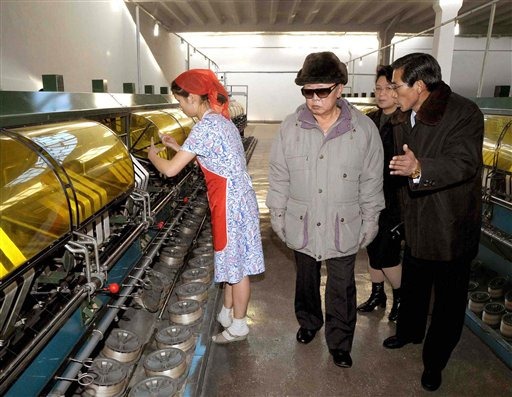
On-the-spot guidance, because the Dear Leader is apparently a baking expert also…

Part one is here.

So in the last week, Wikistrat, a consulting service I work with, ran a scenario to game out a sudden death of Kim Jong-Il. (The website set-up for this is kinda cool; take a look.) I have written a lot about this stuff before (here, here, here), but this useful exercise forced me to go on record about what I think will happen. Given Kim Jong-Il’s poor health and absolute centrality to the regime, his rapid passing would certainly provoke a systemic crisis. Some of the other scenario-gamers were even predicting war, internal dissolution, or foreign invasion! So here is my counterfactual run-through on what would happen if Kim Jong-Il died abruptly:

(the helpful underlined topic headers come from Wikistrat)

Summary

Kim Jong-Un will ascend to the throne, but he will increasingly be a figurehead for a military happy to retain its privileges and avoid South Korean courts.

Scenario Outline

Kim Jong-Un will likely rise into his father’s shoes, but there will be a great deal of jockeying behind the scenes. The son doesn’t have the regime connections of his father, nor the charisma and legacy of his grandfather. So he is likely to be more ceremonial than real, yet this is valuable in itself to the regime’s most important actors: the Kim family and the military. Jong-Un provides a face to the public that maintains the Kim family aura central to DPRK legitimacy. If NK simply becomes yet another dictatorship like Syria or Burma, then what is the point of a separate NK anymore? So a Kim III is a valuable fig eaf; he will not be eliminated; the regime will neither fall nor implode.

The real consequence of Jong-Il’s death will be increasing factionalization in the NK elite. The current system is a messy balance of competing interests including party, state, industry, the police state apparatus, the military – much like the USSR in the 70s. Sitting on top of this fragile balancing act is the extended, decadent Kim family. Jong-Il had the ability to balance these subnational competitors; Jong-Un does not; he’s too inexperience and too unknown in the relevant circles. Expect post-Jong-Il Korea to look like China late in Mao’s life or the USSR in the 80s: disintegrated, erratic, badly factionalized, with frequent subnational capture of national policy, unable to forge a coherent general will because of incessant twilight infighting.

Regional Implications

NK will become yet harder for the neighbors to manage. Factionalization will generate inexplicable foreign policy behaviors that suit domestic actors while undermining further the coherence of the NK state. While this may accelerate eventual collapse, it also means more unprovoked outbursts like the Yeonpyeong shelling last year. China’s delicate position between N and SK will become yet harder. But for SK and Japan, it will be more of the same.

Global Implications

The new, more militarized regime will probably be more willing to bargain. Nuclear weapons have been Jong-Il’s signature achievement in an otherwise disastrous tenure; he cannot surrender them without undermining his legitimacy. This is why all the denuclearization talks go nowhere. With more generals and fewer Kims afterward though, it is more likely that the KPA (Korean People’s Army) will deal. Militaries tend to be a little less paranoid than long-standing dictators…

Opportunities

None that I can think of…

Risks

The earliest years of the transition will be the scariest. The new pecking order among the Kims, party officials, and the KPA will have to be worked out through nasty infighting, including likely purges. So the risks emanating from NK will initially get worse. The noveau regime is likely to pull some stunt in order to grab global attention, build domestic legitimacy (at least among the relevant Pyongyang elites), and shake down SK and Japan for yet more cash. But once the regime settles into its new SOP, its more militarized character will likely restrain the dangerous hijinks associated with past Kim family megalomania.

Probability

70%

I think a civil war is highly unlikely. While the elite will skirmish for rank in the new system, none of the power-brokers wants to risk state implosion. SK still has the death penalty. Post-unification courts will hang much of the top leadership. These guys don’t want to go out like Mussolini or Ceausescu. They like the highly luxurious lifestyle, and they are terrified of a ‘truth and reconciliation’ process post-unification.

Business as usual is unlikely because NK, like Mao’s China, is highly personalized around the two Kims. Yet the next Kim hardly has the weight of his predecessors, leaving a huge hole in the middle. Jockeying to fill that gap seems inevitable. If NK is effectively a ‘Kim-state’ built around a cult of personality, then when that personality dies, crisis and change is inevitable. Both the USSR and China changed dramatically when their god-leaders, Stalin and Mao, passed. It seems likely NK will evolve.

NK will not implode. We’ve been predicting this for years: after the Cold War ended (1990), after Kim Il Sung died (1994), after the famines (1998), after the Axis of Evil speech (2001), etc. It doesn’t happen. NK has turned out to be a lot more durable than anyone expected, probably because it is willing to tolerate barbaric levels of repression. This year, the Egyptian military ultimately proved unwilling to shoot its own people; the KPA has no such compunction. The big question that no one can answer now, is, will the next Kim be so thoroughly harsh as his predecessors; the regime in its current form depends on it.

Gaming Out NK’s post-Jong Il Future (1): Counterfactual North Korea?

KIM-JONGIL

Kim Jong Il as Nietszchean Superman: Now you know who was Casper David Friedrich’s Wanderer

 Part 2 is here.

Regular readers will know that I joined the geopolitical consulting firm Wikistrat as a part-time analyst and blogger. They set up a big simulation this week based on fall-out from a sudden demise of NK leader Kim Jong Il. I think this is a great question and a timely one. This post is to solicit your input for my write-up in that scenario.

Jong-Il turned 70 this week. Most people think he had a stroke in 2008, and defectors have painted a picture of him as hard-drinking and -partying when he was younger. There is lots of speculation that he may have kidney or liver problems. Hence Kim’s death is imminent, and we need to start planning for it, because it will almost certainly be disruptive.

Any system as personalized as the DPRK will struggle when that person passes.However, it is not clear to me whether a protracted death process or a sudden one would be worse for NK. If Kim’s death is a protracted decline, like Brezhnev’s as leader of USSR, NK could slide for years into a grey  zone of factional stasis and drift, unable to make domestic choices or conduct foreign policy. The sort of political immobilism and stagnation that characterized the early 80s of the east bloc could leave Pyongyang inchoate, a fairly scary thought given NK nuke and missile programs that could easily be proliferated away in an environment of state decay.  Conversely, a rapid death, per this Wikistrat scenario, opens the possibility of sharp internal conflict, because the next Kim (Jong-Un) has not yet been properly groomed and trained. Jong-Il had 15 years to learn the ropes; his son will have at best a few years. A quick death would likely expose the many institutional, familial, and factional fault-lines that Jong-Il papers over.

Gaming out these sorts of ‘what if’ scenarios like this is what we call a counterfactual in social science: a thought experiment in which a small, important, and plausible historical change is made in order to reveal new facts. E.g., what if the Cuban Missile Crisis had provoked a nuclear war? Would the Europeans have held their NATO alliance commitment to the US as the missiles were flying over their heads? What would have happened to nonwhite emancipation in the Western Hemisphere if the South had won the American Civil War? This exercise on Kim’s death fits the counterfactual requirements quite well. Here is a bit of method to inform structure this scenario and any comments on a post-Kim NK:

1. Plausibility. A lot of counterfactuals in movies and airport thrillers are so implausible as to be ridiculous. It is reasonable to speculate about a North America after a Southern civil war victory. For the first two years, the South did remarkably well, and a few times it was really close. By contrast, I just finished reading the ridiculous DaVinci Code. It is all but impossible to imagine the Church keeping some super-conspiracy for 2000 years that would turn everything in Christianity upside down. In short, the variable being changed has to be credibly mutable. A counterfactual that posits a German victory in WWI is genuine heuristic device, because it was pretty close and so all the mechanisms to explain and learn from that would-be outcome are in place. By contrast, Dan Brown’s work is so far out that it taught us almost nothing about the Catholicism. Kim’s well-known poor health makes this plausible.

2. Small events. Counterfactuals become more and more ridiculous the more they must change. The best counterfactuals change as little as possible. Hence, counterfactuals usually change discrete events or policy choices by agents who could clearly have changed their mind. Counterfactuals that would undue massive structural characteristics like the discovery of agriculture or gunpowder are all but useless. This is why counterfactuals so frequently focus on the outcome of certain battles and assassinations: the battle could have gone the other way; the assassin might have missed. Probably the most famous to American readers is Oliver Stone’s JFK, which claims if Kennedy hadn’t been shot, the US would have pulled out of Vietnam. This logic is especially applicable to NK. In such cults of personality, the small decisions by all-powerful leaders have huge consequences. Had Hitler died in 1944 assassination attempt, Europe would be quite different. In the same way, when Kim Jong Il dies, an era will end in NK.

3. These small changes must still be important. The world is filled with data that vary, but most of it is irrelevant. It makes no difference if Napoleon liked tea or coffee. Counterfactuals must identify variables that are discrete and limited in scope (point 2), plausibly changeable (point 1), and yet still of major importance. If John Wilkes Booth had missed, what would Reconstruction have looked like? No one cares about his choice of boots, but his target practice played a catastrophic role in American history.

Gaming out Kim’s passing meets all these criterion. Kim’s sudden death is quite plausible, and his eventual death completely predictable. It is a small event – not for him of course – but it requires no re-imagining of the DPRK regime or its history. Finally, Kim’s lifestyle choices are in fact critical; one fear back in the 1990s was that an possibly alcoholic/drug-abusing Kim Jong Il would achieve nuclear power and start pushing buttons in a haze. No one cares if Kim would prefer opera to film, but his health is central. As morbid as it is to say it, it is almost certain that the sooner he passes, the happier NK will be.

My comments following these criteria will go up on Monday. Any previous feedback would be much appreciated.