Japan is an EU Country Trapped in Asia

japan_us_flag

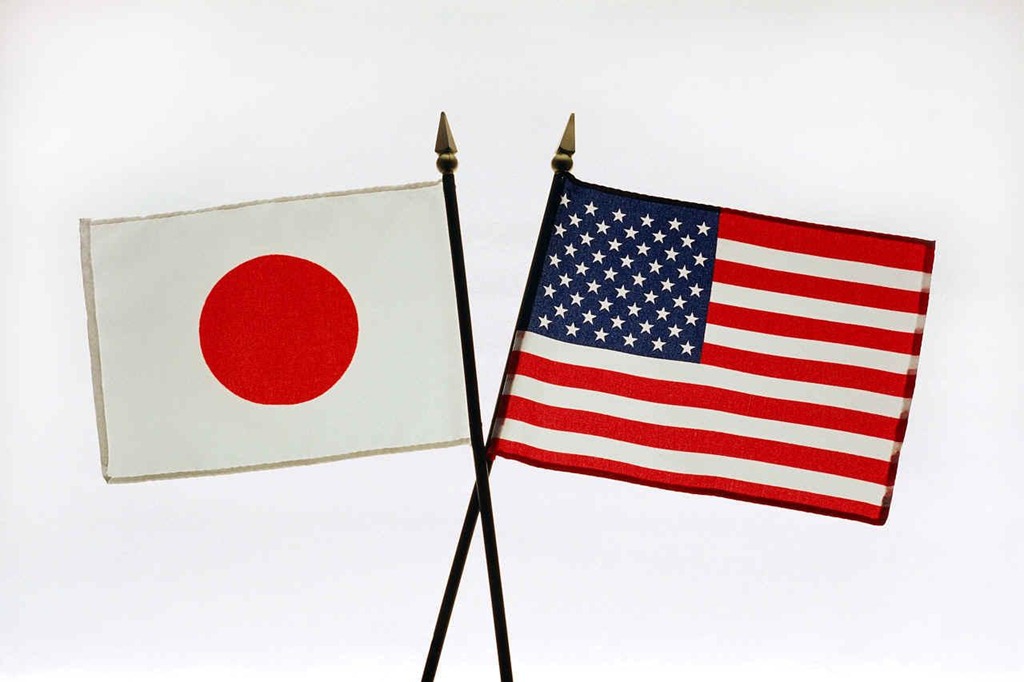
The Council of Foreign Relations blog, Asia Unbound, is quite good. If you don’t read it, you probably should before you read my stuff. To be sure, CFR is establishment; indeed, it is the very definition of the foreign policy establishment in the US. So it is not exactly the font of challenging new ideas. But still, they are linked into power in way that lonely academic bloggers will never be. And this week’s bit on Japan really got me thinking about how Japan is basically stuck with the American alliance indefinitely, whether they like it or not.

Recall a year ago when the LDP got whipped in the election, that there was lots of talk about how Hatoyama was going to create distance between Japan and the US, how this was a new dawn in the relationship, how the Japanese left would be so much more prickly with the US than the old boys network of the LDP. I was fairly skeptical of this at the time, and I think the recent flap with China over the islands has done a lot to confirm that skepticism.

Japan really has nowhere else to go but the US. It is stuck with us, primarily because it is geographically fixed in a neighborhood where it has no friends. And this opens all sorts of room for the US to push and bully Japan, which leads to regular Japanese outbursts that Japan needs to be independent of the US. (For the most famous, read this.) In fact, Japan is like a post-modern EU country in the wrong place. It should be comfortably ensconced in a post-national intergovernmental framework like the EU, where it could promptly forget about history and defense spending, and worry about how to care for its rapidly aging population – like Germany is morphing into ‘Greater Switzerland.’ But it’s not. Instead, Japan is trapped in modernist-nationalist-historical Asia, surrounded by states that don’t trust it and who want a lot from it that it doesn’t really want to give (historical apologies, imports, engagement, development aid, territorial compromises).

Consider that Japan, like China or Russia, has no friends or allies (save the US), and lots of semi-hostile neighbors:

Russia: Neither side has much interest in the other. There is an island dispute that has blocked normalization for decades. And, of course, Russia has been an erratic partner for just about everyone, not just Japan, since the end of the Cold War. So there is nothing to gain there.

Korea: There is also an island dispute with South Korea, over which even North Korea (!) has supported the SK position. NK kidnapped Japanese citizens in the 70s, and this has remained a permanent fixture in Japanese politics. For the North, Japan is high-up on the hit list; the North has launched missiles over it. Relations with the South are possibly even worse. S Koreans are intensely japanophic. The island dispute (Dokdo) rouses extraordinary passions here. Finally, of course, both Koreas are furious with Japan over its invasion and colonization from 1910-1945 and feel that Japan has never properly apologized.  Given how much S Korea and Japan share – democracy, concern over China’s rise, a US alliance, fear of NK, Confucian-Buddhist culture – they should should be natural allies, but Koreans will tell you with a straight face that Japan wants to invade it again. So forget that.

China: Yet another island dispute plagues the relationship from the start. And like Korea, so does history. The Japanese were even harsher in China than they were in Korea. The Rape of Nanking was brutality on par with the Nazis, and the Japanese used biological warfare against the Chinese as well. As the CFR post linked above notes, anti-Japanese street protests are becoming a regular part of Chinese politics now. A Sino-Japanese reconciliation would require astonishing, Willy Brandt-style statesmanship that the immobilist Japanese political system is wholly incapable of delivering.

Southeast Asia/India: Things get a little easier here, if only because it is further afield. But the ASEAN states too suffered under Japan in WWII, and like China and Korea, don’t feel that Japan has engaged in the appropriate historical reckoning. Only India is a possible serious Asian ally of the future because of mutual concern for China and the lack of historical-territorial problems.

Bonus problem – Economic Decline: As if this unhappy neighborhood weren’t trouble enough, add in Japan’s bizarre economic malaise. When China, Korea and the Soviet Union/Russia were a mess a generation ago, Japan could strut in Asia, but now these competitors are closing the gap while Japan stagnates. That just makes all the frictions that much harder to manage. China is so big, it can afford to miff the neighbors, but Japan no longer has this luxury.

In short, a weakening Japan so infuriates it neighborhood, that the US is all its got left. Given Japan’s paucity of options, the US has lots of room to bully and push Japan. But it must ultimately give in, because it’s position in Asia alone would be terrible – isolated, suspected, friendless. So bad is Japan’s position, that the US could effectively bring down the Hatoyama administration over something as minor as Futenma.

This is not meant to be an endorsement of US wedge politics against Japan. But it should certainly explain why its 20-year old complaint about US dominance has led to nothing, just like Gaulle’s petulant withdrawal from NATO ended in ignominy when the French finally gave up on ‘expectionalism’ and rejoined last year. It’s nice to be two oceans away from the competitions of Eurasia…

Post-Unification De-population of North Korea?

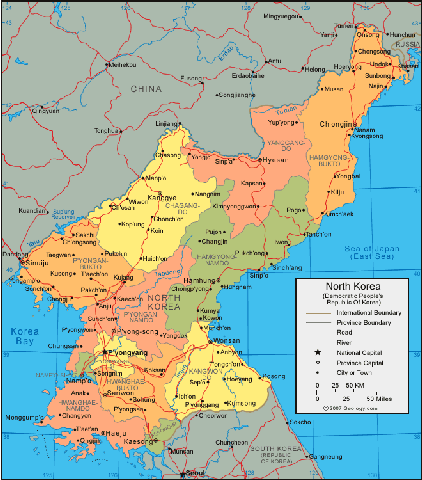
north-korea-map

PNU’s Institute of Social Science Research had a good speaker this week, demographer Berhard Koppen of Landau-Koblenz University in Germany. His talk, “Demographic Change and Immigration in Germany since Unification,” focused on the population impacts of German unification. As you can imagine, the Koreans study the German model (although not as much as you’d think), because they wonder what unification will look like – how much, how long, how disruptive, etc.

Koppen laid out a lot of good demographic data on just how extreme the population shifts from east to west inside Germany have been. I don’t have all the numbers in front of me, but it was pretty striking. In the most underdeveloped parts of the old German Democratic Republic (GDR), the population drop was more than 40% in two decades! In toto, the old GDR is 20% below its old population, despite the move of the capital to Berlin. So bad is it, that many east German communities have had to bulldoze housing, because it has simply sat unused for more than a decade (this, in country with one of the highest population densities in the world).

I have written about the geopolitics of Korean unification before. In short, they are not good, because China is much stronger than the USSR was in the German case. SK is weaker than was the Federal Republic of Germany (FRG). The US is also relatively weaker. And NK is far worse off than the GDR, which was regularly touted as the most advanced socialist state. All this forebodes that China’s role in unification will be much greater than the Soviet Union’s. As Koppen put it, the wealthy FRG could effectively ‘buy’ unification from the bankrupt USSR. China today though is ‘rising,’ and given the NK borders China, its interest and influence in the issue are correspondingly greater. As I wrote a year, China will structure any final status Korean deal much more than most people think right now (and the Chinese were sure to tell me that in Beijing earlier this year).

If this doesn’t scare South Koreans enough, Koppen’s data quieted the room. When I asked about the comparison with Korea, and what Koreans should expect, he could only foresee that a sudden border opening would lead to a huge southward flow – maybe 6 million people in the first few years. The differences between east and west Germany were much smaller than NK-SK, yet look at how much population flight has been happened there. One can only imagine how bad it would be here – a 40% depopulation of NK (9 out of 23 million), perhaps? Where would they be housed, how would they be supported, what would they do all day? The questions are endless.

Koppen closed by arguing that a slow federation of North and South would be better than the lightning unification of a sudden border opening as in the German case. Koppen used the EU as a model for Korean unification (an interesting parallel I never considered). As the EU is gradually federating in stages, so might Korea. I have heard this line of reasoning before using a more Asian model – Hong Kong and mainland China. Like that arrangement, perhaps Korea can go through a ‘one country, two systems’ stage. So North Koreans would get temporary work and living permits in the South, while Southern business would be encouraged to go North, with the North reconceived as something like a massive enterprise zone.

I am skeptical for a number of reasons:

1. North Koreans are vastly poorer than not only east Germans, but any of the eastern EU members. The moral pressure to do more faster would be enormous. Paced unification would look like Southern niggardliness in the face of desperation and poverty. Note also, that Hong Kong is quite wealthy, as is surrounding Guangdong province. This helps mitigates the border pressure; the opposite would be the case in a united Korea.

2. The nationalism factor would make holding the North at arms length difficult and distasteful. If the Koreans are one minjoek, as they never cease to tell us expats here, then how can you justify, save unashamed selfishness, keeping Northerners out? It looks bad, and it would certainly encourage populist North Korean politicians to complain about Southern cheapness, etc.

3. Keeping the North in some kind of semi-national limbo would encourage Chinese meddling. Indeed, the slower the unification process goes, the more likely China and others are to stick their noses into it. Conversely, if unification speeds along as a chaotic mess, then even China will likely say, we want nothing to do with the catastrophe-in-the-making; you South Koreans figure it out. This sounds unfortunate – the more anarchic the reunification, the more likely it will be a Korean-only affair, but I think it is so.

4. And in fact, Korean unification is almost certainly going to be messy, rapid, and chaotic if not downright anarchic. If one looks at Germany, once the communist lid was removed, the desire for unification on the part of the east especially, but also the west, exploded and became like a freight train accelerating downhill. It was just unstoppable. Yes, there were all sorts of GDR intellectuals who wanted east Germany to become a unique space, neither capitalist nor communist, but somehow ‘more humane,’ and all that. But the huge bulk of the population wanted nothing to do with such academic airiness, a luxury for elites. Average east Germans wanted nationalism, unity, wholeness, an end to an awful, artificial historical division, and an immediate improvement in living standards. They just pushed aside all those both internally and externally (Thatcher and Mitterand especially) who wanted a paced process. Helmut Kohl led reunification as much as he was led by it. And even though the GDR was supposedly ‘advanced’,’ it turned out not to be at all. The state collapsed almost immediately, and realistically, there was no one to pick up the many, many pieces expect West Germany. I think this is by far the most likely scenario here too. Once North Korea slips, it will go lightning fast. It will be chaotic, unpredictable, with huge national emotions at play and populations on the move, and near anarchy in the North, given how thoroughly illegitimate the state there is. The only realistic way to get control over this nation-wide meltdown will be the immediate extension of SK constitutional authority across the whole peninsula. It will be messy, hugely expensive, and involve the dramatic depopulation of the North, but realistically, I don’t see serious alternatives given how much worse off NK is than Hong Kong, the GDR, or eastern Europe.

On the Kim Family Succession in North Korea

3highres_00000402386223

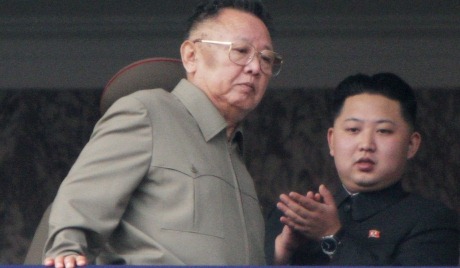
Kim Jong-Un (right), the now annointed successor to Jong Il (left)

As usual, Scott Snyder and Ruediger Frank have the best commentary on the succession and it importance for all Korea. Start with them before me.

I would just add a few points.

1. Much of the discussion about NK focuses on its supposed irrationality and unpredictability. I remember reading somewhere that Paul Wolfowitz was once asked which country on earth he feared the most, and he answered NK, because it operated so far outside international norms on just about everything – besides its regular asymmetric strikes against SK (like the Cheonan sinking, KAL 1987 bombing, or the bombing of the SK cabinet in 1983), it also engages in proliferation, drug-trafficking, insurance fraud (as a gimmick to raise money), and dollar counterfeiting. And of course, George Bush put NK on the Axis of Evil, even though it has no connection to Islamic radicalism at all, precisely because of the fear of irrationality linked to WMD. Increasingly though, I don’t buy this, and I think the succession demonstrates that NK is in fact somewhat predictable. I argued this a few weeks ago in Seoul, and the recent family succession, I believe, reinforces this.

While it is true that NK is nasty and does seem to cheat on all sorts of norms, they do this so regularly now, that its cheating is in fact predictable. This feels rather strange of course. Cheating is supposed to indicate unpredictability; but what if you cheat all the time? That too is regularity, right? As I argued in the link above, the Cheonan sinking does actually fit a pattern of asymmetric outbursts from NK in past, so it shouldn’t be a huge surprise, however awful it was. Similarly, the succession happened much as the last one did – from father to son – and lots of analysts, both Asian and Western predicted it, both then and again this time. And then those predications came true. So while it is unfortunate for the long-suffering North Koreans, and its does not bode well for better NK behavior in future, it was not unexpected. I am not fully convinced by this position myself; erratic and weird still seem to be the best words to describe NK. But its also not the case that we can’t make fairly educated guesses about NK’s future.

2. In line with point 1 is the likelihood that Kim III probably won’t change much. Indeed, he sent a huge signal to the whole world by his dress in last week’s coming out party-parade that he is not a Gorbachev. Just about everyone noticed that he looks strikingly like Kim Il Sung (Kim I). Note the hair style, NK lapel pin, Mao outfit, and, quite honestly, the obesity (presumably to signal stolidity and robustness, although it is a good bet too that he is party-boy like his dad). The speculation is endless that he might actually change stuff, but if NK is more predictable than we think (point 1 above), and if he is consciously cloning himself on Kim I, then it is a good bet that business as usual will roll on. In fact, given his youth and, hence, possible longevity, he could give the NK system a new lease on life, just as Bashar al Assad did when he took over Syria. Like NK, Syria is corrupt, isolated and broke, but the sheer energy of a younger dictator has helped hold Syria together and forestall the endless speculation, endemic to any dictatorship, of palace coups and such. If Kim III can hang on through the early years, which will be the toughest, as factions maneuver for influence in the nouveau regime, then we might be looking at a semi-stable NK for another few decades.

3. Finally, I can’t pass up noting the sheer ideological ridiculousness of a communist monarchy. Nothing demonstrates the ideological bankruptcy of NK as much as a family succession. That is a feudal practice, of course, which is exactly the type of thing communism was supposed to eliminate as backward and repressive. Marx and Lenin, we all know, were bitingly harsh in their critiques of feudalism. One of Marx’ most mean-spirited comments was his famous complaint of the ‘idiocy of the peasantry,’ meaning that they stood outside of history as passive, uninformed spectators mired in ignorance. And of course, the primary historical claim of just about every Marxist theorist and leader was that history moved in stages and the communism was the next one after capitalism. When Khrushchev said ‘we will bury you’,’ he meant exactly that these large Marxist-metaphysical forces of History were working against capitalism, no matter what it did to stop, and that communism was the inevitable future. This is why leaders like Stlin and Pol Pot were so harsh on their feudal-agricultural communities; they were ‘behind’ in the marxist historical mechanic. Even Mao had the sense to avoid the ‘familiazation’ of the CCP (his wife didn’t last too long) and famously criticized Confucius as a feudal reactionary. Yet here we have a communist regime openly going back to a pre-capitalist mode, not moving forward into the post-capitalist era as its own ideology says it should. One wonders how in god’s name NK ideologues must work to square this blatant neo-feudalism with regime ideology. It just baffles the mind.

National Security Decentralization: Kor. Inst. of Defense Analysis (2) – UPDATED: Response to Charli Carpenter – UPDATED II: More in the Comments

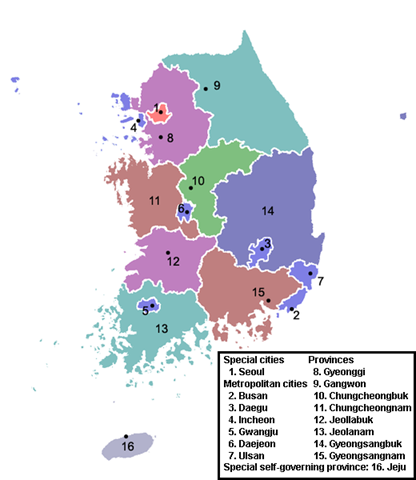
520px-Provinces_of_South_Korea_Txt

Part one is here.

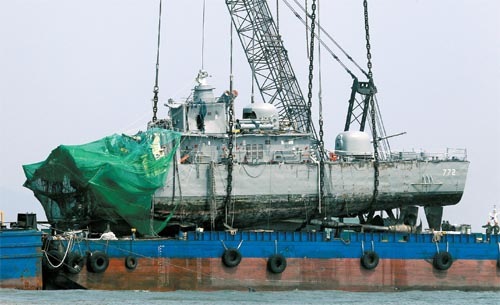
Last week, I spoke at a KIDA discussion of the Korean peninsula post-Cheonan. In brief I argued that there was no ‘post-Cheonan’ world as the SK right was hoping for. South Koreans are unwilling to risk war. There is no desire to hit back for the Cheonan sinking, because escalation might lead to a war in which South Koreans believe their wealthy democracy will get trashed and then burdened with Northern reconstruction.

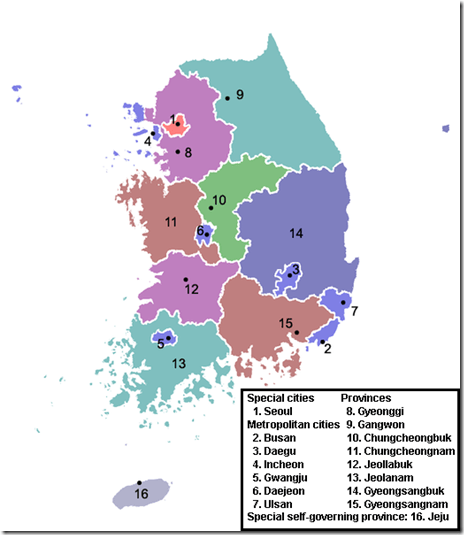
But there is another specific reason why there is no response. SK’s hands are tied by the extreme vulnerability of its major population centers to NK retaliation. Specifically, following the above map of Korea’s provinces and cities, Seoul has 10.464 million; Gyeonggi province around it, filled with Seoul’s suburbs, has 11.549 million, and Incheon has 2.767 million. Busan by contrast has just 3.566 million. Korea’s total population is 48.875 million. (Those numbers come from a colleague at PNU’s Department of Public Policy and Management.) Worse yet, Busan’s population is shrinking, and Incheon’s is growing. So this means that 50% of Korea’s population lives within 50 miles of the DMZ, and 30% lives within just 35 miles.

NK knows this, and in order to hold SK hostage against any Southern retaliation for incidents like the Cheonan, it has stationed something like 10-20k artillery and rockets at the DMZ closest to this massive urban agglomeration in northwest SK. In effect then, half of the SK population is a massive city-hostage to NK, and it is only worsening because of Incheon’s rapid new growth.

In game scenarios of a second Korean war, the first six hours are decisive. NK knows that it will likely lose the war, and that its assets will be quickly eroded by allied air power. That is, in the first few hours, a primary SK-US bombing target will be all those rockets and canon at the DMZ. Nonetheless, almost everyone thinks that the KPA will be able to get off enough shells and rockets to effectively devastate the Seoul-Gyeonggi-Incheon area. Given that Koreans mostly live in high-rise apartment buildings, some with 60+ stories, the result would be hundreds of World Trade Center collapses. I live in such a high-rise; I can’t imagine that it could realistically withstand a Scud missile or two. 2500 live in my building alone. Consider that all across Gyeonggi, and you have a holocaust.

Note too, that all this can occur without Northern nuclear use. Essentially,the early hours of a war would a race between allied air and ground power to hit all those Northern emplacements before they fire. Like the old Cold War logic facing the the US and USSR, NK faces an extreme ‘use-it-or-lose-it’ dilemma. For this reason, the DPRK has repeatedly threatened to turn Seoul into a ‘sea of fire.’ This huge threat to SK’s extremely vulnerable northwest urban centers is the primary reason why the North never suffers military retaliation for attacks such as the 1976 tree-cutting incident or the 1987 KAL bombing.

So what to do? To me it seems rather obvious – the gradual de-centralization of SK’s population (and government and economy) from the northwest. Strangely, I have found almost nothing in the IR-national security literature on SK defense recommending or even discussing this choice. Yet when I suggested it last week at KIDA, multiple SK and US analysts and officers approached me afterwards to discuss the idea. Should Korea’s population be spread more equitably around the peninsula and further south from the DMZ, this would open new strike-back options after incidents like the Cheonan.

There are several objections worth rebutting now.

1. It would be expensive. Ok. Sure. But so is all the ROK defense spending that goes into protecting the northwest already.

2. It would take forever. Yes, this is true. But the stalemate with NK is now entering its seventh decade. To our great surprise, NK has withstood the end of the CW, the collapse of Soviet support, the death of Kim Il Sung, and the famines of the 90s. Rather than taking a perpetually short-term attitude toward NK – when will it just collapse so we can get on with reconstruction? – a better approach might be to consider strategies to win a drawn-out stalemate, which is already what this conflict is anyway. Consider that if decentralization had started in 1990 how much better the post-Cheonan options would be.

3. When NK collapses, this will have been a huge waste of money. Not necessarily, because there are regional growth and national equity reasons also in support of decentralization. Ie, the ROK is already far too centralized in one place (Seoul). Koreans outside of Seoul even call it the ‘Seoul-Republic.’ Like France, SK is wildly unbalanced with one city starving the rest of the country for capital, human talent, government attention, etc. (One sees this quickly living, as I do, in the ‘provinces,’ like Pusan.) Even if NK collapses, it would be healthier for SK to look more like Germany, Canada, or the US, with multiple large cities competing with each other for national resources and talent.

4. Forced population transfer are illiberal and wrong in a democracy. This is the strongest argument. Clearly decentralization would happen most rapidly if it were coerced, but this is, correctly, intolerable. But the government could create lots of incentives short of force. It could move the seat of the ROKG out of Seoul for starters. Brazil did this – for regional equity purposes – in 1960; and West Germany put its capital in sleepy little Bonn, because West Berlin was just too exposed. Israel doesn’t let too many people live near the borders with Gaza and Lebanon. So there is democratic precedent. Also, the Korean government intervenes in the economy all the time to help companies with subsidies and what not. How about directing some of that money outside of the northwest? But I agree it would be tricky; eminent domain, even for national security, would be tough when millions of people are involved.

_____________________________________________________

UPDATED:

This was linked heavily at Lawyers, Guns and Money and the Progressive Realist (h/t Charli Carpenter). Here is a response to the criticims raised in the comments:

“Let me try to answer a few of the objections proposed:

1. ‘You can’t just move cities.’ Perhaps, but that misstates my suggestion. Seoul is very old city with strong emotional roots in Korean national identity. It will not move. But it can shrink. Its postwar explosion into a megalopolis is a direct result of (reversible) policy choices – including the government’s susbsidization of mega-firms (chaebol), huge infrastructure projects like the Incheon airport, and most importantly, the legacy of authoritarian political centralization. Like most dictators, SK’s pre-democratic generals centralized almost everything (in Seoul) in order to more easily control the state. This legacy survived and worsened, gradually depopulating Korea’s other major cities (Pusan, Daegu, Dajeon) as everyone now wants to ‘move up’ (the local term) to Seoul. It has become a vacuum that hoovers up talent relentlessly and starves the rest of the country, and it is actually getting worse now, not better: Pusan, the second city, is shrinking and aging, while Incehon, right next to Seoul, is booming. (This has slowly become a bigger issue in Korean politics in the last two decades as the imbalance between Seoul and the rest has become genuinely extreme. The ‘Sejong City’ project aims to move the capital, although the local argument for rebalancing away from Seoul is made mostly for regional equity, not national security, purposes.) In short, Seoul’s centrality relfects historical path-dependence that can be reversed by new policy choices, although Seoul-based elites in almost all fields oppose this as a major inconvenience.

2. ‘It is illiberal to move them.’ Yes, it is, but a) deomcracies make such calculations all the time, b) living next to NK is vastly more disruptive than refusing to move for the development of a mall or something, and c) I don’t endorse coercion but incentivization. The West Germans imposed all sorts of restrictions on the residents of West Berlin that didn’t apply elsewhere, and Israel too uses zoning codes and such all the time for political purposes. SK already prevents people from living even closer to the DMZ. Also, Korea, unlike Western states, embraces state-led development and expects the state to do these sorts of things. Americans find ’eminent domain’ a culturally unacceptable intrusion on personal freedom, but I bet if you polled Koreans you wouldn’t get nearly that sort of anger. The role of the state in Korean life is much greater, subtler, and desired than it is in the US. Further, all sorts of places are deemed off-limits for residence for national security reasons in many countries. Finally, it hardly strikes me as ‘residential fascism’ or something to encourage people not to live right next  door to a super-dangerous enemy. Indeed, I am rather amazed that SK never did anything to halt this decades ago. The scale, not the legality, strikes me as the real problem. There are just so many people in Seoul and Kyeonggi; any serious plan to encourage relocation would take forever and cost mountains of money. On top of the demographic movement would be the further costs of an economic and political shift. It seems ridiculously expensive when the money could be spent on so much else. But if unwinding the already-exising over-population would be hard, the government could still take steps to prevent it from worsening in the future, as it is doing right now (point 1 above).

3. ‘Can’t we just protect them by destroying the weapons targeted at them?‘ This is what US Forces in Korea (USFK) hope, and they will tell you that in the first few hours of a war, they are going to fly hundreds of sorties to get the canon and artillery. In response to this NK has put, by some estimates 20,000 artillery and rockets at the nearby DMZ as a counter. I have not meet any analyst here – military or cilivian, Korean or America – who believes that allied air power could get them all without several hours (minimum) of bombing runs. Given that most Koreans live in closely clustered high rises, not dispersed homes, you only one need one or two shells or rockets to kill 2000 people. The referent image should be the hundreds of World Trade Center towers clustered tightly in an area smaller than Rhode Island collapsing under a rain of shells. You don’t more than a few hours of Northern shelling to create a holocaust.

4. ‘Can civil defense protect them?‘ Probably not. First, Seoul/Kyeonggi’s transportation network would be dwarfed by the scale. Seoul traffic is already some of the worst in Asia. The subways are bursting during rush hour. The dilemma is similar to New Orleans’ one road out during Katrina. 2. The area around Seoul is hilly and rugged. 75% of the Korean population lives on only 25% of its landmass (that’s one reason we all live in enormous apartment towers). There is simply no where close to Seoul to handle the scale of movement unless you had many weeks to disperse them all over the peninsula. Finally, as I said in the orignal blogpost (above), NK artillery at the DMZ faces a severe ‘use-it-or-lose-it’ dilemma: once the war starts, allied air power is going to hammer these sites relentlessly. So if you start moving people out of Gyeonggi preemptively in a slow-moving crisis (like summer 1914, or right now in Korea?), you are signaling to the North to strike first before its deterrent evaporates.

For all these reasons, it seems to me that there is no short-term answer, but that a medium-term policy incentivizing residence and investment elsewhere is the way to go. That should probably include decentralization of authority to Korea’s provinces, the movement of the capital to either Sejong City or Daejeon (because they are in the geographic middle of the country [and not Busan, because it is too far away]), and the subsidization of economic development outside of the northwest.”

Cheonan Sinking Changes Nothing: Kor. Inst. of Defense Analysis (1)

menubar_toplogo

Another week, another North Korea conference. It amazes me just how much we (in Korean IR) talk about this issue. It is a never ending thrill-ride. And it is not just academics. I meet military, intelligence, even literature and photography experts (deciphering NK propaganda) from the US, SK, and Japan regularly. If you thought the GWoT created a defense-intel-IR gravy train in the the US, try Korea’s never ending circus on what to do about NK. It’s a cottage industry military-industrial-academic complex all of its own. Honestly, I wonder if we’ll all miss NK when she finally goes. Shamelessly, of course, I too am a part of that circus. Part of me understands obviously. The US doesn’t live next to the wackiest, more dangerous state on the planet. But still, I am amazed just how much of my time goes into this issue because of the simple fact of teaching IR in Korea.

So this week, the Korean Institute of Defense Analysis (KIDA) held its conference on what has changed since the sinking of the Cheonan in March. Here is my previous thinking on this. Here is the ROKG final report on it, clearly blaming NK. KIDA is a great institution, with really high-quality material and a super SSCI journal. So off I went to talk about this with the usual suspects of intel, military, diplomacy, academics, and the rest.

So now, 6 months out, tempers have cooled. No one is talking about air-strikes anymore. So what have we learned?

1. We didn’t learn much about NK. We already knew that NK is erratic, prone to savage, but limited outbursts, shamelessly denies everything, and uses external military-intel actions for internal in-fighting purposes. The tree-cutting incident, the cabinet bombing, the KAL bombing, and Cheonan sinking all show these characteristics, as well as the smaller incidents like the sub penetrations or Yellow Sea skirmishes.  So yes, the regime may be attributing this to the new boy-king, Kim Jong-Eun,for internal promotion purposes. But while that is important, it is not new. We didn’t see much we haven’t seen before.

2. Regarding the cause, we still don’t really know. I tend to agree that Jong-Eun (Kim III) is being given some accolades to establish him. But the larger structural cause is the steady factionalization common in late-stalinist systems. We saw internal jockeying among elites and interest groups in the USSR in the 80s, and in China in the early 70s. My read of the Cheonan sinking is that it is a message from the NK military to everyone else – the party and civilians in NK, including Kim III, the ROKG and military, the US, etc. – that it is a major, if not the central, actor to be reckoned with in peninsular affairs. There is no deal to be had without the KPA’s approval, and they will shoot up SK facilities every once in awhile to remind us all of that fact.

3. The Cheonan sinking told us more about SK than NK actually:

3a. We learned that SK has a very high threshold for NK pain; ie, that South Koreans don’t care much about NK and just don’t want to hear about it. There was no outburst of popular anger at NK. No call for air or naval strikes, much less war. Like the Chinese insistence that maybe the Cheonan just hit a rock or the Russian notion that it hit a mine, South Koreans too just want to put their head in the sand and not know the truth. Everyone just wanted it to go away as soon as possible. No one wants to recognize that NK did this, because it is so nasty, it screams for retaliation. Consider if Iran sank a US warship in the Gulf, or if Pakistan shot down an Indian jetfighter. The rhetoric would have been sharp and the responses swift. Here, nothing happened. No one, but for the SK military perhaps, wanted a strike-back. So it all just faded to black, and we are back to where we’ve always been – NK asking for aid, rumors about the 6 party-talks again, a focus on nukes, more talk of succession. The Cheonan changed nothing, because SK doesn’t it want it to.

3b. From this minimal willingness to risk escalation, we can conclude that SK has become a status quo power effectively in the peninsula, despite its formal (ie, constitutional) claim to the whole Korean landmass. SK has labored tremendously to build its consumer society-trading state, and it does not want that wrecked by NK. While most observers would say that NK has more to lose in a war – the regime leaders are terrified they will be hanged in the end – South Koreans clearly don’t see it that way. Instead they see their wealthy democracy getting trashed to save poor people they scarcely know, possibly including the use of nukes on their own soil. For this, they are willing to pay this price of a few Cheonans now and then. 6 months ago, most of us would have said something like the Cheonan would be a redline. But here we are over it with little change, so the question arises, just how far can NK go?

3c. We also learned how deep anti-Americanism runs in SK. To the astonishment of just about every mi-guk-in I know in Korea, something like 1/3 of Koreans believe the US sank the ship. And another third or so, think the sinking reveals the incompetence of the Lee administration. This just floors me. It tells me SK is so desperate to avoid escalation, they’ll believe anything. And how the Lee administration could realistically have been expected to defend against something like this is just beyond me. The case for NK blame is so obvious – yet so disruptive to regional stability – just about everyone – the SK public, the Russians, the Chinese – want to pretend otherwise, and NK denials dovetail perfectly.

4. Finally, the Cheonan tells us just how willfully unhelpful China and Russia really are. Russia’s primary foreign policy goal is to be perceived as a great power, because it can only barely claim that status now. Crises which get Russia invited to the top tables of world politics are therefore to be kept going as long as possible. Russia’s interest is the perpetuation of the stalemate, not its resolution. Regarding China, the news is even worse. When forced to choose between the two Koreas, China chose the North (foolishly); China refused to admit that the North sank the ship. This more clearly pushed NK into China’s embrace, making it ever more likely that China will keep the North alive for awhile yet, and that when unification does happen, China’s role will be more intrusive, including perhaps demands for a buffer zone or unified Korea’s finlandization.

Part 2 is here.

South Koreans are not Neo-cons

Neocon Ideology vs Korean reality: Modern SK is a commercial trading state with zero interest in a war with the North. More than anything, they just want it to go away so that they can get back to more important things like K-pop (above). The social values on display above in no way connect to the constructed ‘axis of evil’ reality neo-cons want South Koreans to live in.

Rodger Payne, at the IR theory blog Duck of Minerva, had a good post on the all-too-predictable ramp-up on neo-con rage on NK regarding the Cheonan. But the South Koreans are not neo-cons. It is cloying, self-serving cultural hubris for Cheney, the Wall Street Journal, John Bolton, the Kagans, Max Boot, Brookings, and all the rest of the usual suspects to speak so sanctimoniously on SK’s behalf. South Koreans do not see NK the way Americans do and do not even know the tenor of the American debate on NK. The US right uses its all-too-convenient sympathy for SK and NK’s oppressed to push for policies that South Koreans do not want, and, worse, for neo-con ideological reasons that South Koreans do not understand at all. I have tried, believe me, to explain the Bush/Fox News view of the war on terrorism here, and Korean students don’t get it at all. They think W was a loopy, rogue Christian imperialist.

Koreans are far less casual about recommending the use of force or even sanctions. A sizeable minority do not accept that the Cheonan was sunk by NK. The majority think the sinking demonstrates the incompetence of the current Lee government more than NK’s belligerence. North Koreans are ethnic brothers (against whom the use of force is a problem), while simultaneously, South Korean interest in reunification is fading (it is not worth fighting for). As the above video should make clear, this is not a militaristic society itching for a fight. Koreans don’t like and don’t understand ‘axis of evil’ talk, and they certainly won’t accept patronizing US analysysts telling them that’s how they should think.

For all these reasons, there is no surge in neo-con anger as manufactured at AEI or the WSJ. The ease with which this faux-anger and one-size-fits-all ‘axis of evil’ schtick emanates from the Washington-based think tank-industrial complex disgusts me. US political language regarding NK fits neither the mindset nor changing interests of SK. Given that South Koreans must carry the costs of neo-con truculence, how about asking them how they see it? Because you wouldn’t get answer that fit the American frame of NK, so it’s best to just ignore. This is the best English-language article I have seen yet that actually tells you how South Koreans themselves see their interests in this mess.

My point is not to say that the neo-con analysis is  philosophically wrong. Maybe Koreans should be neo-cons prepared to risk war for regime change. But that is not my point. Instead, I am disturbed at how quickly the standard issue Washington attitude toward NK circulated with no examination of Korean public opinion. Nobody bothered to think about that, because the think-tank industrial complex of US foreign policy already knows the answer. Maybe South Koreans should be neo-cons, but they aren’t; Koreans neither understand nor accept that analysis. So it is terribly wrong for the neo-con set to invoke the moral weight of Korean nationalism and NK tyranny without ‘permission’ from Korean public opinion. I’m sure the neo-cons would say that South Koreans should be outraged by the Cheonan and ready to risk war for regime change. But they aren’t, and trying to manipulate SK by cloyingly invoking its own tragedies is extreme bad faith.

For my previous thoughts on the Cheonan, click here.

The Six-Party Talks as a Game Theoretic ‘Stag-Hunt’ (2): China Likes the Rabbit Too Much

hackaert-stag-hunt-forest-NG829-fm

Part one of this post is here.

In the formal language of game theory (GT), here is the pay-off matrix for the hunters (SK, PRC, Japan, Russia, US) if they capture the stag (NK’s better behavior in the region):

1. SK: SK is the most obvious winner from taking the stag because NK is an existential threat to the South – both physically and constitutionally.

2. Japan: Japan is the second big winner, because the NK nuclear and missile program increasingly represent a major physical threat to its cities, and perhaps even an existential threat if the North can put enough nukes on missiles.

3. US: The US is a weaker winner, because it is far less threatened by the North directly. The big pay-off from NK change (the stag) would be the reduction in troops and other expense from keeping USFK in Korea. Another benefit would be the reduction in the post-9/11 concern for proliferation of missile and WMD technology to terrorists and rogue states. But this is still far less critical than SK and Japan’s benefit. To the US, NK is more a troublesome, throwback-from-the-Cold-War headache when it would rather concentrate on salafism and the rise China.

4. Russia: Russia has essentially no stake in Northeast Asian security, given that it has basically retrenched from the region to focus on Central Asia and Eastern Europe. However, the Six Party talks are a prestige-generator for a country desperate to still look like a great power even as its lineaments erode. So Russia doesn’t get much from the stag.

5. China: The PRC’s portion of the stag is the smallest, while its rabbit is the biggest. A more docile NK would almost certainly fall heavily under the influence of its southern twin. The more ‘southernized’ NK becomes, the less sinified it will be. (This of course is the whole point from the Korean perspective – reunification.) And the PRC almost certainly reads greater southern influence in the North as greater American influence. So the Chinese rabbit is the long-term survival of a separate NK state to act as a buffer against the democracy, American influence, liberalism, and Korean nationalism that would all flood into NK were an inter-Korean settlement (the stag) finally struck. (A friend at the Renmin University of Beijing all but says this here, and I generally find Chinese scholars will openly tell you why the PRC props up the DRPK even though the PRC’s official policy is reunification.)

What to do then? How do the other hunters get China to stop defecting and start cooperating? The most obvious way is to equalize the pay-offs more, i.e., make it more valuable for China to coordinate by increasing China’s portion of the stag. Here is where strategic restraint on the Cheonan sinking may be useful. If SK holds its fire over the incident, it may be able to ‘sell’ this restraint to China as a hitherto unrecognized benefit. The SK claim to China would be:

See how small your rabbit really is? NK is so unpredictable, so erratic, so uncontrollable, that the stag is more beneficial than you think. Without a long-term settlement, NK’s erratic behavior could eventually generate a crisis the SK population will no longer choose to overlook. Next time this happens, SK government may be forced by popular outrage into coercive retaliation that could pull everyone in northeast Asia into the vortex.

Recall in early 1991 that Israel demonstrated similar strategic restraint as Saddam Hussein shelled it with Scuds before Desert Storm. This helped convince Saddam’s Arab neighbors that Saddam really was a danger to everyone. SK might be able to do the same here.

However, this is unlikely to be enough. China will probably as for a higher concession – a promise for the removal of USFK after unification. It is not clear to me if a unified Korea would need USFK, so this may be an option to explore.

Six-Party Talks as a Game Theoretic ‘Stag-Hunt’ (1): N Korea is the Stag

stag_hunt

Last week, I suggested that South Korea demonstrate ‘strategic restraint’ vis-a-vis NK if the North truly sank that SK destroyer. Not only are the South’s tactical response options terrible, but there is benefit here to be captured if the South’s restraint is marketed to China as a concession in exchange for more pressure on the North. For all of NK’s reputed autarky, it is in fact highly dependent on Chinese aid and trade, both licit and illicit. Without Chinese fuel oil, the lights in the North would go out; without the imports of booze, dollars, and pornography, the life of the Korean elite would be far less pampered. China cannot force the NK to change, but it can dramatically raise the costs of its continued intransigence.

All this is well-known but could be helpfully formalized in our research. In fact, I am surprised how little game theory (GT) I see applied to NK at the conferences here in Asia, given how obvious its utility is to the bargaining and brinksmanship endemic in NK foreign policy.

The stag-hunt (SH) is the best GT model or ‘game’ by which to map Northeast Asia’s security dilemma. We use GT all the time in IR but usually the prisoner’s dilemma (PD). (If you have no idea what I am talking about, start here for GT in IR; the Wikipedia write-ups, linked for the SH and PD, are actually quite good too.) The PD is cooperation came – how do you get the players to cooperate when there are high incentives to cheat on each other. The stag-hunt is better understood as a coordination game – how do you get the players to coordinate a common strategy to get the big pay-off, the stag.

Here is the basic schematic: a group of hunters can probably bag a big stag if they work together. They can weave a net around the stag that is likely to catch him. However, the hunters will also see the occasional rabbit bounce by. If one of the hunters goes for a rabbit, the stag will escape through the hole created and the other hunters will lose the stag almost certainly. Formally put, the stag is a big pay-off, and there is a good probability of successfully catching it if the hunters all coordinate. Conversely, the rabbit is a sure thing, but a much smaller, payoff. So the trick is to convince all the hunters to coordinate and not take the easy rabbit by cheating or ‘defecting’ on the other hunters.

So apply this to the Six Party Talks: The Hunters (players of the game) are the 5 parties besides NK: Japan, US, SK, Russia, and China. The Stag is North Korea, or more specifically change by the NK regime. The NK stag knows that if the 5 hunters can’t cooperate, it can escape. And it is widely noted that this is exactly what NK has done for decades. NK’s foreign-policy methodology since the 50s has been twisting and turning to prevent domination. Since the end of the Cold War, this has meant a constant ‘divide-to-survive’ effort aimed at the other 5 parties to prevent their coalescence into a united front against the DPRK. (I even wrote a book chapter about this, in galleys here.)

So the trick then is to build a common front among NK’s hunters to insure that they won’t defect or cheat and go for the rabbit. The rabbit in the NK case would be NK concessions to one party, but not the others: for example, abductee returns to Japan, family reunions for SK, mineral exploration rights for China, etc. These piecemeal, now-one-but-not-the-other concessions are all designed to keep the other 5 players off-balance and disunited. To date this has worked spectacularly well, even though the 5 hunters all know they are getting shamelessly manipulated.

The big problem to date for the hunters’ coordination is that China sees a lot of gain from taking the rabbit. The Chinese rabbit is in fact so juicy, it probably outweighs the tasty stag. The Chinese rabbit is a route of influence into the Korean Peninsula through North Korea’s continued existence. The big stag – change in NK to be a better international citizen in Northeast Asia – is of much greater value to SK and Japan, followed by the US, than it is to China. So long as China perceives a utility from NK as a buffer against SK, Japan, and the US, it is likely to continue to defect on 5 party cooperation, as it did last year, and take the rabbit of propping up NK in order to influence Korean events.

Part two is here.

How to Respond if North Korea really Sank that SK Destroyer: ‘Sell’ Southern Strategic Restraint to China for Pressure on the North

15214047

The sinking of a South Korean vessel, the Cheonan, has dominated the news here for weeks. Increasingly it looks like an external explosion caused the ship to break in two and sink rapidly. Suspicion is high that the only external force strong enough to sink a modern reinforced warship would have to a be a (presumably NK) mine or torpedo.

Predictably the conservative SK press has started the drumbeat for an aggressive response, including possible military action. President Lee of course is painted into a corner. A wholly unprovoked attack like this screams for blood, and the South Korean right is virulently anti-communist. If Lee does nothing, he’ll be hammered in the media and by his rivals within the governing party.

I sense a decisive moment building, akin to Austro-Hungary’s 1914 debate on how to respond to Archduke Ferdinand’s assassination, or Bush’s post-9/11 reckoning. Here is a moment rich and justified in the aggressive rhetoric so beloved by conservatives the world over; try to imagine how Fox News would respond if the ship had been American. This could easily slide into nationalist hysteria and escalation. 9/11 too raised America’s temperature and pushed the US government to aggressive action in the Middle East. Only a few years later did it become apparent how much the US overreacted. I fear the same here. As Andrei Lankov (one of the best NK experts – read him if you don’t) notes, Lee doesn’t really have much room to do anything against the North that is significantly punishing, yet won’t cause a NK escalatory response, and then a dangerous tit-for tat downward spiral. I think the Korean Foreign Ministry sees this too.

In brief, the problems with any military response are:

1. North Koreans will suffer the costs of any retaliation, not the KPA/KWP elite likely responsible for the attack.

2. NK is heavily ‘bunkered’ and hardened. Any military response would likely be from the air and would require multiple sorties. This means more chances for accidents, shootdowns, and other ‘kinetic’ interactions that could lead to a spiral of violence.

3. Realistically, the US would have to political approve of SK action; this is unlikely.

4. The North is already so deprived and impoverished, it is hard to find a juicy target that would both hurt but not lead the KPA to call for war. (This is what would happen if the nuclear sites were bombed, so scratch that idea.)

5. My friend Brian Myers has convinced me that NK is such a paranoid, ‘national-defense state,’ that any attack is likely to provoke an escalated armed response. The KPA derives it prestige and legitimacy from its ability to defend the country – indeed this built into the constitution now as as the “military-first” policy – so it would be existentially important for it to hit back.

Hence it is extremely likely that any SK strike would be immediately countered and escalated. This is not like Israeli airstrikes in Lebanon or Syria. The North will almost certainly pursue escalation dominance into a quickening and widening cycle of hits and counter-hits. This is not a game the South really wants to play, especially given Seoul’s extreme exposure to North Korean artillery. So swallowing its anger out of sheer fear of escalation is my prediction of SK’s response.

So what to do? How about going to China and telling them, ‘we will hold off on a response in the interest of stability, but you really need to get serious with the pressure. No more bail-outs and trips to Beijing for the Northern elite.’ China doesn’t want a tit-for-tat, degenerative North-South spiral anymore than anyone else. Perhaps the South can use this to really push the Chinese hard on finally cutting off NK.

To be sure, the road to Pyongyang doesn’t go through Beijing. North Korea coldly plays China for gain as much as it does the US, Japan, and South Korea. But I have always thought that if NK ever faced a truly united front of the other 5 parties of the Six Party Talks (China, US, SK, Japan and Russia), the DPRK might finally be cornered. In this way, the relevant Six Party game theory is the stag-hunt. If only the 5 can coordinate and not defect on each other (NK’s constant goal), the can catch the big stag – change in NK. Strategic restraint on the Cheonan sinking might be a way to convince China to finally stop defecting over North Korea.

Is It Moral to Find Humor in North Korea’s Bizarreness?

kimjong2

kimjong5

kimjong7


I never really know how to answer this question. Among IR and foreign policy types, the DPRK is just as easily a punch-line over drinks after a long conference as it is a topic of that same conference. Andrew Sullivan equivocates on the question here.

I found these pictures, with the appended humorous dialogue, here. Remember that Kim declared long hair bad for socialism. The NK media also claims Kim Jong Il can manipulate time. So when it gets this wacky, it’s fairly hysterical. It’s hard not to laugh, right?

On the other hand, you can in fact imagine that the captions above to the third picture are accurate. The regime is that arbitrary and brutal.

My sense is that it is within the bounds of ethics to laugh at communist kitsch after the regimes have collapsed or at loopy Chavez-types who aren’t too destructive  – yet. But North Korea is probably too far. Comments would be appreciated.

If you want even more North Korean surreality to tempt your ethics with humor, try here for the genuinely bizarre subculture fetishizing the pretty but robotic North Korea traffic cops. Yes, it’s that weird. See if you can avoid laughing…

For my other writing on how opaque and bizarre NK is, try here, here and here.