Happy Thanksgiving – Some Korean Humor – See You Next Week

I love this special. Enjoy.

For my passing thoughts on western holidays in Korea, try these for Christmas, Halloween, and Thanksgiving. The short answer is that US holidays have made only minor inroads, so we should be skeptical of antiglobalizers’ claims that globalization is really cultural Americanization/homogenization. Despite 5 decades of huge US cultural influence in Korea, local cultural integrity is pretty intact. I don’t see too much homogenization here; it’s more like hybridization.

So here is a little Westerners-lost-in-Asia humor to tide you over for a week.

Among the expat community here, lots of these ‘You know you have been in Korea too long, when…’ lists circulate on email. Here is a mish-mash of the many I have received over the years. Some are a little punchy; just try to laugh a little. They are meant to be fun and exaggerated.

You know you have been in Korea too long, when…

When you no longer wait for the subway on/off pell-mell to clear; instead you plow in and contribute to it.

When you bow to foreigners too.

When you wear high heels to the beach.

When you fear an imminent Japanese invasion of Pusan.

When you demand steel Korean chopsticks even when you eat at Chinese and Japanese restaurants.

When you use chopsticks even when your Korean dinner partners use a knife and fork.

When you tell your far-too-hot-for-you Korean girlfriend that she needs plastic surgery, and she accepts it without complaint.

When you tell your family that Korean food improves your blood circulation.

When Korean directions – ‘make a left turn at the mountain and go straight for awhile’ – are crystal clear.

When normal women from your home country suddenly appear overweight and underdressed.

When you agree that there are too many foreigners in Korea.

When you bring a dictionary on a date.

When you use your fan’s timer at night.

When you no longer pity the live crabs boiling in the pressure cookers at the street market.

When you prefer Korean beef to ‘imports.’

When you put a picture of yourself on your cell phone instead of your loved ones.

When you enjoy watching street vendors decapitating live shellfish.

When you no longer feel embarrassed talking back to the little kids who point and call you ‘foreigner.’

When you’ve mailed pot to yourself (probably from Canada).

When you smoke in your office and don’t worry or care you’ll get caught.

When you drink in your office and don’t worry or care you’ll get caught.

When you eat meals at FamilyMart.

When you know the HomePlus jingle by heart.

When you’ve stayed a love motel.

When you prefer love motels, because they’re cheap.

When you stop being surprised by ‘service-e-e,’ start expecting it, and then get unhappy when you don’t receive it.

When you automatically assume you should buy all your electronics from Samsung, even though you bought Sony at home.

When you find Arirang TV network a realistic portrait of Korea.

When you finally acquiesce to your Korean girlfriends’ insistence that you wear a tie with sparkles.

When you start agreeing that air-drying your clothes is better than your tumble dryer at home.

When you stop caring that your students laugh at your terrible Korean.

When drinking till memory loss on a work night constitutes ‘improving your network.’

When you stop worrying that your apartment security guard sleeps all night and never seems to be at his desk.

When you start to sort your trash in your apartment.

When you own gold formal chopsticks.

When you’re no longer embarrassed to hit the salons after work; instead you egg your Korean friends to take you with them.

When you keep sandal house shoes at your office.

When you no longer find National Assembly riots hysterical.

When you complain about the quality of the kimchi at restaurants.

When you sit out all night at a small food stand and get loaded with the other ajeossis.

When you start speaking Kongrish-e-e instead of English.

When you have a statue of the happy Buddha on your shelf.

When you keep a bottle of liquor in your office.

When your intestines finally make peace with red pepper at every meal.

When you start styling your hair like Rain.

When you start calling other foreigners ‘wae-guks.’

When you start believing in ghosts, spirits, demons, forest gods, the ancestors, and the 4th floor.

When you re-watch ‘Poltergeist’ for home defense instructions against the ghosts.

When you know who Dangun and the Su-ryeong are.

When you believe in Dangun and tell your students to call you Su-ryeong.

When you actually care about the fate of Dokdo.

When you think making out in the DVD bang is a normal part of a date, not a deportable offense.

When you unthinkingly speak of the “East Sea” to non-Koreans.

When you agree that movies like ‘D-War’ are a global cinema event.

When you no longer miss the Halloween-Thanksgiving-Christmas-New Years holiday season.

When you stop holding doors for people.

When you push through a crowd as well as an ajumma does.

When your cell phone danglies outweigh your cell phone.

When you can perform the full Buddhist bow without your knees cracking.

When you accept that kimchi really does ward off SARS/bird flu/Ebola/swine flu/mad cow disease.

When you do mental addition with your one hand on the palm of the other.

When you expect and want kimchi with your breakfast.

When you prefer soju to ‘imported’ liquor.

When you have watched TV on your cell phone.

When you have bought 2 cell phones in less than 1 year.

When you stare back unfazed at school girls smirking at you.

When loudspeakers on fruit trucks add ‘local color’ instead of ‘noise pollution.’

When ‘home’ is one room 40 stories off the ground with no air conditioner.

HAPPY THANKSGIVING.
Let’s Get Ready to Ruuuumble!!!!! — Korean Style over the US Trade Deal VIDEO UPDATE: Tear Gas (!); Deal Passed

OB-QR705_tearga_G_20111122042710


My original post is below, but the Korea-US Free Trade Area vote came up on the afternoon of the 22nd. The ruling Grand National Party pushed it through (thank god – because imports here are ridiculously overpriced and NTB’d).

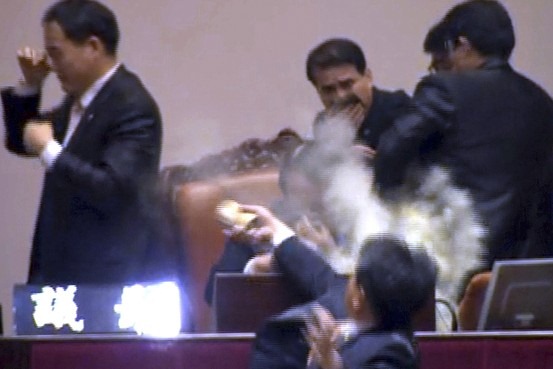
But the opposition tried to block with what must be a new tactic in the history of legislative rioting – tear gas! Wow. Who saw that coming? In my original post, you’ll see that I expected hair pulling and chair-throwing, but not this. As Otter would say, ‘it’s a new low.’ For all my disdain of the modern American right at home, I still can’t understand the SK left. The Democratic Party here strikes as me so unbelievably immature – leaving aside the DP’s inability to see NK as more threatening than the US to SK sovereignty, why would an obviously trade-dependent state like Korea, where the trade surplus is reported on religiously every month, reject an FTA? And what is with all the rioting? These brawls happen now at least once a year. (Read this on the Korean case for the FTA, which is much stronger than for the US.)

But still the video is pretty hysterical. Enjoy with your Thanksgiving turkey:

A new low in the storied history of legislative rioting


————————-  ORIGINAL POST FROM YESTERDAY  BELOW ————–


Democracy Rocks !! LOL


The opposition Democratic Party is getting ready to physically block the Korus FTA legislation from floor consideration in the National Assembly this week. Read this. Time to riot! Just check youtube in a few days for flying chairs, fire extinguishers, and hair-pulling. Awesome.

If you’ve never seen an Asian parliament riot, you’ve missed one of the great pleasures of life in Asia. The above is a nice vid, from South Korea. But the Taiwanese have the best ones. Rumor has it they have breathalyzer tests before the biggest Taiwanese debates. Hah! I love it. Just type ‘parliament fight south korea’ or ‘taiwan’ into youtube and watch them for awhile. They’re hysterical. Here are a few. For my speculation on why these ridiculously embarrassing meltdowns happen, read this.

5 (Bad) Options for Dealing w/ NK (3): Defense Build-Up to Harden SK

pyongyang-north-korea-nc

Part 1 is here; part two is here.

Last week I spoke at the Korean Institute of Defense Analysis. I presented four options for dealing with NK that have all broadly failed: negotiations (NK doesn’t seem to take them seriously), muddling through crisis-by-crisis (condemning the long-suffering NKs to permanent repression and leaving SK open to regular provocation and blackmail), China (despite its widely touted leverage over NK, China doesn’t seem willing or able to use it), and Sunshine Policy bribery (a noble effort that failed, however unfortunately). My review left me with this final choice that I find disagreeable, but I see little alternative at this point (i.e., after the Cheonan and Yeonpyeong incidents last year).

5. Defense Build-up: The idea here is to create space from NK by building a hard ‘shell’ around SK to insulate it from NK antics. The attraction is its unilateralism. Instead of waiting for NK or China to come around, SK can act proactively. Given that SK only spends 2.5% of GDP on defense, there is clear room for more spending. Certainly, the US, which regularly bemoans low allied defense spending, would welcome a more robust SK defense. Indeed, given that SK borders one of history’s worst, most unpredictable rogue tyrannies, SK defense spending is probably too low. Much of the gap has been filled by US forces in country, but with the US in relative decline, SK defense hikes are likely anyway.

A questioner asked me what should SK spend the money on. I made this argument earlier too, after Yeonpyong, but it seems to me that C4ISR, a larger navy, and missile defense would be good choices (although I am no formal military type, so readers comments here would be great). C4ISR are capabilities that SK leans heavily on the US for. A better navy would help harden SK in the Yellow Sea, where most of the clashes take place. And theater missile defense (TMD), which the US has approached SK about a few times, could help neutralize the burgeoning missile threat. In conversation, I rejected armor, because it has stronger offensive implications. A lesson from the offense-defense balance literature in IR is to try to buy defensive weapons as much as possible, in order to lesson your adversary’s paranoid reaction. But more generally, the idea is similar to McNamara’s ‘flexible response’ – give SK a wide range of capabilities to credibly counter NK provocation however it might occur. Needless to say, such ‘full spectrum dominance’ would be expensive, but I don’t see too many alternatives now. (Here is a good essay on defense transformation in Korea.)

The ideal would be to create an environment where SK could respond to NK provocation immediately, proportionately, and precisely. The game theory literature on cooperation argues that retaliation is most effective if, 1) it occurs immediately in response to provocation, so as to create an impression of one connected action in time, 2) it is proportionate to the original provocation so as not create either the downside impression of weakness or the upside impression of warmongering overreaction, and 3) it targets precisely those actors responsible for the provocation. Applying this to the Yeonpyeong shelling last year would result in immediate counter-battery fire onto exactly and only those NK batteries firing, and do only as much damage as SK suffered on its own island. Obviously this is an impossible ideal. No one even knew how many S Koreans were killed or how much property damage was suffered until after the incident. But to the extent investments in C4ISR could improve the information available to SK decision-makers and the rapidity and precision of their response, it will improve SK’s ability to respond ‘kinetically’ without necessarily creating a spiral. The ideal should be ‘perfect retaliation’: instantaneous, precise, and perfectly congruent to the damage done. While obviously impossible, defense spending hikes could narrow the technological gap and allow for better SK point-to-point counterforce and hence improved local deterrence. This should reduce the window of opportunity available to NK to get away with these sorts of strikes, if the political decision is made to respond.

Such hardening could insulate SK from NK, while also pushing NK to exhaustion, as the Reagan build-up helped lead to Gorbachev. The downsides of this option are:

A) It simply may not possible to de-link like this from NK. No matter what SK does to harden itself, it simply may not be possible to draw enough distance from NK and insulate itself. Here I argue that so long as half of SK’s population lives on the border with NK, the SK military’s hands are tied. Hardening would almost certainly require moving the capital out of Seoul which is just 50 miles from the DMZ and hence super-exposed.

B) I worry about the democracy costs to a young democracy that only just escaped military rule in the 80s. Regular readers will know that I bemoan the high price of the military-industrial complex in the US, and worry about the costs of semi-permanent war on US democracy. And here I am arguing for a ramp-up in SK…

The problem is that I just don’t see any other choices. Negotiation and the Sunshine Policy are failures. Yes, we should keep trying. Jaw-jaw is better than war-war. Talk is cheap, so why not? Maybe we’ll get lucky, but it is simply fantastical now to bet on that. The China path too has not lead to progress, and muddling through means more gulags and Cheonans. So improving SK’s position of strength could signal that NK cannot bully SK with provocations, push the NK toward competitive exhaustion, and improve SK autonomy in an era of US relative decline.

I suppose there is a sixth option – an invasion of NK. But to the credit of South Koreans, I have never heard this seriously entertained. I ask my students often what they think should be done, and I always mention this as a possibility (in part because it occurred in 1950). No one has ever raised their hand, even among my hawks. I guess that is the good news among all these bad options…

5 (Bad) Options for Dealing w/ NK (2): China & Bribery don’t Work either

3610146150_76b6755939


Part 1 is here.

I spoke at the Korean Institute of Defense Analysis last week. This is an expansion of my remarks. In part 1, I argued that the first option, negotiation, would fail. Here are three others that I don’t think have lead anywhere either.

2. Wait for Change/Muddling Through: This is the default position, as NK is so erratic, it is hard to build a ‘grand strategy’ to deal with it. Call this permanent crisis management. This is attractive, because it doesn’t require a huge Southern defense budget; the Americans are here and will help SK deterrence. It also appeals to our sense that NK is living on borrowed time. If there is one idea I hear at just about every conference I’ve been to in Asia, it’s that NK can’t last. If SK can just hang-on, then eventually NK will go away. I see two problems: First, NK doesn’t seem to be going away no matter how many experts and economists tell us they are on their last legs. Indeed, NK confounds us all by surviving, somehow, no matter what happens. It’s astonishing actually. Second, insofar as NK is an unbelievable brutal regime, simply waiting for change raises the moral issue of the fate of North Koreans. North Korea is beyond your run-of-the-mill dictatorship; its 1984. It allowed some 1 million of its own people to starve to death in the 1990s, and it runs the worst gulag system on the planet. Insofar as ‘traditional’ dictatorships allow regular people to survive if they keep their heads down, the moral compulsion on outsiders to end that regime is low. But when a regime actively brutalizes its own people, the R2P principle kicks in. I wonder if all this raises moral culpability among the liberal states in the 6 parties? Given just how bad NK really is, do we have a moral responsibility to try to accelerate its demise? Is mutual coexistence defensible with a regime this bad?

3. China: This was the great hope of the last decade, but it seems to be going nowhere. The liberal states of the 6 parties are played for gain by NK less and less; they have learned to not get gimmicked and played off against each other. This has driven NK, in desperation, to China, as its last benefactor. (Russia is neither wealthy nor interested enough to care.) So for awhile in the 2000s, there was talk about the ‘way to Pyongyang runs through Beijing.’ And this would be true, if China used its leverage, and one read of the NK nuclear program is that it prevents the total clientelization of NK by China. But they just aren’t helping. Indeed, the Chinese decision to continually subsidize NK led me to call them ‘liars’ on unification two years ago. Maybe that was an overreaction, but their non-response to both the Cheonan and the Yeonpyeong last year was a terrible failure of global citizenship. NK is ground-zero for all that talk of China being a ‘responsible stakeholder.’ Reining NK is vastly more important the China’s currency gimmicks or even the South Chia sea flap. If there is any one thing the world wants from China, it’s help in bringing the NKs to, if not change internally, at least behave with a modicum of normality externally. My own thinking on China has softened since I’ve lived here. I have had enough ‘track II’-style relations with Chinese scholars and students to see that there is a lot of worry about NK, an awareness that the world is really watching China on this issue, and a general sense that Chinese global prestige is damaged every time it looks like NK is the maniac pitbull whose owner won’t control it. But perhaps old ways die hard, or the PLA is the one really calling the shots on the NK issue. I can certainly understand that China does not want an American-allied, nationalist, larger ROK on its border. Whatever the reason, this is not working; China is not disciplining NK (or maybe it can’t and we have over-estimated it). Sure, we should keep talking to Beijing about this, but like the negotiating strategy, it is time to be realistic that this probably won’t work.

4. Sunshine Policy Bribery: Contrary to SK hawks, I thought this was actually a good idea back in the 90s. By 1997/98, it was pretty clear that NK was going to survive the end of the Cold War and its internal famines. Waiting for NK to collapse feels like waiting for Godot, so just about anything that might work is worth a try at this point. Given that the goal is NK change, not ideological purity, I see no reason we should criticize Presidents Kim or Roh as dupes of NK or something like that. They tried. A pragmatic decision to see if another approach would work was absolutely worth it at the time. It’s unhelpful right-wing ideology to say that we should never talk to NK or that they are part of the ‘axis of evil.’ What we really need is change, and a pragmatic decision to reach out was certainly defensible. It should also be admitted though, that it didn’t work. We know now that both President Kim (1997-2002) and Roh (2002-07) were bitterly disappointed that NK did not respond. Kim Jong Il even needed to be personally bribed in order to come to the inter-Korean summit. In the language of game theory, the Sunshine Policy could be read as persistent, unreciprocated cooperation, even as the other player defects and defects, in order to see if the other player can eventually be brought around. The failure of player B (NK in this case) to respond tells us very important information: at least until the current Kim passes, it is very unlikely that unreciprocated cooperation will work. It was worth a college try; indeed, it was a heroic, noble effort (Kim won the 2000 Nobel Peace Prize). But it also failed almost completely, and I entirely understand why the SK electorate turned against it and took the current hardliner as president. It is unlikely to be tried again, at least while Kim Jong Il is alive.

Part 3 will go up on Monday.

5 (Bad) Options for Dealing with NK (1): Don’t Expect Much from Talks – UPDATE: Today’s Talks flopped again

crest-north-korea-dd-kids-shirts_design

Nov. 2 UPDATE: Not that anyone expected any different, but read this on the latest negotiation stalemate. Is anyone really surprised at this point? This just bolsters my point in this post that negotiation is just not working  – not that we shouldn’t try, but expectations should be very, very low.

—————————————–

So off I went last Thursday for yet another conference on how to deal with NK. Honestly, this like a cottage industry here. I spend so much time on NK, it amazes me. If unification ever happens, it is going to bankrupt thousands of academics and think-tankers around the world…

Nonetheless, this was another excellent conference from the Korean Institute for Defense Analysis (KIDA). KIDA is fairly hawkish, especially on NK – I got some raised eyebrows when I argued that the Sunshine Policy was worth the effort – but honestly, it is hard not to be at this point. NK misbehavior, its rejection of the most basic international norms (man-made famines, gulags, violent provocations against the South, drug running, insurance fraud, counterfeiting), are so severe, that there aren’t too many options left. KIDA also publishes the very good Korean Journal of Defense Analysis, which you should probably read if Asian security is your area.

The conference concerned “Denuclearization and a Peace Community on the Korea Peninsula.” The papers were excellent. I commented on two regarding denuclearization in the run-up to the 2012 nuclear security summit in Seoul. I imagine that the global attention focused on Korea for denuclearization next year helped push the idea behind this conference. Park Geun-hee’s article (she is the front-runner now for the Korean presidency next year) in Foreign Affairs leans in this direction too, but honestly, I am really skeptical NK will change at all, especially after Arab Spring. Over the summer, I argued that NK is likely to go the other way in response to Arab Spring – repress yet more harshly and never, ever give up its nukes. One can only imagine how the footage of Gaddafi being roughed up and then lynched affects despots like Kim Jong Il or Robert Mugabe. One year, you are giving an address to the UN, and the next year you are gunned down in a ditch like some street punk, and all you’ve ‘built’ (Korean socialism, or the ‘Great Socialist People’s Libyan Arab Jamahiriya’) is washed away in a flash. The lesson is never lighten up – ever.

In fact, there was a noticeable gap between the Korean presenters and the foreigners (me, Andrei Lankov, Bredan Howe, Christoph Bluth, Hideshi Takesada). All five of us argued that negotiations would go nowhere, that NK would use them to play for time, capture global attention, and blackmail for aid. Lankov called the Six Party Talks a ‘soap opera,’ and Howe noted that without its nukes, NK would be ‘Turkmenistan without the oil.’ Bluth gave a nice run-down of all the times NK has cheated since the denuclearization talks started – in and out of the Non-Proliferation Treaty, cheating on the Agreed Framework, not reciprocating at all during the Sunshine Policy period, violating two of the Six Party joint statements, and then of course, last year’s sinking of the Cheonan and shelling on Yeonpyeong island. Takesada even argued that NK is building ICBMs (!) for the purpose of blackmailing the US in order to achieve unification on its own terms. (Btw, if anyone can verify that last claim, please let me know. That seems pretty extreme, and its important not to read NK, dangerous as it is, in too ideological a fashion. Let’s not make the ‘Iraq-has-WMD’ mistake again.)

The Korean conferees were all far more confident (hopeful?) that negotiation will work. I am not quite sure what to make of that insider-outsider split. Is it because South Koreans see North Koreans are ‘ethnic brothers’ who speak their language, literally, and therefore can be pulled into a deal? Is it because they are vested, as Korean nationals, here in a way that we are not and so therefore overread bargaining even though they may know better? I don’t know, but the non-Koreans were all terribly skeptical.

So here are the options that I laid out, as I see them (comments welcome):

1. Negotiation: This was the point of the conference, and the papers explaining the evolution of a ‘peace community’ on the peninsula were excellent in their detail. IF North Korea comes around and deals in good faith, then there are clear road maps for building down. And I have the strong sense that S Koreans really, really want this. Last year made South Koreans pretty nervous, and no one wants their country to be an armed camp, especially since SK just escaped military dictatorship in the last generation. I think SK would like to be more ‘normal’ with regular participation in the global economy as a regular country, not endlessly hamstrung by NK shenanigans. This is what President Lee’s ‘Global Korea’ campaign is all about – to show that Korea is a global player, not some half-country locked into the Korean ghetto by a mad uncle in the attic. The problem is that the NK just doesn’t negotiate following the pacta sunt servanda principle, so I argued that the best the liberal states of the Six Parties (Japan, SK, US) could hope for it small improvements like a bit more monitoring here or a few more family reunions there. But this is small stuff. Still, at least if N and SK are talking, then are not shooting. That is progress I guess…

Here is part two.

US Decline & Korea (2): What is US National Interest in Korea? UPDATE – Poll: only 40% of Americans want to defend SK, even it is attacked

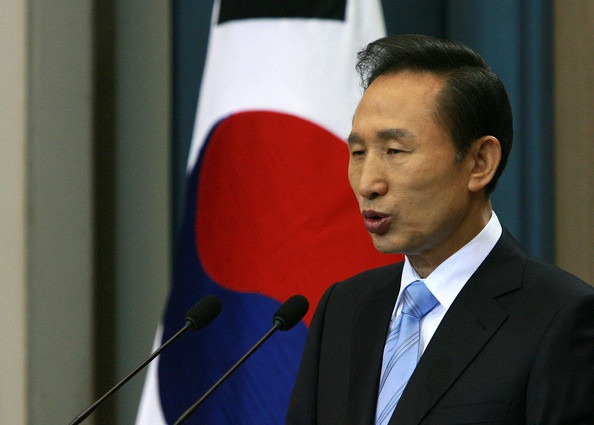
Here is a bit of President Lee of Korea’s speech to the US Congress

Here is part one of my thoughts on the US-Korea alliance after President Lee’s visit last week.

First, despite the invitation from Congress, Americans know very little about Korea compared to allies like Canada, Britain, or Israel. Americans usually see Korea’s geopolitics through the prism of North Korea and the ‘axis of evil.’ The Tea Party movement especially takes a rigidly ideological-neoconservative view of Korea as the ‘frontline of freedom,’ and Sarah Palin notoriously needed to be taught, as vice-presidential candidate, why there are two Koreas. While this doctrinaire view of Korea as a black-white, good-evil contest may suit South Korean conservatives, a neocon-ideological reflex should not be mistaken for deep local or cultural knowledge of Korea. Far more US congressmen have visited Israel than Korea, and how many Americans have you met who can speak Korean? Previous liberal governments of Korea kept some distance from the US for fear that American neo-cons would instrumentalize South Korea to the ‘freedom agenda,’ pull SK into ideologically-driven conflicts like Iraq, and unnecessarily raise tension with the North. Binding oneself too close to the US in foreign policy carries the risk of getting ‘chain-ganged’ into America’s periodic bouts of ‘democratic imperialism.’

Second, the US is flirting with national bankruptcy. This will have dramatic impacts on all its alliances, not just in Korea. In my teaching and public speaking in Korea, I find Koreans disturbingly unaware of just how bad America’s financial situation really is. The US is now borrowing 40¢ of every dollar it spends. The deficit is $1.5 trillion (160% of SK’s entire GDP); the debt is almost $10 trillion; the IMF predicts America’s debt-to-GDP ratio will exceed 100% by the end of the decade; China owns 1/3 of the US debt; US national security spending tops $1.2 trillion, 25% of the budget and 7% of GDP. These are mind-boggling figures that all but mandate at least some US retrenchment from its current global footprint, including perhaps, by not necessarily limited, to Korea.

Unless the US citizenry is willing to except a noticeably lower standard of living, including major cuts in popular welfare-state programs like Medicare, then the burden of the necessary cuts to fix America’s finances will eventually include defense. By almost any definition, the US is overstretched – fighting too many wars for too long and borrowing far too much money. ‘Empire’ is very expensive, and soon American voters will be forced to choose between it and the welfare-state, between guns and butter.

In this regard, the recent Libyan conflict should be instructive. It is a good example of what war in the age of austerity and US budget constraints will look like. US public opinion was deeply hesitant for yet another conflict, so Obama could only provide air support and quickly abjured leadership to NATO. Former Secretary of Defense Gates said before he left office that ‘any future secretary of defense who recommends sending a big US army into Asia or Africa again should have his head examined.’ These sorts of hints should tell Koreans (and Iraqis, Afghans, Israelis, etc.) that America can’t/won’t fight big land wars in Asia for awhile. Yet NK is a far more capable opponent than Gaddafi or the Taliban; the war on terrorism would pale in comparison to an intra-Korean war. What if America could only provide air power, because US banks are suffering from a slow-motion crisis similar to Europe’s today or the Lehman collapse of 2008? What if China, which funds so much of US borrowing, suddenly pulls the plug as US involvement in a war on its border deepens?

Third, Korea needs the US a lot more than the US needs Korea – which means that resolutely unacknowledged US relative decline is the real backstory to Lee’s triumph in Washington. Unlike the US, middle-power Korea has dismal geopolitics – surrounded by large neighbors who have periodically bullied it, and bordered by an unpredictable rogue. Weak, encircled countries as diverse as Poland, Paraguay, and Zaire have seen themselves plundered and divided, so the US alliance is good way for small Korea to get some leverage in its tight space. But this will fade, not just as American power recedes from Asia under massive budgetary pressure, but because Korea is no longer central to American security. The Cold War is over. Today, a NK defeat of SK, while a local tragedy, would not dramatically impact American security. I don’t mean to sound cold; a NK victory would be a humanitarian catastrophe. But the gap between US and SK security is an important truth not often admitted and behind the deeply disturbing statistic that only 40% of Americans want to fight for SK even if it is attacked by NK (p. 6 here). That number should stop the presses, but everyone ignores it. This ‘asymmetric dependence’ is very obviously the reason behind Lee’s visit, Korea’s willingness to go to Iraq, and the astonishing interest in Korea in English and the US. While American public does in fact obsess over Israeli security, small as it is, the Korean alliance has weaker, more ideological, and less tribal, roots in US popular opinion.

None of this means the alliance will break soon, but the strong elite consensus for it should not be mistaken for a deep American popular commitment (p. 6 here), as there is to, for example, Canada, Britain, or Israel. In the next decade, America’s political and financial dysfunction will force a painful prioritization of US foreign policy. Commitments like Germany, Iraq, Afghanistan, Korea, and others will be deeply scrutinized, and no amount of Korean-American friendship will undo a $10 trillion debt.

———————–

NB: Here is the new SecDef saying we won’t pull out of the Pacific. I hope so, but no one seems to want to talk about the money…

NB2: Here is a far more believable account of America’s future troubles projecting force into Asia, with even worse numbers than I present above.

NB3: If you think Korea can/should help the US contain China, try this. More and more I would expect Korea to market itself to the US in this, especially given those poll numbers on NK.

US Relative Decline and the Korean Alliance (1): Cultural Distance

untitled

Part two is here.

On Monday, I put up the wisecracking version of the problems in the US-Korean alliance. I took some flak in the comments, and not everything I wrote is necessarily my own opinion. My own sense is that the US-Korean alliance is a net gain for liberalism globally, and I therefore support it. It definitely helps Korean security, although its national security benefit to the US is less clear after the Cold War. The alliance helps stabilize Asia at a time of rapid Chinese growth and NK bad behavior. While that most benefits East Asia, it does have some flow-down benefits for the US. I thought President Lee’s decision to visit Detroit and wear a Tiger’s baseball cap was a great, very sensitive move – an unexpected, heartfelt outreach to the part of American most beaten down by trade with Asia. (I’m from Cleveland, so I was genuinely touched; I wonder if a Chinese or Japanese leader would ever do something like that.) I really like Lee more and more.

Broadly speaking, I hope the US can help Korea in its tough security dilemma, while I do think Korea needs to spend a lot more on defense and carry more of the load. (America’s too broke, and it is firstly their war.) I don’t think Koreans realize (or don’t want to realize) though, that Korea is and probably always will be a middle power, that Korean security is not as central to the US as it once was, and that a lot of America’s commitment to Korea is ideological, not substantive or tribal. America’s commitment to Britain, Canada, or Israel is informed not just by national interest, but by a genuinely tribal sense of ‘we-ness.’ We look at them, and we see ourselves in religion, language, history, and race. This is most evident among the tea-partiers; just watch the GOP debates, where fealty to Israel is practically an ideological requirement, because so much of the US Right sees as Israel as a ‘Judeo-Christian’ extension of the US in the struggle against Islamism. I don’t think such a cultural bond exists between the US and Korea. Americans just don’t know that much about Korea (again, language acquisition is a good marker) and don’t obsess about it the way we do the Middle East. Instead, we look at Korea, and we see ideology – a democracy battling the axis of evil. This is why neocons who don’t know anything about Korea or Asia are nonetheless super-hawks on NK. Any US interest in provoking and defeating NK is more about right-wing ideology than any on-the-ground knowledge of Korea; how many Americans do a junior-year aboard here? Again, just listen to the GOP presidential debates. That may conveniently overlap the preferences of the SK right, but that is not cultural knowledge. It is post-9/11 semi-imperial, neocon ideology.

So the original faux-essay was trying to think of what a Korean foreign policy-type might really like to tell the Americans. In my experience here, Koreans, broadly speaking, are quite disappointed at how little the US knows and cares about Korea (neocon ideological commitment to SK is not the same as cultural knowledge), are increasingly worried about US relative decline, convinced the war on terror was a quixotic catastrophe, and crave global respect and attention as a G-20 member. I was trying to capture that.

In passing I would like thank Marmot’s Hole, Koreabridge, BusanHaps, and Ask a Korean for linking/reposting that post. My traffic exploded, and I learned that this essay was “quite possibly the most ridiculous, least informed, and mind-bogglingly ignorant claim ever typed on his hopelessly silly little blog.” Got it, W. So here is a more serious version. In short, while Koreans remain strongly committed, the US ‘pillar’ is showing cracks because the US is so overextended now.

President Lee’s speech before the US Congress represents a high point in the Korean relationship with the US. Foreign heads of state rarely address the US legislature, and a strong bond with the US is an important benchmark in the ‘global Korea’ campaign of the Lee administration. Lee and Obama enjoy a good personal rapport, and Americans appreciate Korean fealty after a decade of turbulence with European and Middle Eastern allies. But there are cracks, primarily on the American side, of which Korea should be aware. Last month, Chung-in Moon aptly lamented “our (Korea’s) cash strapped ally”: Koreans, enamored with learning English and studying in the US, are missing the gradual decline of US power and the debilitating turbulence of its domestic politics.

The remainder will be posted on Tuesday.

——————————

NB: Here is some further response to BusanHaps:

Thank you all for reading. I should note that the essay
above was intended to be as satiric as well as substantive. I was trying to put
myself in the shoes of a Korean policy-maker being very honest with the US
Congress, but these are not all necessarily my own opinion. Instead I tried to
distill what I have heard and learned here teaching students and attending
conferences for a few years. For example, I don’t actually think the GWoT was
about chasing ghosts around the ME, but I’ve heard that critique from Koreans
worried that the US is missing the rise of Asia.

In response to the comments here:


I do think the Tea Party is a global
embarrassment. If you were a non-white, non-Christian ally of the US (Pakistan,
Afghanistan, Korea) and you saw a good chunk of white, Christian middle-America
deride the first black president as a foreign imposter, Muslim, socialist, non-citizen
usurper, etc., what would you think? Please recall just how extreme the
language was – Beck claimed that ObamaCare was the beginning of the Fourth
Reich. And I did in fact have students asking me about this in fairly
incredulous tones.


I don’t think America’s relationship with Israel
is about oil. Our relationship with the GCC and Iraq is, but the tight bond with
Israel is more about the cultural panic on the US right over Islam. Israel has
no oil, and I see no leverage for the US over GCC/OPEC exporters coming from
the alliance. In fact, probably the opposite. Instead, watch the current GOP
debates where any criticism of Israel is simply taboo, and once again the
Middle East and Islamism dominate what little discussion of foreign policy
there is. The relationship with Israel is far beyond interest (oil) or even
values (liberal democracy). It is tribal (religion and fear of Islam).


Finally there is a lot of evidence that the US
in decline, and empirically, it is indisputable that the US is in relative
decline. America’s share of global GDP in 1945 was 52%; today it is 25%. The
data in the essay above still stands: continuous war for a decade, $1.5T budget
deficit, $10T in debt, rapid Chinese growth. I don’t think this means the US is
going to implode, or that the alliance with Korea will break, but it clearly
raises the pressure and reduces America’s ability to dictate terms. At some
point, the US will almost certainly have to cut defense, and commitments to
wealthy allies, like Korea, Japan, Germany, Italy will be tempting choices.

Thank you again for reading.

What SK President Lee should have said to the US Congress – UPDATED: A Response to my Critics this Friday

South Korean President Lee Myung Bak Apologies PQZbJ4V5Fo8l

UPDATE: This post got a mountain of traffic and commentary. The good people at Marmot, Busan Haps, KoreaBridge, and Ask a Korean all linked/reposted it. The post was meant half in jest, half seriously, not so much a “rant” (which I comment I found bizarre), but a psychological displacement into Korean shoes with some wisecracks. I was trying to capture what a Korean policy-maker might really like to say to the Americans. Not everything is my own thinking. Yet, one commenter told me my PhD was bogus, another that I hate America. Yikes. I have to say I am surprised at the explosion of interest, when I feel like a lot of my other posts are richer. Much in this post only tells you what you already know if you’ve been here for awhile. In any case, given the response, I’ll post a more serious take on the US-Korean alliance on Friday and Monday. Blogging is time-consuming. Thank you for reading and for those commenters who were polite.

rek

—————————————————

Regular readers will know that I like President Lee, even if he has a taste for hyper-presidentialization. On October 13 he spoke before the US Congress. It was a good speech that didn’t actually tell you much that you didn’t already know. Because Korea is asymmetrically dependent on the US for exports (Korea’s third biggest market) and for security (the US alliance), Lee couldn’t really level any necessary criticisms.

So here is the speech Lee should have given:

“Thank you for inviting me, but honestly how many of you congressmen know anything about my country? How many of you could name a city in Korea besides Seoul? How many of you recognize Kim Jong-Il’s name but not mine? How many of you think the Choseon Dynasty is the name of a Chinese restaurant in Union Station? So let’s drop the insipid, hollow bonhomie about how this ‘visit will also celebrate the strong bonds of friendship between the American and Korean people.’ Koreans most definitely want that, but for most of you untraveled, monolinguistic congressmen, this relationship is ideological more than real: SK confronts a stalinist rogue onto which Americans project an idealization of democracy vs. the axis of evil. But how many of you congressman have ever travelled to Asia (much less Korea), especially you neo-con hawks who want me to risk nuclear brinksmanship with the North? You’re too busy visiting Israel, and if you learn foreign languages, you bone-headed Americans still go for Spanish or French, because they’re easy with lots of cognates. We learn English like mad, but you couldn’t care less about our languageLots of Koreans resent your projection of the US values and foreign policy preferences onto a country you are startling ignorant about. We are just too polite to tell you, and we really need your markets and military help so we don’t say it.

Next, WTH is wrong with your political system? The world used to look at you as model. Remember the Washington Consensus? Now the rest of the world thinks you are bonkers. The Tea Party particularly has become a global embarrassment. The same Republicans in this chamber who so desperately want me to pick fight with North Korea also think your president is a Muslim socialist. You run a budget deficit in excess of 10% of GDP; your unemployment rate would generate street riots in my country, and the IMF thinks your debt-to-GDP ratio will top 100% by the end of the decade. Koreans are starting to realize that your politics are astonishingly dysfunctional and that we can’t count on you the way we used to. We want you to be an Asia-Pacific power, but we also know you are broke and that you lost your mind over Islamism in the last decade. Now we are all wondering if you are in decline or not. Just telling us that America is ‘exceptional,’ or that declinism is an overhyped myth is not enough. We live next to China (and Russia, and NK) not you. So get your act together, or we’ll start looking elsewhere soon, and if really pressed we might have to go nuclear.

Next, you better get used to Asia. The war on terror was a big mistake, even if a lot of Korean Christians supported if for the same tribal reasons the Tea party does. For a decade you chased around ghosts, built a fearsome national security state that makes it hard for my citizens to get visa into your country (even though the ‘American and South Korean peoples share deep ties rooted in history’), and convinced my fellow citizens that you are a global bully. Instead of focusing on China with a billion-plus people engaged in the fastest, widest modernization in history, you obsessed over the Middle East to the expense of other areas of interest. We even went to Iraq with you to show our goodwill and commitment.

But there’s no way my electorate will let us pull that stunt again. It’s time for you to think a lot more about how you really want to participate in the world’s fastest growing region. Remember, we Asians buy about half your Treasury bonds. You need us a lot more than you think. You think you have social discontent in the US now? Just wait until all those cheap Asian products your voters have come to expect in Walmart jump in price because you congressmen pick trade wars with a region you know almost nothing about. Bluster about ‘America is an Asian power’ is not enough. You people need to start learning Asian languages, sending your students here for junior years abroad, get your trade policy in order, and generally realize that trouble in places like Israel, NATO, and Pakistan pale in importance to the monumental rise of China and India. In security, the world may be unipolar, but in economics it is multipolar.

Finally, thank you for helping Korean security. Most Koreans are genuinely aware of the US commitment and are grateful for it. (We just wish you weren’t so d— arrogant and condescending about it.) Indeed, you should contrast us with your other allies. We are not insolent trouble-makers like Israel, Turkey, Greece, Saudi Arabia, Mexico, or Pakistan. Nor are gleefully exploitative free-riders like Germany, Japan, and Italy. We carry our weight pretty well. What other medium power allies went to Iraq or fights the Somali pirates?

So yes, we are grateful for the alliance. We like America generally, and we all learn English because of that. But we also wonder why you don’t seem to know anything about our country, even though we are 50 million people, in the G-20, and a far more capable yet loyal ally than almost any other you have. Israel has only 7 million people and they live in a lot less danger than we do, but you obsess about them in a way you never have about us. Given that Asia is rising, while the Middle East has a become a sink-hole of American power, we understand your disinterest in Asia even less. How many more books with titles like ‘when China rules the world’ do you need to read before you realize that your Middle East obsession is ridiculously overwrought? We look forward to the day your English teachers, soldiers, and other expats can speak a little Korean, behave better, and know what the Choseon Dynasty was.’

Economist Magazine Conf. on Korea (2): Import Competition Needed!

south-korea-gdp-annual-growth-rate

Part one is here, where I argued that Korea is too mercantilist-corporatist and that Korean consumers carry the costs of that statism with their 155% household debt-to-income ratio. I published an op-ed based on these posts also, at the JoongAng Daily here.

b. When the idea of Korean banks functioning globally arose, the Korean speakers argued for a mega-bank so that Korea could ‘compete’ and support its MNCs overseas. Again the idea that Korea as entity must compete against other states and ‘their’ MNCs is a fundamentally mercantilist notion. Korea is not competing against anyone, in the liberal view. Firms compete, and consumers, as rational buyers weighing quality against cost, should not buy ‘nationalistically.’ No one said anything like this: that Korea’s banks should simply evolve as they pursue profitability and if some of them M&A into a mega-bank, then ok. Instead, the state officials (not private bankers) were saying Korea needed a ‘mega-bank.’ Sounds an awful lot like another flag-carrying national champion, like Samsung, or Air France, with lots of cheap government capital and buddies in the bureaucracy, no? One of the Economist hosts thankfully had the temerity to call this a ‘vanity project.’ Hah! That was the most insightful line of the day.

c. Next up was was the limits on foreign penetration into the Korean bond market. Preventing foreigners from buying your debt is a classic form of financial mercantilism. The Japanese have been doing this for years in order to retain the yen as an autonomous domestic policy tool. This is why Japan’s debt-to-GDP ratio is the highest in the world, but its bond rating stays high – all that debt is ‘in-house.’ The Japanese refused to internationalize the yen, because that means foreigners, especially Wall Street and the IMF, get a bigger say in how you run your economy. Witness the Greece meltdown today, and the increasing usurpation of Greek economic autonomy by Germany, the ECB, and the IMF, because so many foreigners own Greek debt. Nationalist-statist Asians would never permit that level of internationalization. They are too obsessed with sovereignty to resolve the ‘trilemma’ with Friedman’s ‘golden straightjacket.’ The Chinese also do this – selling bonds to domestic firms and banks at ridiculously low interest (so treating Chinese depositors as a slush fund for cheap capital) and preventing the RMB from off-shoring. And Korea does it too. It has repeatedly been kept off the World Government Bond Index, because of its ‘macroprudential capital controls’ – a euphemism for the ROKG’s closure of the kimchi bond market when too many foreigners started buying them because the won is undervalued.

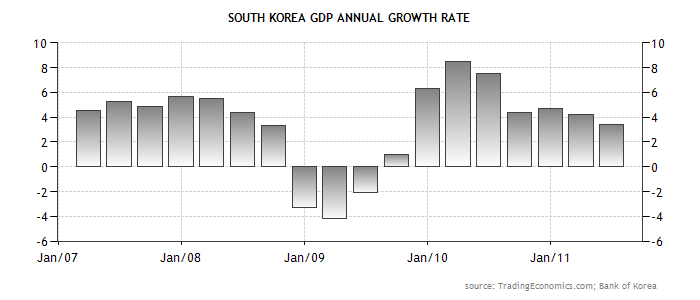
d. Another missed opportunity was inflation. Korean inflation is now over 5%! That is twice the Bank of Korea’s (BoK) target. There is strong suspicion that this is coming from ROKG F/X ‘fine-tuning’ – pardon me – ‘smoothing.’ Among other things, Korean consumer spending is not exploding and so pushing up prices. In fact, it is the opposite, because Korea’s consumer debt (155% of income) is one of the highest in the world. Nor is the BoK monetizing Korea’s debt, another fairly typical inflation-accelerator. Korea’s debt and deficit are low and under control. This suggests that F/X fine-tuning/smoothing/whatever you want to call competitive devaluation (ie, buying dollars and selling won) is what is driving up the money supply. Yet the speakers told us that inflation had to be balanced against growth, i.e., don’t expect an big interest rate hike. This sentiment makes sense in the low-growth US or euro-zone, but not 4%-growth-a-year Korea. So Korean consumers once again get the shaft with a depreciating currency coupled with crushing personal debt. Tell me again that Korea is not a corporate oligarchy punishing consumer and SMEs to reward mega-exporters?

In the end, the back-and-forth was too congenial, allowing too many of the speakers to spin and duck hard issues. Last year I thought the questioners pushed Korean officials a lot harder. It was disappointing this time, maybe because the officialdom level was higher this time. Who wants to publicly challenge the finance minister? Last year was indirectly revealing for the way Korean officials bobbed-and-weaved to avoid answering hard questions about capital controls. This signaled pretty clearly that they were in fact competitively devaluing the won.

This year, no one really tried much. I pushed a bit. I asked a troublesome question – does the Korean government sterilize the won’s appreciation at the behest of Korea’s big exporters? (The right answer is yes.) I have written about this before (here and here), and variants of this question were asked last year too. But my official didn’t try hard. It was spin; he didn’t even make reference to the chaebol in his answer, even though lots of people in the room were convinced (because variants of my questions popped up all day) that they they are the ones pulling the F/X strings to keep export prices low. But no one answered it really. In fact, not one Korean speaker even used the word chaebol the whole day, which left me bemused and disappointed.

The most courageous question came from a Korean who asked a panel point-blank if Korea had the creativity and openness to foreigners necessary to really grasp globalization. This is a major issue; I argued last year that cultural hesitation, not technical or ideological barriers, is the real hurdle to the internationalization of the won. Yet none of the Korean panelists even blinked. A fog of silly disconfirmations about the creation of Hanguel or the (supposed) global popularity of K-pop and Korean food were thrown out to suggest Korean is a creative open economy. Yawn. At that point I overheard the Economist guys talking about how the same issues come up year and again regarding international finance and Korea, but nothing seems to happen. Exactly.

Economist Magazine Conference on Korea 1: Not Quite an Open Economy

images_thumb

The ideas in this post and the next expand on the arguments made in my recent JoongAng Daily op-ed.

Every year the Economist runs a series of conferences on the political economy of Asia. If you are in this part of the world, you should probably go if you can. Here is the link for this year’s on Korea, and here is my review of last year’s. I thank the Economist‘s East Asia staff for inviting me. They are generous enough to realize that academics could never find the $1000 door fee. Sigh. It’s fairly embarrassing to the profession that we have to be comp’d in order to get into these sorts of things. And it is a good reminder that when it comes to the real world and stuff that matters (ie, money), professors scarcely matter. 😦 As with last year, I found it ‘maturing’ to sit in a room with very wealthy people, in very nice suits, focused on the very serious business of making lots of money. ‘Plutonomy’ is pretty imposing.

The Korean line this year from the officials present, including the finance minister, was that Korea is a “small and open economy.” This is manifestly untrue, by OECD standards of openness, and it was disheartening to see so little honesty about how deeply intertwined the Korean government is in the economy. The people from Moody’s in the lobby were even handing out a report about Korea’s ‘public policy banks.’ There is a lengthy political economy literature on Korean statism, and for those who like the idea of state intervention in the economy, Korea is a widely used example. Korea is better defined as small and corporatist, with latter deployed to overcome the former. Korea is sharply divided economy with tight but large conglomerate bloc at the top (the chaebol) overawing the rest of the economy. These firms get such generous access to the state, and its budget and moral approval, that Korea, Inc. is more liberal corporatism than liberalism. And Korean consumers, with debt at 155% of household income (one of the highest ratios in the world), pay out the nose to prop of this oligarchy.

Industrial policy is a reflex here; I see it all the time. Every time I ask my students about some change in the Korean economy, their first response is to say the government should do this or that about it. I get paper after paper about how the government should spend on this or that critical or strategic industry, or how Korea must outcompete Japan, or how the Korean government should ‘lead/guide/administer/direct/run’ the economy. I almost never get liberals in my classes, although to be fair, when I get Japanese and Chinese students, they talk the same way. Korean academics at conferences here are similar. I almost never hear the run-of-the-mill liberal notion that the economy should simply evolve as it will, without direction from the state. When I tell my students that the American car industry deserves to take a beating for making poor vehicles, they look bewildered. When I tell them that Apple should have pounded Samsung in the smart phone wars, except that the ROKG kept the iPhone out with NTBs for 2 years, they tell me that was a good thing. When I tell my students that the jeonse security deposit system doesn’t exist in the US, and that even lower middle class Americans can afford to move out during college, they are amazed. (The jeonse system is one of the most regressive, upwardly redistributive, oligarchy-reinforcing,  middle class-crushing elements of the Korean economy.) And indeed you could see the mercantilist reflex all over the conference, even though no one wanted to say it.

a. When the issue of exchange rates came up, the same division as last year of foreigners vs. Koreans arose. The Korean speakers all defended the interventionist notion that Korea had to ‘compete’ with yen and the dollar, and should value the won against them. That pegging like this is in fact exchange rate manipulation (as the Japanese FinMin said last week) was simply not admitted. That is it unnatural for Korea’s economy to grow faster than the US and Japan while the won does not appreciate meaningfully against their currencies was unanswered. I saw Bernie Lo on MSNBC a few weeks ago note that Korea has grown 4x faster than the US in the last 2 years, but the currency has appreciate by just 10% or so. Wow; that’s so unnatural, it can’t possibly be explained without targeted intervention. Not one speaker defended the liberal notion that Korea’s currency should simply float; in fact, I am not sure I even heard the word ‘liberal’ or ‘float’ the whole day. Last year, the euphemism for such competitive devaluation was ‘fine-tuning;’ this year it was ‘smoothing.’

b. When the idea of Korean banks functioning globally arose, the Korean speakers argued for a mega-bank so that Korea could ‘compete’ and support its MNCs overseas. Again the idea that Korea as entity must compete against other states and ‘their’ MNCs is a fundamentally mercantilist notion. Korea is not competing against anyone, in the liberal view. Firms compete, and consumers, as rational buyers weighing quality against cost, should not buy ‘nationalistically.’ No one said anything like this: that Korea’s banks should simply evolve as they pursue profitability, and if some of them M&A into a mega-bank, then ok. Instead, the state officials (not private bankers) were saying Korea needed a ‘mega-bank.’ Sounds an awful lot like another flag-carrying national champion, like Samsung, or Air France, with lots of cheap government capital and buddies in the bureaucracy, no? One of the Economist hosts thankfully had the temerity to call this a ‘vanity project.’ Hah! That was the most insightful line of the day.

Part two of this post is here.