Six-Party Talks as a Game Theoretic ‘Stag-Hunt’ (1): N Korea is the Stag

stag_hunt

Last week, I suggested that South Korea demonstrate ‘strategic restraint’ vis-a-vis NK if the North truly sank that SK destroyer. Not only are the South’s tactical response options terrible, but there is benefit here to be captured if the South’s restraint is marketed to China as a concession in exchange for more pressure on the North. For all of NK’s reputed autarky, it is in fact highly dependent on Chinese aid and trade, both licit and illicit. Without Chinese fuel oil, the lights in the North would go out; without the imports of booze, dollars, and pornography, the life of the Korean elite would be far less pampered. China cannot force the NK to change, but it can dramatically raise the costs of its continued intransigence.

All this is well-known but could be helpfully formalized in our research. In fact, I am surprised how little game theory (GT) I see applied to NK at the conferences here in Asia, given how obvious its utility is to the bargaining and brinksmanship endemic in NK foreign policy.

The stag-hunt (SH) is the best GT model or ‘game’ by which to map Northeast Asia’s security dilemma. We use GT all the time in IR but usually the prisoner’s dilemma (PD). (If you have no idea what I am talking about, start here for GT in IR; the Wikipedia write-ups, linked for the SH and PD, are actually quite good too.) The PD is cooperation came – how do you get the players to cooperate when there are high incentives to cheat on each other. The stag-hunt is better understood as a coordination game – how do you get the players to coordinate a common strategy to get the big pay-off, the stag.

Here is the basic schematic: a group of hunters can probably bag a big stag if they work together. They can weave a net around the stag that is likely to catch him. However, the hunters will also see the occasional rabbit bounce by. If one of the hunters goes for a rabbit, the stag will escape through the hole created and the other hunters will lose the stag almost certainly. Formally put, the stag is a big pay-off, and there is a good probability of successfully catching it if the hunters all coordinate. Conversely, the rabbit is a sure thing, but a much smaller, payoff. So the trick is to convince all the hunters to coordinate and not take the easy rabbit by cheating or ‘defecting’ on the other hunters.

So apply this to the Six Party Talks: The Hunters (players of the game) are the 5 parties besides NK: Japan, US, SK, Russia, and China. The Stag is North Korea, or more specifically change by the NK regime. The NK stag knows that if the 5 hunters can’t cooperate, it can escape. And it is widely noted that this is exactly what NK has done for decades. NK’s foreign-policy methodology since the 50s has been twisting and turning to prevent domination. Since the end of the Cold War, this has meant a constant ‘divide-to-survive’ effort aimed at the other 5 parties to prevent their coalescence into a united front against the DPRK. (I even wrote a book chapter about this, in galleys here.)

So the trick then is to build a common front among NK’s hunters to insure that they won’t defect or cheat and go for the rabbit. The rabbit in the NK case would be NK concessions to one party, but not the others: for example, abductee returns to Japan, family reunions for SK, mineral exploration rights for China, etc. These piecemeal, now-one-but-not-the-other concessions are all designed to keep the other 5 players off-balance and disunited. To date this has worked spectacularly well, even though the 5 hunters all know they are getting shamelessly manipulated.

The big problem to date for the hunters’ coordination is that China sees a lot of gain from taking the rabbit. The Chinese rabbit is in fact so juicy, it probably outweighs the tasty stag. The Chinese rabbit is a route of influence into the Korean Peninsula through North Korea’s continued existence. The big stag – change in NK to be a better international citizen in Northeast Asia – is of much greater value to SK and Japan, followed by the US, than it is to China. So long as China perceives a utility from NK as a buffer against SK, Japan, and the US, it is likely to continue to defect on 5 party cooperation, as it did last year, and take the rabbit of propping up NK in order to influence Korean events.

Part two is here.

How to Respond if North Korea really Sank that SK Destroyer: ‘Sell’ Southern Strategic Restraint to China for Pressure on the North

15214047

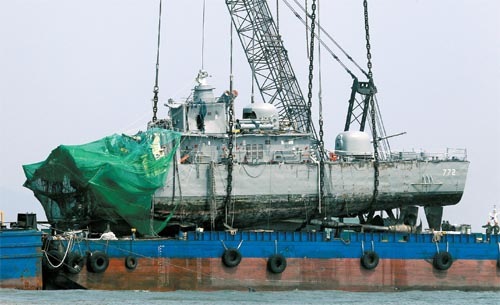
The sinking of a South Korean vessel, the Cheonan, has dominated the news here for weeks. Increasingly it looks like an external explosion caused the ship to break in two and sink rapidly. Suspicion is high that the only external force strong enough to sink a modern reinforced warship would have to a be a (presumably NK) mine or torpedo.

Predictably the conservative SK press has started the drumbeat for an aggressive response, including possible military action. President Lee of course is painted into a corner. A wholly unprovoked attack like this screams for blood, and the South Korean right is virulently anti-communist. If Lee does nothing, he’ll be hammered in the media and by his rivals within the governing party.

I sense a decisive moment building, akin to Austro-Hungary’s 1914 debate on how to respond to Archduke Ferdinand’s assassination, or Bush’s post-9/11 reckoning. Here is a moment rich and justified in the aggressive rhetoric so beloved by conservatives the world over; try to imagine how Fox News would respond if the ship had been American. This could easily slide into nationalist hysteria and escalation. 9/11 too raised America’s temperature and pushed the US government to aggressive action in the Middle East. Only a few years later did it become apparent how much the US overreacted. I fear the same here. As Andrei Lankov (one of the best NK experts – read him if you don’t) notes, Lee doesn’t really have much room to do anything against the North that is significantly punishing, yet won’t cause a NK escalatory response, and then a dangerous tit-for tat downward spiral. I think the Korean Foreign Ministry sees this too.

In brief, the problems with any military response are:

1. North Koreans will suffer the costs of any retaliation, not the KPA/KWP elite likely responsible for the attack.

2. NK is heavily ‘bunkered’ and hardened. Any military response would likely be from the air and would require multiple sorties. This means more chances for accidents, shootdowns, and other ‘kinetic’ interactions that could lead to a spiral of violence.

3. Realistically, the US would have to political approve of SK action; this is unlikely.

4. The North is already so deprived and impoverished, it is hard to find a juicy target that would both hurt but not lead the KPA to call for war. (This is what would happen if the nuclear sites were bombed, so scratch that idea.)

5. My friend Brian Myers has convinced me that NK is such a paranoid, ‘national-defense state,’ that any attack is likely to provoke an escalated armed response. The KPA derives it prestige and legitimacy from its ability to defend the country – indeed this built into the constitution now as as the “military-first” policy – so it would be existentially important for it to hit back.

Hence it is extremely likely that any SK strike would be immediately countered and escalated. This is not like Israeli airstrikes in Lebanon or Syria. The North will almost certainly pursue escalation dominance into a quickening and widening cycle of hits and counter-hits. This is not a game the South really wants to play, especially given Seoul’s extreme exposure to North Korean artillery. So swallowing its anger out of sheer fear of escalation is my prediction of SK’s response.

So what to do? How about going to China and telling them, ‘we will hold off on a response in the interest of stability, but you really need to get serious with the pressure. No more bail-outs and trips to Beijing for the Northern elite.’ China doesn’t want a tit-for-tat, degenerative North-South spiral anymore than anyone else. Perhaps the South can use this to really push the Chinese hard on finally cutting off NK.

To be sure, the road to Pyongyang doesn’t go through Beijing. North Korea coldly plays China for gain as much as it does the US, Japan, and South Korea. But I have always thought that if NK ever faced a truly united front of the other 5 parties of the Six Party Talks (China, US, SK, Japan and Russia), the DPRK might finally be cornered. In this way, the relevant Six Party game theory is the stag-hunt. If only the 5 can coordinate and not defect on each other (NK’s constant goal), the can catch the big stag – change in NK. Strategic restraint on the Cheonan sinking might be a way to convince China to finally stop defecting over North Korea.

Asia’s Nasty History Fight, Korean Edition: Jung-Geun Ahn

201003270009

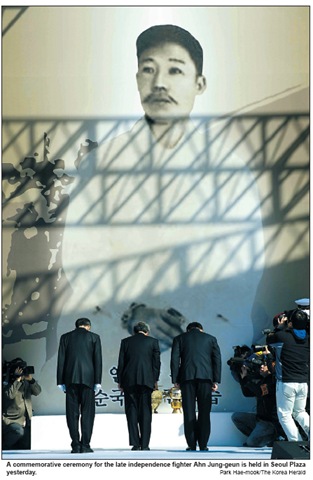
This week on the radio, I talked about the persistent conflict over history and memory in East Asia. March 26 was the 100th anniversary of execution of Jung-Geun Ahn, a Korean nationalist who assassinated the first Japanese Governor-General of occupied Korea, Ito Hirobumi. For the Korea version of the story, try here. For the Japanese ‘version,’ try here. Ahn is treated as a national hero here. He is referred to Korean history textbooks as ‘the Martyr’ and the ‘Patriot.’ Japan’s occupation ran from 1910 to 1945, although slow-but-steady annexation had been ramping up since the 1880s. The occupation was pretty vicious, including the mass impressment of ‘comfort women’ and cultural japanification efforts that included the elimination of Korean names! If you don’t know too much about the endless history/memory conflict between Japan, China, and Korea, the transcript below is a good place to start.

American readers might want to take special note of the fairly embarrassing information contained in the transcript’s last few paragraphs.

The Japanese really ought to be worried about this stuff. 60 years after the war, and they still can’t really talk to the Koreans and the Chinese. The Japanese right’s recalcitrance on history has isolated Japan for decades, and as Japan’s decline continues, the price of this isolation will rise. When China was a mess 30 years ago, and Korea was still a NIC (Newly Industrializing Country), first world Japan could strut like this. But today the gap between Japan, and Korea and China is narrowing, and the Japanese would do well start thinking of a serious, Willy Brandt-style apology tour. Without that serious, German-style soul searching, no one will ever trust Japan, they’ll be indefinitely dependent on the US,  and they’ll stand no chance to get that UN  Security Council seat.

_______________________________________________________________________

TRANSCRIPT – DR. ROBERT E. KELLY, PUSAN NATIONAL UNIVERSITY

BUSAN E-FM: “MORNING WAVE”

MONDAYS, 8 AM

March 29, 2010

BeFM:

…this week we are going to discuss Korea’s foreign affairs at the time Ahn Jung-Geun’s death and the start of Japanese occupation. Hi, Dr. Kelly.

REK:

Hi, Petra. Thanks for having me

BeFM:

Thanks for being with us again today.

REK:

It’s my pleasure.

BeFM:

Usually, we talk of contemporary Korean affairs, but this seems like an interesting topic given the recent 100th anniversary of Ahn Jung-geun’s death. How is this relevant though to Korea’s contemporary foreign policy?

REK:

Well, memory plays a major role in Korea’s relations with its local neighbors and with the United States. A central Korean narrative about Korean history is betrayal and manipulation by Korea’s neighbors resulting in a very harsh, frequently bloody twentieth century. As Koreans well know, historical disagreements with the Japanese are a regular feature of East Asian international relations. So the celebration of Ahn’s assignation of a Resident-General Ito Hirobumi is a deep reminder of that a competitive relationship with Japan persists.

BeFM:

That’s true. So, does this celebration irk the Japanese? And does that make any difference?

REK:

It almost certainly does the former. I am not surprised at all that the Japanese have found it so conveniently difficult to find the body. A central Japanese narrative about its occupation of Korea is that it was good for Korea. This is what I meant by the deep division over memory. What Koreans call imperialism, the Japanese call the modernization of Korea. In Japan, the Pacific War is marketed by Japanese conservatives as an effort to free East Asia from white imperialism and to spread modernity. Korea and China find such an interpretation self-serving, and the Korean commemoration of Ahn’s death is a pointed way to remind that Japanese of that. It’s a tough, emotionally-loaded conflict over remembrance.

BeFM:

And how is this relevant to Korean foreign policy now?

REK:

Well, Korea and Japan, despite their historical antagonism, actually share certain values and interests in East Asia. Both are liberal democracies; both are US allies; both worry about North Korea and the rise of China. So from an American perspective, it is fascinating, and perhaps frustrating, to see Korea and Japan cooperate so little. My students frequently ask me why there is nothing like NATO or the European Union in Asia, and the first reason I give is that the US’ two major allies and the region’s two wealthiest democracies can’t seem to agree on much, such as history or Dokdo.

BeFM:

So Korea and Japan should collaborate more?

REK:

Well, ‘should’ is a tough notion here. Certainly the US would like that. Korean-Japanese reconciliation has long been a US policy goal, but honestly, the US has basically given up pursuing that. The US military works independently with each military, despite the geographic proximity. I find most Koreans warm to the prospect on reconciliation, but they insist on Japanese apologies first of course, including for the execution of Ahn one hundred years ago last Friday.

BeFM:

But you sound like you don’t really expect the Japanese to apologize…

REK:

That’s right. I don’t. And here I sympathize with Korea a great deal. The longer I have lived here and the more I have learned Korean history in detail, the less tenable the Japanese claim of modernization or defense against white imperialism becomes. It is not clear at all of course that Koreans in 1910 wanted to be ‘modernized,’ especially by foreigners, and it is simply ridiculous to assert that Japan saved Korea from white, western imperialism, because there wasn’t any of that here. It was more in southern China and southeast Asia. So it’s hard to argue that Japanese imperialism here was not just as bad as imperialism was anywhere else…

BeFM:

So what about an apology? Various Japanese figures have apologized before, but no one really seems to believe them.

REK:

That’s right, and it’s one of the most frustrating parts of the history debate for everyone involved. I think the Koreans and Chinese want the sort of apology the Germans gave to eastern Europeans and Jews after World War II. In the 60s and 70s, democratic Germany really opened up about the Nazi past. The concentration camps were researched and preserved. Germans leaders went on good will and apology tours. Much of it was very moving, and Germany’s neighbors genuinely accepted that the Germans were sorry and should rejoin the European community. This worked well, and when Germany sought to reunify, no one really thought the new Germany would be a new threat. By contrast, Japan’s historical debate is still where Germany’s was in the 50s. It is clouded by nationalism, romantic notions of the past, and an embarrassed unwillingness to look at the nasty details, such as the comfort women or the elimination of Korean names.

BeFM:

So the apologies aren’t meaningful without more historical soul-searching?

REK:

That’s exactly why they are so unconvincing. The usual pattern is that some Japanese official gives a vaguely-worded apology. Then some other official or parliamentarian cuts loose unofficially about how Japan should not need to keep on apologizing. All this gets picked up in the Korean and Chinese media, and the whole story recycles itself. This is why so many want the Japanese emperor to apologize, not just some foreign ministry official, and this is also why the commemoration of figures like Ahn will continue in Korea. Remember that Kim Il Sung is celebrated in this way too, in the North, as an anti-Japanese patriot. If the Japanese ever want this to cool, they are going to have to try a lot harder.

BeFM:

So Ahn is directly related to the continuing general tension between Japan, and China and Korea. Ok.

REK:

Finally, it would be remiss if I did not mention that US abandonment of Korea to Japan at the time. I find that Americans don’t know this too much, perhaps because today the US-Korean relationship is so tight. But your US listeners should probably know that we sold Korea up the river to Japan in 1905. It is fairly embarrassing…

BeFM:

The Americans had a role in the occupation? Ah, the Plymouth Treaty…

REK:

That’s right. In 1905, the Japanese emerged as a major global power by defeating Russia in a naval contest. The US president at the time was Theodore Roosevelt, TR. TR invited the Russians and Japanese to Portsmouth, New Hampshire in New England in the summer of 1905 to arrange a treaty. One of Japan’s demands was domination of Korea. The US unfortunately agreed, and Japan fully annexed Korea five years later. This was the context in which Ahn assassinated Hirobumi. It’s a sad story, and one in which the US part is rather poor. Most Americans here don’t know about this, but they obviously know that American soldiers died in the Korean War. Fairly convenient to re-tell your history that way, do you think?

BeFM:

I think these sorts of history debates will only accelerate this year as we approach the 60th anniversary of the outbreak of the Korean war. Thank you for being with us again today.

Korea’s Slow Boiling Demographic Crisis

Year Total fertility rate Rank Percent Change Date of Information
2003 1.56 193 2003 est.
2004 1.26 218 -19.23% 2004 est.
2005 1.26 214 0.00% 2005 est.
2006 1.27 213 0.79% 2006 est.
2007 1.28 205 0.79% 2007 est.
2008 1.2 216 -6.25% 2008 est.
2009 1.21 217 0.83% 2009 est.


This week on the radio, I talked about the rapidly aging population of Korea and its effects on Korea’s foreign relations. Please see the transcript below.

The above chart is available here; it is based on CIA data available here. ‘Total Fertility Rate’ means an average Korean female’s total number of children in her lifetime. ‘Rank’ indicates where the ROK fits among the 223 states and entities ranked by the CIA in terms of total children per female. Korea has one of the lowest replacement rates in the world. Note that even North Korea’s replacement rate is higher!

You hardly need to a be a political scientist to see the impact of population. Most of the time, people think of overpopulation as the great issue. In the 70s of course, we talked about a ‘population bomb,’ and Charelton Heston told us that Soylent Green is made of people. For the ur-classic in this area, read Malthus (the Norton Critical is superb). But for wealthy countries, the big deal is the opposite – aging and slow depopulation. (For a good introduction to the “Demographic Transition,” try ch. 19 of this.)

For IR the ramifications link directly to national power. Korea has very clear aspirations to great powerdom. It desperately wants to catch up to the weakest, flagging great powers like Japan, Russia or France. And it might; particularly if it can unify successfully sometime soon. But without people this  is simply impossible, and the collapse of Korean fertility portends all sorts of problems, not least of which is the slow loss of ability to climb the G-20 ranks. To see just how bad depopulation can ravage national power, look at Russia, which is literally imploding. Look here, at the chart at the bottom, to compare the ROK’s population trends to its big neighbors.

Dramatic population contraction will halt Korea’s otherwise successful rise the up the G-20 ranks, and provoke a nasty, divisive ‘culture war’-style domestic debate on immigration (somewhere Glenn Beck is smiling). Korea is one of the world’s most ethnically homogenous countries; only about 2% of the resident population is foreign. Immigration here is mostly a work-value and bride-importing affair. Very few (like me) actually reside permanently here.

All this is going to have to change though if Korea really wants to be a great power. Unless Korean women can be dramatically re-incentived (discussed in the transcript) to child-bear, and a lot, Korea will either have to become a multicultural society with sustained immigration (most likely from Southeast Asia), or content itself to stagnation and perhaps even decline. Japan is interesting case here, as it faced exactly the same choice in this generation. It selected decline and cultural integrity over growth and cultural pluralism. Japan’s population growth has ground to a halt; its average age is rising fast; and Russian-style de-population may have already begun (Wiki has a nice entry on this.) This dilemma is Korea’s future too; my guess is that Korea will choose the cultural integrity and decline route like Japan. I don’t think Koreans will be ready for awhile, if ever, to endorse the mass immigration that sustains US superpowerdom.

__________________________________________________________________________________

TRANSCRIPT – DR. ROBERT E. KELLY, PUSAN NATIONAL UNIVERSITY

BUSAN E-FM: “MORNING WAVE”

MONDAYS, 8 AM

March 22, 2010

BeFM:

Professor Kelly comes to us each Monday to talk about big issues in Korean foreign affairs. And this week we are going to discuss Korea’s declining birth rate and its impact on Korean foreign policy. Hi, Dr. Kelly. This is not a topic we normally think of when discussing foreign relations.

REK:

That’s right, but Korea’s demography is changing so much and so fast, that it is in fact having an unanticipated impact on Korean foreign relations. You may have noticed that last week the government of Cambodia legally prohibited its nationals from marrying Koreans. I have never heard of such a law before, and it made headlines here too.

BeFM:

Yeah, I did see that. I was fairly surprised also. What was that all about? Who bans marriage?

REK:

The Cambodian government is worried that Koreans are ‘bride-hunting’ for poor women in Cambodia, and fears that this is a cover for human trafficking. So in this way, we see the rapidly contracting birth rate of native Koreans impacting diplomacy. Most Koreans are aware that the average Korean woman produces around 1.2 children. There is an emerging baby gap.

BeFM:

Right. But so what? If women and families don’t want to have a lot of children, why is that a problem? Why do people call this a crisis?

REK:

You said it exactly. The declining birth rate is in fact a marker that Korea is a freer place. Korean women are more in control of their reproductive decisions than before, which is certainly a good thing. However, for fairly obvious reasons, some children are still necessary, if only to be sure that the country still exists in a hundred years. And here is where the low birth rate is a collective or national problem, even if it reflects an individual good. It is a tough dilemma.

BeFM:

So how many children does Korea actually need?

REK:

Well, in the study of population, or demography, the traditional figure required to maintain a population over time is 2.2 children per female. This is called the replacement rate. The female must replace both herself, and the males in her society. Her husband obviously cannot have children. So that is two children right there. But other people also do not replace themselves, so the average women must actually have 2.2, not just 2, children. For example, permanently unmarried singles, children who die young, or homosexuals are also not replacing themselves.

BeFM:

I see. So why aren’t Korean women replacing at that rate anymore?

REK:

For fairly common reasons connected to modernization. As countries get wealthier and more liberal, women become more empowered. As they do, they delay marriage until later in life, and they have fewer children when they do. Child-bearing of course gets more risky as one ages. This is a pattern we have seen across wealthy countries. Italy too, for example, has a birth rate well-below replacement, and faces a similar slow-boiling demographic crisis.

BeFM:

This sounds like you are blaming women. That seems kind of unfair.

REK:

It certainly looks that way, but women by definition carry the greater, biological burden of reproduction. That in itself is unfair, I suppose. But Korea can make it easier for women to raise children. Other countries have experimented with flexible work hours for new mothers, as well as child-care facilities at work, so that woman can stay in the workforce. That last idea is partic-ularly effective, as parents are deeply uncomfortable with physically distant day-care services. New mothers especially want their children nearby. Quality daycare at work boosts birthrates by reducing the difficult trade-off between work and motherhood that is so common in Korea.

BeFM:

Ok. I get it. So what does this have to do with foreign policy?

REK:

Well, another way fill the gap of missing Koreans is to import people from other countries and koreanize them. So if you can’t birth more Koreans, then how about asking people to come and join your polity? In other words, immigration. The US, for example, has kept its average national age low basically by importing people. As in Korea, Americans with wealth and education have fewer children, but the ensuing baby gap is filled by immigrants. By contrast Koreans are deeply unsure about immigration. What immigration there has been, is frequently so focused on the birth-rate problem that it is more properly called bride-importing than immigration.

BeFM:

So immigration is probably a big coming issue in Korea foreign policy?

REK:

I think so. The treatment of foreign brides in Korea and their multicultural children is clearly growing into a major political issue now. It’s in the newspapers a lot, and the debate on multiculturalism more generally is firing up. My own university, Pusan National, is going to have its first major conference on this in a few months. But obviously immigration raises all sorts of diplomatic questions. Home countries are likely to worry about their immigrants, as Cambodia’s decision last week showed. And immigrants usually keep old ties for at least a few generations. Now, most immigration into Korea comes from Southeast Asia, and immigrant treatment, particularly if there is abuse of foreign brides, is likely to provoke diplomatic tension.

BeFM:

Ok. Well, are there any other effects of Korea’s demography on its foreign policy?

REK:

One big one – national power. Strong countries need growing, young populations. Russia today is a good example of the slow erosion of national status if your population implodes. Russia’s population shrinks by 700,000 people a year. You can’t be a great power unless you have the sheer numbers to really compete. Japan has the same problem; its population has been stuck around 130 million for the last 20 years. By contrast the US grows by something like 2% a year. So if Korea really wants to climb the ranks of the G-20 and compete against the likes of Britain, France, and Japan, it needs a young and growing population. This is not the case right now.

BeFM:

So what should we do?

REK:

One thing Korea should not do is blame its women. I saw a commercial on Arirang TV the other day telling women that it is their national duty is to have children, not just pursue financial security. Such divisive, male-oriented rhetoric will only provoke unnecessary gender conflict with Korea’s modernized women. Much better would be work rules to ease the work-children trade-off potential mothers dislike so much, especially on-site child-care. Also a major national discussion on immigration would help. Perhaps Koreans would prefer a declining birth rate to serious immigration; Japan does. This will slowly reduce Korea’s G-20 role. But that is price Japan prefers, because it fears immigration will be very culturally disruptive. Koreans may think the same way. We just don’t know Korea’s preference yet, because the issue is so new and the national debate has not really begun.

There’s No US-Israel ‘Crisis’ — It’s just Regular Old Alliance Politics

israeli%20flag

I can’t be the only one who thinks this whole got quickly overbaked – one small step in a well-established, well-publicized endeavor leads to the biggest crisis among friends in decades? Regardless of your opinion of Israeli West Bank behavior, settlement/colonization is a very widely-known and long-standing policy, so there’s little new here.

So this is less about Israel itself, and more about the changed US debate on Israel since the release of The Israel Lobby three years ago. Neocons who are nervous that elite opinion in the US is shifting against Israel saw an opportunity to push back before things go to far. And those pushing for more distance between the US and Israel saw an opportunity to push the issue into  mainstream credibility. But little of this impacts the real depth of the US-Israeli alliance (shared anti-Islamism, liberal democracy, fear of Iran). The whole thing smacks of inside-the-Beltway navel-gazing by people paid to hyperventilate. To rework Rahm Emanuel, never pass up an opportunity to manufacture a crisis.

1. Sure, Biden got snubbed. But ‘alliance politics’ are old hat. At least since the 70s, the US has been complaining that its allies don’t listen to it, that they don’t pay enough for their defense, that they freelance without asking the US for permission. Israel is just doing what lots of US allies have already done (which doesn’t mean it’s right, only that’s fairly typical). Consider that only two or three NATO allies now spend on defense what they they are treaty-obligated to spend (at least 2% of GDP). That includes really big ones like Germany, Italy and Canada. European allies have a pathetic 3 aircraft carriers between them. Or consider that the Europeans don’t want to go to Afghanistan, even thought they are treaty-obligated to do that too. Do we flip out about this every year? No. (Should we? Yes.) Or consider Mexico. Our closest ally in Latin America (since NAFTA)  has illegally exported 10-20 million of its poorest people to the US in the last generation, yet somehow we can’t get them take border security seriously. So why single out Israel so much for its bad behavior? Indeed, this has always been the biggest problem I have had with the Walt/Mearshiemer take on Israel (although I’m sure it’s not because of the idiot charge that they’re anti-semitic).

2. If you want America’s allies to behave better, then stop reaching for hegemony and start playing hard to get (Walt’s own idea btw, thereby increasing my confusion). US hegemony, or more specifically, our relentless celebration of it as America’s right because we are so awesome, tells allies that we love the top-dog slot so much, that we’ll never pull back from more involvement, more force, more shadow world government. This is my biggest beef with the Kagans, Robert Kaplan, Irving Kristol and the neocon persuasion generally. Just how much more do we have to spend on defense? How many more bases do we have to build? Kaplan even admitted that the US mission in Afghanistan is bleeding us white and better serves China than the US; but then he says we must go anyway! How can you possibly convince the allies to help if you say you’ll commit suicide before withdrawing…

This sort of attitude says that being the king-dog, lone superpower isn’t just good for US security or economy. Now it’s a part of our very identity. After three generations have been raised on the post-1940 National Security State, globe-spanning American exceptionalism is a part of who we are now (“God’s special mission for America,” to quote George W. Bush). Besides being exactly the forerunner of domestic tyranny the Anti-Federalists warned about way back in the 1780s, it also tells the world that the US will never abandon allies. Hence we cannot credibly threaten them.

3. Not only does this incentivize free-riding (Germany, Mexico), it also encourages misbehavior (Israel), because the US will never abandon its global role, because it loves it so much. This is (one) fatal flaw of the neo-con argument for US expansion. (The other is that we can’t afford hegemony much longer). Walt makes this argument regularly: if you want the allies to actually do what we tell them, then you have to be willing to cut them off once in awhile, to punish them for misbehavior. But given that NO ONE has the guts to cut Israeli aid on Capitol Hill, then the regular expectation should be Netanyahu-style misbehavior, not compliance. Think of Joe Lieberman and John McCain as enabling an alcoholic: why would Israel possibly stop if the consequences are absolutely zero? Ditto on Germany and defense spending.

Korea is a good comparison case here. US threats of alliance abandonment are far more believable here, because they are real. The size of US Forces in Korea (USFK) is in long-term decline. USFK is not tied into a larger multilateral framework like NATO, which would make it harder for the US to leave. Most Americans don’t know as much about Korea as they do our more culturally western allies, and if they do, they think rich Samsung-land should be able to defend itself. All these reasons cast doubt on the US guarantee to Korea. Koreans know this, and they know how much they need the US. As such, Korea is a far less troublesome ally to the US than most. By contrast, the Israelis or Germans know we aren’t going anywhere; too much of America’s self-identity as a totally awesome superpower is tied up a forward US presence in Europe and the Middle East. (Maybe there is a measurable relationship between cultural distance and credible threats of alliance abandonment; someone write that master’s thesis.)

4. The long-term structure of US foreign policy makes it all but impossible for individual initiatives, even from the POTUS himself, to change allied behavior. We tell Israel to be nice to the Palestinians once in awhile, while we simultaneously deepen our long-term position in the greater Middle East. Do you really think we can credibly threaten Israel with abandonment (a sanction for misbehavior) while US force structure so obviously say we won’t? As we build a huge string of bases that tells everyone – Jew, Muslim, Arab, Afghan, Persian – that we’ll be here for a long time? If you want the allies to burden share and follow orders, then stop enabling them through the endlessly sprawling national security state and endlessly expanding defense budget.

The Big Annual US-Korean Military Exercise this Month

size0-army_mil-33739-2009-03-27-160320

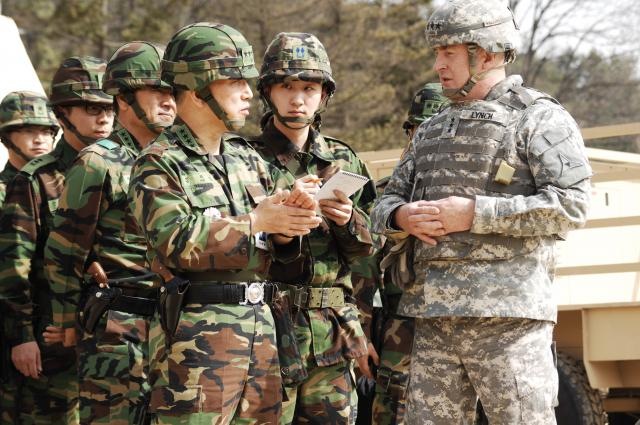
This month is the big annual joint exercise between US Forces in Korea and the Korean military, the army particularly. I talked about this on the radio this week; if you are curious for an introduction to US-Korean military cooperation, check the transcript below.

These drills have shrunk dramatically over the years, mostly in an attempt to bring around the North. Also, as Korea has gotten wealthier, environmental restrictions have made it increasingly difficult and politically unpopular to put a 100,000 people and tanks into the countryside. West Germans used to complain about this too in the 70s and 80s. Try to imagine what, say, 100 M1-A1 tanks would do to a river valley. They weigh 65 tons each! So increasingly these exercises are actually computerized wargame scenarios.

Anyway, these exercise are less and less about maneuver warfare (the old story for the North Korea army), and more and more about what to do if North Korea implodes (or explodes, or whatever – no one really knows). They big concern for the US is how to prevent NK WMD from either being launched or smuggled out. For the South, it is how to prevent NK civil war and army mutinies, to restore civil order, feed the NK population, and capture the party elite before they spring for China. And of course, lurking in the background, undiscussed by everyone and never properly accounted for in the wargaming, is what happens if the Chinese army, the PLA, pushes south and collides with us coming north. Yikes…

____________________________________________________________________________

TRANSCRIPT – DR. ROBERT E. KELLY, PUSAN NATIONAL UNIVERSITY

BUSAN E-FM: “MORNING WAVE”

MONDAYS, 8 AM

March 15, 2010


Petra:

Professor Kelly comes to us each Monday to talk about big issues in Korean foreign affairs. And this week we are going to discuss the big US-Korea military exercises last week. Hi, Dr. Kelly.

REK:

Hi, Petra. Thanks for having me

Petra:


Thanks for being with us again today.

REK:


It’s my pleasure.

Petra:

So last week there were these big Korea-US military drills. It seems like these are so common, we don’t pay attention to them much anymore

REK:

That’s right. They are pretty regularized now. They get a little bit in the news each year, but not much more. Politically the most interesting thing for Korea is not the US participation actually, but how North Korea responds each year.

Petra:

Don’t they usually say this is practice for an invasion?

REK:

That’s right. They always denounce it as imperialism, but the calm or anger of their denunciation tells us a little about what is going on in Pyongyang.

Petra:


And this year they didn’t seem to say much.


REK:

That’s right. In fact, after last year, when the North was very belligerent on just about everything, their recent behavior is downright gentle by historical standards.

Petra:

So what purpose do these drills serve?

REK:

Well, they are essentially practice. The first exercise is called Key Resolve; the second is Foal Eagle. That title is to indicate the resolve of the US to fight for Korea. This a computerized wargame, in which various scenarios are ‘played.’ These scenarios are defensive in nature, although the increasingly focus on the possibility of North Korean collapse. That is why the North Koreans worry. Should the North’s government implode, the US and South Korean militaries need plans on the shelf about how to restore order, disarm the North Korean military, and prevent nuclear weapons from either being launched or slipped out of the country. These are the big areas of interest now.

Petra:

What about an Northern invasion of the South?

REK:

Yes, that is still drilled too, but most experts, both Korea and American, consider that extremely unlikely. In fact, I have never read any war scenarios at all for Korea that realistically predict a Northern victory today. As we all know, the North’s economy is a shambles, its people are under-fed, and its military equipment is increasingly obsolete. In fact, South Korea could probably win a war on its own without the US at this point. This is one of the big reasons Kim Jeong-Il sought nuclear weapons. The inter-Korean race – military, political, economic – is over and has been for 15 to 20 years now. And North Korea has lost, very decisively. Nukes are just a desperation tactic.

Petra:

So do we even need the exercises?

REK:

That’s actually a good question at this point. I think the answer is still yes, but North Korea is in so much trouble now that the US and South do not exercise nearly as much as the used to. There used to be four really large exercise each now. Now it’s more like two, and they are smaller. As you might imagine, it costs a lot of money to run these simulations. Almost 20,000 Americans, beyond the US Forces in Korea here already, are flown for several weeks. Tens of thousands of Koreans are mobilized too. That’s a lot of money, and increasingly, South Korea’s environmental laws make it difficult for huge numbers of soldiers to tramp all over the countryside. It’s quite a big show, although its size has declined in the last decade or so.

Petra:

I heard that the US is going to give up the command of the Korean military sometime soon. What’s that all about?

REK:

Yes, that’s true. Right now, the US military has legal authority over the South Korea military in wartime. The Korean military is integrated with the US military into what we call the Combined Forces Command, or CFC.

Petra:

But that’s going to be abolished or something, right?

REK:

It is supposed to be, in 2012. Former President Roh pushed for this. He sold this to the Korean public as a restoration of Korean sovereignty. Seoul received peacetime control of its military in 1994. Before then actually – many Koreans don’t know this – the US government was legally the permanent, commander in chief of whole Korean military. For obvious reasons of course, that looked like US colonialism, and Kim Il Sung used to say that all the time. So after the Cold War, and the withdrawal of Soviet and Chinese support for North Korea, peacetime authority was returned to Seoul. As said earlier, by the mid-90s, South Korea had essentially won the inter-Korean race. North Korea became increasingly isolated as its former communist patrons turned away. So the Northern threat diminished dramatically. This gradual demilitarization of domestic life also helped South Korea democratize more rapidly.

Petra:

But CFC retained wartime authority. I have seen that discussed in the media a little.

REK:

That is correct. If there were a war, the US would re-take control of the Korean military. From a Korean perspective, this sacrifice was worth it. By giving the Americans command of Koreans’ own military, this helped keep the Americans here and committed to Korea’s defense. But again, it looked somewhat imperialistic – a foreign power controlling your own army – and the South Korean left had complained for years about this.

Petra:

So President Roh negotiated an end to it…

REK:

That’s right. Roh was probably the most anti-American president Korea has ever had, and George Bush was quite unpopular here. So Roh marketed the abolition of CFC as a big deal. CFC is supposed to disappear in April 2012, but now Koreans are starting to get cold feet.

Petra:

Why?

REK:

Under Presidents Kim and Roh, relations with North Korea – the sunshine policy – seemed to be improving. CFC looked like a relic of the Cold War. But sunshine never really came together, and the North’s nuclear program has grown and grown. This helped put a conservative, Lee Myung-Bak in the Blue House, and the Lee people a lot more nervous about ending CFC.

Petra:

What do you think?

REK:

Well, it does make life easier for the Americans. It makes it easier for the Americans, if they want, to say they are not as tightly bound to Korean defense as they were. If I were a Korean I think I would be nervous. I think the political pleasure of ‘total sovereignty’ does not outweigh the military benefit of tying the Americans to Korea as tightly as possible.

Do Americans Know Anything about Korea beyond the North? Not so Much…

Greetings Earthlings

On the radio this week, I spoke about Americans’ image and sense of Korea; the transcript is below. This is a big deal here. Korea has lately gotten quite excited about ‘public diplomacy,’ brand promotion, and soft power. You may recall that the Bush administration got big into this for a few years after the Iraq War and Guantanamo wrecked the world’s opinion of the US.

National ‘branding’ has always struck me as pretty ridiculous. A rose is a rose is a rose, and no cute advertising campaign is suddenly going to make people think differently about you. No amount cheesy ‘peace ambassadors’ or ‘socialist fraternity’ internationales conned people into believing the USSR was any less dangerous. In the same way, Bush hack Karen Hughes’ surreal photo-ops with Arab children could do nothing to change the US image in the Middle East that was being set everyday by the carnage in Iraq. The point being, you can’t do something dumb, have it blowback in your face, and then try to advertise or ‘rhetoric’ your way out of it. If the US wants to change its image with Arabs, killing fewer of them is the most obvious thing to do, not sending some flunky to smile on al Jazeera.

This skepticism applies to Korea’s efforts too. The overwhelming problem for Korea’s image is the North. This simply goes without saying. Newsweek put Kim Jeong Il in its ‘global elite,’ and I dare say most westerners couldn’t name another major Korean figure, political or otherwise. When Gallup recently asked Americans to name their favorite/least favorite countries, North, but not South, Korea was on the list. Pity South Korea. We can’t even remember they’re an ally. (That’s actually pretty pathetic. I’m fairly embarrassed. Even worse: only 41% of Americans think the US should fight to defend South Korea. On how the US is slipping out of the SK defense treaty, read this.)

This annoys Koreans to no end. I hear about it all the time from friends and students. So here are my quick top guesses on why Korea is so ‘foreign’ to Americans and Westerners.

1. It is small. When westerners think of East Asia, that means China or Japan. Korea is just the little bit in between. This could change if unification happens, if unification is successful, if Japan continues its slide. But for the foreseeable future, Koreans should think of  Austria – quiet, small, rich – as their model, not Germany, China, or Japan – rich, aggressive, demanding.

2. Korean food is not distinct enough from other East Asian fare for the median westerner to know the difference. Now that I live here, I know the difference, but, honestly, it is a learned art. For the average westerner looking for lunch, accustomed to eating his national cuisine mostly, Korean food is just another ethnic take-out choice.

3. The language is really hard. The US Defense Department’s Defense Language Institute ranks Korean in its hardest languages to learn category, along with Chinese, Japanese, and Arabic. By contrast, Spanish is a snap for anglophones.  This is an absolutely crucial barrier. It makes the life of all the foreigners I know in Korea much, much harder. (See p 8 here for the complete DLI ranking of language difficulty for anglophones; the State Department’s Foreign Service Institute estimates that a mediocre, ‘professional working proficiency’ in Korean requires 4000 hours of study!! Spanish is ranked at just 1100 hours.)

4. The Confucian-Buddhist tradition. The West’s religious traditions are Christian, Jewish, with some Islam thrown-in. These monotheistic sensibilities are distant from  Korea’s social norms (ancestor veneration, e.g.) and the more ‘metaphysical’ religions of Asia.

_______________________________________________________________________________

TRANSCRIPT – DR. ROBERT E. KELLY, PUSAN NATIONAL UNIVERSITY

BUSAN E-FM: “MORNING WAVE”

MONDAYS, 8 AM

March 8, 2010

Petra:

Hello everyone and welcome to …..

Right now we have our weekly foreign affairs expert for some commentary on Korea and Northeast Asia. Dr. Robert Kelly teaches in the Political Science and Diplomacy Department at Pusan National University. He’s been living in Korea about 18 months now, and his area of expertise is the international relations of East Asia. If you wish to contact him, please see his website at http://www.AsianSecurityBlog.WordPress.com.

Professor Kelly comes to us each Monday to talk about big issues in Korean foreign affairs. And this week we are going to discuss US relations with South Korea. Hi, Dr. Kelly.

REK:

Hi, Petra. Thanks for having me

Petra:

Thanks for being with us again today.

REK:

It’s my pleasure.

Petra:

It seems that several new polls came out about Americans’ image of Korea. What can you tell us?

REK:

About three weeks ago, the biggest US polling service, Gallup, released a survey of American attitudes towards foreign countries. And then last week the Chosun Ilbo and Gallup Korea ran a survey of ten wealthy countries’ attitudes toward each other. Unfortunately, Korea did not fare too well in either survey.

Petra:

Can you tell us some of the details, and why Korea is viewed poorly?

REK:

Well, I think poorly is not the right word. Instead I would say that Korea has two big ‘image’ problems. The first is North Korea. The Democratic People’s Republic of Korea simply dominates the world’s sense of Korea. I know this disappoints South Koreans very much. South Koreans would very much like Yuna Kim or Samsung televisions to be their representatives to the world, but this is just not the case. Kim Jeong Il is easily the best known Korean in the world.

Second, Korea is quite small, and to western populations, geographically and culturally quite distant. I discuss this often with my students. Koreans seem unhappy that there is a strong asymmetry between Koreans’ interest in the US, and American interest in Korea. Koreans, for example, have great interest in English, like to attend American universities, eat US fast food, and watch so many American movies that the Korean film industry requires tariff protection.

Petra:

But Americans don’t really know anything about Korea, do they? Hah!

REK:

Beyond the Korean immigrant community of course, no, not really. The Gallup survey, for example, did not even list South Korea as a choice for Americans to select as favorable or unfavorable. So traditional US allies, such as Germany, Canada, Britain, France, Japan, etc. were listed, and all received high scores of favorability. That is, Americans said they liked these countries. But South Korea was not listed at all. However North Korea was, and the DPRK received an 80% unfavorable rating. The only country with a worse number was Iran. So, no, South Korea is just not really on the radar for most Americans; Korea means North Korea to most Americans.

Petra:

What about the Chosun Ilbo study?

REK:

It too found that South Korea had only a 37% favorability rating.

Petra:

That seems pretty low.

REK:

Yeah, it is. I agree. Actually, I was surprised that the Chosun figure was so low. I am quite aware of how little Americans know of Korea, but the Chosun poll included other Eurasian countries that I thought would have more exposure to Korea, including France, Russia, Italy and China.

Petra:

So what does this mean?

REK:

Well, honestly, I don’t think it means all that much. It does not mean that Korea is any less free, wealthy, green, socially happy, secure, democratic, etc. These sorts of polls are usually like high school popularity contests. They make you feel good or bad, but they don’t actually change that much. However, Koreans have stressed Korea’s ‘global image’ a lot under this administration. Notions like ‘branding’ Korea or Korean ‘soft power’ mean a lot to South Koreans, so the government has embarked, eg, on a big push of Korean food in the West.

Petra:

Right. I read about. The First Lady is pushing Korean food. So these polls are disappointing, but don’t mean too much. Ok.

REK:

Generally, I think so. Koreans worry a great deal, unnecessarily in my opinion, about Korea’s image. But, we all know that clever TV campaigns or cute food advertisement aren’t really the driver of such things. Korea’s image in the world will be built on its political values, not by things like how many LEDs get exported to the EU. Look at India. It is quite poor, yet its long-standing commitment to democracy and freedom, and the pacifist, Gandhian heritage in its foreign relations has won it many friends for decades. And Korea will enjoy this sort of reputation if it continues to build an open, globalized, free democracy.

Petra:

But I think Koreans want more than that. They wants others to see and enjoy their cultural products too – like hanbok or kimchi.

REK:

Yeah I think that’s right, but I just don’t know how well that stuff translates into the West. Asian food is available in the West of course, but quite honestly, I never really knew or cared to know the difference between Chinese, Korean or Japanese food when I lived in the US. I didn’t know many people who could properly eat with chopsticks. And I certainly never met anyone who could speak Korean. There are of course pockets of interest in the biggest cities, but outside the Asian immigrant community, I dare say, Korea just doesn’t have that sort of profile.

Petra:

Why not? I think Koreans really would like Westerners to be more aware of it, as distinct from China or Japan.

REK:

I think you really put your finger on it right there. Korea is small; Japan is big, and China is simply enormous. Less than 10% of Americans have passports; we don’t travel that much. And the US has ethnic populations from almost every country on the planet. In the huge melting pot of American life, Korea is just one far-off place, with a very difficult language and religious traditions very different from those of America. By contrast, when Hispanics immigrants come to the US, they already share some cultural territory: the alphabets are the same, and Spanish is vastly easier for English speakers to learn; Mexican food has already made huge inroads in the US; most Hispanics are Catholics. But the cultural gulf with Korea is much wider – language, Confucianism-Buddhism, food, chopsticks, traditional dress and music. Things like that.

Petra:

So China dominates everything?

REK:

That is an exaggeration of course, but kind of. To the extent that Westerners follow events in Asia, China is the behemoth that dominates discussion, and for Americans, it is the alliance with Japan that is the lynchpin of the US presence in Asia. This is important. It is the alliance with Japan that draws most US attention on security in Asia. Indeed, the one truly important statistic for Koreans is that only 41% of Americans think the US should deploy combat troops to South Korea to defend it. That I think it is genuinely worrisome.

Petra:

Thank you professor for coming again this week.

Kim Yu-Nationalism, Or How Middle Powers Assert Themselves in Global Politics

2010022700174_0

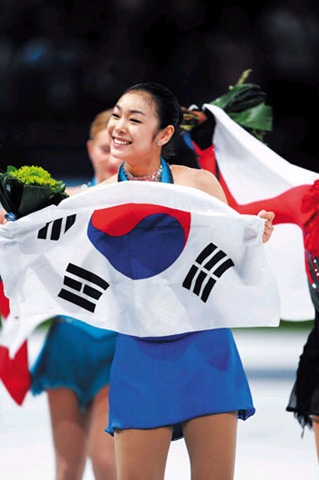
Nothing verifies the claims of my last two posts about the jingoism and politicization of world sport as much as the national euphoria here that greeted Yuna Kim’s Olympics victory last week. Koreans reacted to her medal the same way Americans did to the US hockey’s team 1980 victory – it became a banner symbol of national greatness in world society. Kim has become not an image of skating beauty, but rather the latest capture of an unrelated event to serve Korea’s near obsessive effort to be noted in the world politics. This is how states reinforce themselves in the era of globalization, and this is how middle powers tell the world to pay attention to them.

Here are just a few headlines, to remind you that her victory is not just a gold medal, but a “world historic event,” as one Korean put it to me:

Yuna Becomes ‘Golden Queen’: Kim Yu-na’s Olympic triumph cements her status as the megastar of figure skating and the sport’s most transcendent personality since Germany’s Katarina Witt.”

Beyond Perfection: Fascinating the world with dazzling performance”

Kim Yu-na: Figure skating queen aids Korea’s Olympic dreams”

Olympic favorite Kim Yu-na delighted fans around the world

Korea Energized by Figure Skater’s Olympic Debut: Korea is ablaze with excitement”

This sort of purple rhetoric should convince anyone of the way the state instrumenatlizes sports for nationalist assertion. Kim is a fine athlete obviously. But the far more interesting story for a political scientist is the way her victory was ‘captured’ for the interest of state and nation. Indeed so fanatical have Koreans become about Kim, that she now practices mostly in Canada  in order to avoid the cult of personality that has grown up around her.

Maybe I’m Huntington’s flimsy de-nationalized globalist, but I can’t help but find this sort of adulation extremely discomforting, and not just as  foreigner living here. Aren’t modern, liberal states supposed to outgrow this sort of clannishness? Aren’t cults of personality, uncritical coverage of national ‘heroes,’ and jingoistic assertions of the ‘world’s joy’ over an athlete (?!) a sign of political immaturity and hard-edged nationalism, the sort of thing we associate with dictatorships banking on nationalism as a legitimizing ideology?

My sense is that if Korea really wants to be taken by the rest of the world as a serious, perhaps even leading, member of the G20, this sort of nationalism will need to fade. Like much of East Asia, Korea is torn between a deeply held nationalist narrative of its uniqueness (frequently drifting into racial blood-and-soil narratives of the minjok), and the desire to be cosmopolitan and open to world of globalization (‘Global Korea‘). (China too has the struggle, between the CCP’s growing racialization of Han ethnicity, and the need for Walmart and more FDI.) Yuna Kim embodies both of these trends, as she is both instrumentalized for Korean national purposes (carrying the flag everywhere, eg), yet also reasonbly fluent in English. It is not clear to me which way Koreans want to go.

Why Does North Korea Ritualistically Provoke South Korea?

_47192629_n_s_korea_nl_226

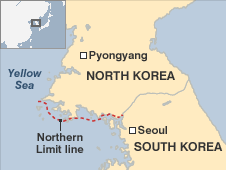
In the last few weeks, North Korea once again threw out a wild, unpredicted military tantrum. Now it has decided to start shelling the weakly agreed-upon sea border, the Northern Line Limit, in the Yellow Sea. For the details, try here or read my radio transcript below.

Less interesting than the details of the latest provocation – these things are terribly formulaic, to the point of ritual – is the IR theory question why. As I note in the transcript below, these gimmicks never work. In fact they usually backfire. Instead of frightening the SK citizenry or elites, these incidents usually stiffen the spine, because they look like bullying, and fairly crude at that. Further, NK truculence always serves to re-gel any possible rifts between SK, the US and Japan. In the same way that the Soviet invasion of Afghanistan reenergized NATO after the ‘alliance politics’ of the 70s, NK provocations routinely evince thicker and more explicit commitments by the US to defend SK.

Assuming the North Koreans aren’t stupid, the obvious question is why? I can think of two reasons, with a hat-tip on number 2 to Bryan Myers of Dongseo University in Busan, with whom I have discussed this at length. As always, this is a good IR master’s thesis-in-waiting.

1. Kim Jong Il is not fully in control of the NK military (the KPA) anymore.

This would not be a great surprise to anyone. Dictatorships are almost always heavily reliant on the military, and North Korea more than most. Indeed, it is hard to think of many truly civilian dictatorships. Most communist dictatorships slide into militarism, and even the Islamic semi-dictatorships of the Middle East usually have deep roots in the military. In the case of NK, this is even more extreme. When Kim the elder passed, so did communist party/civilian rule. Kim the younger immediately began placating the military as a means to neutralize the greatest threat to his shaky authority. In the mid-90s, NK declared a ‘military-first’ policy, whereby the military would have first claim on national resources. In the current NK constitution, Kim Jong Il rules as the chairman of the National Defense Committee, not as the civilian president. So extreme has this militarization become, that Bryan calls the DPRK a ‘national defense state,’ not a stalinist one.

So in such an environment, it is not hard to imagine the KPA high brass insisting on regular displays of their cool toys as means of justifying their insanely large budget, and otherwise trying to impress everyone, Kim Jong Il included, of the KPA’s inordinate influence over peninsular affairs.


2. NK faces a permanent legitimacy crisis which must be regularly ‘abated’ through external confrontation.

Clandestine traffic from China over the Yalu river has introduced far greater awareness of the wider world to North Koreans over the last 15 years. It was the non-response of the regime to the late 90s famine that drove the  Chinese connection originally, and now cell phones and VHS have illicitly gotten in. Indeed, the regime has lost so much of its information control, that is longer tries to claim that it is wealthier than SK. So if East Germany collapsed, if it gave up after 45 years of trying (and failing), why does NK hang on? How does NK legitimize itself when a prosperous, happier Korean national analogue is right next door?

By claiming that SK is an American colony and/or subject to ongoing Japanese control. Hence Myer’s description of NK as a ‘national defense state.’ It is defending the nation, where SK has sold out. To maintain this narrative however, regular tensions with the South, the US and Japan are necessary. Hence outbursts like last November’s North-South naval clash in the Yellow Sea, and now this artillery barrage.

The most gloomy part of this logic is that it predicts that NK will never surrender its nukes, and that it will continue to regularly, indeed, ritualistically, provoke SK.

_________________________________________________________________

TRANSCRIPT – DR. ROBERT E. KELLY, PUSAN NATIONAL UNIVERSITY

BUSAN E-FM: “MORNING WAVE”

MONDAYS, 8 AM

February 8, 2010

Professor Kelly comes to us each Monday to talk about big issues in Korean foreign affairs. And this week we are going to discuss North Korea’s recent artillery firing into the East Sea. Hi, Dr. Kelly.

REK:

Hi, Petra. Thanks for having me

Petra:

Thanks for being with us again today.

REK:

It’s my pleasure.

Petra:

So in the last few weeks, the North Korean military fired artillery shells into the East Sea. Why? What purpose does this serve?

REK:

Well, as usual, the North Korea government gave us no clear reasoning about this. The stated purpose was practice firing, but no one believes that. More likely, is saber rattling in the current North-South negotiations over pay at the Kaesong industrial park. If the artillery fire scares the South somewhat, perhaps it will make a better deal with the North over the salaries at Kaesong.

Petra:

That seems like a fairly crude negotiating stratagem.

REK:

Yes, it is. This sort of military posturing is a commonplace from North Korea. Far more interesting is that it does not really work, yet the North keeps doing it.

Petra:

Why doesn’t it work?

REK:

Well, the South Korean government and citizenry are simply inured to this now. For decades the North has acted like this to extract better deals from the South, but the South has never really given in to this. Southerners are just use to this by now, and they ignore it. Indeed, one can read the North’s nuclear program the same way. It is an elaborate and expensive tool for North Korea to club South Korea, the US and Japan into giving more aid.

Petra:

But this doesn’t work well…

REK:

No not really. The response of South Korea, and by extension Japan and the US, to these sorts of provocations is to stand firm and in fact to stand more closely together. In this way, it is rather foolish. Every time NK tries to bully South Korea and its allies, it backfires. It causes the opposite response. So Robert Gates, the US Secretary of Defense, pledged last year, the most public commitment ever that the US will use nuclear force to protect South Korea, because last year, the North’s rhetoric and behavior was so aggressive.

Remember too, that when South Korea has reached out to North Korea, it has been because of internal change in South Korea; that is, South Koreans the voted for left-leaning Presidents Kim and Roh, and they tried the sunshine policy. If North Korea really wants South Korea to help, you would think they would want to facilitate the election of more such presidents. But events like last week’s artillery barrage serve the opposite. They justify the hawkish, conservative vision of North Korea of the current Lee administration.

Petra:

So why do they do it then?

REK:

Good question. I have two educated guesses on this. First, the civilian government in North Korea can’t fully control the military. Second, these sorts of provocations of the South serve internal North Korean political purposes.

Petra:

Can you explain that a little more?

REK:

Sure. In the last 15 years, the North Korean military has increasingly dominated the government as a whole. The declaration of the ‘military first’ song-gun policy was the end of communism or Stalinism in North Korea, and the most obvious marker that North Korea was evolving into a military dictatorship. Recall that Kim Jong-Il’s title in the North Korean constitution is the Chairman of the National Defense Committee, not president. Kim Il-Sung is the eternal president of North Korea. Kim the younger rules from a military post. So it seems possible that the military was free-lancing last week with these artillery tests. Making trouble like this in inter-Korean relations is a good way for the military to make known its authority over North Korea.

Petra:

Ok. You also suggested there might be a domestic political purpose.

REK:

Yes. The regime suffers from a permanent legitimacy crisis. South Korea is wealthier, healthier, happier, etc. Most North Koreans have learned this in the last 20 years from information filtering in from China. The regime can no longer hide how far behind it is in the inter-Korean race. So an obvious question for any North Korean, is why North Korea still exists, long after the Soviet Union and East Germany are gone.

The regime’s answer to that problem is to manufacture a regular series of external crises. So long as the US, South Korea, and Japan are implacable foes intent on destroying North Korea, then the government can justify to its own people why it persists. This is why things like the artillery shelling last week or the naval skirmish last year in the same area, happen. The North cannot ‘win’ these sorts of stand-offs, but they do serve a domestic political need.

Petra:

So what is it about the East Sea that creates these sorts of problems so much anyway?

REK:

Good question. The East Sea, or in its international title, the Yellow Sea, is a good place for such North Korean shows, because the border there is so imprecise. After the Korean war, there was no formal border commission, on either land or sea. Remember that the war didn’t really cease, it just stopped temporarily. As we all know, this temporary border on land hardened into the demilitarized zone. But on land that was easy insofar as one could easily see where the battle lines between North and South were.

Petra:

But on the seas, no one really knew.

REK:

That’s right. It was just wide open. So the US and South Korea simply declared a de facto border that we call the Northern Limit Line. And in fact, it is drawn awfully close to North Korean islands. When we drew the line, it basically cut north immediately from land. It does, arguably, discriminate against North Korea. One can understand why the North rejects. But it also reflected the balance of seapower in the area in 1953. The US navy controlled the Yellow Sea, so the NLL also correctly reflects the geopolitical realities from the time. It is also worth mentioning that there is a annual crab harvest in the area. So every year, fishing boats from either side wander over the line. All in all, it is a messy, disputed area, so it is ideal for North Korean provocations whenever one is needed.

Petra:

So we should expect more of these sorts of provocations and clashes?

REK:

Yes, I think so. The NLL area is ripe for miscommunication, especially given the fishing traffic. Serious naval clashes have happened there three times in the past. Last November was the most recent. North Korea claimed that last week’s shelling was an annual exercise, so we might expect it again next spring. But honestly, I cannot recall that something like this happened last year, so I am not sure how ‘annual’ it really is. As so often with North Korea, it is murky. But I think you are right that we can expect fairly regular low-level conflict there indefinitely.

Petra:

Ok. Sounds gloomy. Thanks again for coming professor. We’ll see you again next week.

Korea’s Post-American Alliance Choices (1): India?

200x


This will be an occasional series. The US is entering a period of decline. Its ability and willingness to meet its alliance commitment to South Korea is waning. So Korea is, quietly, beginning to poke around in Asia. It is setting up preferential trade areas where possible, signing up whomever it can for ‘strategic partnerships,’ and generally branching out in the region. This serves both its desire to be a more regional player (rather than be permanently trapped in its peninsular ghetto with NK) and its growing need for friends beyond the US. The US has neither the money nor the domestic will to fight another Korean war. So it makes sense for Korea to look around, even if no one will admit that that is what it is doing.

On Monday, I spoke on the radio about this. Last week, the president of Korea had a state visit to India. India is a good choice for several reasons. Like Korea, India is

1. a liberal democracy with a lot of religious diversity.

2. worried about China’s rise.

3. an American ally.

4. Bonus: India is not Japan.

While more common than in the past, stable democracy is still hard to find in Asia. It makes sense for Korea and India to hang together. Of course, the closest democracy to Korea is Japan, but the mutual loathing is so severe, that Japan is a last ditch alliance choice for Korea. Further, both have a good tradition of internal tolerance based on their religious diversity. Everyone knows of India’s of course, but Korea too is one of the most religious fragmented states in Asia (sizeable minorities of Catholics, Buddhists, born-again protestants, and agnostics, with no dominant bloc).

This commonality of values is complemented by a commonality of interests, or rather an interest: China. Both are edgy about its quick rise (no surprise there), and both continue to hedge it and ally with the US in order to do so.

The downsides though are high. India is far away. It does not have the two-ocean fleet necessary to project serious power into Northeast Asia, and it is still losing the race with China.

__________________________________________________________________

TRANSCRIPT – DR. ROBERT E. KELLY, PUSAN NATIONAL UNIVERSITY

BUSAN E-FM: “MORNING WAVE”

MONDAYS, 8 AM

February 1, 2010

Petra:

So President Lee went off to India last week. What happened? Why is this important?

REK:

Two reasons. First, Korean has a trade relationship with India. Second, Korea is slowly poking around Asia for other friends and possible partners.

Petra:

Ok. Is Korea’s trade with India significant?

REK:

Middling. Korea is India’s 9th biggest trading partner. That is ok. But there are 1.3 billion Indians, and they are getting wealthier. So it makes sense for Korea to try to push into this market. This is similar to the growth of China. As China and India both develop and get wealthier, their huge internal markets will attract interest from around the world.

Petra:

So if this was basically a trade mission, why did President Lee go?

REK:

Well, it was more than that. President Lee was a guest of honor for India’s big national holiday. It was an official state visit. Such trips fit President Lee’s style of diplomacy. First, the president has increasingly used his position to act as a salesman for Korea industry. You may recall his earlier bout of commercial diplomacy in the United Arab Emirates regarding Korean-designed nuclear power plants. Second, the pursuit of trade agreements has grown into a major Korean foreign policy tool in the last decade or two.

Petra:

Can you explain that a little more?

REK:

Sure. The bedrock of Korean foreign policy is the security alliance with the United States. But increasingly Korea has looked for an autonomous economic foreign policy. And Korea’s chosen manner of reaching out, especially in Asia, is trade deals. Korea has sought all sorts of preferential and free trade areas, and President Lee has made this a regular focus of his trips abroad.

Petra:

Has it been successful? I thought Korea belonged to the World Trade Organization which organizes global trade rules.

REK:

That’s true. But the WTO is stuck right now. The current round of trade negotiation, begun in Doha in Qatar in the Middle East, has been bogged down for years. With the Doha round frozen, Korea has turned to bilateral and regional trade deals in its foreign policy. This trip to India, as well as the recent sale of nuclear reactors in the Middle East is a part of this process.

Petra:

So the WTO is stuck, and President Lee is trying to push Korean exports on his own on these trips?

REK:

Yes, that’s right. In international relations, we call this commercial diplomacy, and President Lee is getting quite good at it. The big prize, an FTA with the US, is still out of reach though.

Petra:

Ok. Let’s stay with India. You said something about Korea looking for other friends and partners. What does that mean?

REK:

Well Korea is a tight neighborhood. It is surrounded by three big countries – Russia, Japan, and China – who have traditionally bullied or informally dominated the Korean peninsula. Korea’s political geography, or geopolitics, is quite poor; it is encircled. This is the great benefit of the US alliance. The US is too far away from Korea to dominate it, but the US alliance does help Korea prevent itself from being dominated by others. As long as US troops are in Korea, Korea can push back any encroachment by China, Japan or Russia.

Petra:

So what does this have to do with India?

REK:

Well, the US is in trouble now. The US deficit is gigantic. The US public debt is too. The US is fighting two hot wars in the Middle East, and several clandestine conflicts there as well. It is eight and a half years now since 9/11, and Americans are exhausted with all these wars and conflict.

Petra:

Does that include Korea?

REK:

Not really, but Americans certainly don’t want to get pulled into a big conflict here. As most Koreans know, the US military footprint in Korea is shrinking, and the US will officially relinquish wartime authority of the Korean military in 2012. In short, the US is increasingly looking for ways to lower the costs of the Korean alliance.

Petra:

So Korea is shopping for other friends?

REK:

Probably, quietly. I certainly would be. The US looks at Korea, and it sees a wealthy modern country that it believes should be able to defend itself without much US assistance. So Korea is wise to begin to think about friends and possible allies beyond simply the US.

Petra:

So can India be an ally to Korea?

REK:

Maybe. India has some definitely upsides for Korea. Like Korea, India is a democracy. Democracy in Asia is still somewhat rare, so Indo-Korean cooperation on security makes good sense. India also worries a lot about China’s rapid growth. India has an ongoing border dispute with China, much as the two Koreas and China do over the ancient Koguryeo role’s in history. So there is a community of values between India and Korea – liberalism, democracy, religious tolerance – as well as a community of interests – careful observation and response to China’s rise. Finally, both Korea and India are American allies.

Petra:

So how is the Korean government proceeding?

REK:

Well President Lee and the Indian prime minister agreed to upgrade Indo-Korean ties to a ‘strategic partnership.’ That implies that the two see each other as more than just trading partners or friends. President Lee pursued the same approach with US President Obama in the summer 2009. But for observers, it is hard to know the details of this new partnership. There will be regular meetings between officials of the two countries’ ministries, but it is hard to know how serious this will be.

Petra:

So there is no Indo-Korean alliance in the offing?

REK:

Probably not. Better to see this another sign that Korea is aware that the US is in trouble because of the long war on terrorism and the huge financial burden of the crisis. Korea is wise to start poking around for new friends, if not trade partners, and India is a good choice.

Petra:

Thank you coming again, Professor.