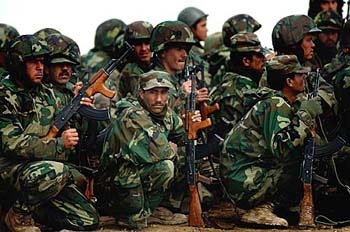
Just How Hard Will Afghanistan Be?: ‘We Issue Pens to Afghan Soldiers’

afghan-soldiers-2

Robert Kaplan has a nice new piece on Afghanistan over at the Atlantic. As usual, it is worth your time. Kaplan travels to places most of us in IR could only dream of visiting, so his work’s got a verite feel that our modeling and endless quotations of one another never do. (This is why people read him, not us.) Unfortunately Kaplan repeats the same motifs again and again, so its not clear if we are reading about Afghanistan, or just Kaplan’s expansive Americanist ideology again. In this way, he is becoming like the Kagans. You already know his answer: geography is a huge constraint on international action; America’s NCOs and infantrymen are kick-a—; we should win the GWoT at even huge expense; and US empire is probably good for the world, even if others resent it.

This time around, Kaplan lays the groundwork for Stanley McChrystal’s presidential bid. What is it with conservatives and the lionization of generals? Just read Kaplan’s purple prose. No one doubts Petraeus or McChrystal’s military talents, but I am pretty sure the US right’s cult of personality tendency for military machismo is unhealthy for the democratic process. Also, is it really admirable that McChrystal only sleeps four hours a day? How many of us could make good decisions living that way regularly? That told me less that McChrystal is super-committed, and more that he is overworked, under-resourced, and under-staffed. That sounds like the Bush-era GWoT all right…

But the money quote from Kaplan’s piece has go to be this from a NATO International Security Assistance Force (ISAF) interviewee:

The recruits may not know how to read, but they are incredibly street-smart. They’re survivalists. Basic soldiering here does not require literacy. We give them a course in how to read and issue them pens afterwards. They take tremendous pride in that. In Afghanistan, a pen in a shirt pocket is a sign of literacy.

Note the use of the military verb ‘issue.’ Yes, the $.50 plastic pen you forgot in the coffee room yesterday is a formally issued piece of military hardware that signals prestige in the wider Afghan society. WOW.

Consider all the information that short anecdote conveys to you about education, poverty, and governance in Afghanistan:

1. Afghans are so poor, they can’t afford pens. ISAF has to issue them, and only qualified soldiers get them.

2. Afghans are so illiterate, no one really needs them.

3. Widespread illiteracy and poverty means the Afghan state, even down into the local level, cannot meaningfully connect to the citizenry.

If illiteracy is so widespread that pens are a mark of social prestige, then Afghanistan can hardly be expected to have complex institutions or national centralization. If you can’t write bills or receipts, what kind of markets will you have? If you can’t read laws from Kabul, much less correspond with state organs, how do you know what the rules are, where to pay taxes, etc? If education is that non-existent, how can you build an army, infrastructure, courts, etc?

None of this means the US and other wealthy states should not help Afghanistan. Indeed, your heart should break when you read that Afghans are issued pens. Nor is this a verdict on the utility of ISAF; maybe we should still go, despite the huge hurdles this very revealing anecdote makes clear.

But this anecdote told me more about how hard the Afghan operation really will be, than Obama’s surge speech last year, or any of the other fearless, ‘we-can-do-it’ prose of Kaplan’s piece. This is way beyond Iraq. Afghanistan doesn’t just need counter-terrorism/insurgency, it needs nation-building on an order that took the US two centuries to achieve.

Obama didn’t include anecdotes this revealing in his Afghan surge address last year. Did he white lie by not showing us just how high the slope is? It kinda seems like it…

Does US Health Care Reform Have Any Diplomatic Impact?

obama_healthcare1

It’s well known that domestic political failures/successes impact foreign policy-making ‘capital.’ This is especially so for the US president, because the US foreign policy-making process includes the legislative branch far more than in other democracies (much less in dictatorships). In other words, the US Congress intervenes a lot more in US foreign policy-making than the parliaments of other countries do, so presidents need more than the usual amount of congressional support to act overseas. You see this in lots of ways: Congress routinely derails trade deals, intervenes in US aid planning (to avoid abortion funding, or to support Israel, eg), pushes unsought weapons-systems on the Pentagon, demands recognition for preferred foreign constituencies (Armenians, Cuban exiles, Christians in China and the Middle East), etc. So the connection between ObamaCare’s passage and the general ability of Obama to push Congress to follow him later on foreign policy is real.

(Addendum: In European and Asian democracies, the legislature is rather deeply excluded; the executive branch runs the whole show. The logic is that when the country acts abroad, it should speak with one voice, and only the executive branch – the president or prime minister –can actually aggregate all the diverse interests in the country into that one voice.  Parliaments cannot do this realistically, as they are so fragmented among competing parties and egos.)

Mead argues that ObamaCare’s failure would have ‘crippled his presidency.’

1. Not really. Health care is such an overwhelmingly internal, domestic issue, I don’t think the specific foreign policy benefits are that high. States pursue all sorts of different health care strategies, and their linkage with specific foreign policy issues is minimal. ObamaCare won’t provide any dividends abroad on the burning immediate issues of US foreign policy, like Israeli settlements, Afghan or Mexican corruption, China’s currency, Iraqi elections, etc.

But it does send some oblique signals:

2. It does bring the US into line with the OECD norm that when countries get rich enough, they are supposed to provide near-universal health care as a basic gesture of ‘social justice.’ One in six Americans didn’t have health insurance, and any American travelling abroad has probably tried, awkwardly, to explain that one away to skeptical interlocutors from other OECD states.

So in this way ObamaCare pulls the US toward the global normative consensus of what a good society looks like; it helps make the US look ‘civilized.’ It aids Obama’s stated goal to return the US to moral authority after W and restock its soft power. It therefore helps the US shame and criticize illiberal states more effectively, because it is less vulnerable to hypocrisy charges. (The US embrace of gun ownership and the death penalty, e.g., make the US a less compelling advocate of the rule of law and state restraint. The US move toward torture similarly undermines the US as an opponent of it.)

3. It does signal that the US will have a harder and harder time maintaining a huge defense posture. The more the welfare state grows, however noble the cause, the more its spending will eat into defense and diplomacy spending

4. It does improve Obama’s domestic political capital and general standing as a powerful POTUS who can get things done. This will increase his leverage in Congress, and perhaps with democratic leaders overseas too. He should be able to more successfully push controversial foreign policy initiatives through Congress, like the Korean-US trade deal or a tougher line on Israel. Reputation and prestige matter in IR, and looking like a winner helps bluff others.

Revaluation Downside: Low-Cost Chinese Goods Help America’s Poorest

ts-krugman-190

My big concern is that all the focus is on the negative side of China’s undervalued currency. Krugman (above) and others, correctly, complain that it artificially reduces US competitiveness. If the yuan floated, the price of US goods in China would slide dramatically. Rationalist Chinese consumers would move toward suddenly cheaper US goods, and that gets you the export boom Obama talked up in the State of the Union. (Although Asian buyers are stubbornly nationalistic. The home country bias here is extreme, so don’t get your hopes up for some big US export surge to Asia. You’ve never seen as many Korean cars as you will in Korea…)

The downside of course is that the poorest Americans benefit most from the undervalued yuan, and their unorganized, underprivileged, and non-corporate voice is completely unheard in this debate. The poorer you are, the more it matters to you that Chinese imports at Walmart are super-cheap. By definition, the tighter your family budget constraint, the proportionally more valuable low consumer prices are. The undervalued Chinese currency ensures that all that consumer stuff imported from China and sold at the big box stores like Walmart and Target helps the poor stretch the dollars. The purchasing power of their fewer dollars goes farther when Chinese imports cost so little.

1. So the poorest benefit the most proportionally from the undervaluation. Why doesn’t that make the news? Because the poorest are also the least political organized, and consumer interests are generally far less well-organized than business interests. So US exporters, who would benefit from a weak dollar, scream, and Congress listens. US consumers benefit enormously from a strong, especially overvalued, dollar. But their voice is disaggregated and diffused across the country, compared to the concentrated corporate power of exporters. Consumer gains from a cheaper Chinese-Walmart stuff is far smaller and diffused than the steep and concentrated pain of exporters suffering from a strong dollar. This is a classic protectionist response: gains are diffused, hard to see, and enjoyed by the weakest, while pain is concentrated, easy to indentify, and felt by the politically privileged.

None of this means that the yuan isn’t overvalued. It is, and the world’s largest economies clearly have a systemic responsibility to let their currencies float. The distortions coming from China’s currency are downright bizarre, with China’s foreign exchange reserves at levels never seen in the history of finance before. But if you wonder why DVD players that used to cost $20 at Walmart suddenly cost $30, now you’ll know. And while you, the middle class reader, might not care because that is within your disposable income range, recall that the poorer you are, the more that extra $10 means. The more overvalued the US dollar, the more America’s poorest are helped.

2. The temperature is rising on China’s currency. The US Congress is starting to seriously pressure the US Treasury to formally label China a ‘currency speculator.’ DoT must once again decide in mid-April. Krugman (above) got the ball rolling on the argument that the US should finally come out and openly accuse China of manipulation for its nationalist/mercantilist trade purposes. And just about everybody seems to agree that the yuan is overvalued. Just how undervalued is the yuan? 49% (!!) according to the Economist and 40% according to the Peterson IIE. For what it’s worth, I certainly agree with these estimates. I don’t think anyone really believes the dollar currently reflects its real purchasing power in Asia. US goods are ridiculously expensive in Korea; a fifth of Jack Daniels costs about $40!

3. All these Asian countries want their currencies undervalued because of the nasty lesson they learned in the Asian financial crisis. Most Americans don’t know this at all, it seems. 15 years ago, Asians did not have the dollar reserves to defend their currencies and when capital flight hit, these economies were turned upside down. Indonesia’s government collapsed into anarchy, Thailand lost something like 1/3 of its GDP, and South Korean couples were donating their wedding rings for gold to the government to pay its foreign debts! In short, the region got turned upside down/inside out, and everybody out here remembers this, while Americans just missed it altogether. So afterwards, the Asians did exactly what the DoT and the IMF told them to – they balanced their books and stocked up dollars in case there would be another crisis.

4. Here is good background on the conflict; try this too. To place the China currency evaluation in the global context, read this excellent introduction to the current problems of the global economy, specifically the problem of ‘imbalances.’ In brief, the US and Mediterranean countries are spendthrifts now carrying huge piles of debt, while Germany, China, and other Asians are overthrifty supersavers. So the broke Americans have no more money to spend to prime the global economy, and the supersaver Asians should fill in the gap by buying a lot. The more stuff they buy, the more people will be hired to make all that stuff they are buying. This will reduce unemployment. So the supersavers are the key to getting global unemployment down, because they have the cash to go on a spending spree.

Asia’s Nasty History Fight, Korean Edition: Jung-Geun Ahn

201003270009

This week on the radio, I talked about the persistent conflict over history and memory in East Asia. March 26 was the 100th anniversary of execution of Jung-Geun Ahn, a Korean nationalist who assassinated the first Japanese Governor-General of occupied Korea, Ito Hirobumi. For the Korea version of the story, try here. For the Japanese ‘version,’ try here. Ahn is treated as a national hero here. He is referred to Korean history textbooks as ‘the Martyr’ and the ‘Patriot.’ Japan’s occupation ran from 1910 to 1945, although slow-but-steady annexation had been ramping up since the 1880s. The occupation was pretty vicious, including the mass impressment of ‘comfort women’ and cultural japanification efforts that included the elimination of Korean names! If you don’t know too much about the endless history/memory conflict between Japan, China, and Korea, the transcript below is a good place to start.

American readers might want to take special note of the fairly embarrassing information contained in the transcript’s last few paragraphs.

The Japanese really ought to be worried about this stuff. 60 years after the war, and they still can’t really talk to the Koreans and the Chinese. The Japanese right’s recalcitrance on history has isolated Japan for decades, and as Japan’s decline continues, the price of this isolation will rise. When China was a mess 30 years ago, and Korea was still a NIC (Newly Industrializing Country), first world Japan could strut like this. But today the gap between Japan, and Korea and China is narrowing, and the Japanese would do well start thinking of a serious, Willy Brandt-style apology tour. Without that serious, German-style soul searching, no one will ever trust Japan, they’ll be indefinitely dependent on the US,  and they’ll stand no chance to get that UN  Security Council seat.

_______________________________________________________________________

TRANSCRIPT – DR. ROBERT E. KELLY, PUSAN NATIONAL UNIVERSITY

BUSAN E-FM: “MORNING WAVE”

MONDAYS, 8 AM

March 29, 2010

BeFM:

…this week we are going to discuss Korea’s foreign affairs at the time Ahn Jung-Geun’s death and the start of Japanese occupation. Hi, Dr. Kelly.

REK:

Hi, Petra. Thanks for having me

BeFM:

Thanks for being with us again today.

REK:

It’s my pleasure.

BeFM:

Usually, we talk of contemporary Korean affairs, but this seems like an interesting topic given the recent 100th anniversary of Ahn Jung-geun’s death. How is this relevant though to Korea’s contemporary foreign policy?

REK:

Well, memory plays a major role in Korea’s relations with its local neighbors and with the United States. A central Korean narrative about Korean history is betrayal and manipulation by Korea’s neighbors resulting in a very harsh, frequently bloody twentieth century. As Koreans well know, historical disagreements with the Japanese are a regular feature of East Asian international relations. So the celebration of Ahn’s assignation of a Resident-General Ito Hirobumi is a deep reminder of that a competitive relationship with Japan persists.

BeFM:

That’s true. So, does this celebration irk the Japanese? And does that make any difference?

REK:

It almost certainly does the former. I am not surprised at all that the Japanese have found it so conveniently difficult to find the body. A central Japanese narrative about its occupation of Korea is that it was good for Korea. This is what I meant by the deep division over memory. What Koreans call imperialism, the Japanese call the modernization of Korea. In Japan, the Pacific War is marketed by Japanese conservatives as an effort to free East Asia from white imperialism and to spread modernity. Korea and China find such an interpretation self-serving, and the Korean commemoration of Ahn’s death is a pointed way to remind that Japanese of that. It’s a tough, emotionally-loaded conflict over remembrance.

BeFM:

And how is this relevant to Korean foreign policy now?

REK:

Well, Korea and Japan, despite their historical antagonism, actually share certain values and interests in East Asia. Both are liberal democracies; both are US allies; both worry about North Korea and the rise of China. So from an American perspective, it is fascinating, and perhaps frustrating, to see Korea and Japan cooperate so little. My students frequently ask me why there is nothing like NATO or the European Union in Asia, and the first reason I give is that the US’ two major allies and the region’s two wealthiest democracies can’t seem to agree on much, such as history or Dokdo.

BeFM:

So Korea and Japan should collaborate more?

REK:

Well, ‘should’ is a tough notion here. Certainly the US would like that. Korean-Japanese reconciliation has long been a US policy goal, but honestly, the US has basically given up pursuing that. The US military works independently with each military, despite the geographic proximity. I find most Koreans warm to the prospect on reconciliation, but they insist on Japanese apologies first of course, including for the execution of Ahn one hundred years ago last Friday.

BeFM:

But you sound like you don’t really expect the Japanese to apologize…

REK:

That’s right. I don’t. And here I sympathize with Korea a great deal. The longer I have lived here and the more I have learned Korean history in detail, the less tenable the Japanese claim of modernization or defense against white imperialism becomes. It is not clear at all of course that Koreans in 1910 wanted to be ‘modernized,’ especially by foreigners, and it is simply ridiculous to assert that Japan saved Korea from white, western imperialism, because there wasn’t any of that here. It was more in southern China and southeast Asia. So it’s hard to argue that Japanese imperialism here was not just as bad as imperialism was anywhere else…

BeFM:

So what about an apology? Various Japanese figures have apologized before, but no one really seems to believe them.

REK:

That’s right, and it’s one of the most frustrating parts of the history debate for everyone involved. I think the Koreans and Chinese want the sort of apology the Germans gave to eastern Europeans and Jews after World War II. In the 60s and 70s, democratic Germany really opened up about the Nazi past. The concentration camps were researched and preserved. Germans leaders went on good will and apology tours. Much of it was very moving, and Germany’s neighbors genuinely accepted that the Germans were sorry and should rejoin the European community. This worked well, and when Germany sought to reunify, no one really thought the new Germany would be a new threat. By contrast, Japan’s historical debate is still where Germany’s was in the 50s. It is clouded by nationalism, romantic notions of the past, and an embarrassed unwillingness to look at the nasty details, such as the comfort women or the elimination of Korean names.

BeFM:

So the apologies aren’t meaningful without more historical soul-searching?

REK:

That’s exactly why they are so unconvincing. The usual pattern is that some Japanese official gives a vaguely-worded apology. Then some other official or parliamentarian cuts loose unofficially about how Japan should not need to keep on apologizing. All this gets picked up in the Korean and Chinese media, and the whole story recycles itself. This is why so many want the Japanese emperor to apologize, not just some foreign ministry official, and this is also why the commemoration of figures like Ahn will continue in Korea. Remember that Kim Il Sung is celebrated in this way too, in the North, as an anti-Japanese patriot. If the Japanese ever want this to cool, they are going to have to try a lot harder.

BeFM:

So Ahn is directly related to the continuing general tension between Japan, and China and Korea. Ok.

REK:

Finally, it would be remiss if I did not mention that US abandonment of Korea to Japan at the time. I find that Americans don’t know this too much, perhaps because today the US-Korean relationship is so tight. But your US listeners should probably know that we sold Korea up the river to Japan in 1905. It is fairly embarrassing…

BeFM:

The Americans had a role in the occupation? Ah, the Plymouth Treaty…

REK:

That’s right. In 1905, the Japanese emerged as a major global power by defeating Russia in a naval contest. The US president at the time was Theodore Roosevelt, TR. TR invited the Russians and Japanese to Portsmouth, New Hampshire in New England in the summer of 1905 to arrange a treaty. One of Japan’s demands was domination of Korea. The US unfortunately agreed, and Japan fully annexed Korea five years later. This was the context in which Ahn assassinated Hirobumi. It’s a sad story, and one in which the US part is rather poor. Most Americans here don’t know about this, but they obviously know that American soldiers died in the Korean War. Fairly convenient to re-tell your history that way, do you think?

BeFM:

I think these sorts of history debates will only accelerate this year as we approach the 60th anniversary of the outbreak of the Korean war. Thank you for being with us again today.

Korea’s Slow Boiling Demographic Crisis

Year Total fertility rate Rank Percent Change Date of Information
2003 1.56 193 2003 est.
2004 1.26 218 -19.23% 2004 est.
2005 1.26 214 0.00% 2005 est.
2006 1.27 213 0.79% 2006 est.
2007 1.28 205 0.79% 2007 est.
2008 1.2 216 -6.25% 2008 est.
2009 1.21 217 0.83% 2009 est.


This week on the radio, I talked about the rapidly aging population of Korea and its effects on Korea’s foreign relations. Please see the transcript below.

The above chart is available here; it is based on CIA data available here. ‘Total Fertility Rate’ means an average Korean female’s total number of children in her lifetime. ‘Rank’ indicates where the ROK fits among the 223 states and entities ranked by the CIA in terms of total children per female. Korea has one of the lowest replacement rates in the world. Note that even North Korea’s replacement rate is higher!

You hardly need to a be a political scientist to see the impact of population. Most of the time, people think of overpopulation as the great issue. In the 70s of course, we talked about a ‘population bomb,’ and Charelton Heston told us that Soylent Green is made of people. For the ur-classic in this area, read Malthus (the Norton Critical is superb). But for wealthy countries, the big deal is the opposite – aging and slow depopulation. (For a good introduction to the “Demographic Transition,” try ch. 19 of this.)

For IR the ramifications link directly to national power. Korea has very clear aspirations to great powerdom. It desperately wants to catch up to the weakest, flagging great powers like Japan, Russia or France. And it might; particularly if it can unify successfully sometime soon. But without people this  is simply impossible, and the collapse of Korean fertility portends all sorts of problems, not least of which is the slow loss of ability to climb the G-20 ranks. To see just how bad depopulation can ravage national power, look at Russia, which is literally imploding. Look here, at the chart at the bottom, to compare the ROK’s population trends to its big neighbors.

Dramatic population contraction will halt Korea’s otherwise successful rise the up the G-20 ranks, and provoke a nasty, divisive ‘culture war’-style domestic debate on immigration (somewhere Glenn Beck is smiling). Korea is one of the world’s most ethnically homogenous countries; only about 2% of the resident population is foreign. Immigration here is mostly a work-value and bride-importing affair. Very few (like me) actually reside permanently here.

All this is going to have to change though if Korea really wants to be a great power. Unless Korean women can be dramatically re-incentived (discussed in the transcript) to child-bear, and a lot, Korea will either have to become a multicultural society with sustained immigration (most likely from Southeast Asia), or content itself to stagnation and perhaps even decline. Japan is interesting case here, as it faced exactly the same choice in this generation. It selected decline and cultural integrity over growth and cultural pluralism. Japan’s population growth has ground to a halt; its average age is rising fast; and Russian-style de-population may have already begun (Wiki has a nice entry on this.) This dilemma is Korea’s future too; my guess is that Korea will choose the cultural integrity and decline route like Japan. I don’t think Koreans will be ready for awhile, if ever, to endorse the mass immigration that sustains US superpowerdom.

__________________________________________________________________________________

TRANSCRIPT – DR. ROBERT E. KELLY, PUSAN NATIONAL UNIVERSITY

BUSAN E-FM: “MORNING WAVE”

MONDAYS, 8 AM

March 22, 2010

BeFM:

Professor Kelly comes to us each Monday to talk about big issues in Korean foreign affairs. And this week we are going to discuss Korea’s declining birth rate and its impact on Korean foreign policy. Hi, Dr. Kelly. This is not a topic we normally think of when discussing foreign relations.

REK:

That’s right, but Korea’s demography is changing so much and so fast, that it is in fact having an unanticipated impact on Korean foreign relations. You may have noticed that last week the government of Cambodia legally prohibited its nationals from marrying Koreans. I have never heard of such a law before, and it made headlines here too.

BeFM:

Yeah, I did see that. I was fairly surprised also. What was that all about? Who bans marriage?

REK:

The Cambodian government is worried that Koreans are ‘bride-hunting’ for poor women in Cambodia, and fears that this is a cover for human trafficking. So in this way, we see the rapidly contracting birth rate of native Koreans impacting diplomacy. Most Koreans are aware that the average Korean woman produces around 1.2 children. There is an emerging baby gap.

BeFM:

Right. But so what? If women and families don’t want to have a lot of children, why is that a problem? Why do people call this a crisis?

REK:

You said it exactly. The declining birth rate is in fact a marker that Korea is a freer place. Korean women are more in control of their reproductive decisions than before, which is certainly a good thing. However, for fairly obvious reasons, some children are still necessary, if only to be sure that the country still exists in a hundred years. And here is where the low birth rate is a collective or national problem, even if it reflects an individual good. It is a tough dilemma.

BeFM:

So how many children does Korea actually need?

REK:

Well, in the study of population, or demography, the traditional figure required to maintain a population over time is 2.2 children per female. This is called the replacement rate. The female must replace both herself, and the males in her society. Her husband obviously cannot have children. So that is two children right there. But other people also do not replace themselves, so the average women must actually have 2.2, not just 2, children. For example, permanently unmarried singles, children who die young, or homosexuals are also not replacing themselves.

BeFM:

I see. So why aren’t Korean women replacing at that rate anymore?

REK:

For fairly common reasons connected to modernization. As countries get wealthier and more liberal, women become more empowered. As they do, they delay marriage until later in life, and they have fewer children when they do. Child-bearing of course gets more risky as one ages. This is a pattern we have seen across wealthy countries. Italy too, for example, has a birth rate well-below replacement, and faces a similar slow-boiling demographic crisis.

BeFM:

This sounds like you are blaming women. That seems kind of unfair.

REK:

It certainly looks that way, but women by definition carry the greater, biological burden of reproduction. That in itself is unfair, I suppose. But Korea can make it easier for women to raise children. Other countries have experimented with flexible work hours for new mothers, as well as child-care facilities at work, so that woman can stay in the workforce. That last idea is partic-ularly effective, as parents are deeply uncomfortable with physically distant day-care services. New mothers especially want their children nearby. Quality daycare at work boosts birthrates by reducing the difficult trade-off between work and motherhood that is so common in Korea.

BeFM:

Ok. I get it. So what does this have to do with foreign policy?

REK:

Well, another way fill the gap of missing Koreans is to import people from other countries and koreanize them. So if you can’t birth more Koreans, then how about asking people to come and join your polity? In other words, immigration. The US, for example, has kept its average national age low basically by importing people. As in Korea, Americans with wealth and education have fewer children, but the ensuing baby gap is filled by immigrants. By contrast Koreans are deeply unsure about immigration. What immigration there has been, is frequently so focused on the birth-rate problem that it is more properly called bride-importing than immigration.

BeFM:

So immigration is probably a big coming issue in Korea foreign policy?

REK:

I think so. The treatment of foreign brides in Korea and their multicultural children is clearly growing into a major political issue now. It’s in the newspapers a lot, and the debate on multiculturalism more generally is firing up. My own university, Pusan National, is going to have its first major conference on this in a few months. But obviously immigration raises all sorts of diplomatic questions. Home countries are likely to worry about their immigrants, as Cambodia’s decision last week showed. And immigrants usually keep old ties for at least a few generations. Now, most immigration into Korea comes from Southeast Asia, and immigrant treatment, particularly if there is abuse of foreign brides, is likely to provoke diplomatic tension.

BeFM:

Ok. Well, are there any other effects of Korea’s demography on its foreign policy?

REK:

One big one – national power. Strong countries need growing, young populations. Russia today is a good example of the slow erosion of national status if your population implodes. Russia’s population shrinks by 700,000 people a year. You can’t be a great power unless you have the sheer numbers to really compete. Japan has the same problem; its population has been stuck around 130 million for the last 20 years. By contrast the US grows by something like 2% a year. So if Korea really wants to climb the ranks of the G-20 and compete against the likes of Britain, France, and Japan, it needs a young and growing population. This is not the case right now.

BeFM:

So what should we do?

REK:

One thing Korea should not do is blame its women. I saw a commercial on Arirang TV the other day telling women that it is their national duty is to have children, not just pursue financial security. Such divisive, male-oriented rhetoric will only provoke unnecessary gender conflict with Korea’s modernized women. Much better would be work rules to ease the work-children trade-off potential mothers dislike so much, especially on-site child-care. Also a major national discussion on immigration would help. Perhaps Koreans would prefer a declining birth rate to serious immigration; Japan does. This will slowly reduce Korea’s G-20 role. But that is price Japan prefers, because it fears immigration will be very culturally disruptive. Koreans may think the same way. We just don’t know Korea’s preference yet, because the issue is so new and the national debate has not really begun.

There’s No US-Israel ‘Crisis’ — It’s just Regular Old Alliance Politics

israeli%20flag

I can’t be the only one who thinks this whole got quickly overbaked – one small step in a well-established, well-publicized endeavor leads to the biggest crisis among friends in decades? Regardless of your opinion of Israeli West Bank behavior, settlement/colonization is a very widely-known and long-standing policy, so there’s little new here.

So this is less about Israel itself, and more about the changed US debate on Israel since the release of The Israel Lobby three years ago. Neocons who are nervous that elite opinion in the US is shifting against Israel saw an opportunity to push back before things go to far. And those pushing for more distance between the US and Israel saw an opportunity to push the issue into  mainstream credibility. But little of this impacts the real depth of the US-Israeli alliance (shared anti-Islamism, liberal democracy, fear of Iran). The whole thing smacks of inside-the-Beltway navel-gazing by people paid to hyperventilate. To rework Rahm Emanuel, never pass up an opportunity to manufacture a crisis.

1. Sure, Biden got snubbed. But ‘alliance politics’ are old hat. At least since the 70s, the US has been complaining that its allies don’t listen to it, that they don’t pay enough for their defense, that they freelance without asking the US for permission. Israel is just doing what lots of US allies have already done (which doesn’t mean it’s right, only that’s fairly typical). Consider that only two or three NATO allies now spend on defense what they they are treaty-obligated to spend (at least 2% of GDP). That includes really big ones like Germany, Italy and Canada. European allies have a pathetic 3 aircraft carriers between them. Or consider that the Europeans don’t want to go to Afghanistan, even thought they are treaty-obligated to do that too. Do we flip out about this every year? No. (Should we? Yes.) Or consider Mexico. Our closest ally in Latin America (since NAFTA)  has illegally exported 10-20 million of its poorest people to the US in the last generation, yet somehow we can’t get them take border security seriously. So why single out Israel so much for its bad behavior? Indeed, this has always been the biggest problem I have had with the Walt/Mearshiemer take on Israel (although I’m sure it’s not because of the idiot charge that they’re anti-semitic).

2. If you want America’s allies to behave better, then stop reaching for hegemony and start playing hard to get (Walt’s own idea btw, thereby increasing my confusion). US hegemony, or more specifically, our relentless celebration of it as America’s right because we are so awesome, tells allies that we love the top-dog slot so much, that we’ll never pull back from more involvement, more force, more shadow world government. This is my biggest beef with the Kagans, Robert Kaplan, Irving Kristol and the neocon persuasion generally. Just how much more do we have to spend on defense? How many more bases do we have to build? Kaplan even admitted that the US mission in Afghanistan is bleeding us white and better serves China than the US; but then he says we must go anyway! How can you possibly convince the allies to help if you say you’ll commit suicide before withdrawing…

This sort of attitude says that being the king-dog, lone superpower isn’t just good for US security or economy. Now it’s a part of our very identity. After three generations have been raised on the post-1940 National Security State, globe-spanning American exceptionalism is a part of who we are now (“God’s special mission for America,” to quote George W. Bush). Besides being exactly the forerunner of domestic tyranny the Anti-Federalists warned about way back in the 1780s, it also tells the world that the US will never abandon allies. Hence we cannot credibly threaten them.

3. Not only does this incentivize free-riding (Germany, Mexico), it also encourages misbehavior (Israel), because the US will never abandon its global role, because it loves it so much. This is (one) fatal flaw of the neo-con argument for US expansion. (The other is that we can’t afford hegemony much longer). Walt makes this argument regularly: if you want the allies to actually do what we tell them, then you have to be willing to cut them off once in awhile, to punish them for misbehavior. But given that NO ONE has the guts to cut Israeli aid on Capitol Hill, then the regular expectation should be Netanyahu-style misbehavior, not compliance. Think of Joe Lieberman and John McCain as enabling an alcoholic: why would Israel possibly stop if the consequences are absolutely zero? Ditto on Germany and defense spending.

Korea is a good comparison case here. US threats of alliance abandonment are far more believable here, because they are real. The size of US Forces in Korea (USFK) is in long-term decline. USFK is not tied into a larger multilateral framework like NATO, which would make it harder for the US to leave. Most Americans don’t know as much about Korea as they do our more culturally western allies, and if they do, they think rich Samsung-land should be able to defend itself. All these reasons cast doubt on the US guarantee to Korea. Koreans know this, and they know how much they need the US. As such, Korea is a far less troublesome ally to the US than most. By contrast, the Israelis or Germans know we aren’t going anywhere; too much of America’s self-identity as a totally awesome superpower is tied up a forward US presence in Europe and the Middle East. (Maybe there is a measurable relationship between cultural distance and credible threats of alliance abandonment; someone write that master’s thesis.)

4. The long-term structure of US foreign policy makes it all but impossible for individual initiatives, even from the POTUS himself, to change allied behavior. We tell Israel to be nice to the Palestinians once in awhile, while we simultaneously deepen our long-term position in the greater Middle East. Do you really think we can credibly threaten Israel with abandonment (a sanction for misbehavior) while US force structure so obviously say we won’t? As we build a huge string of bases that tells everyone – Jew, Muslim, Arab, Afghan, Persian – that we’ll be here for a long time? If you want the allies to burden share and follow orders, then stop enabling them through the endlessly sprawling national security state and endlessly expanding defense budget.

Can Walter Russell Mead Walk the US Right Back from Torture?

waterboard

Walter Russell Mead is an exceptional blogger in IR. If you don’t read him, you should. He can somehow write lengthy, intellectually rich, and sharply incisive posts on foreign policy almost everyday, while at the same time being one of the best diplomatic historians in the US. (Start here.) I am baffled, because my best posts take hours to write, and there is no way I could do my job well and simultaneously blog well every day. Even more amazing for a social science writer, some of his posts are genuinely moving, like this and especially the one I discuss below. Do these guys ever see their families, write even on Christmas morning, go to the movies? I just don’t know where the time comes from…

Perhaps most important politically is his conservatism. Quality conservative punditry was simply decimated by the Bush era. The rise of the Ann Coulter-Rush Limbaugh-Michelle Malkin-Glenn Beck-Sean Hannity set has done terrible damage. Glenn Greenwald has built an entire career just around lampooning and deconstructing this stuff, it’s so prevalent. And Fox News – so relentlessly craven before GOP power, so desirous of  grievance and anger, so aggressively loathesome of academia and learning – has just pushed me over the edge. As an example of the collapse of the intellectually rich conservative movement into partisan hackery, look at the great work of Irving Kristol – one the writers that thrilled my mind and pulled me into the conservative movement back in the 1990s. Then look at how low the son – once so promising as the founder of the Weekly Standard (WS) – has fallen, accusing the Justice Department last week of being the ‘Department of Jihad.’ I remember reading National Review in college, WS when I worked for a GOP congressman in the 90s, and then even Commentary after 9/11. I remember when WS was supposed to be the Right’s equivalent of the New Republic – smart, rooted in learning, not so partisan as to prevent re-consideration and flexibility. I scarcely look at that stuff anymore…

Given the right-wing echo chamber, built around Fox, talk radio, and shock-jock set, Mead plays a critical role, and I hope the pro-torture Right in the US will carefully read this. Money quotes:

The KGB undertook a ruthless and savage repression in Lithuania.  The old Gestapo prison came in handy; the communists tortured and murdered thousands of Lithuanians in padded, soundproofed cells just a few blocks from the city’s cathedral

Today the solitary confinement cells, the cells where prisoners were forced to stand in icy water and beaten brutally when they fell, the holding cells for the condemned and the execution ground are all open for visitors.  Garish and clunky Soviet high tech phones and communications devices are still in the guardrooms. [I am] standing in the cellar of the KGB prison, admiring the ingenuously designed torture cells, retracing the final steps of the prisoners on their journey from the condemned cells to the execution yard.

Visiting places like Lithuania, and seeing sights like the KGB/Gestapo HQ reminds me what the stakes are in American foreign policy.

What we do matters.  Developing American power and reinforcing its economic foundations at home, building alliances, promoting democracy, deterring aggressors: when we do these things well, people thrive.  When we fail, they die miserably, and in droves.

Hear, hear to the notion that US power is generally good for the world! I certainly agree. But maybe the Right will listen to Mead about why the US is a morally good power. It’s not some vague Hegelian metaphysics of ‘American exceptionalism’; it’s because of what we do and not do – like not torturing people like the Gestapo or KGB did, like giving people trials, even though we loathe them. Only willful blindness will allow you to feel the moral power of Mead’s description but not simultaneous sadness over Abu Ghraib or Guantanamo.

Mead’s salvo may be oblique, but it’s important, because he writes for the American Interest. Please tell the Right that torture is not some punchline, but an inversion of America’s moral identity.

The Big Annual US-Korean Military Exercise this Month

size0-army_mil-33739-2009-03-27-160320

This month is the big annual joint exercise between US Forces in Korea and the Korean military, the army particularly. I talked about this on the radio this week; if you are curious for an introduction to US-Korean military cooperation, check the transcript below.

These drills have shrunk dramatically over the years, mostly in an attempt to bring around the North. Also, as Korea has gotten wealthier, environmental restrictions have made it increasingly difficult and politically unpopular to put a 100,000 people and tanks into the countryside. West Germans used to complain about this too in the 70s and 80s. Try to imagine what, say, 100 M1-A1 tanks would do to a river valley. They weigh 65 tons each! So increasingly these exercises are actually computerized wargame scenarios.

Anyway, these exercise are less and less about maneuver warfare (the old story for the North Korea army), and more and more about what to do if North Korea implodes (or explodes, or whatever – no one really knows). They big concern for the US is how to prevent NK WMD from either being launched or smuggled out. For the South, it is how to prevent NK civil war and army mutinies, to restore civil order, feed the NK population, and capture the party elite before they spring for China. And of course, lurking in the background, undiscussed by everyone and never properly accounted for in the wargaming, is what happens if the Chinese army, the PLA, pushes south and collides with us coming north. Yikes…

____________________________________________________________________________

TRANSCRIPT – DR. ROBERT E. KELLY, PUSAN NATIONAL UNIVERSITY

BUSAN E-FM: “MORNING WAVE”

MONDAYS, 8 AM

March 15, 2010


Petra:

Professor Kelly comes to us each Monday to talk about big issues in Korean foreign affairs. And this week we are going to discuss the big US-Korea military exercises last week. Hi, Dr. Kelly.

REK:

Hi, Petra. Thanks for having me

Petra:


Thanks for being with us again today.

REK:


It’s my pleasure.

Petra:

So last week there were these big Korea-US military drills. It seems like these are so common, we don’t pay attention to them much anymore

REK:

That’s right. They are pretty regularized now. They get a little bit in the news each year, but not much more. Politically the most interesting thing for Korea is not the US participation actually, but how North Korea responds each year.

Petra:

Don’t they usually say this is practice for an invasion?

REK:

That’s right. They always denounce it as imperialism, but the calm or anger of their denunciation tells us a little about what is going on in Pyongyang.

Petra:


And this year they didn’t seem to say much.


REK:

That’s right. In fact, after last year, when the North was very belligerent on just about everything, their recent behavior is downright gentle by historical standards.

Petra:

So what purpose do these drills serve?

REK:

Well, they are essentially practice. The first exercise is called Key Resolve; the second is Foal Eagle. That title is to indicate the resolve of the US to fight for Korea. This a computerized wargame, in which various scenarios are ‘played.’ These scenarios are defensive in nature, although the increasingly focus on the possibility of North Korean collapse. That is why the North Koreans worry. Should the North’s government implode, the US and South Korean militaries need plans on the shelf about how to restore order, disarm the North Korean military, and prevent nuclear weapons from either being launched or slipped out of the country. These are the big areas of interest now.

Petra:

What about an Northern invasion of the South?

REK:

Yes, that is still drilled too, but most experts, both Korea and American, consider that extremely unlikely. In fact, I have never read any war scenarios at all for Korea that realistically predict a Northern victory today. As we all know, the North’s economy is a shambles, its people are under-fed, and its military equipment is increasingly obsolete. In fact, South Korea could probably win a war on its own without the US at this point. This is one of the big reasons Kim Jeong-Il sought nuclear weapons. The inter-Korean race – military, political, economic – is over and has been for 15 to 20 years now. And North Korea has lost, very decisively. Nukes are just a desperation tactic.

Petra:

So do we even need the exercises?

REK:

That’s actually a good question at this point. I think the answer is still yes, but North Korea is in so much trouble now that the US and South do not exercise nearly as much as the used to. There used to be four really large exercise each now. Now it’s more like two, and they are smaller. As you might imagine, it costs a lot of money to run these simulations. Almost 20,000 Americans, beyond the US Forces in Korea here already, are flown for several weeks. Tens of thousands of Koreans are mobilized too. That’s a lot of money, and increasingly, South Korea’s environmental laws make it difficult for huge numbers of soldiers to tramp all over the countryside. It’s quite a big show, although its size has declined in the last decade or so.

Petra:

I heard that the US is going to give up the command of the Korean military sometime soon. What’s that all about?

REK:

Yes, that’s true. Right now, the US military has legal authority over the South Korea military in wartime. The Korean military is integrated with the US military into what we call the Combined Forces Command, or CFC.

Petra:

But that’s going to be abolished or something, right?

REK:

It is supposed to be, in 2012. Former President Roh pushed for this. He sold this to the Korean public as a restoration of Korean sovereignty. Seoul received peacetime control of its military in 1994. Before then actually – many Koreans don’t know this – the US government was legally the permanent, commander in chief of whole Korean military. For obvious reasons of course, that looked like US colonialism, and Kim Il Sung used to say that all the time. So after the Cold War, and the withdrawal of Soviet and Chinese support for North Korea, peacetime authority was returned to Seoul. As said earlier, by the mid-90s, South Korea had essentially won the inter-Korean race. North Korea became increasingly isolated as its former communist patrons turned away. So the Northern threat diminished dramatically. This gradual demilitarization of domestic life also helped South Korea democratize more rapidly.

Petra:

But CFC retained wartime authority. I have seen that discussed in the media a little.

REK:

That is correct. If there were a war, the US would re-take control of the Korean military. From a Korean perspective, this sacrifice was worth it. By giving the Americans command of Koreans’ own military, this helped keep the Americans here and committed to Korea’s defense. But again, it looked somewhat imperialistic – a foreign power controlling your own army – and the South Korean left had complained for years about this.

Petra:

So President Roh negotiated an end to it…

REK:

That’s right. Roh was probably the most anti-American president Korea has ever had, and George Bush was quite unpopular here. So Roh marketed the abolition of CFC as a big deal. CFC is supposed to disappear in April 2012, but now Koreans are starting to get cold feet.

Petra:

Why?

REK:

Under Presidents Kim and Roh, relations with North Korea – the sunshine policy – seemed to be improving. CFC looked like a relic of the Cold War. But sunshine never really came together, and the North’s nuclear program has grown and grown. This helped put a conservative, Lee Myung-Bak in the Blue House, and the Lee people a lot more nervous about ending CFC.

Petra:

What do you think?

REK:

Well, it does make life easier for the Americans. It makes it easier for the Americans, if they want, to say they are not as tightly bound to Korean defense as they were. If I were a Korean I think I would be nervous. I think the political pleasure of ‘total sovereignty’ does not outweigh the military benefit of tying the Americans to Korea as tightly as possible.

The New Bible… for International Relations Theory

6a00d83451b8e569e20115709f0ae0970c

The Koran, Talmud, Analects, and KKV have just been replaced as holy writ. Wow. You’ve never seen anything like this before. Save yourself a pile of money and application headaches for grad school. Just read this instead: http://www.isacompendium.com/public/. It is a crushing $3,000, 4,000 pages , and 12 hardback volumes!

Thankfully, if you belong to the International Studies Association, you can read the articles for free. Even more important, the articles tell you at the bottom how to cite them as e-articles. So thank God you don’t have to try to track down a paper copy of the set to get the page numbers. I can’t imagine if anyone is actually going to buy it.

I perused the index – a lengthy reading project in itself. This is basically an IR grad education in a can. Really. If you entered your first year of grad school, and read nothing but this all year, you’d get an ast0nishing education. I think it would be absolutely thrilling to just read this cover to cover as one’s first step into serious IR. It looks that rich, comprehensive, and well-written.

PS: if you want the short-version of IR in a can, try here. It’s excellent too.

‘Hurt Locker’ Backlash, Part 2: A Response to Rodger Payne

image_mini

The Duck of Minerva is one of the better international relations theory (IR) blog out there. You should read it if you don’t already. Its name is a riff on Hegel’s famous comment that the “owl of Minerva” only flies at night; i.e., wisdom only comes in hindsight, or more specifically that philosophy can only understand an age or civilization as it passes away. I don’t quite get the joke behind the title ‘duck of minerva,’ but whatever – it’s quality IR blogging.

Rodger Payne had a post two days ago on the continuing IR back-and-forth over The Hurt Locker (HL). Payne links to the relevant other IR posts on the film, including my own. Payne notes that I and others have found many problems with the film’s much-celebrated ‘realism.’ My own sense is that the lead character, Staff Sergeant William James, probably would have gotten himself or his associates killed a lot earlier through his overt recklesness. That, and the bizarrely out-of-place and unbelievable desert-sniper sequence, do a lot to reduce the film’s credibility as a portrait of the Iraq War. Michael Kamber summarizes.

Payne counters that, while Kamber and I are correct, that’s beside the point.  HL’s strength as an IR film is as a metaphor for US foreign policy more generally since the end of the Cold War, and especially in the Middle East. Money quotes:

The U.S. too has a long and mostly successful military record — and it too has been incredibly lucky. Like James, the U.S. returned to Iraq after a successful first effort in 1990-91… To its critics, the U.S. too is a reckless showboat, willing to take incredible risks with other peoples’ lives, even as it claims to be “saving” them.

In political debates, Americans focus on U.S. forces, casualties, and experiences. Few consider the implications for Iraqis and the wider Middle East… The FUBAR narrative works pretty well to explain the actual U.S. experience in Iraq. The lead character’s addiction to war, recklessness, luck, inexplicable behavior, and need to “save the day” reflect an unsavory, but nonetheless viable, portrayal of American identity.

1. Ok. I don’t really disagree with any of that, but I think it is a reach, a generous overreading that sorta lets the film off the hook. Is Bigelow really giving us the arc of the erratic, poorly-planned Operation Iraqi Freedom in the story of one soldier? Do we really think Bigelow had something this profound in mind? Francis Ford Coppola did when he made Apocalypse Now. He went to Cannes and famously said “We had access to too much money, too much equipment, and little by little we went insane.” That’s going for the big view. But Bigelow’s schtick has been that this is the first realistic film portrait of the Iraq, and that is how it has been received. The problem, as I argue, and Payne admits, is that it’s not that. I certainly agree that the US use of force has drifted toward recklessness since the end of the Cold War, and Payne is dead-on that US audiences love cowboy-style swaggering heroes, but the film is so pointedly apolitical, that it is hard to see James’ swagger as America’s. Maybe, but I just don’t see that in the film itself…

2. Given the film’s ‘reality problem,’ in round 1 I suggested that one alternative is to read the film as a memoir of battlefield stress for the US warfighter in the GWoT. The film goes out of its way to suggest that James is motivated by the narcotic effect of combat, so I think this better fits the small-scale of the film than Payne’s ‘big think’ approach. The problem with my interpretation is that Bigelow unfortunately does not develop this much beyond the initial thought. So we see James at home, bored with his alienated ex-wife. This is supposed to suggest that James misses the thrill-ride (!) of Iraq. But lots of us have had relationships and family lives that go bad, so this was rather weak. Much more convincing would have been imagery of James as an addictive personality. Scenes showing him struggling with drugs or alcohol would have really shoved the ‘psychology’ interpretation of HL forward, because you could see James substituting one thrill (Iraq) for another (booze, perhaps). Instead, Bigelow lets herself wander into a series of unconnected vignettes, like the sniper story, while the audience waits and waits for a theme to hold it all together.

3. HL’s rise is function of ‘intelligence guilt’ over the success of Avatar, plus the American desire to finally have a good GWoT film, not its inherent quality. It is fascinating how this film has grown from an indie joint into a Best Pic taker, and now faces a growing pushback from foreign policy types.

Initially almost nobody saw HL. It grossed a measly $12.7M. Avatar made more than that just here in Korea; its global total is now a staggering $2.2+B. HL was neither in theaters nor DVD here; I had to import it. So if it can’t make it to the world’s 13th biggest economy, did anyone see it beyond the US, Canada and Western Europe? Do we have any idea what Arabs/Iraqis particularly thought of it? Audience attendance is no great mark of quality, but still, without the critical buzz of the last two months generating an anti-Avatar Best Pic vibe, we wouldn’t even be talking about this film. Remember that it was originally released in Italy in October 2008, and for the next 14 months, almost no one saw it. Christopher Orr summarizes.

We all knew that Avatar was shallow, but we swooned for its astonishing GCI, arguably the biggest visual leap since Star Wars. But when the hangover hit in the month before the Oscars, the Academy needed something to suggest we weren’t so fluffy. Nobody wanted Cameron to take two Best Pics for childish stories wrapped in pretty colors. So, given 2009’s poor Best Picture choices, HL became the default anti-Avatar. Call it penance for giving the 1997 Best Pic to Cameron’s Titanic instead of the far more deserving LA Confidential; snubbing the King of the World this time buffs the Academy’s credibility. So HL rolled through the awards season, culminating in the Oscar that will insure it shows up on lots of IR syllabi in the future.

But now that the film is on our radar, the serious critical work is coming in, and the verdict, as this thread, indicates, is a lot more mixed. The irony is that a good Iraq pic does already exist – Generation Kill. Where is that much better, more accurate portrait in this whole debate?