My January Diplomat Essay: Top 5 Northeast Asian Security Stories in 2013

20120818_ASM985

I know these exercises in end-of-year top 5s or top 10s can be silly or fanciful. But there is some value to trying prioritization. Part of social science is determining causal weights – which causes are most important among many possibilities. And that is the logic implicitly behind these sorts of turn-of-the-year lists. It’s also fun to try after a long year. So here is mine; I imagine these will seem pretty predictable though.

“It’s that time of year when analysts everywhere throw out predictions of the year to come and retrospectives of the past year. It’s practically impossible to build a fair metric for these things, but it is fun to try. Here I define consequentiality as those events likely to shape future events on large geopolitical questions in northeast Asia, specifically commerce and conflict. Here is one such list from the Financial Times on Asia. Here is mine:

1. The expansion of the Chinese Air Defense Identification Zone (ADIZ)

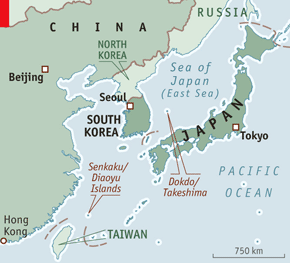
This strikes me as the most important regional geopolitical event of the year, because it effectively ratifies what many analysts have suspected of coming for a long time – a Sino-Japanese competition over Asia, with the US hovering in the background, tilting toward Japan. This will be the defining competition of Asia for the next several decades, and the trend-lines broadly favor China – Japan and the US are in decline relative to China.

Continue reading

My December Newsweek Japan Essay: Japan as a Unique Bulwark to Chinese Hegemony in Asia

5766_p

I recently joined Newsweek Japan in a more official capacity as a regular contributor. I am pleased to do so, as I increasingly think that Japan is the primary bulwark to Chinese hegemony in Asia. So more and more, my research interest is drifting toward the Sino-Japanese competition as weightier than the inter-Korean competition.

In that vein, I wrote the following story for the current volume of Newsweek Japan. In brief, I argue that only Japan has the strength to really block China’s rise to hegemony in east Asia. Russia is too weak, especially out here. India just can’t seem to get its act together (I used to push India really hard as an obstacle, but it just doesn’t seem up to it.) I am a skeptic of the US pivot, and sheer distance alone means the US need not confront China unless it wants to. The US will never be under a Chinese ‘Monroe Doctrine’ as Asia might be in the future. That leaves Japan as a unique bulwark – a front-line state with the wealth and state/bureaucratic capacity to give China a real run for its money. Indeed, one way to see the current tension is as another round of Sino-Japanese competition for Asian leadership going back to the mid-19th century. (As always, I’d love to hear from the Japan mil-tech guys on all this.)

Elsewhere I have argued that China’s rise to hegemony is unlikely, in part because I think Japan will vigorously balance China. (Indeed, it probably is already.) So this essay is an expansion of that previous argument. The essay follows the jump.

Continue reading

My September Diplomat Essay: Relax – Chinese Hegemony in Asia is Unlikely

water_pollulation_shaoxing_zhejiang

The following is a re-up of a piece I wrote for the Diplomat last month as part of an informal back-and-forth series with the National Interest this summer on the US pivot to Asia and AirSea Battle. (Here and here are some of the other entries.) That pic, which has got to be the grossest river in all China, is from here.

In brief, I increasingly think that ASB is a mistake, because it’s almost impossible to read it as anything other than hugely provocative from the Chinese point of view, no matter what we say to them about our peaceful intentions. (Read this, and tell me reasonable Chinese wouldn’t flip out.) It’s a classic example of the security dilemma, but as I argue below, I am not really convinced that we actually need this high-tech, super-fearsome-sounding ASB right up in their face. More generally though, the pivot to Asia – a sharpening of American attention on the region, is probably a good idea. China is vastly more influential on American life than Israel or Iran. But the Middle East and Islam activates belligerent American religiosity so much, that I doubt we’ll really be able to pivot. In any case, the essay follows the jump and is written in an op-ed style.

Continue reading

Guest Post – Dave Kang: “International Relations Theory and East Asian History”

AHN_HOUSEIt’s always my pleasure to guest-post my good friend Dave Kang. Dave teaches at the University of Southern California, runs their Korean Studies Institute (the pic), and knows way more about the issues of this website than I ever will. So if you aren’t reading his work yet, you should be. Here are some previous guest posts he’s written (one, two, three).

Here is his encouragement that you actually apply international relations theory to East Asia. I can’t agree more. There is far too much superficial think-tank wonkery about East Asia (how many nukes does China have? will Pyongyang test another missile? and so on), and not nearly enough real theory. Dave does that and you should too. So instead of writing yet another essay about the South China Sea, the essays referenced below should be good encouragement to write something richer.

“Thanks to Bob for letting me borrow his website yet again. I have an article “International Relations Theory and East Asian History” that appears in the current issue of the Journal of East Asian Studies, edited by Stephan Haggard. In conjunction with this post, Lynne Rienner will make the article freely available to all for the next 30 days; you can download it here until October 1.

The entire issue is devoted to the international relations of historical East Asia. The special issue features essays by James Anderson, Kirk Larsen, Jiyoung Lee, Seohyun Park, Kenneth Robinson, and Yuan-kang Wang, all exploring different aspects of IR and East Asia in many disparate epochs and areas.

Continue reading

My ‘Diplomat’ Essay on whether these Youth Protests will Spread to Asia’s Democracies

Brazil

Here is a re-post of my July contribution to the Diplomat web magazine. It expands on a brief observation I made a few weeks ago – that a lot Asian democracies have the same characteristics that seem to have driven people into the streets in Brazil and Turkey.

Here is the best critical response I’ve gotten so far. In brief, it argues that my conditions for the revolts are so widely drawn, that arguably lots of states could see these kinds of revolts. That is a good point. And many of the commenters that the Diplomat said something similar – that Cambodia, Malaysia, and Thailand should also have been included in my piece as possibilities. I singled out India, the Philippines, and South Korea. I’m not a big expert in the area of modernization and contestation, so thoughtful comments would be great. Here we go:

Continue reading

Could the Youth Protests of the EU, Middle East, Turkey, and Brazil Spread to Asia’s Corrupt Democracies?

brazil-confed-cup-protests_jpeg3-1280x960

Jay Ulfelder and I had a Twitter conversation on this question in the last few days (here and here). But Twitter has such limited space, I thought I would break out our discussion on the blog and ask what others thought.

Watching all these riots – driven heavily by youth dissatisfaction, it seems – is making me wonder if this might spread to Asia’s democracies. A lot of the problems these protests are identifying exist in spades in Asia: high-handed, out-of-touch governments; election-proof pseudo-technocracies that act as unaccountable oligarchies; shallow, clique-ish political parties that provide no meaningful transmission belt of citizen preferences; massive government and business corruption; wasteful white-elephant spending to capture global ‘prestige’ while everyday services like health care and education are underfunded; closed political opportunity structures that regularly reward insiders and large corporations with crony connections to the state; wealthy, de-linking elites with 1% lifestyles wildly at variance with the rest of the population… That’s Asia too; there’s more than enough sleaze to go around.

Jay asked which countries might this apply to in Asia. My first thoughts were India, the Philippines, and South Korea among the democracies (given the obvious problems street protests face in non-democracies). Are those countries really governed better than Brazil? I doubt it. Anna Hazare pushed this sort of agenda in India a few years ago, and South Korea, which Asian case I know best, has all those Brazil problems particularly – and probably even worse than in Brazil. I’ve wondered for years why there isn’t more populist anger and protest over the cronyist, Seoul-based chaebol oligarchy that is Korean democracy. (I’m usually told it has something to do with ‘Confucian’ or ‘Asian’ values.)

It’s terribly hard to predict outbreaks of mass street protest of course, but if I’ve identified the broad structural conditions of the current wave correctly, and if protest in one locale seeds it in another (“cascades”), (two huge “if”s to be sure) then Asia’s oligarchic, corrupt democracies are/should be next.

I’m Done Defending Abe: the Japanese Right is getting Genuinely Creepy

protesting-comfort-women-by-bloggerswithoutbordersIf you’ve ever read this blog before, you know I try to avoid the details of the Korea-Japan tussle. It gets so emotional so fast. Like most Americans, I want Japan and Korea to reconcile so they can work together on the larger, more important issues of North Korea and China. I don’t take a position on the Dokdo/Takeshima flap. I refuse to call the Sea of Japan the ‘East Sea’ (do you want to re-name the Korea Strait too?). When Koreans push me about the war, I try to deflect the issue. It is really not appropriate for outsiders, especially Americans, to weigh in on the details of Asian disputes. We can’t be an umpire to local fights, and our intervention would be seen as illegitimate by the losing party anyway. This is also the USG’s position: we have no position other than that we want all the parties to work out the disagreements without coercion or force. That’s the right attitude IMO.

Continue reading

My ‘Newsweek Japan’ Cover Story on the post-1979 ‘Asian Peace’ & Economic Miracle

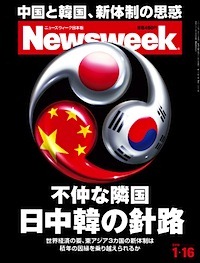
Newsweek 3rd coverNewsweek Japan asked me to write an introductory essay for its January 16 special issue on tension in Northeast Asia (cover story to the left). I should have put this up 4 months ago, but I forgot and the arguments are still valid. Anyway, here is the link in Japanese, but I thought it would be useful to publish the original, untranslated version as well. (If you actually want the Japanese language version, email me for it please.)

The essay argues that Northeast Asia has benefited enormously from an ‘Asian peace’ in the last 35 years. All the remarkable growth in China and South Korea (as well as India and Southeast Asia) would not have happened without it. So fighting over some empty rocks (Liancourt Rocks, Pinnacle Islands) is a terrible idea. And for political scientists, the current Sino-Japanese tension is a good test of the hypothesis that economic interdependence brings peace. It’s fascinating to watch China especially try to figure out just how much economic gain to forego in pushing Japan over the Pinnacle Islands.

This was intended for their print edition, so there are no hyperlinks included in the text. Here we go:

“1979 was an important year in modern East Asia. It captures two of the region’s most important trends. It was the year of both the last serious military conflict between two East Asian countries – a Sino-Vietnamese border war – and the start of China’s capitalist modernization under Deng Xiaoping. These moments usefully frame the following thirty-four years: much of Asia has gotten substantially wealthier, and no major conflicts have broken out to upset that upward economic swing. This magnificent regional achievement has catapulted Asia, particularly East Asia, into the center of world politics.

Continue reading

On Vacation for awhile – Here’s Some New Year’s Reading – See you in March

I break from blogging twice a year, but try to compile a good list of relevant articles I’ve found over the past few months. See you in about a month. Enjoy:

August

The Atlantic runs lots of good stuff on NK it seems to me: this on how NK impossibly continues to survive and this on how just about every NK watcher has wrongfully predicted its collapse.

Mixin Pei’s important piece on why China’s rise is overrated. My own sense of this is that Pei will be proven right in the next 10-15 years, but not sooner. China’s demographic, ecological, and corruption caps strike as growing worse, not better.

A nice piece from the FT on Korea’s biggest company – too bad no one wants to plumb the far-too-close relations between the chaebol and the ROKG Continue reading

USC-CSIS Conference on Korean Unification (3): DPRK ‘Sovereignty’ is a Sino-Russian Fig-Leaf to Slow Unification and Check US Power

New_KSI_Banner_3

Here are part one and part two of this post. I spoke last Tuesday at a USC-CSIS conference on Korean unification. I learned a lot, and it was very good. If you’re interested in unification, start here with the primary report on which the conference was based. The principal investigators said a final wrap-up report will come at some point, and I’ll put up that link when it arrives.

My comments below are on the papers presented on Tuesday about neighboring states’ reactions to Korean unification. These papers aren’t publicly posted yet, so all the comments might not make sense. But in the interest of completism, I’m putting this up to round out my thinking on this excellent unification project. (For my earlier thoughts on dealing with NK, try this; for my travelogue of my trip to the DPRK, try this.)

My big beef with these sorts of conferences on NK – I go to a lot – is that inevitably outsiders, especially Chinese scholars, start laying down all sorts of guidelines, restrictions, parameters, etc. for unification, as if it’s our right to muck around in this thing. I can understand the national interest in doing so. But we shouldn’t have the temerity to try to legitimate our muddying of the waters in what is really an internal family affair. It would also help a lot if the Chinese would stop talking (not so much at this conference, but definitely at others I’ve gone to) about how Korea needs to respect its wishes, because China is big and important now, post-2008 Olympics. I heard one guy once even say that China is now the ‘veto-player’ on unification. That’s true of course in realist sense, but that sorta cockiness infuriates Koreans who’ve really soured on China in the last decade. I see the same kind of emergent Chinese bullying on unification that Southeast Asian littoral states see on the South China Sea. So I try to call that out whenever it seems necessary.

Anyway, here on my thoughts on Japan, Russia, and China’s role in this thing.