China’s Counter to the Asian ‘Pivot’ (1): Korea, India

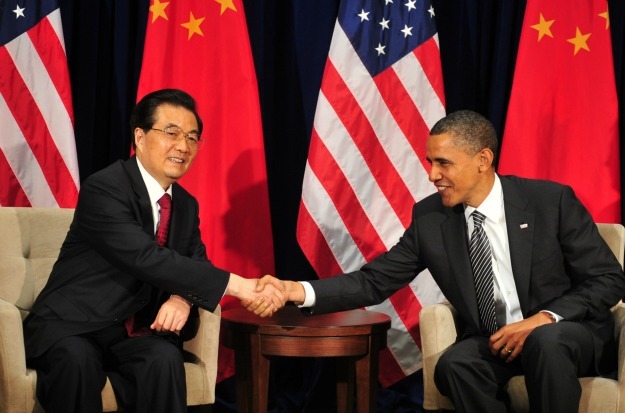
obamahu132628592pk

So the US is supposedly going to pivot to Asia and start worrying more about China. This makes sense (which is probably why we won’t do it). The Middle East has become a pretty terrible sinkhole of American power. Increasingly the verdict on the war on terrorism is negative, and we should probably retrench from the Middle East (but we won’t because of the religious right’s interest in the region). Mearsheimer argued that if it weren’t for 9/11 we probably would have focused on China a lot earlier. Kaplan sketched how the US would defeat China in a war. I argued a few years ago, at the height of the ‘China-has-changed-into-a-scary-revisionist’ hype of 2009-11, that containment of China was likely (maybe even desirable Sad smile). And clearly China’s behavior over the last few years has raised the likelihood of at least soft containment; even the Vietnamese and the Filipinos are asking for US agreements now.

But I don’t see much Western discussion of how China would/should respond. So in the tradition of those old CIA A team/B team exercises, here are five ideas for how China should/could respond to its incipient encirclement:

Continue reading

China & Snyder’s “Myths of Empire” (2): Does the Model Fit China?

I didn’t know the PLA likes Led Zeppelin…

Here is part one, where I argued that China reasonably fits the prerequisites for Jack Snyder’s theory from Myths of Empire. Here is an application of it to China to see how it works:

2. Contra Snyder, China’s modernization is being led by the state and the party, not as much by the military. That’s true. But clearly the PLA does have something of that ‘state within a state’ feel of Germany and Japan’s military early last century. The PLA’s budget has exploded over the last two decades, and like other second world militaries (Egypt, Pakistan), the PLA has lots of business interests (including casinos I’ve even heard) that suffer little state oversight.

Continue reading

China & Snyder’s “Myths of Empire” (1): Theory

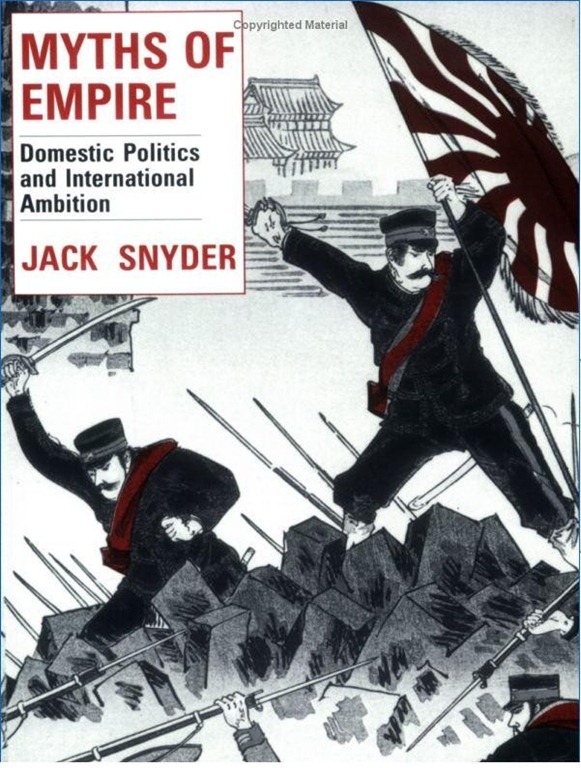
MYTHSOFANEMPIRE

So I am re-reading Snyder’s Myths of Empire for an r&r. (Btw, not that this is bad book, but is anyone’s reading list in life now primarily driven by anonymous reviewers and the need to get in print for promotion? Sad smile) The book is theoretically complex (almost too many moving parts to my mind), and the cases are an exciting read. But when it was big in the 90s (when I first read it), no one really thought about China as fitting the argument. But today, it strikes me that China would be an interesting prediction case for the book. Certainly China looks a lot like the kind of expansionist state Snyder describes – rapid late developer, nationalist-militarist elites suspicious that the extant international system is keeping them down, growing factionalization, nationalist mass ideology, etc. In my grad school classes, one of the big criticisms was that the theory is not very generalizable. By Synder’s own admission in the book, it can’t explain pre-industrial empire (a pretty huge scope condition to my mind); he also has only one non-western case in the book (Japan – the others are Germany, GB, US, and USSR). But China fits a lot of the basics for the applicability of Snyder’s theory – it’s industrial, a great power, growing fast, faces possible encirclement, etc. – so here is a nice example of both theory extension – trying on a new case that ‘should’ fit – and even better, prediction. Prediction is the gold standard of social science, so what would Snyder’s Myths say about China’s future behavior? Can we test the book’s argument against China over the next decade or two?

Continue reading

5 (Bad) Options for Dealing w/ NK (2): China & Bribery don’t Work either

3610146150_76b6755939


Part 1 is here.

I spoke at the Korean Institute of Defense Analysis last week. This is an expansion of my remarks. In part 1, I argued that the first option, negotiation, would fail. Here are three others that I don’t think have lead anywhere either.

2. Wait for Change/Muddling Through: This is the default position, as NK is so erratic, it is hard to build a ‘grand strategy’ to deal with it. Call this permanent crisis management. This is attractive, because it doesn’t require a huge Southern defense budget; the Americans are here and will help SK deterrence. It also appeals to our sense that NK is living on borrowed time. If there is one idea I hear at just about every conference I’ve been to in Asia, it’s that NK can’t last. If SK can just hang-on, then eventually NK will go away. I see two problems: First, NK doesn’t seem to be going away no matter how many experts and economists tell us they are on their last legs. Indeed, NK confounds us all by surviving, somehow, no matter what happens. It’s astonishing actually. Second, insofar as NK is an unbelievable brutal regime, simply waiting for change raises the moral issue of the fate of North Koreans. North Korea is beyond your run-of-the-mill dictatorship; its 1984. It allowed some 1 million of its own people to starve to death in the 1990s, and it runs the worst gulag system on the planet. Insofar as ‘traditional’ dictatorships allow regular people to survive if they keep their heads down, the moral compulsion on outsiders to end that regime is low. But when a regime actively brutalizes its own people, the R2P principle kicks in. I wonder if all this raises moral culpability among the liberal states in the 6 parties? Given just how bad NK really is, do we have a moral responsibility to try to accelerate its demise? Is mutual coexistence defensible with a regime this bad?

3. China: This was the great hope of the last decade, but it seems to be going nowhere. The liberal states of the 6 parties are played for gain by NK less and less; they have learned to not get gimmicked and played off against each other. This has driven NK, in desperation, to China, as its last benefactor. (Russia is neither wealthy nor interested enough to care.) So for awhile in the 2000s, there was talk about the ‘way to Pyongyang runs through Beijing.’ And this would be true, if China used its leverage, and one read of the NK nuclear program is that it prevents the total clientelization of NK by China. But they just aren’t helping. Indeed, the Chinese decision to continually subsidize NK led me to call them ‘liars’ on unification two years ago. Maybe that was an overreaction, but their non-response to both the Cheonan and the Yeonpyeong last year was a terrible failure of global citizenship. NK is ground-zero for all that talk of China being a ‘responsible stakeholder.’ Reining NK is vastly more important the China’s currency gimmicks or even the South Chia sea flap. If there is any one thing the world wants from China, it’s help in bringing the NKs to, if not change internally, at least behave with a modicum of normality externally. My own thinking on China has softened since I’ve lived here. I have had enough ‘track II’-style relations with Chinese scholars and students to see that there is a lot of worry about NK, an awareness that the world is really watching China on this issue, and a general sense that Chinese global prestige is damaged every time it looks like NK is the maniac pitbull whose owner won’t control it. But perhaps old ways die hard, or the PLA is the one really calling the shots on the NK issue. I can certainly understand that China does not want an American-allied, nationalist, larger ROK on its border. Whatever the reason, this is not working; China is not disciplining NK (or maybe it can’t and we have over-estimated it). Sure, we should keep talking to Beijing about this, but like the negotiating strategy, it is time to be realistic that this probably won’t work.

4. Sunshine Policy Bribery: Contrary to SK hawks, I thought this was actually a good idea back in the 90s. By 1997/98, it was pretty clear that NK was going to survive the end of the Cold War and its internal famines. Waiting for NK to collapse feels like waiting for Godot, so just about anything that might work is worth a try at this point. Given that the goal is NK change, not ideological purity, I see no reason we should criticize Presidents Kim or Roh as dupes of NK or something like that. They tried. A pragmatic decision to see if another approach would work was absolutely worth it at the time. It’s unhelpful right-wing ideology to say that we should never talk to NK or that they are part of the ‘axis of evil.’ What we really need is change, and a pragmatic decision to reach out was certainly defensible. It should also be admitted though, that it didn’t work. We know now that both President Kim (1997-2002) and Roh (2002-07) were bitterly disappointed that NK did not respond. Kim Jong Il even needed to be personally bribed in order to come to the inter-Korean summit. In the language of game theory, the Sunshine Policy could be read as persistent, unreciprocated cooperation, even as the other player defects and defects, in order to see if the other player can eventually be brought around. The failure of player B (NK in this case) to respond tells us very important information: at least until the current Kim passes, it is very unlikely that unreciprocated cooperation will work. It was worth a college try; indeed, it was a heroic, noble effort (Kim won the 2000 Nobel Peace Prize). But it also failed almost completely, and I entirely understand why the SK electorate turned against it and took the current hardliner as president. It is unlikely to be tried again, at least while Kim Jong Il is alive.

Part 3 will go up on Monday.

Turkey’s ‘neo-Ottoman’ Rise (3): Why I am Wrong…

turkish flag

This is the continuation of a Wikistrat (where I consult a bit) game scenario on Turkey’s economic and possibly military rise. Readers are counseled to start with parts one and two.

The following are responses to criticism, mostly that I didn’t flesh out the reasons why Turkey is likely to hold broadly western course:

1. Turkey’s rise unbalances the region more than I admit, and I don’t muster enough evidence.

My sense is that Turkey’s growth is pretty good, but I don’t see any particular reason that it should be labeled stratospheric or ‘neo-Ottoman’ or something like that. By the standards of a dysfunctional region – Greece, Iran, Syria, Egypt – it is great. But compared to the old and new cores, or even other middle powers, it is a middle power. Even compared to tiny Israel, Turkey is probably a generation behind in state-development, the translation of economic power into military capability, functional political parties, trustworthy courts, and the many other attributes of thick, cohesive, functional state-ness. The CIA lists Turkey’s growth in 2008 at 0.7%; 2009 at (negative) -4.7%; and 2010 at 7.3%. The IMF’s numbers are 2010: 7.8%; 2011: 3.6%. I don’t see that as revolutionary, nor justifying big rhetoric. However, if the argument is more limited, that Turkey will play a greater role in the Middle East and central Asia, I agree. The big losers will be Greece (further unbalanced competition), Israel (yet another headache) and Egypt and Iran (lost prestige as potential regional leaders).

Turkey faces tough structural constraints that do not really mark it out from other second-world risers. No talks about major Brazilian or South African shockwaves, so why is Turkey’s fairly standard modernization-developmentalist growth arc that much different? I am open-minded about this. My thinking is hardly set. I guess I am just not convinced yet.

Finally, my sense is that the tectonic plates of international politics move terribly slowly. Hence I note the stability of Turkey’s foreign policy. Really deep shifts take a long time, like East Asia’s rise, so I am not convinced that a decade or so of choppy albeit healthy growth, coupled pushy, semi-Islamist rhetoric is enough.

2. “The demographic growth in Turkey is all in populations less likely to be EU/West friendly, i.e, the eastern, more rural hinterlands. What’s Turkey’s motivation?”

I think the motivation is primarily economic. A significant turn from the West would reduce critical inward foreign direct investment flows and tourism dollars, and damage links that military and business cherish (easier visa rules; access to Wall Street, western universities, and the international financial institutions; etc.). Turkish elites are aware of this. Like most late, second world developers, Turkey needs continued access to old (West) & new (East Asia) Core dollars, markets, and technologies. This is why I originally said ‘neo-Ottoman’ rhetoric might be more justified in 20 years. For a comparison, look at Indonesia or Malaysia. They too have populations that rankle at Western dominance, want more international stature and maneuvering room, and have populist, entrepreneurial, Islamist politicians. But these tendencies have been held in check by the huge economic incentive of continuing, decent relations with OECD states. I see this in Turkey too – hence my list of institutions and relationships Turkey has retained.

Populism may work for electoral reasons, but does Turkey want to become Venezuela? Perhaps the the AKP (Justice and Welfare Party) really wants to push in this direction, but resistance from the revenue-generating (western and westernized) parts of the country would be strong. This is the counter to the eastern demographic growth you mention. Perhaps this is why Huntington referred to Turkey years ago as a ‘torn’ country. I did not think so much about the demographic evolution though. Point taken.

A second motive is national security. If Turkey drifts from the West, to whom will it go – Iran and Syria? If so, it faces balancing and isolation by some combination of Israel, the US and the EU, and possible exclusion from NATO and the WTO. I suppose Russia is a possible patron/ally/friend, but what does Russia gain? The reset is important for Russia, as well as WTO entry, and, most importantly, being perceived as a great power by the West. Siding with a semi-islamized, somewhat unpredictable ‘new Turkey’ might be useful to poke the West in the eye – certainly a Putin proclivity – but how much does it advance Russia’s great power pretension? Not much I think, but I admit this question requires more research. Next, Turkey might reach to Central Asia – hence the neo-Ottoman moniker I think. But again, how much is there to gain? Those regimes are terribly poor, with weak state apparatuses, and repressions that have alienated investors. The cost-benefit analysis of the ‘stans vs the core is quite one-sided IMO.

The best chances for a real turn would be some kind of alignment with the Shanghai Cooperation Organization (SCO) against the West. This would effectively split the new core, between China and the Asian democratic periphery. In so far as China has propped up some nasty regimes for the last decade or so, a genuinely independent Turkish line that alienated the old core could still find some succor with Sino-Russian assistance. This SCO strategy strikes me as far more viable than reaching out to local ME nasties like Iran or Syria. I will admit that I haven’t thought through this likelihood, but the SCO doesn’t seem so much like a club or alliance, but just a gang united by ‘anti-hegmonism.’ I am not sure if it represents a coherent enough alternative. But this too requires more scenario thinking.

Finally, I would say that my argument flows directly from Barnett’s general core-gap analysis. I believe it fits rather well actually. Late developers’ future is with the core. The gap represents what they are leaving behind, and what they so very often, so desperately don’t want to be perceived as in the eyes of global public opinion – backward, third-world, irrelevant. Maintaining those newly emergent links to the core – its money, trade, professionalism, geopolitical clout, and general seriousness – weighs heavily in the cost-benefit analysis and motivates important domestic actors – youth, business, military – who will resist populism.

BONUS: Here is the Wall Street Journal on ‘neo-Ottomanism,’ including Erdogan’s appalling refusal to support a no fly-zone over Libya.

Korean-German Unification Parallels (3): Differences & Conclusions

Flag-Pins-South-Korea-Germany

This is the last of a three part post elaborating the often-made parallel between German and Korean unification. Please start with part one and part two.

More Differences in the International Environment between German and Korean unifications:

c. China’s interest is much higher in NK than the USSR’s was in EG. NK borders China; EG was two time-zones away from Moscow. China’s interest in the terms of a final settlement are much more direct. Gorbachev was basically trying to sell EG for desperately needed cash; for China, Korea is a more existential issue. NK is a buffer between democratic SK, Japan, and the US. Hence, China is much more likely to stick its nose into Korean unity talks, and to push for its own terms. Those terms will probably include a ban on US forces north of the current DMZ, and possibly an exit of SK from the US alliance altogether, in exchange for Chinese acquiescence on unification: Korean ‘finlandisation’ (an outcome of which Japan might secretly approve too).

d. SK can’t buy unity from China as West Germany did from USSR. WG was an economic powerhouse by the 1980s – in the OECD and G-7, second biggest donor to the UN, etc. WG could simply  write a huge check to Moscow, and the USSR was so desperate that it took the money and abandoned Honecker. SK is simply not there. Yes, it’s in the OECD and G-20, but its still lists itself as a developing country at the WTO, and it is still decades away from German levels of affluence. Nor do the Chinese need the money. China will play a much harder game than the Soviets were able to 20 years ago.

e. SK has no supportive environment of allies or revolutions, like NATO and the Velvet Revolutions of 1989, which could add momentum to unification. Beyond the US, SK has no real allies. Russia is an unpredictable faux-‘partner’ at best. Because of all the bad history, the Japanese don’t really like the idea of a united, wealthy Korea which is growing faster than them, right on their doorstep. Taiwan is also a divided country, but it is in the NK/EG role as the smaller and weaker of the two. So there is nothing like a local NATO of friends to provide group moral cover for unification efforts, nor can there be any regional momentum for NK change, as the other revolutions like in Eastern Europe provided to East Germans in 1989/90. The are no nearby states similar to NK to catalyze NK change, unless one imagines Chinese democratization, which is a huge leap. As we see in the ME today, revolutions can synergize each other, but there is no region here to provide a wave to wash into NK. Koreans will have to do this themselves.

Conclusions:

Altogether this means that hurdles to and burdens of unification are much higher here:

 There are more NKs than EGs, and they are poorer as well.

There are fewer SKs than WGs, and they are poorer also.

SK’s state strength/capacity is lower than WG’s, while NK is a catastrophe by even EG standards.

So: fewer people with less money in a weaker system will support more people with less money from a worse system.

That domestic arithmetic is brutal, and if that weren’t bad enough, the international balance of forces is worse now than in 1989 too:

Today, the external patron (US) of the free Korean half is weakening, while the external patron of the communist half (China) is strengthening. The opposite was true of the US and WG, and the USSR and EG, in 1989.

Today’s northern patron (China) is trying to push further into the continent (Asia), while yesterday’s eastern patron (USSR) was looking for an exit (from central Europe).

There is no regional encouragement, revolutionary wave, democracy zeitgeist, or whatever to push this thing along in NE Asia.


The incentives for China to meddle – because of the greater importance of NK to China, than of EG to the USSR -, and the greater ease of   such meddling – because the US and SK today are weaker than the US and WG were then, while China is much stronger today than the USSR was then -, mean Chinese intervention is highly likely. It will try hard to structure any final settlement. A major policy question for SK is therefore likely to be, will it dump the US alliance if that is what’s necessary to get China out of the peninsula? Will SK exchange ‘finlandization’ for unity? I think the answer is, and should be, yes.

The only alternative I see to this is a unification process that goes so badly off the rails, is so destructive, disorganized, and chaotic, that China would want to stay out it from sheer concern to avoid a quagmire. In other words, the more chaotic the end-game turns out to be, the more likely it will be a Korean-only affair. This is unfortunate; no one wants Korean unity to be a Hurricane Katrina-style national meltdown that requires heavy western and Japanese support – which might not even be available. because of the accelerating sovereign debt crisis. But reunification chaos seems like the only way to keep the Chinese out, because the balance of forces I sketched in the post are so much worse for Korean today than they were for Germany in 1989/90.

Korean-German Unification Parallels (2): Differences

east_germany_flag_thumb1

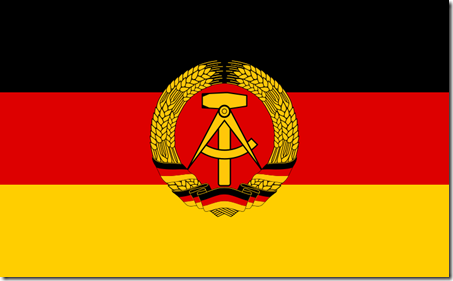
old East German quip: what does GDR (German Democratic Republic) really mean? German District of Russia…


This is part two of a post exploring the similarities and differences of German unification (1989/90) with Korea’s probable future one. Part one explored the similarities of the two cases; Part three presents my conclusions. Here are the differences between these unifications:


Differences:

3.  Domestic

a. EG was much wealthier than NK is now. EG was the ‘leading’ economic performer of the east bloc. The USSR realized how central the German competition was to the overall Cold War competition, so EG was heavily subsidized. NK was never as important, because the cold war contest was never as stark in Asia as it was in Europe, so NK never got such big handouts. NK’s GDP/capita today is a crushing $1700; EG’s in 1989 was $10,000.

b. NK is not just a dictatorship; it is an Orwellian nightmare, more stalinist than even the Soviet Union or Albania ever were. East Germany was bad but never plumbed the depths of repression and madness like NK.  One of our faculty at my university works with NK defectors, and he notes how many of them have psychological trauma from life in NK. Fixing NK will not just be a huge pile of money; we know that. It is also going to require something akin to nation-wide psychiatric care for millions of mentally brutalized Winston Smiths. This will be an event unheard of in the annals of mental health; read here and here.

c. On just about every other benchmark conceivable, NK is worse off than EG: environmental management, infrastructure, labor productivity, health care, education, technology, etc, etc. The per person cost of Korean unification is likely to much higher, because NK is so much further behind in almost every way than EG was. Estimates of Korean unification could begin with these figures: in 20 years, WG has transferred $1.2 trillion euros to the roughly 16 million people of EG at the time of unification. Note than NK has more people (23 M) than east Germany, and those people are significantly poorer per person too ($10k vs 1.7k per capita). So that means the 1.2T euros figure is likely too low for the NK case. Note also that West Germany had around 60 M people in 1989; SK has 49 M today. WG’s 1989 GDP per capita was $25,000; in SK today, it is around $19,500. The arithmetic is punishing.

d. EG and Soviets did a good job deceiving the world that EG really was modern and advanced, just like the West. This is one reason why the WG government granted 1:1 currency convertibility to the GDR mark: almost everyone thought EG would have some reasonably competitive industries and sectors. Yet when WG finally got in there – when the West finally pulled the lid off –  almost everything was badly behind or unusable: the phone system had to be completely replaced, EG cars were a polluting environmental nightmare, laborers had no idea how to use computers or even basic office devices like photocopiers, infrastructure around the country still had World War II battle damage (that is no joke, I saw it), etc. So it’s likely that NK is much worse than we think it is. Even Bruce Cumings has admitted this. Yes, try to imagine that: NK, our customary endpoint of geopolitical awfulness, is probably hiding much worse than we know now. Once we see the NK gulags up close, I think we are going to see Nazi-style atrocities even the Taliban wouldn’t have tried.

e. SK is less politically prepared to carry the enormous stresses of unification – and not just the financial burden. The SK political system is flimsier than WG. Corruption is more regular; its parties are shallow and change names quickly; political unresponsiveness drives a street-protest culture and brawling in the National Assembly. For a state that came out of dictatorship less than a generation ago, SK is doing pretty well, but it clearly does not have the state capacity WG did in 1989, while it faces (points a & c above) a comparatively greater burden. Indeed, this is my greatest fear – the burdens of unification will simply overwhelm SK’s still maturing democracy and leave NK in some kind of semi-annexed limbo like the West Bank.

4. International

a. In 1989, the US was at peak of its postwar relative power. The USSR was in decline; China was still far off. This is the era of the ‘unipolar moment’ and the ‘end of history.’ Today the balance of forces is very different. The US is much weaker. Many think the US is in decline. All this makes it harder and harder for the US to support SK in any contest with China or NK over unification. It is likely that SK will have to do more of the work on its own, compared to the heavy intervention by the Bush 41 administration to support the WG position. The weakened American position means it will be easier for China to dictate its terms for unification (such as no US forces north of the current DMZ, or perhaps even no US forces at all).

b. In 1989, the USSR was a mess; today China is not. The GDR’s patron was imploding. It could no longer afford the contest with the US. The Soviet Union was trying to geopolitically retrench and to re-starts its moribund economy with perestroika and glasnost. The Soviets were getting desperate, and the east bloc – subsidized as it was – had become an albatross. Gorbachev was fumbling to control all the forces unleashed. China is the opposite. It is not overextended, but rather just beginning the international expansion that flows from its rising strength. It is feeling its oats and ready to give the US a run for its money in Asia at least. Tiananmen Square demonstrated a non-Gorbachevian willingness to roll out the tanks to maintain the one-party state, and there is no serious liberalizing force, in part because the Chinese population is being bought off with growth. So China is much more capable of carrying the NK albatross and ready to push its interests into Korea not pull out per Gorby.

Go to part three.

Korean-German Unification Parallels (1): Similarities

KIM_IL_SUNG_mit_HONECKER

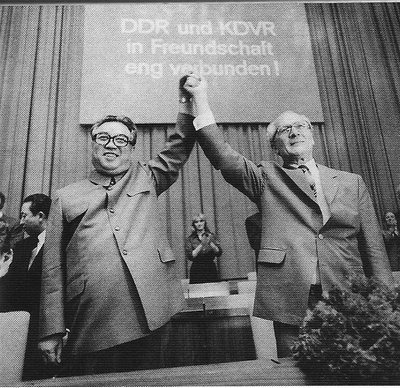
Kim Il Sung and Erich Honecker: *sigh*, don’t you miss the golden days? —- no, me neither

(the placard reads: ‘GDR and DPRK tightly bound in friendship’ – for tyranny and poorly-made men’s wear)

Here is part two and part three.

Last week I ve participated in a scenario to map out possible futures of Kim Jong Il’s sudden death. My best guess is in my previous post – a military dictatorship with Kim III (Jong-Un) as a familial, yet much reduced, figurehead. But one idea that is always floating around in the background is that major regime junctures in the North might lead to break down and then unification. President Lee has taken recently to saying that SK should prepare for imminent unification, and one of my favorite NK experts thinks unification is likely in the next five years.  Does anyone else think this is likely, and why so (in the comments below, please)? I don’t see that actually.

Nevertheless, the most obvious parallel for trying to map Korean unification will work is the German case in 1989/90. I have written about this before, but the following compare and contrast is more complete. For Asian readers in search of a good walk-through of Germany’s experience with division, here is a good place to start.(FYI: I lived in Germany for 4 years in the early 90s and speak German. I recall debating this stuff a lot.)

Similarities  between the German and Korean divisions:

1. Domestic

a. Both nations were divided artificially. Both sides believe the ‘2 states, 1 people’ outcome is temporary. All 4 states face a permanent constitutional legitimacy crisis, because the obvious question is why these separated states exist at all. As such, all states divided by the Cold War were intensely competitive with the other. Outracing each other economically, militarily,  even at the Olympics, became central to proving who was the ‘real’ Korea, Germany, Vietnam, China, etc. Mutual coexistence is basically impossible; each has a limited time window to race the other into international legitimacy. As one or the other pulls away in global opinion – as it becomes ‘the’ Korea or ‘the’ Germany in places like airports or hotel signage, popular movies, CNN, etc. –  it will become ever harder to justify maintaining the division.

b. NK and EG (East Germany) are both communist with all the attendant problems of 20th century ‘real existing socialism.’ They are domestically illegitimate outside their own elites. Those elites are a corrupted ‘red bourgeoisie’ for whom regime ideology became a figleaf for oligarchy and luxury. Neither can produce anything close to the quality and quantity of goods necessary to keep their populations happy – populations further disenchanted by what they see on the other side. Both have a nasty secret police. They are both noticeably poorer than the westernized competitor, and this creates unending pressure on the government to change. All these factors create a disconsolate citizenry that would push out the regime if given the chance. Hence, any manner of internal democratization or liberalization would end the regime as we know it. In the end, both communist half-states had to seal off their borders to prevent exodus; they are national prisons.

c. Underperformance vis the westernized competitor slowly takes its toll internationally. The competitions led to hyper-militarization in the communist half, which only worsens the performance gap between both sides.  Perhaps the best marker of the communist failure after a few decades was that West Germany simply became Germany and South Korea just Korea. To indicate the communist half in everyday speech, one had to affix the directional adjective, the implication being that EG and NK were somehow dead-ends of history. By the 1980s, both NK and EG had effectively lost the race of point 1a above; SK and WG became Korea and Germany.

d. The westernized, ‘Free World’ half of the nation is a wealthy, functioning democracy that has otherwise joined the world – technologies, markets, and institutions (IMF, WTO, etc). This makes the communist half look even more like a basket case. Gradual but sustained wealth and demographic accumulation have dramatically altered the balance against the communist half. The free half also regularly receives communist refugees voting with their feet.


2. International

a. SK and WG are clearly supported by the US and its wealthy democratic allies. Both belong to American/democratic alliance system and enjoy the widespread moral legitimacy that comes from that. They are net contributors to their own defence, clearly outclassing the communist half strategically.

b. NK and EG are practically client states of a communist behemoth, on whom they are extremely dependent. The patron of both finds them troublesome and expensive. Both field an military based around obsolete WWII assumptions of massed infantry and armor formations. Neither can win a conflict with the other half; the economic gap compounds the military gap. The patron regularly debates the merits of cutting the client loose.

c. The neighborhood got used to the division and kinda likes it (especially Japan and France, although no one will say that publicly). There isn’t a lot of impetus from outsiders to end the split. Russia couldn’t care less if Korea unites. Like the French and British on Germany, the Japanese public will come around once they see it on TV. Once we see crying Koreans tearing down the barbwire fences of the DMZ, like we saw Germans hammering the Berlin Wall, no one will stand in its way. But until then, don’t expect anyone else to do much beyond pro forma boilerplate.

Go to part two.

Egyptian Revolution (2): The Egyptian Army’s Moral Superiority to China

imagesFor

For part 1 of my thoughts on the Egyptian revolution, go here.

4. China shot its own people; Egypt has not. Much of the analysis has focused on possible parallels with Iran 1979. But another more recent parallel, especially relevant to this website, is Tiananmen Square 1989. In their moment of crisis, the Chinese turned their guns on themselves, and the PLA (People’s Liberation Army) will be forever stained by the blood of its own citizens en masse. This strikes me as major moment in the evolution of dictatorships. All dictatorships suffer from legitimacy problems, of course, but none want to openly rely on naked force. Militaries are usually the hidden albeit central prop in dictatorships, but they don’t actually want to do the dirty work themselves. That is for the paramilitary thugs and secret police. No officer wants to think the primary enemy of the a state’s military is its own people, not some foreign enemy. Their dignitary and right to rule is based on the whole idea that thy are defending the people, not massacring them; in fact this is the myth of 1952 Free Officers coup in Egypt itself. Hence the call by a dictator in dire straits to shoot the citizenry is a rubicon for any army that cannot be uncrossed. In 1989, the eastern European militaries balked; in China, the PLA did not. My sense is that the social costs to the PLA were lower though, because China is so big. The CCP purposefully brought in rural PLA units for whom Beijing was like another planet. But in small countries like Poland 1989 or Egypt today, army repression in the capital would immediately be felt and transmitted everywhere. So hear, hear to the Egyptian military (I can’t believe I just wrote that sentence). For all its corruption, despotism, and insulation, it still did the right thing when the chips were down. Did anyone imagine even a month ago that we’d be speaking of the moral superiority of the Egyptian military to the PLA?

5. Beyond this evident parallel to Beijing 1989, this is whole things isn’t really that relevant out here. The news media coverage has been thin. The current El Nina cold snap in Northeast Asia has gotten more press time regionally than that Egypt. Not surprisingly the Chinese haven’t discussed Egypt much, but I am disappointed the the Korean and Japanese press seems so disinterested. Initial Korean media coverage focused on the possible loss of ME export markets (groan). From this I would draw two conclusions. First, for all the talk about a flat world, cultural hurdles still matter a lot. The parties caught up in the war on terror (the West, Israel, the Arab/Muslim ME) are riveted by this, but East Asian’s just aren’t, sadly. My experience in East Asia is that locals don’t really care much about the developing world. It’s far away, the languages and religions seem unintelligible, and the societies look backward, especially to East Asians obsessed with development. East Asians worry a lot about the US, and some about Europe, but there is tremendous ignorance of places like Latin America or Africa. Second, I think this disinterest is as much political as it is cultural. Newly wealthy places like Korea or China demonstrate their earned, rightful place in the OECD through an almost purposeful disdain for the third world. Koreans love to demonstrate how worldly they are by spending a year in the US or West; I’ve never met a student or teacher who thought a year a in developing country would be vastly more interesting. (It is.) So Barnett’s ‘new core’ flaunts its new status by forgetting its roots in the third world: disinterest as a mark of superiority.

6. A comment about the commentary: Frank Rich is right that far too few people have any idea what to say on Egypt because so much of the commentary is really about the US (or Israel). This Amero-centrism is why so many are saying the US should do this or that: the working assumption is that that US guides the world and can easily direct events. This is no longer true, so the mountain of US, rather than Egypt, -focused commentary creates unrealistic expectations that we can direct this thing.

Rich also makes the excellent observation that if Americans could actually watch al Jazeera, they might actually learn something about Egypt itself. Instead the mainstream commentary has revealed the embarrassingly nativist ignorance of much of the punditocracy on anything beyond US borders. In general I was very pleased to see how well academics requited themselves in the blogosphere on this; I think especially Walt, Mead, Cole and the Duck of Minerva have been super.

But if you read the op-ed pages, you got recycled banality and the usual suspects: Friedman gave you his typical, ‘this-is-a-defining-moment-in-the-ME’ schtick; Bush neocons desperate for rehabilitation strove to take credit and somehow blame Obama for…what exactly?; Palin blithered; Parker told us that the big story was really about the US media and Cohen that it was about Israel; Colbert King forgot the rest of the world exists; and Beck, well, you already know – just watch the loopy video from part 1. Score yet another point for blogging.

Without the informed blogging voices of people who actually know something about Egypt and revolutions, you really wouldn’t learn much about the events at all. You’d have just gotten an endless series of stories from a royalist, uncosmopolitan press in which Washington was the real story, because that’s all the pundits know how to talk aboutDouthat, for example – and whom I think is a pretty good writer usually – clearly had nothing to say, so he just gave up and wrote about Obama yet again under the guise of Egypt. How easy; this is how the press for a nation of untraveled monolinguists infatuated with their own power evolves. Its all about us. By contrast, here is an example of a non-expert, trained in traditional Washington self-obsession, who nonetheless tried. 

__________________________

ADDENDA:

The Japan Security Watch (JSW) blog of the New Pacific Institute has taken to cross-posting some of my stuff.  JSW is a good review of Japan, and a nice a compliment to my over-focus on Korea and China. They do on a lot on the nuts-and-bolts of hardware and deployment. Mil-Tech junkies on Asia will love it. JSW and I are working on some cooperation in the future. I want to thank them and commend readers to take a look at their good website.

BusanHaps, the big expat newspaper for Busan, SK, has also reposted some of my stuff. I want to thank them too and commend their site. Busan readers almost certainly know it already, but non-local readers will find it a good window on the way expats live here.

Finally, I want to point out that a published version of my remarks on North Korean shelling of Yeonpyeong Island is now available here (RINSA 15) from the Korean National Defense University (KNDU). If you really want to get into the details of SK defense against N, KNDU is the place to go. I want to thank them for soliciting me and thank readers for all the helpful comments that went into the final product.

Egyptian Revolution (1):We should Support the Uprising

Good lord, Beck really is insane…


Part 2 is here.

Like all of you in the last few weeks, I have been glued to CNN regarding Egypt. It is pretty inspiring, and I can only hope that Mubarak leaves and something more genuinely liberal and democratic takes his places. Here are a few thoughts.

1. Regarding the video selected above, I did plan to post a good pic from Egypt, but you’ve seen that a lot already, so that would not have added much new value. This you probably haven’t seen though, and it is ‘important’ for the sheer insanity about US conservatives’ foreign policy concerns in the ME it reveals. Apparently the Egyptian revolution is an islamist plot that will turn the Mediterranean into an Islamic lake, allow Russia to control Northern Europe, and China to control India and Pakistan. Don’t believe me? Beck’s sweeping hand movements will explain all…    h/t: Center for a New American Security.

2. This is one of those critical junctures when observers should to go on the record about what to do. If all this somehow goes wrong, everyone will blame Obama in 20/20 hindsight. That will inevitably be partisan and unfair, because the Obama administration is making decisions under huge uncertainty. Credibility requires one to go on record now, when information is limited and we all have to make our best guess.

That US conservatives are badly split signals this huge uncertainty. Absolute moral certainty is a central pose of the American right’s self-image (tax hikes are always bad, Iraq 2 was a good idea no matter what), so if even the Right –  which IMO takes foreign policy more seriously than domestic-focused US liberals – is divided, that tells you just how confused everyone really is. For the neo-con take that this really is about democracy, try Gerecht (excellent); for the gloomy realism that we should hew to the Egyptian military, try Krauthammer (depressing, but also good). And for the downright bizarre conspiratorial stuff, watch the above vid.

So here’s my line: I’ll say that Krauthammer and the realists are wrong. The Iran parallel is inaccurate; this will not lead to a Muslim Brothers’ dictatorship. Further, the support of democracy is, in itself, an important value. Even if there was a serious risk of an islamist takeover, we should still pressure Mubarak to get out, nor support a military oligarchy (Krauthammer). Who wants to look back in 10 years and say we supported yet another authoritarian in one of the worst governed places on earth, that we didn’t take the chance to push for something better, even if it was risky? How awful and embarrassing for the US; what a betrayal of all those heroic people we’ve seen on TV. And if they want islamists in the government, well, it is ultimately their country. So long as it remains a democracy (the difference between Turkey’s islamists’ participation, and Hamas’ budding oligarchy), then we have to allow them to disagree with us as is their right. Risking fanatics in government is part of democracy (witness, ahem, Sarah Palin). If we believe in it for ourselves, then we must be true to it for them. So, no, this is not a result of George Bush’s foreign policy, but we should support it anyway.

3. Israel should not drive our policy toward Egypt. Has anyone else noticed how much of this discussion has gotten hijacked by the ‘what-will-happen-to-Israel’ externality? (Try here, here, here, here, and here.) This is embarrassing and almost sycophantic. You can’t blame the Arabs for disbelieving we’re an honest broker when the fate of 6 million people in a different country outweighs the 85 million of the country that is actually the center of the story. Really? Should the US point of origin for yet another Middle East event be Israel’s benefit? We are two separate countries, right? Maybe we should care about the Egyptians themselves, right? Israel does have the finest military in the region, nuclear weapons, and a take-no-prisoners lobby in the US Congress, right? Don’t misunderstand me. I realize that Israel’s security is important for the US and that it is the only democracy in the region (although that is increasingly under question). I want Israel to be secure too; I’ve traveled there 3 times and unconditionally support its right to exist. If it would help, usher them into NATO or the EU, or extend formal US deterrence guarantees, even nuclear. But it’s long-overdue time that we break the habit looking over our shoulder to Israel on ME issues, and it’s extremely immoral to support continued Egyptian authoritarianism on the (likely correct) premise that a democratic Egypt will push Israel harder. That sells out the admirable sacrifice of 85 million for 6 million who voted for an openly provocative right-wing government.