It’s the 1930s All Over Again…

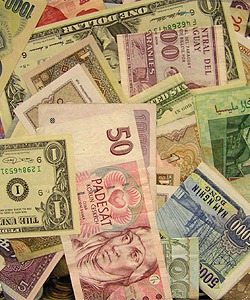
currency

The increasing drift toward a ‘currency war’ should worry just about everyone. And it is remarkable given that we already went through this in the 1930s – a collective disaster for all involved, and which everyone realized afterwards was a huge error. Yet here are on the cusp of another round of beggar-thy-neighbor devaluation rounds as everyone seeks to export their way out of the recession.

In case you don’t know the history, start here. Just about everyone learns this story in Econ 101, but here is the quick version: The Great Depression struck in 1929, and everyone panicked. In that sort of adverse environment, everyone starts to save. This is individually rational, as savings represent a hedge against suddenly increased uncertainty about the future. You see that same thing today in the US as Americans are suddenly saving again to pay off their housing and credit card debt in order to get financially sounder. Unfortunately, as people save, they are not spending, and their spending ultimately creates jobs. When you buy stuff at Walmart, a whole slew of people got their jobs to bring you whatever it is that you just bought. This is the well-known paradox of thrift: while it is rational for you the individual to save ask a hedge against the future, if everyone does that, then our collective future gets that much worse because all that missing consumer spending (demand) eventually creates unemployment (less need for supply). Again, this is what is happening today in the US. As Americans retrench on their spending very suddenly and sharply (household savings rates have jumped something like 5% in 24 months), you get a consequent drop in the need for supply. That in turn means you don’t need so many workers to make that supply anymore, so people get fired. US unemployment has therefore suddenly spiked as savings rates spiked.

One good way out of this recessionary trap (high savings –> high unemployment –> worsening economy –> even more fear about the future –> more savings) is to export to others. If others buy your stuff, then you keep all the employment (to supply the foreigners’ demand), but your own consumer can still continue to save. It is a tempting way out that squares the mathematical circle in which, in a closed economy, savings must equal unemployment. But with exports, you can have your cake and eat it too; ie, the economists’ expression ‘export your way out of a recession.’ Now, a good way to make your exports cheaper is for your currency to be cheap against other currencies. Then your stuff is cheaper for foreigners to buy. It is therefore tempting for governments in recession to intervene artificially in currency markets to keep their currencies cheap, indeed maybe even undervalued (China today). Because a cheaper currency means cheaper exports means a quicker route out of recession. And in the 1930s, everybody tried to do this. But just like the paradox of thrift, if everyone tries to cheapen their currency, then no one’s currency becomes cheaper, and very quickly you can get a cycle of government-forced exchange rate devaluations across the board as everyone tries to get a price advantage over everyone else. We call this ‘beggar-thy-neighbor.’

It is now universally acknowledged by just about everyone (except Marxists I suppose) that this was a disaster that lengthened the Great Depression considerably. This intellectual consensus lies behind the creation of the IMF, and the IMF museum (next to the lobby in the Fund building) walks the visitor through this in excellent detail.

And now we are doing it all over again.

So much for learning from history and all that…

This time it is mostly Asians to blame. China, SK, and Japan all intervene regularly (‘fine-tuning’ they call it in SK) to keep their currencies lower than the market would otherwise say. China of course is the worst, and it is leading to some genuinely desperate policy ideas on what to do.

This leads me to two conclusions. First, it is evidence that global governance (GG) continues to fail. The G-20 squabbling over exchange rates so perfectly fits what we know states shouldn’t do, yet they are doing it anyway. This – along with the astonishing, ‘I-don’t-give-a-damn-what-the-world-thinks’ Bush unilateralism – tells me that GG was a dream of the 1990s that is fading fast. Second it tells me that the only answer is cultural change in Asian attitudes toward imports. For decades, a trade surplus (and if necessary, an undervalued currency) were not just natural outcomes of market processes, but an explicit statist-developmental goal wrapped in nationalism. A trade surplus is a mark of national pride and success in the world, and if Asian consumers must be punished with high prices and higher savings to get it, then so be it. In Korea, I see this ‘imports-are-bad’ everyday; contrast that with the American love of cheap Chinese stuff at Walmart. Given that barrier to Asian rebalancing is a cultural one – getting Asians to accept imports without mercantilist-nationalist distaste – that rebalancing is likely to take a long time. Culture changes slowly.

US Embassy Security – Yikes!

P100614001

There has been a lot of discussion of the ramp-up of US embassy security since 9/11. Generally, the fear is that US embassies increasingly look like bunkers. They are being moved far away from downtowns. They are surrounded by loads of police, military, and barbed wire.

The Seoul one was quite an experience. I needed more passport pages, so off I went. It was frightening. There were multiple layers of security, blast doors, and US and Korean military and police with automatic weapons and body armor all over the place, including the SWAT tanks in my picture above. To boot, cell phones were confiscated, and there were the ubiquitous cameras. I imagine if I wrote more about it, they would be miffed over this post.

It was a depressing experience. I am with Thomas Friedman on this issue of US openness post-9/11. I think this stuff just sends a terrible image to the world about an open society gone loopy. 9/11 abetted the worst instincts of the national security state, and I fear we are moving down an Israeli path toward a barracks democracy with gates and locks all over the place. But this is not what open societies look like. Nor is it what we should want. Who wants barbed wire and cops with rifles at the mall? This is Bin Laden’s real victory – the installation of paranoia in the US. And I fear it will take decades to undo. The 1990s seems like such a paradise by comparison.

And I am not sure all this is necessary. The US has not in fact been targeted that much since 9/11. As John Mueller noted years ago, a lot of this has been overblown. I recall reading somewhere that you are more likely to be hit by lightning – twice – that killed in a terrorist incident. And what terrorism there has been has not been Bin Laden-style plots, but wacky rogues like the underwear bomber or the Fort Hood shooter. It is unlikely that all these walls could have stopped them.

Visiting our embassy was a genuine shock. It certainly didn’t look like America. It reminded me of those execrable gate-communities that fill California and subdivide people against themselves. This doesn’t look like homeland security. It looks like Israel, Pakistan or South Korea in the cold war – democracies under siege and paranoid. This is exactly the sort of freedom-reducing militarization the Founding Fathers warned about in instances of long wars and huge standing armies. This needs to be unwound sometime soon for the health of our democracy.

Ground Zero Mosque & Koran-Burning: the Xian Right Learns ID Politics

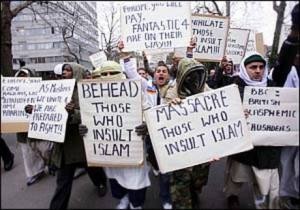
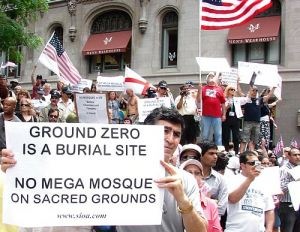
no_mosque_at_ground_zero_22 danish_cartoon_protest

Just about anyone with a website has already commented on this. There is no doubt the Christian right has responded as predictably and disturbingly as one might expect. I have only a few thoughts.

1. The Ground Zero ‘Mosque’ is probably a bridge too far at this point. In his fumbling way, I think Obama got it right. The community center should be permitted legally as an expression of religious freedom, but so many Americans, especially Christians, find it uncomfortable at minimum, terrifying at worst, that it is probably not a good idea at the moment. It is clear misstep in a country still trying to come to grips with 9/11, Iraq, the GWoT, etc. And the hysterical reaction from the US right over it should be an obvious red-flag to Islam generally that it desperately needs to conciliate the rest of the world rather than insist maximally on its rights – an obvious lesson that should have been learned in Europe, India, or after Durban II. To many Americans, Ground Zero is practically holy ground (rightly or wrongly), and it is indisputable that its perpetrators acted in Islam’s name. It is also clear that the US is spending a great deal of blood and treasure pushing back on radical Islam, and that many Americans want to see a pleasant, conciliatory face on Islam before they can swallow something like this. So long as global Islam’s image is dominated by this guy, Muslims in American should really be working bottom-up outreach, demonstrating on 9/11 in solidarity with the victims rather than openly testing the patience of the majority culture, by blaming it on a few bad apples and dismissing the rest of the discussion as islamophobia.

American Muslims need to pick their battles just like any minority; civil rights movements for blacks and homosexuals have showed us that Americans will accommodate. Acceptance will come, but not by pursuing CAIR-style grievance politics that sees racism everywhere. I think most Americans are still waiting for the debate inside Islam on what caused 9/11; this would really prove that Islam accepts pluralism in its heart, not just when some firestorm occurs on CNN. But you only get that from americanized Muslims like Foud Ajami or Fareed Zakaria who are effectively isolated from the discussion. It is outsiders like Olivier Roy, Bernard Lewis, R M Gerecht, Ann Applebaum, or  Christopher Caldwell who have really exposed the pathologies behind 9/11 with no clear response from folks like Tariq Ramadan or Feisal Abdul Rauf, much less the reactionary clerical elites in Iran, Saudi Arabia, etc. Instead, the critiques are just ignored, as were the Arab Human Development reports earlier this decade. Just like Germany had to examine the Holocaust eventually, Islam needs to look inside 9/11 for a good house-cleaning before westerners will really be comfortable. Consider this counterfactual: if CAIR had organized a ‘Solidarity with America’ march on 9/11 every year or some analogously Oprah-style outreach, then I can’t imagine anyone would care now. But instead of introspection and an admission that pathologies deeply rooted in Islam created 9/11, the response of the US Muslim community has been quiescence or CAIR-style identity politics. I criticize America’s Christian right paranoia regularly on this site, but it is also willful ignorance to pretend the US is not a Christian-majority country, and as the Koran-burners show, they have learned identity politics too. How ‘bout everyone cool it on the religion for awhile?

2. The Koran-burning is the revenge of identity politics on the left. They are loopy and dangerous, but they also teach you just how dangerous stoking identity politics is. And for this you must blame the Left in the end. Starting in 1970s, civil rights-era equality was out, and identity politics was in. Non-white minorities in America were trained in multiculturalism by US universities and told to press group-fashioned political claims built around race or gender. The result was political correctness, in which free speech was assailed as permitting ‘disrespect.’ And no concept is more abused by ethnic ideologues than ‘respect.’ What better way to embarrass and delegitimize your critics than to easily cast them as ignorantly disrespectful of your culture, which you can casually invoke by just your last name. If they are racist, then you hardly need to listen to them, a tactic first rolled out against Daniel Moynihan’s famous DoL report 45 years ago. ‘Respect’ is wonderfully indefinable and elastic, its lack implies racist, vulgar stupidity, and it provides an easy out from the hard criticism liberal free speech permits. Pretty quickly, Israel’s defenders learned this; there is no better way to discredit Israel critics than anti-semitism charges. And Islam learned this too at Durban II. Now at last, white Christian Americans are learning this language as well. Regularly assailed as redneck racists, the easy answer is to adopt the pose of the opponent and ‘discover’ prejudice in the liberal anti-Christian media, e.g. This is why Fox News has such a siege mentality tone to its reporting, like the ‘war’ on Christmas. Here is a nice summary of how religious groups get trained to frame their demands as ‘rights’ they deserve as ‘victims’ of never-ending ‘prejudice’,’ i.e., free speech. But to be fair to the US right, it only went down this route after the ‘ethnicization’ of left-wing politics in the US in the last three decades. And for that blame the explosion of ethnic identity studies on US campuses.

“Somebody’s Got To Stand Up to the Experts,” or Why US R&D Outsources to Asia

garden 

Now that I have worked in Asian education for awhile, one question I field again and again from Americans concerns why Asians seem to test so much better than non-Asian Americans. (How much better?: “an Asian American student must score a whopping 450 points higher on the combined math and verbal sections of the SAT to have the same chance of being admitted as an African American applicant.”) But the difficulties of Asian education – conformism, authoritarianism, rote-learning – are well-known and should close the gap, right? Increasingly, I think the culture in which the system is nested matters, and here too much of the US is downright wacky: Christian paranoia increasingly makes it hard for US teachers to do their job.

Nothing channels your standard issue, Bush-era Christianist lunacy like the title quotation from the 2010 Texas school board’s resistance to evolution in state textbooks: "somebody’s got to stand up to experts." Hah! That’s just classic: an educator saying, ‘Boy, all the readin’ and writin’ done wrecked yoh mind…’ Here’s the link. So we have an educator warning against too much education, insofar as deep education makes one an feared ‘expert’ in some area, like, oh, biology or physics. The irony of an educator declaiming ‘too much’ education is so rich, it would be comic if it weren’t so disturbing…

It’s the decline of western civilization here, folks. You wanna know why biotech jobs flee to Singapore and South Korea? You wanna know Asians outscore Americans time and again in science?

Well, if you treat science as an Islamo-liberal conspiracy to hide Obama’s Kenyan communist plot to impose evolution through Nazi-health care on God-fearing patriots rooted in the good earth of the heartland, then there you go. You think the Chinese or Indians are having science-stunting debates in which elected officials, not licensed experts, decide what ‘science’ is? They’d laugh you out of the room over here if you tried that.

Or how about the picture above, available here from the Creation ‘Museum’ in Kentucky? (Sorry, but  I had to put museum in quotes. I visited it last year – at $20 a ticket! – and it’s basically US Protestant creationism. They couldn’t even be ecumenical enough to include Catholics. What a hoot!) Anyway, the above pic is a recreation of the Garden of Eden. Find on the bottom, about one-third in from left, a penguin. Yes, I couldn’t believe that either when I first saw it in the museum, and it sure takes guts to even include the ‘Garden of Eden penguin’ in the museum’s advertising. Penguins were running around Mesopotamia 6000 years ago; it’s all about the ideology, baby!

If that doesn’t answer your question about US decline, I don’t know what will…

The World to the American Right: PLEASE TRAVEL!!!

 world-map

You have to feel bad for so many of the highest officials of the Bush years. Iraq, torture, Katrina, Rovism, etc.  permanently damaged some of the finest resumes in country, including Rice, Rumsfeld, Wolfowitz, and most especially Powell (who should have been the GOP prez instead of the boy-king). For some, like Powell, this is a genuine tragedy, a dirtying of his high reputation to serve coarse politicization. I admire Powell’s willingness to take his punishment and retreat from public life, and his rectitude in the face of Bush’s cold-blooded exploitation of his credibility highlights Rovism’s deviousness even more.

But that must be hard for so many…so what to do when you are an ex-Bush flack, once respected for quality pre-Bush work, but now a known defender/obfsucator of torture? How about writing cloying op-eds, sheltering yourself under the banner of military courage, while insulting the rest of the planet by reciting that most nationalistic, exceptionalist, and self-serving of Lincoln’s comments: ‘America is the last best hope of mankind.’ Mukasey could slide right into the hack neo-con universe of all-too-easy American exceptionalism that flatters rather than challenges the reader.

Like so many other Bush figures, Mukasey was a respected, serious operator. The temptation to reach for power must be so great, the belief that you could change things so high… but in the end, Rove-world corrupted so many of them. Consider that none of Bush’s national security officials have the reputation that Cyrus Vance does. Vance had the courage to resign out of conviction (regardless of one’s opinion of it), and this principled stand has served him well in history. I can’t imagine many Bush officials will enjoy this; speaking truth to power was never a virtue of the W years, and that sullied several, like Wolfowitz or Rice, who could have been truly historic public servants in a Powell administration.

How nice and easy it must be to write for the Wall Street Journal when the simplistic invocation of mawkish Americana plus a Bush-era vita get you op-ed space. I think the right-wing think-tank industrial complex has a machine that simply recombines expressions like ‘America,’ ‘amazing,’ ‘hero,’ ‘greatest,’ ‘unique,’ ‘freedom,’ etc. into ever-changing combinations of pro-American blather. It’s like the music-machines boy bands use, only with hawkish Americana the output instead of junk-pop. I used to read the Journal, because I thought it was a firewall against the populist nonsense of Hannity & co. I figured that the readership – presumably serious, money-making, educated broker-types – had little time for the flat-earthism of the Palin wing. You’d think a journal so insistent on the virtues of international trade would actually care more for the rest of the world than the populist GOP types…

I guess not.

I have said this before, but WILL US CONSERVATIVES PLEASE LIVE OUTSIDE THE US FOR A LITTLE WHILE BEFORE THEY TALK THIS WAY! You have no idea how insulting it is to the rest of the world, when America’s claim the mantle of World Historical Amazing Awesomess so easily and consign the rest of the planet to the ‘Old World.’ All that does it tell you how extreme American nationalism can become, and how little the writer knows about the world beyond the US. Pluralism is an American value too, and that means seeing the rest of the world as more than just a cipher for tired banalities of Americana. Please travel!!!!

A ‘Diabetic Peace’ and the Militarization of Obesity

untitled

So it’s come to this… God, we’re pathetic.

Two former chairmen of the US Joint Chiefs of Staff have now stated that US obesity constitutes a national security crisis, and that dietary changes are a matter of military necessity. This scares me in so many ways, I am not even sure where to start. But it’s also darkly hysterical…

1. If you needed confirmation that the US is sliding into decline, here you go. Last year, on return to the US after a long break, I remember being stunned at just how fat so many Americans were. I asked, “How can you lead when half your people struggle to get off the sofa?” That was meant partially in jest, but it turns out the Chiefs agree with me. How creepy is that? If you want to see US exceptionalism, maybe it’s in the fact that we are fattest hegemon in the history of the great powers! Hah! But maybe if we can open up more MacDonald’s in the BRICs (Brazil, Russia, India, China), we can enjoy a global DIABETIC PEACE in place of a Democratic Peace. When we’re all as big as this woman, why worry about war?

2. Militarizing issues is not a healthy way for democracies to grapple with social problems. It suggests that a our political system is so broken that even something as serious as 40% obesity in the US (with 70% total overweight) can’t spur meaningful political action by the elected civilian leadership. Instead we need militarization to add a sheen of both crisis – the US Right especially will listen whenever the officer corps says something – and legitimacy – our politicians may be impossibly idiotic, but our military is still a respected institution. Think about the signals that that sends about fixing other big problems in America’s future, like debt reduction, financial reform, immigration reform, our response to Asia’s rise? Do all these problems need to be militarized before we will move on them? Must it always be a man in uniform who kicks us into action and shames politicians into compromise?

3. It is not good at all for liberalism and democracy that the military creep into increasing areas of domestic life, like diet and nutrition. This is not really the military’s fault. Although Rumsfeld was a genuine empire-builder, Gates has tried hard to reduce the sprawl. But frequently deficient public and private actors want to dump problems on the military, because it seems so efficient and commands such respect. Consider that Bush said after Katrina that the military will be used more in national disasters and that BP wants to buck the oil spill clean-up to the military. Do we want military-style regimentation of these sorts of non-military issues? Do we really want generals telling parents about food choices? But…

4. Are we really this lame and sallow and lazy, that we need our generals to tell us to control ourselves in this most basic manner of adulthood? And you wonder why rising Asia thinks Americans are ridiculous and childish. We can’t control our budget, we can’t even control our diet. Embarrassing…

More on Asian Multiculturalism: 5 Masters Theses to be Written

rman6645l 


If you don’t know anything about this topic, start here.  This is outside my normal area of interest – foreign relations – but I double majored in political theory in grad school, and PNU just had this big multiculturalism (MC)conference, so its on my mind. On MC specifically in Korea, my previous thoughts are here and here.

1. Northeast Asians (NEA – Chinese, Koreans, Japanese) strike me as quite nationalistic, and nationalism up here is still tied up in right-Hegelian, 19th century notions of blood and soil. In China, the Han race is the focus of the government’s newfound, post-communist nationalism. In Korea, it is only the racial unity of minjeok that has helped keep Korea independent all these centuries. In Japan, the Yamato race is so important that even ethnic Koreans living there for generations can’t get citizenship and there’s no immigration despite a contracting population. MC in NEA faces huge political opposition that the already existing multiculturalism of South and Southeast Asia (SEA) don’t face.

2. SEA is where the real action is on this question, and it is not all clear to me that it has been really successful. In the discussion of last week’s conference, I warned the other participants to look at the ethnic conflict that can come from multiculturalism – Malaysia, Indonesia, the Philippines. Japan saw this and decided to risk a general social decline from ageing and low births, rather than to chance renewal through immigration, because it might lead to ethnic conflict. Really successful MC is rare outside the 4 classic immigration countries (US, Canada, Australia, NZ), and SEA’s MC is more often associated with separatism and ethnic violence than with growth and social harmony.

3. I wonder sometimes how much MC is just an academic fad that Asian countries are mimicking, because they feel like it shows how modern they are if they worry about the same things that western intellectuals and societies do. I have a very deep suspicion that emulation from a desire for foreign respect plays a big role, because the central foreign policy goal for Asian elites is to be accepted by Western elites as equals. In order to be equals, they have to look like and act like equals. As the post-modernists would say, equality with the West will be created by performing as the West does. So Asian mimicry of the MC discourse of western political has nothing to do with functional utility of MC in Asia, and everything to do with capturing respect by acting as already respected  actors do. Besides the cloned MC discourse in Asia, here are two other examples of this emulation phenomenon:

3.a. Western clothes and music, for example, carry much of their cachet in Asia, because they signal modernity in cultures with long, old, highly conservative patriarchal traditions: in the New York and LA Asians see on TV, white people wear designer clothes and go to clubs (think Sex and the City or Friends). Hence if Asians do that too, they are also modern.

3.b. The Asian regionalism discourse in Asian IR is wholly abjured from the empirical reality of persistent Asian nationalism and talk-shop regional organizations. Asian organizations are many but shallow; they don’t actually integrate their members. Yet Asian elites talk about the integration of Asia, even though there is really no evidence for that. ASEAN is 2/3 the age of the EU, but has done maybe 10% of the integration work that the EU has done. Instead, the real explanation for the Asian regionalism discourse in Asian IR is mimicry out a desire to look modern: if the Europeans are regionalizing, and they keep telling us about it, then this is an important ‘modern’ or ‘civilized’ discourse we need to elaborate too, even if it is wholly fanciful and unempirical. (The same thing happened in Africa; the African Union cloned the EU explicitly to make Africa look more like European and hence ‘modern’ or ‘civilized.’ But like Asian regionalism, the AU has gone nowhere, because African citizens don’t actually want it.)

4. I am not convinced that Asians, especially in NEA, really want this. NEA states are in an interesting pre-MC position. That is, Japan, Korea and China (less so) have essentially ethnically homogenous populations that feel that they are a unique people represented by their own national states. MC, by contrast, assumes a universal-generic, non-ethnic state which umpires among different cultures doing their own thing; Canada is the best model of this. So a good question is whether NE Asians want that. The academic discourse may say they should (otherwise they are racist), or that it will happen whether they want it to or not. But that is scholasticism and elitist arrogance. There is a critical democratic choice question that MC routinely avoids in claiming, simply, that MC is inevitable. The better question is whether citizens want their countries to multiculturalize. And I think the answer to that is pretty obviously ‘no’ in most places. I dare say most French would – if offered the choice strictly on its own merits – prefer a France without its Muslim population; Americans would likely say the same thing about the illegal Hispanic population. Hence for ‘pure’ Asian states, the question is whether their demos actually want to open the doors when so many other countries have come to regret it.

5. The big difference between the US debate on immigration and the of Asia (and Europe) is over legality. The US shows its far greater willingness to multiculturalize insofar as it willingly accepts lots of legal immigrants ever year. It strikes me as amazing that resistance to illegal immigration would be read as racism, but that is how far along the US is on the MC route. By contrast Asians are still debating the value of legal immigration. Illegal immigration is not tolerated and punished swiftly with uncontroversial, widely-accepted deportation.

AZ’s Immigration Law is Only ‘Harsh’ if You’ve Never Lived Abroad

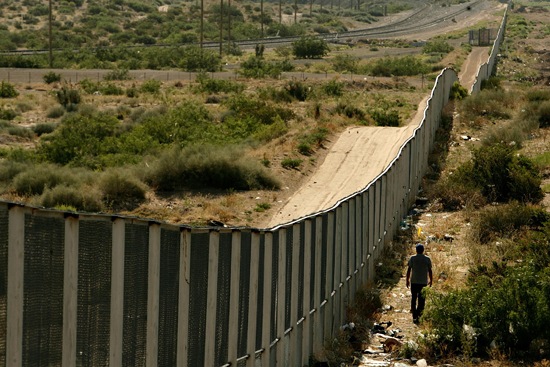
74863546CS061_Would_Be_Immi

Last week’s big PNU conference on multiculturalism in Korea got me thinking about the new Arizona immigration law that allows police to demand valid identity paper on reasonable suspicion.

As with so many other debates in the US, the new one on Arizona’s ‘racist’ immigration law is ridiculously uniformed by practice in other places. Usually this iconic American ignorance of the rest of the world rebounds to the disadvantage of the US Right. Conservatives, absolutely bedazzled by American exceptionalism, refuse to see how Bushism alienated the world and forced Americans travelling to say they were from Canada. But on illegal immigration, it is really the US Left that is benighted, willfully refusing to see the rule of law problem of 10-20 million undocumented people running about. For example, Chait will tell you how your concern for about unlawful migration is really just racism. How cynically, smugly condescending of the race-obsessed American Left to share its moralism with you racists thinking about law and documentation.

I have lived in other countries for 6 years and counting (about 1/6 of my life), and I simply accept it as routine that I can be stopped by the police and demanded for ID. In Germany, I had to have my ID card at all times; in Russia, I had to carry my passport at all times (rather risky, that). In Korea, I must carry my alien ID card at all times too. I do, and I certainly don’t howl and complain about it. I get asked for it, as well as a copy of my visa, all the time – in hospitals, on the internet, by government officials, cops, etc. Since when did non-citizens carrying proper ID become ‘racist tyranny’? Do US liberals really believe that? Do we really want 15 million illegals running around the US without documentation?

I went through the legal immigration process; let them do it too. Yes, it is a pain. Yes, I pay the Korean government a lot of money for some silly stamps, and I wait forever in some stuffy room for a bored bureaucrat to glare at me. But it’s not ‘orwellian racial profiling.’ Come on already. You’re a guest in someone else’s house. You know the rules are going to be a little tougher. And you should accept that, because you choose to go there. That is their system. You must respect it; you can always leave.

Ultimately, immigrants are guests, and it is our responsibility to follow our hosts’ rules. If you don’t like those rules you – a guest – don’t have the moral standing to criticize. We immigrants take what the residents dish out. It’s their system to set, not ours. And it is extraordinary bad faith to name-call our hosts racists. That is offensive to very people we want to allow us in the door. It’s both stupid and rude.

If you think the US rules are burdensome or racist, try living in Asia or Europe! Dual citizenship is nearly impossible. The Korean government makes me renew my visa every year – even though I am long-term employed resident foreigner with property, education, and all that. They make money off the foreigner population by requiring annual visa renewals, but it is also a way to check up on us that we aren’t screwing around too much.

So where in god’s name did ILLEGAL immigrants in the US get the gumption to expect they shouldn’t have to demonstrate who they are to the lawful authorities? If anything the moral posture should be reversed. Illegal immigrants should bend over backward in thankfulness that Americans are so tolerant they even look the other way on rampant illegality. If I were a publicly known illegal immigrant in SK, I would last about 5 minutes before being shoved onto a plane. If that constitutes ‘racism’ and a ‘police state,’ then you can understand why the Tea Party movement hates the government. By law the government is supposed to deport illegal immigrants. Illegal immigration is a misdemeanor, and repeated attempts are a felony. Yet 15 million people function everyday outside the basic rule of law. That is not ‘victory against racism;’ it is a massive failure of the US justice system.

The heart of the US Left’s critique of Bush – which I accept – is that he violated the rule of law with torture. But that means the Left, and America’s Hispanics, must acknowledge the same on this question. If you want different immigration laws, then change them through the policy process. But the current regime of ‘purposive unenforcement’ is incompatible with political order.

I shudder to say it, but the US Right is correct on this one.

Illiberal Zionism Update: Beinart Nails It

images


Peter Beinart is exactly the sort of liberal necessary to win the GWoT. He correctly realized that the American right is not credible in its claims to defend Western liberalism against salafi illiberalism, because too much of the GOP base is too illiberal now and sees the GWoT exactly as Bin Laden does – a theological clash of civilizations – only they are on the other side. The increasingly Christianized and fundamentalist (Protestant mostly) GOP wants to ‘win’ the GWoT as a triumph of Christianity and/or American power. They are, as Walter Russell Mead correctly notes, ‘Jacksonian Zionist,’ not liberal. No Muslim, correctly, will believe US power to be neutral, serving universalist liberalism, when Bush needed to be told that the GWoT had biblical justification and Sarah Palin insists that Israel be allowed to do whatever it wants in the Occupied Territories.

In the same vein, he makes a good case here for the growing illiberalism of Zionism and the increasing inability of liberal countries to support its religio-nationalist, rather than liberal, opposition to Islamism and Arab authoritarianism. I made exactly the same point a year ago. (It is always nice to be confirmed in one’s prejudices I suppose, but Beinart does a better job of it than I did.) Sullivan adds his usually biting and gloomy commentary.

All sides seem to be sliding toward a clash of civilizations paradigm. All the more reason for the US to focus on the battle of ideas against salafism and get out of the Middle East in the medium-term

PNU Multiculturalism Conference: How ‘MC’ is Korea Really? (Not Much)

New Image

Multiculturalism is growing issue in Korean life because of Korea’s severe demographic slow-down and aging. I have written about this before here. The following is my discussant response to a paper on the confused Korean administrative response to Korea’s growing non-citizen population. Multiculturalism is growth area in Asian studies; there is a good dissertation here waiting to be written. Email me if you want the paper on which this post is based. The conference is today.


“This paper provides a valuable first overview of the emerging Korean policy response to the oft-declaimed ‘multiculturalization’ of Korea. Chung provides an impact assessment of various policy tools with which the Korean government is experimenting. She finds that Korea is increasingly treating its foreign population as a resource to be cultivated and exploited through outreach, where in the past the Republic of Korea Government (ROKG) viewed the foreign population more as a burden or necessary evil to be managed. In the jargon of public administration, this is her identified switch from policy instruments stressing ‘negative coercion’ to ‘affirmative non-coercion.’ She also notes the ‘experimentation,’ if not disorganization and bureaucratic turf-conflicts, that characterize the administrative response. I have four comments.


1. Organizational Theory: Bureaucratic Failure

The experimentation and gradual drift of the ROKG toward more positive interaction with the resident foreigner population strikes me as typical bureaucratic behavior in response to new and awkward issues. An organization’s first, pathological response is to punish and sanction what it does not understand. Only as anomalies and policy failures accumulate are new methods tried. In the language of social science theory, Chung has uncovered classic institutional behavior, and I think a future version of this paper would benefit from some comparison of Korea with other, traditionally non-immigration states’ public policies on multiculturalism (MC). Japan would be a fine East Asian example, particular as the contrast would be quite stark. Japan remains in Chung’s first stage of sanction and punishment; ethnic Koreans, e.g., despite decades of residence in Japan, are excluded from Japanese citizenship. Japan has clearly rejected multiculturalization in the last generation, even as its demographic crisis accelerated into absolute population contraction in the last few years.


2. Non-Korean Multiculturalism Experience: Unused Western theory

I wish Korean MC theory would more clearly use the pre-existing Western theory and policy experience. My sense of the media debate and policy response in Korea is that Koreans see this as some radically new issue. And Chung’s work clearly demonstrates the organizational and policy ad hocery and confusion of the last decade. But obviously this debate is not new in the classic immigrant countries – the US, Canada, NZ, and Australia. And European countries face the same dilemma Korea does: they have a strong national sense of distinction and find the ethno-religious pluralism of sustained immigration a major social challenge. So there is a lot of experience out there among Korea’s OECD peers that I think is not being utilized.


3. Low Empirical Multiculturalization of Korea

I believe we can explain Korea’s generally disorganized response – regardless of its improving intentions – because the issue of multiculturalization is not, in fact, as pressing as is made out to be in the Korean media. In a population of 50.2 M, only 1.14 M are not Korean citizens. Of those 1.14 M foreigners are 400k ethnic Korean ‘returnees’ and 100k USFK soldiers and affiliates who live in artificially Americanized and short-term circumstances. In short, the ethnically distinct population of long-term resident foreigners is only about 600k. That is awfully small number. And how many of them actually intend to stay and settle in Korea? Very few I imagine. There are of course issues of racism in Korea, and Koreans remain deeply attached the romantic-organic notion of the minjeok that makes it tough for long-term resident foreigners to join the community. But still, as a public policy issue, Chung’s finding of experimentation and ad hocery should not surprise us given the statistical tininess of the cohort examined.


4. Korean Democratic Consensus for Multiculturalism?

There is a democratic theory problem in the discussion of Korean multiculturalism that I believe is frequently overlooked. It is not clear at all to me that Korea wants to be ‘multiculturalized.’ Before we engage in the normatively self-congratulatory discourse of Korean’s imminent multiculturalization, we should discern whether the median Korean voter actually want this. To be honest, I am not sure. My sense is that Koreans have a strong sense that they have suffered from invasion and turbulence so often in their national history, that they very much want this tiny sliver of land in the world to be theirs and manifestly culturally Korean. At the very least, the multiculturalization of Korea, whether in social science theory or public administration, should proceed on the basis of a deep democratic consensus for this change. I would like to see far more polling data that substantiates that a durable majority of Koreans do in fact want the major socio-cultural shift implied by sustained immigration. Japan again is a good Asian counterfactual. Its citizenry reject MC, even though the demographic argument for immigration is quite strong.

Part 2 is here.