My Latest for Foreign Policy, Un-Paywalled: Israel’s Air Campaign against Iran is Exactly why N Korea Built Nukes and won’t Give Them Up

ec0ac160-4929-11f0-bbaa-4bc03e0665b7This is the un-paywalled version of an essay I wrote for Foreign Policy on Monday.

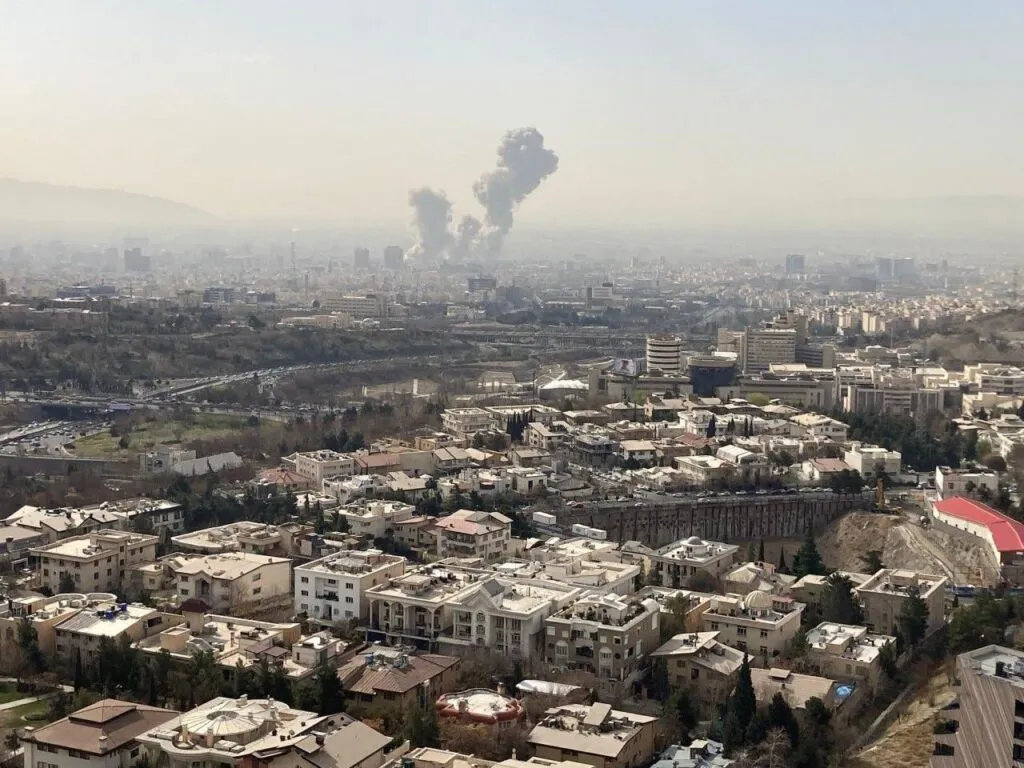
Israel’s preventive disarming strike on Iran last month is a model of what the US and South Korea would do to North Korea – either as a ‘bloody nose’ strike, or in the opening days of a second Korean war. Deterring that from happening is why North Korea built nuclear weapons.

And now that we have helped Israel in the attack – after reneging on our 2015 deal with Iran – North Korea will never denuclearize. That is the very obvious lesson for NK to draw from Israel’s war of choice. This is the core point I make in my FP essay. In fact, NK probably won’t even negotiate arms control with us now. Instead Pyongyang will likely build up even more – convinced that if Iran, Iraq, and Libya had nukes, they never would have been attacked by Western power, which is almost certainly true.

The repeated use of Western power against non-nuclear rogue states – Iran, Iraq, Libya, Syria, Serbia, and, sort of, Cuba & Venezuela – signals to illiberal and anti-western countries that nuking up is your best defense. That we broke our word to Libya in 2011 and, especially, Iran in 2018 reinforces that signal.

Trump particularly deserves blame here. Kaddafi was already in trouble in 2011 when Obama reneged on 2003 nuclear deal, and Kaddafi was promising an enormous bloodbath in Benghazi if we did not intervene. By contrast, the Iran deal of 2015 was working when Trump pulled out of it for no substantive reason. (He did it to please the GWoT hawks and End Times-craving evangelicals in his coalition.) That sent a huge signal to anti-western countries everywhere: the US will not negotiate with you in good faith on nukes; secretly sprinting for nukes is the best way to get security.

No one learned this lesson better than NK. For decades Pyongyang disbelieved our security assurances and pushed relentlessly for nukes. Nukes, as I write in the FP essay, are a ‘unique shield.’ Nothing can replace their deterrent power – certainly not a deal with the US which MAGA will just dump when it is convenient. So now, we should prepare for a world where other nuclear-curious rogues sprint for NWs too.

The full essay follows the jump:

Continue reading

Original Version of My Foreign Affairs Essay on South Korean Nuclearization: America’s Response to Nuclear Risk in the Ukraine War Tells Us a Lot about its Likely Response in a Second Korean War

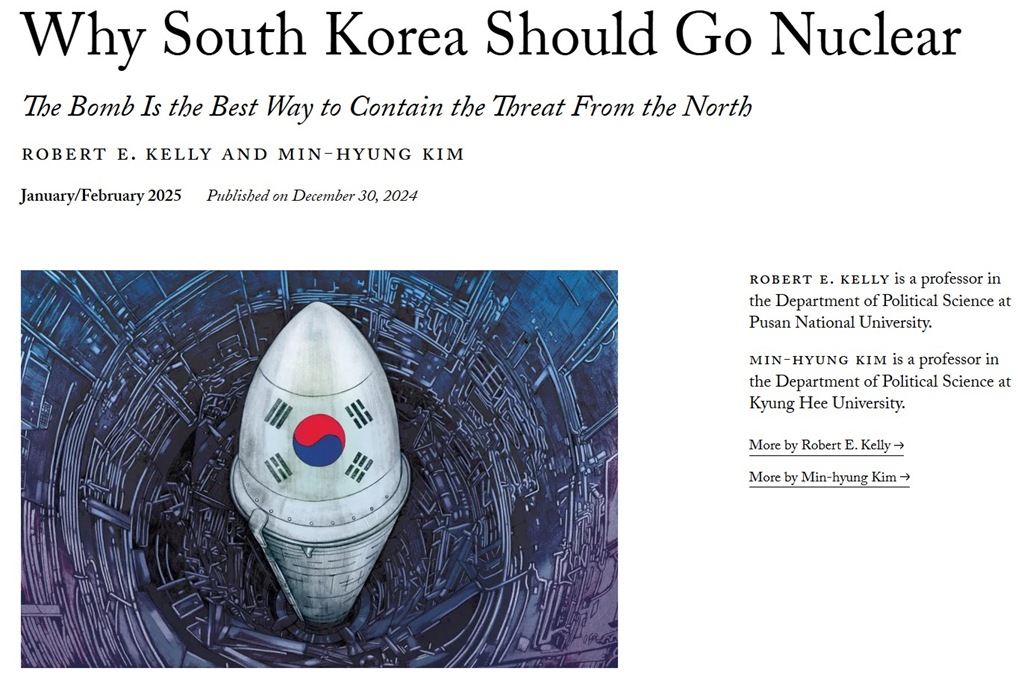
Screenshot 2025-01-11 134514This post is the original version of an article I published this month in Foreign Affairs on potential South Korean nuclearization with my friend Kim Min-Hyung. I think the editing made the essay more readable, but some topics I wanted to elaborate got edited out.

Specifically, US hesitation against fully and robustly supporting Ukraine against Russia – because of Russia’s nuclear threats – is a model for what will happen to South Korea in a second Korean war, especially when Trump is POTUS.

We have known for years that the Biden administration has repeatedly held back on aid, discouraged certain Ukrainian military actions, balked at giving certain weapons systems, and so on for fear of Russian nuclear ‘red lines.’ Here is yet another example from the last few days. Apparently, the Biden team got Russia out of an even bigger defeat around Kherson in 2022 for fear of a Russian nuclear response. Russia’s nuclear threats have worked well, and they aren’t even as credible as North Korea’s!

A lot people think the Russians are just bluffing, but the Biden team has been super cautious anyway. So in a Korean contingency, where NK nuclear threats are even more credible, our behavior in Ukraine suggests we will respond even more cautiously. Our Ukraine behavior strongly suggests we will slowroll aid to SK and try to avoid full involvement for fear of nuclear escalation.

NK nuclear escalation threats are more credible than Russia’s or China’s, because NK is far more vulnerable to collapse after just a single significant conventional defeat than they are. NK’s military is conventionally obsolete; NK lacks strategic depth; its economy is a shambles; its state is sclerotic and shallow. One big defeat at the DMZ, and it’s all over for NK and the Kims who will be lynched by their own people. Russia by contrast does not face regime collapse and an existential leadership crisis if it loses badly conventionally in Ukraine; nor does China face immediate implosion if it loses in a war over Taiwan. But NK and its ruling family do face immediate existential risk if they lose even one battle at the DMZ. So NK has to threaten nuclear use immediately, and it has to use those weapons if its bluff is called. It can’t issue vague, maybe-sorta threats like Putin has for the last 3 years.

So if Russian not-so-credible threat have successfully gotten the US and NATO to slow-roll aid to Ukraine, imagine how much more successful they will be in Korea where NK’s nuclear threats are far more credible because nuclear escalation is its only chance to survive?

If NK will go nuclear almost certainly, will the US risk nuclear strikes on US targets for a distant, medium-sized ally of mid-range importance to US national security? Probably not  because that also describes Ukraine. Like SK, Ukraine is an exposed, mid-sized ally of middling importance to US security under direct nuclear threat. In both cases, a victory by the US partner would be good, but its loss would not be a huge loss for the US either. It would be more important for regional locals. Specifically, SK’s defeat/destruction by NK (or China) is more important to Japan, India, and Australia than to the US, just as Ukraine’s is more important to Europe than to the US.

Now, you say that SK is a treaty ally of the US, but Ukraine is not. So the US will be willing to risk nuclear war for SK, but not for Ukraine. I find this fantastical thinking. US alliance commitments are credible in conventional scenarios in Korea, but would they really be in a contingency where NK would launch a nuclear weapon against Guam, Hawaii, or even CONUS? Are alliance commitments automatic in nuclear escalation scenarios? I doubt that. De Gaulle realized this point 65 years ago. Maybe Biden would act on the US alliance commitment to SK despite high nuclear risk, but Trump very obviously won’t. In fact, I doubt Trump would even fight conventionally for SK.

Then you object that SK is not a mid-sized partner like Ukraine which could be lost, but a major ally because we need it against China. This would be so if SKs wanted to come with us on great power competition with China. But they don’t, especially not the SK left which is about to take the presidency when impeached conservative president Yoon is removed in the next few months.

So if you don’t think the US is going to risk highly like nuclear escalation for you; and you face a frightening nuclear opponent who routinely threatens you with nuclear devastation; and your alliance patron is about to be governed by an irresponsible, autocrat-admiring con-man, what should you do?

If you think about potential SK nuclearization that way, it’s not too hard to figure out why SK opinion tilts towards nukes.

The original, pre-edited version of my essay follows the jump:

Continue reading

No, Donald Trump is Not a Realist or China Hawk; He’s Too Ill-Disciplined for That: The Full Version of My Trump Essay for Foreign Policy

AP-putin-trump-handshake-g20-jef-170710_16x9_1600Trump is too lazy, ill-disciplined, and venal to be the ‘thinker’ or strategist realist and China-first hawks keep trying to make him out to be. This post is the longer and pre-edited version of an essay I just wrote for Foreign Policy magazine.

In fact, I am amazed anyone thinks Trump has the discipline to do this. Are you not watching the same Trump – erratic, confused, chaotic – the rest of us are? Trump is far more likely to simply sell US foreign policy to the highest bidder if he becomes president. He loves money and adulation. The Chinese and the Russians are more than happy to throw that at him to get him to bend on their interests.

We keep hearing that Trump will prioritize China and Taiwan over Europe and Ukraine, but listen to what he says about Taiwan and China. He doesn’t sound a realist at all. He dislikes Taiwan for protectionist and free-riding reasons, and he clearly admires Xi Jinping’s autocracy.

The best predictor for Trump’s second term is what he did in the first term, and that was a confused mess. He dislikes Ukraine – and will surrender it to Russia – because Zelenskyy wouldn’t help him cheat in the 2020, not because of a strategic re-prioritization toward Asia.

Maybe realists will get their wished-for realignment or re-prioritization out of Trump’s staff. Perhaps Elbridge Colby will push that through. But it’s hard to imagine a major foreign policy realignment without POTUS’ consent, if not participation. And Trump just isn’t focused enough. Worse, Trump has a tendency to staff himself with clowns. Your more likely to get incompetence out of a Trump second term than anything.

The full, unedited FP essay is below the jump. Continue reading

The Pro-Russian Bloc in the West is Looking for Any Excuse to End Ukraine Aid. Ukraine should Not Strike Russia

UKRAINE-CRISIS/MISSILES-ATTACKSUkrainian strikes on Russia proper jeopardize the rickety pro-Ukraine aid coalition in the West. Ukraine shouldn’t do this. It is too risky.

I just wrote on this topic for 1945.com.

There are many reasons to strike Russia directly, which Eliot Cohen helpfully develops here:

– Morally, it is fair because Russia has been terror bombing Ukrainian cities for more than a year. This mild Ukrainian response is far below law-of-war proportionality norms.

– Psychologically, bringing the war home to Russians confronts them with the costs of the war and may encourage them to re-consider it.

– Militarily, forcing Russia to spread its defenses helps thin out its forces on the front lines in Ukraine.

Despite all the reasons to hit Russia at home, the political risks in the West to Ukraine are too high. Yes, that is unfair. It is ridiculous that Russia gets to bomb Ukrainian cities, but if Ukraine does the same, it is suddenly a massive escalation. But it is important to remember that the Western hard right and hard left are looking for any excuse to halt aid to Ukraine. These people have variously claimed that we should support Ukraine because it would lead to a nuclear wear, Ukraine could not win anyway, it just prolongs the war, Europeans will freeze without Russian winter gas, the cost is huge, and so on.

There is no consistent or principled argumentation about the war from the pro-Putin Western bloc. What they really want is a Russian victory for ideological reasons. They can’t say that outright, so they keep jumpingn from one rationale to another which would justify an aid cut-off aid. The right admires Putin’s reactionary, anti-woke authoritarianism; the left is hung up on US imperialism. They crave a Russian victory, so they will say anything to claim Ukraine aid is a mistake. Ukrainian strikes inside Russia are precisely the sort of card they will play – it is ‘escalation.’

Ukraine can’t win without Western assistance. The political-strategic risks – to invaluable Western military assistance – outweigh an operational gains of these strike. That sucks, but Trump, Marjorie Taylor Green, the NatCons, the anti-imperial lefties are all looking for any excuse to end aid. Ukraine should do its best to fight in way which gives them no ammunition to press their claims

My full essay on this at 1945.com is here.

My Extended Comments on Potential South Korean/Japanese Nuclearization for the Asian Leadership Conference and Foreign Policy Magazine

imageI spoke at the Asian Leadership Conference in Seoul a few weeks ago on S Korean/Japanese indigenous nuclearization and then published my basic thinking with Foreign Policy magazine on the topic a few days later.

Both of the venues required a more abbreviated presentation for time/space constraints, so I thought I would put up my full remarks here, at my own site. Here is the 2022 ALC site, and here is my original article for FP.

In brief, my argument is that the US should get out of the way to let Seoul and Tokyo make up their own mind. The US has long opposed ROK/Jpn nuclearization, but increasingly that strikes me as inappropriately hegemonic or strong-arming of them. There is a pretty strong case for SK and Japan to counter-nuclearize against China, Russia, and especially NK. I sketch that in detail after the jump, but the short version is:

1. The US is not going to exchange LA for Seoul/Tokyo. In 1961, de Gaulle asked JFK would he exchange NY for Paris. JFK waffled; de Gaulle was no idiot; he built French nukes shortly afterwards. The logic is the same here. The US is not going to fight a nuclear war solely for non-Americans. This will raise endless, irresolvable credibility debates between the US and its Asian allies. The best way to resolve that is to do what our European allies did – self-insure through indigenous nuclearization.

2. Trump will likely get elected – or ‘elected’ – in 2024, and he will ‘blow up’ the ROK alliance as he promised he would. So ROK nuclearization may happen no matter what we think. And a US retrenchment from SK would probably scare Japan so much that the whole nuclear debate there would shift substantially to the right.

There is a lot of anxiety about this step, and I share it too. So I don’t endorse SK/J nuclearization. But there is SK polling showing high interest in this, and SK is terribly exposed to NK nuclear devastation with few good options as the NKs continue to build relentlessly. (All this I cover below.) So the least we Americans can do is get out of the way and let them debate it themselves.

The original, pre-edited FP essay on this follows below the jump:

Continue reading

US Foreign Policy Restraint Does Not Mean Abandoning Ukraine, per Kissinger (nor Taiwan); Proxy Wars are Not Direct Wars

M1A2 Live-FirePursuing a restrained US foreign policy is compatible with helping Ukraine, because restraint still takes threats seriously and Putin is pretty obviously one.

This is a re-post of an essay I just wrote for 1945.com.

I am pretty shocked at how quickly Western opinion gravitated toward abandoning Ukraine just because gas prices and inflation went up.Good grief, people. Ukraine is getting taken apart piece by piece by a quasi-fascist aggressor deploying something like death squads behind the lines, and we can’t tolerate some minor lifestyle pain? Are we seriously that decadent?

More broadly, everybody knows the US needs to follow a more restrained foreign policy. I supported the Afghan withdrawal, even as people we losing their mind that is meant the end of the Western alliance. Helping Ukraine as a proxy does not violate that.

And Kissinger’s schtick that we should arm-twist the victim of the war into giving up tells you more about how Kissinger’s creepy fascination with power and might than it does about US or Western interests. (It’s the same reason he’s been sucking up to China under Xi.)

The war is breaking Russia’s claim to be a great power; we don’t need to treat Putin like he has some realist ‘right’ to stomp on his neighbors. And its pretty clear that Putin is a threat. He’s built a quasi-fascist regime at home and his meddled in his neighbors’ sovereignty for decades. Aren’t we supposed to balance power and threat, not fetishize it?

So yes, the US itself should not march into more quagmires. And yes, the US should not be directly militarily involved in Ukraine. But it is a proxy war pretty obviously in Western national interest, because Putin is pretty obviously a threat. And don’t wave Putin’s nukes around in bad faith. He’s not going to go nuclear against the West, nor does he anticipate a war with the West. If he did, he wouldn’t be allowing his army to be ground up just to take the Donbas. This nuclear scare-mongering is just deflection by pro-Russian MAGA pundits like Rod Dreher, Michael Tracey, or Tucker Carlson to undercut Ukraine, whom they want to lose.

Here is that 1945.com essay:

As the war on terror went off the rails in the last two decades, calls for the US to show greater restraint in its foreign policy grew. One hears such language regularly now from both US political parties. Crucially however, greater caution in US foreign policy need not translate into abandoning Ukraine to be slowly taken apart by Russia. Greater ‘realism’ in US – and Western – foreign policy is not the same thing as cynicism. There is a clear prudential case for helping Ukraine.

Greater Restraint

By now the case for greater restraint in US foreign policy is well understood. After the collapse of the Soviet Union, the United States emerged as the sole superpower, far ahead of any potential rivals. While the administration of President Bill Clinton did not fully grasp just how distinct the US had become, the next administration of President George W. Bush did. And in the wake of the 9/11 terror strike, it launched a massive effort to re-make the Middle East, something only a state with the extraordinary leverage the US had would even contemplate. This led to exorbitant claims fifteen years ago that the US was an ‘empire.’

Read the rest here.

Support for Ukraine is Not ‘Pro-War’, because Some Things, like Sovereignty and Freedom, are More Important than Peace

Sniper RifleCalling Western support for Ukraine ‘pro-war’ is grossly manipulative and deceptive with its implication that Western elites ‘like’ war. That is obviously not the case. Does Ursula von der Leyen strike anyone as ‘pro-war’? Gimme a break.

The following is a re-post of an essay I wrote for 1945.com.

The most nauseating part of the Ukraine war in the West has been the pro-Kremlin ‘anti-war’ set – Tucker Carlson, Tulsi Gabbard, Glenn Greenwald, Michael Brendan Daugherty, and so on. To be ‘anti-anti-Putin’, at this point, is to be effectively pro-Putin and pro-fascist, just as being anti-anti-Trump at this point basically means your MAGA. You’d think the left would not go to the lengths of supporting Russian fascism in order to oppose US imperialism, but that’s where Michael Tracey, who denies the Bucha massacre, has landed.

The usual anti-imperial leftist tropes are meaningless here: Ukraine is not Iraq; this is not a US foreign policy issue; the military-industrial complex is not profiteering off the war; Hillary Clinton, the CIA, Goldman Sachs, the IMF, Davos, and all your favorite neoliberal shills are just irrelevant. Putin has built a semi-fascist regime at home, launched an aggressive war against a weak, democratic neighbor, and tolerated, if not endorsed, war crimes. That’s what matters, not relitigating the American empire debate of 20 years ago.

It is ironic that the anti-imperialist left, which wants to bemoan American empire, makes the same Amero-centric error as the neocons they hate so much: both read US choices as the only thing that matters in world politics. Foreigners have no agency; the Ukraine war is apparently about the US, not Ukraine and Russia. So the war in Ukraine becomes about NATO expansion rather than Putin’s own bluntly stated explanation that it’s because Ukraine is a fake country and really part of Russia. Good grief.

Here is that essay for 1945.com:

“Western Support for Ukraine is Not ‘Pro-War’” – Since the start of the Russian invasion of Ukraine, a small but vocal clutch of Twitter and television personalities have argued that Western support for Ukrainian resistance is ‘pro-war,’ a worsening of the conflict via the provision of aid which prolongs the fighting. This posture might be best described as ‘anti-anti-Putin.’ That is, these voices read Western dislike for Russian President Vladimir Putin since February as overwrought and exaggerated, thereby deepening the war.

To critics, this position is nearly indistinguishable from a pro-Kremlin posture that refuses to admit Putin’s apparent agency in launching the war.

The most prominent voices in the group are Tucker Carlson, the highly-rated Fox News host, and his frequent guest Glenn Greenwald. Others include former Congresswoman Tulsi Gabbard, and Substack gadflies Michael Tracey, Michael Brendon Dougherty, and Matt Taibbi. All seem to suggest that the West should cut off aid to Ukraine, on the premise that the war would end sooner.

Please read the rest here.

Putin is now a Fascist, Imperialist War Criminal. He Himself – his Continuance in Office – is now the Biggest Issue in Any Ukraine Peace Negotiations

Tanks Belarus PutinThe death squad war crimes in Ukraine now mean that Putin himself is the biggest obstacle to a peace deal. He won’t agree to leave power, but with him still office, neither Ukraine nor the West is likely to accept the full re-normalization of Russia, by which I mean the rollback of the war sanctions and the re-entry of Russia into normal diplomatic intercourse with West.

This post is based on an op-ed I wrote at 1945.com.

Just as the Kaiser had to abdicate in Germany after WWI, and the Japanese military junta had to step aside after WWII, so will there be enormous pressure to insist on regime change as part of a sanctions relief deal. Biden already blurted this out last week, and now, after the revelation of the war crimes, it is almost impossible to imagine the West interacting with Russia normally again while Putin is still in charge.

Putin is a fascist, imperialist war criminal. He has built an near-fascist regime at home. He has openly invaded another country in an enormous land war not seen in Europe in decades. He has tolerated death squads systematically killing hundreds of civilians to terrorize his opponents.

Because of this, no Western leader will likely ever meet Putin again, and the sanctions will stay on Russia even if it ends the war. Russia under Putin is just too dangerous.

Here is that essay for 1945:

Russian Re-Normalization with Putin in Charge is Likely Impossible after His War Crimes – At some point, the Ukraine war will end. Mark Milley, chairman of the US Joint Chiefs of Staff, has said the war will last years. Even if true, the war will conclude eventually. A part of the settlement will be the ‘re-normalization’ of Russia. This means rolling back the sanctions and permitting Russia to resume normal economic and diplomatic interaction with the sanctioning states.

After World War I, France famously inhibited Germany’s resumption of normal intercourse with the world via the Versailles Treaty. This is now widely seen as an enormous error. Versailles crippled the Weimar Republic and opened space for both rightist revanchist and Marxist revolutionary movements. In time, fascism destroyed a weak interwar German democracy.

A core challenge of any final settlement with Russia be the terms of its re-normalization. Russia is a large, nuclear-armed, consequential power with a permanent seat on the UN Security Council. Even if the war reduces it to middle power status, it will retain enormous potential to cause trouble. We are already seeing the difficulties of fully de-linking from the Russian economy. It owes debt payments to western institutions who do not wish to lose those monies; it supplies natural gas to Europe which has struggled to find alternatives; it, and Ukraine, are food exporters, and those prices look set to rise.

Please read the rest here.

The Post-War Re-Normalization of Russia Increasingly Turns on Whether Putin Stays in Power, especially after the War Crimes

Putin RussiaAt some point the war in Ukraine will end, and Russia will seek to re-enter diplomacy and the world economy, and shed the heavy sanctions and isolation on it. This will be a major part of whatever the final peace deal emerges. (This is a local re-post of an essay I wrote at 1945.com.)

The model of what not to do is, of course, Weimar Germany. France particularly fought the re-normalization of post-WWI Germany. This fired a revanchist far right which eventually destroyed the Weimar Republic. Any final status deal on Ukraine shouldn’t punish Russia so harshly that we drive its domestic politics toward even more radical right voices than Putin’s.

Conversely, this was pretty clearly a war of choice. Russia has to be punished in someway. Also, Russia is now pretty clearly a threat to its neighbors. There is a case against re-normalization – to leave sanctions and diplomatic isolation on belligerent Russia after the war to keep it weak.

This will be a tough balance to find, especially since Putin will likely stay in power which will insure a continuing informal isolation: western leaders will probably never meet Putin personally again; western companies will likely never return with Putin in power.

My own thoughts on the terms a peace deal are here. In short, I think Ukraine should get an indemnity, EU membership, a military, and territorial integrity, while Russia gets Ukraine out of NATO, sanctions rollback, diplomatic re-normalization, Crimea, and Putin in power.

Here is that essay at 1945:

It is now apparent that Russia will not conquer Ukraine. Russian President Vladimir Putin has significantly over-reached. His defense ministry recently scaled back its war aims. The army now claims to only seek to gain the eastern Donbas region of Ukraine. If Putin follows through on this change, it should take pressure off the Ukrainian capital and the Black Sea coastline.

The War is Stalemated, Perhaps even Turning against Russia

There is obviously much cause for skepticism. Putin has limited his goals because Russia is stalemated in the war, perhaps even on the cusp of losing. It is highly unlikely that Putin has changed his beliefs that Ukraine is a fake country that should be controlled by Russia.

Nevertheless, this partial de-escalation is the first step toward resolving the conflict. Now that Putin’s offensive has culminated, he is unlikely to make any major new gains.

Please read the rest here.

South Korean President-Elect Yoon Suggested Preemptive Strikes on N Korea. There will be a Lot More of that Talk if the NKs Don’t Slow Down, which They Won’t

North Korean MissileThis was accepted and then withdrawn by a SK newspaper as too controversial even though the SK president himself suggested this. I don’t get that…

So I sent it to 1945.com instead. Basically the problem is that neither missile defense nor negotiations are dependable enough to protect South Korea against what is emerging as an existential threat to SK from North Korea’s spiraling missile program. Missile defense does not work well and is very expensive. Negotiations might reduce the North Korean arsenal but almost certainly not enough to eliminate the state- and society-breaking threat of the North’s nuclear missiles

Yoon’s answer is preemptive strikes on NK missile sites in event of a crisis. He got a lot criticism as a reckless war-monger earlier this year, and his suggestion is obviously hugely risky. It could provoke the very war it is trying to defend against. But he is ‘thinking the unthinkable’ as they used to say. Presidents must think about this stuff; that’s Yoon’s job, and if you don’t like his answer, come up with something else.

North Korea increasingly has the ability to rapidly devastate South Korea. The North Korean missile program is mature – more missiles, faster, longer-range, more easily fueled, more maneuverable, and so on. Its nuclear program is maturing too. Kim Jong Un now wants to develop tactical nuclear warheads and MIRVs. And this frightening arsenal is unsupervised. There are no inspectors, no NPT, no IAEA.

So yes, let’s keep talking. And yes, let’s keep throwing money at missile defense and pray it works. But when your facing an orwellian tyranny right next door who has aggressively threatened you for decades, you inevitably start thinking about options which might otherwise seem extreme.

Here’s that 1945 essay:

South Korea’s Debate over Preemption is the Inevitable Result of North Korea’s Rapid Missilization – As a presidential candidate, South Korean President-Elect Yoon Seok-Yeol suggested that South Korea might need to preemptively strike North Korea because of its spiraling missile development. This was criticized as provoking the very conflict it seeks to avoid. Obviously, no one but the most belligerent hawks seeks confrontation with North Korea. A second Korean War would be devasting, which Yoon clearly knows. Instead, Yoon is identifying, correctly, a growing strategic threat to South Korea – one which might become genuinely existential if left unchecked.

The North Korean Missile Challenge:

The conventional inter-Korean stalemate is deadlocked on the ground. In fact, North Korea is gradually losing that stand-off as American and South Korean technological prowess outstrip its large but antiquated conventional forces. The North knows this too. It has therefore invested for decades in nuclear weapons and missiles to deliver them. These capabilities help it level the playing field.

Please read the rest here.