
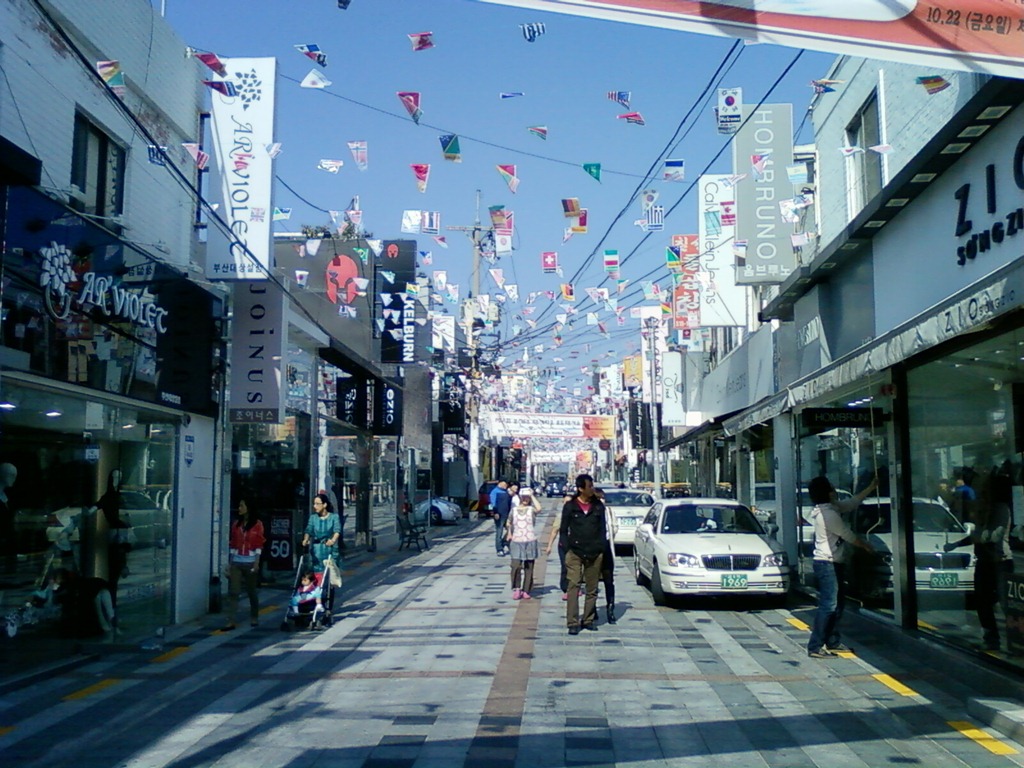
A street near my house got festooned with G-20 flags for a week.
There has been lots about the G-20 in the major financial press, but little on the way in which Korea has rewritten the meeting, at least to itself, as a global homage to Korea’s arrival. Most Koreans haven’t the slightest clue what the G-20 is. Nor do they really care much for OECD trading norms – which, of course, is the whole point of the G-20. In fact, they flagrantly violate those norms (as just about every western businessman I have met in Korea reminds me at every conference I go to). The ROK is irritatingly mercantilist, and Americans are right to think Korea cheats on trade. So if Koreans actually wanted the G-2o to be a success, how about dialing down the protectionism and currency ‘fine-tuning’ (i.e., sterilization of inflows to favor big exporters like the ship builders)? I am hardly one to defend the US auto industry for making cars that no wants to drive and that wreck the environment, but Ford nails it with this write-up. So the Chosun Ilbo says Korea should be a good global citizen, but that’s not what Korea really cares about in the G-20. In Korea-land, the G-20 is an opportunity to preen, not what it actually is suppsed to be – a global economic coordinating body. In the words of no less than the SK president, the G-20 in Seoul means, “Koreans are great and that the world is now recognizing that fact.” Somehow I doubt that is what Medvedev, Singh, Kirchener, and all the rest had in mind. *Sigh*
The Korean press is nothing if not unprofessional and arriviste, aggressively desperate for recognition that Korea is a ‘player’ or, in the locution most preferred by the jingoistic media here, an ‘advanced country‘ (with the obvious implication that other countries are therefore ‘below’ Korea – ask Koreans what they know about Africa, e.g.) Start here and here, in order to learn that the G-20 in Seoul means that the whole world is watching Korea, that Koreans should be proud, that Korea is a global player, a powerhouse, a model, blah, blah, blah. Among other narcisisstic disinformation was the media line that Korea was the ‘first’ non-G-7 state ‘ever’ to host the G-20 leaders. Technically this is so, but the G-20 leaders have only met 4 times before, so it’s hardly as unique as it sounds. (This is preceisely the kind of faux statistic the ROKG and media love to create in lieu of something meaningful; try here for a simliarly desperate non-category – that Korean is a ‘top five food.’) But nothing could stem the self-congratulation. For the three weeks previous, there was a media countdown to ‘D-Day’ – yes, that’s what they called it. Literally, in the top left corner of the major TV networks’ broadcasts, there was a permanent ‘D-15’ (day minus 15) or ‘D-3’ graphic counting down to the big day the whole world would swoon over Korea. Perhaps my favorite moment in this bathos of self-absorption was the televised message on ‘D-1,’ by no less than the mayor of Seoul, that Koreans should be nice to visiting foreigners if they meet them on the street. Hah! How about the rest of the time for those of us who live here, huh? The last thing already hyper-nationalistic Koreans need is to be told that they should be even more proud.
I have said it lots of times before, but Korea is a really nice place to live actually – a lot better than the Central Valley – but then Koreans insist on spoiling that with over-the-top insistence that Korea is unbelievably awesome, and using almost anything to argue that Korea’s ‘brand’ – whatever that means – is on the rise. If all this sounds like the Tea-Party’s hysterical American exceptionalism it should.
For a more serious take on the G-20, one that actually recognizes Korea’s small size and its consequent limits, try this piece by a friend of mine at the Korea Times. Cho admits what Koreans know in their hearts, but adamantly refuse to admit to foreigners: that Korea is a bit-player, that it faces severe constraints in the future, and that Korea’s super-growth days are over. In short, Korea is a middle power, will remain one, and Koreans should accustom themselves to this rather than demanding, Uncle-Tom style, that resident foreigners recite a mawkish Koreaphoria.

 Robert E Kelly