Global Security in 7 Minutes! (2. The Bad)

060706-modern-pirates_big

Part 1 (the good) is here. Part 3 (solutions) is here.

The following were my comments to a global ‘freedom and democracy’ group last week. After arguing that the world is slowly getting safer especially as viewed from 1945 or even 1990, here is the 7-minute list of the big ‘new’ problems:

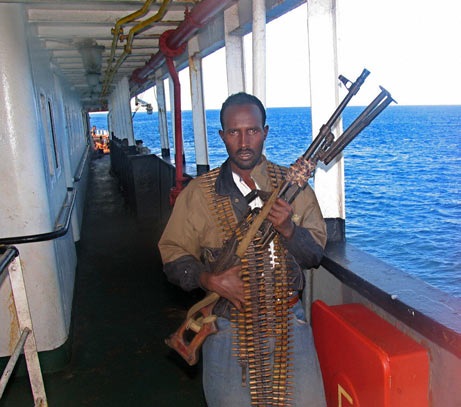
1. Proliferation. This has been slow-boiling for awhile now, but 9/11 threw the hysteria into overdrive. W was right when he argued that the nexus of WMD and fanaticism is the single biggest threat to global security today. I tend to think that this a problem we have to live with, rather than something we can solve. But regardless, it would probably be better if fewer states had WMD (although deterrence theory says maybe not). But we really don’t have good tools for addressing this. No one wants to invade every nuclearizing state (more Iraqs anyone?).  The Non-Proliferation Treaty regime doesn’t work too well, primarily because the nuclear-haves have reneged on their end of the deal. (They are supposed to give up WMD eventually in exchange for others not going for them, but the allure of nuclear discrimination is too much to resist.) AQ Khan-types will try and try to hawk this stuff, and they only need to succeed once for WMD to find their way to terrorists. And the Proliferation Security Initiative is only just be tested now, and honestly, makes me kinda nervous. I heard a nuclear theorist argue a few weeks ago that the PSI is a neo-con/John Bolton idea cooked up to provoke incidents on the high seas with rogues in order to justify the use of force. Finally, I think the biggest proliferation issue, that no one ever talks about, is actually small arms. The AK-47 has killed more people than all the high-tech toys you see in the Transformers. If you really want to reduce global killing rapidly, how about a small arms embargo on much of Africa?

2. China’s gangster pals. This too is a growing issue. My thinking on China is in flux. I still think that a conflict with the democracies is likely, but China is so variegated now, its foreign policy language and behavior so mixed, it is d— hard to make an educated guess. But we do know that China is looking the other way on some of the world’s worst nasties, whether for geopolitical interest (thwarting the US in NK and Iran) or for its neo-mercantilist resource scramble (Sudan, Zimbabwe). FP had a good essay on this recently. It will only make global security problems worse if the world’s rogue states feel that they have a new backer (the old one being the East bloc), who will bail them out and block UN votes. But then the US sorta has this coming by enabling Israel’s worst instincts too.

3. Pushy middle powers. A clutch of ‘rising’ middle powers are increasingly defining their interests as poking a finger in the eye of the leadership of the liberal trading order. Mead has nice piece on this; here is the book-length version. No one minds if others get rich. So much the better. Many of these ‘second world’ powers had terrible poverty in the past, so their rise is a net good. Many people are wealthier, healthier, better educated, etc. as Brazil, South Africa, etc, get their act together. But prestige is a big driver in IR, far bigger than our research indicates. The primary interest of these states, newly brought to the top table as a part of the G-20, is to gain stature acceptance from the older, more prestigious states. Wealth and military power are nice, but they are getting those now, so their real interest is getting attention – getting their diplomats interviewed on CNNi, photographs with Obama at the White House, posturing at Davos about the ‘power shift away from the West,’ etc. The best way to get this sort of attention is to provoke the hegemon. Hence a truculence toward the US and the world order it backstops will be a growing problem. In going from the G-7 to the G-20, you increase the number of players at the top table, so it will become that much harder to organize efficient, coherent action to security threats like civil war in Africa, terrorism, piracy, trafficking, etc. Game theory predicts ever greater coordination problems as the number of players rises, contrary to Obama’s belief that the G7-to-G20 shift will bring greater burden-sharing. Unipolarity was safe and easy (even if it was unjust), and it is starting to look like the game theorists were right.


Global Security in 7 Minutes! (1. The World is Getting Safer)

ln3_1275634757

 Part 2 (the bad) is here. Part 3 (solutions) is here.

So last week, I went off to speak at a soft right-wing regional INGO in Asia. The World League for Freedom and Democracy gave me seven minutes to summarize major successes and threats to global security. You gotta love conference organizers for such hurculean demands, especially in the afternoon panels when everyone’s sleepy from lunch and the weak A/C. So here goes:

Good:

1. The Long Peace. We are now in the 65th year of systemic peace, ie, no general war that pulls in all the main global players into an ‘us-vs-them’ planetary bloodbath. No one really expected this in 40s and 50s. Everyone thought another war – most likely between the US and USSR – would happen rather soon. The depressing familiarity of inter-state war showed no signs of abating. Consider the following missing wars (from the perspective of 1950): US-USSR, US-China, USSR-China, Germany-France, Germany-Russia, Japan-China. Anyone of these would have been a reasonable prediction in 1950 for the next 60 years. Yes, things like Rwanda or Bosnia were brutal, but there were ‘better’ than WWII with its 70 M casualties.

2. Nuclear Pacification. Here again is something wholly unanticipated in the early Cold War when ‘the bomb’ lead to paranoia from Bertrand Russell and Stanley Kubrick about the end of civilization. In fact, quite the opposite has happened. Nukes have had a wholly unanticipated pacifying, status-quo preserving effect. Instead of Mad Max (love the shoulder pads), we got the Nuclear Peace. Why? Because nukes make the costs of war extraordinarily high. There is no possible benefit to be gotten from invading someone else that would outweigh just a few nuclear detonations in your cities (although one or two might be acceptable). In other words, nukes drive up the cost side of the cost-benefit war ledger so high, that it no longer pays to war.

3. Democratic Peace. Here is yet another wholly unanticipated outcome. Policy-makers only lately picked up on this, and it underlay W’s argument for the ‘regime change’ in the Middle East. But it is a pretty robust finding now that democracies don’t war on each other. This is generally thought because liberals don’t believe in using war against other liberals (the normative explanation). Or because democracies’ institutions are slow to war and very transparent, so it is much easier for democracies to credibly manage security problems between each other (the institutional argument). This idea also underlay Clinton’s argument for slowly expanding the ‘democratic zone’ of the world. (It’s too bad that Clinton’s idea got tied to W’s ‘democratization by force,’ because I think it should be western strategy to slowly widen the democratic space in the world.)

4. We’re winning the GWoT, slowly. For as difficult and controversial as the war formally known as the GWoT is, I do think we are winning. Consider the following non-events: There has not been another 9/11 scale attack. There has been no WMD attack. (Given what we thought in 2002, Madrid 2004 should have been a gas or radiological attack, but it wasn’t.) Islamism has not spread to Southeast Asian Islam, a hugely underremarked success of the GWoT. Iraq has not turned into the Democratic Republic of the Congo (which we all feared in, say, 2005). Consider the following progress: Middle Eastern states have slowly begun to turn against the radicals. In the past, these guys were seen as useful ways to hit back at the West, modernity, capitalism, etc., but this tiger has increasingly turned on its master too. Egypt, Saudi Arabia, and Pakistan have all begun to realize what happens if you look the other way on the salafis. Iran is now the primary sponsor of the ideology, but this is awkward alliance of convenience, because your standard issue binladenist is a Sunnite reactionary, who thinks that the Shiites are schismatics who should face the inquisition.

5. East Asia is its most peaceful since the Opium Wars (1839-41). The arrival of western power in Asia brought all sorts of trouble. It ended the Confucian peace, and deeply divided Asians against themselves. It introduced ‘Westphalian’ sovereignty and decentered the traditional Chinese order. Most importantly, it opened the door for Japanese revisionism and Russian meddling. China was lain prostrate and the land/privileges grab began. The next century and a half was brutal. Japan and China competed viciously. The Japanese committed biological atrocities on Chinese civilians. Mao oversaw 25 million deaths and decades of chaos and self-destruction. Nuclear weapons were used. The Khmer Rouge killed 1/3 of Cambodia’s population. Yet today, most of this has faded. NK is still a huge threat, and Asian nationalism is deep, exclusivist, and sometimes racist. But the traditional Sino-Japanese competition is the coolest it has been in a long time. Both basically accept Korean independence, a huge tension-reducer. The worst excesses in SE Asia of the 60s and 70s are over. China and Taiwan are getting along reasonably well. Consider that in 1950, it would have been another easy prediction to foresee in Chinese invasion of Taiwan in the next 60 years. But it hasn’t happened. Democracies in the regions (India, Japan, SK, Taiwan) are strong and lasting. Democracy can no longer be castigated as a white or western import (as it can be in the ME).

So despite the GWoT and the continuing dysfunction in the Middle East and Africa particularly, I think one can say the world is slowing becoming a safer, less violent place, certainly by the benchmarks of 1945 or 1990.

Off to China… 3) There was a Confucian Peace After All…

eindex01

About 8 months ago, I wrote that the notion of a ‘Confucian Peace’ was probably wrong. I thought that usually common cultures inspire competition for dominance. Like envies like. We save our greatest passion for inquisitions not crusades. We would rather punish errant insiders in the name of purity than hazy outsiders we can easily classify as ‘barbarians’ and forget about it. I figured Christians massacred each other for centuries over tedious doctrinal issues despite a New Testament ethic to turn the other cheek. So I figured the Confucian Asians (Japan, China, Korea, Vietnam) would be the same way.

But when I actually did the research it really turned out wrong for Confucians. While it is correct that Christians were hypocrites regarding ‘Christendom,’ Confucians generally were not among themselves. This does mean that Confucians states did not war. Like the Democratic Peace, a Confucian Peace posits only that Confucians don’t war on each other, not that they forgo war altogether. Below is the abstract and two of the graphs. If you want the whole paper, please email me. What is most important is the Confucian ‘peace score’ in the bottom table: one two-month war in 195 years of Confucian diplomatic history. That is quite striking compared to 92/151 war years for Christendom.

“International relations theory about East Asia has increasingly argued that East Asia before Western penetration enjoyed a protracted peace. As explanations, a Chinese military hegemony would fit IR theory fairly well, while a cultural peace based on shared Confucian norms would be a significant anomaly. A Confucian long peace challenges widely-held, albeit Eurocentric, IR presumptions including the perils of anarchy, the arms-racing and misperception of the security dilemma, and the regularity of power balancing. This paper therefore investigates, first, whether such peace did in fact exist, and, second, whether this might be attributed to Confucianism. A cultural peace theory requires a strong anti-war cultural norm and a shared sense of community. Skepticism is established by examining 3 comparative cultural spaces that nonetheless did not enjoy a culturally informed peace: the classical Greek city-state system, early modern Christendom, and the contemporary Arab state system. All were deeply riven and competitive. Nevertheless, empirical investigation of the last Chinese (Ching) dynasty before the Western arrival (1644-1839) demonstrates that it was remarkable peaceful toward its Confucian neighbors, while more ‘normally’ exploiting its power asymmetry against non-Confucian ones. Process-tracing specialized Chinese practices toward fellow Confucians suggests the low Confucian war finding emanates from cultural restraint.”

Model of a Politically-divided Cultural Community

Polities

                                           Japan

China

Korea

Vietnam

Cultural Base or Substratum

                                                                         Confucianism


Empirical Summary of Cultural Peace Cases


Classical Greece

Western Christendom

Modern Arab State System

Pre-Western Confucian-Ching System

Anti-War Ethic

No

Yes

No

Yes

Society of States

Yes

Yes

Yes

Yes

Total War Years / Total System Years

73/141

92/151

8/55

(15/55)[1]

1/195

Percentage of ‘Cultural Peace’ Years

48.22%

39.07%

85.45%

(72.72%)

99.48%


[1] This second figure includes the Libyan 1980-87 invasion of Chad.

Off to China… 2) The ‘Peaceful Rise’ Thesis

image029

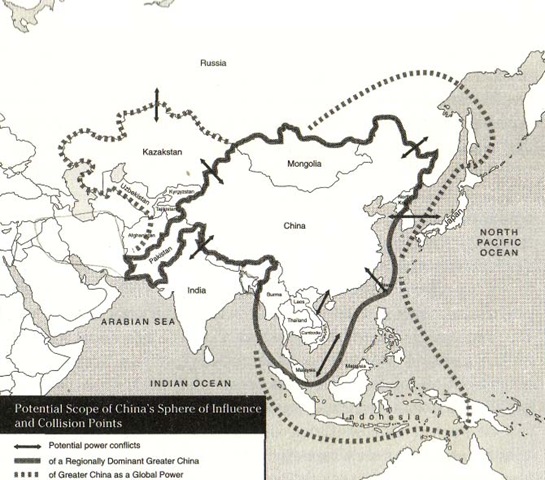
Part one of this post is here. I found this very provocative map here. For the official claim that China’s rise to global power is to be peaceful, read this. For the best academic argument for China’s peaceful rise, try this.

Hawks and realists tend to see China through the lense of history. Lots of other powers have risen in the past to challenge established powers, and usually conflict ensued. Everyone says that peace is preferred and war unnecessary, but in the end, jealous, bitterness, and the ideological pleasures of domination take hold. Minor conflicts grow and worsen; at some point, a hot war or protracted cold war begins. You could throw this model onto Germany (twice), the Punic-Roman competition, Japan’s 19th century rise at China’s expense, the USSR’s rise in the 40s and 50s, etc.

By contrast liberals and especially constructivists  look more at China specifically. Instead of seeing her as just one more hegemon with the same characteristics as others, China’s unique features because a causal possibility for peace. Here is a quick-and-dirty summary:

1. China is getting rich in the current world economic order (epitomized by its membership in the WTO), so why would she rock the boat? Right now she is gaining wealth and prestige, while dumping public goods/security provision on the US military (especially in Afghanistan, which war helps her more than us). Given this great benefit, a peaceful rise makes sense.

2. China has a history in the Sinocentric world order of treating the smaller peoples around it with some generosity. (I actually disagree with this empirically, but so be it.) The idea here is that the Chinese tributary system, especially of the Ming and Ching, only relied on violence when absolutely necessary. Much of Chinese pre-modern hegemony was based in ritual and moral suasion. So future Chinese hegemony in Asia will look back to this model rather than the Nazi or Roman ones in Europe.

3. Globalization has made a collision less feasible and valuable to the riser. This is a Thomas Friedman argument, rather similar to the one made before WWI by Norman Angell. The idea here is that globalization makes war less useful as a tool to pursue national interest and may in fact be remaking the idea of national interest altogether. In this new flat world, war is an anachronism of the nation-state era. The costs of war in the interconnected era are higher, because wars break all these international trade and financial connections that have made China so rich. Also, the benefits of war have declined, because in net-world, holding territory is not really a valuable economic commodity anymore.

4. Globalization and modernization are changing China into a status quo power, possibly prepared to accept US leadership. This is the cultural variant of the argument above. Here the idea is that as China joins the world to get rich, she will also learn from the world to be nicer. This was basically the gamble of the Clinton administration – economic modernization would entrain political liberalization – when it agreed to PMFN 15 years ago.

5. The Chinese elite have seen what happens to other, aggressive risers, and they have learned. This is a Ned Lebow learning argument, and the one I find most persuasive (probably because Ned was on my comps committee in grad school). The idea here is that the rise and fall of powers need not be some mechanical process, as if these states are robots. Instead, later hegemons and risers can learn from earlier ones. Ideally, they learn to avoid the mistakes of the past risers who collided and provoked wars.

6. Chinese made a policy choice to rise peacefully, and we should believe them. Call this the naive argument. One would accept at face value what the Chinese say. Words have meaning; pacta sunt servanda. So if the Chinese say they will rise peacefully, we should take them at their word and not fall back on pre-set notions of realism that permit blithe ignorance of anything the Chinese have to say.

7. The Chinese are nice. This is the most cultural and sino-specific of all the arguments I have heard. It is the one I heard the most last weekend in Beijing. Basically it says ‘we Chinese are different. We are nice and not belligerent. If you see us as a threat, that is your problem, in your head. Instead of telling us we will be mean and nasty someday soon, why don’t you come to China now and see how nice we are.’ As ridiculous as it sounds, I find this one somewhat persuasive. I have generally tilted against the peaceful rise school, but my time in China really gave me pause…

Off to China… 1) The ‘China Threat’ Thesis

China_Decal

Here is part 2, on China as a ‘peaceful riser.’

I am in China right now for the first time for a conference on Asian security (what else?) at the Chinese Foreign Affairs University. I will post impressions on my return. A standard methodological quip in the social sciences is that you should never generalize about a country until you at least flew over it, so I guess I am paying my dues.

So I thought it might be useful to lay out the big running debate about China: whether it will be nasty as it gets more powerful, or will it play in the established global rules of things like the WTO? This is the ‘China threat’ vs the ‘peaceful rise’ school. I lean toward the former, but maybe going there will change my mind…

1. China’s internal politics are repressive: Falun Gong, democracy dissidents, Muslim Uighurs, Tibet. Why would you expect a regime that treats its own people that way to be nicer to the ‘foreign devils’ (the 19th century mandarin term for western traders) ? Why would you trust a regime that shoots its own people? When Iran and Zimbabwe do it, we worry. Why not with China? China is not a democracy.

2. While China is rising, it is vulnerable. It is benefitting enormously from the US/WTO-lead trading order. So of course they will say they want to rise peacefully. They won’t shoot themselves in the foot. They see how Germany’s belligerent rise in the late 19th century got it encircled and crushed in WWI. They aren’t stupid enough to say they want changes, but we shouldn’t be stupid enough to believe them either, especially given point 1 above.

3. China has a historical legacy of xenophobia and cultural supremacism. You can overcome history of course; the Germans did. But the Chinese aren’t there at all, and its historical reservoir of national myths clashes badly with just being ‘one more country.’

4. As countries grow and get wealthier, their perceptions of their national interests change, ie, grow. So yes, today, the Chinese do want to rise peacefully, and maybe they are sincere. But eventually, as its sense of its global role grows, and as the scope of its interests grow, it will become pushier and probably more belligerent. This usually happens when countries grow to new prominence. Britain in the 19th century intervened all over Asia. The US got more involved in Latin America and the Pacific. The USSR dabbled in all over the place during the Cold War. Maybe China is different, but the historical record of big states developing new ‘needs’ and ‘appetites’ is pretty clear. Expect it here.

5. What will they want after they get rich? James Fallows’ work at the Atlantic suggests that China just wants to get rich, and that’s true, but what happens after they get there? As states become richer and more influential, their perceptions of their national interests expand – particularly as states trade more and import resources more (as most rising states must). It is all but inevitable that China’s global footprint will expand as it already has in Central Asia, Africa, and the South China Sea. This does not mean it must be belligerent, but it does mean that there are more possible loci of conflict. The sheer size of China and its reach will insure friction and collisions – just as it did with the British Empire, the USSR, and the US.

Add to this China’s rather toxic internal politics. China is hypernationalist (the replacement ideology after Tiannamen), mercantilist, and repressive. I see nothing benign in that mix. If you were China, wouldn’t you be chafing at the bit, having to listen to Bush or Hillary lecture you about human rights and your exchange rate? And once the first missile lands on Tibet, all the talk of peaceful China will fly out the window. My first-cut schtick on the US and China is in galleys at Geopolitics for publication this fall; here it is in brief. For China’s muscle in the Northeast Asia, try here and here.

In short, I lean toward the view that China is a rising power likely to collide with the US, because its range of interests will expand as its power expands. In 20 years, when China has a bigger navy, it will suddenly ‘discover’ national interests in the South Pacific or Indian Ocean. Rome, Britain, the US, the USSR all went down this path. It is worse, because China has the Sinocentric history of informally dominating its Confucian neighbors. And the regime ideology is still fairly illiberal – mercantilism, hypernationalism, internal repression.

A ‘Diabetic Peace’ and the Militarization of Obesity

untitled

So it’s come to this… God, we’re pathetic.

Two former chairmen of the US Joint Chiefs of Staff have now stated that US obesity constitutes a national security crisis, and that dietary changes are a matter of military necessity. This scares me in so many ways, I am not even sure where to start. But it’s also darkly hysterical…

1. If you needed confirmation that the US is sliding into decline, here you go. Last year, on return to the US after a long break, I remember being stunned at just how fat so many Americans were. I asked, “How can you lead when half your people struggle to get off the sofa?” That was meant partially in jest, but it turns out the Chiefs agree with me. How creepy is that? If you want to see US exceptionalism, maybe it’s in the fact that we are fattest hegemon in the history of the great powers! Hah! But maybe if we can open up more MacDonald’s in the BRICs (Brazil, Russia, India, China), we can enjoy a global DIABETIC PEACE in place of a Democratic Peace. When we’re all as big as this woman, why worry about war?

2. Militarizing issues is not a healthy way for democracies to grapple with social problems. It suggests that a our political system is so broken that even something as serious as 40% obesity in the US (with 70% total overweight) can’t spur meaningful political action by the elected civilian leadership. Instead we need militarization to add a sheen of both crisis – the US Right especially will listen whenever the officer corps says something – and legitimacy – our politicians may be impossibly idiotic, but our military is still a respected institution. Think about the signals that that sends about fixing other big problems in America’s future, like debt reduction, financial reform, immigration reform, our response to Asia’s rise? Do all these problems need to be militarized before we will move on them? Must it always be a man in uniform who kicks us into action and shames politicians into compromise?

3. It is not good at all for liberalism and democracy that the military creep into increasing areas of domestic life, like diet and nutrition. This is not really the military’s fault. Although Rumsfeld was a genuine empire-builder, Gates has tried hard to reduce the sprawl. But frequently deficient public and private actors want to dump problems on the military, because it seems so efficient and commands such respect. Consider that Bush said after Katrina that the military will be used more in national disasters and that BP wants to buck the oil spill clean-up to the military. Do we want military-style regimentation of these sorts of non-military issues? Do we really want generals telling parents about food choices? But…

4. Are we really this lame and sallow and lazy, that we need our generals to tell us to control ourselves in this most basic manner of adulthood? And you wonder why rising Asia thinks Americans are ridiculous and childish. We can’t control our budget, we can’t even control our diet. Embarrassing…

Is there an EU Role in Asia? (2): Not Really… (plus thoughts on Greece)

asem6_logo01

Greece Addendum: I spoke at an EU conference yesterday, and I was amazed at how blithely the EU representatives glided by the Greek meltdown. If you read the coverage from the Economist or Financial Times, they make it sound like this is an existential crisis, but the Europhiles would have none of that. When I asked, I heard variants of the ‘it’s-too-big-fail’ argument: the euro is too important, Greece must and will be bailed out, the EU cannot fail. This strikes me as putting your head in the sand – denial rather than analysis.

Far too much of the EU’s supranationalism is reallyone country’s supranationalism paying for other countries’ nationalisms. That is, Germany pays for its historical guilt by paying for European unity heavily on its own. (Check this graphic to see just how much the Germans fork over.) This free-riding on German liberal guilt has pompously masqueraded as ‘transcending the nation-state.’ It is perilously close to fracture today, but I guess this can’t shake the Kantian-Europhilic elites that dominate the ‘eurocracy’ and its affiliated NGOs and universities. As I argued in paper (below), European regionalism is as much an article of faith as a testable empirical proposition, and this attitude has spread to Asia, where the regionalism discourse – in the face of persistent nationalism and talk-shop regional organizations – seems like an even greater fantastical flight of fancy.

For what its worth, I think the EU and the East Asian Community are both good ideas, but I think they are seen in too rosy a light too often. Nationalism is far more persistent, and a much deeper obstacle to regionalism than European-trained IR and foreign policy elites will admit. For good summaries of the big EU’s challenges, if not coming paralysis, try here and here.

Part 1 of this post is here. This post is intended to be a graphically summary of part 1’s argument.

Korea and the European Union have signed a free trade agreement, and the European Union is regularly a top five export market for Korea. Both sides are now exploring further dimensions to the relationship. Using a traditional list of state goals in foreign policy – national security, economic growth, prestige-seeking, and values-promotion – I examine the prospects for cooperation and integration in the future. What would either side gain by richer contact? I find that deeper engagement is unlikely. Most importantly, neither side is relevant to the basic security issues of the other. Specifically, the EU cannot assist Korea in its acute security dilemma, and ‘sovereigntist’ Korea does not share EU preferences for soft power, regionalization, and multilateral collective security. However, Korea is likely to pursue the relationship for cost-free prestige-taking. And the European Union will understand this ‘Asian bridge’ as a success for the promotion of liberal-democratic values in a non-European context. Pro-regionalist elites, most notably the ‘eurocracy,’ may pursue ‘inter-regional’ ties – such as ASEM (picture above) – for internal institutional reasons, but deep Korean attachment to the Westphalian state model will likely stymie such efforts.

Table 1 summarizes my findings:

Table 1.: EU-Korea Dyadic Benefits

 Foreign Policy Goal                                                      Benefits to each Player

  EU Korea
Security Minimal– no Korean power projection to Europe

– Korean irrelevance to Russia, GWoT/Islam, Southern & Eastern Europe

Minimal– No EU role in 6-Party Talks

– No EU global posture, esp. re: the DPRK

– Shared ambiguity on PRC

– EU irrelevance on Japan

Growth Welfare-Enhancement of FTA assumed Welfare-Enhancement of FTA assumed
Prestige Middling– Korea too small to meaningful raise EU’s global status

– Korea relationship serves eurocracy’s internal bureaucratic interest

High– large, ‘civilized’ EU raises Korea’s global profile
Values High– Korea as central example of universality of western values Minimal– low likelihood of the ‘Korean Wave’s’ success in the EU/West

Is there an EU Role in Asia? (1): EU-Korea Relations beyond just Trade

EU-Korea Flag

This entry is cross-posted at the excellent European Geostrategy. Leave comments there as well. Part 2 is here.

On May 6-7, 2010, the EU Center of the Pusan National University is holding a conference on EU-Korea relations. This is a good time to think about the EU’s relations in Asia, about which I have been pretty critical so far. Here is a summary of my paper. I intend to submit this for publication, so comments would be especially welcome. Email me if you want the whole thing.

In 2009, Korea and the EU signed an free trade agreement (FTA), and the EU is regularly a top five export market for Korea. Interest in future cooperation is high, however the research on which this post is based finds that deeper engagement is unlikely. Most importantly, neither side is relevant to the basic security issues of the other. Specifically, the EU cannot assist Korea in its acute security dilemma, and ‘sovereigntist’ Korea does not share EU preferences for soft power, regionalization, and multilateral collective security. However, Korea is likely to pursue the relationship for cost-free prestige-taking. And the EU will understand this ‘Asian bridge’ as a success for the promotion of liberal-democratic values in a non-European context. Europhile, pro-regionalist elites may pursue ‘inter-regional’ ties to bolster the European Comission (EC) within Europe, but deep Korean attachment to the Westphalian state model will stymie pan-regionalism.

Neither the EU nor Korea can meaningfully contribute to the other’s primary security challenges – a central pillar for deeper bilateral relations among states. As James Rodgers and Luis Simon note frequently, the EU lacks serious power projection far from the Continent. Its ‘loss of strength gradient’ toward East Asia is severe since the British retrenchment from east of Suez. The EU cannot meaningfully deter NK or China. EU land forces do not bolster US Forces in Korea. Although a participant in the Proliferation Security Initiative and the (now defunct) Agreed Framework, the EU plays no role in the new Six Party frame. Similarly, Korea is irrelevant to big EU security issues, such as the course of Russia, terrorism and the Middle East, or Eastern Europe’s stabilization. Their shared liberal democratic values place them broadly in the liberal security community of the democratic peace, but a more positive military contribution to either’s security is unlikely.

Both sides derive prestige from the relationship. Korea, small and peripheral to the global economy until recently, captures most of these benefits. A bilateral relationship with Europe flatters the Korean imagination of its stature in world politics. Instead of a half-country whose international image is dominated by a clownish rogue despot, Korea lusts for Europe’s status and rank. Its famous antiquities, high-profile tourism locations, rich history of art and culture – all nested in a wealthy, healthy, international society broadly at peace with itself – strongly attracts the Korean imagination.

A well-known, highly recognized ‘global player,’ the EU captures little direct prestige from Korea. However, the Korean partnership does benefit pro-European elites within the EU, most notably in the EC/EU bureaucracy. The ‘eurocracy,’ trapped in a decades-long turf-battle with the national bureaucracies, is likely to seize on the prestige of a direct EU-level relationship with a G-20 economy. This is ammunition against critics that the EU is simply a trade deal or that other states do not take it seriously. If the 2010 host of the G-20 summit takes the EU seriously enough to label it a ‘strategic partner,’ then the eurocracy gains in the intra-European conflict to establish the EU more soundly and eventually build a real Common Foreign and Security Policy.

Finally, the EU does reap psychological gains of domestic values validation. Korea is a great successes in the transplantation of liberal, democratic, Enlightenment values outside of the West; Korea is routinely touted a central case that these values not ‘western,’ but in fact universal. This excises the cultural-racial bite of the ‘Asian values’ and ‘human-rights imperialism’ arguments of Asian actors such as the Chinese Communist Party or Matathir Mohamad. Conversely, Korea will find little back-traffic, despite heroic efforts to export the ‘Korean Wave.’

The EU and Korea have an unremarkable relationship. Given the mutual irrelevance of one’s security to the other, it is easy to predict that no alliance is likely. The FTA is step forward, but ultimately one based solely on material utility. The EU also trades with Iran, and Korea has a ‘strategic partnership’ with Kazakhstan. This provides perspective on the mutual, post-FTA rhetoric of ‘strategic partners.’ A ‘friendly partner’ is a more credible assessment. The EU-Korea relationship will not mature into a meaningful bond to rival the more critical relations of either with the US, China, Japan, or Russia.

The EU’s preference for Asian regionalism will generate friction, although Korea will tolerate it in order to retain the huge prestige boost an EU relationship. Hence the greatest frustration will fall on the European side. Korea’s prestige gains are already achieved by the completion of the FTA and the ‘strategic partnership,’ and the EU cannot leverage a security contribution to the peninsula to push Korea into the East Asian Community (EAC) or Asia-Europe Meeting (ASEM). So long as Korea, and East Asia generally, remains committed to the ‘ASEAN Way’ of talk-shop intergovernmentalism, Kantian-Europhilic elites – pro-EU, pro-EAC, and pro-ASEM – are likely to find nationalist Korea, and Asia, a frustrating ‘inter-regional’ partner.

The Six-Party Talks as a Game Theoretic ‘Stag-Hunt’ (2): China Likes the Rabbit Too Much

hackaert-stag-hunt-forest-NG829-fm

Part one of this post is here.

In the formal language of game theory (GT), here is the pay-off matrix for the hunters (SK, PRC, Japan, Russia, US) if they capture the stag (NK’s better behavior in the region):

1. SK: SK is the most obvious winner from taking the stag because NK is an existential threat to the South – both physically and constitutionally.

2. Japan: Japan is the second big winner, because the NK nuclear and missile program increasingly represent a major physical threat to its cities, and perhaps even an existential threat if the North can put enough nukes on missiles.

3. US: The US is a weaker winner, because it is far less threatened by the North directly. The big pay-off from NK change (the stag) would be the reduction in troops and other expense from keeping USFK in Korea. Another benefit would be the reduction in the post-9/11 concern for proliferation of missile and WMD technology to terrorists and rogue states. But this is still far less critical than SK and Japan’s benefit. To the US, NK is more a troublesome, throwback-from-the-Cold-War headache when it would rather concentrate on salafism and the rise China.

4. Russia: Russia has essentially no stake in Northeast Asian security, given that it has basically retrenched from the region to focus on Central Asia and Eastern Europe. However, the Six Party talks are a prestige-generator for a country desperate to still look like a great power even as its lineaments erode. So Russia doesn’t get much from the stag.

5. China: The PRC’s portion of the stag is the smallest, while its rabbit is the biggest. A more docile NK would almost certainly fall heavily under the influence of its southern twin. The more ‘southernized’ NK becomes, the less sinified it will be. (This of course is the whole point from the Korean perspective – reunification.) And the PRC almost certainly reads greater southern influence in the North as greater American influence. So the Chinese rabbit is the long-term survival of a separate NK state to act as a buffer against the democracy, American influence, liberalism, and Korean nationalism that would all flood into NK were an inter-Korean settlement (the stag) finally struck. (A friend at the Renmin University of Beijing all but says this here, and I generally find Chinese scholars will openly tell you why the PRC props up the DRPK even though the PRC’s official policy is reunification.)

What to do then? How do the other hunters get China to stop defecting and start cooperating? The most obvious way is to equalize the pay-offs more, i.e., make it more valuable for China to coordinate by increasing China’s portion of the stag. Here is where strategic restraint on the Cheonan sinking may be useful. If SK holds its fire over the incident, it may be able to ‘sell’ this restraint to China as a hitherto unrecognized benefit. The SK claim to China would be:

See how small your rabbit really is? NK is so unpredictable, so erratic, so uncontrollable, that the stag is more beneficial than you think. Without a long-term settlement, NK’s erratic behavior could eventually generate a crisis the SK population will no longer choose to overlook. Next time this happens, SK government may be forced by popular outrage into coercive retaliation that could pull everyone in northeast Asia into the vortex.

Recall in early 1991 that Israel demonstrated similar strategic restraint as Saddam Hussein shelled it with Scuds before Desert Storm. This helped convince Saddam’s Arab neighbors that Saddam really was a danger to everyone. SK might be able to do the same here.

However, this is unlikely to be enough. China will probably as for a higher concession – a promise for the removal of USFK after unification. It is not clear to me if a unified Korea would need USFK, so this may be an option to explore.

Six-Party Talks as a Game Theoretic ‘Stag-Hunt’ (1): N Korea is the Stag

stag_hunt

Last week, I suggested that South Korea demonstrate ‘strategic restraint’ vis-a-vis NK if the North truly sank that SK destroyer. Not only are the South’s tactical response options terrible, but there is benefit here to be captured if the South’s restraint is marketed to China as a concession in exchange for more pressure on the North. For all of NK’s reputed autarky, it is in fact highly dependent on Chinese aid and trade, both licit and illicit. Without Chinese fuel oil, the lights in the North would go out; without the imports of booze, dollars, and pornography, the life of the Korean elite would be far less pampered. China cannot force the NK to change, but it can dramatically raise the costs of its continued intransigence.

All this is well-known but could be helpfully formalized in our research. In fact, I am surprised how little game theory (GT) I see applied to NK at the conferences here in Asia, given how obvious its utility is to the bargaining and brinksmanship endemic in NK foreign policy.

The stag-hunt (SH) is the best GT model or ‘game’ by which to map Northeast Asia’s security dilemma. We use GT all the time in IR but usually the prisoner’s dilemma (PD). (If you have no idea what I am talking about, start here for GT in IR; the Wikipedia write-ups, linked for the SH and PD, are actually quite good too.) The PD is cooperation came – how do you get the players to cooperate when there are high incentives to cheat on each other. The stag-hunt is better understood as a coordination game – how do you get the players to coordinate a common strategy to get the big pay-off, the stag.

Here is the basic schematic: a group of hunters can probably bag a big stag if they work together. They can weave a net around the stag that is likely to catch him. However, the hunters will also see the occasional rabbit bounce by. If one of the hunters goes for a rabbit, the stag will escape through the hole created and the other hunters will lose the stag almost certainly. Formally put, the stag is a big pay-off, and there is a good probability of successfully catching it if the hunters all coordinate. Conversely, the rabbit is a sure thing, but a much smaller, payoff. So the trick is to convince all the hunters to coordinate and not take the easy rabbit by cheating or ‘defecting’ on the other hunters.

So apply this to the Six Party Talks: The Hunters (players of the game) are the 5 parties besides NK: Japan, US, SK, Russia, and China. The Stag is North Korea, or more specifically change by the NK regime. The NK stag knows that if the 5 hunters can’t cooperate, it can escape. And it is widely noted that this is exactly what NK has done for decades. NK’s foreign-policy methodology since the 50s has been twisting and turning to prevent domination. Since the end of the Cold War, this has meant a constant ‘divide-to-survive’ effort aimed at the other 5 parties to prevent their coalescence into a united front against the DPRK. (I even wrote a book chapter about this, in galleys here.)

So the trick then is to build a common front among NK’s hunters to insure that they won’t defect or cheat and go for the rabbit. The rabbit in the NK case would be NK concessions to one party, but not the others: for example, abductee returns to Japan, family reunions for SK, mineral exploration rights for China, etc. These piecemeal, now-one-but-not-the-other concessions are all designed to keep the other 5 players off-balance and disunited. To date this has worked spectacularly well, even though the 5 hunters all know they are getting shamelessly manipulated.

The big problem to date for the hunters’ coordination is that China sees a lot of gain from taking the rabbit. The Chinese rabbit is in fact so juicy, it probably outweighs the tasty stag. The Chinese rabbit is a route of influence into the Korean Peninsula through North Korea’s continued existence. The big stag – change in NK to be a better international citizen in Northeast Asia – is of much greater value to SK and Japan, followed by the US, than it is to China. So long as China perceives a utility from NK as a buffer against SK, Japan, and the US, it is likely to continue to defect on 5 party cooperation, as it did last year, and take the rabbit of propping up NK in order to influence Korean events.

Part two is here.