Why the Haitian Earthquake will Change Nothing about Development

slide_4402_61804_large

Haiti is pretty far outside my competency, so have only a few thoughts. This is the abbreviated version of my thoughts in the radio transcript below.

1. Natural disasters change nothing in international relations, because they are essentially one-off events. Everyone reads their favorite theory into the mess that follows. Even ever-dependable Pat Robertson managed to find a Christian fundamentalist interpretation in which the earthquake is divine payback for a vodoo pact with the devil to help Haitian independence. The point is that for all the destruction and death, there is little ‘learning,’ but a  great deal of reconfirmation of whatever your pet theory is. It is then easy to forget these catastrophes. Recall that the even Asian tsunami was promptly forgotten in a few months. So will this.

2. Given the above, let me add my ‘real’ interpretation of what happened. The deep cause of the tragedy in Haiti is state failure. Natural disasters are not ‘blameable.’ They simply are, just like gravity or the rain. The issue is what do we do about them. And the public sector is how we cope with such public goods as building codes. Given the staggering incapacity of the Haitian government, very little was done to provide that in Haiti. By contrast, I mention in the transcript below how well Japan deals with its many earthquakes.

3. The US military is still the order-bringer of last resort. It is funny how much the Euros, Chinese, or Arabs loathe US power until something like this happens and only the US military has the global transportation network to actually rapidly move volume in tens of thousands of people or millions of tons of cargo. Call this the upside of the military industrial complex. And it provides good evidence of Mandelbaum’s thesis that the US government provides a lot of ‘world government’ services.

4. Development assistance is woefully underfinanced, and the extra tragedy on top of this tragedy is that even the high Haitian death toll won’t change how much the rich states give in development aid. The UN asks for 0.7% of GDP. Only the green Nordics (Canada, Scandinavia) even come close to that. For readers of this blog, both the US and Korea give less than 0.1% The numbers didn’t budge after the even more cataclysmic tsunami. There is no reason to expect that to change.

5. In part, I attribute this lack of change on the bigger issue of development to the way the media covers these events. Instead of providing investigative journalism on why Indonesia or Haiti were so vulnerable, the only story-line is the awfulness of it all. As Juan Cole pointed out, no context is provided; its all just solemn headshaking and pseudo-‘action journalism’ by show-boaters like Anderson Cooper running about in highwater boots or something.  Where is the story about how the Suharto family looted Indonesia for decades leaving it with a weaker infrastructure than its growth rate would have dictated? Where is the story about the long (and somewhat shady) involvement of the US and France in Haiti? I am an East Asia IR guy, and even I know some of the basics on the US relationship with the Duvalier family of Haitian dictators. But I haven’t seen that once in the coverage. Good lord, the US media is shallow…

__________________________________________________________________________

…this week we are going to discuss the tragedy in Haiti and Korea’s role in development assistance. Hi, Dr. Kelly.

REK:

Hi, Petra. Thanks for having me

Petra:


Thanks for being with us again today.

REK:


It’s my pleasure.

Petra: 

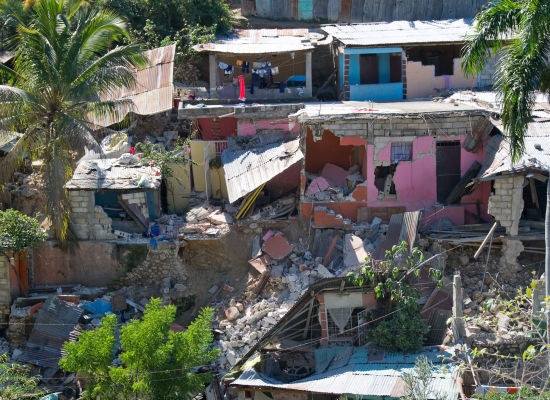
The earthquake in Haiti was a terrible disaster. How did this happen?

REK:

That is a good question, because earthquakes are in fact quite common on the tectonic fault lines around the world. Japan, for example, sits right on intersection of tectonic plates in western Pacific. It is hit by earthquakes regularly, but with nowhere near this level of devastation.

Petra: 

Why?

REK:

Well for starters, as countries become wealthier, they can afford better infrastructure. That is, they build stronger, more resistant buildings that rely on seismological and topographical information. For example, in New York City, you will notice that the taller buildings are concentrated at the southern part of Manhattan island, where the bedrock is deepest and hardest. Similarly in Korea, the most attractive and most architecturally sound buildings are concentrated on the outskirts of Korea’s cities, which developed later, when Korea was wealthier. But it costs lots of money and requires lots of trained technicians to do the necessary physical measurements for this kind of sophisticated building. Many poor countries do not have these kinds of resources, so people simply build whatever they can. Such shantytowns are inevitable easily damaged by extreme weather or other disasters. That is what happened in Haiti.

Petra: 


So Haiti lacks the wealth to build modern, structurally sound buildings?


REK:

It does, and this is one area where medium-term aid can really make a difference. But the quality of Haiti’s building codes is really derivative of its continuing political problems, an issue of development that many Koreans should easily remember.

Petra: 

What does that mean?

REK:

Well, quite honestly, Haiti is not very well-governed. Haiti is what we call in political science a ‘failed state.’ Because governance in Haiti is so poor, there is very little economic growth. No one wants to invest in a country where his investment might be stolen by gangs, thieves, or corrupt state officials.

This story should sound familiar to Korea, because Korea went through something like this in the 50s and 60s. Under President Lee Syngman, Korea too was desperately poor, but a functioning government was slowly built from the wreckage of the Korean war. Later, under President Park, that coherent, reasonably efficient Korean state was able to provide a framework for Korean economic growth. So as Korea modernized in the 60s and 70s, it was able to afford luxuries like better building codes. And better building codes mean extreme natural events don’t create tragedies like Haiti right now.

Petra:

So Korea’s position was similar to Haiti’s 50 or 60 years ago?

REK:

Kind of. Korea was extremely poor; illiteracy was high; growth was low. Had a massive earthquake struck a Korean city in 1948, the devastation would have been terrible. The point is that good governance allows growth. Growth means more money. More money means better, stronger infrastructure. And better infrastructure means natural disasters, which are a regular feature of the planet, will be less devastating. In fact, as global warming accelerates in the coming decades, this will become a more and more pressing issue. Especially populations that live on the coasts in warm water areas will see more and more typhoons.

Petra:

So what about Korea’s role in helping these countries? What is Korea doing in Haiti?

REK:

Well initially of course, these countries need massive amounts of quick aid and money. And the world has responded. Korea has donated $10 million dollars and sent a team of 100 medical personnel. Korea is now in the OECD, the club of rich countries, so there is a global expectation that when disasters like this or the Asian tsunami strike, Korea will also respond.

Petra:

What can Koreans do right now if they want to help?

REK:

Give money. The biggest problem in natural disasters is usually transportation and infrastructure. There is more than enough food in the world, so the required volume of calories is out there. The real issue, as we saw in the tsunami relief effort also, is getting this assistance to people. Such disasters usually wipe out the transportation network, so actually moving food, water, tent-housing, etc., becomes the big problem. And that is what you see right now in Haiti. The airport, seaport, and roads were all badly damaged. So much of the aid is being flown in by US military helicopters. That is excruciatingly slow.

Petra:

So why does money help? And to whom should one give it?

REK:

Well money is more flexible than donated food or bottled water. Money allows the UN and aid agencies on the ground in Haiti to buy the resources they need specifically for this crisis. So in Haiti, there is a clear need to construction equipment to clear debris so that all the assistance can get through. Money can help the aid groups to buy that sort of thing.

As for whom, I would recommend a nongovernmental organization. Smaller, private aid organizations tend to be faster and more nimble than the big bureaucracies of the United Nations.

Petra:

What is Korea’s longer-term role?

REK:

In Haiti, it is probably very little. Once the situation in Haiti is stabilized in the next month, the reconstruction effort will slowly shift to regional players like the United States, the Organization for American States, and the big Latin American countries like Brazil. This is quite common. Korea development aid, for example goes mostly to Southeast Asia countries like the Philippines.

Petra:

I was also thinking more broadly about Korea’s role in development.

REK:

Well Korea is a good case of a country that emerged from African levels of poverty in the 40s to a typical wealthy country by the 90s. Much of the world would like to emulate that. Korea is powerful example case to be studied and possibly imitated.

Petra:

Is there something more concrete?

REK:

Yes. Korea now sits on what we call the Development Assistance Committee, or DAC, of the OECD. The DAC tries to coordinate all the official development assistance given by rich countries to the poor ones. Korea recently joined the DAC. The UN requests that rich countries give 0.7% of GDP to the DAC. Korea gives about 0.1%.

Petra:

That seems low.

REK:

It is, but this is common. Most rich states give far too little, especially if you note that more than one billion people live on less than 1$ a day. Try to imagine how harsh such an existence must be. The US gives an even smaller percentage than Korea. This is a shame actually. The best long-term thing Korea could do is publicly budget more aid, but this is unlikely.

Petra:

Thank you, professor, for coming again.

Is American Global Primacy Just Too Expensive?

200px-Flag_of_the_United_States_svg

One of the reasons I started a blog was because I get pulled into some excellent email chains that deserve to see the light of day. Here is a nice debate between me and a good friend (whose IR background is more law; mine is security and political economy). He thinks the costs of US empire’/dominance/unipolarity are too high to the US, and that we should start pushing burdens onto the allies more – an idea as old as the Nixon Doctrine. I agree in principle, but in practice, the allies won’t do it, the world will slide into multipolarity, and become more dangerous I think.

Friend:

An Empire At Risk. I share all of Niall Ferguson’s concerns, but he is focused, at least in this article, on a military decline as the ultimate effect of our profligate ways.  I say – so what?  I would like to see a US that spends less on the military and is less focused on policing the world. Let’s hear it for Germany, Sweden, Norway, Japan, etc. – countries that direct their resources toward their people and not an extravagant defense establishment and adventurism. In the world today, the US has had to invent a global enemy – ‘terrorism’ or a boogie man China – to justify its fantastically large military. Security today is not as the Neo-Realists traditionally portray. The great powers are not likely to return to the days of the 1930s any time soon.

Me:

Ferguson is always a good read, although ten years ago he said the US was the “colossus” bestriding the world as the new Rome. That didn’t work out too well…

You’re right that the US military needs to go on a diet. After 9/11, the military got everything they wanted including lots of c— we don’t need (F-22s, missile defense, Future Combat System). But the larger point is correct. The ultimate backstop of the liberal global economy is the US military. The more powerful the US is, the less it makes sense to compete against it. Unipolarity encourages bandwagoning and hedging at worst, not open balancing. If the French, Russians and Chinese get their wish for multipolarity, watch security dilemmas in places like northeast Asia, the Middle East, and Central Asia move into defection spirals of arms-racing. Unipolarity correlates well with systemic peace, and a liberal unipole is even better. Switzerland can claim the moral highground of neutralism and abdication, and no one cares. If the US does it, the world will change.

Friend:

We have two basic disagreements.  First, I don’t share your concern about SD and spiraling arms races.  I am a believer in Jervis’ security community, though there are areas outside of it, a great power war is highly unlikely. Peripheral wars have gone on, are going on now  – even with ‘unipolarity’ – and will go on regardless of US military might. Moreover, it is rather speculative that US unipolarity will prevent the consequences you describe as the number of cases of unipolarity is quite small.

Regardless, and second, the problem with maintaining unipolarity is someone has to pay for it.  Why is it the burden of US citizens to maintain this blessed (if often fractured) liberal economic world order of peace and prosperity?  The British are sending an extra 500 troops to Afghanistan and they are one of the better allies there. Everyone knows the current US fiscal deficit is unstainable so, to fund unipolarity, Americans must give up public health insurance, infrastructure investment, and basic government funded research, fight inflation, suffer a depreciating dollar, yada yada, while the rest of the developed world has social safety nets and high-speed trains. If the world becomes more complicated without US unipolarity, if other liberal, peace-loving democracies must step up in a multipolar world, that’s fine. Americans deserve to have their wealth spent on their needs (cancer research comes to mind. Cancer touches everyone of us and will probably kill you and me. Compare what has been spent on that to just one year of defense spending – it’s shocking). 

Me:

1. You don’t think that the regional security dilemmas in places like Northeast Asia or the Middle East would inflame if the US retrenched? I can’t agree. If the US leaves the ME, Israel and Iran will be at blows. In Asia, China and Japan, and India and Pakistan and China would start racing furiously. I think even the Chinese think so, judging by what I have heard from Chinese scholars at conferences out here. Unipolarity has strong causal effects for peace.

2. Here I agree with you partially. But the US DID afford hegemony for awhile. Not even Vietnam broke US power: http://asiansecurityblog.wordpress.com/2009/04/09/careful-with-that-decline-of-the-west-riff-weve-heard-it-before/. In fact, under Clinton, the budget was balanced, the debt was declining, the US was respected, and our foreign policy requirements were reasonable. Sullivan called the 1990s a ‘silver age’ for the US in his book the Conservative Soul. The real problem is that Bush misread unipolarity as omnipotence. Bush and his buddies wrecked US power through conscious choice. It was not the structure of unipolarity itself that bankrupted the US; it was W. Try here.

Friend:

I don’t believe in US isolationism.  Of course, complete disengagement from Asia and the ME would be destabilizing.   Multipolarity is not isolationism. The US should remain a balancer and diplomatic force.

But, I don’t think NE Asia countries would race furiously even with a large US draw down.  I think here we differ because my view is more informed by commercial liberalism and the waning of war among developed countries as a cost-effective or even plausible solution to problems (constructivism).  Though it doesn’t surprise me that Chinese scholars would promote the idea of a spiraling arms race and war if the US draws down – of course the party line is let the US carry our security water while we build our economy.  There view is that the US presence makes every feel OK while China grows.

Sub-Asia and the ME are different, I agree. 

As I mentioned, there are areas outside of the ‘security community,’  but I am not that concerned about arms races there.  India and Pakistan have been racing and warring for years and the world survived without a great power holocaust. Nuclear weapons provide a certain stability there, as does US even- handedness in arms sales to Pakistan and India. Stability can also come from balancing. 

The ME also has a long history of localized arms races and wars and while it has been tense and economically destabilizing at times, we have managed (until recently) without US  military entrenchment there.  The US has balanced through its support of Israel and relationships with ‘moderate’ ME powers.  The prospect of a war in the middle east are less than they ever were (unless the governments of moderate powers topple to extremists) and that is largely because of war exhaustion and peace efforts going back to camp David. Iran is a problem but do you really think a middle east war will result?

I know the world is a dangerous place but I not worried about regional powers balancing themselves – I prefer it because of cost issues for the US. The US should remain engaged and a balancer but not the balancer. If wars break out, that is bad but it’s not like the last 20 years of US unipolarity have been peace and prosperity.  Before Iraq and Afghanistan, there were the Balkans.

I can only say here that today is not the 1960s or even the 1990s.  You know that US economic preeminence, allowing it to afford lots of guns and butter, was an a rare confluence of factors. Those factors have largely receded and are rapidly diminishing.  The 1990s was an economic bubble as we learned in 2000.  Moreover, your domestic agenda (and maybe Sllivan’s) is apparently smaller than mine.  Clinton may have balanced the budget  but he didn’t deliver health care, infrastructure investment, ya da ya da.  (In fact, Clinton, for all his talents and opportunities, was a waste of space.)  So, I don’t view the 1990s as an example of our ability to do it all.  The 1960s is a better case but not a realistic one today. The price of unipolarity: http://www.msnbc.msn.com/id/34263381/ns/us_news-life.”

Obama’s Pragmatism toward North Korea

NK Flag

Yesterday, I participated on a panel at the South Korean Institute for National Security Strategy. The conference was entitled “Prospects for the Situation of the Korean Peninsula and the North Korean Nuclear Issue in 2010.” I think I have been to this conference already about 10 times already in the last 18 months, but if you lived next to the last and weirdest stalinist slave state, with nukes now to boot, you’d probably go over and over the topic endlessly too. My session was entitled “The US and China’s Policy toward the Korean Peninsula and North Korean Issues.” I was a discussant for Brian Myers’ paper “On the New Pragmatism of America’s North Korea Policy.” Brian teaches at Dongseo University here in Busan, and I find his work on NK increasingly persuasive. Here is his most recent intelligent op-ed in the New York Times. Here is the Korean news story on the conference; I looked like I just got punch or something…

Here are my comments on his paper:

“My read of this paper is that is broadly correct. I agree with Brian that NK is highly unlikely to ever surrender its nuclear weapons, because they are central to regime legitimacy. They are more than simply a tool of security or extortion; they are central to the regime’s raison d’etre after the collapse of communism and the decisive NK defeat in the intra-Korean competition in the last 20 years. With the global effort for communism over and defeated, and with South Korea’s obvious success, a self-evident question is why NK even exists anymore. If the East Germans gave up in the wake of communism’s failure and West Germany’s success, why does not NK also? Brian correctly notes that regime ideology has changed more openly toward militaristic nationalism, perhaps even semi-fascism, to compensate, and nuclear weapons are central to the overt nationalist/racialist mission of defending Korea against Yankee imperialism.

I have a few further comments.

1. Brian makes the intelligent observation that although President Obama has moved beyond ideology, various opponents of the United States have not. While this seems fairly obvious to the rest of the world, it comes as a surprise in Washington. The assumption of unipolarity and American dominance is so accepted by the US that the only change needed to bring change to the world is change in Washington. That is astonishing American arrogance, and speaks especially to the ridiculous expectations raised by Obama’s character – expectations which the president did a lot to build as a candidate by constantly referring to his election as the ‘start of a new era’ in history. Only Americans talk that way about the US, and Brian is right to point out that expert opinion about NK is usually in fact expert opinion about the US.

2. Brian makes the argument that Pyongyang means what it says. Northern ideology is a serious exposition of regime beliefs, not a cynical ploy. This is a controversial position, because most NK watchers, as Brian notes, believe the opposite. NK ideology is perceived as so bizarre and so obviously fraudulent – NK has never been self-reliant, e.g., despites decades of juche – that it cannot be taken seriously. As Brian notes, diplomats like Madeline Albright and journalists like Selig Harrison all act on this implicit belief.

Brian is right however to point out that dictatorships – especially right-wing ones – usually mean what they say. Hitler, Mussolini, Franco, Osama bin Laden, the mullah theocrats in Iran, various clerical fascists in Latin America, and the Taliban have all told the whole how they see it and what they wanted to change. Brian’s claim is that NK is doing the same, and that we should listen actively. In IR theory, we refer to this position as ‘second-image.’ In other words, regime beliefs overwhelm international structural pressures to determine a state’s foreign policy. That sounds correct to me and better fits the empirical record of the Kim regime than the cynical approach. Particularly the move toward song-gun, recent crackdown on marketization, and the extraordinary efforts to build and hold nuclear weapons suggest that Brian’s read is more accurate.

3. Brian’s most serious criticism is of the Western and South Korean expert or ‘epistemic community’ on NK itself. He unpacks a series of the reigning assumptions of NK kremlinology and argues that they are wrong, in some cases very badly. He also asserts that the NK has used access to it as a manner of bribery of would-be experts in the West. This is the most explosive argument of the paper, as it implies that well-known NK watchers such as Bruce Cumings or Selig Harrison have been coopted, deceived by pleasantries from Kim Jong Il, or othwerwise pull their punches in order to insure their visa. This is a pretty serious charge, but it seems like a fair concern. It is certainly a good idea from Pyongyang’s point of view. If visas and access can be used a marketing tools, why not? The USSR and Kmer Rouge did the same thing, and certainly Bruce Cumings book – North Korea: Another Country – feels awfully generous to a regime we know has killed hundreds of thousands, if not millions, of its own people in its history. By inviting experts from the West and telling them what they want to hear – that regime ideology is bunk, that the North really just wants a deal, etc – NK sows enormous uncertainty in the West between its public and private statements. But this is hardly surprising, as keeping its various opponents uncertain and confused a long-standing tactic of the regime. If Brian is correct that the regime has no concern to negotiate in bad faith, then hoodwinking experts with access and pseudo-off the record commentary makes perfect sense.

If that is the most controversial argument, I think the most rich is Brian’s argument that NK is a racist-nationalist-militarist regime. Deciphering the true ideology of NK is something of a cottage industry in the social sciences. Bruce Cumings has famously argued that NK is a neo-Confucian dictatorship. IR theorists tend to see it as the last bastion of Cold War stalinism. Neo-conservatives generally see it as a gangster/terrorist/rogue state. And Brian argues that NK is something approaching native Korean fascism. Elsewhere Brian has written that NK is extraordinarily ethnocentric, that even during the Cold War its socialist-internationalist allies perceived little internationalism at all. This ‘ontology’ of NK is a crucial debate. It would help the scholarly and policy community enormously if the expert community on NK could resolve this internal ideology question.”

A ‘Confucian Long Peace’ among East Asian States (2): Probably Not…

east_asia

(For part one of this post, click here.)

1. I am skeptical, because shared cultural bases have rarely stopped conflict in other areas. Instead, they often seem to encourage it, as various states claim leadership of the cultural space as a whole. Every Continental would-be hegemon from Charles V to Hitler said they were ‘uniting Europe.’ Further, we usually save our worst fury and anger for dissenting insiders, not outsiders. So Plutarch and Thucydides both noted somewhere that the ancient Greeks, despite their shared culture, were far more zealous in destroying each other than uniting against their common foes, the Persian, Macedonians, and Romans. Hedley Bull and the EU framers argue that European ideals and perhaps Christianity provide a shared cultural base for a ‘European society,’ but Christendom hardly stopped the Europeans from fighting bitterly to dominate each other, particularly over which form of Latin Christianity was right. Today, the Arab state system shows the same problems. Supposedly united by common language, culture, and religion, the Arab states have vied brutally against each other, frequently recruiting outsiders like the US or USSR to help them defeat local rivals.

Now, one can argue that Confucianism has special or unique war-reducing or –dampening properties, but that needs a lot of research and detailed process tracing rooted in specific examples of conflict averted by appeals to shared values. A far simpler answer is to say that China was a regional unipole (i.e., huge, when others were small), and therefore war against it was pointless. IR strongly believes this logic explains the current global Long Peace; war against the US unipole today is fruitless. So why not simply apply the logic to the regional level? Chinese preponderance made war in classical Confucian Asia less likely, because China’s opponents never stood a chance and so never tried. Following that causal logic, we should speak of a Chinese hegemonic peace, not a cultural Confucian peace.

2. The idea of a Confucian long peace stumps IR, because we aren’t really sure what to do with ‘culture’ as an explanation for outcomes. In fact, social science in general dislikes ‘culture,’ because it feels like a cop-out reason when you’ve got nothing else. If you can’t explain something otherwise, say it is ‘just their culture.’ So if I don’t know why Russians like vodka, the Irish like Guiness, and the Koreans like soju, then it is just ‘cultural preference.’ But that is awfully soft. It does not actually tell me much; it provides no account of mechanisms and choices. Besides, lots of so-called cultural artifacts actually have functional roots. For example, the Jewish and Islamic prohibitions on pork are rooted in the possibility of contracting trichinosis from flesh that might quickly sour and rot in the sun of the ME. Social science prefers such rationalist explanations. Actor X does Y, because there is some tangible material benefit. Maybe Confucian Asia will bandwagon with China for cultural reasons, but the causal map for this behavior feels soft, especially in contrast the explanatory clarity of the regional unipolarity thesis.

For examples of culture’s softness, look at the other three systems I noted with multiple states functioning within a shared culture (Greeks, Christian Europeans, and Arabs). They did not enjoy any war-reducing affects from common culture. In fact, the evidence from psychology points the other way: we tend to save our harshest opprobrium and violence for lapsed insiders (national traitors, religious heretics) than outsiders who are comfortably relegated as ‘barbarians.’ This was Plutarch and Thucydides’ tragic insight, e.g., on the ancient Greeks.

3. If there was a Confucian peace, I don’t think it is coming back. Kang does. He thinks China’s EA neighbors will accept some amount of Chinese hierarchy; that is why they are not balancing against China now. I don’t buy it. Koreans and Japanese strike me as way too nationalistic today to accept that. If anything, the Koreans and Japanese look down on the Chinese as culturally inferior. Koreans will tell you that the Chinese will eat anything (scorpions, beetles) and that Korea should ‘mediate’ China to the West. Sizeable chunks of Japan still think its imperialism liberated Asia from the West and brought modernity. EA states today are just way too nationalized now. Just like the nationalization and de-arabization of contemporary ME states that sets them against each other despite shared culture, EA states may share a vague Confucian background unity, but vague is all it is. EA is far from the level of cultural sharing and trust that undergird a project like the EU. And remember that the Europeans had to destroy each other for 400 years before they decided to live with each other. If no one is balancing against China today, as Kang says, then, 1. they can avoid it, because the US is still around to reassure everyone, and 2, they are certainly hedging against China, if not openly balancing it. No one in Asia is openly running with China, not even NK. This nationalization of EA states is why Samuel Huntington’s proposed Confucian civilizational bloc never really ignited local opinion here; it was based on the Sinco-centric past, which although attractive perhaps as a route to peace today, no longer exists. Asians will have to do the hard work of forging institutions to build trust; culture is not enough…

A ‘Confucian Long Peace’ among East Asian States (1): Does Shared Culture Stop War?

confucius 2

(For part 2 of this post, click here.)

This article is an excellent introduction to the tangle of East Asian security problems today. Chung-in Moon and Seung-won Suh lay out all the nasty problems of territory, nationalism, and historical imperialism that make EA a powderkeg. There is a running debate in IR theory about how peaceful EA actually is. A lot of it focuses on China. Aaron Friedberg and John Mearsheimer worry that China’s growing strength sets it on a collision course with other Asian states, and eventually the US. David Kang thinks that China’s claim to a ‘peaceful rise’ is real. He notes that for all the sound and fury in EA about nationalism or territorial disputes, there is no serious anti-Chinese coalition forming, nor has their been a major war out here since Vietnam and Cambodia in the 70s. This is a historically and theoretically rich debate; you should read about it if you can.

But I want to focus on remarks by Moon and Suh about how peaceful Asia’s IR was before the arrival of the West. The issue of today’s security dilemmas and tensions in Asia are hyperresearched. Everyone out here goes to one conference after another about Asian security. (I will attend 6 by year’s end, with 2 more scheduled already for next year.) But the counterpoint between Asia and Europe’s earlier history is far more fascinating, because no one ever talks about it. There is a vague argument that while European states were destroying themselves in early modern warfare, Asian states were getting along reasonably well under a Chinese umbrella of soft hegemony. Moon and Suh use the terms ‘long peace’ and ‘Confucian peace’ to describe EA IR until the late 19th C. This is woefully underresearched; there is a great dissertation here.

The “Long Peace” is an uncontroversial idea in IR theory. It says that it is pretty remarkable that there has been no global general war or systemic conflict since WWII. That was the last time all the big global powers lined up on one side or the other and destroyed one another. We are now in the 64th year of the Long Peace. And that does seem like quite an achievement… from a Eurocentric view of the world system. Kang has written a lot to convince me that actually Asian IR was a lot more peaceful than European IR before the Europeans arrived in force in the late 19th C and brought the strict state sovereignty system with them. Kang, Moon, and Suh all suggest that East Asia was a characterized by a much longer (as in centuries) “Confucian Peace.”

The deep cultural and historical details of the confucian peace really need to be researched a  lot more. But here is what I pull from Moon, Suh, and Kang. The ‘confucian’ peace suggests that nations/states in the confucian zone (that means China, Japan, Korea and Vietnam) shared a lot of values and cultural similarity. This sharing acted to slow the march to war; that is shared Confucianism has a war-dampening effect. The specific causal mechanisms are Confucianism’s emphasis on 1. respect for the older and more educated, 2. social harmony, and 3. social hierarchy.  China, as the oldest, most culturally ‘advanced’ state in the region, enjoyed formal superiority to Korea, Japan and Vietnam, but allowed them substantial informal leeway. War violated harmony and order and showed disrespect to the older brother (China). Think of this as ‘feudalism that works’ (unlike in Europe where vassals routinely rebelled). So causal arrow goes from shared culture to the specific war-dampening cultural aspects of Confucianism to peace. Someone needs to write a good IR history of this idea and whether or not it was really true. I have 3 criticisms: Go To Part 2.

US Strategy is Now Selective Retrenchment? How Humiliating…

OL345919M-M

As usual, Walt nails it with an incisive critique of US foreign policy. (If you don’t read him, you should.) He argues that the US grand strategy has become ‘selective retrenchment.’ That is a good term that captures well the post-Bush hangover US power is enduring. After W’s dreams of global democratic imperialism, we have crashed into reality. W overreached and infuriated the world. In 2000, the US was the ‘indispensible nation.’ Today, we talk about the coming of non- or multi-polarity, or the ‘post-American world.’ For all W’s strutting machismo about defending and strengthening America, he left us far worse off than the pot-smoking draft-dodger did.

For Americans, this should be rather sad, especially if you think that US hegemony is more benevolent than any others would likely be. Consider the possible list of other leaders: The EU is paralyzed and inward looking, India is too weak, China is undemocratic and culturally arrogant, and Russia is too mean. In short, the list of replacements for global US power are unappealing. For all that US arrogance and messianism under Bush, the US has by and large supported good, liberal things like human rights and democracy. (Compare Chinese and US behavior in Africa, e.g.) Don’t expect the realist Euros or nationalist Chinese to advocate this way. (For the longer version of this argument, read this.)

So, once again, you can blame W for this. Under Clinton, for all his personal shenanigans, US power was relatively secure. Foreign respect for the US was reasonable, US overseas commitments were manageable, the US budget – the long-term foundation for US power projection abroad – was improving. In just 8 years, W did astonishingly damage to US power, and now we must retrench, as Walt says. We must increasingly give up important projects (possibly even AfPak) and share leadership with others in some flimsy multilateral collective effort more likely to induce free-riding and buck-passing than joint leadership. Obama has to run around the world telling to telling foreigners we are not a bully. How humiliating. Andrew Sullivan said the Bush administration was one of the worst presidencies in US history. Any American should be embarrassed at this low ebb of US power. Like the overstretched and widely perceived as imperialist British in the 50s, we now have to start to pull back. It did not have to be this way.

But so hath W wrought. He convinced even a lot our allies that the Pax Americana didn’t have much pax  in it. The notion that the US was a gentle giant, a benevolent hegemon flew out the window; we became Thucydides’ Athenians  – right down to our own Sicilian expedition in Iraq and Melos at Abu Ghraib. Under the preemptive war doctrine, the US became something unheard of in IR – a revisionist hegemon. IR theory doesn’t even know what that means – hegemons, by definition, are supposed to be status quo seeking. It’s an oxymoron. Yet the Bush people pulled it off. We looked like we wanted to rewrite global rules – the very ones that we helped build after WW2. To the rest of the world, we became imperialists. I spend enormous amounts of time here in Asia trying to convince Koreans, Chinese, and Japanese that we are not in fact global imperialists. It’s terribly embarrassing.

To boot, W broke the bank. The budget flew out of extremely out of balance; W added 50% onto the national debt in just 8 years ($6T to $9T). No rainy day fund for crises like the Great Recession was ever even contemplated. The Clinton-Rubin opportunity to place US power on a durable financial footing was squandered. Now we borrow $20B a month from the Chinese. If you think we can hang on at the top doing that, go take Econ 101. We are, literally, selling American preponderance to the PRC – ast0nishing,  heartbreaking. No ‘empire’ can survive very long when it becomes a debtor; yet the Bush people pursued a costly foreign policy while simultaneously stripping the government of the resources to pay for it (through tax cuts we could not afford). This was simply insanity, and the pain of the Great Recession is deserved because we brought it on ourselves. For an example of serious budgeteering, including cuts and tough choices, try Korea, instead of US fantasies that we can spend without worrying about where it comes from. What a waste, what a squandered opportunity to make the world a better place…

Learning to Live with Asian Nuclear Proliferation – Israel, India, Pakistan, North Korea, Iran…

Dr. Strangelove I worry about nuclear proliferation as much as anyone else, but the level of our hysteria over the creeping nuclearization of Asia is only met by our inability to do anything serious about it. I think it would be far more intelligent for us to start thinking seriously about strategy in a nuclearizing world. But we don’t; instead, we insist on a vision of nuclearization that ended decades ago when Israel became the first unofficial member of the nuclear club. Frequently we evoke nightmare images (‘a smoking gun in the shape of a mushroom cloud’) that scare the hell out of the West, but we have no palatable options to stop these programs. Slow but steady nuclearization increasingly seems likely beyond the ‘approved’ nuclear powers of the Non-Proliferation Treaty (NPT). So let’s get used to it and think about it differently.

I say this because it looks like the nuclear hysteria machine is gearing up again around Iran. You remember the last two iterations of this show – Iraq in 2002, and India and Pakistan in 1998. But short of Iraq-style invasions, which no one wants to repeat, it does not seem like there is much outsiders can do to stop a sovereign state’s determined nuclear drive. The technology is out there – the genie can’t go back in the bottle – and there are too many profiteers like North Korea or A. Q. Khan willing to sell nuclear technology. Further, we undermine the NPT regime when we look the other way on some states’ nukes (Israel, India) but flip out over others – Iran, Pakistan, NK.

We seem to have a cycle whereby we claim that ‘absolutely cannot tolerate’ Country X – especially with its dangerous record – with nuclear weapons. We write hyperventilating editorials like this and this. We create bloviating right-wing think-groups with scary names like the Committee on the Present Danger who tell us that WWIII or another 9/11, only with nukes this time, is around the corner! Then, we go to the UN Security Council to get some sanctions and what not, and then we go back again, and again, and then again. We hypocritically invoke the sacred NPT, even though the nuclear-haves have made no serious effort to meet their NPT obligations to the nuclear have-nots. Country X presses on anyway, because nuclear weapons, as de Gaulle famously said, are a prerequisite for great power status. Finally at some point, the CIA says Country X is 1-2 years away from weaponization, and we start talking about air strikes. If you think this sounds familiar, it should. We did this on NK in 1994 and then again after 9/11, Iraq in 2002-03, and today on Iran. At some point, I am sure Huge Chavez will say he needs nukes to defend the revolution against imperialism, and the US Senate will absolutely bananas. All we need to complete the show is an appearance by Dick Cheney to say that if there is even a 1% chance that Myanmar has weapons of mass destruction, we should bomb them. However the show ends with Country X getting the nukes after all, and no does anything because it is too scary, expensive, and unpopular at home.

If I sound cynical, it’s only because the reality is that we are in fact adjusting ourselves to an increasingly nuclear world. I don’t want these shady regimes to have nukes any more than anyone else, but, 1. what are we going to seriously do to stop them? and 2, it increasingly looks like we can slow their drives for awhile and contain their worst proliferation instincts.

1. Short of invading them or setting up an extremely strict UN cordon, it is nearly impossible to stop states committed to nuclearization. NK has proved this. It endured the worst (man-made) famine since the Great Leap Forward in the 1990s, but it still clawed its way into the nuclear club. We could attack incipient nuclearizers, but we tried that in Iraq, and it was a hugely unpopular disaster. No one is willing to invade NK or Iran or Pakistan simply over the nukes. The other alternative would be extremely tight UN sanctions to prevent the inflow of the parts and technology necessary. But the only serious UN cordon effort – of Iraq in the 1990s – failed badly, because the neighbors cheated so much, and because the cordon’s PR was atrocious. Saddam made the world think that Iraqi children were starving because of US/UN cruelty. So the sanctions were eased with the ‘Oil-for-Food’ program. But Saddam of course immediately pilfered that program, and, in UN HQ, ‘Oil-for-Food’ degenerated into corruption. In short, it is practically impossible to seal the nuclearizer off enough, and no one wants to go to war just over a nuclear program.

2. For as much as we worry about spiraling proliferation, we have managed to retard its spread, and more generally, we are learning to live with it. The new US Proliferation Security Initiative has helped contain NK nuclear technology. We bullied Kaddafi in 2004 into giving up any hopes of nukes or other weapons of mass destruction. Remember how the Indo-Pakistan nuclear competition was supposed to lead to rolling proliferation in Asia and the Middle East? That has not happened too much. We can get UN sanctions that will slow nuclear drives, even if total isolation is impossible.

In short, there are steps we can take to slow nuclearization and dampen proliferation. So the process need not occur too fast. We can buy time. But it increasingly it looks like we need to adjust to third world, particularly Asian, nuclearization. We need to start thinking about how to adjust beyond apocalyptic, all-or-nothing declarations about how we can never tolerate the spread of nukes and that military options need to ‘be on the table.’ That sort of  moralizing, black-white rhetoric encourages nuclearizers to buck up and stick it to the ‘empire’ for telling them what to do. Besides, we never follow up on these threats – it’s just too dangerous and democratically unpopular. So we just look foolish in the end.

China is Feeling Its New Strength – and It will Structure Korean Unification

I have been to four conferences on East Asian (EA) security this year. All have had Chinese colleagues. This has been hugely helpful in my thinking on Asian security. In the US, I rarely met Chinese scholars. Studying Asia from a distance reduced it to a pool of cases to rummage through for evidence of this or that theory. Living here has given me a much greater sense of sharpness of the local disagreements, and especially of the punchy, rising strength of China.

David Kang has argued repeatedly that China’s rise is not spurring counter-balancing behavior in EA and that predictions that Europe’s past (nationalism, sharp territorial disputes, war) will be Asia’s future are overblown. I am certainly not the Asia expert he is, and in the US, I agreed with him. But after living here 15 months and going to these conferences and teaching Chinese (and Korean) students on these issues, I am really starting to think he is wrong.

Instead, I think this op-ed by Gideon Rachman in the Financial Times really nails it. (Rachman is excellent. You should read him regularly.) I think he really catches how much more assertive the Chinese are becoming, including toward the US (which we deserve, of course, because we can’t get our house in order). I certainly see the ‘rising China’ vibe here when I listen to the Chinese scholars at the conferences. At the last one, three Chinese participants all stressed how the US was becoming dependent on China and that China was becoming “rich and strong.” I should say that the scholars I meet are usually polite and pleasant in personal conversation over a beer or dinner, but in the presentations, they talk with new found, newly enjoyable strength given US troubles and China’s continuing growth through even this Great Recession. In August I attended a panel entitled ‘China is Back!: East Asia after the Beijing Olympics.’ That sums up the vibe quite well.

After hearing this now for a year, I worked it into an argument about Korean foreign policy in Seoul two weeks ago (see my last 3 blog posts). The Chinese think they are on the up-and-up. They see the US in decline. And they are ready to push harder now for “our legitimate national security interests in Asia.” In the Korean case, I think this means the Chinese are going to become heavily involved in the structuring any final settlement on the Korean peninsula. When NK does finally explode/implode/collapse/whatever, it seems increasingly unlikely to me that SK alone will set the terms of unification. China is growing, and it seems natural that they do not want a democratic, nationalist, unified, American-allied Korea on their border. China already has Russia to the north, India to the south, Japan and the US to the east. It is reasonable therefore to expect them to prop up NK as long as possible (which is what they are doing), and when the inevitable unification does come, they will clearly push to formulate its terms to their liking as much as possible.

Instructive here is the German re-unification case. The USSR was falling apart, and the US was at a peak of postwar relative power. West Germany was a great power with a larger economy than the Soviet Union’s. This balance of forces clearly favored German unification on West German and US terms. In the end, unified Germany was kept in NATO. The USSR had wanted its neutralization, but it was too weak to get it, and West Germany basically bought Soviet compliance.

Little of this applies in Korea. China is rising, and the US is in real trouble. The USSR was dependent on western credit and oil sales; today, the US is dependent on Chinese credit (purchases of US debt). And South Korea does not have nearly the strength that West Germany has. So if China pushes for unified Korean neutralization, as the USSR pushed for it in Germany, the Chinese are lot more likely than the Soviets to get their way. I argued this publicly two weeks ago, and it was controversial enough that it landed in Korea’s foremost newspaper. But honestly, I am surprised. Doesn’t it seem obvious that big, rising, neighboring China would try to structure Korean unification to fit its preferences?

Anyway, Rachman is right. The Chinese are getting stronger, and they are starting to talk that way to the rest of us. They are feeling their oats and starting to throw their weight around. Of course, that will hardly stop the US suicide course of borrowing $20 billion a month from them. *Sigh* We’ve been warned.

“Forging Autonomy in a Tough Neighborhood: Korea’s Foreign Policy Struggle” (3)

This is the conclusion of my last two posts. It is the oral synopsis of a conference paper on Korea’s strategies to escape its harsh geopolitical neighborhood.

“Finally, what is the likely future course of Korean foreign policy? For the South, the answer is easy. Barring unification, the Southern Republic will almost certainly retain the US alliance as the ultimate guarantor of its autonomy. Going your own way is hugely risky, as NK will find out if the 5 other parties of the 6 party talks can ever coordinate a common front against it. Striking out independently from the US risks Chinese subordination. President Roh’s brief flirtation with China (2004-2007) was more to flatter South Korean ego that the country was a ‘player’ or ‘mediator’ between the US and China. The Chinese blithely rebuffed this, and their Dongbei Manchurian history project and treatment of NK refugees quickly drove the South back to the US under the current conservative President Lee.

The North is clearly much more exposed. Going it alone is extraordinarily difficult for small states, and NK’s economic contraction makes this even harder. Clearly the nuclear program is an extreme measure to preserve autonomy from Chinese encroachment particularly. Unlike the SK’s US alliance, if the NK bandwagons openly and clearly with China, it will be absorbed or dominated. The Chinese have neither the geographic distance nor the democratic scruples to preserve NK autonomy.

A unified Korea would change these calculations. I see two possibilities. One, a unified ROK could aspire to stand on its own, particularly if Russia and Japan continue their relative decline. Massive demobilization would follow unification – the NK People’s Army alone has one million soldiers. That newly freed manpower could fuel a production and baby boom that could put a unified ROK within striking distance of still struggling Russia and Japan.

But that still leaves China, rising China. So possibility two is the increasing likelihood that the Chinese price for unification will be the finlandization of united Korea – strict neutralism. Given the US’ relative decline vis-à-vis China, it is unlikely the US will be able to counterbalance this pressure. When Germany unified, West Germany was stronger than South Korea, and East Germany was not as bad off as North Korea. The US was stronger then than now, and the USSR was much weaker than China is now. So the balance of forces today favors a more sinified outcome, and the likely Chinese price for unification is the termination of the US alliance and the withdrawal of the USFK.”

This conference got some press coverage, as have the others I participated in here. That is quite a change from the US, where no really seems to care much about academic conferences.

My argument that the Chinese will likely force Korea to choose between unity and the US alliance went down badly. People didn’t seem to like that, but the Chinese are certainly taking a a tougher line on Korea. I have been to four of these sorts of conferences with Chinese colleagues this year, and the vibe is increasingly: ‘the Olympics went well; the US is a mess; we’re on the up and up; you will need to start to account for us.’ In fact, one of the Chinese scholars at this conference bluntly said in the discussion, “We are big and rich now. Why should we listen to the US?” By extension, that would include Japan and Korea.

NORTH-EAST ASIAN NATIONAL POWER STATISTICS 

Country Population(Millions) Birth Rate Land Mass(km2) Gross Domestic Product (GDP in billions of US Dollars) GDP(Purchasing Power Parity in billions of USD) Economic Growth Rate Budget(in billions of USD) Military Spending (% of GDP & absolute value in billions of USD) Military Manpower(millions) Army Manpower(millions)
China 1,350 +0.7% 9,569,901 $4,300 $8,000 9% $900 4-4.5%      $200 3 2.2
Japan 127 -0.2% 364,485 $4,900 $4,400 0% $1800 1%              $50 0.250 0.148
Russia 140 -0.5% 16,377,742 $1,800 $2,300 6% $275 4%              $80 1 0.4
ROK 48.6 +0.3 96,920 $900 $1300 2.5% $222 2.7%          $24 0.65 0.5
DPRK 22.6 +0.4 120,408 $26 $40 -2.3% $3 N/A 1.2 1

“Forging Autonomy in a Tough Neighborhood: Korea’s Foreign Policy Struggle” (2)

This is the continuation of my last post. It is the oral synopsis of a conference paper on Korea’s strategies to escape is harsh geopolitical neighborhood.

“If this seems gloomy, it is instructive to note how many other states have wrestled with this dilemma and fared far worse than Korea. As Kenneth Waltz tells us, states are ‘self-regarding units.’ They want domestic and foreign policy autonomy – for whatever purpose: cultural promotion, economic growth, individual liberty, ideological reconstruction, etc. But it is easy to get bullied. A few examples are helpful here. In the late 18th C Poland was partitioned three times – in 1772, 1793, and 1795 – by Russia, Austria, and Prussia. After the 1795 partition, it ceased to exist until 1918. But it was partitioned yet again in 1939 between the Nazis and the Soviets.

Paraguay and Mongolia suffered similar, if less well known, fates. From 1864 to 1870, Paraguay fought its much larger neighbors Brazil and Argentina, as well as Uruguay, in the War of the Triple Alliance. Inevitably the Paraguayans lost and were stripped of 25% of their landmass. After centuries of being kicked back and forth between czarist Russia and imperial China, Mongolia finally threw in its lot with the Soviet Union in the 1920s. It was a less an ally than a protectorate and became a forward staging base for the Red Army during the Sino-Soviet split. Like East Germany, Mongolia might easily have been the center of superpower war with little actual control over its fate and that of its citizens. This did not happen to Korea.

This prompts the question why, or rather why not? Why hasn’t either Korea been absorbed or otherwise bullied into submission since WWII? It happened frequently in Korea’s history before 1945. It has not happened since, and today with rising China on its doorstep, it does not appear to be happening again.

I propose two hypotheses to answer this question. One for each Korea. NK has learned to successfully play its opponents off of each other. NK is the weaker of the two Koreas, and it is the most likely to be subverted – by the USSR in the past, and by China since the early 90s. But it has hung on tenaciously. SK by contrast has recruited an external patron – the United States. The Republic of Korea has leveraged US power to push back on local encroachments quite successfully.

In some ways, the North’s ability to prevent domination is more remarkable than the South’s because the North is so much weaker. Its GDP per capita is low $1700 per annum. Yet NK has never been a proper satellite of either the Soviet Union or China. During the Cold War, Kim Il Sung regularly played the two communist behemoths off against each other for gains. Most spectacularly of course, Kim maneuvered both Stalin and Mao into support for his unification war. Material from the Cold War International History Project shows how wary both Stalin and Mao were. Both feared a major American response, including the use of nuclear weapons. Stalin worried about a distraction when the heart of the conflict was in Europe, and Mao feared that his long-sought, newborn revolution would unravel. So unprepared was the People’s Republic that its some of its ‘volunteers’ were sent into Korea without rifles. They were commanded to pick them up from fallen comrades.

Since the Soviet implosion, Northeast Asian geopolitics would suggest that China overlord NK. It is the last serious ‘friend’ of the regime. Without Chinese trade and aid, NK poverty would be so much worse. If the PRC wanted, the People’s Liberation Army could easily eliminate the Kim Jong Il regime. But this has not happened. And China’s much-touted ‘leverage’ over NK has not prevented its various missile and nuclear weapons tests, nor resulted in meaningful sanctions on food, fuel, and luxury items.

The moral of the story is that the Kims have done a masterful job keeping the other five members of the 6 party talks divided and unsure. The Kims have constantly juggled and separated their opponents, and NK has lived in the geopolitical ‘spaces’ created by all this confusion.

The Southern strategy differs. Rather than zig-zag on its own, the South chose to bandwagon with an external party. SK has acquiesced to an asymmetric patron-client relationship with the United States. But the benefits to the South have clearly outweighed the benefits to the Americans. Indeed, the US is an ideal ally for the South, because it is strong enough to project power to NE Asia and so resist local encroachment on Southern sovereignty. But the US is also too far away to really control Southern internal affairs. To which must be add a deep cultural gap which raises the costs of any US domination of Korea, and US liberal-democratic values, skeptical of imperialist expansionism. In short, the US is big enough to help SK, but geographically and culturally distant enough, and democratic enough, not to dominate it.

So Republic of Korea (ROK) received extensive assistance throughout the 50s, although US officials were unable to dissuade President Rhee from either his import-substitution industrialization plans or his constitutional shenanigans. Under General Park, the US had no role in emerging Korean miracle – the US would hardly have supported the oligopolistic cartelization of the Korean economy that created the chaebol. Nor was the US able to redirect Park’s constitutional misbehavior. In the 1980s, the US leaned on President Chun, but again, it hardly structured the emerging democratic politics of the Republic. It is highly unlikely, for example, that the US would have ‘approved’ the semi-presidential system Korea choose. Even the Kwangju suppression – frequently touted as proof of US domination by scholars like Bruce Cumings – occurred mostly by Korean special forces under local control. And certainly since the 1990s, no one would meaningfully suggest that the US Forces in Korea (USFK) dominate or secretly control the South Korean state. Finally, never in the alliance history did the US pursue anything remotely similar to the cultural genocide committed by Soviets in the Baltics, China in Tibet, or Japan in Korea. If Korea is Americanized, that process is driven by Korean consumer demand and interest in things like rock-and-roll or Hollywood films, not by enforced US cultural imperialism.

These two hypotheses from the Korean case suggest explanations for how a middle power with tough geopolitics can retain its autonomy. Other examples such as Benelux, Switzerland, or Canada would be usefully investigated as comparative cases.”