My November Diplomat Essay: China & Russia are Not Displacing the US bc of the Syria Deal

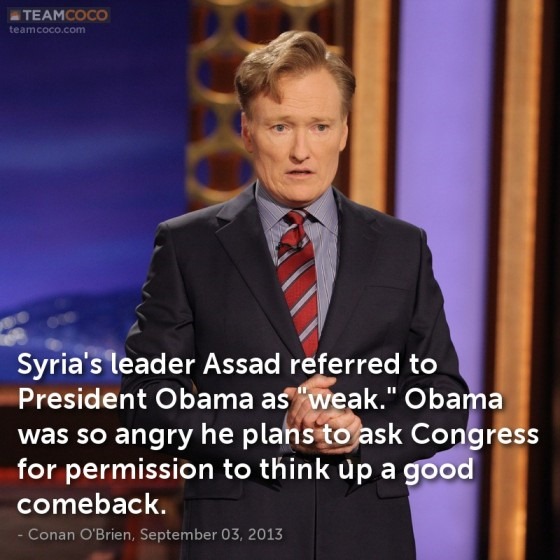
sep-3-2013-syria-s-leader-assad

This is a re-up of my monthly column for The Diplomat for November. Here is the original. I must say I don’t find the comments to be particularly helpful over there, so please give me your thoughts.

My primary argument is that the media is far too shallow in judging “US decline” on passing issues of minor relevance to the lineaments of American power. Remember two months ago, when Obama ‘had’ to act in Syria, even against Congress? That his very presidency was in peril, that American would be perceived as weak and lacking credibility? And now, no one is talking about that. Or then there was the idea that Obama missing APEC amounted to handing Asia to a bullying one-party state with a bad human rights record and no allies ‘rising China’? Good grief. Enough alarmism. Only the vanity of elites who think the very fate of the world hangs on their choices would lead one to believe that some missed meetings and airstrikes will change the balance of power. It won’t.

Always remember that Asian states need the US a lot more than the US needs them. US regional allies need us to hold back China, and even China needs us to buy all their exports and provide a savings safe haven. Sure, we benefit from cheap Asian exports and lending, but that’s a lot less important. The relationship is very asymmetric, and those who tell you otherwise are trying to cover the weakness of many Asian states and their desperation for US attention with bravado that America ‘needs’ Asia. That’s bunk. As I have been trying to argue on this blog for awhile, if they don’t want us in Asia, it’s no big deal for US security, and it’s an economic blow far worse for them than it is for us. And this is getting even more asymmetric as the US becomes energy independent because of fracking – so have fun fixing the Middle East, China! The US Founders identified the luxury of US distance from Eurasia long ago, so forgot all these hyperventilating Asian columnists (Kishore Mahbubani being the most obvious) who resent that America can be a lot more insouciant about Asia than vice versa. *natch Smile

Here’s that essay:

Continue reading

No More Neocon Faux-Cassandra Posturing: American Defense is not “in Decline”

Two pieces got emailed to me in the last few days that nicely illustrate just how entrenched semi-imperial thinking has become in Washington, how wildly disconnected from the reality of US security our foreign policy community’s threat assessments have become, and the hysteria that greets serious debate on DoD’s size in this post-Great Recession era of high unemployment and large deficits. This, by good-journalist-turned-disturbing-militarist Robert Kaplan, and this, by the ‘Iraq was a victory’ crowd at AEI. Here’s Kaplan:

“The bottom may be starting to fall out of the U.S. defense budget. I do not refer to numbers when I say this. I am not interested in numbers. I am only interested in public support for those numbers…. Actually, we might need a big army for an occupation of part of North Korea… The public, in short, wants protection on the cheap. It may not necessarily be willing to police the world with a big navy and a big air force at least to the degree that it has in the past — that is, unless a clear and demonstrable conventional threat can be identified.”

The rest basically follows the depressing neocon pattern: the (invariably hawkish and hegemony-loving) Washington foreign policy community know America’s interests, while the public is annoyingly ‘isolationist.’ If only they believed in the US globocop, (cue grave headshaking at our ignorance), then we wouldn’t have to write these sanctimonious, tsk-tsk op-eds. The AEI brief is even more predictable: throwaway boilerplate about the need for a strong defense in a world of unpredictable and diverse threats and all that. Got it already. Neocons and DC hawks have been saying that sorta stuff now for so long, that I really don’t even need to read this stuff anymore. And of course, any cuts automatically ‘reduce our readiness,’ the all-time favorite cliché of hawks everywhere as if somehow ‘only’ $680+ billion would leave us unable to defend ourselves. Come on, neocons! I thought you were supposed to be intellectuals. Stop recycling 1990s ‘indispensible nation’ bromides, and try a little harder.

Zack Beauchamp and Daniel Drezner’s correctives are very useful here. But here’s mine:

Continue reading

So What do you think of Open Access Journals? Ever Submit to One?

openaccess

I get these mailers from Sage and other academic presses a lot asking me to submit to open access journals. I have never done so, because SSCI peer-review is so absolutely central to what we do. But I feel really bad about that actually, because I absolutely detest paywalls.

I am a big supporter of open access. Like most academics, I think, I find it absolutely preposterous that journal publishers charge $30 to get to an article. It goes without saying that most students have limited means and will not pay that (nor should they). Such an ridiculous fee also punishes people in LDCs who don’t get access to JSTOR and the rest.

Barring some strong countervailing reason, like clearly defined national security concerns, knowledge should be open; it is a public good. While academics want to get paid like everyone else, no one joined this profession to get rich. We do it, because we enjoy the life of the mind and want to share ideas with others. I’m sure you’re rolling your eyes right now, but it’s true. Academics would rather win an argument and have you read their work than get paid. And they will willingly drain the fun out of everything to just convince you they’re correct about something. If we get paid along the way for that, that’s great. But most of are not doing this for the money. In fact, that is probably one reason we get no royalties on our articles. We don’t do it for that, and we probably don’t care enough to organize to push for it.

In sum, publishers simultaneously wildly overcharge end users while paying zippo to providers – all while violating a central academic tenet – that knowledge-production is not primarily about money. Yuck. This has to stop.

But we do of course need tenure and promotion, and the SSCI, especially the very top ones, are just about the excusive road to that. You may like blogging and teaching and mentoring, but peer-review is gold. Hence I never submitted to an open access journal. I don’t really like that, but I wonder what the answer is. Does anyone know?

My September Diplomat Essay: Relax – Chinese Hegemony in Asia is Unlikely

water_pollulation_shaoxing_zhejiang

The following is a re-up of a piece I wrote for the Diplomat last month as part of an informal back-and-forth series with the National Interest this summer on the US pivot to Asia and AirSea Battle. (Here and here are some of the other entries.) That pic, which has got to be the grossest river in all China, is from here.

In brief, I increasingly think that ASB is a mistake, because it’s almost impossible to read it as anything other than hugely provocative from the Chinese point of view, no matter what we say to them about our peaceful intentions. (Read this, and tell me reasonable Chinese wouldn’t flip out.) It’s a classic example of the security dilemma, but as I argue below, I am not really convinced that we actually need this high-tech, super-fearsome-sounding ASB right up in their face. More generally though, the pivot to Asia – a sharpening of American attention on the region, is probably a good idea. China is vastly more influential on American life than Israel or Iran. But the Middle East and Islam activates belligerent American religiosity so much, that I doubt we’ll really be able to pivot. In any case, the essay follows the jump and is written in an op-ed style.

Continue reading

Want to Guest-Post on my Website? b/c I need a Summer Break…

Special-Cool-Summer-Drinks

Traditionally over the summers, I take a break; too much blogging eats up research time, and I have an r&r I gotta finish.

But guest-posting is a nice option to fill in some down time. So if you like the kinda stuff I put up, please comment below or email me, and maybe we can work out a guest-post. Please stick to the sorta stuff I normally put here up – Asian security, US foreign policy, Korea, China, Japan, the Middle East.

Or if you need some reading this summer, here are the 5 best international relations books and articles I have read so far this year:

Don’t Come Home, America: The Case against Retrenchment,” Stephen Brooks, John Ikenberry & William Wohlforth, 2013

– yes, you probably already read it, but if you haven’t, it’s really important. I want to be a retrencher, because I think America has become infatuated with empire, but this is compelling case why that instinct is wrong.

Rebooting Republican Foreign Policy,” Daniel Drezner, 2013

– great summary of why I went from voting and working for the GOP (a congressman) in the 1990s, to sheer disgust today at the neo-con/Tea-Party mania that has unhinged traditionally sober and responsible Republican stewardship of US foreign policy

The Sovereign State and Its Competitors, Hendrik Spruyt, 1994

– fantastic ‘Big Think’ historical social science; the kind of product that justifies why we have political science as a distinct discipline; if I only could write historically-informed social science this good…

Comparative Historical Analysis in the Social Sciences, eds. James Mahoney and Dietrich Rueschemeyer, 2003

– if you like history and have never had a method class, this is a great place to start on how to do social analysis with history right

Path Dependence in Historical Sociology,” James Mahoney, 2000

– the single best essay I’ve ever read about how to build a proper causal argument chain; shoulda been assigned when I was in grad school 

Guest Post – Dave Kang: “International Relations Theory and East Asian History”

AHN_HOUSEIt’s always my pleasure to guest-post my good friend Dave Kang. Dave teaches at the University of Southern California, runs their Korean Studies Institute (the pic), and knows way more about the issues of this website than I ever will. So if you aren’t reading his work yet, you should be. Here are some previous guest posts he’s written (one, two, three).

Here is his encouragement that you actually apply international relations theory to East Asia. I can’t agree more. There is far too much superficial think-tank wonkery about East Asia (how many nukes does China have? will Pyongyang test another missile? and so on), and not nearly enough real theory. Dave does that and you should too. So instead of writing yet another essay about the South China Sea, the essays referenced below should be good encouragement to write something richer.

“Thanks to Bob for letting me borrow his website yet again. I have an article “International Relations Theory and East Asian History” that appears in the current issue of the Journal of East Asian Studies, edited by Stephan Haggard. In conjunction with this post, Lynne Rienner will make the article freely available to all for the next 30 days; you can download it here until October 1.

The entire issue is devoted to the international relations of historical East Asia. The special issue features essays by James Anderson, Kirk Larsen, Jiyoung Lee, Seohyun Park, Kenneth Robinson, and Yuan-kang Wang, all exploring different aspects of IR and East Asia in many disparate epochs and areas.

Continue reading

My ‘Newsweek Korea’ Cover Story: A Defense of Obama’s ‘Strategic Patience’ on North Korea

Newsweek Korea cover 2

Newsweek Korea asked me to participate in a cover story debate on Obama’s strategic patience. A friend of mine wrote against it; I wrote in defense. Here is the Korean language text at the NWK website. Below is my original English language version.

In brief I argue that NK is so hard to pin down, that big strategies never work with it, provoke North Korea into lashing out, and raise impossible expectations on democratic decision-makers. So Obama is acting responsibly, IMO, by not promising more than he can deliver and by not giving a reason for NK to act out.

After 20+ years of negotiating on more or less the same topics, it should be pretty obvious that NK is insistent on not being placed in some box by outsiders. It will not be treated as some technocratic ‘problem’ to be ‘solved’ by a conference of experts, like global warming or something. And it will lash out if necessary to remind us of that. Hence, I argue for ‘muddling through,’ and that we should stop expecting our policy-makers to have some great NK strategy that will fix the issue. That’s not gonna happen. We all know that. We just have to wait for China to stop paying NK’s bills. Until then, all the sweeping declarations (‘agreed framework,’ ‘sunshine’,’ the ‘axis of evil,’ the current big idea du jour of ‘trust’) are rather pointless and raise impossible expectations among voters in SK, the US, and Japan. Let’s be a little more honest about what we can expect from North Korea.

Here we go:

Continue reading

My Joint ‘Newsweek Korea/Japan’ Story: Do US Alliances Create Moral Hazard in Asian Conflicts?

Newsweek Korea coverI am pleased to say that the following essay was printed simultaneously in this week’s Korean and Japanese editions of Newsweek. It think it is critical for both sides to think about the issues I present, and it is pitched to both communities as American allies, no matter how sharp their disagreements.

In brief, I argue that – contrary to the conventional wisdom that US alliances in Asia tamp down conflict by re-assuring everyone that they need not arms-race against each other – US alliances may in fact be freezing those conflicts in place by reducing the incentives of all parties to solve them. The US reassures Asian states not just against each other, but also against their own reckless nationalist rhetoric and racially toxic historiographies. I think the Liancourt Rocks fight is a particularly good example of this ‘moral hazard’ mechanic, as is the recent comment by no less than the South Korean foreign minister (!) that Abenomics’ threat to Korean export competitiveness is a greater danger to SK than North Korea’s nuclear program. That kind of preposterous, reckless myopia can only be explained by taking the US security umbrella for granted. (Or how about SK officers’ golfing during last month’s nuclear crisis?)

I realize the argument will be somewhat controversial, even to Americans given that we are ‘pivoting’ to Asia, but I think it needs to be said and genuinely researched. As with my other Newsweek pieces, there are no hyperlinks because this was intended for print:

Continue reading

Good Survey of Students of International Relations: Please Complete if Relevant to You

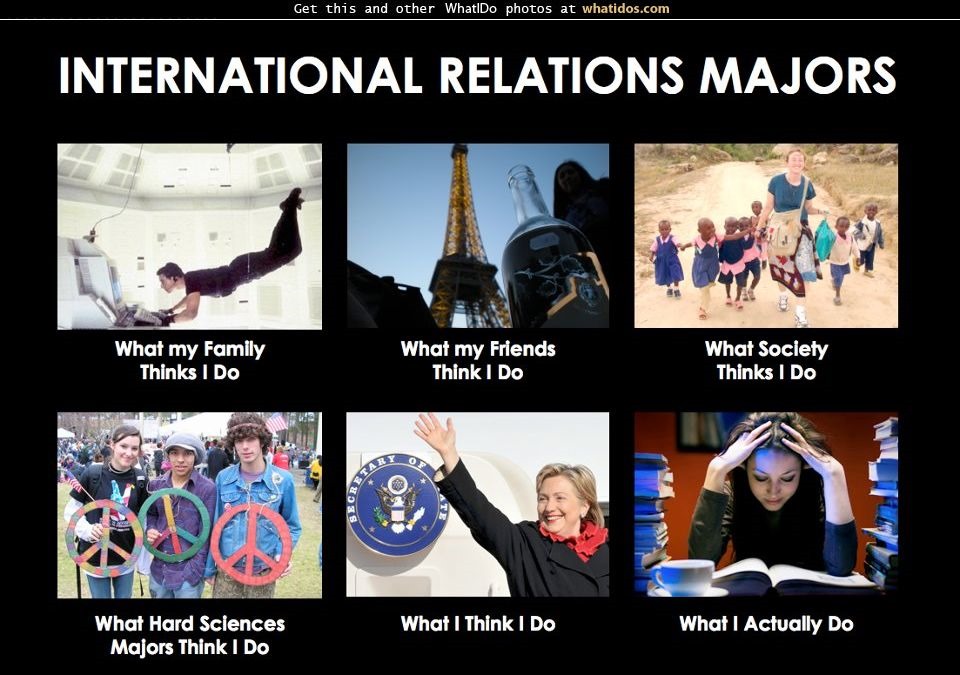
IR majorsDaryl Morini, an IR PhD candidate at the University of Queensland whom I know, has put together an interesting global survey for undergraduate and graduate students of international relations. It looks pretty thorough and might make a pretty interesting student couter-point to the Teaching and Research in International Politics (TRIP) report on scholars’ attitudes. Eventually the goal is an article on our students’ attitudes toward the discipline; here is the full write-up of  the project at e-IR. So far as I know, nothing like this has been done before (please comment if that is incorrect), so this strikes me as the interesting sort of student work we should support. Daryl’s also made an interesting effort to use Twitter as a simulation tool in IR, so I am happy to pitch this survey for him. Please take a look; Daryl may be contacted here.

PS: That pic is dead-on accurate.

My ‘Newsweek Japan’ Story on Korea’s Regional Foreign Policy: Being an Encircled Middle Power Sucks

Newsweek 3rd coverNewsweek Japan asked me to contribute an essay on Korean foreign policy for a special issue on current Northeast Asian tension. I also wrote the introductory essay for this special issue. There is one essay each on Japan, China, and Korea; mine is the Korean one. So this is a nice laymen’s review without too much fatiguing jargon. This was originally published in January, so this translation is late, but the points still hold.

In brief I argue that Korea’s foreign policy is driven by its geography. Korea is a middle power surrounded by three great powers, plus the most orwellian state in history. That position really, really sucks. The US alliance helps buttress Korea sovereignty in that tight neighborhood, but China’s rise is unbalancing everything, especially calculations for unification. Once again, there are no hyperlinks, because it was intended for print. Here we go:

“On December 19, Korea elected a new president, Park Geun-Hye. Park comes from the conservative New Frontier Party. The current president, Lee Myung-Bak, is also a conservative. Park will be inaugurated in late February. Her campaign presented her as more ‘dovish’ on foreign policy than Lee, but she represents greater continuity than her opponent, particularly regarding North Korea.

Korea’s foreign policy is heavily-driven by its geography. It is an encircled middle power that has frequently struggled to defend its autonomy against its much larger neighbors. And since World War II, it has faced the most orwellian country in history in a harsh stand-off that dominates Korean foreign policy. An opening of North Korea, leading to eventual reunification, is the central policy issue of every Korean administration. Beyond that, Korea’s central relations are with the United States, China, and Japan. All three structure Korea’s neighborhood and will significantly influence unification.

Continue reading