If you’ve ever read this blog before, you know I try to avoid the details of the Korea-Japan tussle. It gets so emotional so fast. Like most Americans, I want Japan and Korea to reconcile so they can work together on the larger, more important issues of North Korea and China. I don’t take a position on the Dokdo/Takeshima flap. I refuse to call the Sea of Japan the ‘East Sea’ (do you want to re-name the Korea Strait too?). When Koreans push me about the war, I try to deflect the issue. It is really not appropriate for outsiders, especially Americans, to weigh in on the details of Asian disputes. We can’t be an umpire to local fights, and our intervention would be seen as illegitimate by the losing party anyway. This is also the USG’s position: we have no position other than that we want all the parties to work out the disagreements without coercion or force. That’s the right attitude IMO.
Category Archives: Japan
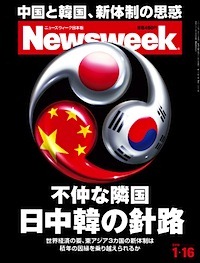
My ‘Newsweek Japan’ Cover Story on the post-1979 ‘Asian Peace’ & Economic Miracle
Newsweek Japan asked me to write an introductory essay for its January 16 special issue on tension in Northeast Asia (cover story to the left). I should have put this up 4 months ago, but I forgot and the arguments are still valid. Anyway, here is the link in Japanese, but I thought it would be useful to publish the original, untranslated version as well. (If you actually want the Japanese language version, email me for it please.)
The essay argues that Northeast Asia has benefited enormously from an ‘Asian peace’ in the last 35 years. All the remarkable growth in China and South Korea (as well as India and Southeast Asia) would not have happened without it. So fighting over some empty rocks (Liancourt Rocks, Pinnacle Islands) is a terrible idea. And for political scientists, the current Sino-Japanese tension is a good test of the hypothesis that economic interdependence brings peace. It’s fascinating to watch China especially try to figure out just how much economic gain to forego in pushing Japan over the Pinnacle Islands.
This was intended for their print edition, so there are no hyperlinks included in the text. Here we go:
“1979 was an important year in modern East Asia. It captures two of the region’s most important trends. It was the year of both the last serious military conflict between two East Asian countries – a Sino-Vietnamese border war – and the start of China’s capitalist modernization under Deng Xiaoping. These moments usefully frame the following thirty-four years: much of Asia has gotten substantially wealthier, and no major conflicts have broken out to upset that upward economic swing. This magnificent regional achievement has catapulted Asia, particularly East Asia, into the center of world politics.
What if US/Japan Try to Shoot Down a North Korean Missile & They Miss?
So my prediction that the North Koreans would launch a test missile on the ‘Day of the Sun’ – that would be Kim Il Sung’s birthday for you imperialist running-dogs yet lacking in proper ideological orientation – was wrong. Hmm. The North Koreans sure are good at keeping us guessing. Maybe they’re dragging this thing out, because they’re enjoying the time in the limelight. My friend Chico Harlan wrote in the Washington Post, ‘North Korea’s gone viral,’ and they gotta be lovin’ it. When else do we listen to them otherwise? (Here’s a collection of some of the NK humor.)
I still think there will be a missile launch, but I remain pretty positive there won’t be much escalation. I sketched an escalation path a few days ago. But despite being the most likely possible path to a conflict, I still don’t think it is in fact likely. Some comments, both on that post and privately made some good further points why escalation is unlikely.
Escalation in the Korean Crisis: What will the NK Military do if Japan Shoots Down the Missile Launch?
A few days ago, I predicted there would be no war, probably because I’m lazy and predicting the future will be the same as the present is an easy way to protect my credibility. However, I also noted that NK could get entrapped by its own belligerent rhetoric and be forced to escalate even if it doesn’t want to. I think this is why Kaesong was closed, for example.
I also noted how sanguine South Koreans are about NK, but foolishly, I didn’t really think about the Japanese. Then came the story about a mistweet by the city of Yokohama that apparently created local panic.The Japanese seem far more nervous about this than South Koreans, and NK did launch a missile once over Japan. The Japanese have also been talking a lot tougher, and Abe is clearly a hawk on NK. So here is the most likely escalation pathway I can see, despite my firm conviction the North Koreans do not want a war, because they will lose badly and quickly, and then face the executioner in Southern prisons:
USC-CSIS Conference on Korean Unification (3): DPRK ‘Sovereignty’ is a Sino-Russian Fig-Leaf to Slow Unification and Check US Power
Here are part one and part two of this post. I spoke last Tuesday at a USC-CSIS conference on Korean unification. I learned a lot, and it was very good. If you’re interested in unification, start here with the primary report on which the conference was based. The principal investigators said a final wrap-up report will come at some point, and I’ll put up that link when it arrives.
My comments below are on the papers presented on Tuesday about neighboring states’ reactions to Korean unification. These papers aren’t publicly posted yet, so all the comments might not make sense. But in the interest of completism, I’m putting this up to round out my thinking on this excellent unification project. (For my earlier thoughts on dealing with NK, try this; for my travelogue of my trip to the DPRK, try this.)
My big beef with these sorts of conferences on NK – I go to a lot – is that inevitably outsiders, especially Chinese scholars, start laying down all sorts of guidelines, restrictions, parameters, etc. for unification, as if it’s our right to muck around in this thing. I can understand the national interest in doing so. But we shouldn’t have the temerity to try to legitimate our muddying of the waters in what is really an internal family affair. It would also help a lot if the Chinese would stop talking (not so much at this conference, but definitely at others I’ve gone to) about how Korea needs to respect its wishes, because China is big and important now, post-2008 Olympics. I heard one guy once even say that China is now the ‘veto-player’ on unification. That’s true of course in realist sense, but that sorta cockiness infuriates Koreans who’ve really soured on China in the last decade. I see the same kind of emergent Chinese bullying on unification that Southeast Asian littoral states see on the South China Sea. So I try to call that out whenever it seems necessary.
Anyway, here on my thoughts on Japan, Russia, and China’s role in this thing.
Abe’s Election, and why Korea should Not Worry (too much)
Seoul English radio asked me to speak last month on Shinzo Abe’s return as Japanese prime minister. (Here is the program I speak on several times a month, and I will be on again tonight at 7:45 pm KST.) I didn’t get a chance to put up my thoughts on Abe earlier, so here we go.
Abe is fairly controversial, because he’s a nationalist and made the wrong noises in the past about Japan’s war crimes in WWII. But I also think he is tactically smart enough to avoid openly provoking the Koreas and China on that. Watch for whether or not he moves to alter the Kono Declaration. That is the big benchmark to focus on. Unfortunately Abe has grumbled about changing it, but I don’t think he will. Similarly, while he has visited the Yasukuni Shrine, he did not do so when he prime minister before. So my sense is he’s reasonable intelligent on these issues, even if the Japanese right continues to be disturbingly unreconstructed about the war. But at least Abe’s trying to talk with Korea again after the implosion of relations last year. That’s a big of progress.
Anyway, the interview follows the jump.
My ‘Newsweek Japan’ Cover Story on Korea’s Economy: De-Concentration Needed
Newsweek Japan asked me for a long-form essay on Korea’s economy for its December 5, 2012 issue (cover story to the left). Here is the link in Japanese, but I thought it would be useful to publish the original, untranslated version as well. (If you actually want the Japanese language version, email me for it please.)
The essay broadly argues that Korea needs to move beyond ‘developmentalism’ toward economic liberalism, as a lot of Asia does in my opinion. Regular readers of this blog will see themes I have emphasized before. This was intended for their print edition, so there are no hyperlinks included in the text. Here we go:
“As Korea’s presidential election moves into the home stretch, the local economic discussion is sharpening. Inequality, demographic collapse, massive concentration of economic weight in a few mega-conglomerates, weak consumer purchasing power, growing trade friction over intellectual property rights, and a chronically under-powered small- and medium-enterprise sector (SME) are among the major problems this outwardly very successful economy must confront. Unfortunately, none of the major candidates are pushing the deep reform needed to fix these underlying issues. As with China’s leadership transition, things seem so good at the moment that elites are wary of rocking the boat; as with the recent American election, tough choices will likely once again be kicked down the road. In Korea’s case, that means moving away from its ‘developmentalist’ growth model before encountering troubles similar to Japan’s.
More on US Allies (2): A Response to My Critics
I found the above image here.
Here is part one of my response to two recent, heavily-trafficked posts (one, two) on hypothetical retrenchment under Ron Paul. (So yes, that makes 4 total posts, including this one.) I got some flak on how I ranked US allies in order of importance, with the implication that those further down were more likely candidates for a diminished American commitment. So rather than responding point-by-point, here are some broad responses on specific countries.
My original ranking, in order, was: Canada, Mexico, Saudi Arabia, Taiwan, India, Indonesia, Israel, South Korea, Japan, EU/NATO, and Egypt. (That’s actually 11, not a ‘top 10,’ because I originally put Canada and Mexico in together at # 1.)
1. I was surprised how much controversy my choice for Canada at # 1 provoked. I thought that was pretty self-evident actually. (Stephen Walt, in a riff on my post, says pretty much the same thing.) Just because Canada is quiet and boring (in a good way) doesn’t mean it is not existentially important for the US. (This same logic, boring ≠ unimportant, applies to my choice for Indonesia. The very fact the Indonesia is a moderate Muslim state is why no one cares about it, but that is a good thing! I guarantee you that if Indonesia had nasty salafists running around like in the ME, we’d all be talking about it.) The US trades the most in the world with Canada. We expect Canada to come with us on just about all our foreign ventures. Its cooperation provides crucial symbolic value: if the country most like us in the world can’t agree with us, then we must be doing something wrong. And most obviously, its security is a direct concern, because of the border. In fact, given that the border is something like 3x the length of the US-Mexico border, Canada easily beats every other state in the world for the most basic US national security concerns.
2. Japan (#9): A good commenter noted that after WWII, the US wanted to make Japan into the ‘Switzerland of Asia,’ and that we are reaping what we sow. Absolutely. I do think Americans send mixed signals to allies. We don’t want them taking an independent line, we want them to do what we say, but then we complain that they free-ride. As I argued in the OP, all this US commitment ‘infantilizes’ US allies by not forcing them to deal with their own regional issues. But Americans, or rather the neocon-liberal internationalist elite synthesis that dominates US foreign policy discourse, ultimately accept weak, dependent allies, because we are in love with our own hegemony. It fires our imagination to compare ourselves to Athens, Rome, or Britain. Neocons read Pericles’ Funeral Oration or Gibbon, and they tear up that America too is the noble, tragic ‘weary titan,’ carrying the great orb of its world-historical task of spreading democracy. Americans thrill to that kind of ‘national greatness’ pseudo-metaphysics while Europeans roll their eyes in disillusionment and Asians wonder wth we are even talking about. So yes, free-riding is pretty obvious to see, because we abet it.
Say Ron Paul Won…Which US Allies would get Retrenched? (2) Japan?
This post series is getting so much traffic, here is a part three on likelihood of retrenchment. Here is part one where argued that America’s 8 most important allies are, in order: Canada, Mexico, Saudi Arabia, Taiwan, India, Indonesia, Israel, and South Korea.
I argued for 3 quick-and-dirty reasons for that ranking, but I got some criticism on these in the first post, so here is some elaboration :
1. National Security: Some places, like SA and Mexico, may not appeal much to Americans, but they are so obviously important, that abandonment would be hugely risky. So yes, SA is a nasty, reactionary ‘frenemy,’ not really an ally at all, but we’re stuck with it. A Saudi collapse would set off both huge economic and Islamic religious turmoil; all the more reason to slowly exit the Middle East and pursue green energy. But until then, I think we have to be honest and say that we can’t really leave the Gulf. But the bar of this criterion should be awfully high. With some frenemies, like Afghanistan and Pakistan, we don’t really need to pretend to be allies actually. We can just get out if have to.
2. Need: In some places, the US can get a lot more bang for its commitment buck, because without us, our ally would likely collapse/lose/fail. Taiwan is the most obvious example. Conversely, other places, like Germany, pretend to need us, because they don’t want to shell out the cash (and we’re so bewitched of our God-given, history-ending, last-best-hope-for-mankind, bound-to-lead neocon unipolar awesome-ness that we let ourselves get taken for a ride).Between Taiwan and Germany, I would place Israel and SK.
3. Values/Symbolism: I don’t like this criterion much, because it reminds me a lot of McNamara, ‘credibility,’ Vietnam, the Munich analogy and all that. But still, there are a few places where the American commitment has taken on an almost ‘metaphysical,’ good-guys-vs-bad-guys dimension. The whole world is watching, and a departure would be seen as a huge retreat from critical values that would bolster dictators everywhere, especially in China and Russia. SK is the most obvious example. NK is so bizarre, frightening, and horrific that while the US commitment isn’t really that necessary anymore, it’s taken on a symbolism wholly out of proportion to events on the peninsula. Taiwan also comes to mind, as does cold war West Germany. Avoiding another such perpetual commitment was one of the important reasons to get out of Iraq. If we’d stayed, we might have have gotten chain-ganged into never leaving our symbol of GWoT ‘success.’ We really don’t need more of that sort thing
So back to the list. Now come the ones that can more easily be retrenched, because either they are wealthy enough to defend themselves, or their value to the US has fallen:
The World Does its Duty & Conforms to Social Science: More on Korea & Japan
If academia’s taught me anything, it’s that the real world is flawed not theory, and that facts should change for me, not the other way around. As Marxists would say, ‘future is certain; it’s the past that keeps changing,’ and Orwell famously quipped that academics would love to get their hands on the lash to force the world fit theory. (I guess Heinlein agreed; check the vid.) So I am pleased to say that the world meet its obligations to abstraction this week a little: Japan and Korea edged a little closer toward a defense agreement (here and here). A little more of this, and I can safely ignore – whoops, I mean ‘bracket’ – any real case knowledge…
Last week I argued that Korea and Japan seem like they’d be allies according to IR theory, but weren’t. I wrote, “Koreans stubbornly refuse to do what social science tells them;” obviously they don’t realize that abstraction overrules their sovereignty. I thought this was fairly puzzling, but got an earful from the Korean studies crowd about how I was living in the clouds of theory. I also learned that area studies folks really don’t like it when you throw stuff like ‘exogenous’ and ‘epiphenomenal’ at them. Once they figure what ‘nomothetic’ actually means, they think you’re conning them. D’oh!
So for those of you argued I didn’t know anything about Korea but was just blathering on about theory that had no necessary time-space application to this case, I thought I’d put up this bit from Starship Troopers. It’s hysterical – when PhDs rule the world, apparently the military has to step in to prevent us from running it over a cliff. Didn’t Buckley once say he’d rather the first 2000 names of the Boston phone book run the US government than the faculty of Harvard?