China, Japan, and these Fights over Islands

diaoyut


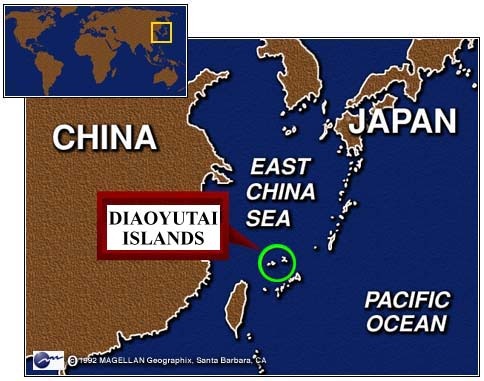
There has been lots of good commentary recently over the China-Japan flap about the fishing captain. (Start here and here.) I tend to agree that China is setting itself back 5 to 10 years with the neighbors, and that this is the somewhat predictable behavior of a ‘rising’ state. Just about everyone expects China’s appetites to grow as its power grows. It is reasonable to expect China to get pushier in its backyard as it grows, just as the US did in Latin America in the late 19th century. I have just a few extra thoughts:

1. All these left over island disputes leave China (and Japan, Korea, Russia, and ASEAN) with lots of friction points. Just last week, the Japanese told the Russians not to visit their disputed islands either. The standard liberal internationalist answer would be to create some joint committee (indeed, boundary demarcation is one of the few things the World Court does well) to iron out the details. But this has never really happened out here, as it has in other places, like South America, where geography also created confusion. (In SA, it was the highest peaks of the Andes that made the lines unclear.) But in Asia, I have the sneaking suspicion that these island/sea disputes never get resolved in part, because domestic elites don’t really care that much; indeed they may like having them around once in awhile for patriotic rallying purposes. They serve an unremarked domestic utility: These disputes are low cost. They can simply be ignored when necessary. A few rocks here or there have no real economic value; according to UNCLOS, if the rocks are uninhabitable without external provision (ie, food and potable water must be transported in), then possession of the islands has no impact on the claims to the surrounding water either. That is why fishermen so frequently seem to spark these flaps; the seas are wide open to everyone. But because these conflicts-in-waiting are always still hanging around, they can be turned on and off at will – whenever domestic leaders need a rally-round-the-flag effect. This is probably especially useful for deeply illegitimate regimes like China or Russia, or in Japan with its endless rotation of governments in search of credibility. In this, I am reminded of the oft-made accusation that Israel’s Arab neighbors don’t really want the Palestinian-Israeli conflict resolved, because it is a nice deflector of public unhappiness at home.

2. One unremarked deep cause of these flaps is Japan’s slow erosion. Most of the excitement focuses on rising China. But just as important is the steady decline of Japan. If Japan were still rising, as it was until the 1990s, the competition here would be quite different – two rising powers side by side (like India and China). But in the western Pacific, China is walking away with the game because both the US and Japan are in decline, and ASEAN remains in its perpetual disorganized dither. This would create space for China, even if it weren’t booming. But it is, hence doubling the power shift. In fact, this is the weakest Japan has been vis China since the Opium War upended China-Japan relations 170 years ago. This is the most important Asian balance of power shift since the West arrived in East Asia. We are moving back toward the 18th C (not the 19th), when China was dominant in the neighborhood.

3. The Chinese leadership is increasingly boxed in by nationalized opinion. 20 years of patriotic reeducation on the national humiliation has created an unhappy nationalistic youth in China with prestige grudges against Japan and the US. As China gets wealthier and more connected, it will become harder and harder for the CCP to avoid dealing with this, and these island fights are a useful outlet, per point 1 above.

4. China will have a harder time carving out a backyard than the US did. Latin America has been weak for centuries and the rest of the world was far way, so there was an easy vacuum for the US to fill. In Asia, China is next to India, Japan, South Korea, and, a bit further out, Australia. All of them have a much better capacity to push back than Mexico, Argentina, or Brazil ever did. (PS: The Economist says the Monroe Doctrine is dead now. I don’t buy it.)

Unrising Sun – Japan as the Austro-Hungarian Empire

images

Perhaps the biggest Asian security news of the summer is the high-profile marker of the shifting tectonic plates out here – China’s surpassing of Japan as the world’s second largest economy. You know your society is in real trouble when being displaced like this is termed a “relief” by a fellow citizen on the New York Times op-ed page. Is anyone in Japan really relieved that China has pushed it aside this way? China’s meteoric growth is nerve-racking enough, but who wants to live in a society that wants to be eclipsed? To boot, how should Japan’s allies/partners on the China question (US, Korea, India) respond to a society that is “shrugging” over its decline?

So this made me think of the fin-de-siecle Austro-Hungarian empire. Maybe there is something romantic in the twilight pessimism of fading greatness coupled with high culture? I remember Poindexter asked in Revenge of the Nerds, ‘would you rather live in a society during its rise or its decline?,’  and maybe there is something lush, overripe, decadent, boozy, and deliciously self-conscious about watching one’s own tragedy (think about the character of Hayward from Of Human Bondage). Contrast this with the regular hysteria that greets the bout of American declinism that besets the US every generation. Americans go into neurotic fits, and start talking about moonshots, new frontiers, mornings in America, new foundations (Obama), etc. By contrast, Kingston wisely asks after yet another dreadful summer for Japan, can anyone govern it anymore? Increasingly you don’t need to be a Japan expert to think the answer is not really…

The sociological questions for Japan broached by this are beyond my skills, but the international consequences can’t be good. This slow eclipse of liberal, democratic, modern Japan can’t make Asia anymore secure. It will only bait China more, scare Korea more toward a separate regional deal with China, and pull the US deeper into Northeast Asia at a time when we desperately need to constrain defense spending and commitments. India, for all its ‘emerging’ potential, still can’t really compete with China as Japan might. In effect, this cedes regional order building to China: Japan won’t try, the US can’t afford to it, and India is still to0 immature to contest it. Normally we think of rising challengers battling leaders to primacy – Wilhelmine Germany v. Britain, the USSR v. the US. But in Asia at least, China is taking the game as much by the failures of the rest as by its own abilities. Note also, that as China takes over Asian leadership by default, it becomes impossible to test its real intentions.  Much of the debate over China is whether or not it is prepared to use to force in the future to get its way. Increasingly, it looks like we won’t know because the democracies are simply abdicating the game to it.

So I’ll ask the same question Kingston does, what needs to happen to get Japan back in the game? Have they really just dropped out to become the Switzerland of Asia?

The Six-Party Talks as a Game Theoretic ‘Stag-Hunt’ (2): China Likes the Rabbit Too Much

hackaert-stag-hunt-forest-NG829-fm

Part one of this post is here.

In the formal language of game theory (GT), here is the pay-off matrix for the hunters (SK, PRC, Japan, Russia, US) if they capture the stag (NK’s better behavior in the region):

1. SK: SK is the most obvious winner from taking the stag because NK is an existential threat to the South – both physically and constitutionally.

2. Japan: Japan is the second big winner, because the NK nuclear and missile program increasingly represent a major physical threat to its cities, and perhaps even an existential threat if the North can put enough nukes on missiles.

3. US: The US is a weaker winner, because it is far less threatened by the North directly. The big pay-off from NK change (the stag) would be the reduction in troops and other expense from keeping USFK in Korea. Another benefit would be the reduction in the post-9/11 concern for proliferation of missile and WMD technology to terrorists and rogue states. But this is still far less critical than SK and Japan’s benefit. To the US, NK is more a troublesome, throwback-from-the-Cold-War headache when it would rather concentrate on salafism and the rise China.

4. Russia: Russia has essentially no stake in Northeast Asian security, given that it has basically retrenched from the region to focus on Central Asia and Eastern Europe. However, the Six Party talks are a prestige-generator for a country desperate to still look like a great power even as its lineaments erode. So Russia doesn’t get much from the stag.

5. China: The PRC’s portion of the stag is the smallest, while its rabbit is the biggest. A more docile NK would almost certainly fall heavily under the influence of its southern twin. The more ‘southernized’ NK becomes, the less sinified it will be. (This of course is the whole point from the Korean perspective – reunification.) And the PRC almost certainly reads greater southern influence in the North as greater American influence. So the Chinese rabbit is the long-term survival of a separate NK state to act as a buffer against the democracy, American influence, liberalism, and Korean nationalism that would all flood into NK were an inter-Korean settlement (the stag) finally struck. (A friend at the Renmin University of Beijing all but says this here, and I generally find Chinese scholars will openly tell you why the PRC props up the DRPK even though the PRC’s official policy is reunification.)

What to do then? How do the other hunters get China to stop defecting and start cooperating? The most obvious way is to equalize the pay-offs more, i.e., make it more valuable for China to coordinate by increasing China’s portion of the stag. Here is where strategic restraint on the Cheonan sinking may be useful. If SK holds its fire over the incident, it may be able to ‘sell’ this restraint to China as a hitherto unrecognized benefit. The SK claim to China would be:

See how small your rabbit really is? NK is so unpredictable, so erratic, so uncontrollable, that the stag is more beneficial than you think. Without a long-term settlement, NK’s erratic behavior could eventually generate a crisis the SK population will no longer choose to overlook. Next time this happens, SK government may be forced by popular outrage into coercive retaliation that could pull everyone in northeast Asia into the vortex.

Recall in early 1991 that Israel demonstrated similar strategic restraint as Saddam Hussein shelled it with Scuds before Desert Storm. This helped convince Saddam’s Arab neighbors that Saddam really was a danger to everyone. SK might be able to do the same here.

However, this is unlikely to be enough. China will probably as for a higher concession – a promise for the removal of USFK after unification. It is not clear to me if a unified Korea would need USFK, so this may be an option to explore.

Six-Party Talks as a Game Theoretic ‘Stag-Hunt’ (1): N Korea is the Stag

stag_hunt

Last week, I suggested that South Korea demonstrate ‘strategic restraint’ vis-a-vis NK if the North truly sank that SK destroyer. Not only are the South’s tactical response options terrible, but there is benefit here to be captured if the South’s restraint is marketed to China as a concession in exchange for more pressure on the North. For all of NK’s reputed autarky, it is in fact highly dependent on Chinese aid and trade, both licit and illicit. Without Chinese fuel oil, the lights in the North would go out; without the imports of booze, dollars, and pornography, the life of the Korean elite would be far less pampered. China cannot force the NK to change, but it can dramatically raise the costs of its continued intransigence.

All this is well-known but could be helpfully formalized in our research. In fact, I am surprised how little game theory (GT) I see applied to NK at the conferences here in Asia, given how obvious its utility is to the bargaining and brinksmanship endemic in NK foreign policy.

The stag-hunt (SH) is the best GT model or ‘game’ by which to map Northeast Asia’s security dilemma. We use GT all the time in IR but usually the prisoner’s dilemma (PD). (If you have no idea what I am talking about, start here for GT in IR; the Wikipedia write-ups, linked for the SH and PD, are actually quite good too.) The PD is cooperation came – how do you get the players to cooperate when there are high incentives to cheat on each other. The stag-hunt is better understood as a coordination game – how do you get the players to coordinate a common strategy to get the big pay-off, the stag.

Here is the basic schematic: a group of hunters can probably bag a big stag if they work together. They can weave a net around the stag that is likely to catch him. However, the hunters will also see the occasional rabbit bounce by. If one of the hunters goes for a rabbit, the stag will escape through the hole created and the other hunters will lose the stag almost certainly. Formally put, the stag is a big pay-off, and there is a good probability of successfully catching it if the hunters all coordinate. Conversely, the rabbit is a sure thing, but a much smaller, payoff. So the trick is to convince all the hunters to coordinate and not take the easy rabbit by cheating or ‘defecting’ on the other hunters.

So apply this to the Six Party Talks: The Hunters (players of the game) are the 5 parties besides NK: Japan, US, SK, Russia, and China. The Stag is North Korea, or more specifically change by the NK regime. The NK stag knows that if the 5 hunters can’t cooperate, it can escape. And it is widely noted that this is exactly what NK has done for decades. NK’s foreign-policy methodology since the 50s has been twisting and turning to prevent domination. Since the end of the Cold War, this has meant a constant ‘divide-to-survive’ effort aimed at the other 5 parties to prevent their coalescence into a united front against the DPRK. (I even wrote a book chapter about this, in galleys here.)

So the trick then is to build a common front among NK’s hunters to insure that they won’t defect or cheat and go for the rabbit. The rabbit in the NK case would be NK concessions to one party, but not the others: for example, abductee returns to Japan, family reunions for SK, mineral exploration rights for China, etc. These piecemeal, now-one-but-not-the-other concessions are all designed to keep the other 5 players off-balance and disunited. To date this has worked spectacularly well, even though the 5 hunters all know they are getting shamelessly manipulated.

The big problem to date for the hunters’ coordination is that China sees a lot of gain from taking the rabbit. The Chinese rabbit is in fact so juicy, it probably outweighs the tasty stag. The Chinese rabbit is a route of influence into the Korean Peninsula through North Korea’s continued existence. The big stag – change in NK to be a better international citizen in Northeast Asia – is of much greater value to SK and Japan, followed by the US, than it is to China. So long as China perceives a utility from NK as a buffer against SK, Japan, and the US, it is likely to continue to defect on 5 party cooperation, as it did last year, and take the rabbit of propping up NK in order to influence Korean events.

Part two is here.

Asia’s Nasty History Fight, Korean Edition: Jung-Geun Ahn

201003270009

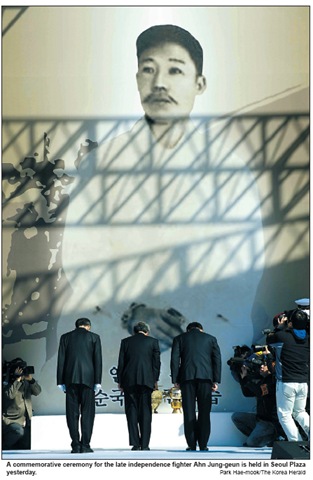
This week on the radio, I talked about the persistent conflict over history and memory in East Asia. March 26 was the 100th anniversary of execution of Jung-Geun Ahn, a Korean nationalist who assassinated the first Japanese Governor-General of occupied Korea, Ito Hirobumi. For the Korea version of the story, try here. For the Japanese ‘version,’ try here. Ahn is treated as a national hero here. He is referred to Korean history textbooks as ‘the Martyr’ and the ‘Patriot.’ Japan’s occupation ran from 1910 to 1945, although slow-but-steady annexation had been ramping up since the 1880s. The occupation was pretty vicious, including the mass impressment of ‘comfort women’ and cultural japanification efforts that included the elimination of Korean names! If you don’t know too much about the endless history/memory conflict between Japan, China, and Korea, the transcript below is a good place to start.

American readers might want to take special note of the fairly embarrassing information contained in the transcript’s last few paragraphs.

The Japanese really ought to be worried about this stuff. 60 years after the war, and they still can’t really talk to the Koreans and the Chinese. The Japanese right’s recalcitrance on history has isolated Japan for decades, and as Japan’s decline continues, the price of this isolation will rise. When China was a mess 30 years ago, and Korea was still a NIC (Newly Industrializing Country), first world Japan could strut like this. But today the gap between Japan, and Korea and China is narrowing, and the Japanese would do well start thinking of a serious, Willy Brandt-style apology tour. Without that serious, German-style soul searching, no one will ever trust Japan, they’ll be indefinitely dependent on the US,  and they’ll stand no chance to get that UN  Security Council seat.

_______________________________________________________________________

TRANSCRIPT – DR. ROBERT E. KELLY, PUSAN NATIONAL UNIVERSITY

BUSAN E-FM: “MORNING WAVE”

MONDAYS, 8 AM

March 29, 2010

BeFM:

…this week we are going to discuss Korea’s foreign affairs at the time Ahn Jung-Geun’s death and the start of Japanese occupation. Hi, Dr. Kelly.

REK:

Hi, Petra. Thanks for having me

BeFM:

Thanks for being with us again today.

REK:

It’s my pleasure.

BeFM:

Usually, we talk of contemporary Korean affairs, but this seems like an interesting topic given the recent 100th anniversary of Ahn Jung-geun’s death. How is this relevant though to Korea’s contemporary foreign policy?

REK:

Well, memory plays a major role in Korea’s relations with its local neighbors and with the United States. A central Korean narrative about Korean history is betrayal and manipulation by Korea’s neighbors resulting in a very harsh, frequently bloody twentieth century. As Koreans well know, historical disagreements with the Japanese are a regular feature of East Asian international relations. So the celebration of Ahn’s assignation of a Resident-General Ito Hirobumi is a deep reminder of that a competitive relationship with Japan persists.

BeFM:

That’s true. So, does this celebration irk the Japanese? And does that make any difference?

REK:

It almost certainly does the former. I am not surprised at all that the Japanese have found it so conveniently difficult to find the body. A central Japanese narrative about its occupation of Korea is that it was good for Korea. This is what I meant by the deep division over memory. What Koreans call imperialism, the Japanese call the modernization of Korea. In Japan, the Pacific War is marketed by Japanese conservatives as an effort to free East Asia from white imperialism and to spread modernity. Korea and China find such an interpretation self-serving, and the Korean commemoration of Ahn’s death is a pointed way to remind that Japanese of that. It’s a tough, emotionally-loaded conflict over remembrance.

BeFM:

And how is this relevant to Korean foreign policy now?

REK:

Well, Korea and Japan, despite their historical antagonism, actually share certain values and interests in East Asia. Both are liberal democracies; both are US allies; both worry about North Korea and the rise of China. So from an American perspective, it is fascinating, and perhaps frustrating, to see Korea and Japan cooperate so little. My students frequently ask me why there is nothing like NATO or the European Union in Asia, and the first reason I give is that the US’ two major allies and the region’s two wealthiest democracies can’t seem to agree on much, such as history or Dokdo.

BeFM:

So Korea and Japan should collaborate more?

REK:

Well, ‘should’ is a tough notion here. Certainly the US would like that. Korean-Japanese reconciliation has long been a US policy goal, but honestly, the US has basically given up pursuing that. The US military works independently with each military, despite the geographic proximity. I find most Koreans warm to the prospect on reconciliation, but they insist on Japanese apologies first of course, including for the execution of Ahn one hundred years ago last Friday.

BeFM:

But you sound like you don’t really expect the Japanese to apologize…

REK:

That’s right. I don’t. And here I sympathize with Korea a great deal. The longer I have lived here and the more I have learned Korean history in detail, the less tenable the Japanese claim of modernization or defense against white imperialism becomes. It is not clear at all of course that Koreans in 1910 wanted to be ‘modernized,’ especially by foreigners, and it is simply ridiculous to assert that Japan saved Korea from white, western imperialism, because there wasn’t any of that here. It was more in southern China and southeast Asia. So it’s hard to argue that Japanese imperialism here was not just as bad as imperialism was anywhere else…

BeFM:

So what about an apology? Various Japanese figures have apologized before, but no one really seems to believe them.

REK:

That’s right, and it’s one of the most frustrating parts of the history debate for everyone involved. I think the Koreans and Chinese want the sort of apology the Germans gave to eastern Europeans and Jews after World War II. In the 60s and 70s, democratic Germany really opened up about the Nazi past. The concentration camps were researched and preserved. Germans leaders went on good will and apology tours. Much of it was very moving, and Germany’s neighbors genuinely accepted that the Germans were sorry and should rejoin the European community. This worked well, and when Germany sought to reunify, no one really thought the new Germany would be a new threat. By contrast, Japan’s historical debate is still where Germany’s was in the 50s. It is clouded by nationalism, romantic notions of the past, and an embarrassed unwillingness to look at the nasty details, such as the comfort women or the elimination of Korean names.

BeFM:

So the apologies aren’t meaningful without more historical soul-searching?

REK:

That’s exactly why they are so unconvincing. The usual pattern is that some Japanese official gives a vaguely-worded apology. Then some other official or parliamentarian cuts loose unofficially about how Japan should not need to keep on apologizing. All this gets picked up in the Korean and Chinese media, and the whole story recycles itself. This is why so many want the Japanese emperor to apologize, not just some foreign ministry official, and this is also why the commemoration of figures like Ahn will continue in Korea. Remember that Kim Il Sung is celebrated in this way too, in the North, as an anti-Japanese patriot. If the Japanese ever want this to cool, they are going to have to try a lot harder.

BeFM:

So Ahn is directly related to the continuing general tension between Japan, and China and Korea. Ok.

REK:

Finally, it would be remiss if I did not mention that US abandonment of Korea to Japan at the time. I find that Americans don’t know this too much, perhaps because today the US-Korean relationship is so tight. But your US listeners should probably know that we sold Korea up the river to Japan in 1905. It is fairly embarrassing…

BeFM:

The Americans had a role in the occupation? Ah, the Plymouth Treaty…

REK:

That’s right. In 1905, the Japanese emerged as a major global power by defeating Russia in a naval contest. The US president at the time was Theodore Roosevelt, TR. TR invited the Russians and Japanese to Portsmouth, New Hampshire in New England in the summer of 1905 to arrange a treaty. One of Japan’s demands was domination of Korea. The US unfortunately agreed, and Japan fully annexed Korea five years later. This was the context in which Ahn assassinated Hirobumi. It’s a sad story, and one in which the US part is rather poor. Most Americans here don’t know about this, but they obviously know that American soldiers died in the Korean War. Fairly convenient to re-tell your history that way, do you think?

BeFM:

I think these sorts of history debates will only accelerate this year as we approach the 60th anniversary of the outbreak of the Korean war. Thank you for being with us again today.

Korea’s Slow Boiling Demographic Crisis

Year Total fertility rate Rank Percent Change Date of Information
2003 1.56 193 2003 est.
2004 1.26 218 -19.23% 2004 est.
2005 1.26 214 0.00% 2005 est.
2006 1.27 213 0.79% 2006 est.
2007 1.28 205 0.79% 2007 est.
2008 1.2 216 -6.25% 2008 est.
2009 1.21 217 0.83% 2009 est.


This week on the radio, I talked about the rapidly aging population of Korea and its effects on Korea’s foreign relations. Please see the transcript below.

The above chart is available here; it is based on CIA data available here. ‘Total Fertility Rate’ means an average Korean female’s total number of children in her lifetime. ‘Rank’ indicates where the ROK fits among the 223 states and entities ranked by the CIA in terms of total children per female. Korea has one of the lowest replacement rates in the world. Note that even North Korea’s replacement rate is higher!

You hardly need to a be a political scientist to see the impact of population. Most of the time, people think of overpopulation as the great issue. In the 70s of course, we talked about a ‘population bomb,’ and Charelton Heston told us that Soylent Green is made of people. For the ur-classic in this area, read Malthus (the Norton Critical is superb). But for wealthy countries, the big deal is the opposite – aging and slow depopulation. (For a good introduction to the “Demographic Transition,” try ch. 19 of this.)

For IR the ramifications link directly to national power. Korea has very clear aspirations to great powerdom. It desperately wants to catch up to the weakest, flagging great powers like Japan, Russia or France. And it might; particularly if it can unify successfully sometime soon. But without people this  is simply impossible, and the collapse of Korean fertility portends all sorts of problems, not least of which is the slow loss of ability to climb the G-20 ranks. To see just how bad depopulation can ravage national power, look at Russia, which is literally imploding. Look here, at the chart at the bottom, to compare the ROK’s population trends to its big neighbors.

Dramatic population contraction will halt Korea’s otherwise successful rise the up the G-20 ranks, and provoke a nasty, divisive ‘culture war’-style domestic debate on immigration (somewhere Glenn Beck is smiling). Korea is one of the world’s most ethnically homogenous countries; only about 2% of the resident population is foreign. Immigration here is mostly a work-value and bride-importing affair. Very few (like me) actually reside permanently here.

All this is going to have to change though if Korea really wants to be a great power. Unless Korean women can be dramatically re-incentived (discussed in the transcript) to child-bear, and a lot, Korea will either have to become a multicultural society with sustained immigration (most likely from Southeast Asia), or content itself to stagnation and perhaps even decline. Japan is interesting case here, as it faced exactly the same choice in this generation. It selected decline and cultural integrity over growth and cultural pluralism. Japan’s population growth has ground to a halt; its average age is rising fast; and Russian-style de-population may have already begun (Wiki has a nice entry on this.) This dilemma is Korea’s future too; my guess is that Korea will choose the cultural integrity and decline route like Japan. I don’t think Koreans will be ready for awhile, if ever, to endorse the mass immigration that sustains US superpowerdom.

__________________________________________________________________________________

TRANSCRIPT – DR. ROBERT E. KELLY, PUSAN NATIONAL UNIVERSITY

BUSAN E-FM: “MORNING WAVE”

MONDAYS, 8 AM

March 22, 2010

BeFM:

Professor Kelly comes to us each Monday to talk about big issues in Korean foreign affairs. And this week we are going to discuss Korea’s declining birth rate and its impact on Korean foreign policy. Hi, Dr. Kelly. This is not a topic we normally think of when discussing foreign relations.

REK:

That’s right, but Korea’s demography is changing so much and so fast, that it is in fact having an unanticipated impact on Korean foreign relations. You may have noticed that last week the government of Cambodia legally prohibited its nationals from marrying Koreans. I have never heard of such a law before, and it made headlines here too.

BeFM:

Yeah, I did see that. I was fairly surprised also. What was that all about? Who bans marriage?

REK:

The Cambodian government is worried that Koreans are ‘bride-hunting’ for poor women in Cambodia, and fears that this is a cover for human trafficking. So in this way, we see the rapidly contracting birth rate of native Koreans impacting diplomacy. Most Koreans are aware that the average Korean woman produces around 1.2 children. There is an emerging baby gap.

BeFM:

Right. But so what? If women and families don’t want to have a lot of children, why is that a problem? Why do people call this a crisis?

REK:

You said it exactly. The declining birth rate is in fact a marker that Korea is a freer place. Korean women are more in control of their reproductive decisions than before, which is certainly a good thing. However, for fairly obvious reasons, some children are still necessary, if only to be sure that the country still exists in a hundred years. And here is where the low birth rate is a collective or national problem, even if it reflects an individual good. It is a tough dilemma.

BeFM:

So how many children does Korea actually need?

REK:

Well, in the study of population, or demography, the traditional figure required to maintain a population over time is 2.2 children per female. This is called the replacement rate. The female must replace both herself, and the males in her society. Her husband obviously cannot have children. So that is two children right there. But other people also do not replace themselves, so the average women must actually have 2.2, not just 2, children. For example, permanently unmarried singles, children who die young, or homosexuals are also not replacing themselves.

BeFM:

I see. So why aren’t Korean women replacing at that rate anymore?

REK:

For fairly common reasons connected to modernization. As countries get wealthier and more liberal, women become more empowered. As they do, they delay marriage until later in life, and they have fewer children when they do. Child-bearing of course gets more risky as one ages. This is a pattern we have seen across wealthy countries. Italy too, for example, has a birth rate well-below replacement, and faces a similar slow-boiling demographic crisis.

BeFM:

This sounds like you are blaming women. That seems kind of unfair.

REK:

It certainly looks that way, but women by definition carry the greater, biological burden of reproduction. That in itself is unfair, I suppose. But Korea can make it easier for women to raise children. Other countries have experimented with flexible work hours for new mothers, as well as child-care facilities at work, so that woman can stay in the workforce. That last idea is partic-ularly effective, as parents are deeply uncomfortable with physically distant day-care services. New mothers especially want their children nearby. Quality daycare at work boosts birthrates by reducing the difficult trade-off between work and motherhood that is so common in Korea.

BeFM:

Ok. I get it. So what does this have to do with foreign policy?

REK:

Well, another way fill the gap of missing Koreans is to import people from other countries and koreanize them. So if you can’t birth more Koreans, then how about asking people to come and join your polity? In other words, immigration. The US, for example, has kept its average national age low basically by importing people. As in Korea, Americans with wealth and education have fewer children, but the ensuing baby gap is filled by immigrants. By contrast Koreans are deeply unsure about immigration. What immigration there has been, is frequently so focused on the birth-rate problem that it is more properly called bride-importing than immigration.

BeFM:

So immigration is probably a big coming issue in Korea foreign policy?

REK:

I think so. The treatment of foreign brides in Korea and their multicultural children is clearly growing into a major political issue now. It’s in the newspapers a lot, and the debate on multiculturalism more generally is firing up. My own university, Pusan National, is going to have its first major conference on this in a few months. But obviously immigration raises all sorts of diplomatic questions. Home countries are likely to worry about their immigrants, as Cambodia’s decision last week showed. And immigrants usually keep old ties for at least a few generations. Now, most immigration into Korea comes from Southeast Asia, and immigrant treatment, particularly if there is abuse of foreign brides, is likely to provoke diplomatic tension.

BeFM:

Ok. Well, are there any other effects of Korea’s demography on its foreign policy?

REK:

One big one – national power. Strong countries need growing, young populations. Russia today is a good example of the slow erosion of national status if your population implodes. Russia’s population shrinks by 700,000 people a year. You can’t be a great power unless you have the sheer numbers to really compete. Japan has the same problem; its population has been stuck around 130 million for the last 20 years. By contrast the US grows by something like 2% a year. So if Korea really wants to climb the ranks of the G-20 and compete against the likes of Britain, France, and Japan, it needs a young and growing population. This is not the case right now.

BeFM:

So what should we do?

REK:

One thing Korea should not do is blame its women. I saw a commercial on Arirang TV the other day telling women that it is their national duty is to have children, not just pursue financial security. Such divisive, male-oriented rhetoric will only provoke unnecessary gender conflict with Korea’s modernized women. Much better would be work rules to ease the work-children trade-off potential mothers dislike so much, especially on-site child-care. Also a major national discussion on immigration would help. Perhaps Koreans would prefer a declining birth rate to serious immigration; Japan does. This will slowly reduce Korea’s G-20 role. But that is price Japan prefers, because it fears immigration will be very culturally disruptive. Koreans may think the same way. We just don’t know Korea’s preference yet, because the issue is so new and the national debate has not really begun.

Korea’s Post-American Alliance Choices (1): India?

200x


This will be an occasional series. The US is entering a period of decline. Its ability and willingness to meet its alliance commitment to South Korea is waning. So Korea is, quietly, beginning to poke around in Asia. It is setting up preferential trade areas where possible, signing up whomever it can for ‘strategic partnerships,’ and generally branching out in the region. This serves both its desire to be a more regional player (rather than be permanently trapped in its peninsular ghetto with NK) and its growing need for friends beyond the US. The US has neither the money nor the domestic will to fight another Korean war. So it makes sense for Korea to look around, even if no one will admit that that is what it is doing.

On Monday, I spoke on the radio about this. Last week, the president of Korea had a state visit to India. India is a good choice for several reasons. Like Korea, India is

1. a liberal democracy with a lot of religious diversity.

2. worried about China’s rise.

3. an American ally.

4. Bonus: India is not Japan.

While more common than in the past, stable democracy is still hard to find in Asia. It makes sense for Korea and India to hang together. Of course, the closest democracy to Korea is Japan, but the mutual loathing is so severe, that Japan is a last ditch alliance choice for Korea. Further, both have a good tradition of internal tolerance based on their religious diversity. Everyone knows of India’s of course, but Korea too is one of the most religious fragmented states in Asia (sizeable minorities of Catholics, Buddhists, born-again protestants, and agnostics, with no dominant bloc).

This commonality of values is complemented by a commonality of interests, or rather an interest: China. Both are edgy about its quick rise (no surprise there), and both continue to hedge it and ally with the US in order to do so.

The downsides though are high. India is far away. It does not have the two-ocean fleet necessary to project serious power into Northeast Asia, and it is still losing the race with China.

__________________________________________________________________

TRANSCRIPT – DR. ROBERT E. KELLY, PUSAN NATIONAL UNIVERSITY

BUSAN E-FM: “MORNING WAVE”

MONDAYS, 8 AM

February 1, 2010

Petra:

So President Lee went off to India last week. What happened? Why is this important?

REK:

Two reasons. First, Korean has a trade relationship with India. Second, Korea is slowly poking around Asia for other friends and possible partners.

Petra:

Ok. Is Korea’s trade with India significant?

REK:

Middling. Korea is India’s 9th biggest trading partner. That is ok. But there are 1.3 billion Indians, and they are getting wealthier. So it makes sense for Korea to try to push into this market. This is similar to the growth of China. As China and India both develop and get wealthier, their huge internal markets will attract interest from around the world.

Petra:

So if this was basically a trade mission, why did President Lee go?

REK:

Well, it was more than that. President Lee was a guest of honor for India’s big national holiday. It was an official state visit. Such trips fit President Lee’s style of diplomacy. First, the president has increasingly used his position to act as a salesman for Korea industry. You may recall his earlier bout of commercial diplomacy in the United Arab Emirates regarding Korean-designed nuclear power plants. Second, the pursuit of trade agreements has grown into a major Korean foreign policy tool in the last decade or two.

Petra:

Can you explain that a little more?

REK:

Sure. The bedrock of Korean foreign policy is the security alliance with the United States. But increasingly Korea has looked for an autonomous economic foreign policy. And Korea’s chosen manner of reaching out, especially in Asia, is trade deals. Korea has sought all sorts of preferential and free trade areas, and President Lee has made this a regular focus of his trips abroad.

Petra:

Has it been successful? I thought Korea belonged to the World Trade Organization which organizes global trade rules.

REK:

That’s true. But the WTO is stuck right now. The current round of trade negotiation, begun in Doha in Qatar in the Middle East, has been bogged down for years. With the Doha round frozen, Korea has turned to bilateral and regional trade deals in its foreign policy. This trip to India, as well as the recent sale of nuclear reactors in the Middle East is a part of this process.

Petra:

So the WTO is stuck, and President Lee is trying to push Korean exports on his own on these trips?

REK:

Yes, that’s right. In international relations, we call this commercial diplomacy, and President Lee is getting quite good at it. The big prize, an FTA with the US, is still out of reach though.

Petra:

Ok. Let’s stay with India. You said something about Korea looking for other friends and partners. What does that mean?

REK:

Well Korea is a tight neighborhood. It is surrounded by three big countries – Russia, Japan, and China – who have traditionally bullied or informally dominated the Korean peninsula. Korea’s political geography, or geopolitics, is quite poor; it is encircled. This is the great benefit of the US alliance. The US is too far away from Korea to dominate it, but the US alliance does help Korea prevent itself from being dominated by others. As long as US troops are in Korea, Korea can push back any encroachment by China, Japan or Russia.

Petra:

So what does this have to do with India?

REK:

Well, the US is in trouble now. The US deficit is gigantic. The US public debt is too. The US is fighting two hot wars in the Middle East, and several clandestine conflicts there as well. It is eight and a half years now since 9/11, and Americans are exhausted with all these wars and conflict.

Petra:

Does that include Korea?

REK:

Not really, but Americans certainly don’t want to get pulled into a big conflict here. As most Koreans know, the US military footprint in Korea is shrinking, and the US will officially relinquish wartime authority of the Korean military in 2012. In short, the US is increasingly looking for ways to lower the costs of the Korean alliance.

Petra:

So Korea is shopping for other friends?

REK:

Probably, quietly. I certainly would be. The US looks at Korea, and it sees a wealthy modern country that it believes should be able to defend itself without much US assistance. So Korea is wise to begin to think about friends and possible allies beyond simply the US.

Petra:

So can India be an ally to Korea?

REK:

Maybe. India has some definitely upsides for Korea. Like Korea, India is a democracy. Democracy in Asia is still somewhat rare, so Indo-Korean cooperation on security makes good sense. India also worries a lot about China’s rapid growth. India has an ongoing border dispute with China, much as the two Koreas and China do over the ancient Koguryeo role’s in history. So there is a community of values between India and Korea – liberalism, democracy, religious tolerance – as well as a community of interests – careful observation and response to China’s rise. Finally, both Korea and India are American allies.

Petra:

So how is the Korean government proceeding?

REK:

Well President Lee and the Indian prime minister agreed to upgrade Indo-Korean ties to a ‘strategic partnership.’ That implies that the two see each other as more than just trading partners or friends. President Lee pursued the same approach with US President Obama in the summer 2009. But for observers, it is hard to know the details of this new partnership. There will be regular meetings between officials of the two countries’ ministries, but it is hard to know how serious this will be.

Petra:

So there is no Indo-Korean alliance in the offing?

REK:

Probably not. Better to see this another sign that Korea is aware that the US is in trouble because of the long war on terrorism and the huge financial burden of the crisis. Korea is wise to start poking around for new friends, if not trade partners, and India is a good choice.

Petra:

Thank you coming again, Professor.

2010 Asian Security Predictions

FASI

This is always a useful exercise, if only to see how wrong you are next year. So let me go on record.

These are in no particular order.

1. There will be some kind of power-sharing deal in Iran before the end of the year.

Why: Andrew Sullivan’s superb coverage suggests to me that the regime is increasingly facing a mobilized population pushing for something like a color revolution. Given the the regime is divided too – which is a strong hallmark that it may lose the gathering contest – it seems highly unlikely the troika dictatorship of Ahmedinijad & cronies, the clerics, and the Basij can survive entirely intact. The won’t be swinging from the lamposts, but look for something shaky and transitional like Zimbabwe’s messy on-again-off-again coalition government.

2. Israel will not bomb Iran.

Why: I have always found this possibility wildly overrated. The logistics are atrocious, the military value is mixed at best (b/c Iran has de-concentrated its nuclear program, unlike Iraq’s Osarik), the Americans oppose it, the Palestinians will go ballistic, it would save the mullahs from the own currently rebelling people.

3. Japan will disappoint everyone in Asia by doing more of the same – more moral confusion over WWII guilt and wasteful government spending that does nothing meaningful to reverse its decline.

Why: The DJP did not really get elected to change things, but more to make the status quo work again. The Japanese growth model was great until 1988, and then the Japanese locomotive just went off the rails. But I’ve seen no evidence of the socio-cultural revolution in attitudes toward consumption, education style, the construction industry, lifetime employment, government debt, etc. that means the Japanese public actually wants to reform Japanese social structures.  In fact, Hatoyama wants to roll back the one big change of the LDP in the last 20 years – the privatization of postal service cum government slush fund. On education, e.g., various Japanese figures have said for decades that the Asian mandarin system of memorization is rigorous and suffocating. (Koreans say the same.) But nothing has happened.

As for the apology tour everyone in Asia wants from Hatoyama? Forget it. Again, there is no public opinion data from Japan that suggests that Japanese really want a Willy Brandt-style Asienpolitik to heal wounds with China and Korea. East Asians still retain 19th C notions of race, and the Japanese are still tempted by the rightist spin on WWII that it saved Asia from white imperialism and brought modernity to Korea, China, and SE Asia. If Japan really apologizes – particularly to Koreans on whom they look down as weaker and backward – then a central myth in the conservative pantheon of Japanese race and history will shatter. The Japanese elderly and conservatives are not even close accepting this normative shift; there’d be riots in the streets.

4. North Korea won’t change at all.

Why: If there is one thing we all seem to expect all the time, but never happens, it’s this. Everyone has predicted the implosion of North since the early 1990s. The end of Soviet aid, the Chinese recognition of SK, the death of Kim Il Sung, the weakness of the playboy son Kim Jong Il, the famine, the placement on the axis of evil, Jong Il’s stroke – all were supposed to bring the much-prophesied end.

I see only one faint shred of evidence of movement –the pushback on the currency reform of December 2009. The regime sought to reign in private markets – emergent as an alternate food source after the 1990s famine – by dramatically shrinking the money supply. There has been resistance, especially in the Chinese border regions. But that Kim felt that he could simply roll back 10 years of under-the-radar marketization suggests how strongly the regime feels it is entrenched.

5. The US drawdown from Iraq will be softened, hedged and qualified to be a lot smaller than Obama seemed to promise.

Why: If there is one thing post-Saddam Iraq has always needed, its more US troops, not less. I agree that we seem to have turned a corner there. But Thomas Ricks seems worried, and I think he scoped Iraq’s problems better than anyone, including DoD under Bush. We are supposed to leave by August 31, 2010, but are they taking down those mega-bases we put up? Are the contractors pulling up stakes? If more contractors simply fill the US hole, isn’t that cheating? A fairer way to put it is that the US will be there in a different capacity – training, protecting, arming, flying, fighting (semi-publicly and less though) – kinda like the way we stayed in Vietnam even after Nixon and Laird declared Vietnamization. So, I will agree that US combat troops will shrink somewhat, but the US presence will stay massive, and I bet that combat troops will hang on for awhile under various escape-hatch provisions about ‘conditions on the ground’ and what not.

2010 Predictions for Korea on the Radio

Busan e-FM


One of my nice new gigs in 2010 in Busan is a role as a ‘foreign affairs expert’ – please don’t laugh too much 🙂 – on a local English radio station. It is kinda flattering to be asked. The show is “Morning Wave” on Busan’s English language radio station. I speak on Monday mornings for about 8 minutes.

Today was my first contribution. I made a couple of quick predictions about Korea in 2010. The transcript is below. But here is the condensed version:

1. Korea will grow well, having sloughed off the Great Recession with little trouble.

Korea is a fairly small economy globally, even regionally. But it is fairly advanced, and it is a top 15 economy in GDP size. It is quite impressive how well Korea moved through the Great Recession. Unemployment did not spike. There was no capital flight, as there was in 1997. The contrast with the US is striking. There was a little nervousness last year, and the currency slipped for about 8 months as everyone sprinted to the dollar haven, but that’s it. Things never really got un-normal, in contrast to the West. There were not huge banking collapses, etc. So in 2009 things rolled along pretty smoothly, and they should in 2010.

2. The Korea-US free trade deal won’t go through.

What a shame. Just about every business and political official I know in Korea, from both countries, want the FTA to go through. But I don’t see any movement at all from the Democrats in Congress. The Great Recession stirred up all the old protectionist impulses of the Democratic Party. Hillary and Obama even competed to undo NAFTA. Amazing! The Democrats still haven’t made their peace with NAFTA 20 years later, so I see no trade deals at all going through this year. This is too bad, as the conservative Korean president could probably push the FTA through the legislature here if US movement was likely. Ironically that hurts us, the South Korean consumer more, because South Korea is a much more protected, and smaller, economy. Price differentials between foreign and domestic products are marked. The deal actually matters more here, but the US Congress cares more.

3. North Korea won’t change a bit.

NK is odd in so many ways. It is a closed to being a failed state, yet extraordinary stable for a stalinist hole. Everyone is terribly desperate to find change in NK. We look ceaselessly for any shred of movement, especially the doves who thought that putting it on the axis of evil was a mistake and that the sunshine policy was a good idea. But 10 years after sunshine, little has changed. NK is still the same awful repressive place it was, only now it is has nukes. We should stop predicting that NK is going to imminently collapse and strategize on those grounds, and we should start accepting that it has learned from the fall of communism in Europe and is going to hang around for awhile.

4. Japan won’t really come around on Korea.

This is probably the biggest disappointment coming to Koreans in 2009. The new, leftish Democratic Party of Japan government has really raised hopes in Korea for a meaningful apology (finally) over Japanese colonialism in Korea (1910-45) and a pro-Korean (naturally) settlement of a territorial issue (the Liancourt Rocks). The Lee government is even trying to finagle a Japanese Imperial visit. But I am with Jennifer Lind on this: the Japanese are just not there yet. The public doesn’t really care much about Korea, although Koreans care a great deal about Japan. Korean opinion is a nuisance most don’t care about; most voters want good relations with the US and China, which would compel Korea to come around anyway. But for the one group in Japan that really does think about Korea, it is firmly against the apology. Korea is ground zero for all the old rightist pretensions in Japan about WWII – that was defending Asia against the whites, that brought modernity to backward places, etc. To admit that Japanese was simply a rapacious colonialist here would definitively strip the Japanese right of a deep prejudice about Japan’s ‘proper’ place in Asia history. It will take more than the election of Hatoyama to get the Japanese to climb down from that one. But at least he is not visiting the Yasukuni shrine. That’s progress.


_____________________________________________

TRANSCRIPT:

Petra (the host):

Hello everyone and welcome to …..

Today we have a new foreign affairs contributor at Busan e-FM. Dr. Robert Kelly teaches in the Political Science and Diplomacy Department at Pusan National University. He came to Korea about 18 months ago.

So good morning Professor Kelly. Please, tell us a little about yourself.

REK:

Good morning Petra. Let me first start by thanking you and the producers here at e-FM for inviting me. It’s an honor to speak on Busan’s only English radio station.

As for me, I am a professor of international relations at Pusan National University. I grew up in the US. I am originally from the city Cleveland in the state of Ohio. Cleveland lies about midway between New York City and Chicago, on the south coast of Lake Erie.

One of my areas of study is the foreign policy and political economy of northeast Asia, so I am happy to join the Busan e-FM team in that capacity.

Petra:

Well, we’re happy to have you, and we hope are enjoying living in Korea.

REK:

I am indeed. I enjoy Korea very much. And Busan is wonderful place to live; the city is very vibrant and enjoyable.

Petra:

That’s great to hear.

So let’s turn now a bit to the future. It is the first full week in 2010. Would you like to hazard any big predictions about Korea or East Asia in the coming year? We can always check up on them next year to see how you did.

REK:

Sure. Well, first, I would say, looking ahead, that Korea’s economy will almost certainly be a growth leader in Asia in 2010 – after China of course. Korea has done a remarkable job bouncing back from the nasty recession of the last 18 months. Economists are now calling this the ‘Great Recession.’ Korea’s performance through the Great Recession has in fact been extremely instructive, and it has justified many of the Seoul’s policies since the last big economic crisis in 1997-98, the Asian Financial Crisis.

Petra:

That’s reassuring to hear. What did we do right that helped so much this time around?

REK:

Well, first, Korea’s growth is a lot more balanced now than it was a decade ago. In the 1990s, the large chaebol conglomerates like SK or Samsung represented a larger share of Korea’s economy. So when they had trouble, the whole Korean economy got in trouble too. They were, in the language of today’s Great Recession, ‘too big to fail.’ Today, small and medium enterprises are healthier and more diversified in Korea’s economy. This gives Korea some insurance if chaebol exports fall, as they briefly did last year.

Petra:

What else?

REK:

Korea’s economy is also cleaner and more transparent than it was. Before the elections of the 1990s, Korea’s biggest companies had preferential and politicized access to national budget. This helped spur the reckless borrowing of the 1990s that fed the Asian financial crisis. This time around however, Korea’s biggest companies are more exposed to financial accounting standards, so there are no hidden ‘toxic assets,’ as in the US. In fact, it is ironic, that just as Korea learned and implemented good lessons from its 1990s crisis, the US ignored those same lessons, and we are seeing the fallout today. American unemployment is over 10%; Korea’s is somewhere around 4%. That is quite an achievement.

Petra:

Hmm. It sounds like it. So much for Korea’s economy. I like those reassuring words. What about Korean foreign policy? There are a lot of big issues coming up, right? Like the FTA with the US, North Korean nuclear weapons, a reconciliation with Japan…

REK:

Yes, that’s right. 2010 has the potential to be a big year for the Republic of Korea. But here my predictions are gloomier.

First, on the FTA with the US, I must say that I cannot see it passing. The Korean National Assembly could probably be pushed into ratifying it, if the Blue House really thought the US was going to move on the treaty too. But quite honestly, this is unlikely. The American Democrats control both parts of the US Congress, as well as the White House. For several decades, the Democrats have been skeptical of the economic benefits of globalization, and I see no shift in that attitude. It is unlikely the US Congress will ratify the FTA.

Petra:

But I thought the business communities in both Korea and the US really support the deal?

REK:

That’s right. They do. But that is just not enough. Globalization and trade are met with a lot of skepticism in the US right now, even towards close partners in Europe and Asia, like Korea. So I think the probability is low, and that means higher prices for all of us.

Petra:

How about North Korea? Our previous foreign affairs expert, Brian Myers of Dongseo University, was pretty skeptical.

REK:

I am afraid I am too. Brian is right about most things North Korean. I share his pessimism.

Of course, we all hope for change in North Korea, but the regime has remained remarkably impervious to reform or renewal. Despite 20 years of hardship, including a brutal famine and Kim Jong Il’s stroke, the regime continues to hang on. I see no reason to expect that to change. In fact, the North’s nuclear weapons only serve to strengthen the government in this difficult period. So I see meaningful movement on the nuclear question as almost impossible. To me, the government’s repression and its nuclear weapons go hand-in-hand.

Petra:

How unfortunate. How about Japan? President Lee extended an invitation to the Japanese emperor to come to Korea. That would be quite a breakthrough.

REK:

Your third issue – Korea’s relations with Japan – is the most likely for progress, but again I am pretty pessimistic. What Korea really wants from Japan is a sincere, heartfelt apology for the colonial period of 1910-1945, and an admission that Dodko is, in fact, Korean, territory.

I don’t see either as likely. Just in the last two weeks, another round of Japanese textbook reform missed the chance to narrow the distance. The election of the Democratic Party of Japan is a major event. It has promised better relations with Japan’s neighbors, and above all, that means Korea.  But any apology,  much less an imperial visit, will require a major shift in Japanese popular attitudes toward Korea. An election is simply not enough. And right now, the Japanese persist in old attitudes toward Korea, as a dependent or a little brother. Its apologies continue to be mixed and half-hearted. And they seem unable to formally relinquish claims to Dokdo, even though they already have in substance.

Petra:

How gloomy for your first day on our show! Why did we invite you here? Can you at least close out with something positive?

REK:

Sure, I think the biggest under-appreciated international story in Northeast Asia is enduring peace. For all today’s troubles with China’s growth, Japan’s historical ambivalence, and North Korea’s nukes, East Asia is more peaceful now than it has been in centuries, and wealthier and more contented too. This is a huge achievement – bigger even than Yuna Kim. No one wants to jeopardize that, so one happy prediction for 2010 is the continuation of military peace and of economic growth, both in Korea and the region. This is a good time to live in East Asia. Enjoy it.

A ‘Confucian Long Peace’ among East Asian States (2): Probably Not…

east_asia

(For part one of this post, click here.)

1. I am skeptical, because shared cultural bases have rarely stopped conflict in other areas. Instead, they often seem to encourage it, as various states claim leadership of the cultural space as a whole. Every Continental would-be hegemon from Charles V to Hitler said they were ‘uniting Europe.’ Further, we usually save our worst fury and anger for dissenting insiders, not outsiders. So Plutarch and Thucydides both noted somewhere that the ancient Greeks, despite their shared culture, were far more zealous in destroying each other than uniting against their common foes, the Persian, Macedonians, and Romans. Hedley Bull and the EU framers argue that European ideals and perhaps Christianity provide a shared cultural base for a ‘European society,’ but Christendom hardly stopped the Europeans from fighting bitterly to dominate each other, particularly over which form of Latin Christianity was right. Today, the Arab state system shows the same problems. Supposedly united by common language, culture, and religion, the Arab states have vied brutally against each other, frequently recruiting outsiders like the US or USSR to help them defeat local rivals.

Now, one can argue that Confucianism has special or unique war-reducing or –dampening properties, but that needs a lot of research and detailed process tracing rooted in specific examples of conflict averted by appeals to shared values. A far simpler answer is to say that China was a regional unipole (i.e., huge, when others were small), and therefore war against it was pointless. IR strongly believes this logic explains the current global Long Peace; war against the US unipole today is fruitless. So why not simply apply the logic to the regional level? Chinese preponderance made war in classical Confucian Asia less likely, because China’s opponents never stood a chance and so never tried. Following that causal logic, we should speak of a Chinese hegemonic peace, not a cultural Confucian peace.

2. The idea of a Confucian long peace stumps IR, because we aren’t really sure what to do with ‘culture’ as an explanation for outcomes. In fact, social science in general dislikes ‘culture,’ because it feels like a cop-out reason when you’ve got nothing else. If you can’t explain something otherwise, say it is ‘just their culture.’ So if I don’t know why Russians like vodka, the Irish like Guiness, and the Koreans like soju, then it is just ‘cultural preference.’ But that is awfully soft. It does not actually tell me much; it provides no account of mechanisms and choices. Besides, lots of so-called cultural artifacts actually have functional roots. For example, the Jewish and Islamic prohibitions on pork are rooted in the possibility of contracting trichinosis from flesh that might quickly sour and rot in the sun of the ME. Social science prefers such rationalist explanations. Actor X does Y, because there is some tangible material benefit. Maybe Confucian Asia will bandwagon with China for cultural reasons, but the causal map for this behavior feels soft, especially in contrast the explanatory clarity of the regional unipolarity thesis.

For examples of culture’s softness, look at the other three systems I noted with multiple states functioning within a shared culture (Greeks, Christian Europeans, and Arabs). They did not enjoy any war-reducing affects from common culture. In fact, the evidence from psychology points the other way: we tend to save our harshest opprobrium and violence for lapsed insiders (national traitors, religious heretics) than outsiders who are comfortably relegated as ‘barbarians.’ This was Plutarch and Thucydides’ tragic insight, e.g., on the ancient Greeks.

3. If there was a Confucian peace, I don’t think it is coming back. Kang does. He thinks China’s EA neighbors will accept some amount of Chinese hierarchy; that is why they are not balancing against China now. I don’t buy it. Koreans and Japanese strike me as way too nationalistic today to accept that. If anything, the Koreans and Japanese look down on the Chinese as culturally inferior. Koreans will tell you that the Chinese will eat anything (scorpions, beetles) and that Korea should ‘mediate’ China to the West. Sizeable chunks of Japan still think its imperialism liberated Asia from the West and brought modernity. EA states today are just way too nationalized now. Just like the nationalization and de-arabization of contemporary ME states that sets them against each other despite shared culture, EA states may share a vague Confucian background unity, but vague is all it is. EA is far from the level of cultural sharing and trust that undergird a project like the EU. And remember that the Europeans had to destroy each other for 400 years before they decided to live with each other. If no one is balancing against China today, as Kang says, then, 1. they can avoid it, because the US is still around to reassure everyone, and 2, they are certainly hedging against China, if not openly balancing it. No one in Asia is openly running with China, not even NK. This nationalization of EA states is why Samuel Huntington’s proposed Confucian civilizational bloc never really ignited local opinion here; it was based on the Sinco-centric past, which although attractive perhaps as a route to peace today, no longer exists. Asians will have to do the hard work of forging institutions to build trust; culture is not enough…