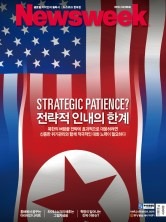
My ‘Newsweek Korea’ Cover Story: A Defense of Obama’s ‘Strategic Patience’ on North Korea

Newsweek Korea cover 2

Newsweek Korea asked me to participate in a cover story debate on Obama’s strategic patience. A friend of mine wrote against it; I wrote in defense. Here is the Korean language text at the NWK website. Below is my original English language version.

In brief I argue that NK is so hard to pin down, that big strategies never work with it, provoke North Korea into lashing out, and raise impossible expectations on democratic decision-makers. So Obama is acting responsibly, IMO, by not promising more than he can deliver and by not giving a reason for NK to act out.

After 20+ years of negotiating on more or less the same topics, it should be pretty obvious that NK is insistent on not being placed in some box by outsiders. It will not be treated as some technocratic ‘problem’ to be ‘solved’ by a conference of experts, like global warming or something. And it will lash out if necessary to remind us of that. Hence, I argue for ‘muddling through,’ and that we should stop expecting our policy-makers to have some great NK strategy that will fix the issue. That’s not gonna happen. We all know that. We just have to wait for China to stop paying NK’s bills. Until then, all the sweeping declarations (‘agreed framework,’ ‘sunshine’,’ the ‘axis of evil,’ the current big idea du jour of ‘trust’) are rather pointless and raise impossible expectations among voters in SK, the US, and Japan. Let’s be a little more honest about what we can expect from North Korea.

Here we go:
Continue reading

My ‘Diplomat’ Interview: the Inter-Korean Talks Collapsed over a very Korean Hang-up over Rank and Status

korea-talks

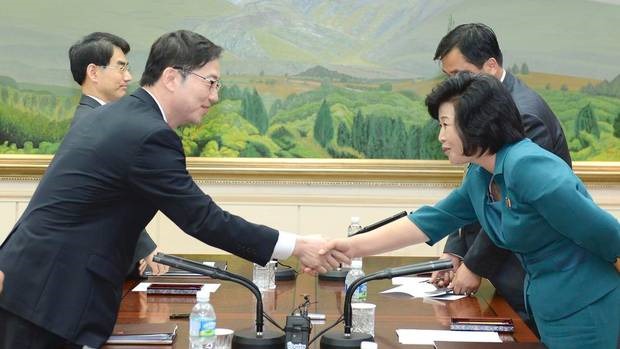
I write for the Diplomat magazine occasionally, and they just interviewed me on the collapse of the recent high-level inter-Korean talks. This is a re-print of that interview. It might seem ridiculous to non-Koreans, but Koreans take rank and status pretty seriously (because Korea is such hierarchical culture IMO). So a break-down over who out-ranks who (which is what happened) is not too extraordinary given the shared cultural context. Here’s that interview:

Continue reading

Abenomics is Not more Dangerous than the North Korean Missile Program

okRegular readers know that I write now-and-again for the Diplomat web-magazine. This post is a re-print of my June column. Abenomics is still dominating Korean business news, and I continue to be amazed at how few people want to admit that Japan’s revival is really good for democracy in Asia and the prevention of Chinese regional primacy.

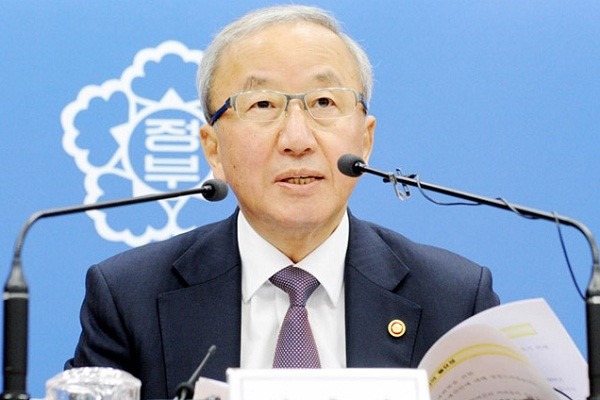
As I discuss below, no less than the SK finance minister (pic) actually said Abenomics is more dangerous to SK than the NK missile program. Wait…what??? Did you know the mic was on? Does anyone genuinely believe that the worst totalitarianism in history gets a pass when the Bank of Japan prints a lot of cheap money? Come on. Are Korean officials so deeply bought by the chaebol that they actually have to say stuff like that? Honestly if Minister Hyun really believes that (I doubt that though, see below), he should probably resign. This is just a travesty, hugely embarrassing – so if this post reads a little rant-ish, that’s why.

Continue reading

My ‘Newsweek Japan’ Story on Korea’s Regional Foreign Policy: Being an Encircled Middle Power Sucks

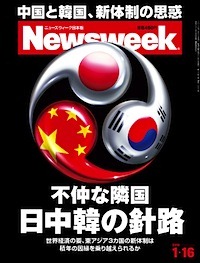
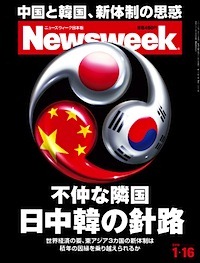
Newsweek 3rd coverNewsweek Japan asked me to contribute an essay on Korean foreign policy for a special issue on current Northeast Asian tension. I also wrote the introductory essay for this special issue. There is one essay each on Japan, China, and Korea; mine is the Korean one. So this is a nice laymen’s review without too much fatiguing jargon. This was originally published in January, so this translation is late, but the points still hold.

In brief I argue that Korea’s foreign policy is driven by its geography. Korea is a middle power surrounded by three great powers, plus the most orwellian state in history. That position really, really sucks. The US alliance helps buttress Korea sovereignty in that tight neighborhood, but China’s rise is unbalancing everything, especially calculations for unification. Once again, there are no hyperlinks, because it was intended for print. Here we go:

“On December 19, Korea elected a new president, Park Geun-Hye. Park comes from the conservative New Frontier Party. The current president, Lee Myung-Bak, is also a conservative. Park will be inaugurated in late February. Her campaign presented her as more ‘dovish’ on foreign policy than Lee, but she represents greater continuity than her opponent, particularly regarding North Korea.

Korea’s foreign policy is heavily-driven by its geography. It is an encircled middle power that has frequently struggled to defend its autonomy against its much larger neighbors. And since World War II, it has faced the most orwellian country in history in a harsh stand-off that dominates Korean foreign policy. An opening of North Korea, leading to eventual reunification, is the central policy issue of every Korean administration. Beyond that, Korea’s central relations are with the United States, China, and Japan. All three structure Korea’s neighborhood and will significantly influence unification.

Continue reading

My ‘Newsweek Japan’ Cover Story on the post-1979 ‘Asian Peace’ & Economic Miracle

Newsweek 3rd coverNewsweek Japan asked me to write an introductory essay for its January 16 special issue on tension in Northeast Asia (cover story to the left). I should have put this up 4 months ago, but I forgot and the arguments are still valid. Anyway, here is the link in Japanese, but I thought it would be useful to publish the original, untranslated version as well. (If you actually want the Japanese language version, email me for it please.)

The essay argues that Northeast Asia has benefited enormously from an ‘Asian peace’ in the last 35 years. All the remarkable growth in China and South Korea (as well as India and Southeast Asia) would not have happened without it. So fighting over some empty rocks (Liancourt Rocks, Pinnacle Islands) is a terrible idea. And for political scientists, the current Sino-Japanese tension is a good test of the hypothesis that economic interdependence brings peace. It’s fascinating to watch China especially try to figure out just how much economic gain to forego in pushing Japan over the Pinnacle Islands.

This was intended for their print edition, so there are no hyperlinks included in the text. Here we go:

“1979 was an important year in modern East Asia. It captures two of the region’s most important trends. It was the year of both the last serious military conflict between two East Asian countries – a Sino-Vietnamese border war – and the start of China’s capitalist modernization under Deng Xiaoping. These moments usefully frame the following thirty-four years: much of Asia has gotten substantially wealthier, and no major conflicts have broken out to upset that upward economic swing. This magnificent regional achievement has catapulted Asia, particularly East Asia, into the center of world politics.

Continue reading

NKorea Recap (2): NK is an ‘Upper Volta with Nukes’, so Ignore Them

Still my favorite TV interview I have done yet: Jump to the 1:05 mark, and tell me you would not laugh out loud at that awesome question


Here is my original essay on the NK crisis, where I called NK ‘the boy who cried wolf’: no one believes their war-mongering rhetoric anymore, because they say outrageous stuff all the time that they never follow-up on. That piece enjoyed good traffic at the Diplomat, where it was originally posted. So I wrote a response to the comments made both there and at Reddit. That response was originally posted at the Chinese Policy Institute Blog of the University of Nottingham and at e-IR. I re-post it here for convenience. I would like to thank John Sullivan of Nottingham and Max Nurnus of e-IR for soliciting me.

Rather than respond individually – some of those guys at Reddit are just off-the-wall – I thought I would provide some general follow-up to certain critiques that showed up regularly.

1. You’re just an arm-chair general, air-head liberal, cloistered academic hack, and so on.

I was surprised that the essay was taken by some as ‘liberal’ or ‘blind to the NK threat’ and so on. I am actually fairly hawkish on NK. I think the Sunshine Policy failed and should not be tried again unless NK makes real concessions it did not last time. I also think the Six Party Talks were a gimmick to allow NK to play China, the US, SK, Japan, and Russia off against each other. For example, Kim Jong Il mentioned in the context of those talks that NK could be an ally of the US against China, and a lot of people think NK built nuclear weapons to prevent Chinese political domination even as NK becomes its economic colony.

Continue reading

Was Kaesong a Hole in the Korean Iron Curtain or a Subsidy to the Kim Monarchy?

kaesong


The following was originally published at the Diplomat here.

So it increasingly looks like the inter-Korean Kaesong industrial zone is closed for good. (The Wikipedia write-up is a pretty good quick history of it if you don’t know the basics.)

The zone was set-up during the Sunshine Policy period (1998-2007). It was to do 3 things: 1) Lead to some liberal-capitalist spill-over in the North, 2) Expose regular North Koreans (the workers in the area) to regular South Koreans (the managers and staff), and 3) Generally provide some inter-Korean cooperation that might hopefully reduce larger tensions. A resort area in North Korea (Mt. Kumgang) was also opened along these lines in the Sunshine period. Broadly the idea was along the lines of liberal explanations for the Soviet Union’s changes in the 1980s: the Helsinki Accords and CSCE opened the USSR to the outside world, and the inflowing liberalism slowly changed attitudes that eventually helped wind-down the Cold War. Unfortunately, none of this seems to working in the NK case.

Continue reading

NK Recap (1): “North Korea is the Boy Who Cried Wolf – There will be No War”

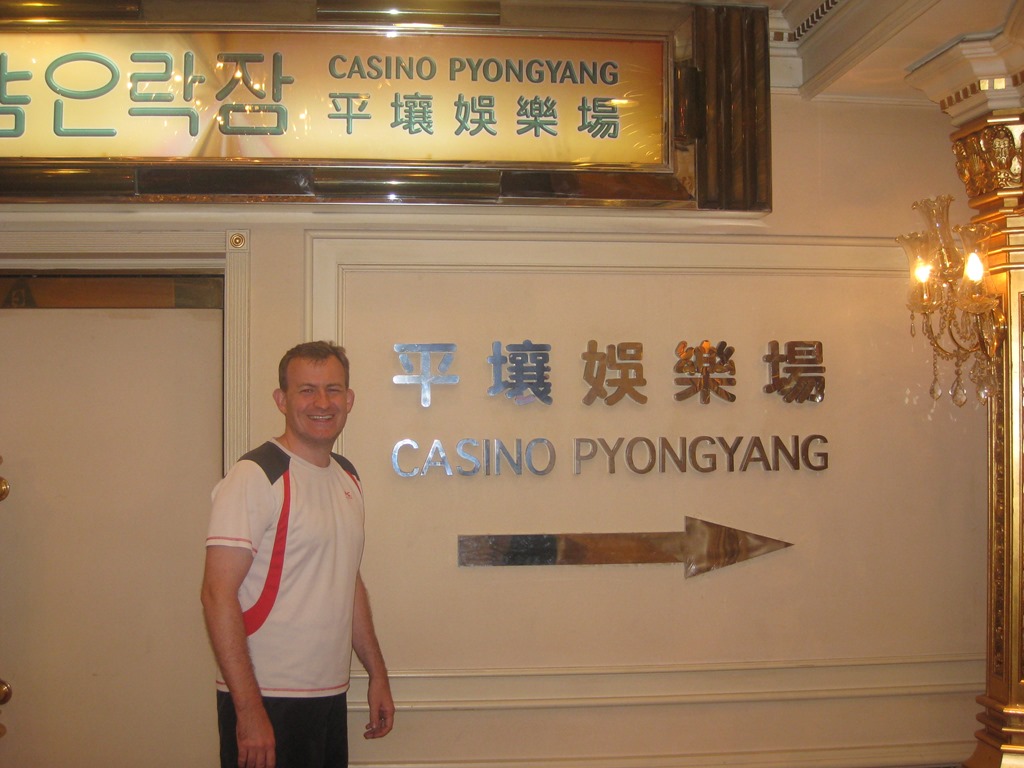
North Korea 2012 131The North Korea flap seems to be calming down, so here I reprint my original essay for the Diplomat a few weeks ago on the crisis. I’d like to thank Diplomat Editor Harry Kazianas for inviting my submission. And yes, that is a picture of me heading off to the Pyongyang Casino last summer, and I am happy to say I won $60 at blackjack against the Chinese dealer. Apparently my gambling problem is ‘pivoting’ to Asia too.

North Korea is a constant enigma, a point made apparent once again in the current crisis. Analysts of every stripe have mispredicted its behavior and longevity for decades, and this time around, it is again very unclear what exactly they want. So rather than make any predictions that will turn out to be laughably wrong next month, here are some observations that help narrow range.

1. Goaded into Conflict?

The North Koreans are experts at bluster. The previous president of South Korea was so disliked, that he was portrayed as a rat being decapitated in the Pyongyang newspapers. So when the North started saying outrageous stuff this time around, the first response of analysts everywhere was cynicism. And in the South Korean media, although it is front-page news, the commentary borders on ridicule. No one believes they mean it. A Korean friend of mine spoke for a lot of South Koreans, I believe, when he said to me that he almost wished NK would pull some stunt so that SK would finally give the NK the beating it richly deserves after so many decades of provocation.

Continue reading

What if US/Japan Try to Shoot Down a North Korean Missile & They Miss?

Is our BMD better today than it was in 1985?…If they take out MTV though, that’d still be ok


So my prediction that the North Koreans would launch a  test missile on the ‘Day of the Sun’ – that would be Kim Il Sung’s birthday for you imperialist running-dogs yet lacking in proper ideological orientation – was wrong. Hmm. The North Koreans sure are good at keeping us guessing. Maybe they’re dragging this thing out, because they’re enjoying the time in the limelight. My friend Chico Harlan wrote in the Washington Post, ‘North Korea’s gone viral,’ and they gotta be lovin’ it. When else do we listen to them otherwise? (Here’s a collection of some of the NK humor.)

I still think there will be a missile launch, but I remain pretty positive there won’t be much escalation. I sketched an escalation path a few days ago. But despite being the most likely possible path to a conflict, I still don’t think it is in fact likely. Some comments, both on that post and privately made some good further points why escalation is unlikely.

Continue reading

Escalation in the Korean Crisis: What will the NK Military do if Japan Shoots Down the Missile Launch?

Jpn Patriots

A few days ago, I predicted there would be no war, probably because I’m lazy and predicting the future will be the same as the present is an easy way to protect my credibility. However, I also noted that NK could get entrapped by its own belligerent rhetoric and be forced to escalate even if it doesn’t want to. I think this is why Kaesong was closed, for example.

I also noted how sanguine South Koreans are about NK, but foolishly, I didn’t really think about the Japanese. Then came the story about a mistweet by the city of Yokohama that apparently created local panic.The Japanese seem far more nervous about this than South Koreans, and NK did launch a missile once over Japan. The Japanese have also been talking a lot tougher, and Abe is clearly a hawk on NK. So here is the most likely escalation pathway I can see, despite my firm conviction the North Koreans do not want a war, because they will lose badly and quickly, and then face the executioner in Southern prisons:

Continue reading