My Diplomat on Essay on Xi’s Trip to Korea: SK as a Hole in the Pivot in Exchange for Help w/ NK

This is a re-post of an essay I wrote last week at the Diplomat. I guess South Korea-China relations is a hot topic, because I got a bunch of emails over this – note to grad students.

The quick version is that South Korea really needs China now to get any kind of movement on North Korea, so it kinda has to suck up to Xi. I am of the school that says that North Korea is sliding into an economic colony of China, regardless of how they bluster and blow off nukes. In fact, the reason Pyongyang probably has the nuclear and missile programs is not just to deter the US, but to prevent China’s economic domination from turning into political domination too. So Park will be practically begging Xi to rein in Pyongyang. She has to – which sucks, btw, and shows just how cynically China manipulates the human rights catastrophe that is North Korea to its own callous advantage. Awful.

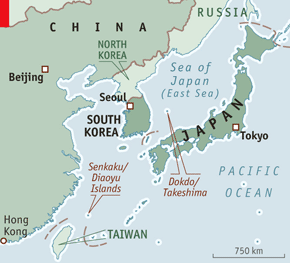
But Park can offer to restrain/impede the US pivot/containment of China as a quid pro quo for North Korea help. China really needs South Korea in order to prevent the US pivot from becoming full-blown encirclement of China. Because South Korea is so virulently anti-Japanese, it is an important hole in the tightening containment line around China that runs from Japan through Southeast Asia to India. The Koreans don’t want to line up against China, and they really don’t want to line up with Japan. If China is smart, they’ll exploit that. So China is unlikely to really bully South Korea as it has in the South China Sea.

Here’s that essay:

Continue reading

My Lowy Post on the Sewol Sinking, the Captain’s Trial, and the Long Overdue Focus on Corruption in Korea

This will be my last post on the sinking of the Sewol ferry, unless the trial reveals blockbuster new information. The essay below is the longer version of a piece originally printed here for the Lowy Institute.

I actually doubt the trial will tell us much that is new. We know why the ship foundered (covered below). The most important information that could come now is why the captain and crew abandoned ship so early. They had told the passengers to stay in place, so did they not realize that they were leaving hundreds of people to drown? Korean maritime law requires crew to help passengers. Did they not see the massive dereliction of duty in abandoning hundreds of people below decks on a sinking ship? Wow. That’s pretty d— obtuse. In fact, that is probably criminal.

At the very least, they might have just said ‘run for your lives’ on the speakers. Instead, the passengers dutifully followed orders – until it was too late. That is where so much of the anger comes from. Many of the drowned were healthy young teenagers, who easily might have escaped. Instead they died in place, because the captain told them to stay. This is why people are talking about the death penalty. What possible excuse is there for not just telling people to get out anyway they can? That would have required all of 5-10 seconds on the PA system. I don’t get that at all.

Here is that essay:

“On April 16 this year, the South Korean passenger ferry Sewol capsized off the southwest coast of Korea. The ferry carried 476 people; at the time of this writing almost 300 are confirmed dead, with several dozen still missing. The Sewol was en route from Incheon port on the Yellow Sea, south to Jeju Island in the Korea Strait. Jeju is a popular island vacation destination in Korea. Well over 300 of the passengers, and the majority of the fatalities, were high school students on vacation.

Overlapping Bureaucratic Failures Cause Disaster

The cause of the sinking is not yet fully known. Apparently around 8:45 am, the ship made a sharp starboard turn. Why is unclear; initial theories suggesting a struck reef, or swerving to avoid one, have proven wrong. The turn lead to a sharp list, worsened by poorly secured cargo that came loose, far too much cargo weight, and too little ballast. As a result, the ship was top-heavy and hard to steer. Some reports have suggested the previous crewmembers had noted the instability of the ship. Others have suggested that the cargo weight may have been almost four times the recommended limit. Hence much of the investigative focus has been on safety rules and if they were followed.

Continue reading

My Newsweek Japan Cover story: The Sewol Sinking and the Modernization of Korea

Sewol Japan Cover

The following is a story I wrote for Newsweek Japan this week on the sinking of the ferry Sewol in Korea in May. Here is the Japanese version.

Sewol has a been a terrible national tragedy, and that callous, incompetent captain should almost certainly get life imprisonment for hundreds of cases of negligent homicide. But there was more than just that. A series of bureaucratic failures led to the sinking. Bad seamanship may be been the spark, but a lot of poor regulation and corruption laid the groundwork for the sinking to become a major catastrophe.

If Park is serious about cracking down on corruption post-Sewol, it could be a big deal. I am skeptical myself; she leads a traditionalist, not reformist, coalition, and she has not governed as a innovator. But the costs of corruption in Korea – its 46 score from Transparency International – are now clear. Let’s hope she really tries.

Here’s the full version of this argument:

“On April 16 this year, the South Korean passenger ferry Sewol capsized off the southwest coast of Korea. The ferry carried 476 people; at the time of this writing almost 250 are confirmed dead, with several dozen still missing. The Sewol was enoute from Incheon port on the Yellow Sea, south to Jeju Island in the Korea Strait.

The emergency response to the sinking was badly botched. The captain initially told all the passengers to stay in their rooms and not exit to the deck. Retrospectively, the captain has argued that the water was too cold to abandon ship. But later he and the crew were among the first to escape. It is not clear if the ‘abandon ship’ order was ever given, or if it was properly transmitted. Many of the bodies recovered were found in passenger rooms. President Park Geun Hye called the captain’s actions “akin to murder;” he and the entire crew have since been arrested. Worse, only two of the lifeboats on the ship activated properly, and the coast guard response was confused. The initial call for assistance went to far away Jeju; only later did local coast guard get an alert. In fact, one of the initial calls for help came from a student passenger calling a national emergency hotline.

My Lowy Post on Obama’s Asia Trip – Watch Every Interest Group Instrumentalize it for its Own Purposes

PHOTO: Barack Obama waves as he walks down the stairs from Air Force One at Fiumicino Airport on March 28, 2014 in Rome, Italy.

So Obama is off to Asia this week for a quick trip that is inevitably being over-hyped by every Asia analyst on the planet as some major turning point in the US relationship with Asia. It’s not: below is re-printed my original, ‘watch-elites-manipulate-the-Obama-trip’ comment for the Lowy Institute. The spin will be over-the-top as every Asia pundit races for media exposure. Presidential trips are a great opportunity for the analyst community to posture and hyperventilate about how Obama ‘must’ do this, ‘has’ to do that.

Yawn.

Most of that is bunk. A lot of that is 1) analysts trying to demonstrate their own relevance and self-importance – is it surprising that Asia hands defend the Asia pivot so vociferously? But there is also 2), the unwillingness of a lot of Asia hands and hawks to admit that the US does not actually ‘have’ to do anything in Asia. America has huge freedom to move here, and Asian states – both allies and China – need the US way more than we need them. Where would Asian economies be without the US consumer? And even China might be nervous about a US forces withdrawal given the open balancing behavior that would likely spark in Japan, India, Vietnam, and the Philippines. So ignore all the commentary that the US ‘needs’ Asia; the real story is the opposite and that space which that gives the US to play hard-ball on things like Asian mercantilism and North Korea.

Continue reading

My Diplomat Essay for April: Unintended Consequences of US Alliances in Asia

UC

So this month for the Diplomat I wrote a speculative essay on US alliances in Asia – reposted below, original here. I think some people over-read it to mean that the US should leave Asia or that I endorse Chinese regional hegemony or whatever. I don’t. As I say in the piece, I still think the US presence is balance-positive, especially as China is moving from the ‘peaceful rise’ to capacious maritime claims off its east coast. Instead this was to be a thought experiment – an effort to tease out whether US regional alliances have negative impacts, given that almost all the discussion rather blithely assumes the opposite. I think the first possible downside suggested below – that China won’t cut North Korea loose until the US leaves Korea – is particularly strong and unsettling to the conventional wisdom. Ideally, this analysis would encourage thinking on mitigating these unintended side-effects.

Here is that essay. If you follow CSIS’ ‘PacNet’ series (which you should btw), a variant of this will come out there shortly:

“The conventional wisdom on US alliances in Asia, at least in the West, Japan, and Taiwan (but not necessarily in South Korea), is that they are broadly a good thing. One hears this pretty regularly from US officials and the vast network of US think-tanks and foundations like CSIS or AEI and their many doubles in Asia. US alliances, we are told, provide stability. They keep China from dominating the region. They hem in North Korea and defend the powerfully symbolic South Korean experiment in liberal democracy and capitalism. They prevent the nuclearization of South Korea and Japan and a spiraling regional arms race. In short, they re-assure.

Continue reading

My March Essay for the Diplomat: 3 Hypotheses for Korea’s ‘Japanobia’ – 1. Genuine; 2. Post-Colonial Score-Settling; 3. RoK Legitimating Ideology

This, I hope, is my last piece on Japan-Korea relations for awhile. I think everyone is getting burned out by this topic. And I am sick of the hate-mail. But at least Obama got Abe and Park into the same room last week. Park look pretty furious, but at least the meeting was progress.

This essay goes into what purpose or function Korea’s resentment of Japan fulfills. Koreans get a little upset when I phrase it this way, but the extreme nature of Korean resentment of Japan tells me there is more going on than just memory and the war. That picture, from here, is a good illustration of just how instrumentalized ‘anti-Japan-ism’ has become for South Korean political identity.

This essay was originally written for the Diplomat this month. As always, when I write on this topic, I just don’t read the comments there anymore, because the hostility is so over-the-top. So if you’re here to tell me I am traitor to your favored cause, don’t worry. I know already. Thanks. Save your vitriol and try to stick to the social science research question I sketch in this essay. The essay follows the jump:

My last Lowy February Essay – Review of Park Geun-Hye’s first Year as Korean President

My comments to Al Jazeera on Park Geun-Hye’s first year in office


Last week at the Lowy Institute, I posted some comments on Park Geun-Hye’s first year in office as Korean president. Below is a longer re-up. In short, I think she has been ok. She’s basically done nothing on domestic policy to change the Korean status quo which so punishes schoolchildren, women, SMEs, and consumers. So much for the idea that a female president would be Korean an easier place for women.

The ‘474 plan’ is typical Korean industrial policy with its rigid planning and strict guidelines and bureaucratic guidance – all of which rejects the basic unpredictability and flexibility of market economics. It’s yet another example of the creativity-killing developmentalism that still treats Korea like a second-world economy in the 1970s. In the US, the Tea Party would call 474 communism. And if she really believes she can get per capita GDP up to $40,000, she’s in a dream-world.

On foreign policy, she’s managed North Korea well enough. And that is good enough for any Korean president. But she’s really dropped the ball on Japan. She’s been unable or unwilling to stop the tit-for-tat downward spiral. If I had to guess, I would say it’s because he father so obviously loved Japan, right down to his own samurai sword, that she has to go overboard the other way. Abe is creepy, but the Korean media doesn’t help and Park’s done little to guide the conversation in a healthier way.

Here’s that essay:

Continue reading

My Expanded Lowy Post on Moral Hazard in US Alliances: Explaining Japan-Korea (and Greece-Turkey?)

domhSo this post is a bleg to those of you who know more about alliances than me. I am considering writing up this for an article, so I thought I would ‘crowd-source’ early comments on this. I also wonder if someone elsewhere has already suggested this idea in the vast alliance literature, so please let me know. The motivation is inductive – the deepening tension between Japan and Korea has suggested the addendum to alliance theory I am proposing here. But I wonder if others have said this before.

Put briefly, I don’t think entrapment or abandonment captures the US position between allies in dispute, like Japan and Korea, or Greece and Turkey (perhaps – I know that latter case less well). Instead, each seems to use the US alliance patron to: a) compete with each other, because b) the US alliance relieves external pressures (China and North Korea, and the USSR and chaos in the Balkans and Middle East, respectively) that would otherwise incentivize a rapprochement. These four states are not trying to ‘entrap’ the US so much as leverage it for an intra-alliance squabble, with the shared patron as referee. I’ve not read this theorized elsewhere, so here is an effort to do so.

Continue reading

My January Diplomat Essay: Top 5 Northeast Asian Security Stories in 2013

20120818_ASM985

I know these exercises in end-of-year top 5s or top 10s can be silly or fanciful. But there is some value to trying prioritization. Part of social science is determining causal weights – which causes are most important among many possibilities. And that is the logic implicitly behind these sorts of turn-of-the-year lists. It’s also fun to try after a long year. So here is mine; I imagine these will seem pretty predictable though.

“It’s that time of year when analysts everywhere throw out predictions of the year to come and retrospectives of the past year. It’s practically impossible to build a fair metric for these things, but it is fun to try. Here I define consequentiality as those events likely to shape future events on large geopolitical questions in northeast Asia, specifically commerce and conflict. Here is one such list from the Financial Times on Asia. Here is mine:

1. The expansion of the Chinese Air Defense Identification Zone (ADIZ)

This strikes me as the most important regional geopolitical event of the year, because it effectively ratifies what many analysts have suspected of coming for a long time – a Sino-Japanese competition over Asia, with the US hovering in the background, tilting toward Japan. This will be the defining competition of Asia for the next several decades, and the trend-lines broadly favor China – Japan and the US are in decline relative to China.

Continue reading

My December Diplomat Essay: US Alliance with Japan Sparks a Korean Grand Strategy Debate

hagel japan

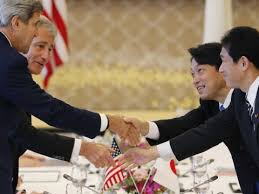
This is a re-up of my most recent monthly essay for the Diplomat. The original is here.

The idea here is to explore why Korea is not simply going to line up with the US and Japan against China. A lot of Americans, understandably focused on China in Asia, assume Korea will just join up. I really doubt that. I have been arguing this point for awhile on this site (start here), but Korea is way more alienated from Japan, for all sorts of reasons, than a lot of westerners realize. And it simply does not worry that much about China (no, I don’t understand that either). When I go to the conferences, Americans worry about China, the Japanese really worry…but the Koreans are like, ‘meh…whatever,’ but they get really activated over Dokdo. That dichotomy in response drives just about every American analyst I know up the wall, but it is the way it is. We need to realize that instead of trying to force Korea into the kind of black-and-white, good-guys-vs-bad-guys cold war frame Americans usually insist on in world politics. The essay follows the jump.

Continue reading