National Security Decentralization: Kor. Inst. of Defense Analysis (2) – UPDATED: Response to Charli Carpenter – UPDATED II: More in the Comments

520px-Provinces_of_South_Korea_Txt

Part one is here.

Last week, I spoke at a KIDA discussion of the Korean peninsula post-Cheonan. In brief I argued that there was no ‘post-Cheonan’ world as the SK right was hoping for. South Koreans are unwilling to risk war. There is no desire to hit back for the Cheonan sinking, because escalation might lead to a war in which South Koreans believe their wealthy democracy will get trashed and then burdened with Northern reconstruction.

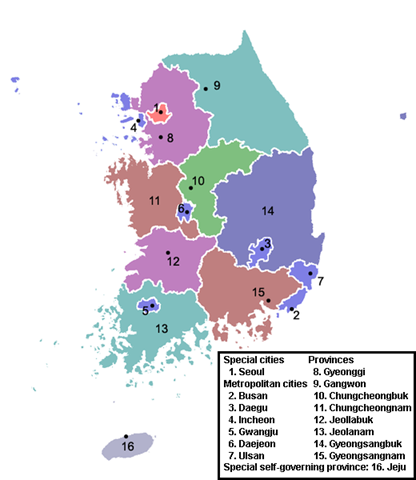
But there is another specific reason why there is no response. SK’s hands are tied by the extreme vulnerability of its major population centers to NK retaliation. Specifically, following the above map of Korea’s provinces and cities, Seoul has 10.464 million; Gyeonggi province around it, filled with Seoul’s suburbs, has 11.549 million, and Incheon has 2.767 million. Busan by contrast has just 3.566 million. Korea’s total population is 48.875 million. (Those numbers come from a colleague at PNU’s Department of Public Policy and Management.) Worse yet, Busan’s population is shrinking, and Incheon’s is growing. So this means that 50% of Korea’s population lives within 50 miles of the DMZ, and 30% lives within just 35 miles.

NK knows this, and in order to hold SK hostage against any Southern retaliation for incidents like the Cheonan, it has stationed something like 10-20k artillery and rockets at the DMZ closest to this massive urban agglomeration in northwest SK. In effect then, half of the SK population is a massive city-hostage to NK, and it is only worsening because of Incheon’s rapid new growth.

In game scenarios of a second Korean war, the first six hours are decisive. NK knows that it will likely lose the war, and that its assets will be quickly eroded by allied air power. That is, in the first few hours, a primary SK-US bombing target will be all those rockets and canon at the DMZ. Nonetheless, almost everyone thinks that the KPA will be able to get off enough shells and rockets to effectively devastate the Seoul-Gyeonggi-Incheon area. Given that Koreans mostly live in high-rise apartment buildings, some with 60+ stories, the result would be hundreds of World Trade Center collapses. I live in such a high-rise; I can’t imagine that it could realistically withstand a Scud missile or two. 2500 live in my building alone. Consider that all across Gyeonggi, and you have a holocaust.

Note too, that all this can occur without Northern nuclear use. Essentially,the early hours of a war would a race between allied air and ground power to hit all those Northern emplacements before they fire. Like the old Cold War logic facing the the US and USSR, NK faces an extreme ‘use-it-or-lose-it’ dilemma. For this reason, the DPRK has repeatedly threatened to turn Seoul into a ‘sea of fire.’ This huge threat to SK’s extremely vulnerable northwest urban centers is the primary reason why the North never suffers military retaliation for attacks such as the 1976 tree-cutting incident or the 1987 KAL bombing.

So what to do? To me it seems rather obvious – the gradual de-centralization of SK’s population (and government and economy) from the northwest. Strangely, I have found almost nothing in the IR-national security literature on SK defense recommending or even discussing this choice. Yet when I suggested it last week at KIDA, multiple SK and US analysts and officers approached me afterwards to discuss the idea. Should Korea’s population be spread more equitably around the peninsula and further south from the DMZ, this would open new strike-back options after incidents like the Cheonan.

There are several objections worth rebutting now.

1. It would be expensive. Ok. Sure. But so is all the ROK defense spending that goes into protecting the northwest already.

2. It would take forever. Yes, this is true. But the stalemate with NK is now entering its seventh decade. To our great surprise, NK has withstood the end of the CW, the collapse of Soviet support, the death of Kim Il Sung, and the famines of the 90s. Rather than taking a perpetually short-term attitude toward NK – when will it just collapse so we can get on with reconstruction? – a better approach might be to consider strategies to win a drawn-out stalemate, which is already what this conflict is anyway. Consider that if decentralization had started in 1990 how much better the post-Cheonan options would be.

3. When NK collapses, this will have been a huge waste of money. Not necessarily, because there are regional growth and national equity reasons also in support of decentralization. Ie, the ROK is already far too centralized in one place (Seoul). Koreans outside of Seoul even call it the ‘Seoul-Republic.’ Like France, SK is wildly unbalanced with one city starving the rest of the country for capital, human talent, government attention, etc. (One sees this quickly living, as I do, in the ‘provinces,’ like Pusan.) Even if NK collapses, it would be healthier for SK to look more like Germany, Canada, or the US, with multiple large cities competing with each other for national resources and talent.

4. Forced population transfer are illiberal and wrong in a democracy. This is the strongest argument. Clearly decentralization would happen most rapidly if it were coerced, but this is, correctly, intolerable. But the government could create lots of incentives short of force. It could move the seat of the ROKG out of Seoul for starters. Brazil did this – for regional equity purposes – in 1960; and West Germany put its capital in sleepy little Bonn, because West Berlin was just too exposed. Israel doesn’t let too many people live near the borders with Gaza and Lebanon. So there is democratic precedent. Also, the Korean government intervenes in the economy all the time to help companies with subsidies and what not. How about directing some of that money outside of the northwest? But I agree it would be tricky; eminent domain, even for national security, would be tough when millions of people are involved.

_____________________________________________________

UPDATED:

This was linked heavily at Lawyers, Guns and Money and the Progressive Realist (h/t Charli Carpenter). Here is a response to the criticims raised in the comments:

“Let me try to answer a few of the objections proposed:

1. ‘You can’t just move cities.’ Perhaps, but that misstates my suggestion. Seoul is very old city with strong emotional roots in Korean national identity. It will not move. But it can shrink. Its postwar explosion into a megalopolis is a direct result of (reversible) policy choices – including the government’s susbsidization of mega-firms (chaebol), huge infrastructure projects like the Incheon airport, and most importantly, the legacy of authoritarian political centralization. Like most dictators, SK’s pre-democratic generals centralized almost everything (in Seoul) in order to more easily control the state. This legacy survived and worsened, gradually depopulating Korea’s other major cities (Pusan, Daegu, Dajeon) as everyone now wants to ‘move up’ (the local term) to Seoul. It has become a vacuum that hoovers up talent relentlessly and starves the rest of the country, and it is actually getting worse now, not better: Pusan, the second city, is shrinking and aging, while Incehon, right next to Seoul, is booming. (This has slowly become a bigger issue in Korean politics in the last two decades as the imbalance between Seoul and the rest has become genuinely extreme. The ‘Sejong City’ project aims to move the capital, although the local argument for rebalancing away from Seoul is made mostly for regional equity, not national security, purposes.) In short, Seoul’s centrality relfects historical path-dependence that can be reversed by new policy choices, although Seoul-based elites in almost all fields oppose this as a major inconvenience.

2. ‘It is illiberal to move them.’ Yes, it is, but a) deomcracies make such calculations all the time, b) living next to NK is vastly more disruptive than refusing to move for the development of a mall or something, and c) I don’t endorse coercion but incentivization. The West Germans imposed all sorts of restrictions on the residents of West Berlin that didn’t apply elsewhere, and Israel too uses zoning codes and such all the time for political purposes. SK already prevents people from living even closer to the DMZ. Also, Korea, unlike Western states, embraces state-led development and expects the state to do these sorts of things. Americans find ’eminent domain’ a culturally unacceptable intrusion on personal freedom, but I bet if you polled Koreans you wouldn’t get nearly that sort of anger. The role of the state in Korean life is much greater, subtler, and desired than it is in the US. Further, all sorts of places are deemed off-limits for residence for national security reasons in many countries. Finally, it hardly strikes me as ‘residential fascism’ or something to encourage people not to live right next  door to a super-dangerous enemy. Indeed, I am rather amazed that SK never did anything to halt this decades ago. The scale, not the legality, strikes me as the real problem. There are just so many people in Seoul and Kyeonggi; any serious plan to encourage relocation would take forever and cost mountains of money. On top of the demographic movement would be the further costs of an economic and political shift. It seems ridiculously expensive when the money could be spent on so much else. But if unwinding the already-exising over-population would be hard, the government could still take steps to prevent it from worsening in the future, as it is doing right now (point 1 above).

3. ‘Can’t we just protect them by destroying the weapons targeted at them?‘ This is what US Forces in Korea (USFK) hope, and they will tell you that in the first few hours of a war, they are going to fly hundreds of sorties to get the canon and artillery. In response to this NK has put, by some estimates 20,000 artillery and rockets at the nearby DMZ as a counter. I have not meet any analyst here – military or cilivian, Korean or America – who believes that allied air power could get them all without several hours (minimum) of bombing runs. Given that most Koreans live in closely clustered high rises, not dispersed homes, you only one need one or two shells or rockets to kill 2000 people. The referent image should be the hundreds of World Trade Center towers clustered tightly in an area smaller than Rhode Island collapsing under a rain of shells. You don’t more than a few hours of Northern shelling to create a holocaust.

4. ‘Can civil defense protect them?‘ Probably not. First, Seoul/Kyeonggi’s transportation network would be dwarfed by the scale. Seoul traffic is already some of the worst in Asia. The subways are bursting during rush hour. The dilemma is similar to New Orleans’ one road out during Katrina. 2. The area around Seoul is hilly and rugged. 75% of the Korean population lives on only 25% of its landmass (that’s one reason we all live in enormous apartment towers). There is simply no where close to Seoul to handle the scale of movement unless you had many weeks to disperse them all over the peninsula. Finally, as I said in the orignal blogpost (above), NK artillery at the DMZ faces a severe ‘use-it-or-lose-it’ dilemma: once the war starts, allied air power is going to hammer these sites relentlessly. So if you start moving people out of Gyeonggi preemptively in a slow-moving crisis (like summer 1914, or right now in Korea?), you are signaling to the North to strike first before its deterrent evaporates.

For all these reasons, it seems to me that there is no short-term answer, but that a medium-term policy incentivizing residence and investment elsewhere is the way to go. That should probably include decentralization of authority to Korea’s provinces, the movement of the capital to either Sejong City or Daejeon (because they are in the geographic middle of the country [and not Busan, because it is too far away]), and the subsidization of economic development outside of the northwest.”

Cheonan Sinking Changes Nothing: Kor. Inst. of Defense Analysis (1)

menubar_toplogo

Another week, another North Korea conference. It amazes me just how much we (in Korean IR) talk about this issue. It is a never ending thrill-ride. And it is not just academics. I meet military, intelligence, even literature and photography experts (deciphering NK propaganda) from the US, SK, and Japan regularly. If you thought the GWoT created a defense-intel-IR gravy train in the the US, try Korea’s never ending circus on what to do about NK. It’s a cottage industry military-industrial-academic complex all of its own. Honestly, I wonder if we’ll all miss NK when she finally goes. Shamelessly, of course, I too am a part of that circus. Part of me understands obviously. The US doesn’t live next to the wackiest, more dangerous state on the planet. But still, I am amazed just how much of my time goes into this issue because of the simple fact of teaching IR in Korea.

So this week, the Korean Institute of Defense Analysis (KIDA) held its conference on what has changed since the sinking of the Cheonan in March. Here is my previous thinking on this. Here is the ROKG final report on it, clearly blaming NK. KIDA is a great institution, with really high-quality material and a super SSCI journal. So off I went to talk about this with the usual suspects of intel, military, diplomacy, academics, and the rest.

So now, 6 months out, tempers have cooled. No one is talking about air-strikes anymore. So what have we learned?

1. We didn’t learn much about NK. We already knew that NK is erratic, prone to savage, but limited outbursts, shamelessly denies everything, and uses external military-intel actions for internal in-fighting purposes. The tree-cutting incident, the cabinet bombing, the KAL bombing, and Cheonan sinking all show these characteristics, as well as the smaller incidents like the sub penetrations or Yellow Sea skirmishes.  So yes, the regime may be attributing this to the new boy-king, Kim Jong-Eun,for internal promotion purposes. But while that is important, it is not new. We didn’t see much we haven’t seen before.

2. Regarding the cause, we still don’t really know. I tend to agree that Jong-Eun (Kim III) is being given some accolades to establish him. But the larger structural cause is the steady factionalization common in late-stalinist systems. We saw internal jockeying among elites and interest groups in the USSR in the 80s, and in China in the early 70s. My read of the Cheonan sinking is that it is a message from the NK military to everyone else – the party and civilians in NK, including Kim III, the ROKG and military, the US, etc. – that it is a major, if not the central, actor to be reckoned with in peninsular affairs. There is no deal to be had without the KPA’s approval, and they will shoot up SK facilities every once in awhile to remind us all of that fact.

3. The Cheonan sinking told us more about SK than NK actually:

3a. We learned that SK has a very high threshold for NK pain; ie, that South Koreans don’t care much about NK and just don’t want to hear about it. There was no outburst of popular anger at NK. No call for air or naval strikes, much less war. Like the Chinese insistence that maybe the Cheonan just hit a rock or the Russian notion that it hit a mine, South Koreans too just want to put their head in the sand and not know the truth. Everyone just wanted it to go away as soon as possible. No one wants to recognize that NK did this, because it is so nasty, it screams for retaliation. Consider if Iran sank a US warship in the Gulf, or if Pakistan shot down an Indian jetfighter. The rhetoric would have been sharp and the responses swift. Here, nothing happened. No one, but for the SK military perhaps, wanted a strike-back. So it all just faded to black, and we are back to where we’ve always been – NK asking for aid, rumors about the 6 party-talks again, a focus on nukes, more talk of succession. The Cheonan changed nothing, because SK doesn’t it want it to.

3b. From this minimal willingness to risk escalation, we can conclude that SK has become a status quo power effectively in the peninsula, despite its formal (ie, constitutional) claim to the whole Korean landmass. SK has labored tremendously to build its consumer society-trading state, and it does not want that wrecked by NK. While most observers would say that NK has more to lose in a war – the regime leaders are terrified they will be hanged in the end – South Koreans clearly don’t see it that way. Instead they see their wealthy democracy getting trashed to save poor people they scarcely know, possibly including the use of nukes on their own soil. For this, they are willing to pay this price of a few Cheonans now and then. 6 months ago, most of us would have said something like the Cheonan would be a redline. But here we are over it with little change, so the question arises, just how far can NK go?

3c. We also learned how deep anti-Americanism runs in SK. To the astonishment of just about every mi-guk-in I know in Korea, something like 1/3 of Koreans believe the US sank the ship. And another third or so, think the sinking reveals the incompetence of the Lee administration. This just floors me. It tells me SK is so desperate to avoid escalation, they’ll believe anything. And how the Lee administration could realistically have been expected to defend against something like this is just beyond me. The case for NK blame is so obvious – yet so disruptive to regional stability – just about everyone – the SK public, the Russians, the Chinese – want to pretend otherwise, and NK denials dovetail perfectly.

4. Finally, the Cheonan tells us just how willfully unhelpful China and Russia really are. Russia’s primary foreign policy goal is to be perceived as a great power, because it can only barely claim that status now. Crises which get Russia invited to the top tables of world politics are therefore to be kept going as long as possible. Russia’s interest is the perpetuation of the stalemate, not its resolution. Regarding China, the news is even worse. When forced to choose between the two Koreas, China chose the North (foolishly); China refused to admit that the North sank the ship. This more clearly pushed NK into China’s embrace, making it ever more likely that China will keep the North alive for awhile yet, and that when unification does happen, China’s role will be more intrusive, including perhaps demands for a buffer zone or unified Korea’s finlandization.

Part 2 is here.

Asia’s ‘Culture of Export’ 2: The Case of Korean Mercantilism

P091004002

Part one is here. On the financial mercantilism rising in the wake of the Great Recession, go here.

Any foreigner living in Korea is bombarded with the notion of Korea globalizing. Its everywhere – both at the IR academic conferences, and in everyday life. The government-sponsored English agitprop network (Arirang) positively gushes about how cosmopolitan Korea is and how happy resident expats are to live here. Korean print media is constantly hyping this or that Korean star breaking into global attention. Yuna Kim in iceskating was last year’s rave; this year its Yong-Eun Yang the golfer. Korean films, we are told, have a worldwide audience, as does Korean pop music. Even Korean food they tell us, is poised for a global breakout. (I actually doubt all 3 claims; they are recycled endlessly like propaganda. In 32 years living in the US, I only saw 1 Korean movie – The Host – and never heard K-pop or saw a Korean restaurant. That hardly means they don’t exist in the US, but if they are as popular as the Korean government tells us, then I should have seen something.) And Koreans are downright obsessed with the numbers and kinds of foreigners living here, and multiculturalism is a raging debate right now in Korea.

Yet for some reason, this incipient globalization never seems to happen. And every once in awhile, you get a glimpse of the real story – the deep seated nationalism and the desire to have globalization occur on strictly Korean terms. Try here and here,  and note that the primary response to a trade deficit with Japan is the desire to reduce it through increasing self-sufficiency, a third worldist economic notion directly at odds with globalization.

This sorts of articles show you exactly the Korean ambivalence on globalization that prevents it from every attaining the global status it so desperately craves. I see this attitude all the time at conferences on the topic of Korean trade and IPE policy: exports are good, but imports are bad. For a raw, almost xenophobic, example of this mercantilist, illiberal spirit (trade surplus = health), try here.

So its great that Korea exports this or that to the world (food, cars, TVs), but Koreans clearly violate the spirit of the WTO by formally and informally discriminating (‘nationalist buying’) against imports. Koreans are downright desperate for global cultural recognition (endless stories on Korea’s ‘brand’ – whatever that means), but lots of knowledgeable people I know in academia still insist that Korea needs a positive current account and should mimic rather than import successful foreign products. Of course, you can’t have it both ways; you can’t demand ‘buy Korea’ from locals and then tell foreigners you are globalized.

Here a just a few examples. Imported goods are almost always far more costly in run-of-the mill stores. The best known stories are the 20-30% tariffs on cars imported into Korea. You’ve never seen as many Korean cars in the entire rest world as you do here in this one small market. Alcohol too has a extreme price differentials. A fifth of Jack Daniels costs $40 (see the picture above from my local grocery store)! Even something as mundane as scotch tape is hammered. Scotch brand transparent tape is 3 times the cost as the Korean brand. When I bought a TV, there was not even a discussion that I would buy a Sony or a Panasonic. They were a good 25% more costly, so of course, I bought the Samsung. And the cell phone sector too is overpriced, protected, and cartelized. Blackberry, Apple and Microsoft scarcely operate here. So forget about the easy compatibility of Windows Mobile or an I-phone.

This attitude is hardly specific to Korea. Lots of countries express a preference for mercantilism, and the everyday voter generally does not support free trade anywhere in the world. But economic nationalism is stronger in Korea than it was when I lived in Europe, and the cost differentials are more obvious and so extreme, there is no way they reflect just market pricing. Further, it jars badly with Korea’s constant repetition that it is globalizing. Because of course, globalization goes both ways. The flow of goods, people, ideas, etc. comes in and out. Little I have seen here or read in the literature or media suggests Koreans really want a lot of inbound traffic. Exports are great, but imports will probably bring swine flu. Incoming traffic is strictly controlled, especially of foreign people living here.

‘Economist’ Magazine Conference on South Korea

the-economist-logo

Like most of you, I have been reading the Economist off-and-on for 20 years. It, along with the Financial Times, is the most reliable journalism in English I think. I find it less partisan and noxious than most US journalism (or maybe I just agree with the classical liberal bent more). In any case, I got invited to its ‘Bellwether’ conference series on South Korea last week. Here are a few thoughts.

1. Bankers and financiers are a greater force for liberalization than I realized. I have the general IPE knowledge of Asian mercantilism, which I bemoan regularly here. But these guys really knew the details in depth, and they hammered the Korean policy-makers on this. This was an education. Among other things, I didn’t realize how much the Bank of Korea intervenes to ‘fine-tune’ the exchange rate or just how many gimmicky non-tariff barriers Korea uses to continue to protect its car industry. The ‘fine-tuning’ (nice euphemism that) is done at the behest of Korea’s biggest exporters – the chaebols in shipping, automobiles, and electronics. And it was quite amusing to watch the westerners at the event try to get the Koreans to admit that such gaming was in fact ‘capital controls,’ but the policy-makers ducked that one again and again. Being a political scientist focused on politics, I assumed the dirty work of pushing Asia toward liberalism fell mostly on the western bureaucrats who arrange FTAs. It was pleasing to see so many private sector people saying the same things that we say, only without all the theory.

2. Korea’s modernity. Nothing is a better marker of Korea’s modernity than a conference like this – filled with foreigners who want to make a lot of money! Having written my dissertation about the IMF and World Bank, I am accustomed to going to conferences on development, debt and similar travails. But here was a country that escaped from all that to be a good recipient of FDI, just as those institutions hope. (The World Bank calls former borrowers like Korea ‘graduates’ into private sector capital markets. Condescending?) 

3. Korea’s failed quest to be a ‘hub.’ For 10 years now, the ROKG has been trying to build up Seoul as an ‘international financial hub,’ and the session on this was downright self-congratulatory until I asked a question. I suppose academics exist to speak truth-to-power (which we don’t do usually – see Iraq). So I was pleased for a moment to be persona non grata on this, because I think it is wildly overhyped. The idea is that Seoul in Northeast Asia could become like Hong Kong (HK) is to China, or Singapore is to Southeast Asia – a bastion of modernity for international banks in a wild west region. There are some pretty obvious problems though:

3.a. Northeast Asia doesn’t really need hubs like Southeast Asia does, because Northeast Asia is already quite settled (but for NK) and developed. A ‘hub’ implies a surrounding piedmont that is less orderly or coherent, like Hong Kong to early 20th century China, or Singapore to ASEAN, but still worth penetrating. But there is no disorderly yet still accessible backyard up here: NK is closed; China is modernizing; and Japan is already modern. That leaves Russia’s extremely underpopulated Far East. Anyway, if there was such an opportunity, Tokyo would have grabbed it long ago. And this leads to the next problem…

3b. The hub market is Asia is already full – HK, Singapore, Shanghai, Tokyo. You can’t have too many hub or special economic zones, or they aren’t special anymore. So the first mover advantages are high and Seoul has come late to this party.

3c. North Korea. Seoul is 35 miles from the DMZ. This proximity makes it a city-hostage to the North. None of Seoul’s regional hub competitors have such a geopolitical backdrop. I find it hard to believe that big banks will locate their Asia HQs so close to such unpredictability. I can’t see Seoul competing among Asia’s biggest cities until the peninsular situation is resolved.

3d. Korea is still struggling with just how much it wants to multiculturalize, and until it accepts ‘diversity,’ it will be very difficult to get lots of middle-aged professional foreigners with families to reside here permanently (as in HK or Singapore). English is spread only thinly among the elite; getting a taxi is still a hassle. Foreign schools are insanely expensive here ($15-20k a year). The bureaucratic hassles of foreign life in Korea are endless – our national identity numbers are coded to mark us as foreigners, so shopping websites routinely block us. Cell phone companies still make it hard for foreigners to buy phones themselves (my Korean wife had to reserve our iPhone 4; Korea Telecom would not accept me). Tenant law is a nightmare (the courts tilt against us), as is contract law or getting a serious bank loan, like a mortgage or a car loan. In short, the primary hurdle for Korea to international/regional ‘hub’ status is not infrastructural, political, technical, etc., but cultural. Do they really want us here in large numbers, and are they prepared to really entrench the English bilinguism necessary to attract professionals, as has been the case in Singapore and NK for decades? The answer is still no.

4. Bankers, financiers and policy-makers find academics sort of a waste of time. There were 200 invitees, and among them only 5 academics. Given that I usually go only to academic conferences, I was out of my comfort zone – which of course is a good thing for most of us. I really began to see just how peripheral we are to, well, almost anything really important to these guys. This was quite a let down, and somewhat humiliating. Everyone was quite polite, but their skill sets were radically different, they had their fingers deeply on the pulse of policy in SK, and Asia, far better than I, and they speak their own CPA/MBA/Wall Street language that I really struggled with. My commentary seemed tiresomely abstract to them. I felt like a high school kid in a college class – out of my league and eventually cowed into silence from fear of looking like an idiot. Walt and Mead worry a lot about the ‘cult of irrelevance’ in political science, and nowhere in my recent experience did I perceive that as strongly as sitting in a room filled with serious people in expensive suits about the serious business of making money. What a contrast to the ridiculousness of so much academic theorizing! Conscious of this over the years, I have forced myself through econ textbooks and the Financial Times’ business coverage (a HUGE education that), but it was a healthy shot again my academic hubris to realize I didn’t understand 20% of what was said at this event. Even more humiliating was being told that most invitees must pay up to $2000 to attend these Bellwether conferences, but they invite academics gratis, because they assume we are broke. Good grief. 😦

5. Korea and Islamic finance? A couple of speakers mentioned this as a future expansion possibility for Korean banks. I found this downright off the wall. I suppose when there is big money involved, everything else fly out the window, and international private sector banking is far from my skill set. But the political scientist in me sees several huge hurdles. First, most obviously, Koreans know very little about Islam, and what they do know is generally negative stuff flowing from the GWoT. My students ask my astonishingly basic questions. The cultural distance is huge; Korea has less than 35k Muslims. Second, Korea is becoming more Christian, specifically more evangelical, and more closely aligned with the US in the GWoT. Third, the cultural fit of the sovereign wealth funds of the Gulf states make them the obvious choice for pious Muslims. If you were an devout Indonesian investor, what would really draw you to Korea of all places? I just don’t buy it all. Far more realistic would be a move into development financing in Southeast Asia without the cultural baggage. This is far closer to Korea’s own past and skills.

Asia 21, or the IMF Comes Crawling Back to Asia…

md_lee

1. For an organization regularly accused of wrecking the world, the July IMF-Korea get-together was a lark. 13 years ago in the Asian Financial Crisis (AFC), the Fund pummeled emerging Asia with all sorts of tough but necessary reforms. And Korea, for an OECD economy, took a hell of beating at the time and never forgave the Fund. Never ones to admit they were wrong, Korean elites steadfastly refuse to recognize that the Fund’s advice was necessary and was the reason Korea bounced back so fast from what at the time observers thought was going to be a regional meltdown. And now, as the world’s money flows into Asia in the coming decades, the IMF has had to come crawling back. The irony of course is that Fund advice why the AFC lasted so briefly and why Asia returned to growth so quickly.

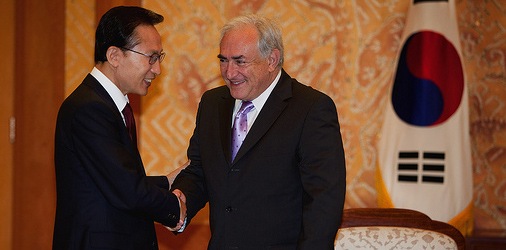
But no one EVER thanks the Fund, and now, with the Western powers traditionally supporting the Fund all bankrupt, the Fund desperately needs Asia. So after a 13 year mexican stand-off over the Fund’s AFC advice, the Fund has finally blinked. It has come back to ask to be let back in. For Korea this was a moment of triumph. Not one Korean speaker missed the opportunity to dredge up the old grievances, and not one IMF speaker had the professional courage to defend the Fund. Even Managing Director Strauss-Kahn (right above) didn’t have the backbone to defend the rescue package that saved Korea from default and an Argentine-style depression. Instead the MD told sob-stories about how the IMF refused to loan money to countries which included cuts in children’s services in their programs. See how nice the IMF is now! 15 years ago they were killing babies, now they are saving them from faceless bureaucrats. Make sure to blast-fax that to all the NGOs and the New York Times. Bleh. Strauss-Kahn has otherwise been a good MD after the last two forgettables. But he sounded so craven it was embarrassing.

But I suppose he had no choice. Asians so loathe the Fund that they are brink of building their own local version of it – the Chiang Mai Initiative (CMI). 13 years ago the IMF was able to sink this idea, because Asia was broke and the US was the ‘indispensible nation.’ Now, the world’s cash is in Asia, and its debtors are in the West. The Fund can’t play so hard, and CMI represents a genuine threat to institutional relevance. Hence the peace offering at Asia 21.

2. The conference didn’t say too much you wouldn’t already know from reading the (required) FT and Economist, but at least Asians seem to be realizing the West won’t import as it did before and that the US stimulus was essentially sterilized by cuts in local, state, and consumer spending. This is progress. Two years ago, when the crisis started, the first instinct was to ignore the depth of the crisis in Asia’s major export markets and just wait for things to return to the 2000s status quo: massive overconsumption (and debt) in the US and much of the EU, coupled with a huge run-up in dollars reserves in Asia. Smart observers like Martin Wolf have been arguing since the start that an Asian buying binge is the fastest, safest way out of the crisis, but Asian elites would have none of that. Now at least, I had the impression that they realizing that the wild imbalances of the post-AFC pseudo-expansion are risky to even to them. But I still didn’t see a commitment to reverse the current account surpluses, only to lessen them somewhat. Not even this Great Recession can dent the Asian reflex for mercantilism.

3. There was a great deal of fear that Greece might spiral into a sovereign debt crisis throughout the OECD, and much hand-wringing about how the West could be moved toward structurally lower fiscal deficits. As a political scientist though, I found the answers to the latter curiously technocratic and formal. None of the speakers note what seems to me the obvious, cultural, answer – generational expectations. In the EU, the biggest problem for balance is not corruption, better tax-collecing, the Common Agricultural Program; it is the mindset that the work is ‘oppressive’ beyond 35 hours a week and 55 years of age. It is cultural or socio-political expectations that are the real limits on fiscal seriousness. A ‘social-democratized’ population taught that generous government is a right has made it all but impossible to get Europeans to live within their means. In the US, the primary problem with balance is analogous: an anti-tax commitment on the right that borders on paranoia. I can’t think of any serious economist who believes the US can balance its budget in the medium-term without tax increases – the deficit is now $1 trillion, so please tell me how to fix that without more tax revenue? – but taxes have achieved a totemic significance on the right that makes them nearly impossible to raise despite the obvious mathematical case for them.

By contrast, it seems that Asian populations are willing to pay their taxes and accept less social welfare redistribution. We say that the West needs to learn to live within its means, Asia has some good examples of that. South Koreans want low taxes and lots of goodies like anyone else, but I have never seen, in the press or my students or colleagues here, the suicidal drive to spend without taxing that has become the curse of the contemporary West.

4. A quick tip to the IMF guys at these big conferences: maybe you shouldn’t clique up so much and be unfriendly to everyone else; that is why people think you are a big conspiracy. I defend the IMF all the time, but really, the IMF does bring some of the conspiracy thinking on itself. A little people skills would go a long way – how about not giving the impression that the rest of us are wasting your time? I have been to many conferences with IMF types (I wrote my dissertation on the Fund), and again and again I have seen them tie-up together in little knots, where they whisper (yes, whisper) among themselves, and generally not talk with the others as much. Not only is it the royal blow-off to the rest of us, it creates among the suspicious the perception of a disinterested priesthood. I guess global domination means they don’t have time to talk with some lowly political scientist. Hah!

South Koreans are not Neo-cons

Neocon Ideology vs Korean reality: Modern SK is a commercial trading state with zero interest in a war with the North. More than anything, they just want it to go away so that they can get back to more important things like K-pop (above). The social values on display above in no way connect to the constructed ‘axis of evil’ reality neo-cons want South Koreans to live in.

Rodger Payne, at the IR theory blog Duck of Minerva, had a good post on the all-too-predictable ramp-up on neo-con rage on NK regarding the Cheonan. But the South Koreans are not neo-cons. It is cloying, self-serving cultural hubris for Cheney, the Wall Street Journal, John Bolton, the Kagans, Max Boot, Brookings, and all the rest of the usual suspects to speak so sanctimoniously on SK’s behalf. South Koreans do not see NK the way Americans do and do not even know the tenor of the American debate on NK. The US right uses its all-too-convenient sympathy for SK and NK’s oppressed to push for policies that South Koreans do not want, and, worse, for neo-con ideological reasons that South Koreans do not understand at all. I have tried, believe me, to explain the Bush/Fox News view of the war on terrorism here, and Korean students don’t get it at all. They think W was a loopy, rogue Christian imperialist.

Koreans are far less casual about recommending the use of force or even sanctions. A sizeable minority do not accept that the Cheonan was sunk by NK. The majority think the sinking demonstrates the incompetence of the current Lee government more than NK’s belligerence. North Koreans are ethnic brothers (against whom the use of force is a problem), while simultaneously, South Korean interest in reunification is fading (it is not worth fighting for). As the above video should make clear, this is not a militaristic society itching for a fight. Koreans don’t like and don’t understand ‘axis of evil’ talk, and they certainly won’t accept patronizing US analysysts telling them that’s how they should think.

For all these reasons, there is no surge in neo-con anger as manufactured at AEI or the WSJ. The ease with which this faux-anger and one-size-fits-all ‘axis of evil’ schtick emanates from the Washington-based think tank-industrial complex disgusts me. US political language regarding NK fits neither the mindset nor changing interests of SK. Given that South Koreans must carry the costs of neo-con truculence, how about asking them how they see it? Because you wouldn’t get answer that fit the American frame of NK, so it’s best to just ignore. This is the best English-language article I have seen yet that actually tells you how South Koreans themselves see their interests in this mess.

My point is not to say that the neo-con analysis is  philosophically wrong. Maybe Koreans should be neo-cons prepared to risk war for regime change. But that is not my point. Instead, I am disturbed at how quickly the standard issue Washington attitude toward NK circulated with no examination of Korean public opinion. Nobody bothered to think about that, because the think-tank industrial complex of US foreign policy already knows the answer. Maybe South Koreans should be neo-cons, but they aren’t; Koreans neither understand nor accept that analysis. So it is terribly wrong for the neo-con set to invoke the moral weight of Korean nationalism and NK tyranny without ‘permission’ from Korean public opinion. I’m sure the neo-cons would say that South Koreans should be outraged by the Cheonan and ready to risk war for regime change. But they aren’t, and trying to manipulate SK by cloyingly invoking its own tragedies is extreme bad faith.

For my previous thoughts on the Cheonan, click here.

PNU Multiculturalism Conference: How ‘MC’ is Korea Really? (Not Much)

New Image

Multiculturalism is growing issue in Korean life because of Korea’s severe demographic slow-down and aging. I have written about this before here. The following is my discussant response to a paper on the confused Korean administrative response to Korea’s growing non-citizen population. Multiculturalism is growth area in Asian studies; there is a good dissertation here waiting to be written. Email me if you want the paper on which this post is based. The conference is today.


“This paper provides a valuable first overview of the emerging Korean policy response to the oft-declaimed ‘multiculturalization’ of Korea. Chung provides an impact assessment of various policy tools with which the Korean government is experimenting. She finds that Korea is increasingly treating its foreign population as a resource to be cultivated and exploited through outreach, where in the past the Republic of Korea Government (ROKG) viewed the foreign population more as a burden or necessary evil to be managed. In the jargon of public administration, this is her identified switch from policy instruments stressing ‘negative coercion’ to ‘affirmative non-coercion.’ She also notes the ‘experimentation,’ if not disorganization and bureaucratic turf-conflicts, that characterize the administrative response. I have four comments.


1. Organizational Theory: Bureaucratic Failure

The experimentation and gradual drift of the ROKG toward more positive interaction with the resident foreigner population strikes me as typical bureaucratic behavior in response to new and awkward issues. An organization’s first, pathological response is to punish and sanction what it does not understand. Only as anomalies and policy failures accumulate are new methods tried. In the language of social science theory, Chung has uncovered classic institutional behavior, and I think a future version of this paper would benefit from some comparison of Korea with other, traditionally non-immigration states’ public policies on multiculturalism (MC). Japan would be a fine East Asian example, particular as the contrast would be quite stark. Japan remains in Chung’s first stage of sanction and punishment; ethnic Koreans, e.g., despite decades of residence in Japan, are excluded from Japanese citizenship. Japan has clearly rejected multiculturalization in the last generation, even as its demographic crisis accelerated into absolute population contraction in the last few years.


2. Non-Korean Multiculturalism Experience: Unused Western theory

I wish Korean MC theory would more clearly use the pre-existing Western theory and policy experience. My sense of the media debate and policy response in Korea is that Koreans see this as some radically new issue. And Chung’s work clearly demonstrates the organizational and policy ad hocery and confusion of the last decade. But obviously this debate is not new in the classic immigrant countries – the US, Canada, NZ, and Australia. And European countries face the same dilemma Korea does: they have a strong national sense of distinction and find the ethno-religious pluralism of sustained immigration a major social challenge. So there is a lot of experience out there among Korea’s OECD peers that I think is not being utilized.


3. Low Empirical Multiculturalization of Korea

I believe we can explain Korea’s generally disorganized response – regardless of its improving intentions – because the issue of multiculturalization is not, in fact, as pressing as is made out to be in the Korean media. In a population of 50.2 M, only 1.14 M are not Korean citizens. Of those 1.14 M foreigners are 400k ethnic Korean ‘returnees’ and 100k USFK soldiers and affiliates who live in artificially Americanized and short-term circumstances. In short, the ethnically distinct population of long-term resident foreigners is only about 600k. That is awfully small number. And how many of them actually intend to stay and settle in Korea? Very few I imagine. There are of course issues of racism in Korea, and Koreans remain deeply attached the romantic-organic notion of the minjeok that makes it tough for long-term resident foreigners to join the community. But still, as a public policy issue, Chung’s finding of experimentation and ad hocery should not surprise us given the statistical tininess of the cohort examined.


4. Korean Democratic Consensus for Multiculturalism?

There is a democratic theory problem in the discussion of Korean multiculturalism that I believe is frequently overlooked. It is not clear at all to me that Korea wants to be ‘multiculturalized.’ Before we engage in the normatively self-congratulatory discourse of Korean’s imminent multiculturalization, we should discern whether the median Korean voter actually want this. To be honest, I am not sure. My sense is that Koreans have a strong sense that they have suffered from invasion and turbulence so often in their national history, that they very much want this tiny sliver of land in the world to be theirs and manifestly culturally Korean. At the very least, the multiculturalization of Korea, whether in social science theory or public administration, should proceed on the basis of a deep democratic consensus for this change. I would like to see far more polling data that substantiates that a durable majority of Koreans do in fact want the major socio-cultural shift implied by sustained immigration. Japan again is a good Asian counterfactual. Its citizenry reject MC, even though the demographic argument for immigration is quite strong.

Part 2 is here.

Is there an EU Role in Asia? (2): Not Really… (plus thoughts on Greece)

asem6_logo01

Greece Addendum: I spoke at an EU conference yesterday, and I was amazed at how blithely the EU representatives glided by the Greek meltdown. If you read the coverage from the Economist or Financial Times, they make it sound like this is an existential crisis, but the Europhiles would have none of that. When I asked, I heard variants of the ‘it’s-too-big-fail’ argument: the euro is too important, Greece must and will be bailed out, the EU cannot fail. This strikes me as putting your head in the sand – denial rather than analysis.

Far too much of the EU’s supranationalism is reallyone country’s supranationalism paying for other countries’ nationalisms. That is, Germany pays for its historical guilt by paying for European unity heavily on its own. (Check this graphic to see just how much the Germans fork over.) This free-riding on German liberal guilt has pompously masqueraded as ‘transcending the nation-state.’ It is perilously close to fracture today, but I guess this can’t shake the Kantian-Europhilic elites that dominate the ‘eurocracy’ and its affiliated NGOs and universities. As I argued in paper (below), European regionalism is as much an article of faith as a testable empirical proposition, and this attitude has spread to Asia, where the regionalism discourse – in the face of persistent nationalism and talk-shop regional organizations – seems like an even greater fantastical flight of fancy.

For what its worth, I think the EU and the East Asian Community are both good ideas, but I think they are seen in too rosy a light too often. Nationalism is far more persistent, and a much deeper obstacle to regionalism than European-trained IR and foreign policy elites will admit. For good summaries of the big EU’s challenges, if not coming paralysis, try here and here.

Part 1 of this post is here. This post is intended to be a graphically summary of part 1’s argument.

Korea and the European Union have signed a free trade agreement, and the European Union is regularly a top five export market for Korea. Both sides are now exploring further dimensions to the relationship. Using a traditional list of state goals in foreign policy – national security, economic growth, prestige-seeking, and values-promotion – I examine the prospects for cooperation and integration in the future. What would either side gain by richer contact? I find that deeper engagement is unlikely. Most importantly, neither side is relevant to the basic security issues of the other. Specifically, the EU cannot assist Korea in its acute security dilemma, and ‘sovereigntist’ Korea does not share EU preferences for soft power, regionalization, and multilateral collective security. However, Korea is likely to pursue the relationship for cost-free prestige-taking. And the European Union will understand this ‘Asian bridge’ as a success for the promotion of liberal-democratic values in a non-European context. Pro-regionalist elites, most notably the ‘eurocracy,’ may pursue ‘inter-regional’ ties – such as ASEM (picture above) – for internal institutional reasons, but deep Korean attachment to the Westphalian state model will likely stymie such efforts.

Table 1 summarizes my findings:

Table 1.: EU-Korea Dyadic Benefits

 Foreign Policy Goal                                                      Benefits to each Player

  EU Korea
Security Minimal– no Korean power projection to Europe

– Korean irrelevance to Russia, GWoT/Islam, Southern & Eastern Europe

Minimal– No EU role in 6-Party Talks

– No EU global posture, esp. re: the DPRK

– Shared ambiguity on PRC

– EU irrelevance on Japan

Growth Welfare-Enhancement of FTA assumed Welfare-Enhancement of FTA assumed
Prestige Middling– Korea too small to meaningful raise EU’s global status

– Korea relationship serves eurocracy’s internal bureaucratic interest

High– large, ‘civilized’ EU raises Korea’s global profile
Values High– Korea as central example of universality of western values Minimal– low likelihood of the ‘Korean Wave’s’ success in the EU/West

Is there an EU Role in Asia? (1): EU-Korea Relations beyond just Trade

EU-Korea Flag

This entry is cross-posted at the excellent European Geostrategy. Leave comments there as well. Part 2 is here.

On May 6-7, 2010, the EU Center of the Pusan National University is holding a conference on EU-Korea relations. This is a good time to think about the EU’s relations in Asia, about which I have been pretty critical so far. Here is a summary of my paper. I intend to submit this for publication, so comments would be especially welcome. Email me if you want the whole thing.

In 2009, Korea and the EU signed an free trade agreement (FTA), and the EU is regularly a top five export market for Korea. Interest in future cooperation is high, however the research on which this post is based finds that deeper engagement is unlikely. Most importantly, neither side is relevant to the basic security issues of the other. Specifically, the EU cannot assist Korea in its acute security dilemma, and ‘sovereigntist’ Korea does not share EU preferences for soft power, regionalization, and multilateral collective security. However, Korea is likely to pursue the relationship for cost-free prestige-taking. And the EU will understand this ‘Asian bridge’ as a success for the promotion of liberal-democratic values in a non-European context. Europhile, pro-regionalist elites may pursue ‘inter-regional’ ties to bolster the European Comission (EC) within Europe, but deep Korean attachment to the Westphalian state model will stymie pan-regionalism.

Neither the EU nor Korea can meaningfully contribute to the other’s primary security challenges – a central pillar for deeper bilateral relations among states. As James Rodgers and Luis Simon note frequently, the EU lacks serious power projection far from the Continent. Its ‘loss of strength gradient’ toward East Asia is severe since the British retrenchment from east of Suez. The EU cannot meaningfully deter NK or China. EU land forces do not bolster US Forces in Korea. Although a participant in the Proliferation Security Initiative and the (now defunct) Agreed Framework, the EU plays no role in the new Six Party frame. Similarly, Korea is irrelevant to big EU security issues, such as the course of Russia, terrorism and the Middle East, or Eastern Europe’s stabilization. Their shared liberal democratic values place them broadly in the liberal security community of the democratic peace, but a more positive military contribution to either’s security is unlikely.

Both sides derive prestige from the relationship. Korea, small and peripheral to the global economy until recently, captures most of these benefits. A bilateral relationship with Europe flatters the Korean imagination of its stature in world politics. Instead of a half-country whose international image is dominated by a clownish rogue despot, Korea lusts for Europe’s status and rank. Its famous antiquities, high-profile tourism locations, rich history of art and culture – all nested in a wealthy, healthy, international society broadly at peace with itself – strongly attracts the Korean imagination.

A well-known, highly recognized ‘global player,’ the EU captures little direct prestige from Korea. However, the Korean partnership does benefit pro-European elites within the EU, most notably in the EC/EU bureaucracy. The ‘eurocracy,’ trapped in a decades-long turf-battle with the national bureaucracies, is likely to seize on the prestige of a direct EU-level relationship with a G-20 economy. This is ammunition against critics that the EU is simply a trade deal or that other states do not take it seriously. If the 2010 host of the G-20 summit takes the EU seriously enough to label it a ‘strategic partner,’ then the eurocracy gains in the intra-European conflict to establish the EU more soundly and eventually build a real Common Foreign and Security Policy.

Finally, the EU does reap psychological gains of domestic values validation. Korea is a great successes in the transplantation of liberal, democratic, Enlightenment values outside of the West; Korea is routinely touted a central case that these values not ‘western,’ but in fact universal. This excises the cultural-racial bite of the ‘Asian values’ and ‘human-rights imperialism’ arguments of Asian actors such as the Chinese Communist Party or Matathir Mohamad. Conversely, Korea will find little back-traffic, despite heroic efforts to export the ‘Korean Wave.’

The EU and Korea have an unremarkable relationship. Given the mutual irrelevance of one’s security to the other, it is easy to predict that no alliance is likely. The FTA is step forward, but ultimately one based solely on material utility. The EU also trades with Iran, and Korea has a ‘strategic partnership’ with Kazakhstan. This provides perspective on the mutual, post-FTA rhetoric of ‘strategic partners.’ A ‘friendly partner’ is a more credible assessment. The EU-Korea relationship will not mature into a meaningful bond to rival the more critical relations of either with the US, China, Japan, or Russia.

The EU’s preference for Asian regionalism will generate friction, although Korea will tolerate it in order to retain the huge prestige boost an EU relationship. Hence the greatest frustration will fall on the European side. Korea’s prestige gains are already achieved by the completion of the FTA and the ‘strategic partnership,’ and the EU cannot leverage a security contribution to the peninsula to push Korea into the East Asian Community (EAC) or Asia-Europe Meeting (ASEM). So long as Korea, and East Asia generally, remains committed to the ‘ASEAN Way’ of talk-shop intergovernmentalism, Kantian-Europhilic elites – pro-EU, pro-EAC, and pro-ASEM – are likely to find nationalist Korea, and Asia, a frustrating ‘inter-regional’ partner.

The Six-Party Talks as a Game Theoretic ‘Stag-Hunt’ (2): China Likes the Rabbit Too Much

hackaert-stag-hunt-forest-NG829-fm

Part one of this post is here.

In the formal language of game theory (GT), here is the pay-off matrix for the hunters (SK, PRC, Japan, Russia, US) if they capture the stag (NK’s better behavior in the region):

1. SK: SK is the most obvious winner from taking the stag because NK is an existential threat to the South – both physically and constitutionally.

2. Japan: Japan is the second big winner, because the NK nuclear and missile program increasingly represent a major physical threat to its cities, and perhaps even an existential threat if the North can put enough nukes on missiles.

3. US: The US is a weaker winner, because it is far less threatened by the North directly. The big pay-off from NK change (the stag) would be the reduction in troops and other expense from keeping USFK in Korea. Another benefit would be the reduction in the post-9/11 concern for proliferation of missile and WMD technology to terrorists and rogue states. But this is still far less critical than SK and Japan’s benefit. To the US, NK is more a troublesome, throwback-from-the-Cold-War headache when it would rather concentrate on salafism and the rise China.

4. Russia: Russia has essentially no stake in Northeast Asian security, given that it has basically retrenched from the region to focus on Central Asia and Eastern Europe. However, the Six Party talks are a prestige-generator for a country desperate to still look like a great power even as its lineaments erode. So Russia doesn’t get much from the stag.

5. China: The PRC’s portion of the stag is the smallest, while its rabbit is the biggest. A more docile NK would almost certainly fall heavily under the influence of its southern twin. The more ‘southernized’ NK becomes, the less sinified it will be. (This of course is the whole point from the Korean perspective – reunification.) And the PRC almost certainly reads greater southern influence in the North as greater American influence. So the Chinese rabbit is the long-term survival of a separate NK state to act as a buffer against the democracy, American influence, liberalism, and Korean nationalism that would all flood into NK were an inter-Korean settlement (the stag) finally struck. (A friend at the Renmin University of Beijing all but says this here, and I generally find Chinese scholars will openly tell you why the PRC props up the DRPK even though the PRC’s official policy is reunification.)

What to do then? How do the other hunters get China to stop defecting and start cooperating? The most obvious way is to equalize the pay-offs more, i.e., make it more valuable for China to coordinate by increasing China’s portion of the stag. Here is where strategic restraint on the Cheonan sinking may be useful. If SK holds its fire over the incident, it may be able to ‘sell’ this restraint to China as a hitherto unrecognized benefit. The SK claim to China would be:

See how small your rabbit really is? NK is so unpredictable, so erratic, so uncontrollable, that the stag is more beneficial than you think. Without a long-term settlement, NK’s erratic behavior could eventually generate a crisis the SK population will no longer choose to overlook. Next time this happens, SK government may be forced by popular outrage into coercive retaliation that could pull everyone in northeast Asia into the vortex.

Recall in early 1991 that Israel demonstrated similar strategic restraint as Saddam Hussein shelled it with Scuds before Desert Storm. This helped convince Saddam’s Arab neighbors that Saddam really was a danger to everyone. SK might be able to do the same here.

However, this is unlikely to be enough. China will probably as for a higher concession – a promise for the removal of USFK after unification. It is not clear to me if a unified Korea would need USFK, so this may be an option to explore.