The Latest Bogus North Korean Peace Offering

images

Once again, North Korea asked for a peace treaty last week to formally end the bizarre stand-off on the DMZ. This was the topic of my weekly radio chat on Busan’s English language radio station. As you might imagine, every tremor from the North is felt in the South, no matter how small or gimmicky. The CW is that last week’s offer was not serious. Both the US and SK quickly rejected it. But nevertheless, it is amazing to see how ‘keyed in’ SK is to NK. That must be a great, albeit perverse, joy to Pyongyang. Whenever they want to make a fuss, they have a captive audience in the South who will jump whenever they pull the strings. His own country may be falling apart, but at least Kim can keep South Koreans jittery and jumpy year-in, year-out. Awful. In fact, there is probably a good master’s thesis in there about how states in a highly integrated region have massive side-effects (lateral pressure) on each other. Think about how inter-linked where Europe’s militaries before World War I. Once one mobilized in 1914, everyone else had to. It is the same here.

The interview below is mostly a review of how we got here. The inter-Korean border is the most militarized in the world, and the most irregular. The DMZ is technically an armistice space, not a border. (And it’s downright surreal to visit.) Legally, the war is still on. But no one really quite knows what that means. In practice of course, it means that the SK and US militaries are on a hair-trigger. The UN has long since been sidelined.

I don’t buy it at all that last week’s treaty offer was serious. My best guess is that now that NK has demonstrated that it is a nuclear weapons state, it is on a charm offensive. As I argued on air, I think NK is pursuing an ‘Indian strategy’ on nuclearization. The US told India not to go for nukes in the late 90s. They did anyway. The US and the other nuclear states complained and sanctioned for awhile, but after a few years, everyone just gave up. India hung tough, and eventually, it came back into international society with no serious damage for nuclearization and a nice new toy to prove it is a great power.

I think the same bargaining logic is occurring here. NK has changed the ‘facts on the ground.’ It is now a nuclear weapons states. It can now reconfigure the ‘status quo’ in any negotiation to include its nukes. The US will see the status quo ante is the baselines, but NK will not, and the reality of its functioning nukes will implicitly change the game. As always, NK proves to astonishingly successful and canny at brinksmanship.

__________________________________________________________________________

Petra:

So last week, North Korea suggested a peace treaty be brokered to officially end the Korean War.

REK:

That’s right. North Korea is really struggling under the weight of sanctions imposed by the United Nations. A lot of experts think North Korea is desperate.

Petra:

I see. Why do we need a peace treaty at all? The war is long since over…

REK:

That’s right. The active, shooting war ended in 1953, but amazingly, a formal treaty was never signed. Technically North and South Korea are still in a state of war. What exists today between them is simply a pause, what we technically call an armistice. But this has never actually been formalized in a signed document. So it would be technically legal for both sides to start shooting again.

Petra:

Yes, that’s right. So why don’t they?

REK:

Well, by 1953, everyone was exhausted from the war. Everyone wanted the peace, and over time, the armistice hardened into this long-term stalemate that we see today at the demilitarized zone. Indeed, the inter-Korean border and its strange war-like status is unique in world politics. Not even the two Germanies in the Cold War had this sort of relationship. In Korea, neither side has wanted a formal treaty, because neither side wants to officially recognize the other. Both claim to be the legitimate government of the whole Korean peninsula, so the war devolved into this unfinished stalemate. As I said, it’s a strange, unprecedented situation.

Petra:

So why is North Korea proposing a peace treaty now? What does this mean?

REK:

The North Koreans have sought a treaty for about 15 years now. In the early 90s, North Korea was badly hurt by major changes, including the withdrawal of Soviet support, China’s diplomatic recognition of South Korea, and the death of Kim Il Sung. Then of course came the brutal famine. Given all this difficulty, Pyongyang has repeatedly tried to get a peace treaty to bolster its own existence. North Korea has basically lost the race with South Korea, and it is desperate to get the US and South Korea to recognize it officially. Pyongyang fears that the continuing stalemate is helping to slowly destroy the country. A peace treaty would open the door for aid money.

Petra:

So why did the US and South Korea so quickly reject the offer last week?

REK:

Two reason. First, US official policy is that North Korea must negotiate with South Korea primarily, and North Korea has not made clear if the peace treaty would include South Korea. Excluding South Korea from Northern diplomacy is a longtime Northern trick. It prefers to negotiate directly with the US. The second reason is nuclear weapons. Last year, the North clearly demonstrated to the world that it is a nuclear weapons state. But the US and South Korea do not want to recognize that nuclearization. So any progress on the peace treaty is linked to denuclearization.

Petra:

Is that likely?

REK:

Quite honestly, I don’t think so. North Korea has endured staggering levels of poverty and deprivation to get nuclear weapons. Even as its people starved, the regime continued nuclear development, and 2009 was a banner year in which all that work came to fruition. After so much hardship it is almost unimaginable that the North will go back – unless there were some kind of amazing deal of aid and support from the US, South Korea, and perhaps Japan. But this is terribly unlikely.

Petra:

The North already know most of your argument about giving up its nukes right?

REK:

We think so. It is terribly hard to read Northern intentions, but US secretaries of state have been saying basically the same thing for almost twenty years now.

Petra:

So why are they proposing the peace treaty now if they already know it is unlikely to advance?

REK:

Again, no one knows for sure, but probably because of the weight of UN sanctions on the regime. Last year, after the nuclear test definitively proved North Korea was a nuclear power, the US, South Korea, and Japan pushed a tough set of trade and economic sanctions though the UN. These newest sanctions more than ever target the foreign enterprises and wealth of the North Korean elite. The sanctions are beginning to bite not just the long-suffering population, but also the ruling clique, especially the military, and that is dangerous for Kim Jong Il.

Petra:

So the treaty is just a trick or a gimmick?

REK:

No, I don’t think so. They genuinely want it, because they are so fearful of the South’s superior economic and military power. North Korea faces a perpetual legitimacy crisis, because South Korea is so obviously more successful and happy. Few Koreans would choose to live in North over South Korea, so the regime desperately wants Southern recognition and money.

Petra:

Bu nuclear weapons make that so much harder to achieve.

REK:

It does, which is why the decision to nuclearize is somewhat puzzling. I think the nukes are to prove that even though North Korea is economic inferior to South Korea, it is military superior. I think the regime hoped that it could stall and obscure the negotiations long enough to get nuclear weapons, and then the US – and South Korea and Japan – would be forced to recognize its nuclear status.

Petra:

So the negotiations would ‘reset’ after the achievement of nuclear weapons…

REK:

That is exactly right. Before nuclearization, North Korea’s cards in its poker game with the South were weaker. But now, the nukes are huge new ace. I think North Korea wanted to mimic the success of India with nuclearization in the 1990s.

Petra:

What happened there?

REK:

Well, the US told India not to pursue nukes. They did anyway – to have the global prestige of being a nuclear power. The US responded with sanctions, but not really with much commitment. A few years later, America gave up, and its normal relationship with India resumed. In other words, India hung tough through a few years of US-led sanctions, but eventually the US dropped the issue. So India got to keep its nuclear power, and have its relations with America.

Petra:

And North Korea is trying to do the same?

REK:

Basically yes. They know the US and South Korea are furious over the nukes, but they guess that if they can weather that dislike for a few years, they will be able to keep them, just like India. The peace treaty is just a way to signal that they are nice now they achieved nuclear weapons.

Why Korea is going (back) to Afghanistan, or how Middle Powers get Muscled by their Patrons

_46638147_soldier_getty

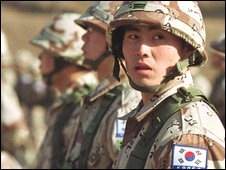
So Korea will head back to Afghanistan this summer. I spoke on this today in my radio slot on Busan’s English language station. The transcript is below.

The obvious question is why. The provincial reconstruction team Korea will send is pretty small. They won’t be able to do much. They won’t be in a particularly dangerous part of the country. And the Korean public is awfully skeptical.

So why go? The short answer is because the US wants Korea to go; they are part of the ally round-up of the Obama administration to reach McChrystal’s 40,000 soldier figure for counterinsurgency in Afghanistan. Korea’s geopolitics are awful. It is surrounded by 3 larger powers with whom it has terrible relations, plus bizarro North Korea. So SK is terribly dependent on the US to help it maintain its autonomy in such a bad neighborhood. And the US has repeatedly (ab)used this asymmetric dependence to push Korea into things it doesn’t want to do.

It’s also a nice way for Korea to strut its stuff as an emerging global player – something Koreans desperately want to be.

But I don’t think Koreans are ready for the blowback that comes with participation in the GWoT. As Greenwald and Walt have both noted repeatedly, it is ridiculous to assume that if you kill Muslims in the ‘war,’ they won’t hit back – e.g., in the Christmas bombing attempt. Koreans have already been targeted in the GWoT. The more Korea gets sucked into this thing, the more they will be targeted.

Further, Korea is an increasingly Christian society. Islamic radicals have traditionally avoided Asian religions. They worry about ‘backward’ monotheisms (Christians and Jews haven’t ‘updated’ to Mohammed, the last and definitive prophet of the God of Abraham) and polytheistic irreligion (i.e., Hinduism). But the more metaphysical/non-theistic faiths of East Asia don’t really activate them. Look at Malaysia, whose large minority of Buddhists have never been targeted. But as Korea christianizes (due to heavy proselytization here), expect the al Qaeda types to start eyeing it, especially if its soldiers use force in Muslim countries.

__________________________________________________________________

TRANSCRIPT

BUSAN E-FM

MONDAY, 8 AM

January 11, 2010

Petra:

So in the last few weeks, the government has agreed to redeploy Korean forces to Afghanistan, but not very many. So why is this important?

REK:

You’re right that the numbers are small – less than 500 people – in what we call a provincial reconstruction team. But it is important for Korea for at least three big reasons – beyond the obvious costs and risks to personnel.

Petra:

And those reasons are what?

REK:

First, Korea has almost no record of overseas force deployments. The Republic did send a few peacekeepers to East Timor and Iraq, but these were very controversial. Under the left-leaning Kim and Roh administrations, the Korean government disagreed badly with the US over Middle East policy, and one way to show that displeasure was avoid overseas deployments

Petra:

So why is Korea going to Afghanistan now then?

REK:

The conservative Lee administration wants a more mature, or ‘global,’ profile for Korea. President Lee wants Koreans to become accustomed to thinking of themselves globally, and peacekeeping is a part of that role. If Korea is to cut a larger role on the global stage – a deeply held Korean political goal – then it must also carry more of the burden. For the same reason, Korea is expanding its foreign aid programming.

Petra:

Ok. So what are the other reasons Korea is going?

REK:

Sure. The second big reason is because the US is asking Korea to go. Before President Lee, the Korean government was distancing itself from the US. President Roh particularly liked to use his flirtation with China to tweak the Bush administration. President Bush was deeply unpopular in Korea, as was the Iraq war.

Petra:

So President Lee is trying to mend fences with America by sending us to Afghanistan?

REK:

Basically, yes. President Lee is staunchly pro-American in a way his predecessors were not. Unlike South Korea’s drift toward China earlier in the decade, President Lee is strongly committed to returning the US alliance to centrality in Korean foreign policy…

Petra:

And going to Afghanistan is way to show that.

REK:

Exactly.

Petra:

You said there was a third big issue stemming from this deployment.

REK:

Yes, as Korea’s global profile and global intervention accelerate, it will eventually become a target of those forces that resent globalization, global governance, and the United States.

Petra:

I don’t understand.

REK:

Sorry. If Korea joins world politics more explicitly, if it moves beyond simply East Asia – its regional home for decades – then eventually it will encounter the turbulence of big international relations issues, such as terrorism or piracy.

Petra:

That’s right. I have heard before about Korean aid workers killed in the Middle East.

REK:

And Koreans have been increasingly pulled into the problem of Somali piracy.

Petra:

So what does this mean for Korean foreign policy?

REK:

Well, on the one hand, it means that Korean is increasingly becoming a mature global player. Its foreign policy is no longer dominated solely by North Korea. This is a deep desire of the current Lee administration – to pull South Korea out of the local ‘ghetto’ of peninsular politics, where everything in Korean foreign policy is dominated by erratic Pyongyang. President Lee and most Koreans want Korea accepted globally – as a wealthy, prestigious, functional, responsible democracy.

Petra:

And going to Afghanistan shows that. I get it. But you sound like you see a downside.

REK:

Yes, there is. The more Korea gets pulled into the US-led war on terror, the more likely Koreans are to become targets too.

Petra:

That’s unfortunate. Why?

REK:

Well, for two reasons. One, Korea is a US ally. And al Qaeda and similar groups target not only Americans but close allies, like Great Britain, too. Second, Korea has a growing Christian population.

Petra:

Why is that important?

REK:

Because for al Qaeda, the war on terror is really a clash of civilizations or a religious conflict. Islamic radicals are, in their mind, defending the faith against aggressive, imperialistic Christians, Jews, and to a lesser extent Hindus.

Petra:

But Korea’s heritage is mostly Buddhist and Confucian.

REK:

That’s right. Which is why East Asia has generally been spared the effects of 9/11. Islamic radicalism is just not as worried about Asian religions. But as Korea’s Christian population expands, and as its role in the war on terror expands also, al Qaeda attacks on Koreans are more likely.

Petra:

Those are the costs of global profile for Korea?

REK:

Yup.

Petra:

Do you think it’s worth it?

REK:

I don’t know, and I worry sometimes that Koreans don’t know either. Koreans are so concerned to achieve global status, that they haven’t really thought too much about its costs. You know, it’s not so bad to be the Austrias or the Canadas of the world.

Petra:

Is that what Korea is in East Aisa?

REK:

Kind of. And it could be if you wanted it that way. I even wrote a paper once saying that Korea might consider trying to be like Finland, instead of Japan – small, rich, and neutral – with lots of good skiing.

Petra:

But that’s not really what Koreans want right now, is it? So off we go to Afghanistan.

REK:

Basically, yes. You have decided to be an American ally, and so you get pulled into stuff like this.

2010 Predictions for Korea on the Radio

Busan e-FM


One of my nice new gigs in 2010 in Busan is a role as a ‘foreign affairs expert’ – please don’t laugh too much 🙂 – on a local English radio station. It is kinda flattering to be asked. The show is “Morning Wave” on Busan’s English language radio station. I speak on Monday mornings for about 8 minutes.

Today was my first contribution. I made a couple of quick predictions about Korea in 2010. The transcript is below. But here is the condensed version:

1. Korea will grow well, having sloughed off the Great Recession with little trouble.

Korea is a fairly small economy globally, even regionally. But it is fairly advanced, and it is a top 15 economy in GDP size. It is quite impressive how well Korea moved through the Great Recession. Unemployment did not spike. There was no capital flight, as there was in 1997. The contrast with the US is striking. There was a little nervousness last year, and the currency slipped for about 8 months as everyone sprinted to the dollar haven, but that’s it. Things never really got un-normal, in contrast to the West. There were not huge banking collapses, etc. So in 2009 things rolled along pretty smoothly, and they should in 2010.

2. The Korea-US free trade deal won’t go through.

What a shame. Just about every business and political official I know in Korea, from both countries, want the FTA to go through. But I don’t see any movement at all from the Democrats in Congress. The Great Recession stirred up all the old protectionist impulses of the Democratic Party. Hillary and Obama even competed to undo NAFTA. Amazing! The Democrats still haven’t made their peace with NAFTA 20 years later, so I see no trade deals at all going through this year. This is too bad, as the conservative Korean president could probably push the FTA through the legislature here if US movement was likely. Ironically that hurts us, the South Korean consumer more, because South Korea is a much more protected, and smaller, economy. Price differentials between foreign and domestic products are marked. The deal actually matters more here, but the US Congress cares more.

3. North Korea won’t change a bit.

NK is odd in so many ways. It is a closed to being a failed state, yet extraordinary stable for a stalinist hole. Everyone is terribly desperate to find change in NK. We look ceaselessly for any shred of movement, especially the doves who thought that putting it on the axis of evil was a mistake and that the sunshine policy was a good idea. But 10 years after sunshine, little has changed. NK is still the same awful repressive place it was, only now it is has nukes. We should stop predicting that NK is going to imminently collapse and strategize on those grounds, and we should start accepting that it has learned from the fall of communism in Europe and is going to hang around for awhile.

4. Japan won’t really come around on Korea.

This is probably the biggest disappointment coming to Koreans in 2009. The new, leftish Democratic Party of Japan government has really raised hopes in Korea for a meaningful apology (finally) over Japanese colonialism in Korea (1910-45) and a pro-Korean (naturally) settlement of a territorial issue (the Liancourt Rocks). The Lee government is even trying to finagle a Japanese Imperial visit. But I am with Jennifer Lind on this: the Japanese are just not there yet. The public doesn’t really care much about Korea, although Koreans care a great deal about Japan. Korean opinion is a nuisance most don’t care about; most voters want good relations with the US and China, which would compel Korea to come around anyway. But for the one group in Japan that really does think about Korea, it is firmly against the apology. Korea is ground zero for all the old rightist pretensions in Japan about WWII – that was defending Asia against the whites, that brought modernity to backward places, etc. To admit that Japanese was simply a rapacious colonialist here would definitively strip the Japanese right of a deep prejudice about Japan’s ‘proper’ place in Asia history. It will take more than the election of Hatoyama to get the Japanese to climb down from that one. But at least he is not visiting the Yasukuni shrine. That’s progress.


_____________________________________________

TRANSCRIPT:

Petra (the host):

Hello everyone and welcome to …..

Today we have a new foreign affairs contributor at Busan e-FM. Dr. Robert Kelly teaches in the Political Science and Diplomacy Department at Pusan National University. He came to Korea about 18 months ago.

So good morning Professor Kelly. Please, tell us a little about yourself.

REK:

Good morning Petra. Let me first start by thanking you and the producers here at e-FM for inviting me. It’s an honor to speak on Busan’s only English radio station.

As for me, I am a professor of international relations at Pusan National University. I grew up in the US. I am originally from the city Cleveland in the state of Ohio. Cleveland lies about midway between New York City and Chicago, on the south coast of Lake Erie.

One of my areas of study is the foreign policy and political economy of northeast Asia, so I am happy to join the Busan e-FM team in that capacity.

Petra:

Well, we’re happy to have you, and we hope are enjoying living in Korea.

REK:

I am indeed. I enjoy Korea very much. And Busan is wonderful place to live; the city is very vibrant and enjoyable.

Petra:

That’s great to hear.

So let’s turn now a bit to the future. It is the first full week in 2010. Would you like to hazard any big predictions about Korea or East Asia in the coming year? We can always check up on them next year to see how you did.

REK:

Sure. Well, first, I would say, looking ahead, that Korea’s economy will almost certainly be a growth leader in Asia in 2010 – after China of course. Korea has done a remarkable job bouncing back from the nasty recession of the last 18 months. Economists are now calling this the ‘Great Recession.’ Korea’s performance through the Great Recession has in fact been extremely instructive, and it has justified many of the Seoul’s policies since the last big economic crisis in 1997-98, the Asian Financial Crisis.

Petra:

That’s reassuring to hear. What did we do right that helped so much this time around?

REK:

Well, first, Korea’s growth is a lot more balanced now than it was a decade ago. In the 1990s, the large chaebol conglomerates like SK or Samsung represented a larger share of Korea’s economy. So when they had trouble, the whole Korean economy got in trouble too. They were, in the language of today’s Great Recession, ‘too big to fail.’ Today, small and medium enterprises are healthier and more diversified in Korea’s economy. This gives Korea some insurance if chaebol exports fall, as they briefly did last year.

Petra:

What else?

REK:

Korea’s economy is also cleaner and more transparent than it was. Before the elections of the 1990s, Korea’s biggest companies had preferential and politicized access to national budget. This helped spur the reckless borrowing of the 1990s that fed the Asian financial crisis. This time around however, Korea’s biggest companies are more exposed to financial accounting standards, so there are no hidden ‘toxic assets,’ as in the US. In fact, it is ironic, that just as Korea learned and implemented good lessons from its 1990s crisis, the US ignored those same lessons, and we are seeing the fallout today. American unemployment is over 10%; Korea’s is somewhere around 4%. That is quite an achievement.

Petra:

Hmm. It sounds like it. So much for Korea’s economy. I like those reassuring words. What about Korean foreign policy? There are a lot of big issues coming up, right? Like the FTA with the US, North Korean nuclear weapons, a reconciliation with Japan…

REK:

Yes, that’s right. 2010 has the potential to be a big year for the Republic of Korea. But here my predictions are gloomier.

First, on the FTA with the US, I must say that I cannot see it passing. The Korean National Assembly could probably be pushed into ratifying it, if the Blue House really thought the US was going to move on the treaty too. But quite honestly, this is unlikely. The American Democrats control both parts of the US Congress, as well as the White House. For several decades, the Democrats have been skeptical of the economic benefits of globalization, and I see no shift in that attitude. It is unlikely the US Congress will ratify the FTA.

Petra:

But I thought the business communities in both Korea and the US really support the deal?

REK:

That’s right. They do. But that is just not enough. Globalization and trade are met with a lot of skepticism in the US right now, even towards close partners in Europe and Asia, like Korea. So I think the probability is low, and that means higher prices for all of us.

Petra:

How about North Korea? Our previous foreign affairs expert, Brian Myers of Dongseo University, was pretty skeptical.

REK:

I am afraid I am too. Brian is right about most things North Korean. I share his pessimism.

Of course, we all hope for change in North Korea, but the regime has remained remarkably impervious to reform or renewal. Despite 20 years of hardship, including a brutal famine and Kim Jong Il’s stroke, the regime continues to hang on. I see no reason to expect that to change. In fact, the North’s nuclear weapons only serve to strengthen the government in this difficult period. So I see meaningful movement on the nuclear question as almost impossible. To me, the government’s repression and its nuclear weapons go hand-in-hand.

Petra:

How unfortunate. How about Japan? President Lee extended an invitation to the Japanese emperor to come to Korea. That would be quite a breakthrough.

REK:

Your third issue – Korea’s relations with Japan – is the most likely for progress, but again I am pretty pessimistic. What Korea really wants from Japan is a sincere, heartfelt apology for the colonial period of 1910-1945, and an admission that Dodko is, in fact, Korean, territory.

I don’t see either as likely. Just in the last two weeks, another round of Japanese textbook reform missed the chance to narrow the distance. The election of the Democratic Party of Japan is a major event. It has promised better relations with Japan’s neighbors, and above all, that means Korea.  But any apology,  much less an imperial visit, will require a major shift in Japanese popular attitudes toward Korea. An election is simply not enough. And right now, the Japanese persist in old attitudes toward Korea, as a dependent or a little brother. Its apologies continue to be mixed and half-hearted. And they seem unable to formally relinquish claims to Dokdo, even though they already have in substance.

Petra:

How gloomy for your first day on our show! Why did we invite you here? Can you at least close out with something positive?

REK:

Sure, I think the biggest under-appreciated international story in Northeast Asia is enduring peace. For all today’s troubles with China’s growth, Japan’s historical ambivalence, and North Korea’s nukes, East Asia is more peaceful now than it has been in centuries, and wealthier and more contented too. This is a huge achievement – bigger even than Yuna Kim. No one wants to jeopardize that, so one happy prediction for 2010 is the continuation of military peace and of economic growth, both in Korea and the region. This is a good time to live in East Asia. Enjoy it.

Merry Christmas – Is Christmas Any Different in Korea? Not Really…


Merry Christmas, all. I hope Santa brings you a Red Ryder BB gun.


As for a Korean Kristmas, there isn’t much difference. The holiday is not as big here. Korea is only about 20-25% Christian. And actually, the muted size of the festivities more appropriately matches Christmas’ relative importance (somewhat low) in the Christian calendar. As in the US, Christmas has been overtaken by commercialism. It’s all about tacky plastic decorations and the most decorations you see are in the stores, not in domiciles.

I was the only one to put up Christmas decorations in my office. I couldn’t find a live tree either – a crushing blow, that. All the Christmas specials you know aren’t on TV or at the DVD store. And about the only Christmas movies Koreans really like are the Home Alone films.

On a more serious, culture studies note, it might interest you to note that Santa is interpreted here as a Caucasian. The race of Jesus has been an issue of dispute occasionally – see the first few minutes of Ali for an sharp look at the impact of a white Jesus on the young Cassuis Clay. But there is not such tussle over Santa here.

Should the US Pull Out of South Korea (2): No

USFK

(Part one of this post, in favor of leaving, is here.)

US SecDef Gates recently reaffirmed in very strong language the US commitment to Korean security. This served as a catalyst to extensive discussions among my colleagues about the value of the US commitment to SK. This is part 2 of the debate. My own thinking tilts toward the opinions in this post.

So here is why we should stay:

1. If we leave, everyone in Asia will read it as a sign that we are weak and that we are leaving Asia generally. Yes, this is the credibility argument straight out of the Vietnam, Iraq, and Afghanistan debates. But the world sees US power today as wavering; we are the tottering giant, especially in Asia. If we leave during the GWoT, that image will be confirmed, and the Chinese will push hard in Asia. A US departure will touch off an arms race as regional uncertainty rises. Asia is not where Europe or Latin America are in terms of regional amity. The US presence is more needed in this region, and it earns the US the friendship of the local democracies. It is hard to see how a spiraling arms race, as Japan and China openly start competing for regional leadership, plus perhaps India and China, would help the US. The US could very well be pulled back in later. A US departure from Korea (and Japan next?) will be read as a clear victory for China in the Sino-US regional competition.

2. It also means that the US will lose SK as an ally, because without the troops, they’ll feel, rightfully, that the US abandoned them. It would be nice to assure SK security without the ground forces, but US infantry on the ground (the USFK logo above) sends a much greater signal of commitment than air and sea power. SK will slide into China’s orbit if the US leaves. It’s already edging that way now. If America bails, it loses them. It is correct that SK no longer needs us to win a second Korean war though. So after unification, US retrenchment from Asia would be more possible and likely. But if America sticks with the Koreans through these difficult times, it will have them as good allies long into the future. Consider how loyal Kuwait and Germany are to the US because of historical goodwill. When Korea finally does unify – and it will happen as the post-Cold War North is in a permanent economic and legitimacy crisis – the Koreans will be deeply grateful if the US is here, or deeply resentful, and likely very pro-Chinese, if the US is not.

3. Unless the US demobilizes the troops of USFK, it must to rebase them somewhere else. That will require money, construction, hassle, etc. So long as the Koreans are paying for them – and they are, somewhat – and so long as they have Korean popular assent – and they do (USFK is not hated as US forces in Iraq are, e.g.) – then why withdraw them? They are not seen as occupiers; their establishments are already in place; the locals do not mind (too much) their presence.

4. Finally, DoD is restructuring USFK so that the bulk of any warfighting will fall of the ROKA. The primary US contribution to a second Korean war will be airpower. The ROKN already outguns the NK navy significantly, and the US ground presence here (28.5k) is too small to be really meaningful against the NK army (1.1 million). In other words, the costs to the US military in lives and dollars is shrinking. The US is dumping most of the burden on the locals, and Koreans generally seem to accept that this is really their responsibility.


So rather than leave, the US should continue to push South Koreans to pay a lot more under the USFK Status of Forces Agreement. This is renegotiated every 2 or 3 years, and SK’s portion of the burden has regularly. Right now, as best I can determine, SK pay about 47% of the (USFK) bill. For an OECD economy, that is low. So we could probably squeeze them for more, as Walt would recommend, but I don’t think we should leave.

Should the US Pull Out of South Korea? (1): Yes

 korea_beef_protest(1)

(See Part 2, in oppostion of withdrawal, here.)

Last month US SecDef Gates pledged the most formal statement yet of US “extended deterrence” to South Korea in history. Extended deterrence is an IR theory term. A country deters aggression against itself by a powerful military. A strong military drives up the costs of conquering a country, and so it deters aggression. During the Cold War, the US extended its deterrence to its weak and exposed allies. Countries like West Germany and South Korea could not withstand a communist onslaught alone, so the US pledged to defend them by extending its security umbrella. Such ‘collective security’ made everyone safer against the communists. In Korea, this has always included the use of nuclear weapons, as Gates made clear again  week.

The US Forces in Korea (USFK) total about 28,500 men. The are stationed north of Seoul by the DMZ, although they are being slowly withdrawn south of the DMZ to Pyeongtaek. Elsewhere, I have argued that this shift implies a loosening of the US commitment to SK. And lots of smart people – Bruce Cumings, Selig Harrison, and Brian Myers – have argued that the US should leave SK altogether. Chalmers Johnson said the US refusal to withdraw from Asian bases after the Cold War helped convince him the US had become an empire.

So here is the debate as I see it. Here are the reasons to leave:

1. In terms of raw US national interest, the value of the Korean alliance has decline dramatically. The Cold War is over, so the original rationale of US extended deterrence here is gone. Even if NK invaded SK and won, i.e., if the peninsula were reunified on communist terms, it would not matter that much to US security. Japan and China would still be around to balance/contain a communist united Korea. This is essentially the retrenchment argument. The Soviets were a genuine global threat that required a global US response. No one in world politics today poses such a threat – not China, NK, or Islamism. The US is a very secure great power – safe behind two oceans, a large nuclear arsenal, and the world’s most capable conventional military. Walt makes this argument regularly at Foreign Policy.

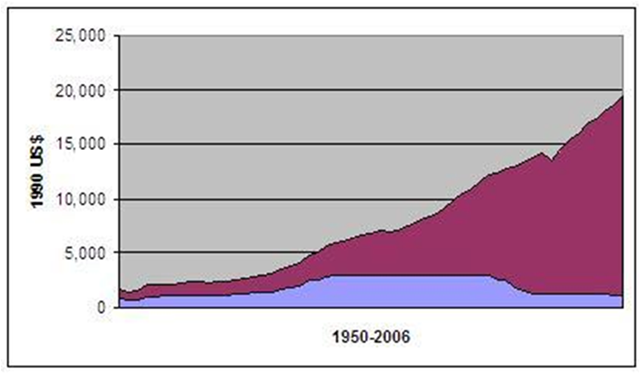
2. A more ‘moral,’ or altruistic approach would grapple with the social fact of South Korea’s long-term friendship with the US. It has stood by us for a long time as a reliable ally. It is a friend. It has participated in the coalitions of the willing in both Iraq and Afghanistan, even though it didn’t really want to go. Compared the to Europeans, the Koreans take their alliance commitment to the US very seriously. But even by this reckoning, we could arguably leave SK without great loss. SK has clearly won the intra-Korean competition. NK would lose a war with SK, even without US help. In a presentation I saw last moth in a conference at Changwon National University, my friend James Strohmaier of Pukyong National University presented this powerful graph of per capita GDP in the North and South. SK is purple; NK is blue. Obviously the race is over:

image

NK’s military, while large, is badly behind the South in technology. No one I have heard here thinks NK could win, even with the use of its nukes. So if SK can win this thing all by itself, what is the point of the US staying?

What the Europeans Might Learn from Korea about Free-Riding on US Power

nato-EU_preview south-korea-flag

For almost 40 years, since the Nixon doctrine, the US has complained that its allies free-ride on its power. The US does heavy lifting like fighting in Afghanistan or building a huge and costly military against the USSR. The Europeans enjoy the benefits, without providing much for the costs. Stephen Walt has made this argument in IR theory, as has Robert Kagan more popularly. Kagan particularly is the best-known proponent of the idea that the EU is ‘post-modern’ and focuses on soft power. By contrast the Russians are playing the ‘modern’ nation-state game of power politics in Eastern Europe, and the Middle East is ‘pre-modern’ insofar as supranational identities (Arabism, Islam) and sub-national identities (tribes and clans) contest the state and make state function very difficult. I like to think of Europe as an ally for the US and concerned about terrorism, Russian misbehavior, N Korea, etc., but it increasingly looks like Kagan is right. My thoughts are here and here.

This well-worn argument strikes me as wrong though in Korea. I am repeatedly impressed at Korea’s willingness to go along with US military ventures for the sake of global public goods provision. I go to conferences a lot here and constantly hear about the US as a ‘strategic partner’ for Korea, and that Korea must move into things like peacekeeping. My students genuinely seem to be aware of what the US provides here and that Korea should make a reciprocating effort. Consider the last line of this Korean op-ed about the current ‘what to do in Afghanistan’ debate: “The Korean government has to consider its obligations as a responsible member of the international society and find a way to help reduce the suffering of the people of Afghanistan from a humanitarian point of view.” Find something like that in European op-ed.

It is true that the Koreans went to Iraq, because they need the US against N Korea. And Poland signed up because of Russia. France and Germany have the luxury of Poland as their front-yard, so they can play hard-to-get. But it is also clear that ‘old Europe’ just doesn’t want to contribute to collective goods that much any more. Their defense spending is atrociously, irresponsibly low; only 5 out of 28 NATO members meet the ‘required’ NATO defense spending minimum of 2% of GDP (see Table 3 of this NATO 2009 defense spending report). Germany, supposedly a great power, spends just 1.3%. They like US power when things get hairy, but they are quite content to free-ride otherwise. Bush was a gift to western Europe in that his belligerence allowed them to duck the war on terror. But now Obama can’t get them to contribute either, and he was supposed to initiate a new era. European restrictions on troop behavior in Afghanistan mean too many European troops are just glorified policemen. Consider the ridiculous German reaction to the civilian deaths of a recent anti-Taliban airstrike. The deaths, of course, are regrettable, but ‘collateral damage’ is ‘normal’ in war and permissable under international law. But now the Germans want to leave. It is a European luxury to say ‘we can’t participate in any dirty operations at all.’ That just bucks the burden and blood to the US. The Europeans can retain their moral purity while enjoying the benefits the US military gives by trying to win (whatever that means) in Afghanistan. It is very poor form and smacks of deep selfishness.

By contrast, I find Koreans far more understanding about the costs of global order maintenance. Maybe this is because they live next to NK and every male has to serve in the military. But I find a moral shame at the idea of Korean free-riding that I do not when I talk to Europeans. The Europeans I meet here (a lot inevitably, because foreigners in Korea clump together) are quite content with the Der Spiegel-Le Monde image of the US as imperialist bully, and when I mention NATO obligations, I might as well be talking about space travel. The idea that European NATO members are treaty-obliged to help in Afghanistan (they are – Article 5 of the Washington Treaty was invoked after 9/11) falls on tone-deaf ears. For shame! The Europeans are natural US allies, because of high cultural and political similarity, and Islamic radicals target all of us. Yet Koreans seem to realize better the costs of the US commitment in the war on terror, and they feel some sense that the should help. I find this reversal stunning and disappointing.

A ‘Confucian Long Peace’ among East Asian States (2): Probably Not…

east_asia

(For part one of this post, click here.)

1. I am skeptical, because shared cultural bases have rarely stopped conflict in other areas. Instead, they often seem to encourage it, as various states claim leadership of the cultural space as a whole. Every Continental would-be hegemon from Charles V to Hitler said they were ‘uniting Europe.’ Further, we usually save our worst fury and anger for dissenting insiders, not outsiders. So Plutarch and Thucydides both noted somewhere that the ancient Greeks, despite their shared culture, were far more zealous in destroying each other than uniting against their common foes, the Persian, Macedonians, and Romans. Hedley Bull and the EU framers argue that European ideals and perhaps Christianity provide a shared cultural base for a ‘European society,’ but Christendom hardly stopped the Europeans from fighting bitterly to dominate each other, particularly over which form of Latin Christianity was right. Today, the Arab state system shows the same problems. Supposedly united by common language, culture, and religion, the Arab states have vied brutally against each other, frequently recruiting outsiders like the US or USSR to help them defeat local rivals.

Now, one can argue that Confucianism has special or unique war-reducing or –dampening properties, but that needs a lot of research and detailed process tracing rooted in specific examples of conflict averted by appeals to shared values. A far simpler answer is to say that China was a regional unipole (i.e., huge, when others were small), and therefore war against it was pointless. IR strongly believes this logic explains the current global Long Peace; war against the US unipole today is fruitless. So why not simply apply the logic to the regional level? Chinese preponderance made war in classical Confucian Asia less likely, because China’s opponents never stood a chance and so never tried. Following that causal logic, we should speak of a Chinese hegemonic peace, not a cultural Confucian peace.

2. The idea of a Confucian long peace stumps IR, because we aren’t really sure what to do with ‘culture’ as an explanation for outcomes. In fact, social science in general dislikes ‘culture,’ because it feels like a cop-out reason when you’ve got nothing else. If you can’t explain something otherwise, say it is ‘just their culture.’ So if I don’t know why Russians like vodka, the Irish like Guiness, and the Koreans like soju, then it is just ‘cultural preference.’ But that is awfully soft. It does not actually tell me much; it provides no account of mechanisms and choices. Besides, lots of so-called cultural artifacts actually have functional roots. For example, the Jewish and Islamic prohibitions on pork are rooted in the possibility of contracting trichinosis from flesh that might quickly sour and rot in the sun of the ME. Social science prefers such rationalist explanations. Actor X does Y, because there is some tangible material benefit. Maybe Confucian Asia will bandwagon with China for cultural reasons, but the causal map for this behavior feels soft, especially in contrast the explanatory clarity of the regional unipolarity thesis.

For examples of culture’s softness, look at the other three systems I noted with multiple states functioning within a shared culture (Greeks, Christian Europeans, and Arabs). They did not enjoy any war-reducing affects from common culture. In fact, the evidence from psychology points the other way: we tend to save our harshest opprobrium and violence for lapsed insiders (national traitors, religious heretics) than outsiders who are comfortably relegated as ‘barbarians.’ This was Plutarch and Thucydides’ tragic insight, e.g., on the ancient Greeks.

3. If there was a Confucian peace, I don’t think it is coming back. Kang does. He thinks China’s EA neighbors will accept some amount of Chinese hierarchy; that is why they are not balancing against China now. I don’t buy it. Koreans and Japanese strike me as way too nationalistic today to accept that. If anything, the Koreans and Japanese look down on the Chinese as culturally inferior. Koreans will tell you that the Chinese will eat anything (scorpions, beetles) and that Korea should ‘mediate’ China to the West. Sizeable chunks of Japan still think its imperialism liberated Asia from the West and brought modernity. EA states today are just way too nationalized now. Just like the nationalization and de-arabization of contemporary ME states that sets them against each other despite shared culture, EA states may share a vague Confucian background unity, but vague is all it is. EA is far from the level of cultural sharing and trust that undergird a project like the EU. And remember that the Europeans had to destroy each other for 400 years before they decided to live with each other. If no one is balancing against China today, as Kang says, then, 1. they can avoid it, because the US is still around to reassure everyone, and 2, they are certainly hedging against China, if not openly balancing it. No one in Asia is openly running with China, not even NK. This nationalization of EA states is why Samuel Huntington’s proposed Confucian civilizational bloc never really ignited local opinion here; it was based on the Sinco-centric past, which although attractive perhaps as a route to peace today, no longer exists. Asians will have to do the hard work of forging institutions to build trust; culture is not enough…

A ‘Confucian Long Peace’ among East Asian States (1): Does Shared Culture Stop War?

confucius 2

(For part 2 of this post, click here.)

This article is an excellent introduction to the tangle of East Asian security problems today. Chung-in Moon and Seung-won Suh lay out all the nasty problems of territory, nationalism, and historical imperialism that make EA a powderkeg. There is a running debate in IR theory about how peaceful EA actually is. A lot of it focuses on China. Aaron Friedberg and John Mearsheimer worry that China’s growing strength sets it on a collision course with other Asian states, and eventually the US. David Kang thinks that China’s claim to a ‘peaceful rise’ is real. He notes that for all the sound and fury in EA about nationalism or territorial disputes, there is no serious anti-Chinese coalition forming, nor has their been a major war out here since Vietnam and Cambodia in the 70s. This is a historically and theoretically rich debate; you should read about it if you can.

But I want to focus on remarks by Moon and Suh about how peaceful Asia’s IR was before the arrival of the West. The issue of today’s security dilemmas and tensions in Asia are hyperresearched. Everyone out here goes to one conference after another about Asian security. (I will attend 6 by year’s end, with 2 more scheduled already for next year.) But the counterpoint between Asia and Europe’s earlier history is far more fascinating, because no one ever talks about it. There is a vague argument that while European states were destroying themselves in early modern warfare, Asian states were getting along reasonably well under a Chinese umbrella of soft hegemony. Moon and Suh use the terms ‘long peace’ and ‘Confucian peace’ to describe EA IR until the late 19th C. This is woefully underresearched; there is a great dissertation here.

The “Long Peace” is an uncontroversial idea in IR theory. It says that it is pretty remarkable that there has been no global general war or systemic conflict since WWII. That was the last time all the big global powers lined up on one side or the other and destroyed one another. We are now in the 64th year of the Long Peace. And that does seem like quite an achievement… from a Eurocentric view of the world system. Kang has written a lot to convince me that actually Asian IR was a lot more peaceful than European IR before the Europeans arrived in force in the late 19th C and brought the strict state sovereignty system with them. Kang, Moon, and Suh all suggest that East Asia was a characterized by a much longer (as in centuries) “Confucian Peace.”

The deep cultural and historical details of the confucian peace really need to be researched a  lot more. But here is what I pull from Moon, Suh, and Kang. The ‘confucian’ peace suggests that nations/states in the confucian zone (that means China, Japan, Korea and Vietnam) shared a lot of values and cultural similarity. This sharing acted to slow the march to war; that is shared Confucianism has a war-dampening effect. The specific causal mechanisms are Confucianism’s emphasis on 1. respect for the older and more educated, 2. social harmony, and 3. social hierarchy.  China, as the oldest, most culturally ‘advanced’ state in the region, enjoyed formal superiority to Korea, Japan and Vietnam, but allowed them substantial informal leeway. War violated harmony and order and showed disrespect to the older brother (China). Think of this as ‘feudalism that works’ (unlike in Europe where vassals routinely rebelled). So causal arrow goes from shared culture to the specific war-dampening cultural aspects of Confucianism to peace. Someone needs to write a good IR history of this idea and whether or not it was really true. I have 3 criticisms: Go To Part 2.

Koreanism of the Month: Bizarro English-Language T-Shirts

Writing about nuclear weapons, NK brutality, and the US Right’s extremist meltdown is enough to make any reader jump out a window. So here is my monthly effort at humor – Korean habits that fit the ‘I’ve-lived-here-awhile-and-I-still-don’t-get-it’ category for Western expats in Korea.

English is all the wave here. Apartment buildings use English names, advertising sprinkles English words throughout. English words that have Korean analogues are nonetheless transliterated without translation.

But the most everyday occurrence of this is in clothing. Koreans wear a lot of shirts with English words and expressions but almost certainly have no idea what it means. To boot, the English is often incoherent or downright profane. For more on the English language t-shirt craze, try here.

Try these:

P090909001 P090918002

P090916003 P090922002

P090916004P090924003 P090924006