Who I Voted for and Why, II: Clinton, bc Trump is Grossly Unqualified

Image result for cleon greek

Cleon, demagogue of Athens during the Peloponnesian War and the archetype of democratic demagogue feared by conservatives like Thucydides, Plato, and Aristotle.

The following essay is a re-print of an op-ed I just wrote for the Lowy Institute’s Interpreter blogline.

Conservatives who plan to vote for Trump might want to consider for a moment just how much Trump violates the basic principles capital-C Conservatism cherishes: order; paced, digestible change; caution/pragmatism;  stability and moderation in leadership; robust institutions. It is hard to imagine Burke, Buckley, Kirk, Disraeli, and other Conservatives reading Trump as anything other than the type of demagogue political philosophy has long warned can be spawned by democracies in tumult. Just go read Thucydides if you don’t believe me.

I say this one inclined to such Conservatism. I worked for the GOP on/off throughout the 1990s. I am hardly a liberal, even if I am an academic. But if you can’t see the demagogic potential in Trump – the likelihood that he’ll use the law to pursue his enemies or enrich his family; his demonization of out-groups; his belligerent, apocalyptic tone – then you just haven’t been paying attention. Trump just proved that there is a potential for something like authoritarian, maybe even fascist, politics in the US, and that should scare the hell out of all of us.

Continue reading

Trump and Northeast Asian Nuclearization: Not as a Terrible an Idea as You’ve Heard

Image result for nuclear weapons northeast asiaThis is a re-post of something I wrote for the Lowy Institute earlier this month. The original is here.

So yes, Donald Trump is awful. He is a threat to American democracy, an vain narcissist, doesn’t know anything about nuclear weapons or national security, and so on. I know what you’re thinking, so I will say that I mailed-in my absentee ballot today, and I voted for Hillary Clinton.

That does not necessarily impugn all of his ideas however. And when he says that Japan and South Korea might pursue their own nuclear weapons, I have never understood the hysteria that greets this notion. That Trump says it, and that he might not really even understand what he’s saying, does not automatically mean it is wrong.

The debate over SK and Japanese nuclearization is a lot more variegated that we normally hear from mostly ‘liberal international order’ analysts who dominate Washington thinking on foreign policy. The essay below makes several claims, but the strongest to my mind is that a northeast Asian nuclear arms race is already underway; SK and Japan are just not participating in it – which does not mean it is not happening. It is true that they need not to some extent, because they are covered by American extended deterrence, which gives them ‘shadow nuclear weapons’ I suppose.

But the costs of them going nuclear are not that high anymore. Russia and North Korea have both substantially elevated the role of nuclear weapons in their grand strategies in the last two decades. China might start counter-building, but what is China doing for Japan or South Korea that it earns the privilege of them staying non-nuclear? Specifically, if China won’t rein in NK, the case for SK and Japanese nuclear restraint diminishes.

The full essay follows the jump.

Continue reading

Would a Chinese Cut-Off of North Korea Bring It Down?

This is a re-posting of something I wrote for the Lowy Institute here. Basically, I was trying to think of what might either bring North Korea down, or otherwise force it to change substantially. Usually at this point, people say something like, a war, or an internal revolt. But a war would be so disastrous, that it is worth looking at other possibilities. And an internal popular revolt seems really unlikely. In 71 years, North Korea has never had one.

In the movies, like Avatar, the people rise up and overthrow their oppressors. In reality, authoritarian regimes almost always collapse when the regime’s internal groups turn on each other. Regime splits, possibly catalyzed by popular protest, can force dictatorships to change or even collapse. In Egypt in 2011, the regime split after Mubarak failed to quell the revolt with his thugs and then flirted with using the army. They brass balked, and Mubarak began to lose internal support.

But if there won’t be popular revolt in North Korea, how to set the regime’s factions against one another? Well, how about going after their cash? The military and police who keep the Kim regime afloat pay a pretty high price for that. They are globally isolated, hated by the countrymen, and will be remembered in Korean history as thugs. What is the compensation? The great lifestyle of the gangster racket Pyongyang runs – the HDTVs, booze, women, foreign cars, and so on. All of that depends on a) foreign cash, and b) a foreign pipeline. China is required for both. Shut that gate, and the pie of foreign goodies suddenly starts to dry up. That might get them them tearing at each other.

The full essay follows the jump:

Continue reading

What a Trumpish GOP would Mean for Asia: Reduced Trade & Migration, and More Defense Spending


This a re-print of an op-ed I just published with the Lowy Institute.

I’ve argued elsewhere that I don’t think a President Trump would pull the US out of Asia. That would requiring battling a deep Washington consensus of government officials, think-tankers, military, and the rest who strongly support a continued American presence out here. Trump is too lazy and too ill-informed to try that. So don’t worry about that. Nor will Trump win. So don’t freak out yet. 

But I do think Trump has changed the GOP a lot, and that he will have successors. Trump just proved that the median GOP voter doesn’t give a damn about Reaganism. Republican voters are now lower middle class and downscale (whites), and they are not anti-statists who want tax cuts for the rich. Nor are they neocons (it’s their kids that fight the wars), nor are they social conservatives, as their rates of divorce, single parenthood, and substance abuse make clear. What they do want though is a dramatic reduction of immigration in order that the United States remain majority white longer.

In short, Trump has just showed the potential for the US to have a European-style nationalist-rightist party, complete with a whiff of fascism in Trump’s authoritarian posturing.

So my prediction is that: 1) Trump will lose, but 2) post-Trumpers will pop-up and try to use his message to win GOP primaries. This will ignite a serious civil war inside the GOP between the establishment – who are mostly Reaganites like Paul Ryan but who have weak roots among actual GOP voters, as Trump just illustrated – and white nationalist post-Trumpers who actually speak to issues the GOP base cares about. It’s not clear to me who will win, but the post-Trumpers have the votes and the passion.

The full essay follows the jump.

The Huge, Strange Coalition Opposed to an Obama Apology at Hiroshima

A G-7 meeting will take place on May 26-27 at Ise, Japan. This has prompted some discussion about whether or not President Obama will and/or should apologize for the August 6, 1945 bomb-drop. I figure he won’t for the reasons sketched in this essay: basically no one wants him to. The coalition opposed to an apology is huge. The below essay is a repost of my May essay for the Lowy Institute.

I did not engage the issue much of whether Obama should apologize, which also part of the reason why he won’t. It is not really clear that the bomb-drop was a war-crime deserving of an apology. That is different than pointing out that the bomb-drop may not have actually ended the war as American mythology insists it does. It probably did not actually convince the Japanese to quit. It was the Soviet entry into the war that finally pushed the cabinet to give in. But that does not mean that the bombing was unjustified, because US policy-makers obviously did not know that at the time. So be sure to distinguish between 1) did the bomb cause Japan to give up? (probably not; it was Stalin); 2) was the bomb drop immoral? (probably not, as the war was still going on and there was good reason to believe a shock weapon like this this might finally convince the junta to give up).

There are two good movie versions of all this too: Japan’s Longest Day (which is scarcely known in the West), and Hiroshima. My full Lowy essay follows the jump.

Continue reading

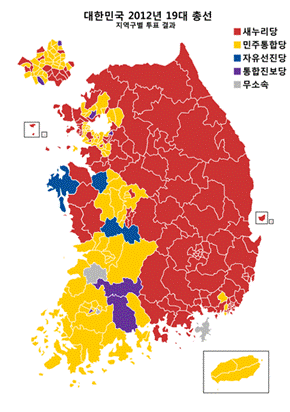
My Predictions and Expectations for the Upcoming South Korean Parliamentary Elections: The Left will get Hammered

clip_image002

This is a re-post of something I wrote a few days ago for the Lowy Institute. I thought it would be helpful to put some predictions out there, with a logic for why I made them.

That map to the left is the last South Korean parliamentary election’s distribution of seats. Red and blue are conservative parties. Yellow and purple are left-wing. Gray is independent. The reason red (the Saenuri Party) looks so dominant is because rural Korea is empty. So the parliamentary districts in the countryside are very big in order to capture the necessary number of voters. You can see this in the US as well, where the geographic expanse of urban congressional seats is much smaller than rural ones.

In brief, my prediction is that Ahn Chul Soo’s upstart left-wing party will throw lots of seats (10-30?) to the right by fragmenting the left-wing vote. 82% of the National Assembly’s seats are won by plurality voting. So all the right has to do is stick together under one roof, and they win while the left fragments its votes. The Diplomat interviewed me on this, and I said the same: Ahn doesn’t want to admit that he is sucking away votes from the main left-wing (Minjoo) party. So Ahn is the Jesse Ventura of South Korean politics, a vague, apolitical who-knows-what-he-believes purposefully damaging the larger effort of the left for his own egomania. (To be fair, parties to the left of Minjoo – typically pro-North Korean – also have a record of pointlessly splitting the left’s vote.)

The full essay follows the jump, but you probably shouldn’t listen to me anyway. My wife, naturally, won’t have any of this and will vote for Ahn, because he’s new… or something… I just don’t get the Korean liberal voter…

Continue reading

Will the Comfort Women Deal between Korea and Japan Hold? I’m Skeptical

This is a re-post of an essay I just wrote for the Lowy Institute.

Japan and South Korea clinched a deal in late December over the comfort women. It is pretty controversial in Korea, and the Japanese are now insisting that the deal means the issue should never be brought up again ever. Given how deeply Koreans care about this – I can’t begin to list the huge number of student papers, conference papers, journal and newspaper articles, TV programs, emails, and what all I have read/seen over the years on this – I am very skeptical that an intergovernmental deal will suddenly close down an issue that attracts so much civil society and journalistic attention, not to mention helps shape South Korea’s anti-Japanist political identity.

Luckily for President Park Geun-Hye, the North Korean tests and bad weather of the last month distracted attention and made street protests difficult. In the coming year, I think the big tests of the deal’s ‘stickiness’ are the April parliamentary elections, and the moving the statue (pic above) from in front of the Japanese embassy. If the left doesn’t use this as a wedge issue, and if students and activists don’t human-shield the statue or attack the crane, then perhaps Koreans really are ready to move on. But I am very skeptical that an issue which has been built-up in K national consciousness for 25 years can suddenly be switched off by secretive, high-level deal among a bunch of bureaucrats. I don’t buy it…

The full Lowy essay on my skepticism follows the jump

5 Interpretations of N Korea: Communist, Rogue, Fascist, neo-Confucian, or Gangster?

This is a re-post of an essay I just wrote for the Lowy Institute, available here. And yes, that Godfather pic is meant to imply that I accept the last of the interpretative frameworks suggested: North Korea as a gangster racket.

The more time I spend in this field, the more I see analysts get into really sharp debates over just what North Korea ‘really’ is. The best way to de-legitimize your opponent in this area is to say you don’t understand the ‘real’ North Korea, or know what they ‘truly’ want. This can get pretty intense. And it does not help that we know so little about how North Korea is governed.

As I have listened to these fights over the years, it strikes me that there are roughly 5 major interpretations or schools. And these approaches are politicized too, not just intellectual frameworks, because they have direct implications for how South Korea and the US should respond to North Korea. For example, if you think North Korea is a rogue state gremlin ripping at the fabric of US hegemony, you are more likely to endorse tough action than if you accept leftist interpretations that US-led isolation of North Korea is what makes North Korea so dangerous.

The 5 basic interpretations are:

1. Traditionalist Conservative: North Korea as a cold war stalinist state

2. Neoconservative: NK as dangerous, unpredictable rouge state

3. Fascist: NK as a racist, national security barracks state

4. Leftist: NK as ‘Korean’ (rather than socialist or fascist), neo-Confucian,or post-colonial

5. Gangster: NK as a massive shake-down racket; mafia have overthrown the government

The full essay follows the jump.

Continue reading

On the 70th Anniversary of the North Korean Communist Party, Just How Communist is North Korea?

It was the 70th anniversary of the North Korean communist party – officially, the Korean Workers Party (KWP) – on October 10. The event got lots of press for the usual military bluster, but given that the event ostensibly celebrated a communist party, I thought it a nice opportunity to consider just how ‘communist’ North Korea actually is. If you look at that pic above, it sure looks communist: red everywhere, the iconography, the Mao suit, the Soviet-esque military uniforms (complete with those ridiculously oversized hats), the party symbol, and so on. So the stalinist form is still there.

But three changes since the end of the cold war have turned North Korea into something else:

1. Monarchic Succession, an openly feudal practice

2. The Replacement of Juche by Songun, ie, the flirtation with racism/fascism in the place of socialism as regime ideology

3. The effective Collapse of the Public Distribution System and its (unadmitted) replacement by creeping marketization from below and rampant corruption.

The original post is here at Real Clear Defense. Next month I want to write on other possible interpretive frames for North Korea once one throws out Marxism – is it a mafia state, or a national defense state, for example?

Continue reading

Park Geun-Hye’s Trip to that Bombastic Chinese Military Parade Was Actually a Good Idea

South Korean President Park Geun-hye (2nd from L) talks with Russian President Vladimir Putin (3rd from L) as they, along with Chinese President Xi Jinping (far R), stand to review a massive military parade marking the 70th anniversary of China`s victory over Japan in World War II at Tiananmen Square in Beijing on Sept. 3, 2015, (Yonhap)

I know what your thinking: there’s the president of a democracy standing next to three dictators, one of whom insists on dressing like Mao, watching Chinese soldiers goose-step like fascists. Yikes! I agree that the optics are terrible. (Quick quiz: who’s the ‘president for life’ in blue on the left? Here.)

But Park is flattering China like this is for a purpose – to isolate North Korea. So stop all your nattering about her clothes at this event (yes, I’ve heard that); that she is Xi’s ‘girlfriend;’ that she’s a ‘sinophile;’ that she’s drifting from the US or turned her back on her friends or democracy or whatever. None of that is true. All of that is speculative.

Instead, she’s hustling hard – 6 trips to China in 3 years – to convince China that South Korea is not an enemy and that China can therefore give up the North Korean buffer. How many times have you heard American analysts, in an attempt to get China to do more on North Korea, say, ‘the road to Pyongyang runs through Beijing’? Well, here are the South Koreans taking that to heart. If you think she’s dissing the US alliance, recall that the whole purpose of the US-SK alliance is North Korea. The US alliance is not an end in itself, no matter what neocons think.

China is North Korea’s last trap-door to escape the obvious inefficiencies of its economy. Without China, the perks of running North Korea – the cars, yachts, booze, trips to Hong Kong, girls, foreign education for your kids, and all the rest – disappear. Cut that Chinese umbilical cord, and North Korean resources will diminish dramatically. As the budget steadily shrinks, regime elites will turn on each other over a diminishing pie. The Songun bargain (my term) – struck by Kim Jong Il to keep the system rolling after the Cold War, in which the KPA generals do not overthrow the Kims in exchange for the cushy lifestyle – would collapse, because the lifestyle is impossible without some access to the outside world. And the only place North Korean elites can park their money, traffick their meth and missile parts, import skiing equipment (yes, really), and all the rest, is China.

If you can finally cut off North Korea from the world – no more hidden pipelines – then I’d bet the regime would collapse within a decade from elite infighting over the small domestic, not very cushy resource pie leftover (no more Hennessey!). After the jump is a reprint of an essay I wrote for the Lowy Institute making this argument at length.

Continue reading