Guest Post, part 2 – Dave Kang: Yes, the Media Coverage of the Korean Crisis is Inflammatory

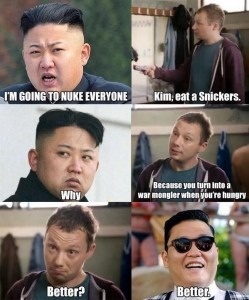
Kim-Jong-Snickers-249x300Yeah, I know what you’re thinking, two guest posts in a row? Christ, Kelly, you’re lazy as hell. In the midst of the biggest North Korea flap in years, you’re at the bar playing Xbox or something.

While that is true, I did get up that piece on the Diplomat. It summarizes my thinking on this current crisis-that’s-not-really-a-crisis and got me promptly accused of being an air-head liberal in the comments. Lovely. I was also pleased to respond to Kim Jong Un’s threat that I should leave the country. And I managed not to explode laughing when a reporter asked me point blank on live TV if Kim Jong Un was ‘just bonkers.’ Was itching to say yes to that one actually. Good times… Never waste a missile crisis, right?

Anyway, here’s my good friend Dave Kang agreeing with yesterday’s guest post query on whether the cable and satellite news services are overhyping this thing. Regular readers will know that Dave is my good friend, and a far better Korea/Asia hand than I’ll ever be. A professor of international relations and business at the University of Southern California and director of its Korean Studies Institute, you really should be reading him if you aren’t already. Here is his Amazon page; here and here are his previous guest posts on this site.

The non-crisis on the Korean Peninsula

In a poll released by Donga Ilbo last week, 4.5 percent of South Koreans think North Korea means to start a war.

In contrast, a CNN poll reveals that 51 percent of Americans think the latest round of name-calling will only end in war, and 41 percent think North Korea is an “immediate threat” to the U.S.

So – either South Koreans are incredibly naïve, or Americans over-reacting. Hmmm…I wonder which it is.

A few comments:

Reading the entire statements by the KCNA would actually give a fairly clear view of North Korea’s position. Most North Korean statements are reported in the Western press with the first clause missing. That is, almost all North Korean rhetoric is of the form “IF you attack us first, we will hit you back.” (Incidentally, that’s what we’re telling the North Koreans, too). If you can ignore the hilarious Communist-style rhetoric about capitalist running dogs and the like, the situation is actually quite stable, because despite their bluster, the North Korean rhetoric is also cast almost entirely in deterrent terms. For example, although widely reported as a threat to preemptively attack the U.S. with nuclear weapons, the full quote from the KCNA April 4 reads: “We will take second and third countermeasures of greater intensity against the reckless hostilities of the United States and all the other enemies… Now that the U.S. imperialists seek to attack the DPRK with nuclear weapons, it will counter them with diversified precision nuclear strike means of Korean style…The army and people of the DPRK have everything including lighter and smaller nukes unlike what they had in the past.” Clearly intended to deter, clearly saying that North Korea will respond if attacked first.

Second – why are we playing this game? North Korean rhetoric should be ignored as the empty threats that they are. Perhaps there could be one or two mild statements from the U.S. reminding North Korea that we can crush them like a grape whenever want. But after that, why are we allowing North Korea to set the tone? Why do we let them make us react? I may be missing something here about this all being an indirect show of force for China, or something clever like that, but still. This is getting ridiculous.

Third, I remain mystified why this is a crisis. I was quite surprised a few weeks ago when everybody got upset. After all, North Korea is only talking – they haven’t actually done anything yet. There has been no attack on the U.S., not even engage in a skirmish over the NLL. So why are we reacting this way now?

Finally, you can never, ever, go wrong being a pessimistic realist. [This is really good theoretical insight, because it allows realism to be nearly unfalsifiable yet sound ‘clear-eyed’ – REK]  I.e., “I don’t know, the situation looks dangerous…power is all that matters in international relations…things can get really bad, nuclear war is just one hair-trigger, slight miscalculation away.” You could be 100% wrong, but nobody will ever accuse you of being naïve. But I want to point out that while it’s important to be careful around the peninsula, deterrence has been extraordinarily stable for the past sixty years. Why? Because we believe what they say – that they will fight back and destroy Seoul; and I am quite sure they believe us when we say we will fight back and end the regime. Far from being one mistake away from the 2nd Korean War, we have experienced numerous shooting incidents in which people died but no all-out war occurred….

Guest Post – Is the Media Coverage of the North Korea Crisis Inflammatory?

I’m going to put something on the Diplomat about this preposterous faux-crisis in a few days, and I’ll re-post that here. In the meantime, go here for the many posts I’ve written about North Korea beforehand. And go here for my recent TV appearances where I ague that a war is really unlikely, because North Korea will lose unequivocally, and its elites will wind up in SK jails and then before the hangman like Saddam. (SK still has capital punishment.)

Given my fatigue with NK, I am happy to invite a guest-post on North Korea from John Corrado. John’s a Korea studies graduate student at Seoul National University. Here is his website, on issues similar to those I cover here. And I do like his basic observation that the news media can get carried away with all the talk about nuclear war in Korea. You’ve probably noticed a point I will develop in the Diplomat: the cleavage between the analyst community and the international media regarding the current peninsular crisis. The analysts say it’s a lot of bluster, while reporters react rather incredulously when we say that. Maybe they know something we don’t; in their own way, reporters are closer to decision-makers than we are. But I also have the sense that all this media coverage is one of the things NK wants from this faux-crisis. No would care one bit about crappy, backward, dysfunctional little NK (it is; I’ve been there) if they didn’t make endless trouble. No one likes to be ignored and consigned to the kiddie table, so NK pulls these shenanigans just so we’ll all pay attention. *sigh* It’s all so inane… Anyway, here’s that guest-post. REK

Continue reading

‘Rodman-gate’: Can ‘Useful Idiots’ please Stop Shilling for North Korea?

rodman nk

Studying North Korea inevitably means people ask me pretty outlandish stuff. People have asked, if the North really believes long hair is bad for socialism, if that goiter on Kim Il Sung’s neck made him crazy, if Kim Jong Il’s platform shoes meant that he liked disco, and if North Korean women are good looking because a food shortage would mean everyone is slim. (I presume that last one is a reaction to obesity epidemic in the US.) So I tried to avoid this latest outbreak of Norko bizarreness with Rodman. But people keep asking me, so here a few thoughts to the effect that: no one should shill for NK – ever.

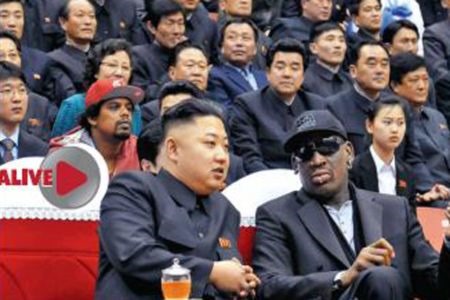
Call it yet another chapter in the history of clueless foreigners getting lost in and manipulated by North Korea – what Lenin used to call ‘useful idiots,’ knaves from the West who defended the Soviet experiment, blissfully ignorant of the camps. Who knows what to make of that utterly weird photograph of Rodman in bling and Kim Jong Un dressed like Mao. There are so many contradictions in there, it’s not even worth unpacking.

Continue reading

My Comments to al Jazeera TV on Park GH’s Inauguration as SK Prez


Despite the fact that Donald Rumsfeld supposedly wanted to bomb al Jazeera during the Iraq War as a jihadi propaganda machine, I have to say I find it a pretty good news source. It’s got a great documentary hustle that lazy incumbents like CNN don’t, and its Middle East coverage is far more balanced and fair than most Americans think.

Anyway, the vid is my quick thoughts on Park Geun Hye’s inauguration as South Korea’s new president. The quick sum: she can’t follow through on making Korea ‘happier’ unless she takes on the vested interests, especially the chaebol, central to her political coalition. I don’t think she can do that, and, honestly, I’m not even sure she wants to. So I would not expect anything big at home in her term; the right, the elderly, and business in Korea like the status quo, and they’re the ones that put her in office. And certainly, the social democratic policies of ‘economic democratization’ kicked around last year won’t happen meaningfully. That’s my prediction at least. I’ll have more in a few days when my contribution to a foreign ‘Korea analyst’ forum on PGH is published in the Korea Times.

For my previous TV appearances, go here.

5 Biggest Strategic Errors of the Emperor: a Contribution to Spencer Ackerman’s ‘Battle of Hoth’ Debate

You can’t defeat a rebellion with counter-insurgents like these


Technically, I am supposed to be on vacation, but I couldn’t miss this.

An international relations theory website I also write for has gotten into an excellent debate with Wired’s Spencer Ackerman on the Empire’s blown opportunity to stamp out the Space Vietcong Rebellion at Hoth. William Westmoreland spent 5 years trying to nail down the VC in set-piece battles where US firepower could be brought decisively to bear and end the Vietnam war. Here was the Emperor’s similar chance, but Darth Vader and Admiral Ozzel blew it (mostly because the Empire’s officer corps was filled with grandstanding self-promoters, as Ackerman rightly points out).

But as the respondents noted, the larger context does a better job explaining why the Empire’s massive advantages seem to fail repeatedly (Yavin 4, Hoth, Bespin, Endor), beyond just the poor tactical leadership at Hoth. The larger strategic context is counterinsurgency, and obviously the Emperor spent too much time cackling in the Senate to watch The Battle of Algiers. So here are the five big structural problems in the background:

1. Trusting the Bloated, Showboating Navy to do Counterinsurgency

Navies are big, blunt instruments with hugely expensive platforms vulnerable to swarming, as at Yavin and Endor, and only useful for large, ‘target-rich’ enemies. They scream national vanity, and they’re terrible for hunting rebels. Why does the Empire need a massive, and massively expensive, fleet after the Clone Wars? Probably because the army was staffed by clones – genetically-designed to be dull-witted – who couldn’t push their bureaucratic interest, while the navy had lots of fully human, showboating egos like Tarkin’s Death Star council.

Continue reading

On Vacation for awhile – Here’s Some New Year’s Reading – See you in March

I break from blogging twice a year, but try to compile a good list of relevant articles I’ve found over the past few months. See you in about a month. Enjoy:

August

The Atlantic runs lots of good stuff on NK it seems to me: this on how NK impossibly continues to survive and this on how just about every NK watcher has wrongfully predicted its collapse.

Mixin Pei’s important piece on why China’s rise is overrated. My own sense of this is that Pei will be proven right in the next 10-15 years, but not sooner. China’s demographic, ecological, and corruption caps strike as growing worse, not better.

A nice piece from the FT on Korea’s biggest company – too bad no one wants to plumb the far-too-close relations between the chaebol and the ROKG Continue reading

‘I Find your Lack of Cheer Disturbing’ – Merry Christmas

vader xmas

This is awesome. Smile

My ‘Foreign Affairs’ Piece on the Korean Election – Longer, Fuller Version

Election pics 008

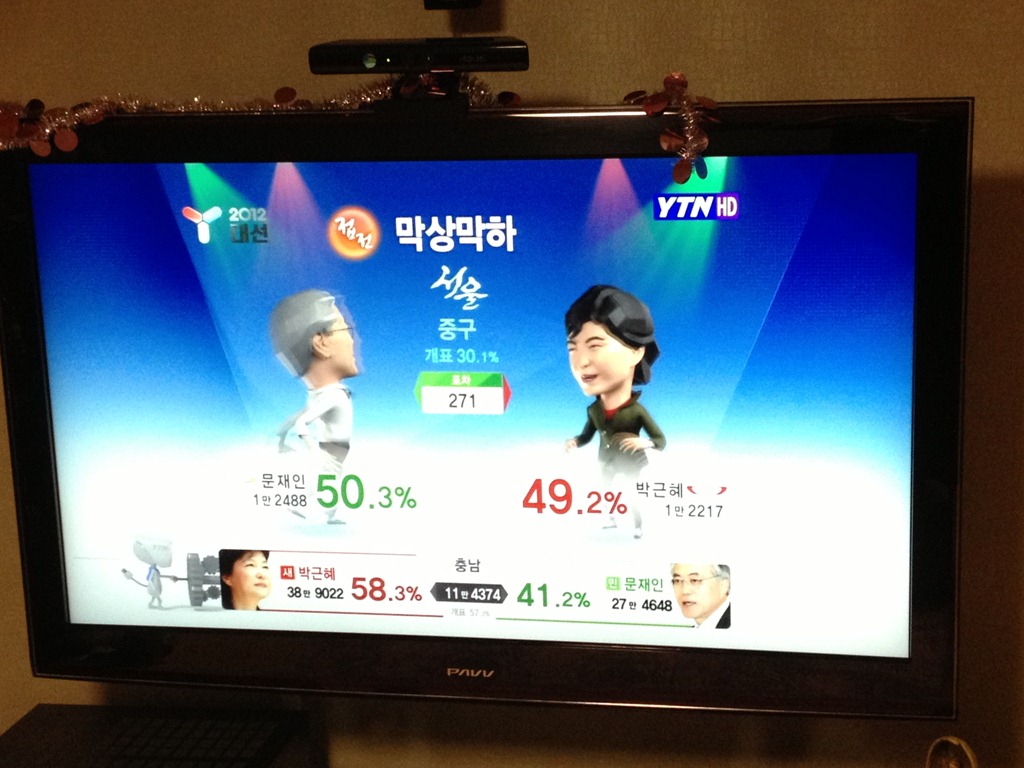
This pic is from the TV election coverage on the Korean version of CNN. That would be the two main candidates (the liberal Moon Jae-In on the left, and conservative Park Geun-Hye, who won, on the right) as dancing electronic cartoon avatars. Yes, they do look like boogying Nintendo Miis, and yes, they are the most bizarre, hysterical election graphics I have ever seen. Who says political science is boring?

So Foreign Affairs solicited me for a ‘snapshot’ essay on the Korean election. Here is the link, but I also thought it might be useful to post my first draft which is fuller:

“South Korea’s next presidential election will occur on December 19. The main candidates are Park Geun-Hye of the conservative New Frontier (Sae Nuri) party and Moon Jae-In of the liberal Democratic United Party (DUP). A third, unaffiliated liberal candidate, Ahn Chul-Soo, dropped out in late November. Ahn had no clear party identification, which was part of his attraction, although he was broadly center-left. A former hi-tech entrepreneur and professor, he was popular with the young who feel alienated by the closed, oligarchic character of Korean politics and for much of the year, he outpolled Moon. Because he and Moon were splitting the anti-Park liberal vote, they tried to merge their campaigns. But Ahn’s hasty, somewhat bitter withdrawal speech implied that old-style, backroom politics by the DUP had pushed him out. Post-withdrawal polls showed Park picked up around one-fifth of Ahn voters, a very strong showing.

Continue reading

5 Fox News Myths about the Fiscal Cliff – and no more ‘Cliff’ Metaphors either, please! stop!

11-30-12-stewart-sg-cropped-proto-custom_2

Does anyone else find Fox News strangely appealing to watch? For some reason I watch it all the time. As ideology that is inadvertently entertaining, interwoven with a veneer of ‘news,’ it’s a freaky, terrifying wonder to behold. It is vastly more interesting – maybe because it’s akin to experiencing an alternate reality –  than it’s-so-bland-what’s-the-point-anymore CNN. Watching Fox is like watching yourself becoming dumber, all while being shamelessly entertained by gorgeous teleprompter-readers and militant American nationalism. It’s like the news + ‘Call of Duty’ + ‘Baywatch.’

As a news station it is, of course, preposterous. Its presentations are astonishingly partisan. Even after 15 years, I am amazed at what Hannity, O’Reilly, etc. can get away with (try here or here in just the last few weeks). It does very little investigative/reportorial work itself. It generally repackages what other outlets have produced or presents lengthy ‘Crossfire’-style opinionating, which is not really journalism. And it’s Michael Bay-style presentations, particularly its graphics and swooping necklines, make the news look like an action movie, not like, you know, the news.

Continue reading

My ‘Newsweek Japan’ Cover Story on Korea’s Economy: De-Concentration Needed

NewsweekNewsweek Japan asked me for a long-form essay on Korea’s economy for its December 5, 2012 issue (cover story to the left). Here is the link in Japanese, but I thought it would be useful to publish the original, untranslated version as well. (If you actually want the Japanese language version, email me for it please.)

The essay broadly argues that Korea needs to move beyond ‘developmentalism’ toward economic liberalism, as a lot of Asia does in my opinion. Regular readers of this blog will see themes I have emphasized before. This was intended for their print edition, so there are no hyperlinks included in the text. Here we go:

“As Korea’s presidential election moves into the home stretch, the local economic discussion is sharpening. Inequality, demographic collapse, massive concentration of economic weight in a few mega-conglomerates, weak consumer purchasing power, growing trade friction over intellectual property rights, and a chronically under-powered small- and medium-enterprise sector (SME) are among the major problems this outwardly very successful economy must confront. Unfortunately, none of the major candidates are pushing the deep reform needed to fix these underlying issues. As with China’s leadership transition, things seem so good at the moment that elites are wary of rocking the boat; as with the recent American election, tough choices will likely once again be kicked down the road. In Korea’s case, that means moving away from its ‘developmentalist’ growth model before encountering troubles similar to Japan’s.

Continue reading