
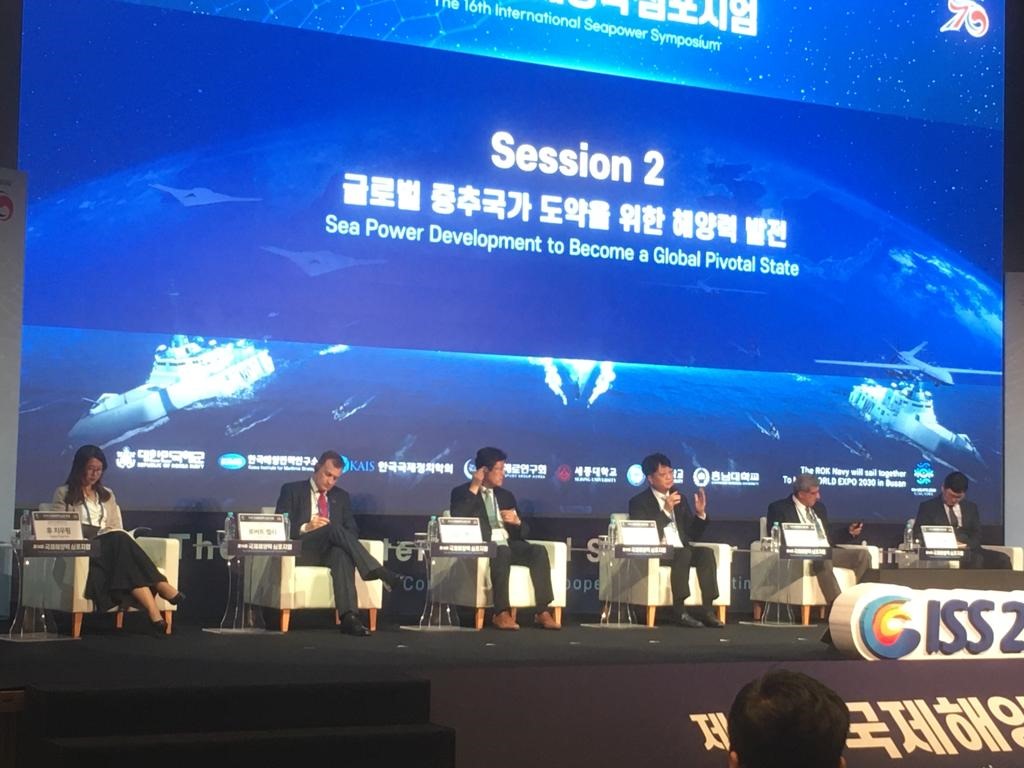
 Without a headline defense budget hike, ROKA, ROKAF, and ROKN are going to collide over the costs of army manpower replacement, missile defense, and an aircraft carrier in the next decade. (I am second from the left in the picture.)
This was the gist of my comments at the South Korean Navy’s 16th Annual International Seapower Symposium here in Busan this month. Here is my Twitter thread on that event with some nice pictures. I also wrote up these ideas in an essay for 1945.com.
To my mind, a big new issue for the SK navy in the next 10-20 years is the Chinese naval threat to SK SLOCs through the South China Sea. Particularly, SK oil shipments from Persian Gulf through the SCS are vulnerable to a PLAN blockade if China gets upset at something South Korea does, like cooperation on missile defense with the US and Japan. China has already bullied SK on missile defense in the past.
China’s creeping control of the SCS will eventually allow it to ‘quarantine’ shipping there to punish SK, Japan, and Taiwan. The odds of this strike me as pretty high once China has de facto control down there. Any embargo will be done informally, first with fishing fleet and coast guard harassment, escalating if necessary. I am surprised more thinking is not given over to this possibility. It seems really obvious to me.
This is one reason why South Korea is thinking about building an aircraft carrier, which I support. Expecting the US to do all the heavy lifting in the SCS is cheap-riding, so SK. Japan, and others should consider maritime bulking up to help.
For SK, the problem is the expense of the carrier at the same time that its army and air force have new, expensive needs too:
-
ROKA is facing a large manpower shortage in the next twenty years bc of SK’s birthrate is super low. ROKA will likely try to fill that gap with tech like drones and armor, which is pricier than conscript infantry.
-
ROKAF faces NK’s spiraling missile program. It will need lots of missile defense and strike fighters (to hit NK missile launch sites). That too will be expensive too given just how costly THAAD and F-35s are.
These army and air force pressures will probably squeeze out the aircraft carrier – an argument I made for the Korean Institute of Maritime Strategy a few years ago (and which has turned out to be correct).
So I figure that MND will see a pretty sharp inter-service budget fight in the next decade or so unless the overall defense budget goes up. All three service branches are looking for pricey, big-ticket platforms.


 Robert E Kelly