Korean-German Unification Parallels (2): Differences

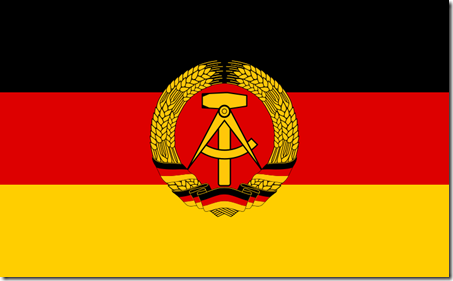
east_germany_flag_thumb1

old East German quip: what does GDR (German Democratic Republic) really mean? German District of Russia…


This is part two of a post exploring the similarities and differences of German unification (1989/90) with Korea’s probable future one. Part one explored the similarities of the two cases; Part three presents my conclusions. Here are the differences between these unifications:


Differences:

3.  Domestic

a. EG was much wealthier than NK is now. EG was the ‘leading’ economic performer of the east bloc. The USSR realized how central the German competition was to the overall Cold War competition, so EG was heavily subsidized. NK was never as important, because the cold war contest was never as stark in Asia as it was in Europe, so NK never got such big handouts. NK’s GDP/capita today is a crushing $1700; EG’s in 1989 was $10,000.

b. NK is not just a dictatorship; it is an Orwellian nightmare, more stalinist than even the Soviet Union or Albania ever were. East Germany was bad but never plumbed the depths of repression and madness like NK.  One of our faculty at my university works with NK defectors, and he notes how many of them have psychological trauma from life in NK. Fixing NK will not just be a huge pile of money; we know that. It is also going to require something akin to nation-wide psychiatric care for millions of mentally brutalized Winston Smiths. This will be an event unheard of in the annals of mental health; read here and here.

c. On just about every other benchmark conceivable, NK is worse off than EG: environmental management, infrastructure, labor productivity, health care, education, technology, etc, etc. The per person cost of Korean unification is likely to much higher, because NK is so much further behind in almost every way than EG was. Estimates of Korean unification could begin with these figures: in 20 years, WG has transferred $1.2 trillion euros to the roughly 16 million people of EG at the time of unification. Note than NK has more people (23 M) than east Germany, and those people are significantly poorer per person too ($10k vs 1.7k per capita). So that means the 1.2T euros figure is likely too low for the NK case. Note also that West Germany had around 60 M people in 1989; SK has 49 M today. WG’s 1989 GDP per capita was $25,000; in SK today, it is around $19,500. The arithmetic is punishing.

d. EG and Soviets did a good job deceiving the world that EG really was modern and advanced, just like the West. This is one reason why the WG government granted 1:1 currency convertibility to the GDR mark: almost everyone thought EG would have some reasonably competitive industries and sectors. Yet when WG finally got in there – when the West finally pulled the lid off –  almost everything was badly behind or unusable: the phone system had to be completely replaced, EG cars were a polluting environmental nightmare, laborers had no idea how to use computers or even basic office devices like photocopiers, infrastructure around the country still had World War II battle damage (that is no joke, I saw it), etc. So it’s likely that NK is much worse than we think it is. Even Bruce Cumings has admitted this. Yes, try to imagine that: NK, our customary endpoint of geopolitical awfulness, is probably hiding much worse than we know now. Once we see the NK gulags up close, I think we are going to see Nazi-style atrocities even the Taliban wouldn’t have tried.

e. SK is less politically prepared to carry the enormous stresses of unification – and not just the financial burden. The SK political system is flimsier than WG. Corruption is more regular; its parties are shallow and change names quickly; political unresponsiveness drives a street-protest culture and brawling in the National Assembly. For a state that came out of dictatorship less than a generation ago, SK is doing pretty well, but it clearly does not have the state capacity WG did in 1989, while it faces (points a & c above) a comparatively greater burden. Indeed, this is my greatest fear – the burdens of unification will simply overwhelm SK’s still maturing democracy and leave NK in some kind of semi-annexed limbo like the West Bank.

4. International

a. In 1989, the US was at peak of its postwar relative power. The USSR was in decline; China was still far off. This is the era of the ‘unipolar moment’ and the ‘end of history.’ Today the balance of forces is very different. The US is much weaker. Many think the US is in decline. All this makes it harder and harder for the US to support SK in any contest with China or NK over unification. It is likely that SK will have to do more of the work on its own, compared to the heavy intervention by the Bush 41 administration to support the WG position. The weakened American position means it will be easier for China to dictate its terms for unification (such as no US forces north of the current DMZ, or perhaps even no US forces at all).

b. In 1989, the USSR was a mess; today China is not. The GDR’s patron was imploding. It could no longer afford the contest with the US. The Soviet Union was trying to geopolitically retrench and to re-starts its moribund economy with perestroika and glasnost. The Soviets were getting desperate, and the east bloc – subsidized as it was – had become an albatross. Gorbachev was fumbling to control all the forces unleashed. China is the opposite. It is not overextended, but rather just beginning the international expansion that flows from its rising strength. It is feeling its oats and ready to give the US a run for its money in Asia at least. Tiananmen Square demonstrated a non-Gorbachevian willingness to roll out the tanks to maintain the one-party state, and there is no serious liberalizing force, in part because the Chinese population is being bought off with growth. So China is much more capable of carrying the NK albatross and ready to push its interests into Korea not pull out per Gorby.

Go to part three.
Korean-German Unification Parallels (1): Similarities

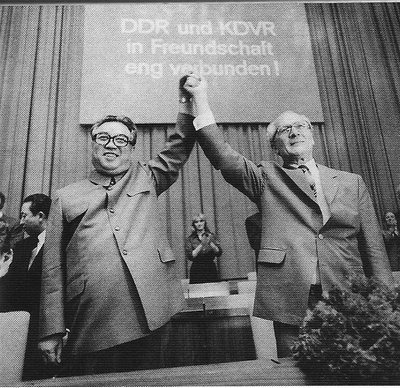
KIM_IL_SUNG_mit_HONECKER

Kim Il Sung and Erich Honecker: *sigh*, don’t you miss the golden days? —- no, me neither

(the placard reads: ‘GDR and DPRK tightly bound in friendship’ – for tyranny and poorly-made men’s wear)

Here is part two and part three.

Last week I ve participated in a scenario to map out possible futures of Kim Jong Il’s sudden death. My best guess is in my previous post – a military dictatorship with Kim III (Jong-Un) as a familial, yet much reduced, figurehead. But one idea that is always floating around in the background is that major regime junctures in the North might lead to break down and then unification. President Lee has taken recently to saying that SK should prepare for imminent unification, and one of my favorite NK experts thinks unification is likely in the next five years.  Does anyone else think this is likely, and why so (in the comments below, please)? I don’t see that actually.

Nevertheless, the most obvious parallel for trying to map Korean unification will work is the German case in 1989/90. I have written about this before, but the following compare and contrast is more complete. For Asian readers in search of a good walk-through of Germany’s experience with division, here is a good place to start.(FYI: I lived in Germany for 4 years in the early 90s and speak German. I recall debating this stuff a lot.)

Similarities  between the German and Korean divisions:

1. Domestic

a. Both nations were divided artificially. Both sides believe the ‘2 states, 1 people’ outcome is temporary. All 4 states face a permanent constitutional legitimacy crisis, because the obvious question is why these separated states exist at all. As such, all states divided by the Cold War were intensely competitive with the other. Outracing each other economically, militarily,  even at the Olympics, became central to proving who was the ‘real’ Korea, Germany, Vietnam, China, etc. Mutual coexistence is basically impossible; each has a limited time window to race the other into international legitimacy. As one or the other pulls away in global opinion – as it becomes ‘the’ Korea or ‘the’ Germany in places like airports or hotel signage, popular movies, CNN, etc. –  it will become ever harder to justify maintaining the division.

b. NK and EG (East Germany) are both communist with all the attendant problems of 20th century ‘real existing socialism.’ They are domestically illegitimate outside their own elites. Those elites are a corrupted ‘red bourgeoisie’ for whom regime ideology became a figleaf for oligarchy and luxury. Neither can produce anything close to the quality and quantity of goods necessary to keep their populations happy – populations further disenchanted by what they see on the other side. Both have a nasty secret police. They are both noticeably poorer than the westernized competitor, and this creates unending pressure on the government to change. All these factors create a disconsolate citizenry that would push out the regime if given the chance. Hence, any manner of internal democratization or liberalization would end the regime as we know it. In the end, both communist half-states had to seal off their borders to prevent exodus; they are national prisons.

c. Underperformance vis the westernized competitor slowly takes its toll internationally. The competitions led to hyper-militarization in the communist half, which only worsens the performance gap between both sides.  Perhaps the best marker of the communist failure after a few decades was that West Germany simply became Germany and South Korea just Korea. To indicate the communist half in everyday speech, one had to affix the directional adjective, the implication being that EG and NK were somehow dead-ends of history. By the 1980s, both NK and EG had effectively lost the race of point 1a above; SK and WG became Korea and Germany.

d. The westernized, ‘Free World’ half of the nation is a wealthy, functioning democracy that has otherwise joined the world – technologies, markets, and institutions (IMF, WTO, etc). This makes the communist half look even more like a basket case. Gradual but sustained wealth and demographic accumulation have dramatically altered the balance against the communist half. The free half also regularly receives communist refugees voting with their feet.


2. International

a. SK and WG are clearly supported by the US and its wealthy democratic allies. Both belong to American/democratic alliance system and enjoy the widespread moral legitimacy that comes from that. They are net contributors to their own defence, clearly outclassing the communist half strategically.

b. NK and EG are practically client states of a communist behemoth, on whom they are extremely dependent. The patron of both finds them troublesome and expensive. Both field an military based around obsolete WWII assumptions of massed infantry and armor formations. Neither can win a conflict with the other half; the economic gap compounds the military gap. The patron regularly debates the merits of cutting the client loose.

c. The neighborhood got used to the division and kinda likes it (especially Japan and France, although no one will say that publicly). There isn’t a lot of impetus from outsiders to end the split. Russia couldn’t care less if Korea unites. Like the French and British on Germany, the Japanese public will come around once they see it on TV. Once we see crying Koreans tearing down the barbwire fences of the DMZ, like we saw Germans hammering the Berlin Wall, no one will stand in its way. But until then, don’t expect anyone else to do much beyond pro forma boilerplate.

Go to part two.

Is Ban Ki-Moon the Antichrist? Teaching End-Times UN Hatred in Asia

duncanlong131

In teaching the UN this week, we discussed the issue of purposeful American defunding of the UN since the 1980s and the rocky US-UN relationship since the 1970s. For a good review of the ‘this-wordly’ issues go here. But then, inevitably, one must discuss the ‘theological’ complaints of US Christians. Something like 30-40% of Americans have had a born-again experience, in which Jesus purportedly intervenes personally in their life, former President Bush being the most prominent example. Koreans already find this to be pretty bizarre.  But then when you have to explain that lots of these people also believe the book of Revelation is a real prediction of future history (ie, Armageddon), then they just find it ridiculous. I tried as best I could to present it objectively, but I was genuinely embarrassed for the US to look so foolish. Most of my students were laughing out loud by the time I got to the end of the presentation. The same thing happened when I tried explain the Tea Party and those protestors with signs of Obama as Hitler. I don’t think American conservatives, who love the discourse of American exceptionalism, realize how much damage this kind of stuff does to foreigners’ impression of our ability and legitimacy to lead.

I struggled a bit on the details. In my Catholic grade school, we never read Revelations. The Church seemed to find it an embarrassment, and we spent most of our time on the Evangelists’ books. Most of my experience has come from watching the three Left Behind films (which I watched explicitly to get a handle on this material, although their unintentionally campiness is pretty hysterical). In that trilogy the UN Secretary-General (S-G) is the Antichrist. Speaking with a goofy pseudo-Transylvanian accent, he provokes a global war that inevitably includes an invasion of Israel. He assassinates people with impunity on the floor of the UN Security Council, and a shady Arab henchman organizes a global currency. The Rapture is there too of course (although not the fact that God would be thereby responsible for all the deaths from plane crashes due to raptured pilots). The demonic S-G, a slick Euro-bad guy, seduces the hot blonde  and builds a global tyranny from the UN, complete with a new unitarian-style religion. The American heroes have macho names like Buck and Steele. (Grrr!)

But all this strikes me as more American than Christian. First, it is Americans who have come up with this stuff, and I never met a European or Asian Christian who even knew about the Rapture and end-times wars, much less believed it. Second, it seems conveniently American that the US plays such a central role in these future histories, and that the UN, already disliked in the US, is the enemy yet again. Third, the movie bad guy looks and talks like the stock, ‘slick Euro’ character, whom Americans love to hate (like Alan Rickman in Die Hard). To be fair, I haven’t read the Left Behind novels though.

Teaching can be a great profession, and moments like this are real classics you will always remember in your career  (like the time I had a student ask me what OBL’s economic plan was for the caliphate after he re-united it). ‘Intercultural confusion’ would be the political correct expression, but honestly, the students just found it idiotic. Most East Asians come from a Buddhist-Confucian background (even the Christians, because Christianity is still pretty recent here). So most of my students had no context at all; indeed, for Americans who find this End-Times stuff ‘normal,’ nothing shows you just how absolutely absurd it is like trying to explain it to uninitiated foreigners. You want to convince Asians we aren’t fit to lead? Just let them watch Sarah Palin for awhile and then give a screening of Left Behind. Try explaining that it isn’t all anti-science, superstitious conspiracy theories. It’s just laughably implausible when taught as a straight ‘theory.’

First I had to lay the groundwork about the splintering of American Protestantism, because this eschatology is not mainline. Most Koreans are Catholics or Methodists. Korean Protestantism looks more like Europe than the US. Mega-churches built around one preacher don’t really exist. But they are coming. Indeed, one downside of the major US influence in Korea, because of the long alliance and commercial ties, is that US variants of charismatic-evangelical Protestant are coming, with an even greater stress on proselytization than in the US. Here, fundamentalists will stand at train stations and walk through subway cars holding big red crosses yelling (yes, yelling, not really preaching). Most Koreans resent them, so once I started discussing the details of evangelical end-times theology, my students were rolling their eyes immediately. That a Korean is the current UN S-G only raises their level of amazement and incredulity even faster. By the time I wrapped up, I was practically laughing myself – something I could never do in a US classroom, because there were always students who believed this stuff.

For all its absurdity, I do think teachers of IR should at least know the outlines of fundamentalist Protestant eschatology. It motivates UN hatred in the US far more than is acknowledged, and American ‘Christian Zionists’ – for whom Israel plays a role in the end-times wars – are far more important supporters of Israel than American Jews. This is a good IR article waiting to be written. I know of no serious investigation of the end-times version of world politics, despite its wide influence in the US electorate.

NB: I am just about positive that I will be ‘left behind,’ but thankfully the Tea Party is telling me how to  stock up for it

Egyptian Revolution (2): The Egyptian Army’s Moral Superiority to China

imagesFor

For part 1 of my thoughts on the Egyptian revolution, go here.

4. China shot its own people; Egypt has not. Much of the analysis has focused on possible parallels with Iran 1979. But another more recent parallel, especially relevant to this website, is Tiananmen Square 1989. In their moment of crisis, the Chinese turned their guns on themselves, and the PLA (People’s Liberation Army) will be forever stained by the blood of its own citizens en masse. This strikes me as major moment in the evolution of dictatorships. All dictatorships suffer from legitimacy problems, of course, but none want to openly rely on naked force. Militaries are usually the hidden albeit central prop in dictatorships, but they don’t actually want to do the dirty work themselves. That is for the paramilitary thugs and secret police. No officer wants to think the primary enemy of the a state’s military is its own people, not some foreign enemy. Their dignitary and right to rule is based on the whole idea that thy are defending the people, not massacring them; in fact this is the myth of 1952 Free Officers coup in Egypt itself. Hence the call by a dictator in dire straits to shoot the citizenry is a rubicon for any army that cannot be uncrossed. In 1989, the eastern European militaries balked; in China, the PLA did not. My sense is that the social costs to the PLA were lower though, because China is so big. The CCP purposefully brought in rural PLA units for whom Beijing was like another planet. But in small countries like Poland 1989 or Egypt today, army repression in the capital would immediately be felt and transmitted everywhere. So hear, hear to the Egyptian military (I can’t believe I just wrote that sentence). For all its corruption, despotism, and insulation, it still did the right thing when the chips were down. Did anyone imagine even a month ago that we’d be speaking of the moral superiority of the Egyptian military to the PLA?

5. Beyond this evident parallel to Beijing 1989, this is whole things isn’t really that relevant out here. The news media coverage has been thin. The current El Nina cold snap in Northeast Asia has gotten more press time regionally than that Egypt. Not surprisingly the Chinese haven’t discussed Egypt much, but I am disappointed the the Korean and Japanese press seems so disinterested. Initial Korean media coverage focused on the possible loss of ME export markets (groan). From this I would draw two conclusions. First, for all the talk about a flat world, cultural hurdles still matter a lot. The parties caught up in the war on terror (the West, Israel, the Arab/Muslim ME) are riveted by this, but East Asian’s just aren’t, sadly. My experience in East Asia is that locals don’t really care much about the developing world. It’s far away, the languages and religions seem unintelligible, and the societies look backward, especially to East Asians obsessed with development. East Asians worry a lot about the US, and some about Europe, but there is tremendous ignorance of places like Latin America or Africa. Second, I think this disinterest is as much political as it is cultural. Newly wealthy places like Korea or China demonstrate their earned, rightful place in the OECD through an almost purposeful disdain for the third world. Koreans love to demonstrate how worldly they are by spending a year in the US or West; I’ve never met a student or teacher who thought a year a in developing country would be vastly more interesting. (It is.) So Barnett’s ‘new core’ flaunts its new status by forgetting its roots in the third world: disinterest as a mark of superiority.

6. A comment about the commentary: Frank Rich is right that far too few people have any idea what to say on Egypt because so much of the commentary is really about the US (or Israel). This Amero-centrism is why so many are saying the US should do this or that: the working assumption is that that US guides the world and can easily direct events. This is no longer true, so the mountain of US, rather than Egypt, -focused commentary creates unrealistic expectations that we can direct this thing.

Rich also makes the excellent observation that if Americans could actually watch al Jazeera, they might actually learn something about Egypt itself. Instead the mainstream commentary has revealed the embarrassingly nativist ignorance of much of the punditocracy on anything beyond US borders. In general I was very pleased to see how well academics requited themselves in the blogosphere on this; I think especially Walt, Mead, Cole and the Duck of Minerva have been super.

But if you read the op-ed pages, you got recycled banality and the usual suspects: Friedman gave you his typical, ‘this-is-a-defining-moment-in-the-ME’ schtick; Bush neocons desperate for rehabilitation strove to take credit and somehow blame Obama for…what exactly?; Palin blithered; Parker told us that the big story was really about the US media and Cohen that it was about Israel; Colbert King forgot the rest of the world exists; and Beck, well, you already know – just watch the loopy video from part 1. Score yet another point for blogging.

Without the informed blogging voices of people who actually know something about Egypt and revolutions, you really wouldn’t learn much about the events at all. You’d have just gotten an endless series of stories from a royalist, uncosmopolitan press in which Washington was the real story, because that’s all the pundits know how to talk aboutDouthat, for example – and whom I think is a pretty good writer usually – clearly had nothing to say, so he just gave up and wrote about Obama yet again under the guise of Egypt. How easy; this is how the press for a nation of untraveled monolinguists infatuated with their own power evolves. Its all about us. By contrast, here is an example of a non-expert, trained in traditional Washington self-obsession, who nonetheless tried. 

__________________________

ADDENDA:

The Japan Security Watch (JSW) blog of the New Pacific Institute has taken to cross-posting some of my stuff.  JSW is a good review of Japan, and a nice a compliment to my over-focus on Korea and China. They do on a lot on the nuts-and-bolts of hardware and deployment. Mil-Tech junkies on Asia will love it. JSW and I are working on some cooperation in the future. I want to thank them and commend readers to take a look at their good website.

BusanHaps, the big expat newspaper for Busan, SK, has also reposted some of my stuff. I want to thank them too and commend their site. Busan readers almost certainly know it already, but non-local readers will find it a good window on the way expats live here.

Finally, I want to point out that a published version of my remarks on North Korean shelling of Yeonpyeong Island is now available here (RINSA 15) from the Korean National Defense University (KNDU). If you really want to get into the details of SK defense against N, KNDU is the place to go. I want to thank them for soliciting me and thank readers for all the helpful comments that went into the final product.

Egyptian Revolution (1):We should Support the Uprising

Good lord, Beck really is insane…


Part 2 is here.

Like all of you in the last few weeks, I have been glued to CNN regarding Egypt. It is pretty inspiring, and I can only hope that Mubarak leaves and something more genuinely liberal and democratic takes his places. Here are a few thoughts.

1. Regarding the video selected above, I did plan to post a good pic from Egypt, but you’ve seen that a lot already, so that would not have added much new value. This you probably haven’t seen though, and it is ‘important’ for the sheer insanity about US conservatives’ foreign policy concerns in the ME it reveals. Apparently the Egyptian revolution is an islamist plot that will turn the Mediterranean into an Islamic lake, allow Russia to control Northern Europe, and China to control India and Pakistan. Don’t believe me? Beck’s sweeping hand movements will explain all…    h/t: Center for a New American Security.

2. This is one of those critical junctures when observers should to go on the record about what to do. If all this somehow goes wrong, everyone will blame Obama in 20/20 hindsight. That will inevitably be partisan and unfair, because the Obama administration is making decisions under huge uncertainty. Credibility requires one to go on record now, when information is limited and we all have to make our best guess.

That US conservatives are badly split signals this huge uncertainty. Absolute moral certainty is a central pose of the American right’s self-image (tax hikes are always bad, Iraq 2 was a good idea no matter what), so if even the Right –  which IMO takes foreign policy more seriously than domestic-focused US liberals – is divided, that tells you just how confused everyone really is. For the neo-con take that this really is about democracy, try Gerecht (excellent); for the gloomy realism that we should hew to the Egyptian military, try Krauthammer (depressing, but also good). And for the downright bizarre conspiratorial stuff, watch the above vid.

So here’s my line: I’ll say that Krauthammer and the realists are wrong. The Iran parallel is inaccurate; this will not lead to a Muslim Brothers’ dictatorship. Further, the support of democracy is, in itself, an important value. Even if there was a serious risk of an islamist takeover, we should still pressure Mubarak to get out, nor support a military oligarchy (Krauthammer). Who wants to look back in 10 years and say we supported yet another authoritarian in one of the worst governed places on earth, that we didn’t take the chance to push for something better, even if it was risky? How awful and embarrassing for the US; what a betrayal of all those heroic people we’ve seen on TV. And if they want islamists in the government, well, it is ultimately their country. So long as it remains a democracy (the difference between Turkey’s islamists’ participation, and Hamas’ budding oligarchy), then we have to allow them to disagree with us as is their right. Risking fanatics in government is part of democracy (witness, ahem, Sarah Palin). If we believe in it for ourselves, then we must be true to it for them. So, no, this is not a result of George Bush’s foreign policy, but we should support it anyway.

3. Israel should not drive our policy toward Egypt. Has anyone else noticed how much of this discussion has gotten hijacked by the ‘what-will-happen-to-Israel’ externality? (Try here, here, here, here, and here.) This is embarrassing and almost sycophantic. You can’t blame the Arabs for disbelieving we’re an honest broker when the fate of 6 million people in a different country outweighs the 85 million of the country that is actually the center of the story. Really? Should the US point of origin for yet another Middle East event be Israel’s benefit? We are two separate countries, right? Maybe we should care about the Egyptians themselves, right? Israel does have the finest military in the region, nuclear weapons, and a take-no-prisoners lobby in the US Congress, right? Don’t misunderstand me. I realize that Israel’s security is important for the US and that it is the only democracy in the region (although that is increasingly under question). I want Israel to be secure too; I’ve traveled there 3 times and unconditionally support its right to exist. If it would help, usher them into NATO or the EU, or extend formal US deterrence guarantees, even nuclear. But it’s long-overdue time that we break the habit looking over our shoulder to Israel on ME issues, and it’s extremely immoral to support continued Egyptian authoritarianism on the (likely correct) premise that a democratic Egypt will push Israel harder. That sells out the admirable sacrifice of 85 million for 6 million who voted for an openly provocative right-wing government.

American Dual Containment in Asia

pet-containment-pen

Last month I published an article in Geopolitics entitled “American Dual Containment in Asia.” In brief, I argued that a double containment of both Islamic fundamentalism and of China is the likely US strategy in Asia in the coming decades. The containment of salafism in the Middle East is bound to be hard and violent (as it already is), because Al Qaeda and associated movements are so genuinely revolutionary and dangerous. The containment of China is likely to be soft until the Chinese decide just how much they wish to challenge the reigning liberal democratic order. In the last year, many seem to fear that China is ramping up in this direction. Hence my prediction that India will be a pivot in this containment line. It is a unique ally for the US, because it is worried about both China and Islamic fundamentalism, and because it is democratic. In this way, it is unique among American alliance choices. Here is abstract:

“US grand strategy after 9/11 turned from post-containment drift to preemption. But the costs are high – suspicion of American power, hedging by traditional allies, expensive, go-it-alone ventures like Iraq. Tried-and-true containment better reflects American values. While forward in the world, containment is also defensive. It reassures skittish partners and reflects liberal, anti-imperial US preferences. In Asia, containment would deter the primary contemporary challengers of US power – radical Islam and Chinese nationalism – without encouraging a Bush-style global backlash. In a reductive analysis of US alliance choices, this article predicts a medium-term Indo-American alliance. India uniquely shares both US liberal democratic values and the same two challengers; it is the likely pivot in a US-backed neo-containment architecture in Asia.”

Here are the relevant graphs that, I hope, make the argument clearer:

Graph 1. Contemporary Revisionists to the ‘American System’


Power

High

Low

Commitment


High

(Revolutionary)


Islamist-Jihadist Networks,

Iran ?

Low

(Dissatisfied)

China ?

Rogues (Cuba, North Korea, Venezuela)


The good news above is that just about everyone accepts the international status quo – roughly, the liberal international political economy led by the US (what Ikenberry calls “the American system”). While al Qaeda is clearly a scary revisionist – i.e., the they want to dramatically rewrite the international order by refounding the caliphate, e.g. – they are also pretty weak. The only powerful revisionist is China, and no one knows yet just how much she seeks to change things. This is good for the US, insofar as it backstops the international order, and it is also good for the many states in Asia and Europe that function within that order. Although the internal challenges to the liberal order are growing (i.e, the Great Recession), there is currently no powerful and revolutionary external challenger like the Nazis or USSR were.


 Graph 2. Contemporary US Alliance Picks


Competitors

Values


China

Islamist-

Jihadist

Networks

Great Britain/NATO


         X

               X

Russia

          X

          X


Japan/East Asia

          X


                X

Israel/Arab clients


           X

               X?

India

          X

           X

               X


This graph tries to reductively explain the appeal of India as an alliance partner. It uniquely shares the both the geopolitical interests of the US in Asia; that is, it is worried about both Islamism and China. And it shares our liberal democratic values. Russia is an obvious point on shared interests – the ultimate driver of alliances of course – but it is so erratic and semi-dictatorial, that is still distasteful despite the ‘reset.’

The most controversial part of this analysis is certainly my open claim that China will be a target of US soft containment, and maybe hard in the future. I should say here that I do not want this. I am very aware of the self-fulfilling prophecy problem; i.e., if we openly come out and say China is an enemy or threat, then by doing so, we make it into one. And certainly articles like mine are exactly what the Chinese declaim – a not-so-secret effort by US analysts to keep China down and such. And see Barnett on why I am completely wrong, if not dangerous, about China. But as an empirical prediction, I do think it holds. China’s growth and current values (populist nationalism, deep historical grievance, residual communism) are just too rapidly destabilizing, and I think Barnett doesn’t give nearly the necessary attention to the security dilemma problems China creates on its periphery. (IMO, Barnett overfocuses on China and G-2 coziness, while missing the nervousness in places like Korea, Japan, Singapore, and Indonesia.)   For my own writing on why I think the ‘China threat’ school is likely to win this debate, try here.

Finally, I should say in fairness that my own perception of China-as-threat has declined somewhat, in part because I visited the place. This strikes me as natural; closeness and exposure frequently breed understanding, and I like to think that all the nice Chinese scholars and hospitality I experience were in fact real. But the liberal values of academics exposed to new ideas and travel as a professional requirement hardly apply to populations and elites, especially those as nationalist as China and the US. The misperception likelihood is huge here; remember the Bush 2 administration came in ready to take on China until 9/11 happened. This will likely reassert itself as American dependence on Chinese financing grows and as the GWoT (hopefully) winds down. (Another problem here is the peer-review process. Articles take years to between the first inspired write-up and the end-point of publication. Reviewers send you back to the drawing board, and the pipeline effect means that even after final acceptance you may wait a year or more to see it in print.)

That South Korean Commando Raid against the Somali Pirates

I couldn’t find any actual video of the assault so here is a decent news vid about it


Here is a Korean news blurb about the anti-pirate raid, and here is some quick analysis. As you might imagine, the Korean media has trumpeted this, and the Korean President Myung-Bak Lee, who ordered the assault, took a lot of deserved credit. At the risk of sounding like a shill, I must say I continue to be very impressed by Lee’s presidency. He is a good example of the kind of conservative I want to vote for but simply cannot find in the US anymore (where its all Christianity and tea party paranoia). Lee is tough, professional, fiscally balanced, not terribly ideological, business-focused, comfortable with science, tolerant of Korea’s growing diversity, but still on the right side of most of the big foreign policy issues like China, NK, Afghanistan, etc. Yes, he is prone to autocratic outbursts, but no more so than W’s constitution-bending. In any case, he is vast improvement over the accommodationist SK left which seems to think the US is a greater threat to SK than NK or China (no, that is not a joke). So hear, hear, President Lee, for giving the pirates the shellacking they deserve.

Here are a few more thoughts on the raid.

1. In a way, the raid helps justify the on-going, much maligned, dismal, I-want-it-to-go-away-as-much-as-you-do war on terror. No, the pirates are not terrorists, nor are they islamists as far as we can tell. But they do demonstrate the fundamental international political problem behind the GWoT – state failure. To be more specific, failed/failing states create wild west zones on the planet (Somalia, central Africa, parts of central and southeast Asia and Caribbean basin) that open room for all sorts of nasties to set up shop. All sorts of asymmetric threats are enabled by the absence of law in state-less spaces, and they morph in unexpected ways that pull in players one wouldn’t expect (the US goes to Afghanistan, and SK goes to the Gulf of Aden). If the Middle East were governed better, it is unlikely 9/11 would have happened. Indeed, many of the problems we associate with the GWoT – piracy, trafficking, mass human rights violations, drug cartels, generalized social chaos (like in Children of Men) – are broadly attributable to the lack of robust, functioning, reasonably legitimate states in central Eurasia and Africa. This is really what Iraq and Afghanistan are all about – trying to fashion somewhat modern states that can locally control/contain/enervate violent, frequently atavistic, non-state actors like al Qaeda or the Lord’s Resistance Army. And state-less spaces create threats we don’t really anticipate or think about much. IR theory and security studies is mostly about states. Irregular forces like militias, terrorists, pirates don’t have the cachet that worrying about the Chinese navy does. But clearly we do need some general global strategy for cleaning up what Thomas Barnett calls the ‘Gap.’

2. I was quite impressed by the SK military’s prowess, and this may be the biggest unanticipated story. Usually the security discussion of East Asia revolves around the big guys – China, Japan, India. When Korea gets mentioned, the usual line is NK-as-psycho, with SK as a hapless victim. SK is somewhat responsible for this. The SK electorate is quite pacifist (certainly compared to the US), and SK’s extreme exposure to NK means they can’t respond the way Israel does when it is provoked. But far from peninsular restrictions, the SK military was able to show its stuff and they did a super job. I don’t think people realize just how large, professionalized, and modern the SK military actually is (600k conscripts and a $30 billion annual budget). Given the sort of budgetary pressures Europe’s decaying great powers are facing, and the likely post-Yeonpyeong defense build-up in SK, SK is now almost certainly in the top 10 of the world’s most efficacious militaries, as bizarre as that may seem, and it is giving Japan a run for its money. Japan is bigger of course and has a great deal of latent military power, but its defense budget  has been just 1% of GDP/year for decades, its debt burden is crushing, and it hasn’t fought on any combat missions at all since WWII. Yet here is tiny Korea projecting coherent, efficacious force all the way into the Gulf of Aden. Not bad…

3. The larger story must be the growing depth and reach of Asian economies. Indian Ocean sea-lines of communication (SLOC) are pretty important for Asia’s economies, and the piracy fight tells us two things.

a. Asia’s economies are now so big and prosperous that pirates can make a living off of them. Can you imagine anyone preying on Indian Ocean shipping as a profession 40 years ago? Indian Ocean SLOCs, connecting East Asia with the Middle East and Europe, now clearly rival those focused on the US in the Atlantic and Pacific – yet another mark of the gravity shift from West and East.

b. East Asia’s economies are now rich and confident enough to project power pretty far from their shores. Of course the US Navy is dominant, but East Asia has the money now to buy bigger and better ships, while US military cuts are almost a certainty, and the US navy is an obvious budget-cutting target as the costs of the GWoT have fallen mostly on the Army and Marines. So here is yet another example of that more equal world in which the US will move in the future. If East Asian economic interests and the military force to protect them now extend all the way to Africa, that pretty clearly pushes the US back in the Indian Ocean and raises the obvious question of when the US will move back in the Pacific too.

Another Unassuming State of the Union that Ducks the Debt Issue

Obama Haiti Earthquake

For my take on last year’s state of the union, go here and here for the Republican response.

I thought this year’s speech was pretty good – not exciting or gripping, but fairly solid. This seems to be an Obama characteristic, perhaps in response to George W. Bush’s penchant for soaring metaphysics in his SotUs. Increasingly I admire that. I knew the W’s SotUs were generally theater, but Obama’s feel more professional. My sense is that Obama the lawyer believes words matter more than W, who thought instincts mattered more than troublesome vocabulary.

Here are a few thoughts:

1. For a country supposed to be the ‘global leader,’ the president focused overwhelmingly on domestic policy. I imagine this is electorally-driven, but the foreign policy bit was painfully short. Most of it focused on the GWoT, although Obama maddeningly refuses to call it that. But there was little on the real future challenge to American power – the rise of Asia and a whole clutch of middle income states elsewhere that all constrain America’s freedom to move. Barnett calls the wealthy East Asian tier the “new core” of the global economy (the ‘old core’ being the North Atlantic). I heard nothing about how to react to these risers, should we accommodate, contain, ignore, etc. Instead, we got yet more bromides about how no one in the room would rather live in another country and how great America is. Sigh. Pandering to Americans’ nationalism is not analysis, doesn’t slow China’s growth, doesn’t get US kids better educated in math and science,  doesn’t diminish our addiction to Chinese money and Saudi oil, etc. The world is getting more crowded and wealthier, and the sovereign debt crisis in the West is reducing our ability to push others around (a bad thing if you are a westerner, good if you are not). We need to think about our place in a more equal world, but Obama gave you nothing on that. Instead, it was how he cleaned up W’s messes.

The GOP responses were even worse: Michelle Bachmann had the gall to recite Madeleine Albright’s old expression, ‘the indispensible nation,’ sure to anger any foreign listener, and her description of the battle of Iwo Jima seems informed by video game posturing, not history. (The battle was very late in the war; the Japanese were outnumbered and outgunned, without air or naval support, had no hope of relief, and were fighting for an obviously lost cause. Kinda seems more like they were really courageous, huh? Oops! Maybe she should stick the standard issue right-wing example of American heroism – Normandy.)

2. Obama really tried to reach out. It speaks to how visceral the Republican opposition has become that Obama tried so hard to pull in Republicans. But I don’t believe the GOP bought it. Speaker Boehner sitting behind him could barely get out a smile, smirking and looking bored most of the time, a pretty poor showing to my mind. His obvious disinterest and smirks reinforced to me yet again that this GOP loathes this president – he’s a newbie, funny looking, maybe not a citizen, a socialist, etc. And Bachmann’s Tea Party response was downright disingenuous about the deficits on Obama’s watch. As with last year’s GOP response, there was no admission that the alternative to those huge deficits was another Great Depression, no admission that W started the TARP/bailout process, no admission that unemployment would probably 15% or more without the stimulus and bailout. I want balanced budgets too, but it is simply mythic to ignore that W created a huge amount of the debt while the economy was growing, and that Obama had no choice but to spend madly, because the alternative was catastrophe. I am disgusted by the give-not-an-inch trench warfare the GOP is practicing against a fairly technocratic, not ideological, Democrat.

3. There were lots of subtle hints about how ‘diverse’ or ‘multicultural’ America is. He mentioned how there are Hindu soldiers in the US (which remark must be a first in SotU history). He broke Americans down into the standard ‘5 color’ scheme – white, black, Latino, Asian, and Native Americans (so where do those Hindu soldiers fit in?). He talked about the idea that binds the ‘American family,’ presumably in response to the idea of an ethnic nation. American Muslims are loyal to the country (even though very few Americans believe that). I suspect this served to remind the Tea party, which is sort of a white conservative reaction to change, that non-whites are entrenched in American life. It is also probably a personal response to those endless attacks on him that flirt with race and nationality to delegitimize him. I find all this helpful in beating back Tea Party cultural panic, but also debilitating. I dislike the open recitation of ethnic fault lines in American discourse, because it serves to reinforce them and delegitimize things like border security as ‘racism.’ It also reinforces the noxious disunifying narrative that American is a salad bowl of nationalities rather than a melting pot. Enough! We get it already.

4. Once again, no one said anything meaningful about the debt. I am getting tired of raising this issue. I have been saying it almost since the beginning of my blog two years ago, and gave the same response a year ago. Here are a few basic principles to remember amid all the empty, if overheated, talk about reducing the deficit and eventually paying down the debt:

a. The required cuts are MASSIVE – around $1.4 trillion just for the deficit (which is bigger than the entire South Korean economy!). So forget all this cute stuff about discretionary pay freezes for government workers and such. That is a start, but a really minor one. Getting real reductions out of discretionary will likely require closing down some portion of the government altogether – that means abandoning some government services almost completely, like the Department of Education, e.g. This will almost certainly not happen.

b. The real money is in 4 places: Defense, Medicare, Medicaid, and Social Security. These represent about 70% of the budget – around $3 trillion. That is where the real conflict is, and Obama completely avoided it. All that heroic rhetoric about the guy who saved the Chilean miners was just flim-flam for the real part of the speech everyone wanted to hear, and he flubbed it – as did the two Republican responders. The budget issue is no further along than it was last year. The rest is just atmospherics to get re-elected.

c. Tax hikes are needed to fix the fiscus. The political unwillingness to admit this is simply inexcusable, especially by the GOP. No one has the courage to admit what everyone knows – that the US government needs a lot more money from its citizens. No one knows how to find $1.4 T in savings in the budget without some cut that would fundamentally alter US identity. That is, to cut $1.4T would so deeply cut into particular government services that it would render the post-cut government unrecognizable to a large chunk of the electorate. For example, we could balance the budget if we chopped the military in half and simply eliminated Social Security. But the former would end American superpowerdom as Americans have come to know (and love) it, while the latter would remove a service (retirement assistance) that most Americans now understand to be as fundamental to our way of life as the First Amendment. My point is that the cuts required, in lieu of any tax hikes at all, would force a fundamental reimaging of what the US government is and does. Unless there is a social revolution to support a dramatically smaller government – and no, the Tea Party is not that because so many of its members are Social Security recipients and nationalists committed to a huge military – then the only alternative consonant with Americans’ perceptions of what their government is, is a tax hike (and a fairly large one too).

See also Robert Samuelson of the Washington Post on the debt/deficit; I find him regularly superb on this issue.

Hu, Obama, and the Chinese-Confucian Hankering for Status Recognition

0120hu01_G_20110120061748

Everyone and their mother has commented on Hu’s trip to Washington this week. I would only add a few points.

1. I kinda wonder why Hu even wanted to come. Consider all the things the US wants to talk to China about that Hu has zero-interest in discussing: democracy, human rights, Liu Xiaobo (the 2010 Nobel Peace prize winner) and press freedom, the non-float of the yuan, the forced partnerships between foreign MNCs and Chinese companies to informally coerce technology transfer, hacking, Tibet, IPR/piracy, NK, Taiwan, the South China Sea, etc, etc… You don’t need to be a sinologist to know that the Chinese Communist party (CCP) isn’t going to change on this stuff for awhile, and certainly not at the behest of foreigners. Nor does it really even want to talk about this stuff at all; hence the Chinese recitation/dodge that almost every point of contention is an ‘internal Chinese affair.’ The tide is running in China’s direction macroeconomically, meaning China doesn’t have to listen to us. So why bother to show up at all?

2. My answer is prestige. Gordon Chang pretty much nailed it for Hu himself. China’s government is a bureaucratic monster even worse than the US government. Not only is China four times the size of the US demographically – thereby requiring more people in government – but the CCP and PLA (military) are heavily involved in politics and industry, making the beast yet larger. The only possible way that Hu can try to guide this sprawling, confused, self-contradictory Titanic of a ship-of-state is through his own stature. And what better way to buttress that than through pictures with the leader of the world’s only superpower. Dictators have no means of ascertaining their domestic legitimacy, and therefore seek parallel legitimacy abroad which can be ‘reflected’ back home. So if the president of the world’s superpower is sitting next to your repressive nasty, then it must be ok to be repressive and your guy isn’t as bad as you thought.

3. But it’s more than just Hu’s tough spot back home. China’s elites deeply hanker for US recognition. China’s national ideology is grievance and nationalism – the 100 years of humiliation. When you visit Tiananmen Square, there is a huge video screen playing regular imagery of this post-1989 ‘China is awesome’ motif. Communism is dead; ‘getting rich is glorious’ is hardly bracing or communitarian enough to bind a billion people together; democracy is not a option. So a Weimar-style nationalism of grievance and national shame is the substitute (even if Chinese academics think it is bunk, as was my experience in China). So China’s got a big chip on its shoulder and satisfying this thirst for status is the reason for all the pomp and fuss of the visit, for the Rovian levels of choreography that left nothing to spontaneity (as with the 2008 Olympics), for the Chinese insistence that it be a ‘state visit’ with Obama in a tux, for the meeting with Congress, for the empty banalities of Hu’s actual comments, etc. Process, not substance, was the whole point – a process wherein the US looks like an equal to China, not a superior, wherein the leader of the only superpower bows and toasts to a Chinese, wherein ceremonialism, flags, uniformed soldiers saluting, endless fussing about who sits where, and lofty rhetoric go unsullied by real work or substance.

4. So you say, what was the whole point then?Process for its own sake sounds like a huge waste of money all around, and giving the Chinese something for nothing. This is true, but the US is now so dependent on Chinese Treasury purchases that playing China’s reindeer games is a worthwhile tradeoff to get more of their money, at least until we get our fiscal house in order. That’s the US benefit. And for the Chinese?

Atmospherics count for a lot in Asia. Asian media is more self-congratulatory, more statist, and more concerned with image and rank of their leaders aboard. This is why ASEAN meetings, an endless, do-nothing merry-go-round of photo-ops and ceremony, still happen. Little is achieved; ASEAN is 2/3 the age of the EU but has done maybe 10% of the work. Yet still it meets, because process – with consequent coverage on CNN and pictures in the Economist or New York Times – is a goal itself.  A few years ago, when President Lee of Korea met George Bush for golf, Lee drove the golf cart around. To Americans, it looked like two buddies having fun, and this was exactly the sort of downhome, buddy-buddy stuff W liked in diplomacy. But Koreans took it as Lee chauffeuring George Bush around and got miffed that it was some kind of snub by the white guy. This was between allies, and the Americans had no idea the pic would be received that way. In fact, Lee looks like he’s having a pretty good time – all the more demonstration of Asian tetchiness on perceptions of rank and social hierarchy. For China then, this is even worse, because the media is wholly state-directed and even more jingoistic than Korea.

The root of this is Asia is Confucianism. Western traditions of equality and individualism are imports here. The long cultural tradition is hierarchy, in which a junior recognizes the moral/intellectual superiority of a senior (and increasingly today, greater wealth implies the higher ranking position). Social disruption stems from the junior’s unwillingness to recognize his place (yes, just like in Plato). Hence, the endless Chinese usage ‘harmonious society’: China’s population is supposed to recognize the moral/developmental excellence of the CCP and follow its learned orders, not protest for human rights or democracy. Applied internationally, this Confucian schematic of rank and dominance layers a further moral sheen onto the realpolitik division of the world into great, medium and small powers. For a long time, the West (and whites, to be very honest) was perceived as the senior, even if the British imperialists and American administrators who embodied this, did not know it. But with EA’s recent growth, it is time, deliciously, to rebalance the hierarchy. Hence Obama has to give a state dinner to an Asian, and W should be the one driving the car. There is a lot more going in this visit than China’s growth; Western fetes of Asian leaders serve a deep, local cultural/racial desire to see Asians in place of the Confucian master/senior in interstate relationships.

5. More generally, everyone likes recognition, and recognition flows downhill. That is, stature is imparted by those ‘above’ you. Hence the president of Korea likes golfing with W, because it makes Korea look like a great power, while the US gains little prestige from the visit. For China, the only possible state than can confer rank on it is the US. Getting US peer recognition is central to the ‘we’ve-been-stepped-on-by-foreigners’ narrative of the CCP. Rising powers particularly care a lot about recognition of their ‘place in the sun’ by the old guard.

6. Also: I was pretty pleased to see the western media give Hu a hard time on human rights. The US media was made a fool of by the Bush administration. Here was a chance to get its integrity back. Well done.

2011 Asia Predictions (2): Middle East, South Asia, Russia

Russia to the World – Bite me!


For my 2011 East Asia predictions (predictions 1-3), try here.

Last year, I put up 2010 predictions for Asia and Korea. Last week, I evaluated those predictions. This week come my 2011 predictions. It’s a fun exercise, if only to see how bad you blow it 12 months from now…

4. The Middle East peace process will go nowhere.

Why: Ok, this is not a particularly challenging prediction. Yet, we can always hope, but my guess is our hopes will once again be dashed. There are no elections coming up which might open possible policy shifts, and none of the big players seem to be rethinking much. Indeed, everyone seems fairly comfortable with the status quo, the current mix of intransigence and inaction. Particularly the Israelis seem to be fairly comfortable with the drifting-toward-apartheid status quo. And Obama, like so many POTUS before him, seems burned out with trying to resolve this tangle. So I don’t see anything suggesting real movement by anybody. Indeed, I increasing think that the two-state solution is pretty much gone; as Pillar says, wth are the Israelis thinking? So the status quo is pretty much the future: stasis.

5. India will back off on Afghanistan to give some room for US success and less Pakistani paranoia.

Why: This prediction is a little gutsier. If India continues to intervene in Afghanistan to encircle Pakistan, then Pakistan will never properly democratize, nation-build itself, or repress its Islamist-Taliban buddies, because they will remain a tool to use against India and to control Afghanistan after we leave. My sense is that there is growing recognition of this ‘AfPak’ logic. Increasingly it is clear that the Afghan war is irresolvable without some kind of Indo-Pakistan rapprochement. That is not likely and not my prediction, but I do increasingly see the Indians talking as if they are already a great power. If so, then Pakistan isn’t that important anymore. If India is just a regional power, then Pakistan is big trouble. But if India is a great power, then Pakistan is just a sideshow. So if India is growing up as a great power – they got Obama to support a UNSC seat for them last year – then Pakistan is the past. Far more important for India is the relationship with China and America, and Indian moves to encircle Pakistan in Afghanistan ultimately harm the US and aid China (by pushing Pakistan toward China) – exactly the opposite of its preferred outcome if it is a global power. Yes, India wants to reduce and humiliate Pakistan as it has Bangladesh, but I reckon the Indians increasingly see the costs of such pointless ideological satisfactions. India cannot retake Pakistan. Even without Pakistan’s nukes in the way, an Indian reabsorption would be colossal expensive and permanently delegitimize it as a great power. In short, global India has increasingly little to gain by provoking regional Pakistan. Even Kashmir isn’t really worth it: poverty, mountains, and fanatics – why bother? India has already won the Indo-Pak competition, as just about everyone knows. Pakistan is a paranoid faux-democracy riven by militarism, religious fanaticism, and terrorism. India is none of those things, so it can just savor Pakistan’s implosion and move on. Pakistan to India today is less like East Germany to West Germany, and more like Mexico to the US.

6. Russia will stay a Corrupt Mess, and Putin will genuinely reemerge.

Why: For several years now we have all been hoping that Putin might actually recede from the spotlight, that Medvedev might actually become a meaningful figure, that law might slowly push back corruption there, etc. All this was captured by the Obama administration expression ‘the reset.’ By 2011, it is time to admit this is over. The signal moment for me last year was the open farce of the Khodorkovsky trial – rather than the various gas tricks with Eastern Europe, stomping on local NGOs, or journalist murders (awful as all that is) – because ending ‘legal nihilism’ (ie, corruption) was Medvedev’s signal political promise. Well here was the big chance to show that with just a bit of movement on the biggest court case in Russia in a decade, one the world was watching. A little restraint might have convinced people that Medvedev wasn’t wholly a marionette of the old man. Instead, as Ioffe notes, Putin didn’t even both trying to cover up the sham. If I were an investor, I’d dump my rubles today. Putin just gave Wall Street (and the West) the finger. So I predict in 2011, that it will become widely acknowledged that Putin is still the chief, that he will be yet more public in preparation for reassuming the Russian presidency in 2012, that Russo-US cooperation will therefore slide, and that Russia’s political economy will stay a black market nightmare. To be sure, these aren’t exactly gutsy predictions, but it does seem to me that 2010 was an important year regarding the direction of the Putin-Medvedev tag-team, and the year’s events clearly downgraded the latter for all the world to see. We now know that Medvedev is a joke. So in 2011, given the looming presidential election and Putin’s consequent need to reassert himself for it, Medvedev will fade to black.