2010 Korea Predictions: How did I do ?

I couldn’t find a good vid for this post, so here is fun Korea video clip instead…


Last year in January, I made  some predictions about Korea in 2010. It is always useful to look back at how one did. Prediction is very hard, but it is the gold standard of the social sciences. Ultimately, prediction lies behind our claims to expertise.

I also made general Asia predictions for 2010. Here is 2011 my write-up on them. I think I did better on Korea specifically than Asia generally.

So here we go:

1. Korea will grow well, having sloughed off the Great Recession with little trouble.

I got this one right. Korea grew about 6% in 2010, and its future projections are quite good. Korea’s exports rolled along – 10 straight months of trade surpluses in 2010 (which isn’t good globally of course, but is good locally). Unemployment and inflation are below 4%. No big banks blew up or otherwise had scandals in 2010; no chaebol presidents got busted for corruption. Capital reserve requirements are good here, and the banks are far less leveraged than western banks. In fact, when I read about all the trouble of the US economy, it sometimes seems like a different world. There is very little indication in Korea’s aggregate numbers – job-loss, exports, poverty, growth, the stock market (KOSPI), etc – that suggest the crisis even happened here. Even NK’s crazier-than-usual antics of last year didn’t bring gloom or capital flight. Well done! Koreas seem to loathe their president, Lee Myung-Bak, but actually I think he deserves huge credit for this. He maneuvered Korea through an economic environment that brutalized many other economies, and he even managed to ram through the US and EU trade deals last year. That’s quite a record – along with keeping Korea’s budget balanced, maintaining those good numbers discussed above, and deterring NK. (NB: the SK left is correct to note that the way Lee pushes through legislation is perilously anti-democratic. His policies are pretty good, but his mildly autocratic tendencies are disturbing.)

2. The Korea-US free trade deal won’t go through.

X

I got this one wrong, but only partially. The deal was signed in December 2010 (my prediction almost made it!). But it must still be ratified by both legislatures. Conservatives control the Korean National Assembly, so Lee can probably push through the FTA. The new Republicans in Congress should also help Obama get ratification on his side. My thinking last year was that Congressional Democrats would block this, particularly under the weight of the US auto unions. Korean cars are good, and US cars still face high, if informal, cultural prejudice here. Further, Lee and Korea wanted the deal more than the US, because Korea is more a ‘trading state’ than the US is. Korea is far more trade-dependent than the US. So I anticipated more US hesitation (which is what happened).

But no one expected both the Cheonan sinking and the Yeonpyeong shelling. This raised the need for Obama and the US to signal commitment to SK against Northern aggression. Obama may also have realized that the incoming Republicans of 2011 would make it much easier to get this through. So once the GOP won the 2010 midterms, Obama could accept the FTA. In short, Obama is probably smart enough to know why trade is good, only he couldn’t get it through a more Democratic Congress. While he certainly didn’t want the GOP to win big in 2010, he opportunistically took what he could get in the new environment. The shift to the GOP made it easier, and NK’s behavior made it more necessary.

[In passing, I find that the average Korean is more pro-trade than the average American. Koreans seems far more aware of the importance of trade, probably because they are small. Small states have high ‘comparative disadvantage’ costs when they don’t trade, so the effects of trade are more immediate here. By contrast American students generally seem surprised when they learn how much the US actually imports and exports. I’ve always thought the biggest hurdles to this deal were on the US side, even though the biggest changes will occur in Korea.]

3. North Korea won’t change a bit.

X! – It got worse!

Who would have thought that the worst state in the world could plumb the depths yet further? Somehow the loopy Corleones of Korea – the Kim family gangster-state – became ever more unhinged and dangerous. My original prediction was aimed at those who thought that Kim Jong Il’s trips to China and China’s growing ‘investment’ in NK might somehow hail a Chinese-style liberalization, at least of the economy a little. To be fair, no one expected NK to morph into a ‘normal,’ somewhat well-behaved dictatorship like Syria or Burma. But there was a mild hope that NK, finally, under the weight of economic collapse and the pressure to show results for the 2010 65th anniversary of the (North) Korean Worker’s Party, might open a little. I thought that was far-fetched, so in that sense, my prediction was right. But more importantly, I missed that NK would actually go the other way. Instead of possible better behavior, NK went overboard – provoking two major crisis – the Cheonan and Yeonpyeong – in just 7 months. Wow. Wth is going up on there?!

4. Japan won’t really come around on Korea.

This wasn’t really a Korea prediction, but it is an issue Koreans care about very deeply. This is a negative prediction, and seems like an easy one too, because it just predicts more of the same from a country trapped in stasis. But placed the context of the DPJ’s (pseudo-)revolutionary election victory of late 2009, it still seemed like a somewhat risky prediction at the time. Recall that the DPJ came in saying it would change so much – fixing the ever-sliding economy, improving Japan’s relations with its neighbors, edging away from the US, etc. All that turned out for naught. Some of this was because China seemed to flip out in 2010. China’s 2010 behavior pushed Japan back toward the US in a way the DPJ probably wanted to avoid. But on the other issues, Japan still strikes me as stuck in a terrible historical funk. It can’t seem to get beyond the fact that the glory days of its developmentalist economy (1960s-80s) are over, and that more Asian-style state intervention now just means more debt. Nor can it seem to figure out, despite the DPJ talk, that the rest of Asia is genuinely freaked out by Japan and pays attention to every change in Japan’s defense policy and utterance by defense officials. Worse, every time some disgruntled righty in Japan say the old empire wasn’t so bad after all, the neighbors go into paroxysms on incipient Japanese re-militarization. My own experience with Japanese students tells me that Japanese are just blind to this (although Japanese academics do seem aware). So my sense was that for all the DPJ chatter, there was no real popular interest in a Willy Brandt-style ostpolitik on the history issues. Nor does that seem to have changed in the last year.

My 2011 predictions will follow next week.

2010 Asia Predictions: How did I do?

new-year-image


Last year in January, I made  some predictions on Asian security. It is always useful to look back at how one did. I did ok, but one might criticize me  that I predicted too many things would not happen. That predicts the lack of change, which is easier than predicting proactive change. That is true.

But prediction is one of the great goals of the social sciences. Indeed it is our hardest chore, and no matter how much we read, data we collect, or theories we propound, we still don’t seem to do much better than the ‘random walk’ theory. Depressing, but nonetheless worth the effort. So here is a quick review of my record. (For a nice collection of the worst world politics predictions from 2010, try here; thankfully none of mine are as eye-rollingly bad as them.) Here is a nice run-down from CFR on the big (East) Asia events of 2010. Note the differences from mine below.

My review of my 2010 Korea predictions will go up on Thursday. Here are my 2010 Asia predictions in retrospect:

1. There will be some kind of power-sharing deal in Iran before the end of the year.

X!

I really blew this one. My sense 12 months ago was that Iran was really slipping toward some sort of genuinely systemic crisis. Not primarily because of the street demonstrations. Those are relatively easy for dictatorships to contain with nasty head-crackings. In the movies (Avatar), the people overthrow the powerful, but in reality it is usually other powerful who overthrow the powerful. That is, elites usually depose other elites in dictatorships. And that is what I thought we saw in late 2009: the emergence of real splits inside the regime’s elites. Particularly, I thought that the clerics’ growing hesitation on Ahmadinejad’s policy of confrontation with the West might lead to a real cleavage requiring some kind of accommodation. Note that I did not predict a revolution or major change in the regime’s Islamist character. No one really expected that. But I did think that Ahmadinejad needed the clerics for legitimacy in what is still an overtly theocratic state. Looking back, I am fairly impressed at his ability to maneuver these domestic difficult waters, while nonetheless continuing to bluff the West. Yet perhaps the external bluff is the key to that internal success. Perhaps the nuke program insulates him against clerical unhappiness. He can appeal to a Persian populist nationalism with the nuclear issue, which allows him to ideologically outflank the clerics. If this is so, then Ahmadinejad is more enduring then we anticipate.

2. Israel will not bomb Iran.

This is a negative prediction, so it was a little easier. But still, given how much noise Netanyahu and the Israel lobby in the US make on this issue, including regular veiled threats to take matters into their own hands, I do think this deserves some credit. Also, the Wikileaks revelations that Sunni Arab states might look that other way on a bombing add further weight to my prediction’s riskiness. Netanyahu is playing a tough negotiating game with the US, but this one was probably a bridge too far, although I bet the righties in his cabinet are unhappy. Still, Israel really needs the US, and that need will deepen the more it becomes apparent that the Israeli right is the primary force blocking an Israeli accommodation with the rest of the Middle East. And without US approval, unlikely on Obama’s watch, I still think the cost-benefit calculus tilts against an Israeli strike. That said, a strike is more likely this year, because the Iranian nuclear program keeps rolling along and Iran (point 1 above) has not softened.

3. Japan will disappoint everyone in Asia by doing more of the same – more moral confusion over WWII guilt and wasteful government spending that does nothing meaningful to reverse its decline.

This is another negative prediction, and seems like an easy one too, because it just predicts more of the same from a country that has been doing that for 20 years. But placed the context of the DPJ’s (pseudo-)revolutionary election victory of late 2009, it still seemed like a mildly risky prediction at the time. Recall that the DPJ came in saying it would change so much – fixing the ever-sliding economy, improving Japan’s relations with its neighbors, edging away from the US, etc. All that turned out for naught. Some of this was because China seemed to flip out in 2010 (a big positive prediction I really missed – X!). China’s 2010 behavior pushed Japan back toward the US in a way the DPJ probably wanted to avoid. But on the other issues, Japan still strikes me as stuck in a terrible historical funk. It can’t seem to get beyond the fact that the glory days of its developmentalist economy (1960s-80s) are over, and that more Asian-style state intervention now just means more debt. Nor can it seem to figure out, despite the DPJ talk, that the rest of Asia is genuinely freaked out by Japan and pays attention to every change in Japan’s defense policy or utterance by defense officials. Worse, every time some disgruntled righty in Japan say the old empire wasn’t so bad after all, the neighbors go into paroxysms on incipient Japanese re-militarization. My own experience with Japanese students tells me that Japanese are just blind to this (although Japanese academics do seem aware). So my sense was that for all the DPJ talk, there was no real popular interest in a Willy Brandt-style ostpolitik on the history issues. Nor does that seem to have changed in the last year.

4. North Korea won’t change at all.

X! – It got worse!

Who would have thought that the worst state in the world could plumb the depths yet further? Somehow the loopy Corleones of Korea – the Kim family gangster-state – became ever more unhinged and dangerous. My original prediction was aimed at those who thought that Kim Jong Il’s trips to China and China’s growing ‘investment’ in NK might somehow hail a Chinese-style liberalization, at least of the economy a little. To be fair, no one expected NK to morph into a ‘normal,’ somewhat well-behaved dictatorship like Syria or Burma. But there was a mild hope that NK, finally, under the weight of economic collapse and the pressure to show results for the 2010 65th anniversary of the state’s founding, might open a little. I thought that was far-fetched, so in that sense, my prediction was right. But more importantly, I missed that NK would actually go the other way. Instead of possible better behavior, NK went overboard – provoking three major crisis – the Cheonan, the new uranium plant, and Yeonpyeong– in just 7 months. Wow. Wth is going up on there?!

5. The US drawdown from Iraq will be softened, hedged and qualified to be a lot smaller than Obama seemed to promise.

✔/X

This one seems mixed but broadly accurate. It was a gutsier positive prediction, but the evidence is not definitive. I was genuinely surprised when the last brigades rolled out, but then, there are still 50k US troops in Iraq (more than in Korea or Japan, btw). Now that Iraq is off the front pages, and with Obama’s speech that it is all over, no one pays attention much. But we are still running around performing what really should be called combat operations, and Americans are still dying. And in Afghanistan, the Obama people are now openly moving the goal posts from 2011 to 2014 now. While I didn’t predict that, it does fit into my general sense that Obama can’t really end the GWoT quickly as he hinted during the campaign. Instead, it seems likely that it will slowly splutter out.

The Korea-US Free Trade Agreement Serves Korea more than the US – UPDATED

080107_p05_election

UPDATE (December 6, 2010): Just yesterday, the deal got a lot closer , but the comments below still hold, insofar as the US and Korean legislatures must now approve the deal, and legislatures are historically more protectionist than executives.

UPDATE II (December 7, 2010): This is why I would have voted for Lee Myung-Bak if I were a Korean. Well done! Lee has the wisdom to see the long-term benefit of the Korus FTA – keeping the US engaged in Korea at a time of Tea Party disdain for huge government, US imperial overstretch in Iraq and Afghanistan, record US debt and deficits, and increased NK truculence. So if Korean car-makers have to wait a year or two, wth difference does that make when you live next to the last, worst stalinist slave state? Get real; look at the bigger picture. Lee is light-years ahead of the SK left on Korea’s extreme geopolitical vulnerability – small, encircled by historical opponents, desperately in need of US power to maintain its autonomy in such a tough neighborhood. Generally I think he has been a good leader for Korea. And again this time. Good job, and shame on the US for leveraging Korea like this for concessions.

___________

Reflecting on the recent G-20, I think more and more that the continuing impasse on the Korus (Korea-US) FTA (free trade agreement) is the biggest disappointment. The impasse between deficit and surplus countries is a huge, long-term headache that will take years, perhaps even generational change, to break. A ‘culture of export’ grips especially the Asian exporters, where a trade surplus is viewed mercantilitistically as a national victory in a global competition and something not to be surrendered even if it jeopardizes the whole global trading framework. (For why that is both wrong and destructive, start here.) The FTA by contrast was more doable – the issues are smaller and easier, and the US and Korea are long-standing allies. But the US has insisted on re-negotiations, and President Lee dropped the ball on global leadership by caving to domestic protectionists. So now the whole thing is up in the air again. This jeopardizes Korea more than the US, but I am struck by how little of the Korean commentary sees the dramatic asymmetry of benefits toward Korea, as well as obvious national security linkage behind the deal.

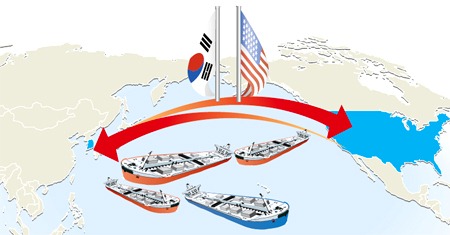
1. As the image above makes clear, Korea is substantially smaller than the US. Demographically, Korea is 6.5 times smaller than the US. In GDP, it is 15 times smaller. In terms of sheer scale, opening the American door for Korea exports means far greater breadth of possible export reach than vice versa. In the same way that Mexican firms could suddenly operate across a huge North American expanse after NAFTA, tiny Korea should reap significantly greater rewards than US firms exporting to a smaller (and comparatively poorer) market with a strong history of nationalist buying and tacit import discrimination. Indeed, given that, I am surprised the American business community even cares that much.

2. Korean GDP per capita is about 75% of that of the US. Hence the convergence benefit of the FTA for Korea is quite clear. When economic entities at very different stages of wealth accumulation are put together in a free trade environment, the majority of the benefits accrue to the poorer of the two, as investment races to the location of highest return. Poorer economies catch-up, or ‘converge.’ This happened after the American South was forcefully reunited with the Union; it is happening again in Mexico after NAFTA and eastern Europe after EU accession. It is happening more generally in East Asia, as it has joined the WTO in the last 20 years. (By contrast, the US-Canada FTA of 1988 had little dramatic impact on either side, because they were already fairly similar.) In short, the biggest beneficiaries of free trade spaces are almost always the poorer states; rapid convergence is commonly understand as an ‘economic miracle’ (Germany in the 50s and 60s, Korea in the 70s and 80s). So US exporters will benefit at the margins in a small and poorer economy, but Korea’s benefits will be much greater.

3. The Korea market is far more closed than the US. Opening it up will create for greater disruption, therefore, for established winners like the chaebol (hence the general ambivalence of the Korean business community to the FTA), but the rewards to consumers here will be enormous. A wave of healthy competition from American imports will force Korea’s sluggish providers to ramp up services while bringing down Korea’s ridiculously high consumer prices. An obvious example is smart phones. Smart phone technology – available in the US for almost a decade – only came to Korea this year, because the Korean telco duopoly (KT and SK at 90% market share) had no incentive to make better phones and used their market power and government connections to block imports (particularly the Nokia, Apple, and Microsoft). Only the possibility that ‘backward’ China might get the i-Phone before ‘advanced’ Korea finally kicked the ROKG into facing down the duopoly and opening the door last year. And now suddenly, smart phones are the rage. [Yet I find that Koreans are so devoted to the success of the chaebol, that they seem unwilling to act as rational consumers pushing for more choice (imports) and lower prices (due to import competition). It was national prestige – that Korea should beat less advanced China – that finally got the i-Phone in. This is frustrating to no end as a consumer here – it would sure be nice if a bottle of Heinekin didn’t cost $2.50 in a grocery store. But the Korean media – also a massive corporate monster tied to government elites – have disseminated this myth that what is good for Samsung is good for Korea, and Koreans have drunk that agit-prop kool-aid to the dregs.)

4. Korea really needs to bolster the US alliance in the wake of the spiraling costs of the GWoT. Here is where Korean myopia is the worst, and where Korea is so badly served by its self-congratulatory, parochial media that doesn’t report on the rest of the world they way it needs to. Most Koreans are blithely unaware of their extreme geopolitical vulnerability, which I blame on a media relentlessly dedicated to overhyping Korea’s importance in world politics. The US is Korea’s most important ally – it’s only really. The US alliance backstops Korean security in what is a terrible geographic environment. Korea is small, divided, encircled by great powers, and has poor relations with all its neighbors. Without the US in the background, Korea would have lost the Dokdo squabble years ago, e.g. To make it worse, the US is burned out after two wars and a brutal recession. Only 41% of Americans now believe we should fight for Korea anymore. USFK has gotten smaller and smaller in last few decades, and it is repositioning itself away from the DMZ in order to avoid getting immediately pulled into any conflict. And there is a coming defense retrenchment in the US too, because US defense spending is simply incommensurate with the size of its budget deficit. I would be surprised if the US still has forces here by 2020, unless they are completely subsidized by the ROK. The national security case for the FTA strikes me as so obvious, that claiming US beef has BSE or that US cars are ‘low quality’ is just suicidally foolish.

What the Yeonpyeong Shelling Taught Us

Not quite… He actually ducks a little


Actually, not a whole lot. Mostly, it just reinforced stuff we already know. I said the same thing after the Cheonan was sunk earlier this year.

1. Koreans take this stuff in stride. It was more the international media that portrayed this as a major crisis. In Korea, everyone went about their regular business. The stock market didn’t drop. There was no rush on food-stuffs in grocery stores. No one is digging bunkers. It’s not evolving into the Cuban Missile Crisis. The Korean media reported rather well on the crisis, without the level of overstatement – ‘Korea on the brink of war!’ – that was common from the international media in the first few days especially. This is far from the worst crisis with NK in the history of the stand-off.

2. These sorts of things re-galvanize the flagging US-Korea defense relationship. This may be the biggest benefit to South Korea from the whole mess. Although US political and military figures regularly invoke the alliance as shoulder-to-shoulder (which of course you would expect them to say) both here and in the US, the reality is that the American position here is shrinking and moving away from the hot-spots under substantial US budgetary pressures at home (a $1.3 trillion deficit!). USFK (US Forces in Korea) has shrunk substantially over the years. US nukes are out. The Combined Forces Combined (CFC) is schedule for termination. The number of bases has shrunk. The US is no longer deployed along the DMZ (the big bases will be around Pyeongtaek, south of Seoul, in the future). The massive US fiscal mess will make it even harder to retain what we still have here. Defense budget cuts are coming – in a big way if we want to save Medicare, Medicaid, and Social Security – and US overseas deployments are an obvious place to cut (Iraq, Afghanistan, Korea, western NATO especially, unless the hosts want to pay 100% of the costs – which option the Koreans should genuinely consider as a part of point 3 below). Here is my fuller commentary on this. Also here and here.

Korea particularly is a tempting place to cut. Korea is wealthy and has a capable military. It can afford to spend even more on defense (below), while the US most certainly cannot. Nor is Korea really a core US defense interest. Unification on Northern-terms would have little impact on the US now that the Cold War is over; Korea is more a regional issue now, not a global one. Korea hardly ranks against Japan, Canada, Mexico, (Israel?) or Western Europe as obvious ‘core commitments’ to American security. This does not mean I want the US to abandon Korea, only that the likelihood is growing, because the costs to the US of an ROK defeat/reduction are low for the US. Nor do Americans really want to fight in Korea (only 41% now), especially after all the misadventures of the 10-year war on terrorism. Read this as well on this issue.

So if you are Korea, these sorts of scrapes are secretly valuable from a medium-term national defense view.  They put NK back on page 1 for the US voter. They force the US to say yet again in public, that the US will defend Korea. This creates greater ‘audience costs’ for US elites should they try to slip out of the alliance commitment in the future. After the Cheonan, the dissolution of the CFC was delayed for 3 years. Note here that Obama talked around Barbara Walters’ excellent question, ‘is an attack on SK  an attack on the US?’ The president ducked that one (video above). These kinds of public comments make it harder for the US to retrench (even though we really need to), and that is good if you are SK.

3. SK needs to spend more on defense. SK only spend 2.7% of GDP (according to the CIA). I hate to sound like an uber-hawk, but honestly, that is really not enough if you live next to NK and are number one on the hit list. By now it should be clear to almost everyone except the most unreconstructed SK leftist, that dealing with NK is only possible from a position of strength. The North cheated a lot during the Sunshine Policy years, even demanding a big cash payment for Kim Jong Il personally to get him to attend the inter-Korean summit. And in the last few years, the North has gotten even nastier – with the nuke and missile tests and more of these sorts of asymmetric strikes. But Koehler has a series of good links and analysis here that SK has not adjusted well. The US is broke; SK is not. The time for burden-sharing is here.

But you say this is just arms racing. Everyone will just run faster and faster to stay in place. More Southern weapons will scare the North into further wild behavior and yet further punish the much-suffering NK taxpayer. Maybe, but the NK military functions as a state-within-a-state already, and its stringencies on the NK citizenry derive as much from its internal as external insecurities. And NK policy-makers are so irresponsible (Brzezinski went so far as to call them insane), that the causal connection between lower SK defense spending and better NK behavior seems loose at best, while the costs – like the Cheonan and Yeonpyeong – are very clear. Among other things, South Korea might want to consider militarizing more areas north of Seoul and depopulating them gradually, expanding the navy, as these flashpoints occur mostly in the Yellow Sea, paying for more of USFK, even for its expansion, conscribing women as well as men (as Israel does), and possibly – I hesitate to say – signaling renewed interest in nuclear weapons. That last one is hugely controversial, but given the growing likelihood of US retrenchment and the expanding Northern nuclear program, it should probably be discussed.

Another Laugh-Riot Asian IR Video, on the Currency War

And you thought economics was the dismal science…


It is Thanksgiving week, so here is something light. If you aren’t watching Charlie Brown Thanksgiving, get to it. See you next week.

(Should you actually want to ruin your holiday with serious reading on this issue, my previous thoughts are here, here and here.)

Hat-tip to Daniel Nexon on Duck of Minerva for this one.

This is great, yet another clever inside joke for the field. Here a few thoughts:

1. This is yet more evidence that IR needs some kind of serious treatment of alternative media presentations of what we do. Movies, video games, and now videos like this or the Chinese professor ad, all bolster my growing belief that we are missing something by not seriously examining media and IR. Reading – what IR-types do all day, cause its all we did in grad school – is obviously competing with lots of other sources of information in our digital age. Anyone who has taught undergrads for more than a few months knows that they don’t like doing the reading, but they love digital media. In the same way we now teach more and more IR film courses, we more generally need to adapt our pedagogy to the multifarious ways our students absorb information. NB: This is not an argument to dumb-down the field with video; it is a pedagogical concern. IR grad programs will still be the chilling, totalist, never-exercise, read-all-day, live-on-cigarettes-and-microwavable-food boot camp for you brain.

2. I am impressed how much knowledge of detail the authors of the video assume. Insofar as this is meant for a general audience, that reflects a fair amount of economic literacy in your average Joe viewer. Consider all this insider jargon: ‘capitalism with Chinese characteristics,’  DoT Secretary Geithner is only referred to as ‘Timmy G,’ ‘reserve currency,’ ‘currency manipulator,’ the list of Chinese premiers, the joke that GM means ‘government motors,’ Argentina’s 2002 default/meltdown, ‘buyer of last resort,’ ‘dollar denomination.’ That is a nice compliment to how much about econ the general public has learned since the Great Recession broke.

3. Great jokes: Uncle Sam dances and fires a machine gun in the air as Obama wears ‘USA No. 1’ bling. Somehow they managed to build a rhyme with ‘capitalism with Chinese characteristics.’ Did anyone else notice that the Chinese panda looked like Panda from Tekken? Obama’s dog died from lead in the Chinese dog food, complete with a green cloud around the dog. Adding the macarena dance from the 1990s was superb. I am embarrassed to admit that I thought the macarena was pretty cool dances moves back in the 1990s golden age…

Asian Myopia on the Imbalances – Deficit Importers will Revolt in Time…

Suominenfig1

This week, I explained the issue of imbalances in my classes, as well as the general failure of the Seoul G-20. For all the talk of Korean ‘leadership’ at the G-20, it fizzled. Instead of leading by example to actually push through a deal, Korea ethnocentrically took the G-20 as an opportunity to grandstand to the world that “Koreans are great.” So self-congratulatory G-20 concerts took the place of any real leadership on the most obvious thing Korea could have done – finish the US-Korea free trade agreement (FTA) – to help unwind those imbalances. Instead, President Lee choose to sink the FTA at the behest of rabidly protectionist, consumer-punishing Korean auto and agricultural interests. So, with no help from Korea’s ‘world leadership,’ global imbalances have worsened this year.

So let’s go over this once again – with economic logic in the place of raw nationalism.

1. In a closed system, like world trade, some one needs to buy stuff. Everyone cannot export; everyone cannot run a permanent trade surplus; it is mathematically impossible. We cannot export to the moon or God. There must be global demand somewhere, and for much of the last two decades, the US was that anchor – so much so that we even re-packaged the business term  ‘buyer of last resort’ to apply to the US. So, as my students protested, it is true that the US government and consumers, as well as many EU countries, went wild in the last decade with their credit cards and created their own debt problems. But it is also true that without their demand, Asia and the Germans would have nowhere to export to. Now that the US and many other places are deeply in debt, it is obviously time to return the favor. The old exporters should become new importers in order to restore some balance to the system. ‘Diffuse reciprocity’ in trade is a basic requirement, in order that no one feels too much like they are being rooked by the other side. Without rough balancing over time, political disruption ensues (think Greece this year). This threatens the whole system in the long-term. Why is the Korean media too myopic to not see that?

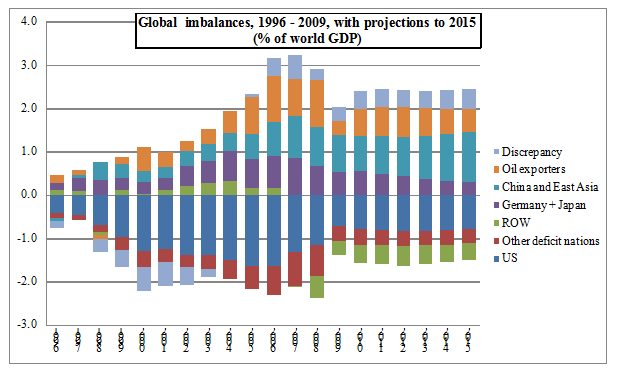
2. The near permanent trade surpluses (above graph) in Asia are not, NOT, natural. It is mathematically all but impossible that a free-trade environment would return a situation where Korea, Japan, China and Germany would run 30 years of trade surpluses while the US ran corresponding deficits in the hundreds of billions USD. Why is this nearly impossible? Because the currency of such super-exporters would go up and up as their exports went up and up. In laymen’s terms, if the whole world wants to buy your stuff (Japanese cars, Korean TVs, Chinese everything), then the whole world needs more and more of your currency to buy all those amazing exports. So all those foreigners buying your stuff exchange their currencies for your currency. All this bidding to buy your currency (so they can buy your exports) means that the price of your currency goes up and up. So if you are permanently exporting more than importing, your currency should be permanently rocketing to the moon as foreigners scramble to buy it. Of course this has not happened. If you look at east Asian currencies, they all are pretty soft against the dollar, frequently moving downward. This is mathematically impossible to square with a permanent trade surplus. The only possible explanation is currency interventions to keep their currencies undervalued. In other words, cheating. And this is in fact well documented. China’s currency is pegged at a ridiculously low value to the dollar (estimates rage around 40-50% undervaluation!), and the Koreans and Japanese regularly ‘sterilize’ their currencies’ appreciation through massive dollar purchases. The Korean central bank’s euphemism for such raw mercantilism is ‘fine-tuning.’

3. Trade must be a two-way street in the medium-term, or the permanent deficit countries will eventually revolt. Here the Korean media is totally unhelpful with its nationalist and short-termist thinking that Korea’s success requires a surplus. This is also logically incorrect. There is no especial value to piling up dollars. Foreign currency cannot be spent in another country, so why stockpile hundreds of billions of dollars, or in China’s case, trillions, of someone else’s currency? If you don’t spend it back by importing, then at some point your export targets run out of money. And this is precisely what has happened in the great recession. The importers of yore are broke, and they need some of their dollars recycled back as export sales. But if you politically refuse to countenance a trade deficit by buying imports from your trade partners, then eventually you anger them: you are trade manipulator, and you provoke trade conflicts. Japan learned this the hard way. Its currency and trade gaming lead to two US backlashes – first when the US broke the Bretton Woods system and inflated in the 1970s, and then again the 1980s with the Plaza Accord. And this is what the Fed’s current quantitative easing is today. The US, unable to convince the surplus countries (esp. China) to import for the collective good of the system, is going to force them to do so, or they will see the value of their dollar reserves evaporate in inflation. Quantitative easing is a declaration of war by the Fed on the People’s Bank of China. This is extremely risky for everyone, as it throws the dollar’s reliability in the air, but it shows you just how head-in-the-sand obstinate the surplus countries are. In order to maintain short-term trade surpluses, they risk the inflation of the very currency they have stockpiled.

That Hysterical ‘Chinese Professor’ Ad from the 2010 Election Campaign

China’s own Heinrich von Treitschke!


This is a great ad. Anyone with an interest in Asian security should see it. Not only is it a great inside joke if you are in this area, it also does a great job capturing the American public’s angst about China’s rise. And quite honestly, it’s basically correct. We are spending our way into oblivion, and the Chinese are (deservedly) laughing as we fall into the abyss of our own making. We are doing this to ourselves – and Chinese elites are studying past hegemonies – so the scenario presented in the ad is, in fact, credible. Plus, it’s nice to see a professor presented in the US media who actually looks serious and authoritative instead of the usual Fox Network tropes that we’re pointy-headed, irrelevant Marxists who have affairs with our students. Now if only that professor image could include Americans…

There is some grumbling that the ad is racist. A friend in the field suggested it replaces the bogus Japanese threat 20 years ago with a Chinese one today. But I don’t really see that myself. The concern of the ad is not the ‘yellow-peril,’ but American foolishness, and the Chinese are presented rather well actually. The students look serious, civil, and healthy, while the prof behaves and talks like he actually knows wth he is talking about. Contrast that with typically condescending or idiotic portraits of academics in the US media – think about the ridiculous professor sequence from last year’s Transformers 2, e.g. At least this guy actually moves and speaks the way we really do in class. Ok, well, maybe he is a little more like Heinrich von Treitschke than most of us are, but still, he looks like a pretty good lecturer. Think of him as the Chinese Leo Strauss or something. LOL. I imagine that his class would be pretty fun to take. Fallows’ treatment of the ad is worth a look too.

More seriously, the ad is right on target actually in its basic claim. American errors and profligacy are the makers’ real targets; it is not ‘Asia-baiting,’ although it may feel that way initially. If it gets Americans to think more seriously about the looming debt crisis and the seriousness of the Chinese challenge, so much the better. Certainly the Tea Party, for all its sturm and drang, has neither the guts nor focus to say anything meaningful about the US response to Asia – another one of its many failures of seriousness. Nor does anyone in official Washington really know how to rein the $1.3 T budget deficit – funded, incidentally, by massive borrowing from China – without huge tax increases and spending cuts. (Quick note: It’s mathematically impossible!, which is why no one has any idea.) So if we must scare Americans into budgetary seriousness by noting that China is breathing down our neck (which they are starting to), then so much the better.

Finally, it is worth noting that China is a much more serious long-term threat than Japan ever was. China is 10 times larger in population (and 4 times larger than the US), and it is not democratic. So while I wouldn’t want yellow-baiting, ads like this that prick America’s unipolar daydream are useful actually.

The Tea-Partiers and US Foreign Policy, post-2010 election

tea-party-signs

So Obama took the ‘thumpin’’ that W got back in 2006. I find this unfortunate generally, because I believe the GOP is still unreconstructed from the dark days of George W Bush. Yes, the Democrats are protectionists tied to rapacious public sector unions, but the anti-science, jingoistic GOP is worse. I worked for the GOP on-off throughout the 1990s and cast a heartfelt vote for Bob Dole. But when Bush said Jesus was his favorite political philosopher in 2000, he lost my vote, and things went downhill fast – Iraq, torture, ‘big government conservatism’ (ie, debt), Katrina, Rumsfeld, etc. Yet astonishingly, the GOP learned nothing in the wilderness and got even worse after W – which still confounds me – with the rise of Sarah Palin. She and the Fox News set of Hannity and such strike me as astonishingly unserious; I recall reading that McCain’s people had to explain to Palin why there are two Koreas! With their capacious, uncompromising rhetoric of freedom or American power and awesomeness, I just can’t image them actually doing the hard, compromising business of government.

So on their big day of triumph, that is my ultimate question about the Tea Partiers – American exceptionalists in the extreme – about foreign policy. Consider:

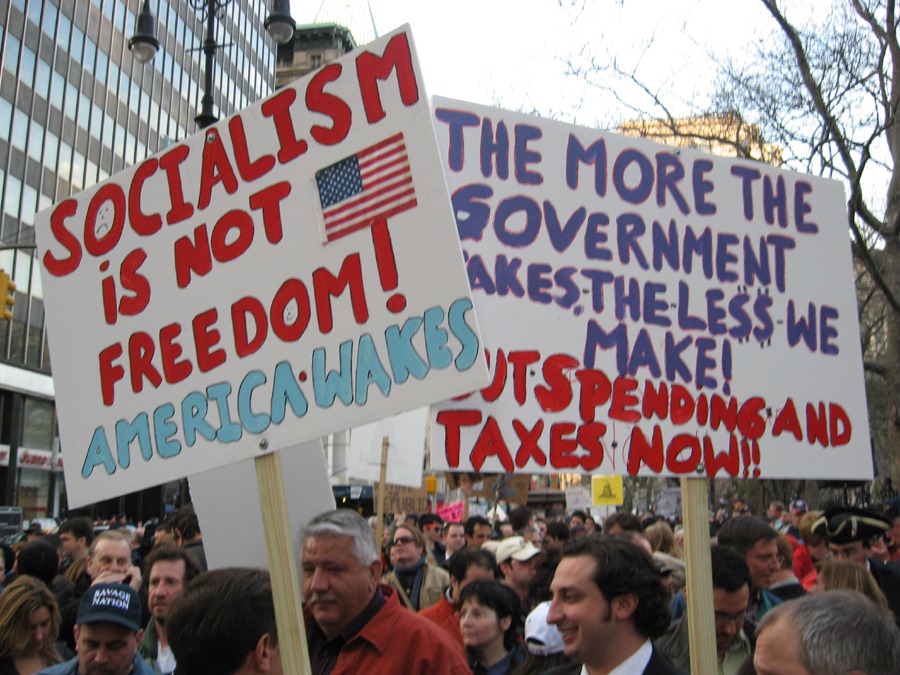
1. Tea Partiers worry about debt, but nothing bloats out government like defense. The combined budget for national security is around $1 trillion, if one includes intelligence, veterans affairs, some relevant homeland security spending, and the Department of Energy’s control of US nukes with the traditional DoD budget. I just saw Rand Paul on CNN. In his acceptance speech he talked about freedom from socialism and crushing debt, but as Andrew Sullivan identified months ago about the movement generally, Paul did not mention what he will cut. And none of them seem prepared to say that Defense really needs to go on a big diet, unless you want to start cutting Medicare/Medicaid/Social Security.

Defense plus M/M/SS are 80%+ of the budget, so something’s got to give. Is the Tea Party ready to chop defense as the Brits just finally admitted was necessary? I don’t see this, given how super-nationalist the Tea Partiers are. Their rallies were filled with endless paeans to the uniformed soldier. But Americans love M/M/SS entitlements too; no one wants grandma to lose her check either, regardless of their feelings about ‘socialism.’ I would love to see a serious debate inside the GOP, like just happened among Britain’s Tories this fall, on how to square guns-and-butter. That the Tea Party simply will not go into the details and grit on this is why I just don’t believe they’re serious. (Try here for ideas on DoD’s needed diet.)  Obama may a ‘socialist’ to them, but I don’t see them proposing what parts of the government to close to save the money. Even WR Mead admits this about the movement.

2. What do the Tea Partiers say about the rise of Asia and the BRICs? Phillip Stephens really nails this, IMO. Obama has tried to push the US to adjust to a world where US power is imperiled by overstretch (from huge debt and two wars) and simultaneously confronted by the ‘rise of the rest,’ ie, the growing wealth and social mobilization of much of the former third world. I don’t mean just China and India either. Lots of places are closing the gap with the US as they get wealthier. Smaller countries too like Turkey, Indonesia, S Korea, South Africa, etc. are all getting wealthier and so more capable of resisting US pressure, forging deals and agreements beyond the US, etc. As I’ve said before, this not the end of American power – only intra-US foolishness like the Iraq War and the debt can do that. But the social and economic modernization of much of the planet through globalization does slowly reduce the US room to maneuver. Hence we have the G-20 now.

Yet I see no recognition of this in the Tea Party, only endlessly repeated neocon/theocon narcissism about America as the greatest country on earth. I really do wish American conservatives would travel more to grasp that they are limits, that God is not an American, that foreigners find this sort of rhetoric deeply insulting, etc. This partly what I meant about the Tea Party simply not being serious. The Tea Parties, so far as I heard and read their stuff, are militant in insisting on Henry Luce-style US exceptionalism. This may make good politics against Obama the non-citizen Muslim, but in the real world, it is is poor training for the serious trade-offs the US faces in a crowded, ‘post-Atlantic’ world, where the US fractions of global GDP and global population are in decline and many foreigners don’t trust us after W.

Shallow, narcissistic talk about how awesome the US is, how it is the greatest force for freedom in the world, or the most amazing place in history is not actually real geopolitical analysis at all. It does nothing to prepare the US electorate for challenges like the Chinese juggernaut, a looming defeat in Afghanistan, a NATO unable and unwilling to fight with the US much at all anymore, climate change, etc. The irony of course is that earlier Republicans did in fact talk seriously about foreign policy. Nixon, Kissinger, Scowcroft, Bush 1 – all spoke realistically about America’s reach. This is exactly what the US needs now given the debt and dysfunction of the GWoT. Hence I like Obama’s more restrained style, such as the Cairo speech. But neoconservatism seems to have replaced realism as the dominant foreign policy ideology of the GOP, and too much of it is easily politicized fantasy to stroke the American ego about our ‘special role.’

Japan is an EU Country Trapped in Asia

japan_us_flag

The Council of Foreign Relations blog, Asia Unbound, is quite good. If you don’t read it, you probably should before you read my stuff. To be sure, CFR is establishment; indeed, it is the very definition of the foreign policy establishment in the US. So it is not exactly the font of challenging new ideas. But still, they are linked into power in way that lonely academic bloggers will never be. And this week’s bit on Japan really got me thinking about how Japan is basically stuck with the American alliance indefinitely, whether they like it or not.

Recall a year ago when the LDP got whipped in the election, that there was lots of talk about how Hatoyama was going to create distance between Japan and the US, how this was a new dawn in the relationship, how the Japanese left would be so much more prickly with the US than the old boys network of the LDP. I was fairly skeptical of this at the time, and I think the recent flap with China over the islands has done a lot to confirm that skepticism.

Japan really has nowhere else to go but the US. It is stuck with us, primarily because it is geographically fixed in a neighborhood where it has no friends. And this opens all sorts of room for the US to push and bully Japan, which leads to regular Japanese outbursts that Japan needs to be independent of the US. (For the most famous, read this.) In fact, Japan is like a post-modern EU country in the wrong place. It should be comfortably ensconced in a post-national intergovernmental framework like the EU, where it could promptly forget about history and defense spending, and worry about how to care for its rapidly aging population – like Germany is morphing into ‘Greater Switzerland.’ But it’s not. Instead, Japan is trapped in modernist-nationalist-historical Asia, surrounded by states that don’t trust it and who want a lot from it that it doesn’t really want to give (historical apologies, imports, engagement, development aid, territorial compromises).

Consider that Japan, like China or Russia, has no friends or allies (save the US), and lots of semi-hostile neighbors:

Russia: Neither side has much interest in the other. There is an island dispute that has blocked normalization for decades. And, of course, Russia has been an erratic partner for just about everyone, not just Japan, since the end of the Cold War. So there is nothing to gain there.

Korea: There is also an island dispute with South Korea, over which even North Korea (!) has supported the SK position. NK kidnapped Japanese citizens in the 70s, and this has remained a permanent fixture in Japanese politics. For the North, Japan is high-up on the hit list; the North has launched missiles over it. Relations with the South are possibly even worse. S Koreans are intensely japanophic. The island dispute (Dokdo) rouses extraordinary passions here. Finally, of course, both Koreas are furious with Japan over its invasion and colonization from 1910-1945 and feel that Japan has never properly apologized.  Given how much S Korea and Japan share – democracy, concern over China’s rise, a US alliance, fear of NK, Confucian-Buddhist culture – they should should be natural allies, but Koreans will tell you with a straight face that Japan wants to invade it again. So forget that.

China: Yet another island dispute plagues the relationship from the start. And like Korea, so does history. The Japanese were even harsher in China than they were in Korea. The Rape of Nanking was brutality on par with the Nazis, and the Japanese used biological warfare against the Chinese as well. As the CFR post linked above notes, anti-Japanese street protests are becoming a regular part of Chinese politics now. A Sino-Japanese reconciliation would require astonishing, Willy Brandt-style statesmanship that the immobilist Japanese political system is wholly incapable of delivering.

Southeast Asia/India: Things get a little easier here, if only because it is further afield. But the ASEAN states too suffered under Japan in WWII, and like China and Korea, don’t feel that Japan has engaged in the appropriate historical reckoning. Only India is a possible serious Asian ally of the future because of mutual concern for China and the lack of historical-territorial problems.

Bonus problem – Economic Decline: As if this unhappy neighborhood weren’t trouble enough, add in Japan’s bizarre economic malaise. When China, Korea and the Soviet Union/Russia were a mess a generation ago, Japan could strut in Asia, but now these competitors are closing the gap while Japan stagnates. That just makes all the frictions that much harder to manage. China is so big, it can afford to miff the neighbors, but Japan no longer has this luxury.

In short, a weakening Japan so infuriates it neighborhood, that the US is all its got left. Given Japan’s paucity of options, the US has lots of room to bully and push Japan. But it must ultimately give in, because it’s position in Asia alone would be terrible – isolated, suspected, friendless. So bad is Japan’s position, that the US could effectively bring down the Hatoyama administration over something as minor as Futenma.

This is not meant to be an endorsement of US wedge politics against Japan. But it should certainly explain why its 20-year old complaint about US dominance has led to nothing, just like Gaulle’s petulant withdrawal from NATO ended in ignominy when the French finally gave up on ‘expectionalism’ and rejoined last year. It’s nice to be two oceans away from the competitions of Eurasia…

Is there Halloween in Korea? Alas, no…

I still love Charlie Brown 30 years later…


It’s Halloween, so here is something semi-serious – if US holidays show up in Asia, is that proof of cultural Americanization?

One of the things I miss most in Korea as an expat is the US holiday season. In terms of fun, parties, color and festivities, nothing beats the three-month run of Halloween, Thanksgiving, Christmas and New Year’s. Interculturally then, it is always interesting to see how much of this washes into other countries, given the endless debate about Americanization, globalization as cultural American imperialism, and all that.

In that vein, readers from the left might be glad to hear that little of that occurs in Korea. US holidays are generally un-celebrated here. While Korea is christianizing rapidly, Christmas has not even come close to the annual fun-time blow-out it has become in the US. It is still a religious holiday, not the cultural and shopping event it has evolved into in the US. (Ironically, religious conservatives who disdain the commercialization of the holidays might like the Korean attitude.) And Halloween has come mostly as an odd American event that is seen as somewhat fun, but kind of strange. When I explain Halloween to Koreans – Hallow’s Eve as the last night for evil spirits’ rampage in old Christian tradition – most Koreans find it fairly ridiculous. And all those new Korean Protestants don’t seem to know that story either.

Because of the big US presence in Korea for decades – first political-military, then commercial, increasingly now religious (American Protestantisms are pretty successful here) – you do have an awareness of US holidays, and some celebrations. But interest in this among Koreans generally serves Koreans’ interest to demark themselves from their fellows as cosmopolitan, worldly, and traveled. Ie, if you’re a Korean who celebrates Halloween with some resident expats, then you are ‘linked-in’ to the US culture in a way other Koreans are not, and that is a mark of social prestige. It is ‘cool’ to be able to say you celebrated Halloween with some white guy, kinda like it was to own a pair of blue jeans in the USSR.

In practice, then there is no trick-or-treating at all. Koreans mostly live in high-rises anyway, so trick-or-treating would be a weird, vertical affair requiring constant one-floor trips in the elevator. Horizontal neighborhoods filled with lights and people ambling about don’t really exist here. There are Halloween parties though. Korean clubs have them, but I have heard they are pretty strange events – just like a regular night at a club, only with some people in weird make-up. (Technically, there is no race-line for club attendance, but there are Korean clubs where foreigners would just never go in practice.) Ultimately though, it is the expat bars that try the hardest. They have costume contests and catch the spirit pretty well. The best expat bars are mixed; ie, Koreans come too. My impression though at these has always been that Koreans in attendance find the whole thing pretty bizarre and don’t get it at all.

So enjoy your Halloween. You are lucky to have the real deal…