The ‘Interview’ Hack Suggests N Korea will now Cyber-Target the Private Sector too

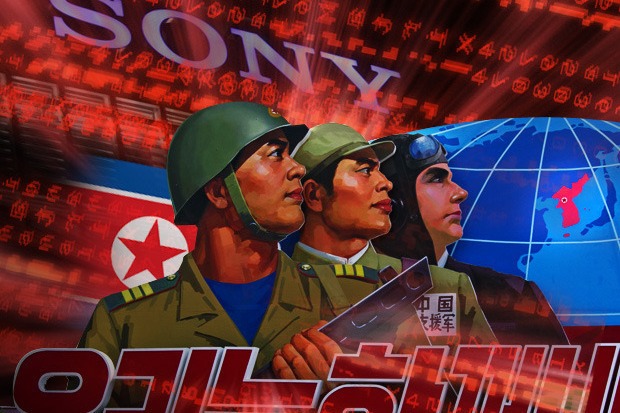
northkorea-hack-100537123-primary_idgeAll the hubub on North Korea hacking Sony got me thinking about the impact this might have on the private sector. To date, most of the North Korea & hacking discussion has focused on cyber-attacks on big, predictable targets like the US Defense Department or South Korean Ministry of National Defense. But targeting a private sector firm, especially a big, well-known one like Sony strikes me as a major expansion. Now for-profit entities with far fewer resources, especially intelligence, have been put on notice. That’s gotta make a lot of foreign companies who are thinking of operating in Korea think twice. Who wants to accidentally anger the Norks for who knows what by opening a store in Daejon or something? Best to just steer away. At least that is what I would be thinking, or more correctly fearing, if I were South Korean commercial officials.

So if you are major foreign firm operating in the Korean space, you’ve been warned. The Sony hack is meant to put you on notice. Hopefully you do the right thing: pulling investment or chilling creativity because of totalitarian threats would be a terrible outcome.

The essay below was first published at the Lowy Interpreter and then picked up by The National Interest. It starts after the jump:
My Review of ‘The Interview’: Dumb, but Mildly Subversive

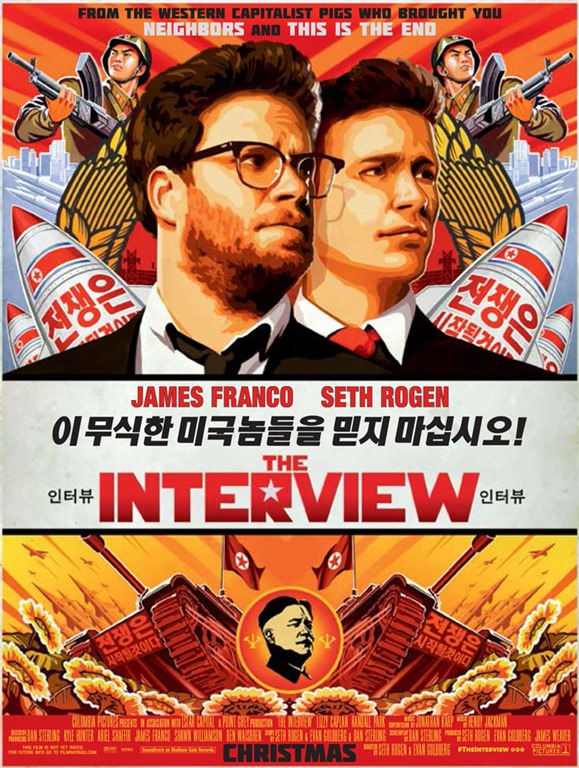
theinterview-movieposter

I know this came out awhile back and almost everyone has seen it now. But my review just went up at the Lowy Institute, so here is my local mirror of that post.

I saw it twice and actually found it reasonably funny the second time, but for low-brow reasons that had nothing to so with N Korea. If you watch it over some beers with your drinking buddies, it’s reasonable Saturday night fare. But all its best jokes are Animal House-style, guys-behaving-badly stuff that has nothing to do with NK, and for which the NK backdrop is totally unnecessary. So why was the film even set there?

Finding humor in North Korea, while nonetheless respecting how awful the place is, is a tough task which would require good writing, something along the lines of The Great Dictator. But Seth Rogen scarcely tries that. Instead it’s all twenty-something American humor (lots of western movies and music references, and sex jokes). So why drag in all the moral weight that comes from engaging North Korea? I didn’t find that morally offensive, as some reviewers did, but rather just bizarre and incongruous. It’s as if a standard issue Hollywood ‘dudebro’ comedy just fell out of the sky into North Korea. Wait, what? Who thought that mix of elements would work?

Whatever. If you haven’t seen it once, you should. Review follows the jump.

Invading North Korea is a Really, Really Bad Idea

clip_image002

The idea of invading North Korea comes up now and again. Usually this is quickly dismissed as hugely risky, naïve, and so on. But the idea does keep recurring and there is an underlying moral attraction to stomping on North Korea. NK is just about the worst place on earth, barring perhaps the ISIS statelet emerging in the Middle East.

So I took this opportunity to sketch out a more detailed rebuttal than the usual ‘this is crazily dangerous’ response. I lay out 6 reasons, probably the most important of which is that South Korea, which will carry most of the costs of a NK collapse, is strongly opposed to preemptive attack. More generally, I continue to be amazed at how blithely neocons and liberal internationalists recommend the American use of force all over the place. Iraq (and Libya and Afghanistan) haven’t made it obvious how risky regime change decapitations are?

This essay was motivated by this original argument for an invasion by Pascal-Emmanuel Gobry. Should Gobry read this response, please note: ‘I did notice that you blocked my access to your twitter account. My apologies if this response came off as harsh or inappropriate. That was not my intention. Contact me if you like.’

This essay was originally picked up by the Lowy Institute and, I was pleased to see, reprinted by the National Interest. It begins after the jump:

Continue reading

Northeast Asia 2015 Predictions: Another Year of the Repetitive, Uninspiring Status Quo

images

This is another of my end of year prediction/look-back posts. The others, on 2014, are here and here. This time I want to look forward to 2015, and I’ve got to admit that I see little that inspires confidence. Every state in northeast Asia is run by nationalists and social conservatives who have little interest in overcoming regional foreign policy splits, or altering the bureaucratic, crony corporatist status quo.

So expect another year of the same: loud, angry, status-quo reinforcing foreign policy fights over empty rocks and events 80 years ago; corruption scandals; competitive devaluation and outrageously punitive consumer prices; a rough deal for working women; dirigisme instead of innovation; North Korean shenanigans; and so on. NE Asia really needs visionary leaders – an Adenauer or Mandela – someone to pull the region out of the blind alley of nationalism and crony statism that rewards nationalist elites and punishes everyone else.

The following predictions were originally made in the Diplomat here.

Continue reading

Looking Back on What Predictions for East Asia 2014 I got Wrong…and a little Right

untitledI have always liked these end of the year prediction check-ups, and new year prediction-making exercises. It’s fun, but it also is an important check on irresponsibility in our punditry. Month after month we say this or that is important, or this or that will happen. But later when the current we thought was important turns out not to be, or the ‘revolutionary’ leader we thought would ‘change everything’ turns out to be a bust, we conveniently forget about that and say some other trend is actually what really matters.

This is intellectually pretty shoddy but understandable. No one likes to admit they are wrong. But identifying why causal mechanisms we thought important actually weren’t, is an important way for us to improve our thinking and explain ourselves to readers. The alternative is those neocons who got Iraq really, really wrong, but still come back on TV unchastened. Bleh.

So here is a run-down of the big things I got wrong in 2014 in Asia. In brief, I overestimated the importance of the Sewol in driving reform in Korea, and the depth of the freeze between North Korea and China; I underestimated the importance of the UN report on North Korean human rights, and China’s efforts to build parallel institutions in Asia particularly. This was originally posted at the Lowy Institute last week:

Continue reading

My Top 5 List for 2104: 5 Biggest Foreign Policy Events in Korea

clip_image001

This is a follow-up to my previous post – a top 5 list of events for US power in Asia in 2014.

South Korea had a good year. President Park’s cozying up to Beijing is starting to pay off. China-North Korea relations are frosty, which is important progress. Seoul also got OPCON delayed indefinitely, which is great for Southern security, as well as its defense budget (but not so great for the US). And the UN report on North Korea human rights has gotten a lot of traction – way more than I thought – and looks increasingly likely to show-up China and Russia for what they really are out here – shameless, cold-blooded supporters of the worst regime on earth. The more that point is made in public and Moscow and Beijing suffer the embarrassment costs of that support, the better.

The full post comes after the jump; it was originally written for the Lowy Institute:

Continue reading

My Top 5 List for 2014: 5 Biggest Foreign Policy Events for the US in Asia

empire-in-asia-e1377199333368

I love these hoky, end-of-the-year lists. But I don’t know much about genuinely interesting or cool stuff, like the top 5 classical music pieces or architectural masterpieces of the year. So before you read another list about the Kardashians’ top 5 lip glosses, or the 5 most repetitive comic movies of the year, here is an uber-wonky one that’s basically about the sustainability of the pivot.

I am constantly wondering whether the US can carry through on the ‘rebalance,’ whether we can actually shift out of the Middle East and Europe and pay more attention to the Asia-Pacific. I am skeptical, in part because I tend to see US commitments as opportunity costs of one another. In other words, if we are tangling with Putin or ISIS, then we don’t have much time for China or Maduro. But if you’re a neocon, then the pivot is no trouble. Getting involved in Asia doesn’t mean lessening commitments elsewhere, because the US should be globocop anyway, and US domestic expenses should be cut to fund to all this intervention.

The following post was originally put up at the Diplomat:

The “Interview” Fits a Long Tradition of Really Stupid US Portrayals of North Korea (but SK Film is much Better)

9inter

If you are looking to watch The Interview immediately, you can buy it on YouTube here. But the reviews on Rotten Tomatoes have been weak so far.

I am not quite sure what to make of all the hacking controversy yet, but in the run-up to the film, I wrote this quick comparison of North Korea in South Korean and US film. Not surprisingly, South Korea handles NK far more intelligently, whereas the US seems to have a weird, somewhat creepy obsession with North Korea invading America. Yes, really; read the review below: the US will have four ‘NK invades the US’ movies or video games in five years. I am still trying to figure out what that means.

Anyway, this was first written for Lowy Institute; the essay follows the jump.

My Lowy Essay on the Paranoid Anti-Americanism of South Korean Geopolitical Film

Take that English Teacher with Bad Hair!

So I watch way too many movies when I should be working, probably because I am pretty lazy. But a side benefit is noticing the various tropes and themes of movie genres. And one thing I’ve picked up watching movies in my field (international relations) in South Korea, is the regular use of stock American villains. Maybe I notice it just because I am an American, but it seems pretty pronounced to me.

It is well-known that westerners in Korean soaps are frequently used to introduce duplicity, sleaze, STDs, and so on. But in the film industry, the Americans are more nefarious, usually plotting to manipulate Korea  to serve neo-imperial goals or something preposterous like that. Amusingly, the plots are usually ludicrous to the point of laughable (Americans mass-bombing plague victims in downtown Seoul in broad daylight?! – hah!); the dialogue is risibly ridiculous as well (“Korea is independent and sovereign, and you Yankees can’t tell us what to do!” Yeah!!); and the ‘American’ characters almost always sound like Russians or non-American English teachers the movie producers just pulled off the street and stuck in a bad rip-off of a US Army uniform.

It is also noticeable that all this American manipulation of Korea is self-congratulation: if the Americans are going to great lengths to use Korea for their dastardly plots, then Korea must be pretty important to the world’s lone superpower. Better fanciful American flattery of Korea, in trying to manipulate it, than the reality of American ignorance of it.

So here is some nice holiday relaxation. Revel in the sheer laughable paranoia of left-wing Korean cinema. It’s a hoot:

Continue reading

My 2014 Hate-Mail of the Year: ‘Kelly, You’re Wrong; North Korea’s Awesome!’

North Korea 2012 279-Kelly-Viao

For my 2013 hate-mail of the year award, go here.

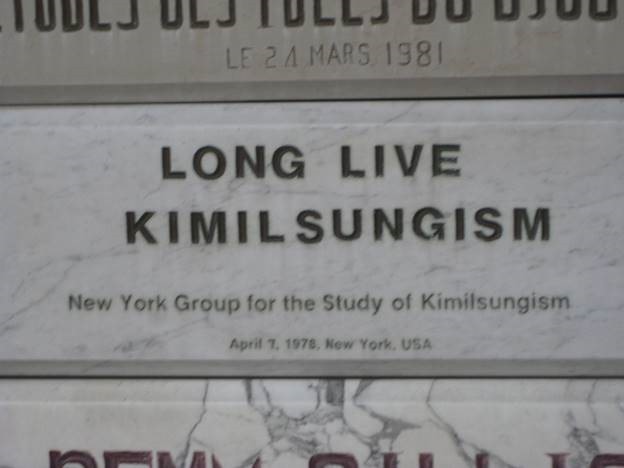
So I get a lot of weird email and comments because of my blog, or in the comment sections of my op-eds for the Diplomat. A lot of it is fairly ridiculous (‘you want the terrorists to win!’) or ad hominem (‘you’re a tool of the IMF; you’re a Muslim’), but occasionally I get pretty unique stuff like this letter below. (The image above is a personal picture of a plaque on the Juche Tower in Pyongyang. Perhaps the correspondent comes from this study group.)


“Dear Robert Kelly,

I read your column in The Korea Times with great interest and would like to share my thoughts with you.

You may think that my opinion is weird and crazy from a point of American.

Most Americans think that North. Korea is vitally harmful, threatening the world peace by shooting the missile toward America.

America had fought with North. Korea at 1950 and kept a hostile relations with it since then.

I think North. Korea is a great country, because it has shown sophisticated diplomacy against a big country.

I claim that North. Korea is less westernized and less materialized. It keeps a strong defense for people.

I also argue that North. Korea has not tarnish tradition and nature unlike South. Korea.

I wonder that you can say that all the people in South. Korea and U.S. are happy, just because they live in a democratic and capitalistic society.

I also ask you that most people in North.Korea is unhappy, because their government infringes on its citizen’s individual freedom severely.

I am sure some people may have been successful in adapting to a totalitarian society and they may have made a fortune and achieved a solid social position.

If the U.S. is a perfect society for living, I wonder why so many American came to Korea to get a job.

I have met many Americans who blamed their country and they don’t want to go back to their country.

Some American has settled down in Korea, marrying a Korean woman.

Deciding which government is better is subjective.

In a nutshell, North. Korea never collapses.

Best regards,

———“