Asia’s ‘Culture of Export’ (1): Persistent, Politicized Asian Imbalancing

export_ship

Part 2 is here.

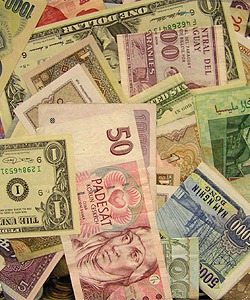
In my IPE class this week, we discussed the issue of global imbalances. (If you have no idea what this means, start reading Martin Wolf at the Financial Times.) I argued that it will take awhile to ‘unwind’ them, because Asians have acquired a cultural habit of saving and exporting. Imports are suspect, and a trade surplus has become a downright obsessive national goal out here rather than a natural, occasional imbalance in trade. Now this would be a laudable goal if East Asian states were highly indebted poor states, as in Africa and Latin America, but East Asia is sitting on close to $4 trillion in US debt stocks from two decades of single-minded stockpiling. If China didn’t run a trade surplus in a given year, it would provoke an existential political crisis in the Chinese Communist Party. This is just how deeply mercantilist Asia is. Korea’s trade balance is reported every month in the news, and it is frequently the leading story. The reporter’s spin is always congratulatory and nationalistic. The trade surplus is always reported as a major national-political goal, not a technical economic outcome. In Japan in the last month, the BOJ intervened to keep the yen down at the behest of major exporters, and it is threatening to do so again this week. There is your ‘culture of export.’ East Asians are politically opposed to running trade deficits. Trade surpluses are not economic outcomes; they are nationalistic, highly managed, artificially and purposefully-created political outcomes. This is a massive cultural hurdle to righting the global economy.

Asians desperately want the old system of high exports and high savings to continue, but it can’t because traditional global importers are leveraged to this hilt. But I genuinely believe Asia’s mercantilist elites will put their hands in the sand on this and simply refuse to play ball seriously in the medium-term and so prolong global unemployment. Exporting in Asia is not just a regular economic activity on par with consumption or government spending. Export has acquired a near-mythic status as a mark of national greatness and power. This is wildly mercantilist and unsustainable, but that won’t prevent Asian elites from trying anyway and dragging the globe into a long ‘savings glut’ recession.

In liberal trade theory, current account surpluses are natural outcomes of an unforeseen change in the desirability of a country’s exports. One year, a country’s exports may be suddenly very desirous. Recall that the first Playstation 3s were resold on Ebay for $1000+, so Japan got an export surge. This is ok, because when you exports surge, your currency, if it is floating, should surge too. Your stronger currency reflects that your stuff is in greater demand than you are demanding others’ stuff. The following year, as your stuff becomes more expensive due to your appreciated currency, your net exports over imports, your current account surplus, should recede. Broadly, your imports and exports should tend toward equilibrium, because the world is a closed system. So everybody is happy, because in the long-run, there should be – in fact, mathematically, there must be – equilibrium.

But this healthy process of circulating trade and currency got all gummed up in the last 15 years or so, and this is why the Great Recession is so brutal. In short, East Asia (and Germany) are big net exporters, and the US and peripheral Europe are big importers. If the exporters don’t buy stuff from the importers though – ‘recyle’ the importers’ currency back to them by buying stuff from them – then the importers eventually run out of money. This is ‘natural.’ Previous importers should pendle back to export, and vice versa. But that is not at all what happened.

Instead, running out money didn’t stop the Americans (or the Greeks) in the last decade. When the money ran out, we just borrowed more – and from the exporters. The average American burned through all his savings by around 2005 and went into debt; the US government of course was in debt too. So everyone was borrowing more and more, and Asian states, unwilling to import more, were super-willing to lend their savings back to Americans so that they could keep on buying. (The same thing happened within the euro-zone between the German exporter and the southern European importers.) Hence the ‘imbalance’ – importers piled up more and more debt borrowed from the exporters, and the exporters piled up more and more savings by lending and re-lending their profits back to the importers.

We piled up debt to buy more, while they lent us our own money back to us so we could keep buying. This bizarre, predatory symbiosis is why Ferguson coined the expression ‘Chimerica,’ and its unsustainability has now become evident for all to see. Resembling a ponzi-scheme by 2008, it all collapsed.

The big problem is that if the pre-Great Recession super exporters (above all, China) don’t start spending, not saving their foreign currency, then global consumer demand will collapse, because the erstwhile importers’ demand is much reduced. Indebted and overleveraged, the former consumers are now saving again. The problem is that all that US (particularly) consumption before created global demand which created jobs. Now that US demand has contracted dramatically. Without demand from consumers to buy stuff, companies don’t need as many laborers to make stuff, so they start firing people – unemployment.

So in brief, US demand imploded under debt, but Asians don’t really really want to substitute for that demand. They don’t want to go shopping, or rather their governments don’t want them to go to shopping, because the governments are trapped in a Spanish Habsburg mindset that they MUST run trade surpluses all the time. Getting Asian consumers, especially the Chinese, into the malls is the globe’s best hope for a fast recovery, but the cultural blowback from 40 years telling citizens to save as a national mission is a huge obstacle, as is the Chinese government’s adamant, infuriating refusal to encourage its citizens to shop.

Part 2 will be a case study of Korean mercantilism.

US Embassy Security – Yikes!

P100614001

There has been a lot of discussion of the ramp-up of US embassy security since 9/11. Generally, the fear is that US embassies increasingly look like bunkers. They are being moved far away from downtowns. They are surrounded by loads of police, military, and barbed wire.

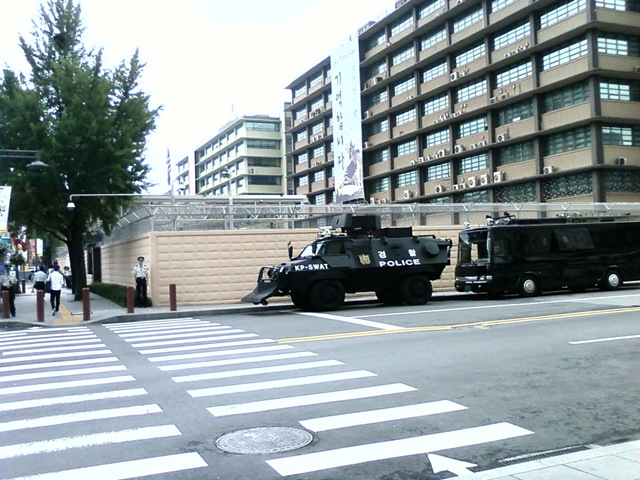
The Seoul one was quite an experience. I needed more passport pages, so off I went. It was frightening. There were multiple layers of security, blast doors, and US and Korean military and police with automatic weapons and body armor all over the place, including the SWAT tanks in my picture above. To boot, cell phones were confiscated, and there were the ubiquitous cameras. I imagine if I wrote more about it, they would be miffed over this post.

It was a depressing experience. I am with Thomas Friedman on this issue of US openness post-9/11. I think this stuff just sends a terrible image to the world about an open society gone loopy. 9/11 abetted the worst instincts of the national security state, and I fear we are moving down an Israeli path toward a barracks democracy with gates and locks all over the place. But this is not what open societies look like. Nor is it what we should want. Who wants barbed wire and cops with rifles at the mall? This is Bin Laden’s real victory – the installation of paranoia in the US. And I fear it will take decades to undo. The 1990s seems like such a paradise by comparison.

And I am not sure all this is necessary. The US has not in fact been targeted that much since 9/11. As John Mueller noted years ago, a lot of this has been overblown. I recall reading somewhere that you are more likely to be hit by lightning – twice – that killed in a terrorist incident. And what terrorism there has been has not been Bin Laden-style plots, but wacky rogues like the underwear bomber or the Fort Hood shooter. It is unlikely that all these walls could have stopped them.

Visiting our embassy was a genuine shock. It certainly didn’t look like America. It reminded me of those execrable gate-communities that fill California and subdivide people against themselves. This doesn’t look like homeland security. It looks like Israel, Pakistan or South Korea in the cold war – democracies under siege and paranoid. This is exactly the sort of freedom-reducing militarization the Founding Fathers warned about in instances of long wars and huge standing armies. This needs to be unwound sometime soon for the health of our democracy.

‘Economist’ Magazine Conference on South Korea

the-economist-logo

Like most of you, I have been reading the Economist off-and-on for 20 years. It, along with the Financial Times, is the most reliable journalism in English I think. I find it less partisan and noxious than most US journalism (or maybe I just agree with the classical liberal bent more). In any case, I got invited to its ‘Bellwether’ conference series on South Korea last week. Here are a few thoughts.

1. Bankers and financiers are a greater force for liberalization than I realized. I have the general IPE knowledge of Asian mercantilism, which I bemoan regularly here. But these guys really knew the details in depth, and they hammered the Korean policy-makers on this. This was an education. Among other things, I didn’t realize how much the Bank of Korea intervenes to ‘fine-tune’ the exchange rate or just how many gimmicky non-tariff barriers Korea uses to continue to protect its car industry. The ‘fine-tuning’ (nice euphemism that) is done at the behest of Korea’s biggest exporters – the chaebols in shipping, automobiles, and electronics. And it was quite amusing to watch the westerners at the event try to get the Koreans to admit that such gaming was in fact ‘capital controls,’ but the policy-makers ducked that one again and again. Being a political scientist focused on politics, I assumed the dirty work of pushing Asia toward liberalism fell mostly on the western bureaucrats who arrange FTAs. It was pleasing to see so many private sector people saying the same things that we say, only without all the theory.

2. Korea’s modernity. Nothing is a better marker of Korea’s modernity than a conference like this – filled with foreigners who want to make a lot of money! Having written my dissertation about the IMF and World Bank, I am accustomed to going to conferences on development, debt and similar travails. But here was a country that escaped from all that to be a good recipient of FDI, just as those institutions hope. (The World Bank calls former borrowers like Korea ‘graduates’ into private sector capital markets. Condescending?) 

3. Korea’s failed quest to be a ‘hub.’ For 10 years now, the ROKG has been trying to build up Seoul as an ‘international financial hub,’ and the session on this was downright self-congratulatory until I asked a question. I suppose academics exist to speak truth-to-power (which we don’t do usually – see Iraq). So I was pleased for a moment to be persona non grata on this, because I think it is wildly overhyped. The idea is that Seoul in Northeast Asia could become like Hong Kong (HK) is to China, or Singapore is to Southeast Asia – a bastion of modernity for international banks in a wild west region. There are some pretty obvious problems though:

3.a. Northeast Asia doesn’t really need hubs like Southeast Asia does, because Northeast Asia is already quite settled (but for NK) and developed. A ‘hub’ implies a surrounding piedmont that is less orderly or coherent, like Hong Kong to early 20th century China, or Singapore to ASEAN, but still worth penetrating. But there is no disorderly yet still accessible backyard up here: NK is closed; China is modernizing; and Japan is already modern. That leaves Russia’s extremely underpopulated Far East. Anyway, if there was such an opportunity, Tokyo would have grabbed it long ago. And this leads to the next problem…

3b. The hub market is Asia is already full – HK, Singapore, Shanghai, Tokyo. You can’t have too many hub or special economic zones, or they aren’t special anymore. So the first mover advantages are high and Seoul has come late to this party.

3c. North Korea. Seoul is 35 miles from the DMZ. This proximity makes it a city-hostage to the North. None of Seoul’s regional hub competitors have such a geopolitical backdrop. I find it hard to believe that big banks will locate their Asia HQs so close to such unpredictability. I can’t see Seoul competing among Asia’s biggest cities until the peninsular situation is resolved.

3d. Korea is still struggling with just how much it wants to multiculturalize, and until it accepts ‘diversity,’ it will be very difficult to get lots of middle-aged professional foreigners with families to reside here permanently (as in HK or Singapore). English is spread only thinly among the elite; getting a taxi is still a hassle. Foreign schools are insanely expensive here ($15-20k a year). The bureaucratic hassles of foreign life in Korea are endless – our national identity numbers are coded to mark us as foreigners, so shopping websites routinely block us. Cell phone companies still make it hard for foreigners to buy phones themselves (my Korean wife had to reserve our iPhone 4; Korea Telecom would not accept me). Tenant law is a nightmare (the courts tilt against us), as is contract law or getting a serious bank loan, like a mortgage or a car loan. In short, the primary hurdle for Korea to international/regional ‘hub’ status is not infrastructural, political, technical, etc., but cultural. Do they really want us here in large numbers, and are they prepared to really entrench the English bilinguism necessary to attract professionals, as has been the case in Singapore and NK for decades? The answer is still no.

4. Bankers, financiers and policy-makers find academics sort of a waste of time. There were 200 invitees, and among them only 5 academics. Given that I usually go only to academic conferences, I was out of my comfort zone – which of course is a good thing for most of us. I really began to see just how peripheral we are to, well, almost anything really important to these guys. This was quite a let down, and somewhat humiliating. Everyone was quite polite, but their skill sets were radically different, they had their fingers deeply on the pulse of policy in SK, and Asia, far better than I, and they speak their own CPA/MBA/Wall Street language that I really struggled with. My commentary seemed tiresomely abstract to them. I felt like a high school kid in a college class – out of my league and eventually cowed into silence from fear of looking like an idiot. Walt and Mead worry a lot about the ‘cult of irrelevance’ in political science, and nowhere in my recent experience did I perceive that as strongly as sitting in a room filled with serious people in expensive suits about the serious business of making money. What a contrast to the ridiculousness of so much academic theorizing! Conscious of this over the years, I have forced myself through econ textbooks and the Financial Times’ business coverage (a HUGE education that), but it was a healthy shot again my academic hubris to realize I didn’t understand 20% of what was said at this event. Even more humiliating was being told that most invitees must pay up to $2000 to attend these Bellwether conferences, but they invite academics gratis, because they assume we are broke. Good grief. 😦

5. Korea and Islamic finance? A couple of speakers mentioned this as a future expansion possibility for Korean banks. I found this downright off the wall. I suppose when there is big money involved, everything else fly out the window, and international private sector banking is far from my skill set. But the political scientist in me sees several huge hurdles. First, most obviously, Koreans know very little about Islam, and what they do know is generally negative stuff flowing from the GWoT. My students ask my astonishingly basic questions. The cultural distance is huge; Korea has less than 35k Muslims. Second, Korea is becoming more Christian, specifically more evangelical, and more closely aligned with the US in the GWoT. Third, the cultural fit of the sovereign wealth funds of the Gulf states make them the obvious choice for pious Muslims. If you were an devout Indonesian investor, what would really draw you to Korea of all places? I just don’t buy it all. Far more realistic would be a move into development financing in Southeast Asia without the cultural baggage. This is far closer to Korea’s own past and skills.

‘Responsible’ Sovereignty vs the Responsibility to Protect

rwandan_african_union_soldier

The ramp up in drones and special operations in the GWoT has me thinking we are stumbling into a future of unspoken limitations on sovereignty.

Limits on sovereignty is an old story, and one of the classic points of disagreement in IR. Usually, it pits realists against liberals – the general lines being that states won’t really cede any authority to a higher institution, while liberals scramble to find examples from the UN system to suggest that sovereignty is slowing leeching away. The ‘institutional’ debate is wrapped up in globalization too. Globalization supposedly makes the world more interdependent. More interdependence means more rules are needed, so states will slowly give up some prerogatives in order to get the benefits of the global economy. Earlier generations of IR talked about ‘spillover,’ as states slowly slid into more rule-bound orders, almost unconsciously.

But now we are seeing something different. Now, we see the US (usually) telling countries that if they can’t get their act together internally, we will take action. The issue is the responsible use of your sovereignty (RS). If you turn your country over  to drug lords, proliferators, pirates, terrorists, etc, then you are gambling with your sovereign inviolability (Afghanistan, northern Pakistan). Or even if you don’t agree to turn over your state to such non-state and if it happens against your will, others will still feel it ok to intrude (Somalia, Congo).

This most definitely does not fit the traditional liberal IR image of sovereignty cession. It is a product of state-weakness (Somalia) or nastiness (Taliban Afghanistan), not democratic decision-making or spill-over (the EU).

If intruding on sovereignty used ‘irresponsibly’ sounds like another neo-con excuse for democratic imperialism (it is), one can always try the liberal internationalist version of this – ‘the responsibility to protect’ (R2P). R2P puts a lefty spin on this by saying that the government has a responsibility to protect its own people; i.e., governments can’t prey on their own people as in Sudan. Governments that continue to do so will ultimately face international sanction and an agreement by the great powers, ideally through the UN Security Council, to step into your affairs to protect your own people from you. Obviously, this only happens in extreme circumstances (Kosovo, Rwanda), and the Chinese, with their regular opposition to any ‘intervention in internal affairs,’ will oppose it. But nevertheless, R2P thinking clearly suggests that human rights sensibilities are now so advanced, that there are extreme limits to sovereignty, and that is almost certainly a good thing. Governments can do a lot, but they can’t do anything anymore.

If this sounds kind of benign, focused on human rights and the domestic population’s well-being, ‘responsible sovereignty’ is a little scarier, because it is focused on outsiders’ well-being (defined by them of course), and it explicitly embraces the use of force by outsiders to protect themselves from you and your carelessness. So if Sudan is a good example of the R2P logic – a nasty state tearing up its own people which should get whacked a bit by the international community for doing that – then Somalia is a good example of RS – failed state so out of any domestic control, and thereby becoming so dangerous to the rest of us, that it has essentially forfeited its right to manage itself and foreigners will do (some of) it for them. Is this neocolonialism?

Finally, the US has already flirted with RS before the declaration of preemption by the Bush administration. A century ago, in the Roosevelt and Wilson Corollaries to the Monroe Doctrine, the US reserved the right to intervene in Latin America should its governments become too ‘disorderly.’ The neo-con update of this idea is to expand it worldwide, which I can’t help wondering if the US can really afford now, with a $1.5 trillion deficit. Sounds like overstretch all over again…

Pop Culture and International Relations Theory


Just about everyone plays video games now, and a sizable chunk model international relations in one way or another. Over the years, I have noticed that students have picked up ‘information’ from games – just as they do from film – which filters into the classroom. For example, I had a student once who insisted on basing his cyberterrorism paper on the scenario of Die Hard 4. Film, and increasingly now video games, are a shared language and pool of narratives among our undergraduates. They provide common stories and references, just as the transmission of Homer did among the Greeks. But the big films of the last 40 years are the stories they know now: my students are far more likely to know the Star Wars mythology than classical myth. Yoda has replaced Zeus, and Halo replaced the Iliad as a depiction of combat.

This raises all sorts of interesting pedagogical questions, and it places a burden on us as teachers to at least be mildly informed of what they watch and play. (If you don’t,  students think you are a hopelessly out of touch dork they can’t relate to, and hence, you are less likely to reach them.) The study of IR film is mature, but I have yet to see any serious treatment of video games as either depiction of international relations or as teaching tools. Duck of Minerva has touched on this a little bit. But this topic needs to be really worked on by someone in IR with an interest in communications. It doesn’t strike me as a well-organized enough topic for a dissertation, but definitely an MA. If Lord of the Rings can be discussed as an IR teaching tool, then so should gaming. Most of our students now game. Military games are hugely popular – including a bestseller released by the US Army itself originally designed as an in-house simulation and now used as a recruiting tool. Such games regularly include depictions of war, the normative concern behind IR’s very existence. At the very least we should think about how this impacts what they bring to class.

Sound ridiculous? Actually, in my experience in the classroom, it’s not at all. Whenever a big war or history movie shows up in theaters, we inevitably discuss it in class, because students ask questions about it or it otherwise creates such a stir in the larger society. So frequently did I notice this when I first started teaching, that I actually bought a few movies that I was asked about most, because I thought it was a good idea to know them well – including Black Hawk Down, Saving Private Ryan, Apocalypse Now, JFK, and the Hurt Locker. This has been a constant experience in teaching undergrads. It may depress more mature readers and IR observers, but it is nonetheless a reliable element of teaching undergrads. In fact, so prevalent are references to Black Hawk Down especially, that I even read the book, because I fielded so many questions on it.

I don’t have the training in media studies for this, but two video games which I have played leap out to me as relevant in IR – the Civilization series and the Modern Warfare series. Civilization is essentially a state-building simulation, complete with interaction with other states, including warfare. But Modern Warfare is far more important given how much the games have sold and how directly they model the current GWoT. The sequel is basically  ‘Iraq War- the video game,’ which is pretty shocking the first time you see it. Sequences are ripped straight out of the documentary Generation Kill. The battle-realism of the violence is far beyond anything you have seen in a game before. The gunfire, killing, and destruction are extreme and amazingly graphic. There are no aliens that are morally easy to dispatch by the battalion (Halo, Quake, etc). Instead your character knifes people, shoots dogs (yes, that’s right), and fairly easily racks up ‘collateral damage.’ At one point, your character even participates in a terrorist massacre at an airport (video above), which generated a big controversy apparently. Quite honestly, it is a shocking sequence in the game – you are expected to participate in machine gunning hundreds of civilians! The sequence creeped my wife out so much she made me turn the game off. This is calling out for a serious treatment.

More African Impressions


P100716001

This continues my just-off-the plane post from our return from Africa in late August. Further discussion with political science colleagues, commenters, and students got me thinking more:

1. Where are the Americans and Japanese? To my great surprise, we met very few Americans on the trip. Usually Americans are everywhere when one travels. Being a superpower with bases and businesses around the world, Americans are a fixture of the global tourism industry. So much that the term ‘ugly American’ came about – a vague caricature that we’re monolinguist rednecks, like Sheriff Pepper in the ‘Man with the Golden Gun.’ But I didn’t see too many. In fact, we scarcely saw any Americans. And we didn’t see any black American tourists at all. (I’m not quite sure what to make of that; all the western tourists were white.) Ditto for Japanese. 80% of the tourists we met were Europeans. There were 5 Koreans in our safari trip. And of course, we saw Chinese – not just from all the construction projects, but even tourists too. Chinese tourists, but no Japanese tourists? What a sea-change. Is this a sign of the bite of the Great Recession or disinterest, or what?

2. Africa Time/TIA (this is Africa)/‘It’s always Friday night in Mozambique.’ This was the hardest one to get used to, as you don’t know if it is a real ‘cultural attribute’ you should respect, or just a BS excuse for bad service, endless delays, and cold food.  The last expression came from our South African tour guide in Mozambique; the other 2 are ubiquitous. After a few weeks on the road in Africa, we started using them too. Africa time is the same thing as ‘Latin time,’ as a friend told me they say in Belize. The idea is the ‘we are slower here than you noxious, western city slickers. Life is pleasant, and we enjoy ourselves. So take a load off; drink a beer; and don’t worry. Your bus will show up some time, and you’ll get there eventually.’ TIA gets to the dysfunction of, well,  almost everything. When the bus you paid a lot of money to take breaks down, and you are standing around in the desert for 12 hours getting sunstroke (true story), or when the border guards rip you off for your visa (also true), or there is one clerk at immigration and a 2 hour line at midnight in the outdoor cold (also true), well, this is Africa. Get used to it. Don’t stress or try to fix it. You can’t. And inevitably, you do just give up and go with the flow. You plan that 5-10% of your expenses will be rip-offs where you are overcharged for stuff, because you’re a tourist. You get used to the fact that a sandwich and a Coke take 45 minutes to prepare in a restaurant. When our truck broke down for a whole day in South Africa, the recently-arrived European tourists on our trip got furious and impatient. But my wife and I, after 5 weeks already in-country, were just fine with it. We napped and read, and then watched Weird Al videos all day at the farm of a friend of our driver (yes, that’s true too). And no, the guide never even bothered to suggest that we be compensated for the whole lost day of the tour we paid for. Sigh. TIA…

3. Where is the developmentalism? This observation is as much a product of living in East Asia as it is of visiting Africa. In Korea, you see everywhere the dynamism and energy driving this place. Koreans are obsessed with catching up with the first world, joining modernity, being taken seriously in the G-20 and OECD, etc. To be sure, I was in Africa for only 6-7 weeks, but I didn’t see that vibe at all. I was amazed how much loitering about there was. In countries with 30-40% unemployment, this is inevitable. But the economist in me saw huge wasted labor potential. All those young men just standing around, looking for something to do,and then, inevitably, depressingly, trying to rip me off by changing money on the street with folded notes and other tricks, or harassing me to buy some shoddy overpriced souvenir. And there was so much obvious need for all that unused labor. Streets needed to be cleaned, trash picked up (the amount of litter in southern Africa is astonishing), decaying, half-finished building are everywhere. Nothing made me more sympathetic to the ‘Beijing consensus’ as this trip.

4. They still say ‘coloured.’ This was another big surprise as an American. Raised on strict US political correctness, where you can only say ‘colored’ if you say ‘NAACP,’ it was pretty striking to hear whites say this or that guy is coloured or black. I even heard ‘mulatto.’ But the blacks and ‘coloureds’ talk that way too, so you quickly realize the language of race is a lot more relaxed, and I have to say I kinda liked that. I couldn’t bring myself to say ‘colored;’ I used the more anodyne US ‘mixed.’ But still, compared to the verbal acrobatics Americans go through to talk about race – like ‘European-American,’ – this was kind of refreshing. I found it rather more mature.

Ground Zero Mosque & Koran-Burning: the Xian Right Learns ID Politics

no_mosque_at_ground_zero_22 danish_cartoon_protest

Just about anyone with a website has already commented on this. There is no doubt the Christian right has responded as predictably and disturbingly as one might expect. I have only a few thoughts.

1. The Ground Zero ‘Mosque’ is probably a bridge too far at this point. In his fumbling way, I think Obama got it right. The community center should be permitted legally as an expression of religious freedom, but so many Americans, especially Christians, find it uncomfortable at minimum, terrifying at worst, that it is probably not a good idea at the moment. It is clear misstep in a country still trying to come to grips with 9/11, Iraq, the GWoT, etc. And the hysterical reaction from the US right over it should be an obvious red-flag to Islam generally that it desperately needs to conciliate the rest of the world rather than insist maximally on its rights – an obvious lesson that should have been learned in Europe, India, or after Durban II. To many Americans, Ground Zero is practically holy ground (rightly or wrongly), and it is indisputable that its perpetrators acted in Islam’s name. It is also clear that the US is spending a great deal of blood and treasure pushing back on radical Islam, and that many Americans want to see a pleasant, conciliatory face on Islam before they can swallow something like this. So long as global Islam’s image is dominated by this guy, Muslims in American should really be working bottom-up outreach, demonstrating on 9/11 in solidarity with the victims rather than openly testing the patience of the majority culture, by blaming it on a few bad apples and dismissing the rest of the discussion as islamophobia.

American Muslims need to pick their battles just like any minority; civil rights movements for blacks and homosexuals have showed us that Americans will accommodate. Acceptance will come, but not by pursuing CAIR-style grievance politics that sees racism everywhere. I think most Americans are still waiting for the debate inside Islam on what caused 9/11; this would really prove that Islam accepts pluralism in its heart, not just when some firestorm occurs on CNN. But you only get that from americanized Muslims like Foud Ajami or Fareed Zakaria who are effectively isolated from the discussion. It is outsiders like Olivier Roy, Bernard Lewis, R M Gerecht, Ann Applebaum, or  Christopher Caldwell who have really exposed the pathologies behind 9/11 with no clear response from folks like Tariq Ramadan or Feisal Abdul Rauf, much less the reactionary clerical elites in Iran, Saudi Arabia, etc. Instead, the critiques are just ignored, as were the Arab Human Development reports earlier this decade. Just like Germany had to examine the Holocaust eventually, Islam needs to look inside 9/11 for a good house-cleaning before westerners will really be comfortable. Consider this counterfactual: if CAIR had organized a ‘Solidarity with America’ march on 9/11 every year or some analogously Oprah-style outreach, then I can’t imagine anyone would care now. But instead of introspection and an admission that pathologies deeply rooted in Islam created 9/11, the response of the US Muslim community has been quiescence or CAIR-style identity politics. I criticize America’s Christian right paranoia regularly on this site, but it is also willful ignorance to pretend the US is not a Christian-majority country, and as the Koran-burners show, they have learned identity politics too. How ‘bout everyone cool it on the religion for awhile?

2. The Koran-burning is the revenge of identity politics on the left. They are loopy and dangerous, but they also teach you just how dangerous stoking identity politics is. And for this you must blame the Left in the end. Starting in 1970s, civil rights-era equality was out, and identity politics was in. Non-white minorities in America were trained in multiculturalism by US universities and told to press group-fashioned political claims built around race or gender. The result was political correctness, in which free speech was assailed as permitting ‘disrespect.’ And no concept is more abused by ethnic ideologues than ‘respect.’ What better way to embarrass and delegitimize your critics than to easily cast them as ignorantly disrespectful of your culture, which you can casually invoke by just your last name. If they are racist, then you hardly need to listen to them, a tactic first rolled out against Daniel Moynihan’s famous DoL report 45 years ago. ‘Respect’ is wonderfully indefinable and elastic, its lack implies racist, vulgar stupidity, and it provides an easy out from the hard criticism liberal free speech permits. Pretty quickly, Israel’s defenders learned this; there is no better way to discredit Israel critics than anti-semitism charges. And Islam learned this too at Durban II. Now at last, white Christian Americans are learning this language as well. Regularly assailed as redneck racists, the easy answer is to adopt the pose of the opponent and ‘discover’ prejudice in the liberal anti-Christian media, e.g. This is why Fox News has such a siege mentality tone to its reporting, like the ‘war’ on Christmas. Here is a nice summary of how religious groups get trained to frame their demands as ‘rights’ they deserve as ‘victims’ of never-ending ‘prejudice’,’ i.e., free speech. But to be fair to the US right, it only went down this route after the ‘ethnicization’ of left-wing politics in the US in the last three decades. And for that blame the explosion of ethnic identity studies on US campuses.

Korea is not such a bad Model for Iraq…


I thought the Wednesday speech was quite good. Obama reached out to the right by repeatedly speaking of the armed forces’ sacrifice. Simultaneously, he made it clear what his priorities are – Afghanistan and domestic nation-building. At this late date, it is hard to argue with the wisdom of getting out of Iraq. It was such a misadventure, that it is probably best to get it over as soon as possible and move on.

On the other hand, I worry that the progress made at such expense might dissipate if the withdrawal is too hasty. The logic of sunk costs says that we should not ignore what progress there has been in Iraq, no matter how awful the decision-making up to this point. Future decisions need to be based on future projected costs, and I wonder if the costs in Iraq can’t be much lower than they were. I wonder if the end of next year is too rapid. This is why I liked Paul Wolfowitz’ op-ed last week arguing Korea as a model for Iraq. The American commitment to Korea paid off in the (very) long-rung, and lots of folks at the beginning thought it was a waste. Maybe this can be the case in Iraq. If the costs of an American stabilizing commitment in Iraq can be kept down and the footprint light, it might, just might, help create a positive pay-off for this wild ride…

Walt of course immediately went after him, and Walt is right to be skeptical of almost anything Wolfowitz says at this point – it’s as much CYA for the history books as commitment to Iraq for many neocons at this point. But I do think Wolfowitz was intellectually convinced of the benefit of the war, from the beginning. He wasn’t one of those Beck-Palin-types who is simply supported it because of raw, America-right-or-wrong patriotism and now can’t back out.

Korea is intriguing example for Wolfowitz to use because it does seem to have worked so well, which you will note that Walt does not question. Korea was a mess for the first decade of the US commitment and only slowly pulled itself together. Yet it undeniably did, and now it is clearly a boon to the US in a tough region. Simultaneously, the US commitment there has slowly decreased in cost, and as Korea got wealthier, it had been able to carry more of the cost. The problem was that this took 4 decades!

The Korean parallel holds for a little bit of Iraq. It is in an important region where the US lacks a good local ‘spoke.’ And the risks of Iraq backsliding are obvious, and it seems like the Iraqis are now worrying that the finally-occurring US withdrawal increases the likelihood of slippage. Iraq does have development potential, given its oil reserves and educated middle class.

But the risks are so high, that maybe Walt is right. It is a good question when a superpower should just give up. Bacevich bitingly says Iraq is just hopeless for the US, and there must be a time when we recognize the defeat is cheaper than victory. In Korea, it took decades for the return to show-up on the 1950-53 investment. That seems so far away, and the possibility that was unique and irreplicable in Iraq seems so high, that maybe Obama and Biden are right and we should just get out as soon as we can. I just don’t know…

Asia 21, or the IMF Comes Crawling Back to Asia…

md_lee

1. For an organization regularly accused of wrecking the world, the July IMF-Korea get-together was a lark. 13 years ago in the Asian Financial Crisis (AFC), the Fund pummeled emerging Asia with all sorts of tough but necessary reforms. And Korea, for an OECD economy, took a hell of beating at the time and never forgave the Fund. Never ones to admit they were wrong, Korean elites steadfastly refuse to recognize that the Fund’s advice was necessary and was the reason Korea bounced back so fast from what at the time observers thought was going to be a regional meltdown. And now, as the world’s money flows into Asia in the coming decades, the IMF has had to come crawling back. The irony of course is that Fund advice why the AFC lasted so briefly and why Asia returned to growth so quickly.

But no one EVER thanks the Fund, and now, with the Western powers traditionally supporting the Fund all bankrupt, the Fund desperately needs Asia. So after a 13 year mexican stand-off over the Fund’s AFC advice, the Fund has finally blinked. It has come back to ask to be let back in. For Korea this was a moment of triumph. Not one Korean speaker missed the opportunity to dredge up the old grievances, and not one IMF speaker had the professional courage to defend the Fund. Even Managing Director Strauss-Kahn (right above) didn’t have the backbone to defend the rescue package that saved Korea from default and an Argentine-style depression. Instead the MD told sob-stories about how the IMF refused to loan money to countries which included cuts in children’s services in their programs. See how nice the IMF is now! 15 years ago they were killing babies, now they are saving them from faceless bureaucrats. Make sure to blast-fax that to all the NGOs and the New York Times. Bleh. Strauss-Kahn has otherwise been a good MD after the last two forgettables. But he sounded so craven it was embarrassing.

But I suppose he had no choice. Asians so loathe the Fund that they are brink of building their own local version of it – the Chiang Mai Initiative (CMI). 13 years ago the IMF was able to sink this idea, because Asia was broke and the US was the ‘indispensible nation.’ Now, the world’s cash is in Asia, and its debtors are in the West. The Fund can’t play so hard, and CMI represents a genuine threat to institutional relevance. Hence the peace offering at Asia 21.

2. The conference didn’t say too much you wouldn’t already know from reading the (required) FT and Economist, but at least Asians seem to be realizing the West won’t import as it did before and that the US stimulus was essentially sterilized by cuts in local, state, and consumer spending. This is progress. Two years ago, when the crisis started, the first instinct was to ignore the depth of the crisis in Asia’s major export markets and just wait for things to return to the 2000s status quo: massive overconsumption (and debt) in the US and much of the EU, coupled with a huge run-up in dollars reserves in Asia. Smart observers like Martin Wolf have been arguing since the start that an Asian buying binge is the fastest, safest way out of the crisis, but Asian elites would have none of that. Now at least, I had the impression that they realizing that the wild imbalances of the post-AFC pseudo-expansion are risky to even to them. But I still didn’t see a commitment to reverse the current account surpluses, only to lessen them somewhat. Not even this Great Recession can dent the Asian reflex for mercantilism.

3. There was a great deal of fear that Greece might spiral into a sovereign debt crisis throughout the OECD, and much hand-wringing about how the West could be moved toward structurally lower fiscal deficits. As a political scientist though, I found the answers to the latter curiously technocratic and formal. None of the speakers note what seems to me the obvious, cultural, answer – generational expectations. In the EU, the biggest problem for balance is not corruption, better tax-collecing, the Common Agricultural Program; it is the mindset that the work is ‘oppressive’ beyond 35 hours a week and 55 years of age. It is cultural or socio-political expectations that are the real limits on fiscal seriousness. A ‘social-democratized’ population taught that generous government is a right has made it all but impossible to get Europeans to live within their means. In the US, the primary problem with balance is analogous: an anti-tax commitment on the right that borders on paranoia. I can’t think of any serious economist who believes the US can balance its budget in the medium-term without tax increases – the deficit is now $1 trillion, so please tell me how to fix that without more tax revenue? – but taxes have achieved a totemic significance on the right that makes them nearly impossible to raise despite the obvious mathematical case for them.

By contrast, it seems that Asian populations are willing to pay their taxes and accept less social welfare redistribution. We say that the West needs to learn to live within its means, Asia has some good examples of that. South Koreans want low taxes and lots of goodies like anyone else, but I have never seen, in the press or my students or colleagues here, the suicidal drive to spend without taxing that has become the curse of the contemporary West.

4. A quick tip to the IMF guys at these big conferences: maybe you shouldn’t clique up so much and be unfriendly to everyone else; that is why people think you are a big conspiracy. I defend the IMF all the time, but really, the IMF does bring some of the conspiracy thinking on itself. A little people skills would go a long way – how about not giving the impression that the rest of us are wasting your time? I have been to many conferences with IMF types (I wrote my dissertation on the Fund), and again and again I have seen them tie-up together in little knots, where they whisper (yes, whisper) among themselves, and generally not talk with the others as much. Not only is it the royal blow-off to the rest of us, it creates among the suspicious the perception of a disinterested priesthood. I guess global domination means they don’t have time to talk with some lowly political scientist. Hah!

Unrising Sun – Japan as the Austro-Hungarian Empire

images

Perhaps the biggest Asian security news of the summer is the high-profile marker of the shifting tectonic plates out here – China’s surpassing of Japan as the world’s second largest economy. You know your society is in real trouble when being displaced like this is termed a “relief” by a fellow citizen on the New York Times op-ed page. Is anyone in Japan really relieved that China has pushed it aside this way? China’s meteoric growth is nerve-racking enough, but who wants to live in a society that wants to be eclipsed? To boot, how should Japan’s allies/partners on the China question (US, Korea, India) respond to a society that is “shrugging” over its decline?

So this made me think of the fin-de-siecle Austro-Hungarian empire. Maybe there is something romantic in the twilight pessimism of fading greatness coupled with high culture? I remember Poindexter asked in Revenge of the Nerds, ‘would you rather live in a society during its rise or its decline?,’  and maybe there is something lush, overripe, decadent, boozy, and deliciously self-conscious about watching one’s own tragedy (think about the character of Hayward from Of Human Bondage). Contrast this with the regular hysteria that greets the bout of American declinism that besets the US every generation. Americans go into neurotic fits, and start talking about moonshots, new frontiers, mornings in America, new foundations (Obama), etc. By contrast, Kingston wisely asks after yet another dreadful summer for Japan, can anyone govern it anymore? Increasingly you don’t need to be a Japan expert to think the answer is not really…

The sociological questions for Japan broached by this are beyond my skills, but the international consequences can’t be good. This slow eclipse of liberal, democratic, modern Japan can’t make Asia anymore secure. It will only bait China more, scare Korea more toward a separate regional deal with China, and pull the US deeper into Northeast Asia at a time when we desperately need to constrain defense spending and commitments. India, for all its ‘emerging’ potential, still can’t really compete with China as Japan might. In effect, this cedes regional order building to China: Japan won’t try, the US can’t afford to it, and India is still to0 immature to contest it. Normally we think of rising challengers battling leaders to primacy – Wilhelmine Germany v. Britain, the USSR v. the US. But in Asia at least, China is taking the game as much by the failures of the rest as by its own abilities. Note also, that as China takes over Asian leadership by default, it becomes impossible to test its real intentions.  Much of the debate over China is whether or not it is prepared to use to force in the future to get its way. Increasingly, it looks like we won’t know because the democracies are simply abdicating the game to it.

So I’ll ask the same question Kingston does, what needs to happen to get Japan back in the game? Have they really just dropped out to become the Switzerland of Asia?