My ‘Newsweek Japan’ Cover Story on the Agenda for Korea’s Next Prez

Newsweek cover 2

Newsweek Japan asked me for a long-form essay on the challenges facing the new Korean president-elect for its December 26, 2012 issue (cover story to the left). Here is the link in Japanese, but I thought it would be useful to publish the original, untranslated version as well. (If you actually want the Japanese language version, email me for it please.)

The essay was actually written up before the outcome (a Park Geun-Hye victory) was known, but the argument still applies. In brief, I argue that Korea is drifting leftward. The young in Korea want chaebol reform and less political elitism at home, and abroad they want a foreign policy both less hawkish on North Korea and less influenced by the United States. In fact, if Korea weren’t aging so extremely fast, this agenda would have won. But Korea’s demography is now so skewed that ‘missing’ youth voters due to Korea’s super-low birthrate probably cost Moon Jae-In the election. (Not surprisingly, the Korean news is already reporting on youth action against against free bus fair for the elderly, because they ‘stole’ the election.) Nevertheless, the generational split is real, and the right would be foolish to govern against future voters’ wishes in the name of aging voters who will naturally pass away. Hence my prediction that Park will govern as a centrist not a conservative.

Regular readers of this blog will see themes I have emphasized before. This was intended for their print edition, so there are no hyperlinks included in the text. Here we go:

“On December 19, South Korea will have its sixth democratic election since the end of military rule in 1987. The main candidates are Park Geun-Hye of the conservative New Frontier Party and Moon Jae-In of the liberal Democratic United Party. Park is expected to win, as Moon has run a poorly organized campaign and the Korean left has split. Ahn Chul-Soo, a popular reformist liberal candidate, dropped out late in the race and only weakly endorsed Moon, while a far-left party, the Unified Progressives, has stayed in the race. All this will fragment the left’s vote, likely throwing the election to Park.

Continue reading

‘I Find your Lack of Cheer Disturbing’ – Merry Christmas

vader xmas

This is awesome. Smile

My ‘Foreign Affairs’ Piece on the Korean Election – Longer, Fuller Version

Election pics 008

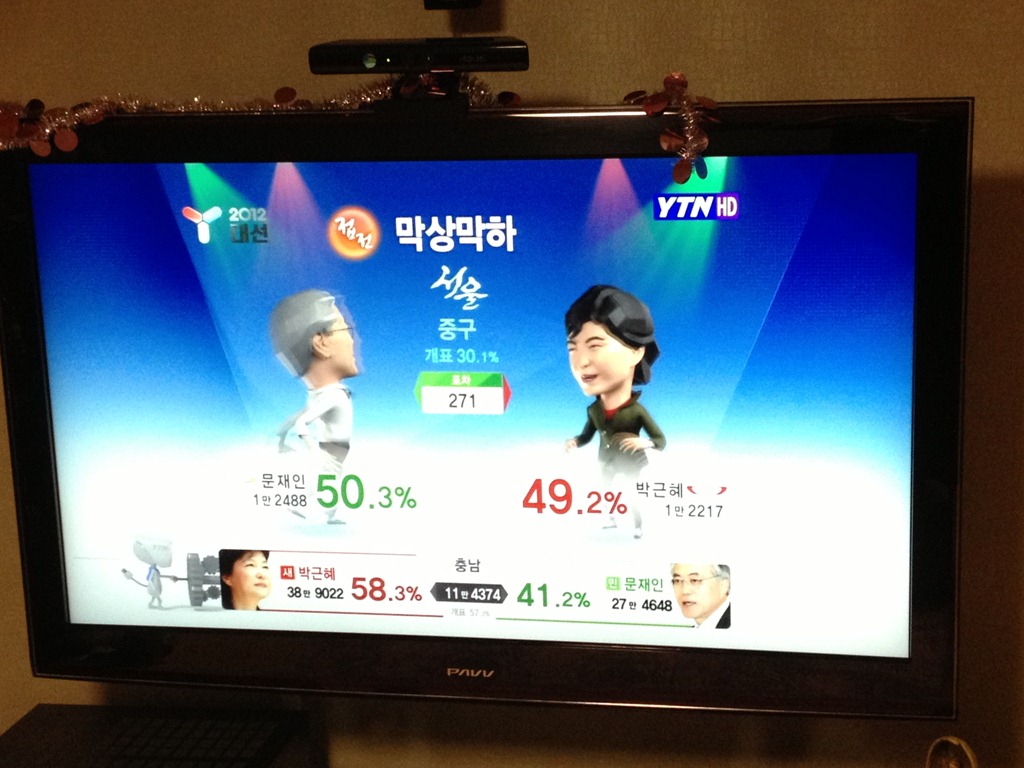
This pic is from the TV election coverage on the Korean version of CNN. That would be the two main candidates (the liberal Moon Jae-In on the left, and conservative Park Geun-Hye, who won, on the right) as dancing electronic cartoon avatars. Yes, they do look like boogying Nintendo Miis, and yes, they are the most bizarre, hysterical election graphics I have ever seen. Who says political science is boring?

So Foreign Affairs solicited me for a ‘snapshot’ essay on the Korean election. Here is the link, but I also thought it might be useful to post my first draft which is fuller:

“South Korea’s next presidential election will occur on December 19. The main candidates are Park Geun-Hye of the conservative New Frontier (Sae Nuri) party and Moon Jae-In of the liberal Democratic United Party (DUP). A third, unaffiliated liberal candidate, Ahn Chul-Soo, dropped out in late November. Ahn had no clear party identification, which was part of his attraction, although he was broadly center-left. A former hi-tech entrepreneur and professor, he was popular with the young who feel alienated by the closed, oligarchic character of Korean politics and for much of the year, he outpolled Moon. Because he and Moon were splitting the anti-Park liberal vote, they tried to merge their campaigns. But Ahn’s hasty, somewhat bitter withdrawal speech implied that old-style, backroom politics by the DUP had pushed him out. Post-withdrawal polls showed Park picked up around one-fifth of Ahn voters, a very strong showing.

Continue reading

5 Fox News Myths about the Fiscal Cliff – and no more ‘Cliff’ Metaphors either, please! stop!

11-30-12-stewart-sg-cropped-proto-custom_2

Does anyone else find Fox News strangely appealing to watch? For some reason I watch it all the time. As ideology that is inadvertently entertaining, interwoven with a veneer of ‘news,’ it’s a freaky, terrifying wonder to behold. It is vastly more interesting – maybe because it’s akin to experiencing an alternate reality –  than it’s-so-bland-what’s-the-point-anymore CNN. Watching Fox is like watching yourself becoming dumber, all while being shamelessly entertained by gorgeous teleprompter-readers and militant American nationalism. It’s like the news + ‘Call of Duty’ + ‘Baywatch.’

As a news station it is, of course, preposterous. Its presentations are astonishingly partisan. Even after 15 years, I am amazed at what Hannity, O’Reilly, etc. can get away with (try here or here in just the last few weeks). It does very little investigative/reportorial work itself. It generally repackages what other outlets have produced or presents lengthy ‘Crossfire’-style opinionating, which is not really journalism. And it’s Michael Bay-style presentations, particularly its graphics and swooping necklines, make the news look like an action movie, not like, you know, the news.

Continue reading

My ‘Newsweek Japan’ Cover Story on Korea’s Economy: De-Concentration Needed

NewsweekNewsweek Japan asked me for a long-form essay on Korea’s economy for its December 5, 2012 issue (cover story to the left). Here is the link in Japanese, but I thought it would be useful to publish the original, untranslated version as well. (If you actually want the Japanese language version, email me for it please.)

The essay broadly argues that Korea needs to move beyond ‘developmentalism’ toward economic liberalism, as a lot of Asia does in my opinion. Regular readers of this blog will see themes I have emphasized before. This was intended for their print edition, so there are no hyperlinks included in the text. Here we go:

“As Korea’s presidential election moves into the home stretch, the local economic discussion is sharpening. Inequality, demographic collapse, massive concentration of economic weight in a few mega-conglomerates, weak consumer purchasing power, growing trade friction over intellectual property rights, and a chronically under-powered small- and medium-enterprise sector (SME) are among the major problems this outwardly very successful economy must confront. Unfortunately, none of the major candidates are pushing the deep reform needed to fix these underlying issues. As with China’s leadership transition, things seem so good at the moment that elites are wary of rocking the boat; as with the recent American election, tough choices will likely once again be kicked down the road. In Korea’s case, that means moving away from its ‘developmentalist’ growth model before encountering troubles similar to Japan’s.

Continue reading

The International Relations Discipline and the Rise of Asia

Buddha

A few months ago, I was commissioned by the International Relations and Security Network of the Swiss Federal Institute of Technology to provide a brief write-up on how Asia’s rise will impact the formal discipline of international relations (IR) within political science. I didn’t get a chance to put it up earlier, and inevitably, the brief means sweeping judgments in just a few pages, but I think it’s a reasonable effort. Here is the version on their website; below it is reprinted:

“It is widely understood that international relations (IR) relies on modern (post-Columbus) and North Atlantic cases as the research base for its general theory. Our graduate students are well-versed in a heavily researched set of cases such as the Napoleonic Wars, World War I, or the Cuban Missile Crisis. While this is arguably ‘eurocentric’ training – white, western practitioners feigning to build ‘universal’ theory from just the cases and languages they know best from their own civilizational background – it might be also reasonably explained by Western dominance of world politics for so many centuries. So long as the West (including the USSR as a basically Western leftist project) so overawed the planet’s politics, then a modern and Atlantic prejudice was perhaps less narrow than it seems. Whatever the cause, this will likely change in the coming decades.

Continue reading