I have been writing at lot here on the growing likelihood that the US will be forced to pull back from its many commitments. So on May 16, I published an op-ed on the issue in the Korea Times. It captures most of my major points. Any comments would be appreciated.
I also thought this blog-post from Walt captured the retrenchment problem pretty well.
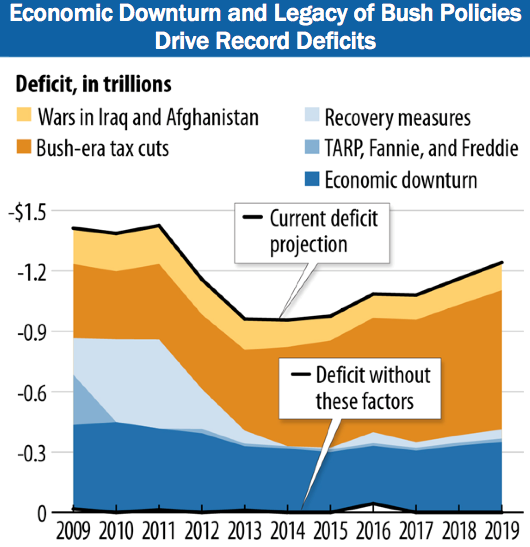
Finally, the graph below gives you a nice breakdown of the current $1.5T deficit. It comes from here:
No one in academia talks this way to undergraduates…
In this website’s continuing tradition of reducing difficult issues to ridiculous YouTube videos (here, here, here ), the above is a nice follow-up to my previous post on teaching the Apocalypse in Asia. Didn’t you know that American academics regularly berate their students’ beliefs, plot against Christians on campus, and openly criticize students’ parents to their faces? Enjoy the above for the ideology, but maybe the director should sit in on an actual class sometime…
Back in the 1990s, I worked for moderate Republicans and donated to GOP candidates; my 1996 vote for Bob Dole for president is still the most heartfelt vote I ever cast. So I still get the occasional right-wing email, and none better than this recent one pitching the movie above:
Fellow Patriot–
I wanted to forward this message about The Genesis Code, the conservative movie of the year! It deals with some important conservative issues that deserve to be discussed: the intersection of faith and science, the right to life, and discrimination against people of faith in American higher education.
When paleontology student Kerry Wells is told by an academic advisor that she’ll need to choose between her faith and her career in academia, she begins a search for truth that will touch the hearts and minds of everyone around her.
Despite the fact that university studies are purported to be a marketplace of intellectual diversity, Kerry’s constant inquiries in class and involvement in Christian campus ministry lead the faculty to consider her unfit for a life of science. Can her determination and academic talents overcome the department’s prejudice against religion?
For the actual website, try here. To be fair, I have not yet seen the film.
For Asian readers, I post this stuff once in awhile just so you have a sense of where the bizarre US stuff you see in the news comes from. I get lots of questions out here like, wth Palin is about, what is up with loopy Tea party, why do Americans think Obama is Hitler, etc. I have warned before that the American Right’s extreme reaction to Obama’s election is delegitimizing America’s global leadership. Why would anyone follow the US when 1 in 3 Americans think Obama is a Kenyan imposter or something? Not only is all the paranoia unnerving in itself, but it has real foreign policy consequences – namely that the rest of the world – which US conservatives claim we lead – thinks we are batty. The above vid is yet another demonstration of the kind of creationist idiocy that Asian science institutions simply would not tolerate.
I also feel compelled to note the unbelievably ridiculous portrait of academia yet again on display in film. That Chinese professor ad (plus Dr. Strangelove, Wargames, and Fail Safe) got people thinking we are fascists; network TV shows show us regularly sleeping with our students; Indiana Jones and Michael Crichton make us into skilled gunmen and adventurers; Bret Easton Ellis thinks we’re lazy druggies (also sleeping with our students); Michael Bay apparently thinks we can rant out authoritarian sexual innuendo without students/faculty noticing or caring; theSocial Network treats us as behind-the-curve prigs; in Animal House, we’re tedious ballonheads; Tom Clancy turns us into lefty traitors; and of course the absent-minded professor is a stock character across media. In the Christian apocalyptica genre, we are written in as postmodern stalinists responsible for tyrannizing our conservative students (while secreting pining to sleep with them presumably) and de-Christianizing America.
Yet none of this even close to accurate; I am still waiting for a movie with professors who actually look and talk like what I know. I’ve been in academia for more than decade and my father’s been in it for 40 years, and I can’t think of one good movie that actually shows what professors really do and how we really interact with our students. Sure, individual professors do dumb things, but I challenge anyone to find quantitative data to support the classical stereotypes listed above, much less the Christian right view that university is some kind of liberal concentration camp. The portrayal of the professor in the media is so routinely inaccurate, I feel compelled to say something, especially to the Christian righties who are convinced we’re tenured atheists stripping patriotism and faith from students. To see what we really do, in all its boring, nerdy scholasticism, take a look at the sort of dry, Tylenol-PM-in-print articles that fill the Chronicle of Higher Education.
The vast majority of our time is spent in fairly mundane office work – meetings, grading, research. Most of the professors I have known take this stuff reasonably seriously, and come to work on time and dressed properly to do their jobs with no more or less level of commitment than other knowledge workers. Yet almost no movie portrayals of academia actually show this; the most realistic portrait of higher education I have seen in the last few years in a film was in Knowing.I have never known a colleague who slept with a student or schemed against them, lost his a glasses on his forehead, got in wild adventures in the field, or fought ideological wars against student groups. The latter can get you in a lot of trouble, as students have grievance recourses the above vid clearly doesn’t show.
Very rarely do we get students coming to our office to simply to talk about ideas and life and what not; the Kerry character described in the third quoted paragraph is extremely rare. Far more common student behavior, and real issues that universities grapple with, are illustrated here or here. When students do come to see us, it is usually some need or grievance: grades (why did I get an F even though I never bought the book?), attendance (can I get the last 4 weeks of classnotes?), recommendation letters (how can I get into Yale on 2.5 GPA?). And we certainly don’t get into personal criticisms and harsh career counseling like in the vid above. The professor’s behavior is shockingly unprofessional, and I dare the director to find real evidence that this is common.
My point is that, yes, we are usually secularist, not Christian, and cosmopolitan, not nationalist. But students almost never come to our classes to fight for God and nation against us. Their needs and concerns are far more banal and everyday. Far more of our interaction with students is coaching them through hard material (I know you loathe the book, but Wikipedia is not really a substitute), trying to professionalize them (you can’t just cut class for a week or two and expect a bailout), begging and pleading with them to read (cliff notes are a high school gimmick you have to give up now), encouraging them to study and not just party away the four years (even though we did that too). It’s a lot more about management, mentoring and helping than about ideology. And if students raise their hand to discuss God and evolution, our response is to rejoice that students want to participate on a meaningful, exciting topic, not to stomp on them like some KGB of atheists.
So please, before yet another insulting, idiot, ideological, or conspiratorial portrayal of academia, someone make a movie that actually looks like college. That would be a real ‘revelation’…
I am happy to announce today that I am partnering with the international politics and economics consulting firm Wikistrat. Wikistrat provides geopolitical analysis, some of it at cost, but it is a good site for readers of this blog. Its foci and temperament are close to mine, so I am pleased to be an affiliate. I encourage you to take a look. Readers will find it more digestible and less theoretical than my writing here, as it is meant for policy-makers and corporate clients (i.e., regular people). So, mercifully, it is not formal IR theory. I will join the Wikistrat family of blogs and analysts that includes most notably Thomas Barnett.
Close readers will note that I cite Barnett probably around once a month here and that he is on my blogroll. I find him an excellent analyst especially of globalization, the US military, and China. His book The Pentagon’s New Map is an well-known interpretation the relationship between globalization and conflict after the Cold War. It has enough IR theory to satisfy the academic in you, while enough policy-relevance that laymen could read it too. Very nice. It was one of those books, like the The End of History or the World is Flat, that caught the zeitgeist well and gets cited all the time (including critically). I can comfortably recommend that book to to any reader of this website. I taught it in class, and the ‘core-gap’ map has become pretty famous.
FULL DISCLOSURE: Besides being a Wikistrat blog affiliate, I am a partner analyst as well, so this is a relationship I believe in. It should be said though that I do receive a small commission if readers click through on the Wikistrat advertisement on this website and then sign-up for its for-pay services. However, there is NO editorial control exerted. The Wiki folks are professional and committed enough to respect and solicit independent input.
For part 1 of my thoughts on the Egyptian revolution, go here.
4. China shot its own people; Egypt has not. Much of the analysis has focused on possible parallels with Iran 1979. But another more recent parallel, especially relevant to this website, is Tiananmen Square 1989. In their moment of crisis, the Chinese turned their guns on themselves, and the PLA (People’s Liberation Army) will be forever stained by the blood of its own citizens en masse. This strikes me as major moment in the evolution of dictatorships. All dictatorships suffer from legitimacy problems, of course, but none want to openly rely on naked force. Militaries are usually the hidden albeit central prop in dictatorships, but they don’t actually want to do the dirty work themselves. That is for the paramilitary thugs and secret police. No officer wants to think the primary enemy of the a state’s military is its own people, not some foreign enemy. Their dignitary and right to rule is based on the whole idea that thy are defending the people, not massacring them; in fact this is the myth of 1952 Free Officers coup in Egypt itself. Hence the call by a dictator in dire straits to shoot the citizenry is a rubicon for any army that cannot be uncrossed. In 1989, the eastern European militaries balked; in China, the PLA did not. My sense is that the social costs to the PLA were lower though, because China is so big. The CCP purposefully brought in rural PLA units for whom Beijing was like another planet. But in small countries like Poland 1989 or Egypt today, army repression in the capital would immediately be felt and transmitted everywhere. So hear, hear to the Egyptian military (I can’t believe I just wrote that sentence). For all its corruption, despotism, and insulation, it still did the right thing when the chips were down. Did anyone imagine even a month ago that we’d be speaking of the moral superiority of the Egyptian military to the PLA?
5. Beyond this evident parallel to Beijing 1989, this is whole things isn’t really that relevant out here. The news media coverage has been thin. The current El Nina cold snap in Northeast Asia has gotten more press time regionally than that Egypt. Not surprisingly the Chinese haven’t discussed Egypt much, but I am disappointed the the Korean and Japanese press seems so disinterested. Initial Korean media coverage focused on the possible loss of ME export markets (groan). From this I would draw two conclusions. First, for all the talk about a flat world, cultural hurdles still matter a lot. The parties caught up in the war on terror (the West, Israel, the Arab/Muslim ME) are riveted by this, but East Asian’s just aren’t, sadly. My experience in East Asia is that locals don’t really care much about the developing world. It’s far away, the languages and religions seem unintelligible, and the societies look backward, especially to East Asians obsessed with development. East Asians worry a lot about the US, and some about Europe, but there is tremendous ignorance of places like Latin America or Africa. Second, I think this disinterest is as much political as it is cultural. Newly wealthy places like Korea or China demonstrate their earned, rightful place in the OECD through an almost purposeful disdain for the third world. Koreans love to demonstrate how worldly they are by spending a year in the US or West; I’ve never met a student or teacher who thought a year a in developing country would be vastly more interesting. (It is.) So Barnett’s ‘new core’ flaunts its new status by forgetting its roots in the third world: disinterest as a mark of superiority.
6. A comment about the commentary: Frank Rich is right that far too few people have any idea what to say on Egypt because so much of the commentary is really about the US (or Israel). This Amero-centrism is why so many are saying the US should do this or that: the working assumption is that that US guides the world and can easily direct events. This is no longer true, so the mountain of US, rather than Egypt, -focused commentary creates unrealistic expectations that we can direct this thing.
Rich also makes the excellent observation that if Americans could actually watch al Jazeera, they might actually learn something about Egypt itself. Instead the mainstream commentary has revealed the embarrassingly nativist ignorance of much of the punditocracy on anything beyond US borders. In general I was very pleased to see how well academics requited themselves in the blogosphere on this; I think especially Walt, Mead, Cole and the Duck of Minerva have been super.
But if you read the op-ed pages, you got recycled banality and the usual suspects: Friedman gave you his typical, ‘this-is-a-defining-moment-in-the-ME’ schtick; Bush neocons desperate for rehabilitation strove to take credit and somehow blame Obama for…what exactly?; Palin blithered; Parker told us that the big story was really about the US media and Cohen that it was about Israel; Colbert King forgot the rest of the world exists; and Beck, well, you already know – just watch the loopy video from part 1. Score yet another point for blogging.
Without the informed blogging voices of people who actually know something about Egypt and revolutions, you really wouldn’t learn much about the events at all. You’d have just gotten an endless series of stories from a royalist, uncosmopolitan press in which Washington was the real story, because that’s all the pundits know how to talk about. Douthat, for example – and whom I think is a pretty good writer usually – clearly had nothing to say, so he just gave up and wrote about Obama yet again under the guise of Egypt. How easy; this is how the press for a nation of untraveled monolinguists infatuated with their own power evolves. Its all about us. By contrast, here is an example of a non-expert, trained in traditional Washington self-obsession, who nonetheless tried.
__________________________
ADDENDA:
The Japan Security Watch (JSW) blog of the New Pacific Institute has taken to cross-posting some of my stuff. JSW is a good review of Japan, and a nice a compliment to my over-focus on Korea and China. They do on a lot on the nuts-and-bolts of hardware and deployment. Mil-Tech junkies on Asia will love it. JSW and I are working on some cooperation in the future. I want to thank them and commend readers to take a look at their good website.
BusanHaps, the big expat newspaper for Busan, SK, has also reposted some of my stuff. I want to thank them too and commend their site. Busan readers almost certainly know it already, but non-local readers will find it a good window on the way expats live here.
Finally, I want to point out that a published version of my remarks on North Korean shelling of Yeonpyeong Island is now available here (RINSA 15) from the Korean National Defense University (KNDU). If you really want to get into the details of SK defense against N, KNDU is the place to go. I want to thank them for soliciting me and thank readers for all the helpful comments that went into the final product.
First, Chalmers Johnson has died. This happened in late November, but the Yeonpyeong shelling captured the attention of my blogging. But given how important he was to the study of East Asia in political science, this should be mentioned here. This is very sad for our field. Two years ago, when Samuel Huntington died, I felt the same way. These guys are what we all aspire to in political science. I can’t think of one thing I have written in my career that I would recommend over an article by someone like Johnson or Huntington. Every time I whine about Asian mercantilism, Johnson’s work is in the back of mind (as is Robert Wade’s). I read Johnson’s Asian political economy stuff in grad school, and I see it living in Asia all the time. That is what our field is supposed to produce – these sorts of durable, well-researched insights that make our world a little more understandable. Very nice, and a genuine loss. (This is why we have political science, by the way.)
To be sure, Johnson jumped the rails in the 2000s with Bush and the Iraq War. I read the Blowback trilogy after the Iraq invasion. The first one is the best, but by the time he gets to the last book and starts musing about a military takeover of the US, you’re wondering if this is the same guy who wrote path-breaking research on Asia. Johnson was in good company though. Lots of other good left-wing foreign policy writers were pushed over the edge by W also; Chomsky and Bacevich spring to mind. Read Michael Lind’s useful deconstruction of how the foreign policy left kinda lost its head over W. But still, I think this stuff is quite valuable. It is a useful check on US neo-con fantasies that unipolarity and American exceptionalism mean rules don’t apply as much to the US as to others. It is hard in retrospect to think the Bush presidency wasn’t a disaster for the US, and Johnson, corrected for overstatement, will tell you why on foreign policy. (For an example, of lefty criticism that maintained better perspective on the Bush years, try here.)
2. Living in Asia means I missed the full coverage of the Wikileaks flap. My sense generally is that they don’t tell us too much we didn’t already know. I think Carpenter gets it about right here, and Yadav gives an excellent IR take here. I would only add 2 things:
A. Occasional random revelations like this might actually serve a foreign policy purpose. They remind others in world politics that for all our diplomatic niceties, we can see right through them and know they are flim-flaming us. This brings a certain (inappropriate to be sure) pressure on these guys to get their act together. It is kinda nice to see the Russians reminded that we are under no illusions about Putin’s closet semi-dictatorship, or for the N Koreans to know that we are thinking about a world beyond their nasty, civilian-murdering slave state, or for Robert Mugabe to know that we basically think he’s bonkers. Secretary of State Clinton is absolutely correct that this stuff should not have been leaked, but didn’t anyone else find it refreshing to hear US diplomats speaking honestly and insightfully? Wasn’t it pleasing to hear US officials trenchantly blow off the world’s buffoons? I was pretty impressed actually at the quality of their off-the-cuff analyses, and pleased to see my tax payers dollars contributing to this work.
B. I worry about the long-term build-up of secrecy in the US government under the cloak of national security. Lefty writers like Johnson or Bacevich will even tell you we live in a National Security State now. A healthy democracy requires openness and transparency. Over time, stuff really should get declassified. It is the property, in the end, of the taxpayers and the voters, because it is our government. Assange himself seems to be drifting toward toward some bizarre hexagonal conspiracy theory stuff, but I am sympathetic to the general notion that the US is too secretive and that the presumptive prejudice in the US bureaucracy should be for declassification unless otherwise demonstrable and clear national security grounds can be established. An Economist blogger captures my concerns pretty well, and of course, the Bush administration, once again *sigh*, is responsible for much of the recent fear of secret government in the US. Greenwald, as usual, nails the hypocrisy of those defending spiralling classification.
3. This is unrelated, but if you haven’t read this description of the 30 worst pundits-turned-hacks in the US, you should. It is a great dissection of everything wrong with journalism masquerading as social science, too frequently in the service of ideology. It is left-biased, but so what. It is punchy, trenchant, humorous, and good warning to everyone with a blog (me too) to do you homework and not just recycle your prejudices. It illustrates one of the great benefits of the Internet – independent bloggers and others can fact check and hit back in real-time. It makes me worry that maybe I recycle stuff here…
The stats helper monkeys at WordPress.com mulled over how this blog did in 2010, and here’s a high level summary of its overall blog health:
The Blog-Health-o-Meter™ reads Wow.
Crunchy numbers
The average container ship can carry about 4,500 containers. This blog was viewed about 17,000 times in 2010. If each view were a shipping container, your blog would have filled about 4 fully loaded ships.
In 2010, there were 99 new posts, growing the total archive of this blog to 220 posts. There were 192 pictures uploaded, taking up a total of 10mb. That’s about 4 pictures per week.
The busiest day of the year was November 25th with 980 views. The most popular post that day was The North Korean Shelling.
Where did they come from?
The top referring sites in 2010 were rjkoehler.com, facebook.com, blogs.the-american-interest.com, en.wikipedia.org, and lawyersgunsmoneyblog.com.
Some visitors came searching, mostly for asia security blog kelly, asian security blog, expatriate tax, robert kelly asian security blog, and stag hunt international relations.
Attractions in 2010
These are the posts and pages that got the most views in 2010.
So last weekend was my first trip to China. As I said a few days ago, actually being there did change my mind a bit. I was pushed a little from the ‘China threat’ to the ‘peaceful rise’ school. I imagine this is natural. Travel humanizes other people and makes one less suspicious…
So here some relevant observations:
1. Tiananmen Square has a Mao mausoleum, just like Red Square has the Lenin mausoleum. I have visited both, and I can genuinely say they are some of the strangest, creepiest political artefacts I have ever seen. You go in well-dressed and walk in silence around the embalmed body kept under glass. (What must they do to preserve it one wonders.) It is like visiting the Vatican for commies. As communist ‘holy relics,’ they are conceptual oxymorons. Russians used to tell me that Stalin killed God, so he took him out of heaven and put him in Red Square mausoleum as Lenin. Communism could destroy individuals religions like Christianity, but not the religious impulse – which of course was a central point in Marxism. These mausoleums, in deifying communist founders, betray a central principle of the movement. On top of that irony, they sell red kitsch of Mao inside the mausoleum. So after you see the Great Helmsman and think Great Thoughts about China, you can buy Mao cufflinks and playing cards in the on-site giftshop. Hah! If that doesn’t make a mockery of the whole point of the mausoleum… Mao is now a tourist attraction, not a communist patron.
2. The Great Wall really spurs the imagination about big, Will Durant-style topics like ‘Civilization vs barbarism.’ It is hard not to be swept away by the romanticism of it all. You can easily picture some Ming guard pacing in the cold night suddenly looking out at some vast swarthy horde like the Teutons from the beginning of Gladiator. The Great Wall is built along dramatic mountain ridges, so it grips the imagination as Hadrian’s Wall does not. It is also more intact and much larger than Hadrian’s.
3. The Forbidden City, like the Winter Palace or Versailles, explains why republican and communist revolutions happen. The opulence is just astonishing. Wow. I was just blow away by how big it was. As you go through, you keep thinking that this court or that room will be the last one, but no, it keeps going and going. The emperor even got his own individual tunnel to exit and enter. (Ie, the place is so huge, that there are multiple giant tunnels through the walls, not just one, and the emperor got one all to himself.) I visited Versailles and Winter Palace as well, and every time I see these megalomaniacal monuments to a ‘sun-king,’ it is easy to see why these guys get tipped at some point and frequently executed. I also think that is terribly hard for moderns raised in a democracy to feel the moral weight of such places. To us, they look more like criminal waste of national resources than the necessary glorification of the unity of man, state, and god in the sung-king’s person, which contemporaries must have seen.
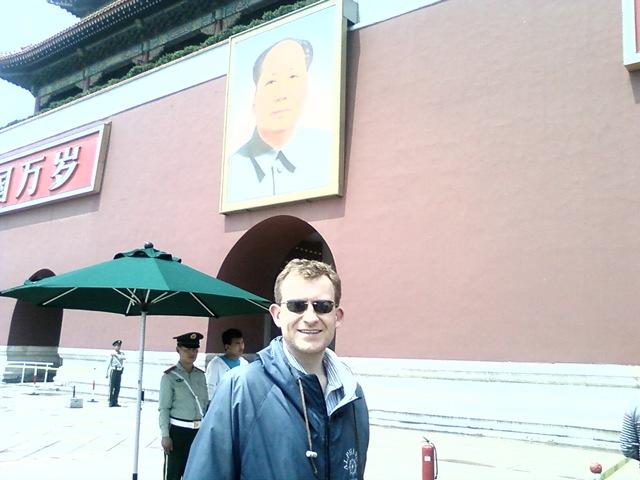
4. The Mao portrait on the Forbidden City is a symbol of communist modernity’s defeat of feudalism. This did not really hit me until I went there. Once you see the size of the Forbidden City, and then the huge portrait placed right on top of it, you get the idea. How ironic then that China is now digging around in its history for its post-communist nationalist identity. Chinese language institutes are called the ‘Confucius Institute,’ even though Mao loathed Confucius as a reactionary. Communist modernity failed, so now China’s feudal past is being reworked as a tourist attraction and cause for nationalism.
5. You can see the two Chinas phenomenon everywhere. Any rapidly developing state is going to have this kind of social fracture, as the young and globalized pull away from the older and traditional. This is happening in India right now also. You can see the older parents – smaller, worse teeth and skin, plain clothing – and the increasingly US teenager-looking kids in bluejeans and t-shirts. This must be quite a culture clash in the home, and it makes me wonder if that is the reason China emphasizes harmony so much. The social cleavage is wide, and both sides have strong claims. The young represent the future and wealth of China; the old built the place (however mixed that accolade might be) and are deeply vested in the party-state that ended the ‘national humiliation.’
6. China’s scholars are reveling in big talk about the changing balance of power. At the conference I attended at the China Foreign Affairs University, speaker after speaker made sure to tell us how China was rising and the US needed to make room for China’s ‘legitimate interests.’ I heard this a lotlast year too, but this time I was on the home-turf, so it was even more self-congratulatory than before. At one point, I just couldn’t take it anymore, and got into a major scrap over the Cheonan. I told them everyone in SK knows that China is propping up NK. The response was more obfuscation – maybe the ship hit a rock, we need ‘calm’ on the peninsular. Bleh…
About 8 months ago, I wrote that the notion of a ‘Confucian Peace’ was probably wrong. I thought that usually common cultures inspire competition for dominance. Like envies like. We save our greatest passion for inquisitions not crusades. We would rather punish errant insiders in the name of purity than hazy outsiders we can easily classify as ‘barbarians’ and forget about it. I figured Christians massacred each other for centuries over tedious doctrinal issues despite a New Testament ethic to turn the other cheek. So I figured the Confucian Asians (Japan, China, Korea, Vietnam) would be the same way.
But when I actually did the research it really turned out wrong for Confucians. While it is correct that Christians were hypocrites regarding ‘Christendom,’ Confucians generally were not among themselves. This does mean that Confucians states did not war. Like the Democratic Peace, a Confucian Peace posits only that Confucians don’t war on each other, not that they forgo war altogether. Below is the abstract and two of the graphs. If you want the whole paper, please email me. What is most important is the Confucian ‘peace score’ in the bottom table: one two-month war in 195 years of Confucian diplomatic history. That is quite striking compared to 92/151 war years for Christendom.
“International relations theory about East Asia has increasingly argued that East Asia before Western penetration enjoyed a protracted peace. As explanations, a Chinese military hegemony would fit IR theory fairly well, while a cultural peace based on shared Confucian norms would be a significant anomaly. A Confucian long peace challenges widely-held, albeit Eurocentric, IR presumptions including the perils of anarchy, the arms-racing and misperception of the security dilemma, and the regularity of power balancing. This paper therefore investigates, first, whether such peace did in fact exist, and, second, whether this might be attributed to Confucianism. A cultural peace theory requires a strong anti-war cultural norm and a shared sense of community. Skepticism is established by examining 3 comparative cultural spaces that nonetheless did not enjoy a culturally informed peace: the classical Greek city-state system, early modern Christendom, and the contemporary Arab state system. All were deeply riven and competitive. Nevertheless, empirical investigation of the last Chinese (Ching) dynasty before the Western arrival (1644-1839) demonstrates that it was remarkable peaceful toward its Confucian neighbors, while more ‘normally’ exploiting its power asymmetry against non-Confucian ones. Process-tracing specialized Chinese practices toward fellow Confucians suggests the low Confucian war finding emanates from cultural restraint.”
The Koran, Talmud, Analects, and KKV have just been replaced as holy writ. Wow. You’ve never seen anything like this before. Save yourself a pile of money and application headaches for grad school. Just read this instead: http://www.isacompendium.com/public/. It is a crushing $3,000, 4,000 pages , and 12 hardback volumes!
Thankfully, if you belong to the International Studies Association, you can read the articles for free. Even more important, the articles tell you at the bottom how to cite them as e-articles. So thank God you don’t have to try to track down a paper copy of the set to get the page numbers. I can’t imagine if anyone is actually going to buy it.
I perused the index – a lengthy reading project in itself. This is basically an IR grad education in a can. Really. If you entered your first year of grad school, and read nothing but this all year, you’d get an ast0nishing education. I think it would be absolutely thrilling to just read this cover to cover as one’s first step into serious IR. It looks that rich, comprehensive, and well-written.
PS: if you want the short-version of IR in a can, try here. It’s excellent too.
The Duck of Minerva is one of the better international relations theory (IR) blog out there. You should read it if you don’t already. Its name is a riff on Hegel’s famous comment that the “owl of Minerva” only flies at night; i.e., wisdom only comes in hindsight, or more specifically that philosophy can only understand an age or civilization as it passes away. I don’t quite get the joke behind the title ‘duck of minerva,’ but whatever – it’s quality IR blogging.
Rodger Payne had a post two days ago on the continuing IR back-and-forth over The Hurt Locker (HL). Payne links to the relevant other IR posts on the film, including my own. Payne notes that I and others have found many problems with the film’s much-celebrated ‘realism.’ My own sense is that the lead character, Staff Sergeant William James, probably would have gotten himself or his associates killed a lot earlier through his overt recklesness. That, and the bizarrely out-of-place and unbelievable desert-sniper sequence, do a lot to reduce the film’s credibility as a portrait of the Iraq War. Michael Kamber summarizes.
Payne counters that, while Kamber and I are correct, that’s beside the point. HL’s strength as an IR film is as a metaphor for US foreign policy more generally since the end of the Cold War, and especially in the Middle East. Money quotes:
The U.S. too has a long and mostly successful military record — and it too has been incredibly lucky. Like James, the U.S. returned to Iraq after a successful first effort in 1990-91… To its critics, the U.S. too is a reckless showboat, willing to take incredible risks with other peoples’ lives, even as it claims to be “saving” them.
In political debates, Americans focus on U.S. forces, casualties, and experiences. Few consider the implications for Iraqis and the wider Middle East… The FUBAR narrative works pretty well to explain the actual U.S. experience in Iraq. The lead character’s addiction to war, recklessness, luck, inexplicable behavior, and need to “save the day” reflect an unsavory, but nonetheless viable, portrayal of American identity.
1. Ok. I don’t really disagree with any of that, but I think it is a reach, a generous overreading that sorta lets the film off the hook. Is Bigelow really giving us the arc of the erratic, poorly-planned Operation Iraqi Freedom in the story of one soldier? Do we really think Bigelow had something this profound in mind? Francis Ford Coppola did when he made Apocalypse Now. He went to Cannes and famously said “We had access to too much money, too much equipment, and little by little we went insane.” That’s going for the big view. But Bigelow’s schtick has been that this is the first realistic film portrait of the Iraq, and that is how it has been received. The problem, as I argue, and Payne admits, is that it’s not that. I certainly agree that the US use of force has drifted toward recklessness since the end of the Cold War, and Payne is dead-on that US audiences love cowboy-style swaggering heroes, but the film is so pointedly apolitical, that it is hard to see James’ swagger as America’s. Maybe, but I just don’t see that in the film itself…
2. Given the film’s ‘reality problem,’ in round 1 I suggested that one alternative is to read the film as a memoir of battlefield stress for the US warfighter in the GWoT. The film goes out of its way to suggest that James is motivated by the narcotic effect of combat, so I think this better fits the small-scale of the film than Payne’s ‘big think’ approach. The problem with my interpretation is that Bigelow unfortunately does not develop this much beyond the initial thought. So we see James at home, bored with his alienated ex-wife. This is supposed to suggest that James misses the thrill-ride (!) of Iraq. But lots of us have had relationships and family lives that go bad, so this was rather weak. Much more convincing would have been imagery of James as an addictive personality. Scenes showing him struggling with drugs or alcohol would have really shoved the ‘psychology’ interpretation of HL forward, because you could see James substituting one thrill (Iraq) for another (booze, perhaps). Instead, Bigelow lets herself wander into a series of unconnected vignettes, like the sniper story, while the audience waits and waits for a theme to hold it all together.
3. HL’s rise is function of ‘intelligence guilt’ over the success of Avatar, plus the American desire to finally have a good GWoT film, not its inherent quality. It is fascinating how this film has grown from an indie joint into a Best Pic taker, and now faces a growing pushback from foreign policy types.
Initially almost nobody saw HL. It grossed a measly $12.7M. Avatar made more than that just here in Korea; its global total is now a staggering $2.2+B. HL was neither in theaters nor DVD here; I had to import it. So if it can’t make it to the world’s 13th biggest economy, did anyone see it beyond the US, Canada and Western Europe? Do we have any idea what Arabs/Iraqis particularly thought of it? Audience attendance is no great mark of quality, but still, without the critical buzz of the last two months generating an anti-Avatar Best Pic vibe, we wouldn’t even be talking about this film. Remember that it was originally released in Italy in October 2008, and for the next 14 months, almost no one saw it. Christopher Orr summarizes.
We all knew that Avatar was shallow, but we swooned for its astonishing GCI, arguably the biggest visual leap since Star Wars. But when the hangover hit in the month before the Oscars, the Academy needed something to suggest we weren’t so fluffy. Nobody wanted Cameron to take two Best Pics for childish stories wrapped in pretty colors. So, given 2009’s poor Best Picture choices, HL became the default anti-Avatar. Call it penance for giving the 1997 Best Pic to Cameron’s Titanic instead of the far more deserving LA Confidential; snubbing the King of the World this time buffs the Academy’s credibility. So HL rolled through the awards season, culminating in the Oscar that will insure it shows up on lots of IR syllabi in the future.
But now that the film is on our radar, the serious critical work is coming in, and the verdict, as this thread, indicates, is a lot more mixed. The irony is that a good Iraq pic does already exist – Generation Kill. Where is that much better, more accurate portrait in this whole debate?








 Robert E Kelly
