The International Relations Discipline and the Rise of Asia

Buddha

A few months ago, I was commissioned by the International Relations and Security Network of the Swiss Federal Institute of Technology to provide a brief write-up on how Asia’s rise will impact the formal discipline of international relations (IR) within political science. I didn’t get a chance to put it up earlier, and inevitably, the brief means sweeping judgments in just a few pages, but I think it’s a reasonable effort. Here is the version on their website; below it is reprinted:

“It is widely understood that international relations (IR) relies on modern (post-Columbus) and North Atlantic cases as the research base for its general theory. Our graduate students are well-versed in a heavily researched set of cases such as the Napoleonic Wars, World War I, or the Cuban Missile Crisis. While this is arguably ‘eurocentric’ training – white, western practitioners feigning to build ‘universal’ theory from just the cases and languages they know best from their own civilizational background – it might be also reasonably explained by Western dominance of world politics for so many centuries. So long as the West (including the USSR as a basically Western leftist project) so overawed the planet’s politics, then a modern and Atlantic prejudice was perhaps less narrow than it seems. Whatever the cause, this will likely change in the coming decades.

Continue reading

Guest Post: Dave Kang: “Is America Listening to its East Asian Allies?”

china choice

REK, Ed.: Regular readers will know that I like Dave’s work a lot. He’s been a good friend and mentor to me in this area. I am pleased to post a longer, fuller version of a book review he wrote for CSIS. My thanks to CSIS as well. If you aren’t reading Dave yet, you should be.

“Is America listening to its East Asian allies?: Hugh White’s The China Choice

David C. Kang

For all the recent attention on increasing tensions between the U.S., China, and East Asian countries, regional balance of power dynamics remain muted. The past few years have seen increased Chinese assertiveness, which has led many to expect that East Asian states will flock to the side of the U.S. This has not proven to be the case, however, and Hugh White’s thoughtful and bold new book, The China Choice: Why America Should Share Power, provides some clues as to why not. White argues that neither China nor America “can hope to win a competition for primacy outright, so both would be best served by playing for a compromise.” White concludes that the best policy would be an explicit “Concert of Asia” in which the U.S. and China agree to treat each other as equals and create two clear spheres of influence. White is probably right that a U.S. balancing strategy in East Asia is unlikely to succeed – yet a concert of Asia with two clearly defined spheres of influence would appear fairly similar in the eyes of East Asian states. East Asian countries are clearly hoping to find a pathway that avoids taking sides, and the best approach for the U.S. to take is a strategy that helps them achieve that goal.

Continue reading

VP Debate once again tells Asia & the World that all We care about is the Middle East

Yes, it’s partisan, but it’s a somewhat useful deconstruction


First, I included the above video to reference a point I tried to make last week – that Romney flip-flopped so much in the first debate that I no longer have any idea what he thinks about the big issues of campaign. I just wish I knew wth Romney wants to do with the presidency. There has to be some purpose, some reason to vote for him, and I can’t find it. Someone tell me in a few coherent, specifics-laden paragraphs why I should vote for him? Not why Obama is a bad president – I know that already – but why Romney should be president. Honestly, I don’t know, which makes his presidential run look like a vanity project or something.

Second, did anyone else think that the vice-presidential debate once again broadcast to the world that our foreign policy is dominated by the Middle East? It was all about Iran, Syria, Libya, and Afghanistan. Obviously, these are all important places and issues. But it doesn’t take a lot of foreign policy training to know that Russia’s ever-more erratic course under Czar Putin, a possible euro-EU meltdown, or China are a lot more important to the US’ future than a bunch of small, poor fractured states in the Middle East. But no, let’s argue once again about Israel, Iran, terrorism, Iraq…  Good grief. There are other issues out there!

Continue reading

Going to IQMR – Some Summer Asian Security Reading – Back in August

CQRM

I am off to the Institute for Qualitative and and Multi-Method Research for their summer training at Syracuse University. Take a look at the syllabus. Whoa. ‘Can you spell ‘Bayesian hermeneutics’ correctly, little Johnny? No? Me neither!’ But the preparation looks great for qualitative-types like me. I must thank Colin Elman and Andrew Bennett for taking me. The people in that pic look so much more lucid and intelligent than me, that I think they must have read the wrong file or something. I hope they don’t bust me playing ‘Halo’ in the back there…

If debating multicollinearity doesn’t sound like fun (yeah, I don’t really know what it means either, but I think it’s bad), then here is my regular list of good reads from the last few months before I go on break:

Continue reading

Ranking US Allies: A Response to Stephen Walt, Andrew Sullivan & all those Canadians…

Who knew Canada could be so controversial…


Ok, this has gotta be my last response to the many comments from this sprawling series  (one, two, three, four, five) of posts on ranking US allies. Thanks for all the interest. Who knew Canada was so interesting or Canadians so passionate?

I’d like to thank Stephen Walt (whose blog I think is the best in IR) for linking this debate, and Andrew Sullivan for linking me twice. If you aren’t reading Sullivan yet, you’re at the wrong website. Thanks too to all those Canadians who came out of the woodwork to defend its boring relevance. Finally, who could fail to thank a website disturbingly entitled  f—-dgaijin.com?! (Yes, that’s the actual name; check it out for yourself; at least these guys know where we resident-foreigners stand in the East Asian racial food-chain – at the bottom.)

So here are some final thoughts on the many comments, but especially Walt and Sullivan:

1. I accept the arguments from several commenters that Turkey should be on the list. So here is a final list, a ‘top 12’ of US allies in order: Canada, Mexico, Saudi Arabia, Taiwan, India, Indonesia, Israel, South Korea, Japan, EU/NATO, Egypt, and Turkey.

2. I was please to see that Sullivan flagged – not necessarily approved, but just noted – my argument for Indonesia as America’s most important bridge to the Muslim world. I realize this is kinda off-beat, given that the ME is what dominates our perceptions of Islam and where Islamist pathologies are worst. (Here is a critic, a neocon perhaps, calling me ‘delusional’ for ranking Indonesia this way.) So here is a quick defense, more or less along the lines of what Secretary Clinton said a few years.

Indonesia is a syncretic model of pluralist Islam and politics; I think this is pretty widely accepted. No, it’s not as modern and liberal as we might like, but by the standards of the region, other developing countries, and the OIC, it is a paragon. Let’s be honest about that. It could easily be far, far worse (think Pakistan), which is why I find it unfortunate that we don’t pay attention much. We should not let the perfect be the enemy of the good, and a friendship with Indonesia doesn’t mean avoiding tough issues, just like engaging China doesn’t mean we should ignore human rights and other similar issues.

So in its own imperfect, struggling way, Indonesia represents the future of political Islam (speaking very broadly to be sure), not the past, which is a lot of what the ME represents and what Arab Spring is trying to break. If the flat-earth religious elites of places like Iran, Pakistan, or Saudi Arabia are allowed to dominate the global conversation on Islam, more conflict is likely. By contrast, Indonesia offers a possible model for Islam to live with both democratic politics and religious pluralism. That we should vigorously support such an effort, through some kind of alignment, strikes me as so self-evident, that I am amazed that we never talk about this.

Continue reading

More on US Allies (2): A Response to My Critics

The_world_seen_from800

I found the above image here.

Here is part one of my response to two recent, heavily-trafficked posts (one, two) on hypothetical retrenchment under Ron Paul. (So yes, that makes 4 total posts, including this one.) I got some flak on how I ranked US allies in order of importance, with the implication that those further down were more likely candidates for a diminished American commitment. So rather than responding point-by-point, here are some broad responses on specific countries.

My original ranking, in order, was: Canada, Mexico, Saudi Arabia, Taiwan, India, Indonesia, Israel, South Korea, Japan, EU/NATO, and Egypt. (That’s actually 11, not a ‘top 10,’ because I originally put Canada and Mexico in together at # 1.)

1. I was surprised how much controversy my choice for Canada at # 1 provoked. I thought that was pretty self-evident actually. (Stephen Walt, in a riff on my post, says pretty much the same thing.) Just because Canada is quiet and boring (in a good way) doesn’t mean it is not existentially important for the US. (This same logic, boring ≠ unimportant, applies to my choice for Indonesia. The very fact the Indonesia is a moderate Muslim state is why no one cares about it, but that is a good thing! I guarantee you that if Indonesia had nasty salafists running around like in the ME, we’d all be talking about it.) The US trades the most in the world with Canada. We expect Canada to come with us on just about all our foreign ventures. Its cooperation provides crucial symbolic value: if the country most like us in the world can’t agree with us, then we must be doing something wrong. And most obviously, its security is a direct concern, because of the border. In fact, given that the border is something like 3x the length of the US-Mexico border, Canada easily beats every other state in the world for the most basic US national security concerns.

2. Japan (#9): A good commenter noted that after WWII, the US wanted to make Japan into the ‘Switzerland of Asia,’ and that we are reaping what we sow. Absolutely. I do think Americans send mixed signals to allies. We don’t want them taking an independent line, we want them to do what we say, but then we complain that they free-ride. As I argued in the OP, all this US commitment ‘infantilizes’ US allies by not forcing them to deal with their own regional issues. But Americans, or rather the neocon-liberal internationalist elite synthesis that dominates US foreign policy discourse, ultimately accept weak, dependent allies, because we are in love with our own hegemony. It fires our imagination to compare ourselves to Athens, Rome, or Britain. Neocons read Pericles’ Funeral Oration or Gibbon, and they tear up that America too is the noble, tragic ‘weary titan,’ carrying the great orb of its world-historical task of spreading democracy. Americans thrill to that kind of ‘national greatness’ pseudo-metaphysics while Europeans roll their eyes in disillusionment and Asians wonder wth we are even talking about. So yes, free-riding is pretty obvious to see, because we abet it.

Continue reading

Korea 1997 & the Greece mess today

Flag-Pins-South-Korea-Greece

Here is a good article on Korea and other near-defaulters or defaulters, and what lessons they might have Greece now. Greece can in fact recover if it leaves the euro, and increasingly, I think both it will and it should. However, one important element Greece should not pass up, is using the crisis to force discipline on the parts of the economy that caused the currency run to begin with. The Korean government was partially able to discipline the out-of-control chaebol who had caused the crisis by wildly over-borrowing on Wall Street in the mid-90s. Koreans hate to hear it, but their political economy got substantially cleaner and less corrupt because of the 1997 brush with default. Greece should do the same; it should not leave the euro just so it can go back to its bad old ways. That would be a catastrophe and turn Greece into a prototypical Middle Eastern patronage state.

Continue reading

China’s Counter to the Asian ‘Pivot’ (2): ‘Swarms’ in the Pacific

china-us-economic-warfare

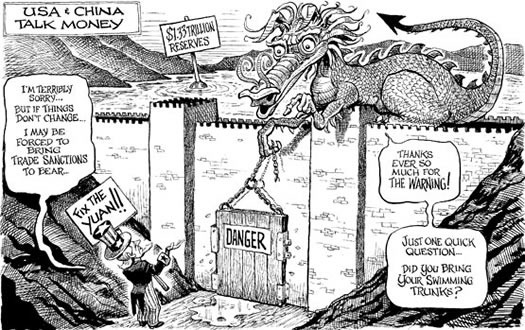
Part one is here, where I noted China’s growing fear of encirclement (I get Chinese students a lot who talk about this). So, in the role of China, I argued for an Indian charm offensive to prevent encirclement, and how China might buy off Korea from the US camp by abandoning North Korea. Here are some more ‘B-Team’ style ideas for pushing back on US local dominance, including swarming the US navy in the western Pacific with cheap drones and missiles:

Continue reading

It’s Time to De-Russianize the BRICS — UPDATED (twice): Response to My Critics

UPDATED, March 22, 24: This post got a lot of traffic, due to Andrew Sullivan’s citation of it. Thank you to all those readers coming for the first time; please come again. The criticisms levelled here have been similar to those made at the Duck of Minerva, where I also blog. It seems there are three main critiques, although you may wish to scroll further down to the original post first: 1. I exaggerated; Russia is still a great power. 2. I didn’t provide enough data and links. 3. I don’t really ‘get’ Russia, or I’m just recycling western propaganda.

(In passing, I find it both curious/frustrating as an author that what I think is my more creative and fresh work in the last few months [this or this series] didn’t get nearly so much attention, whereas lamenting Russia’s postimperial decline, which so many have done before me [see all the links below], got an explosion of interest. Not quite sure what to make out of that…)

1. I overshot in saying Russia isn’t a great power anymore.

Ok, but not by much. I’ll agree that it was probably gratuitous to call Russia a ‘joke’ as a great power. But then again, be honest with yourself and tell me you didn’t laugh: when Putin rode around shirtless on horseback, when Putin stage-managed a discovery of ‘antiquities’ while scuba diving, when Putin claimed the State Department and Secretary Clinton were fomenting the Moscow protests, when Zhirinovsky “backed free vodka and the reconquest of Alaska,” when the president fired a minister on live TV (!), the minister refused (!!), and Medvedev responded with farcical lecture on Russia’s globally-regarded ‘constitionalism’ (!!!). Or just read this from Gawker on the Putin the crossbow-toting whaler and tell me you don’t burst out laughing – over a head of state with superpower pretensions?

These are the sorts of howlers and hijinks we expect from leaders like Qaddafi, with his retinue of female ‘bodyguards,’ or Idi Amin, with so many gold medals on his uniform you could store it in a bank vault. But modern states, desirous of global prestige, seeking to be taken seriously at the highest levels of the game, just don’t do this stuff. Could you imagine Wen Jiabao doing he-man photo-ops? You’d laugh, right? Well… Putin’s become a punchline, regardless of Russia’s other strengths, which is ultimately what motivated the original post.

As Niall Ferguson put it last December, “Russia—who cares? With its rampant voter fraud and declining population, the country is careening toward irrelevance. …Russia isn’t quite “Upper Volta with missiles”—West German chancellor Helmut Schmidt’s immortal phrase. But it’s certainly a shadow of its former Cold War self. The U.S. economy is 10 times larger than Russia’s. Per capita gross domestic product is not much higher than in Turkey. Male life expectancy is significantly lower: 63, compared with 71 on the other side of the Black Sea. And the population is shrinking. There are nearly 7 million fewer Russians today than there were in 1992. By 2055, the United Nations estimates that the population of Egypt will be larger. Remind me: why did Goldman Sachs group Russia with Brazil, India, and China as the “BRICs,” supposedly the four key economies of the 21st century? Give me Turkey or Indonesia any day.” That’s exactly right (I know people think Ferguson is a neo-victorian apologist for empire, but hold that thought),  and it should deeply worry and embarass Russians that the rest of the planet thinks this way about one of the world’s great cultures. I wrote something similar last fall when Putin announced his re-taking of the presidency, and the whole world shrugged.

Here is more from the Duck of Minerva comment section:

“My interest was more developmental than realist-theoretical. On re-reading the post, it was a bridge to far to say that Russia isn’t a great power anymore. It still is, by the skin of its teeth. Nukes compensate for other areas of decline, I suppose, as you are suggesting. De Gaulle saw this, as did N Korea.

My real goal was to developmentally differentiate between Russia and the other BRICS. That BRICS moniker is to imply some level of cosmopolitan comfort with the modern world economy and rapid growth to greater weight within that economy (hence my reference to Parag Khanna). The other 4 BRICS capture that upward trend – as do other economies like Turkey, S Korea, Mexico, or Indonesia (hence my preference for Khanna’s term ‘second world’). But Russia really doesn’t. Russia is slipping, not rising and has been, more or less, since the late 1970s. That’s quite a hegemonic decline. Its internal rot is pretty severe now. Its Transparency International score in 2011 is a staggering 143 out of 182, putting it in the company of Nigeria, Belarus, and Togo, and obviously calling into question not just its BRIC credentials, but its great power ones too. And the shirtless one’s return puts off a turn-around for another six to twelve years. Given that China rose to the ‘G-2’ in just 30 years, 20+ long years of Putinism (after 10 years of Yeltsin chaos plus late Soviet stagnation) portends a disaster for Russia. This is the real reason for the Moscow protests. They see this now.

Rotation at the top is just one marker for BRIC normalization, but other obvious red flags include the relentless xenophobia of the Putin regime, the alienation from the WTO, the huge missed opportunities of globalization, the blow-out levels corruption and state capriciousness including the murder of journalists, the third worldish reliance on carbon and weapons exports, the 19th century ‘spheres of influence’ obsession with countering the West in Eurasia, the confiscatory attitude toward private wealth most obvious displayed in the Khodorkovsky case, or Putin’s laughably ridiculous throwback-to-Kaiser-Wilhelm bravado of hunting on TV with a crossbow or fighting stage-managed martial arts contests. Does that sound like a BRIC or Khanna’s ‘second world’? Not really. It sounds like Venezuela or Iran. It sounds like an angry, Weimar-style pseudo-democracy high on petro-dollars with a ‘postimperial hangover,’ as Vice-President Biden once put it. Hence the argument that BRIC/second world is the wrong developmental category for Russia. For more of this, ‘should the R be taken out of the BRICS’ debate, try here and here. For a similar write-up on how Putin’s return will critically aggravate so many of Russia’s outstanding problems, try here.

2. I didn’t provide enough data.

Ok, so here you go. It’s pretty easy to find. Please read the links above and these below. From the Duck:

Actually there’s lots of data on this that’s pretty easy to find with Google. I suppose I should have included more links orignally, but I thought a lot of this was common knowledge at this point. But here you go; all the following links come from the last few years:

a. On demography, I was thinking of Nicolas Eberstadt’s work. He’s been writing on this for a long time now, most recently November 2011 in Foreign Affairs. His title, ‘The Dying Bear,’ is pretty blunt about the population contraction. For more, try this.

b. On corruption so high, it’s incommensurate with being a great power, here’s that Transparency International score again.

c. It is downright heroic, if not irresponsible, to suggest that alcoholism is not a huge problem in modern Russia and severely impacting men’s health and mortality: here or here. Just look at those estimates of average male lifespan – around 60! Gorbachev even thought alcoholism imperiled the very existence of the USSR and launched a major government campaign against it.

d. On the brain drain, try here.  Note the big listed reason – problems with the Putinist regime – and their profile: “vast majority of those who admitted wanting to leave were under 35 years old, lived in a major city, and spoke a foreign language.”

e. On the economic overreliance on carbon and how weak the economy really is under the hood, try this from the Financial Times just today. More generally try this and this from the Economist how post-‘reelection’ dysfunctional.

For what it’s worth, this wasn’t intended to be ‘anti-russian gloom and doom.’ I studied in Russia for a bit and spoke it reasonably well once; I’d like to think I am sympathetic. But simply denying Russia’s internal decay is not really a response – as the Moscow protestors themselves understand.”

3. I am not sympathetic enough to Russia’s unique condition/I’m just spinning western propaganda.

Maybe, but I did study there for a bit, and I could speak the language pretty well once. And none of that really changes how Putin is dragging Russia down.

From the Duck:

“On my empathy, try this, which I wrote in 2009, long before this flap. I noted how Americans vastly underestimate how much Russia did to win the Second World War and that our Spielbergian self-congratulation leads us to overlook the huge suffering of Russians at the hands of the SS: “I didn’t really realize this much until I went to Russia to learn the language and travelled around. The legacy of the ‘Great Patriotic War’ is everywhere. Everyone lost someone, and frequently in brutal circumstances Americans can’t imagine. Every Russian guide you get will tell you how Americans don’t know much about war, because we were never invaded, occupied, and exterminated. The first time I heard that, I just didn’t know what to say. You can only listen in silent horror as the guides tell you about how the SS massacred everyone with more than a grammar school degree in some village you never heard of before, or how tens of thousands of those Kiev PoWs starved or froze to death because the Wehrmacht was unprepared for such numbers and the Nazi leadership just didn’t care.” Please note that a Russian even graciously commented there about how rare it is for Americans so say stuff like that. I did study in Russia; I did have friends there; I do have some language and culture skills. So I’d like to think of myself as a sympathetic critic. My real concern is that Putin’s awful misgovernment of Russia is pushing it towards irrelevance, per Ferguson above, and as I think the protestors intuit. Putin has become a global laughingstock, and he’s pulling Russia down with it.

I don’t disagree that Russians have deep social energies that we miss by focusing on Putin and the Kremlin, but one could say that about almost any country. Most peoples like to think of themselves as proud, energetic, innovative, unique, etc. Americans love to call themselves exceptional, and Koreans regularly tell me how the ‘miracle on the Han’ proves how Korea is the most awesome, cohesive, energetic, team-work society in the world that can overcome anything. Ironically, the most consequential grassroots/civil society movement in Russia is the anti-Putin protests, which fits my argument.

Finally, you raise an interesting question about whether all the issues I discuss combine into real momentum for decline. I wonder how that could not be the case, unless the leadership changes. Russia’s traditionally been a top-down place. It’s hard to see turn-around coming from below. (Again, this is why the protests are so important; they’re trying to change that.) Russia’s been slipping for three decades now. I agree it hasn’t fallen off a cliff, like, say, the end of the Ming dynasty or something, but a generation’s worth of negative trends is slowly chewing away at Russian power. I have stepped back from the original statement that Russia is not a great power; that was overreach. But the margins are narrowing.”

———————–  ORIGINAL POST ——————————————-

With Putin’s ‘return’ to the presidency, Russia is now officially a joke as a serious great power state. True, Putin has been ridiculous for awhile, what with those shirtless photo-ops that came across like desperate, bizarre geopolitical ‘ads’ that Russia is still a superpower. But this is different. Not even Chinese elites play the sorts of merry-go-round games at the top that Putin has engineered in the last 6 months. To their great credit, Chinese presidents and premiers serve and go. Russia is now the only one of the BRICS in which power does not rotate. Instead, Putin is starting to look like one of those oil-rich Arab dictators who never leaves, continually gimmicking the the ‘institutions’ and ‘constitution’ to justify how, mirabile dictu, he keeps staying in power. In the meantime, the real power structure morphs into an oil-dependent, rent-seeking, cronyistic despotism. And like those Arab dictators, Putin is facing a local resistance that increasingly realizes that Putinism is taking their country nowhere but nest-feathering. To paraphrase Helmut Schmidt, Russia’s pretty much a petro-state with nukes at this point.

Continue reading

The US will not ‘Pivot’ much to Asia (3): We can’t afford it

Pesident-Obama-China-001

Please read parts one and two first, where I argued that there is no constituency in the US for the pivot, and that Asia is so culturally distant from the US, that Americans are unlikely to care enough to sustain the pivot. But we also don’t really need to pivot, nor do we have the money for it:

3. The Middle East is characterized by so many nondemocracies that the US must be heavily invested (at least to meet current US goals – oil, Israel, counterterrorism). Katzenstein noted this; America has no strong subordinate anchor-state in the region (like Germany in Europe and Japan in Asia). This is why the GOP particularly emphasizes an enduring, semi-imperial presence in the Gulf. Besides tiny Israel, we don’t have the friends necessary for things like the dual containment (Iran and Iraq) of the 90s, and or the Iraq war of the 2000s. So we have to do it all ourselves.

By contrast in Asia, we have lots of allies and semi-friends who are strong and functional – Japan, Australia, Korea, and Taiwan most obviously – with improving relations with India and Vietnam too. Now, if we are smart – or maybe just because we are broke – we can push a lot of the costs of our goals onto them. Specifically, much of the pivot has been assumed to be targeted at China. But why should we encircle, contain, or otherwise provoke China, when the frontline states should be it doing it first? In other words, we don’t have to pivot toward Asia unless China threatens to invade everybody, because places like India, Korea, and Japan will work hard to build and maintain a multipolar equilibrium. They don’t want to be dominated by China, and they will suffer a lot more than we will if China becomes the regional hegemon. So we can hover in the background, offshore, over the horizon, as we always have. Given the strength of liberal democracy in Asia (unlike the ME), there is no need for us to be there in strength.

Continue reading