Please read parts one and two first, where I argued that there is no constituency in the US for the pivot, and that Asia is so culturally distant from the US, that Americans are unlikely to care enough to sustain the pivot. But we also don’t really need to pivot, nor do we have the money for it:
3. The Middle East is characterized by so many nondemocracies that the US must be heavily invested (at least to meet current US goals – oil, Israel, counterterrorism). Katzenstein noted this; America has no strong subordinate anchor-state in the region (like Germany in Europe and Japan in Asia). This is why the GOP particularly emphasizes an enduring, semi-imperial presence in the Gulf. Besides tiny Israel, we don’t have the friends necessary for things like the dual containment (Iran and Iraq) of the 90s, and or the Iraq war of the 2000s. So we have to do it all ourselves.
By contrast in Asia, we have lots of allies and semi-friends who are strong and functional – Japan, Australia, Korea, and Taiwan most obviously – with improving relations with India and Vietnam too. Now, if we are smart – or maybe just because we are broke – we can push a lot of the costs of our goals onto them. Specifically, much of the pivot has been assumed to be targeted at China. But why should we encircle, contain, or otherwise provoke China, when the frontline states should be it doing it first? In other words, we don’t have to pivot toward Asia unless China threatens to invade everybody, because places like India, Korea, and Japan will work hard to build and maintain a multipolar equilibrium. They don’t want to be dominated by China, and they will suffer a lot more than we will if China becomes the regional hegemon. So we can hover in the background, offshore, over the horizon, as we always have. Given the strength of liberal democracy in Asia (unlike the ME), there is no need for us to be there in strength.
Here is part one, where I argued that there is no constituency in the US to support an Asian pivot besides the some business people.
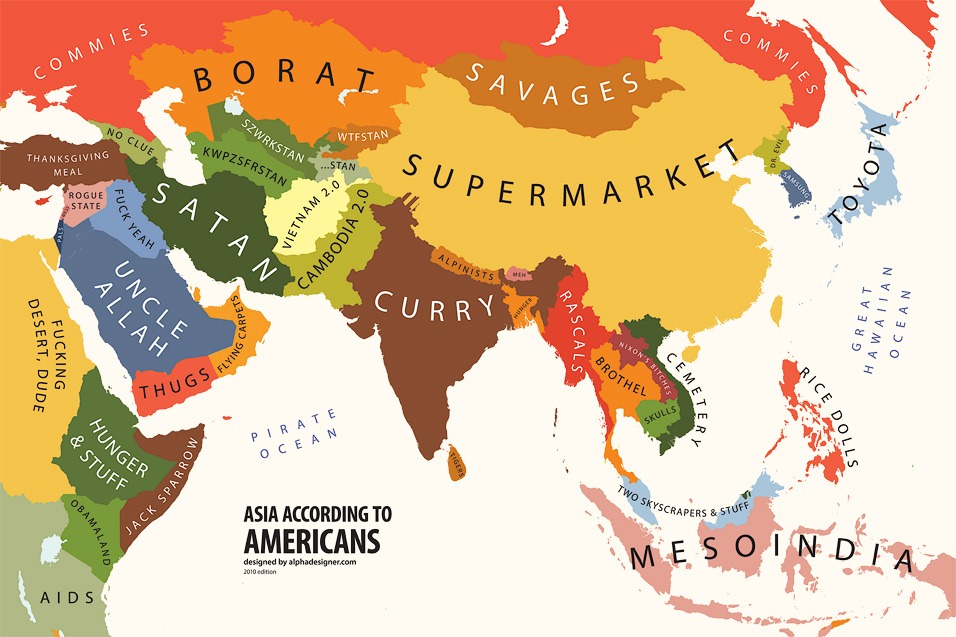
2. Connected to the first point is that Americans don’t know much about Asia. Of course, it’s true Americans don’t know a lot about the world generally. We are a superpower, so we don’t have to know about others; others have to know about us. That’s why ‘they’ learn English, and we think Urdu is a country in the Sahara. We are geographically far away, so touring Europe or Asia is very expensive. We don’t (need to) speak foreign languages. But beyond that general ‘ugly American’ stuff, I think Americans are particularly ignorant about Asia.Asia is the most culturally different social space in the world from the US I can think of, with the possible exception of central Africa. Latin America, Europe, Oceania, and Russia are all in, or close enough to, Western Civilization that what we learned in high school civics classes can apply. They look like us (kind of); they eat like us, their languages are fairly similar (Indo-European roots); they dress like us; they worship like us. The tribal cultural gap (how others eat, dress, talk, worship, look, write, etc.) is not that wide .
So the US pivot toward Asia is all the rage in foreign policy now. Obama and Secretary Clinton genuinely seem to believe in this, and there good reasons for it. Briefly put, Asia has the money, people, and guns to dramatically impact world politics in a way that no other region can now. But I think the US Asian pivot won’t happen much nonetheless, because: 1) Americans, especially Republicans, don’t care about Asia, but they really care about the Middle East (a point the GOP presidential debates made really obvious); 2) Americans know less about Asia than any part of the world, bar Africa perhaps; 3) intra-Asian soft balancing (i.e., almost everyone lining up informally against China) means we don’t really need to be that involved, because our local allies will do most of the work; 4) we’re too broke to replicate in Asia the sort of overwhelming presence we built in the Middle East in the last decades.
Here is part one, where I noted how much the communist super-idolization of leaders like Ho and Mao weirds me out. Here are a few more social science impressions from our trip:
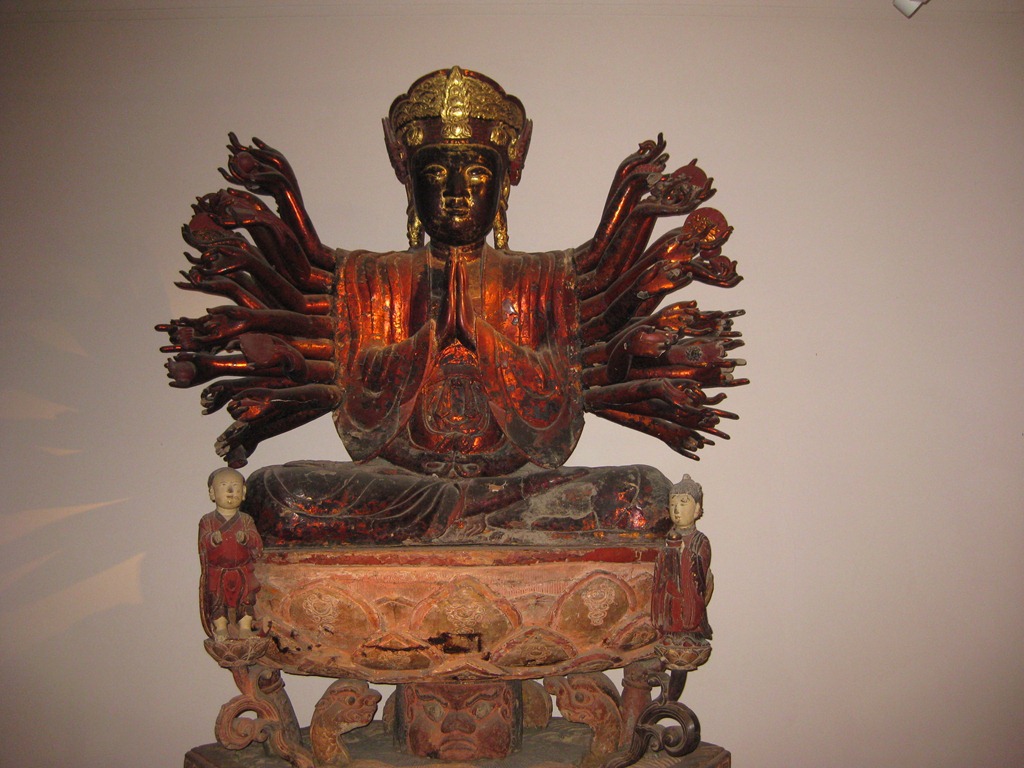
4. The Indo-Sinic collision in Vietnam makes the local art the most interesting I’ve seen yet in Asia. The national museum of fine art has (above) a wonderful serene Buddha, with his hands clasped and face placid (fairly typical) – plus 30 arms. Wow! That stopped me cold: Buddha + Vishnu = I have no idea. I can only imagine how the monks back in Korea (my wife is a Buddhist) would react. But it is truly unique, and I find Confucian art with all its rigid, formal wise men telling me to be a good son kinda boring. Bring on the wild Champa statuary with bodhisattvas who look like Hindu gurus and dancers with their legs backwardly touching their heads. Awesome.
Our social science faculty association organized a trip to Vietnam last week. It was pretty fascinating. It was my first trip, and I don’t speak the language, so obviously I am qualified to generalize wildly about it now. As Gabriel Almond once quipped, ‘you should never generalize about a country until you’ve at least flown over it. So guess I meet that test at least. Here are some anecdotal, political science-y impressions:
1. Communist hagiography really freaks me out. I have now been to the ‘holy-site’ tombs of Lenin, Mao, and Ho Chi Minh, and they are some of the most bizarre human artefacts I’ve ever seen. (Kim Il Sung has one too.) If you’ve never seen a communist mausoleum, you should visit at least one, especially if you are a political scientist. Modeled on the Lenin tomb of Red Square, Ho’s is a large, raised rectangular box, designed in hideously ugly Soviet-esque grey concrete. Ho is inside in-state – even though he explicitly wanted to be cremated (Lenin too wanted to be buried). And yes, they do refer to him as Uncle Ho to your face. Accompanying the mausoleum are two museums – and a gift shop in which you can buy Ho Chi Minh keychains and playing cards. Wait, what?!
Part one is here, where I noted how teaching IR in Asia taught me to stop worrying and love American empire, and that American social science’ monolinguism is actually a highly responsible research technique. Here are a few more:
4. Imperial Star‘Fleet Professors,’ or why everyone seems to want to work for MOFAT. In his essay in Cooperation under Anarchy(btw, was that sorta the bible for anyone else in their first year of IR grad school?), Van Evera had that good remark about ‘fleet professors.’ The German navy, in the race with the Royal Navy, coopted professors, through money, access, and prestige, to make an intellectual case for expansion and competition. We used that term in grad school to indicate PhDs who wanted to work for the government or DoD, or more generally, had possible conflicts of interest because of relations with the state. Yet connection to the state is fairly common in Korea and smiled upon by university administration. Everyone (yes, me too) seems to have some relation to government-affiliated think-tanks and such (here, here, here). Conferences routinely and explicitly invite policy-makers and expect academics to comment on current issues. I worry about this, because government preferences inevitably influence positions, and it is so easy to get pulled into predictions for which you have little knowledge beyond a few articles you’ve read. I am regularly asked when NK will collapse, e.g., or who should own the Liancourt Rocks, but as Saideman noted, it’s so easy to put your foot in your mouth when you reach like that. It’s also kind of easy for this to turn into an academic food-fight, as it did the first time I debated a Chinese IR academic. By contrast, I find Korean colleagues quite excited to engage in the policy-making joust.
This year I will be cross-posting my work on the international relations theory website, The Duck of Minerva. For readers of my site interested in social science theory in world politics, the Duck is a great place to start. Readers will also find the comments section much more vigorous than here on my own site. I encourage you to visit the Duck. The writing is fairly complex, and its contributors are excellent. I am flattered to be asked to guest-post this year. I’d especially like to thank Vikash Yadav for his solicitation.
I have been teaching IR (international relations theory) in Korea for almost 4 years. Generally, it’s a lot like teaching it in the West. The same theories get circulated, and we read the same journals. My university, a big state school, is organized a lot like any Big U in the US – dozens of departments, huge faculty, growing administration, a large middle class student body (but no student athletics). As at home, my department has theorists, internationalists, comparativists, and Koreanists. In fact, given how far away the Western system is geographically, it is almost a little too easy, too seamless. I guess this means political science really is a globalizing discipline.
So here are a few macro-lessons I have picked up teaching and conferencing IR in Asia:
It’s time for a break. Blogging is pretty time-consuming, so I need some down-time. I will be back in mid to late January, and I will be cross-posting at the academic international relations blog The Duck of Minerva. After 2.5 year of blogging, I am excited to step up to something with greater visibility next year. Academic readers especially will find that site a good one, and I want to thank the Duck’s outreach guy, Vikash Yadav, for inviting me.
So while your guzzling too much eggnog for New Year’s, I have tried to put together a list of stuff from 2011 that is worth your time. I try to avoid academic articles and stick to informed journalism that is easier to digest. Here we go:
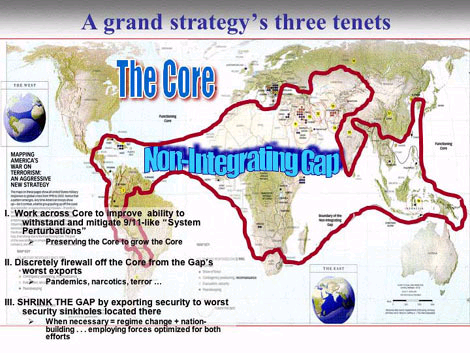
Mackinder’s famous map is on the left; Barnett’s is on the right. Here is Mackinder’s famous article; here is Barnett’s book.
It is a slow fall for Asian stuff. China is behaving better; Japan and SK are quiet; NK always seems like its building a new military installation somewhere, but it’s fairly quiet too. If you missed KJI’s birthday though, click here. The big recent new is the US decision to ‘shift’ toward Asia and the placement of US forces in Australia. Last year, I predicted that the US would lead a containment ring around China (yes, I realize that that is not a very gutsy ‘prediction’ at this point in the game). I see this as the first step. So here are some big geopolitics thoughts on the US shift, because I was re-reading Mackinder for work.
Halford Mackinder practically founded the field of geopolitics single-handedly with his famous article and the above map. It became the informal basis of US strategy in WWII and to certain extent, justified Cold War containment: keeping the Soviets penned into Northeast Eurasia. So it’s easy to roll this over to China. Mackinder’s map privileges land power. Mackinder thought the center of Eurasia constituted the ‘heartland’ that would be the pivot of global dominance. (China could arguably be a part of that, as it is far more populous than Siberia.) His famous quote was: Who rules East Europe commands the Heartland; Who rules the Heartland commands the World Island; Who rules the World Island commands the World.” Generations of German, Russian/Soviet, and (to a much lesser extent) American cold war strategists, took this as established wisdom. And indeed, I argue similarly in my Geopolitics article. The US is safe behind two big oceans, so long as no one controls all of Eurasia. If Napoleon, Hitler or Stalin had managed to control that whole stretch though, then a transoceanic invasion of the US might actually be possible. (Inter alia, it was Mackinder who coined that term ‘Eurasia.’) Probably the most famous exposition of the heartland theory’s importance for the US was from Frank Capra (yes, the guy who made It’s a Wonderful Life.)
Barnett comes more from the traditional American school privileging seapower, best known from the work of A T Mahan. Mahan thought (and Teddy Roosevelt agreed) that a powerful US navy was a the shield of the nation against the chaos of Eurasia. There is no need to get into long wars about the heartland; off-shore balancing is possible. The long US naval tradition is why the heartland school was never as dominant in the US as in Eurasia. Even though the US invented the nuke and has fought a land war in Asia for a decade now, the US is still firstly a naval power. I also think Barnett’s map reflects the American infatuation with technology and capitalism. Mackinder’s image is very traditional or realist: big states with big industries build big armies to conquer big spaces. This is a recipe every land strategist from Sun Tzu to Clausewitz could love. Barnett goes around all that to re-write geopolitics politically not militarily. In post-industrial economies, the control of land isn’t so important anymore (people’s brains are a lot more important than their manual labor in the fields of Ukraine). The critical divide is then between those states that function and those that do not. The functioning ones join globalization, get rich in the process, and then can use their wealth to set the rules. The nonfunctioning ones can’t grasp the benefits of globalization, generate all sorts of asymmetric problems, and are therefore the locus of military conflict. Policing failing states as spaces is more important the conquest of strategic territory. In Barnett’s world, Iraq, Somalia, Afghanistan, etc. are the threats of the future; in Mackinder’s China should start bullying central Asia and maybe Russia soon.
Has Barnett’s vision of Eurasia divided into functioning and failed states replaced Mackinder’s land-power realism? It seems to me that this is a good test of whether or not globalization is really changing a lot. If China and Russia become status quo powers, then yes. Then the only big issues will be integrating the periphery and rogues into the world economy. In this environment, salafism and other ‘remnants of war’ becomes the biggest challenger (headache really) to the US. But Russia, and especially China, pursue major changes in the land order in Asia, then score one for the realists. And America’s decision to base in Australia now too says Obama is leaning against Barnett-Mahan offshore balancing, toward forward deterrence of Asia domination.
I would add to other factors to this macro-musing:
1. A strong test of these competing maps is Chinese and Russian behavior if US power weakens. Radical Islamists, driven by the fear of God, will assault the West regardless of the chances of victory. So in that sense, Barnett will always be correct. But Russia and China are more rational. If US unipolarity holds, they are not likely to challenge the US, so then we’ll never know if the Russians and Chinese have changed because of globalization or were just deterred. But if the US declines, if military power genuinely disperses, and multipolarity emerges, then look for a challenge. As Beinart notes, “Offshore balancing, by contrast, reemerges when the money and bravado have run out.”
2. Global warming will raise the importance of the Heartland. In 1943, Mackinder noted the importance of the river basins in the Heartland. Fortunately for the West, those that flowed into the Arctic were blocked mostly be ice. Russian/Soviet naval power was forced to the fringes – Vladivostok, Leningrad, Odessa. If the Arctic truly meets permanently, perennial land power Russia will immediately become a sea power too. This would be an unprecedented shift, as geographic obstacles like the Arctic ice pack have generally been understood to be permanent, immovable features of geopolitics.
MEDIA UPDATE: On November 8, I published a brief write-up on the US-Korean alliance with the East Asia Forum. EAF is a good outlet for readers of this site. The piece was based on longer writings here on the blog earlier this fall. Comments are welcome.
——————
There have been lots of these GOP debates (here is the whole schedule), and the one above, from Nov 12, is the most relevant for readers of this site. Here is a decent write-up on that debate, and after months of them, there is enough said to provide something to say on the (otherwise scarcely discussed) foreign policy edge of the primary.
1. Any first foreign policy comment must be, paradoxically, that foreign policy isn’t really much of an issue. No one at the primary stage really cares about foreign policy, beyond Israel, which increasingly isn’t seen as foreign policy at all, at least by the GOP, and a general chest-thumping of American awesomeness. This is not news for Americans. US observers all know that domestic politics, especially the economy, pretty much determines elections. When you are a superpower you have the luxury to disdain and ignore foreigners. But foreigners don’t know this as well, and US allies especially often build-up (self-serving) images of themselves as ‘critical’ to the US, even though monolinguistic, untravelled Americans couldn’t care less about these countries (poor Georgia; the entirely ginned-up Korean belief that K-pop is a ‘wave’ in the US; a self-important German colleague once told me that America should never force Berlin to choose between Washington and Paris – oh please! like we care, dude!). Indeed, Hermann Cain’s rise and his staggering ignorance about the non-US world tells you that disinterest in the world – presumably because we are so exceptional and powerful that we don’t need to care – is almost welcomed by the Tea Partiers who hate IOs, illegal immigrants, and US bargaining with foreigners. Build the fence higher! And electrify it!
2. For all the hype about the US switching its focus to Asia, you wouldn’t know that from the debates. Do you really think that the average tea party white guy voter cares about SK or Japan? The Middle East was far more dominant. Iran, Pakistan, Israel, and the rest of the usual suspects were everywhere. I think I heard Gingrich mention NK once in this debate. The China stuff between Huntsman and Romney was flat. India wasn’t even mentioned, but waterboarding (of GWoT detainees) was a disturbingly hot topic. Again, this isn’t news to US observers who know how many Americans, especially Christians, take a fairly apocalyptic, clash-of-civilizations view of the GWoT. Bachmann even warned of a global nuclear war against Israel (god, she’s a terrifying flake). Elites may want an Asian turn in US focus (as I think would also be a good idea), but the ‘Christianist’ GOP electorate remains focused on the ME, and we should expect that to continue to dominate US time, even if we don’t want it to. Terrorism, oil, and Israel aren’t going anywhere.
Asians are bound to be disappointed, because of the deep-rooted belief (desire, actually), verging on desperation, that the US should pay attention more to them. (Read this and this – apparently India and Southeast Asia are ‘indispensible’ for the US. Oh, and so is Latin America. — Not! Americans just don’t care. Elites aren’t the voters. Build the fence higher!) What this tells you is that the Asia hype is a lot more hollow than Asians want to admit, because it requires US attention to be justified. So America is still the unipole whether you like it or not (natch), and the ‘new Asia’ schtick is more about Asian insecurity and desire for prestige, than it is about empirical shifts. (Yes, the shift is happening, but a lot slower than the ‘Asia is the future’ types I meet here all the time will admit.) I have argued before that Americans just don’t care than much about Asia, no matter how many Asians tell us we should. Israel or even ‘old Europe’ Ireland is a lot more recognizable to Americans than Shanghai or Bangalore. Further, so long as India, Japan, China, and the rest out here are all balancing each other and competing, the US doesn’t really need to get sucked into the maelstroms of the Korean peninsula or the South China Sea anyway. The Asian hype that the US should pay more attention out here is really an effort to get the US to help locals contain China, which bait we should not take, IMO.
3. Cain, Bachmann, and Perry are way out of their depth. By now everyone knows Cain’s ‘U beki beki stan stan’ remark and Bachmann’s off-the-wall assertion that the ‘ACLU runs the CIA.’ (Yes, the same Agency that runs the drone strikes that now kill US citizens.) But even Perry can’t seem to give good answers – that he ‘commands’ the national guard and has friends in the Defense Department are qualifications for the White House. That’s all he’s got after 3 months on the trail? What happened to Perry? He seemed so imposing back in August, and he has just crashed. He comes off more clueless and lost in the woods, after his pre-scripted reply sentences run out, than even Bush. It’s amazing how weak this field is (which is why Romney is running away with this thing, even though no one likes him).




 Robert E Kelly