My Essay for Newsweek Korea on the Current Korean Strategy Debate in the Media: K Caught b/t the US and China

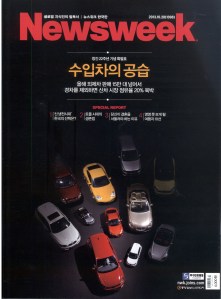
newsweek-1028_페이지_1 (3)This is a lengthy piece I just wrote for this week’s edition of Newsweek Korea. Here is the link for the Korean version; below is the English translation. The Korean version is unfortunately gated after page 1, so if you want the whole thing in Korean, email for the PDF. That is the edition’s cover to the left.
The short, IR theory version is that: a) S  Korea is a middle power that risks ‘overplaying its hand’ against Japan, as a think-tanker friend put it, because of the ‘moral hazard’ facilitated by the American alliance (as Katzenstein noted, Japan is the US anchor state in Asia, and Koreans can’t change that no matter how much they resent that special relationship); b) the Americans believe in the democratic peace and simply don’t accept that Japan is some kind of proto-fascist state (this is a real breakpoint with the Americans); and c) Korean geography basically traps it in a Waltian ‘balance of threat’ quandary: even though it is small, its proximity means it will get pulled into the Sino-US/Japan stand-off whether it likes it or not. The only possible way out I can think of for Korea is unilateral nuclearization (yikes). Also, my continuing skepticism of the pivot pops up. I still don’t think Americans actually care enough about Asia to really get pulled into a major competition with China. Here’s that essay:

Continue reading

My Website is blocked in China – Hah! I’m flattered

greatfirewallofchina

I was just in China for a work thing, when I checked the Duck of Minerva (the IR blog where I also write) for something. Turns out the Duck is screened out by the Great Firewall. Even if you go to Google Search Hong Kong, it’s still blocked.

Wow. Who knew even nerdy IR theory and pop culture references posed a threat to CCP rule? Lame. Even more lame – my own website, which gets way less traffic, is blocked too. For sites as small as mine, that’s almost a complement – hah. If only I had readers similarly interested enough to even bother…

My Diplomat Interview on North Korea, Syria, and China’s Rise

the-diplomat_logo_en

Frequent readers know that I am regular contributor to the Diplomat web-magazine. On October 10, Editor James Pach interviewed me, mostly about Northeast Asia. Jim is a great guy, and I think these questions helpfully expand on some ideas I have put on the blog recently, especially my recent piece on reining in US presidential wars powers. The original interview is here.

JP: North Korea has put its troops on high alert, restarted its reactor at Yongbyon and called South Korean President Park Geun-hye an “imbecile.” We’re accustomed to the pendulum of ratcheting up and then easing tensions, but this year Pyongyang seems especially schizophrenic. Is this the new leader Kim Jong-un settling in, or are there other factors at play?

REK: This is a tough question given how opaque North Korean leadership decisions are. My own sense is that this is typical North Korean game playing. I made a similar argument at the Diplomat during the spring war crisis. It is true that Kim Jong Un is likely still finding his way. He is too young and too inexperienced in the old boys networks that run NK to easily step into his father’s shoes. But his period of greatest vulnerability was last year. The regime seems to be settling in around him comfortably – to many people’s surprise – so my sense is that this is the Korean People’s Army going through its usual hijinks to justify its massive and massively expensive role in NK life. I thought this too was the reason for the spring crisis, because NK does not actually want a war which they will lose, badly.

Continue reading

My September Diplomat Essay: Relax – Chinese Hegemony in Asia is Unlikely

water_pollulation_shaoxing_zhejiang

The following is a re-up of a piece I wrote for the Diplomat last month as part of an informal back-and-forth series with the National Interest this summer on the US pivot to Asia and AirSea Battle. (Here and here are some of the other entries.) That pic, which has got to be the grossest river in all China, is from here.

In brief, I increasingly think that ASB is a mistake, because it’s almost impossible to read it as anything other than hugely provocative from the Chinese point of view, no matter what we say to them about our peaceful intentions. (Read this, and tell me reasonable Chinese wouldn’t flip out.) It’s a classic example of the security dilemma, but as I argue below, I am not really convinced that we actually need this high-tech, super-fearsome-sounding ASB right up in their face. More generally though, the pivot to Asia – a sharpening of American attention on the region, is probably a good idea. China is vastly more influential on American life than Israel or Iran. But the Middle East and Islam activates belligerent American religiosity so much, that I doubt we’ll really be able to pivot. In any case, the essay follows the jump and is written in an op-ed style.

Continue reading

My ‘Newsweek Japan’ Story on Korea’s Regional Foreign Policy: Being an Encircled Middle Power Sucks

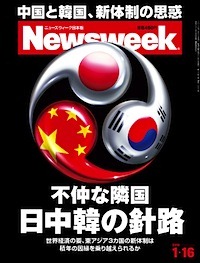
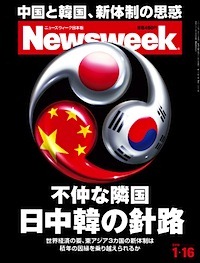
Newsweek 3rd coverNewsweek Japan asked me to contribute an essay on Korean foreign policy for a special issue on current Northeast Asian tension. I also wrote the introductory essay for this special issue. There is one essay each on Japan, China, and Korea; mine is the Korean one. So this is a nice laymen’s review without too much fatiguing jargon. This was originally published in January, so this translation is late, but the points still hold.

In brief I argue that Korea’s foreign policy is driven by its geography. Korea is a middle power surrounded by three great powers, plus the most orwellian state in history. That position really, really sucks. The US alliance helps buttress Korea sovereignty in that tight neighborhood, but China’s rise is unbalancing everything, especially calculations for unification. Once again, there are no hyperlinks, because it was intended for print. Here we go:

“On December 19, Korea elected a new president, Park Geun-Hye. Park comes from the conservative New Frontier Party. The current president, Lee Myung-Bak, is also a conservative. Park will be inaugurated in late February. Her campaign presented her as more ‘dovish’ on foreign policy than Lee, but she represents greater continuity than her opponent, particularly regarding North Korea.

Korea’s foreign policy is heavily-driven by its geography. It is an encircled middle power that has frequently struggled to defend its autonomy against its much larger neighbors. And since World War II, it has faced the most orwellian country in history in a harsh stand-off that dominates Korean foreign policy. An opening of North Korea, leading to eventual reunification, is the central policy issue of every Korean administration. Beyond that, Korea’s central relations are with the United States, China, and Japan. All three structure Korea’s neighborhood and will significantly influence unification.

Continue reading

My ‘Newsweek Japan’ Cover Story on the post-1979 ‘Asian Peace’ & Economic Miracle

Newsweek 3rd coverNewsweek Japan asked me to write an introductory essay for its January 16 special issue on tension in Northeast Asia (cover story to the left). I should have put this up 4 months ago, but I forgot and the arguments are still valid. Anyway, here is the link in Japanese, but I thought it would be useful to publish the original, untranslated version as well. (If you actually want the Japanese language version, email me for it please.)

The essay argues that Northeast Asia has benefited enormously from an ‘Asian peace’ in the last 35 years. All the remarkable growth in China and South Korea (as well as India and Southeast Asia) would not have happened without it. So fighting over some empty rocks (Liancourt Rocks, Pinnacle Islands) is a terrible idea. And for political scientists, the current Sino-Japanese tension is a good test of the hypothesis that economic interdependence brings peace. It’s fascinating to watch China especially try to figure out just how much economic gain to forego in pushing Japan over the Pinnacle Islands.

This was intended for their print edition, so there are no hyperlinks included in the text. Here we go:

“1979 was an important year in modern East Asia. It captures two of the region’s most important trends. It was the year of both the last serious military conflict between two East Asian countries – a Sino-Vietnamese border war – and the start of China’s capitalist modernization under Deng Xiaoping. These moments usefully frame the following thirty-four years: much of Asia has gotten substantially wealthier, and no major conflicts have broken out to upset that upward economic swing. This magnificent regional achievement has catapulted Asia, particularly East Asia, into the center of world politics.

Continue reading

My Comments to BBC TV about yesterday’s North Korean Nuclear Test

That would be the finest academic haircut in all of Asia… 😦


I spoke this morning on BBC’s Asia Business Report on the North Korean nuclear test. My quick take is:

Yes, it was a terrible idea, but no, it is not surprising. Nuclearization takes time and ‘practice,’ so these sorts of tests are expectable. This one was about half the yield (size) of the weapon dropped on Hiroshima, so they’re getting pretty good at this now. I’m continually astonished at how a near-third world state under heavy embargo nonetheless pulls this off. Wow. What are we missing?

Yes, there’ll probably by a UN resolution, but no, it won’t have any real bite. The reason is China. There’s a near consensus now in North Korea studies that China is the key here. China is the reason sanctions don’t work – because the Chinese don’t enforce them. And it is China that politically enables these childish North Korean stunts by not attaching any real costs of aid or diplomacy to them. That said, one of the reasons for all these NK hijinks is to keep the Chinese out of their business. We all assume the nukes are aimed at Seoul, Tokyo, and LA, but they’re also a nice deterrent to Chinese domination. The nukes signal that even though NK is now an economic satellite of China, it will never be a political one. NK will not become China’s East Germany.

The real question for the future then, is how the democracies among the Six Parties (SK, Japan, the US) can walk China back from support of NK. How do we get China to stop obsessing about retaining NK as a ‘buffer’ against the democracies? How do we get Beijing comfortable with Southern-led unification? When that happens, then Beijing will drift from the North, and the possibility of collapse becomes much more real. But that is probably one to two decades away. Yes, this drama will go on and on and on…

For my travelogue on my trip to North Korea, go here.

The video is simply my phone recording our home TV, so the quality is not so hot. Also, if you’re wondering my eyes are wandering all over the place, it’s because BBC does not provide the image back to the interviewee when you’re on Skype with them. So I am sitting there just looking at nothing – my desktop maybe – trying to find something to do with my eyes. Ah well…

USC-CSIS Conference on Korean Unification (3): DPRK ‘Sovereignty’ is a Sino-Russian Fig-Leaf to Slow Unification and Check US Power

New_KSI_Banner_3

Here are part one and part two of this post. I spoke last Tuesday at a USC-CSIS conference on Korean unification. I learned a lot, and it was very good. If you’re interested in unification, start here with the primary report on which the conference was based. The principal investigators said a final wrap-up report will come at some point, and I’ll put up that link when it arrives.

My comments below are on the papers presented on Tuesday about neighboring states’ reactions to Korean unification. These papers aren’t publicly posted yet, so all the comments might not make sense. But in the interest of completism, I’m putting this up to round out my thinking on this excellent unification project. (For my earlier thoughts on dealing with NK, try this; for my travelogue of my trip to the DPRK, try this.)

My big beef with these sorts of conferences on NK – I go to a lot – is that inevitably outsiders, especially Chinese scholars, start laying down all sorts of guidelines, restrictions, parameters, etc. for unification, as if it’s our right to muck around in this thing. I can understand the national interest in doing so. But we shouldn’t have the temerity to try to legitimate our muddying of the waters in what is really an internal family affair. It would also help a lot if the Chinese would stop talking (not so much at this conference, but definitely at others I’ve gone to) about how Korea needs to respect its wishes, because China is big and important now, post-2008 Olympics. I heard one guy once even say that China is now the ‘veto-player’ on unification. That’s true of course in realist sense, but that sorta cockiness infuriates Koreans who’ve really soured on China in the last decade. I see the same kind of emergent Chinese bullying on unification that Southeast Asian littoral states see on the South China Sea. So I try to call that out whenever it seems necessary.

Anyway, here on my thoughts on Japan, Russia, and China’s role in this thing.

Say Ron Paul Won…Which US Allies would get Retrenched? (2) Japan?

retrenchment graph

This post series is getting so much traffic, here is a part three on likelihood of retrenchment. Here is part one where argued that America’s 8 most important allies are, in order: Canada, Mexico, Saudi Arabia, Taiwan, India, Indonesia, Israel, and South Korea.

I argued for 3 quick-and-dirty reasons for that ranking, but I got some criticism on these in the first post, so here is some elaboration :

1. National Security: Some places, like SA and Mexico, may not appeal much to Americans, but they are so obviously important, that abandonment would be hugely risky. So yes, SA is a nasty, reactionary ‘frenemy,’ not really an ally at all, but we’re stuck with it. A Saudi collapse would set off both huge economic and Islamic religious turmoil; all the more reason to slowly exit the Middle East and pursue green energy. But until then, I think we have to be honest and say that we can’t really leave the Gulf. But the bar of this criterion should be awfully high. With some frenemies, like Afghanistan and Pakistan, we don’t really need to pretend to be allies actually. We can just get out if have to.

2. Need: In some places, the US can get a lot more bang for its commitment buck, because without us, our ally would likely collapse/lose/fail. Taiwan is the most obvious example. Conversely, other places, like Germany, pretend to need us, because they don’t want to shell out the cash (and we’re so bewitched of our God-given, history-ending, last-best-hope-for-mankind, bound-to-lead neocon unipolar awesome-ness that we let ourselves get taken for a ride).Between Taiwan and Germany, I would place Israel and SK.

3. Values/Symbolism: I don’t like this criterion much, because it reminds me a lot of McNamara, ‘credibility,’ Vietnam, the Munich analogy and all that. But still, there are a few places where the American commitment has taken on an almost ‘metaphysical,’ good-guys-vs-bad-guys dimension. The whole world is watching, and a departure would be seen as a huge retreat from critical values that would bolster dictators everywhere, especially in China and Russia. SK is the most obvious example. NK is so bizarre, frightening, and horrific that while the US commitment isn’t really that necessary anymore, it’s taken on a symbolism wholly out of proportion to events on the peninsula. Taiwan also comes to mind, as does cold war West Germany. Avoiding another such perpetual commitment was one of the important reasons to get out of Iraq. If we’d stayed, we might have have gotten chain-ganged into never leaving our symbol of GWoT ‘success.’ We really don’t need more of that sort thing

So back to the list. Now come the ones that can more easily be retrenched, because either they are wealthy enough to defend themselves, or their value to the US has fallen:

Continue reading

China’s Counter to the Asian ‘Pivot’ (2): ‘Swarms’ in the Pacific

china-us-economic-warfare

Part one is here, where I noted China’s growing fear of encirclement (I get Chinese students a lot who talk about this). So, in the role of China, I argued for an Indian charm offensive to prevent encirclement, and how China might buy off Korea from the US camp by abandoning North Korea. Here are some more ‘B-Team’ style ideas for pushing back on US local dominance, including swarming the US navy in the western Pacific with cheap drones and missiles:

Continue reading