Egyptian Revolution (1):We should Support the Uprising

Good lord, Beck really is insane…


Part 2 is here.

Like all of you in the last few weeks, I have been glued to CNN regarding Egypt. It is pretty inspiring, and I can only hope that Mubarak leaves and something more genuinely liberal and democratic takes his places. Here are a few thoughts.

1. Regarding the video selected above, I did plan to post a good pic from Egypt, but you’ve seen that a lot already, so that would not have added much new value. This you probably haven’t seen though, and it is ‘important’ for the sheer insanity about US conservatives’ foreign policy concerns in the ME it reveals. Apparently the Egyptian revolution is an islamist plot that will turn the Mediterranean into an Islamic lake, allow Russia to control Northern Europe, and China to control India and Pakistan. Don’t believe me? Beck’s sweeping hand movements will explain all…    h/t: Center for a New American Security.

2. This is one of those critical junctures when observers should to go on the record about what to do. If all this somehow goes wrong, everyone will blame Obama in 20/20 hindsight. That will inevitably be partisan and unfair, because the Obama administration is making decisions under huge uncertainty. Credibility requires one to go on record now, when information is limited and we all have to make our best guess.

That US conservatives are badly split signals this huge uncertainty. Absolute moral certainty is a central pose of the American right’s self-image (tax hikes are always bad, Iraq 2 was a good idea no matter what), so if even the Right –  which IMO takes foreign policy more seriously than domestic-focused US liberals – is divided, that tells you just how confused everyone really is. For the neo-con take that this really is about democracy, try Gerecht (excellent); for the gloomy realism that we should hew to the Egyptian military, try Krauthammer (depressing, but also good). And for the downright bizarre conspiratorial stuff, watch the above vid.

So here’s my line: I’ll say that Krauthammer and the realists are wrong. The Iran parallel is inaccurate; this will not lead to a Muslim Brothers’ dictatorship. Further, the support of democracy is, in itself, an important value. Even if there was a serious risk of an islamist takeover, we should still pressure Mubarak to get out, nor support a military oligarchy (Krauthammer). Who wants to look back in 10 years and say we supported yet another authoritarian in one of the worst governed places on earth, that we didn’t take the chance to push for something better, even if it was risky? How awful and embarrassing for the US; what a betrayal of all those heroic people we’ve seen on TV. And if they want islamists in the government, well, it is ultimately their country. So long as it remains a democracy (the difference between Turkey’s islamists’ participation, and Hamas’ budding oligarchy), then we have to allow them to disagree with us as is their right. Risking fanatics in government is part of democracy (witness, ahem, Sarah Palin). If we believe in it for ourselves, then we must be true to it for them. So, no, this is not a result of George Bush’s foreign policy, but we should support it anyway.

3. Israel should not drive our policy toward Egypt. Has anyone else noticed how much of this discussion has gotten hijacked by the ‘what-will-happen-to-Israel’ externality? (Try here, here, here, here, and here.) This is embarrassing and almost sycophantic. You can’t blame the Arabs for disbelieving we’re an honest broker when the fate of 6 million people in a different country outweighs the 85 million of the country that is actually the center of the story. Really? Should the US point of origin for yet another Middle East event be Israel’s benefit? We are two separate countries, right? Maybe we should care about the Egyptians themselves, right? Israel does have the finest military in the region, nuclear weapons, and a take-no-prisoners lobby in the US Congress, right? Don’t misunderstand me. I realize that Israel’s security is important for the US and that it is the only democracy in the region (although that is increasingly under question). I want Israel to be secure too; I’ve traveled there 3 times and unconditionally support its right to exist. If it would help, usher them into NATO or the EU, or extend formal US deterrence guarantees, even nuclear. But it’s long-overdue time that we break the habit looking over our shoulder to Israel on ME issues, and it’s extremely immoral to support continued Egyptian authoritarianism on the (likely correct) premise that a democratic Egypt will push Israel harder. That sells out the admirable sacrifice of 85 million for 6 million who voted for an openly provocative right-wing government.

American Dual Containment in Asia

pet-containment-pen

Last month I published an article in Geopolitics entitled “American Dual Containment in Asia.” In brief, I argued that a double containment of both Islamic fundamentalism and of China is the likely US strategy in Asia in the coming decades. The containment of salafism in the Middle East is bound to be hard and violent (as it already is), because Al Qaeda and associated movements are so genuinely revolutionary and dangerous. The containment of China is likely to be soft until the Chinese decide just how much they wish to challenge the reigning liberal democratic order. In the last year, many seem to fear that China is ramping up in this direction. Hence my prediction that India will be a pivot in this containment line. It is a unique ally for the US, because it is worried about both China and Islamic fundamentalism, and because it is democratic. In this way, it is unique among American alliance choices. Here is abstract:

“US grand strategy after 9/11 turned from post-containment drift to preemption. But the costs are high – suspicion of American power, hedging by traditional allies, expensive, go-it-alone ventures like Iraq. Tried-and-true containment better reflects American values. While forward in the world, containment is also defensive. It reassures skittish partners and reflects liberal, anti-imperial US preferences. In Asia, containment would deter the primary contemporary challengers of US power – radical Islam and Chinese nationalism – without encouraging a Bush-style global backlash. In a reductive analysis of US alliance choices, this article predicts a medium-term Indo-American alliance. India uniquely shares both US liberal democratic values and the same two challengers; it is the likely pivot in a US-backed neo-containment architecture in Asia.”

Here are the relevant graphs that, I hope, make the argument clearer:

Graph 1. Contemporary Revisionists to the ‘American System’


Power

High

Low

Commitment


High

(Revolutionary)


Islamist-Jihadist Networks,

Iran ?

Low

(Dissatisfied)

China ?

Rogues (Cuba, North Korea, Venezuela)


The good news above is that just about everyone accepts the international status quo – roughly, the liberal international political economy led by the US (what Ikenberry calls “the American system”). While al Qaeda is clearly a scary revisionist – i.e., the they want to dramatically rewrite the international order by refounding the caliphate, e.g. – they are also pretty weak. The only powerful revisionist is China, and no one knows yet just how much she seeks to change things. This is good for the US, insofar as it backstops the international order, and it is also good for the many states in Asia and Europe that function within that order. Although the internal challenges to the liberal order are growing (i.e, the Great Recession), there is currently no powerful and revolutionary external challenger like the Nazis or USSR were.


 Graph 2. Contemporary US Alliance Picks


Competitors

Values


China

Islamist-

Jihadist

Networks

Great Britain/NATO


         X

               X

Russia

          X

          X


Japan/East Asia

          X


                X

Israel/Arab clients


           X

               X?

India

          X

           X

               X


This graph tries to reductively explain the appeal of India as an alliance partner. It uniquely shares the both the geopolitical interests of the US in Asia; that is, it is worried about both Islamism and China. And it shares our liberal democratic values. Russia is an obvious point on shared interests – the ultimate driver of alliances of course – but it is so erratic and semi-dictatorial, that is still distasteful despite the ‘reset.’

The most controversial part of this analysis is certainly my open claim that China will be a target of US soft containment, and maybe hard in the future. I should say here that I do not want this. I am very aware of the self-fulfilling prophecy problem; i.e., if we openly come out and say China is an enemy or threat, then by doing so, we make it into one. And certainly articles like mine are exactly what the Chinese declaim – a not-so-secret effort by US analysts to keep China down and such. And see Barnett on why I am completely wrong, if not dangerous, about China. But as an empirical prediction, I do think it holds. China’s growth and current values (populist nationalism, deep historical grievance, residual communism) are just too rapidly destabilizing, and I think Barnett doesn’t give nearly the necessary attention to the security dilemma problems China creates on its periphery. (IMO, Barnett overfocuses on China and G-2 coziness, while missing the nervousness in places like Korea, Japan, Singapore, and Indonesia.)   For my own writing on why I think the ‘China threat’ school is likely to win this debate, try here.

Finally, I should say in fairness that my own perception of China-as-threat has declined somewhat, in part because I visited the place. This strikes me as natural; closeness and exposure frequently breed understanding, and I like to think that all the nice Chinese scholars and hospitality I experience were in fact real. But the liberal values of academics exposed to new ideas and travel as a professional requirement hardly apply to populations and elites, especially those as nationalist as China and the US. The misperception likelihood is huge here; remember the Bush 2 administration came in ready to take on China until 9/11 happened. This will likely reassert itself as American dependence on Chinese financing grows and as the GWoT (hopefully) winds down. (Another problem here is the peer-review process. Articles take years to between the first inspired write-up and the end-point of publication. Reviewers send you back to the drawing board, and the pipeline effect means that even after final acceptance you may wait a year or more to see it in print.)

Hu, Obama, and the Chinese-Confucian Hankering for Status Recognition

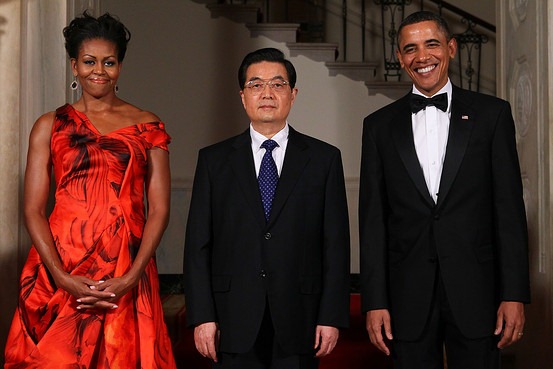
0120hu01_G_20110120061748

Everyone and their mother has commented on Hu’s trip to Washington this week. I would only add a few points.

1. I kinda wonder why Hu even wanted to come. Consider all the things the US wants to talk to China about that Hu has zero-interest in discussing: democracy, human rights, Liu Xiaobo (the 2010 Nobel Peace prize winner) and press freedom, the non-float of the yuan, the forced partnerships between foreign MNCs and Chinese companies to informally coerce technology transfer, hacking, Tibet, IPR/piracy, NK, Taiwan, the South China Sea, etc, etc… You don’t need to be a sinologist to know that the Chinese Communist party (CCP) isn’t going to change on this stuff for awhile, and certainly not at the behest of foreigners. Nor does it really even want to talk about this stuff at all; hence the Chinese recitation/dodge that almost every point of contention is an ‘internal Chinese affair.’ The tide is running in China’s direction macroeconomically, meaning China doesn’t have to listen to us. So why bother to show up at all?

2. My answer is prestige. Gordon Chang pretty much nailed it for Hu himself. China’s government is a bureaucratic monster even worse than the US government. Not only is China four times the size of the US demographically – thereby requiring more people in government – but the CCP and PLA (military) are heavily involved in politics and industry, making the beast yet larger. The only possible way that Hu can try to guide this sprawling, confused, self-contradictory Titanic of a ship-of-state is through his own stature. And what better way to buttress that than through pictures with the leader of the world’s only superpower. Dictators have no means of ascertaining their domestic legitimacy, and therefore seek parallel legitimacy abroad which can be ‘reflected’ back home. So if the president of the world’s superpower is sitting next to your repressive nasty, then it must be ok to be repressive and your guy isn’t as bad as you thought.

3. But it’s more than just Hu’s tough spot back home. China’s elites deeply hanker for US recognition. China’s national ideology is grievance and nationalism – the 100 years of humiliation. When you visit Tiananmen Square, there is a huge video screen playing regular imagery of this post-1989 ‘China is awesome’ motif. Communism is dead; ‘getting rich is glorious’ is hardly bracing or communitarian enough to bind a billion people together; democracy is not a option. So a Weimar-style nationalism of grievance and national shame is the substitute (even if Chinese academics think it is bunk, as was my experience in China). So China’s got a big chip on its shoulder and satisfying this thirst for status is the reason for all the pomp and fuss of the visit, for the Rovian levels of choreography that left nothing to spontaneity (as with the 2008 Olympics), for the Chinese insistence that it be a ‘state visit’ with Obama in a tux, for the meeting with Congress, for the empty banalities of Hu’s actual comments, etc. Process, not substance, was the whole point – a process wherein the US looks like an equal to China, not a superior, wherein the leader of the only superpower bows and toasts to a Chinese, wherein ceremonialism, flags, uniformed soldiers saluting, endless fussing about who sits where, and lofty rhetoric go unsullied by real work or substance.

4. So you say, what was the whole point then?Process for its own sake sounds like a huge waste of money all around, and giving the Chinese something for nothing. This is true, but the US is now so dependent on Chinese Treasury purchases that playing China’s reindeer games is a worthwhile tradeoff to get more of their money, at least until we get our fiscal house in order. That’s the US benefit. And for the Chinese?

Atmospherics count for a lot in Asia. Asian media is more self-congratulatory, more statist, and more concerned with image and rank of their leaders aboard. This is why ASEAN meetings, an endless, do-nothing merry-go-round of photo-ops and ceremony, still happen. Little is achieved; ASEAN is 2/3 the age of the EU but has done maybe 10% of the work. Yet still it meets, because process – with consequent coverage on CNN and pictures in the Economist or New York Times – is a goal itself.  A few years ago, when President Lee of Korea met George Bush for golf, Lee drove the golf cart around. To Americans, it looked like two buddies having fun, and this was exactly the sort of downhome, buddy-buddy stuff W liked in diplomacy. But Koreans took it as Lee chauffeuring George Bush around and got miffed that it was some kind of snub by the white guy. This was between allies, and the Americans had no idea the pic would be received that way. In fact, Lee looks like he’s having a pretty good time – all the more demonstration of Asian tetchiness on perceptions of rank and social hierarchy. For China then, this is even worse, because the media is wholly state-directed and even more jingoistic than Korea.

The root of this is Asia is Confucianism. Western traditions of equality and individualism are imports here. The long cultural tradition is hierarchy, in which a junior recognizes the moral/intellectual superiority of a senior (and increasingly today, greater wealth implies the higher ranking position). Social disruption stems from the junior’s unwillingness to recognize his place (yes, just like in Plato). Hence, the endless Chinese usage ‘harmonious society’: China’s population is supposed to recognize the moral/developmental excellence of the CCP and follow its learned orders, not protest for human rights or democracy. Applied internationally, this Confucian schematic of rank and dominance layers a further moral sheen onto the realpolitik division of the world into great, medium and small powers. For a long time, the West (and whites, to be very honest) was perceived as the senior, even if the British imperialists and American administrators who embodied this, did not know it. But with EA’s recent growth, it is time, deliciously, to rebalance the hierarchy. Hence Obama has to give a state dinner to an Asian, and W should be the one driving the car. There is a lot more going in this visit than China’s growth; Western fetes of Asian leaders serve a deep, local cultural/racial desire to see Asians in place of the Confucian master/senior in interstate relationships.

5. More generally, everyone likes recognition, and recognition flows downhill. That is, stature is imparted by those ‘above’ you. Hence the president of Korea likes golfing with W, because it makes Korea look like a great power, while the US gains little prestige from the visit. For China, the only possible state than can confer rank on it is the US. Getting US peer recognition is central to the ‘we’ve-been-stepped-on-by-foreigners’ narrative of the CCP. Rising powers particularly care a lot about recognition of their ‘place in the sun’ by the old guard.

6. Also: I was pretty pleased to see the western media give Hu a hard time on human rights. The US media was made a fool of by the Bush administration. Here was a chance to get its integrity back. Well done.

2011 Asia Predictions (1): East Asia

Watch this if you haven’t seen it yet. It’s pretty scary.


Last year, I put up 2010 predictions for Asia and Korea. Last week, I evaluated those predictions. This week come my 2011 predictions. It’s a fun exercise, if only to see how bad you blow it 12 months from now…

1. China will back off.

Why: It has been widely noted that China seemed to suddenly get aggressive last year. They got to bullying about the South China Sea, and their behavior over the island conflict with Japan seemed extreme to almost everybody. (The video above comes from a Japanese YouTube contributor; I tried to find one that is less ideologically questionable, but generally, there is agreement now that the Chinese fisherman purposefully rammed the Japanese coast guard, per the vid above. It is worth noting that Chinese fishermen also do the same thing to the SK coastguard – only the Koreans don’t make such a big deal out of it.) But my sense is still that the Chinese aren’t foolish enough to provoke real local balancing against them – at least not yet while they are still comparatively weak. China has invested a lot over the last few decades to prevent this possibility.While I do think medium-term balancing against China is likely, I also think the Chinese think about this a lot and want to avoid it as long as possible. Events like the video above tell me that China has a big bureaucracy with multiple factions struggling to control foreign policy in a system where the chain of command is blurry and civilian control is disputed – common problems in dictatorships . My guess is last year’s belligerence was a mix of free-lancing by tougher elements to prove a point but not a conscious strategy shift toward provocation. China’s not really the ‘responsible stakeholder’ we want it to be, but I don’t think they are openly reckless suddenly either. They are likely to pull back this year toward conciliation – at least until they are stronger.

2. North Korea won’t pull any big stunts this year.

Why: Last year NK pulled some of its most foolish, dangerous tricks in years. And it got what it wanted. The whole world is once again paying attention to its noxious tin-pot dictatorship. China gave it cover, twice!, and more cash. It once again made SK look weak, vulnerable, and confused, right after the nice G-20 raised SK’s global profile. (What better way to play the spoiler of an event that made Korea look modern and normal?) Intelligent western analysts went on record saying stupid things that sound awfully close to appeasement. SK caved and once again called for the 6 Party Talks; this opens the door, yet again, for the North to play the other 5 parties off each other for gain. Not bad for a broke, dysfunctional gangster-state. So there isn’t much more to be gotten from raising the temperature further, and the costs for them are rising. The DPRK doesn’t really want to provoke a war, and SK attitudes seem to be hardening on responses. NK gimmicked its way into most of what it wants, so I anticipate calm for a while – at least until some other regime crisis (famine, currency collapse, Kim Jong-Il’s death) pushes another KPA outburst for attention and money.

3. Nothing much interesting will happen in South Korea or Japan

Why: Korea seems pretty pleased with itself as it is and should be. Inflation, unemployment, debt, deficit, tax rates, and poverty are all low. (If you are a Westerner and that sentence makes you gasp in envy, it should. Korea’s macroeconomics are miraculous). It has little reason for any major domestic shifts, while in foreign affairs it is increasingly a status quo power. That means that while it is de jure, in the constitution, committed to ending the intra-Korean stalemate, de facto, the SK population doesn’t really want to sacrifice too much for that goal anymore. They just want to be a rich trading state and for NK to go away. So expect more of the same muddling along on the NK issue, crisis-by-crisis. There are no big reasons for Korea to do anything really new this year (notwithstanding that external events might force something of course.) Japan is the opposite; it desperately needs to change. But it can’t, because its population is terrified of confronting the enormity of its troubles, and its corrupted political class is trapped in decades of merry-go-round immobilism. I see no willingness to address the spiraling debt, the overprotected sectors like retail, ag, or construction, the history and territory issues with the neighbors, or broken political system. Hugging the US alliance tight allows these issues to be pushed off indefinitely, and I see nothing to suggest Japan will finally grow-up this year. Stasis, functional and dysfunctional respectively, will be the rule on both sides of the Korea Strait in 2011.

Another Laugh-Riot Asian IR Video, on the Currency War

And you thought economics was the dismal science…


It is Thanksgiving week, so here is something light. If you aren’t watching Charlie Brown Thanksgiving, get to it. See you next week.

(Should you actually want to ruin your holiday with serious reading on this issue, my previous thoughts are here, here and here.)

Hat-tip to Daniel Nexon on Duck of Minerva for this one.

This is great, yet another clever inside joke for the field. Here a few thoughts:

1. This is yet more evidence that IR needs some kind of serious treatment of alternative media presentations of what we do. Movies, video games, and now videos like this or the Chinese professor ad, all bolster my growing belief that we are missing something by not seriously examining media and IR. Reading – what IR-types do all day, cause its all we did in grad school – is obviously competing with lots of other sources of information in our digital age. Anyone who has taught undergrads for more than a few months knows that they don’t like doing the reading, but they love digital media. In the same way we now teach more and more IR film courses, we more generally need to adapt our pedagogy to the multifarious ways our students absorb information. NB: This is not an argument to dumb-down the field with video; it is a pedagogical concern. IR grad programs will still be the chilling, totalist, never-exercise, read-all-day, live-on-cigarettes-and-microwavable-food boot camp for you brain.

2. I am impressed how much knowledge of detail the authors of the video assume. Insofar as this is meant for a general audience, that reflects a fair amount of economic literacy in your average Joe viewer. Consider all this insider jargon: ‘capitalism with Chinese characteristics,’  DoT Secretary Geithner is only referred to as ‘Timmy G,’ ‘reserve currency,’ ‘currency manipulator,’ the list of Chinese premiers, the joke that GM means ‘government motors,’ Argentina’s 2002 default/meltdown, ‘buyer of last resort,’ ‘dollar denomination.’ That is a nice compliment to how much about econ the general public has learned since the Great Recession broke.

3. Great jokes: Uncle Sam dances and fires a machine gun in the air as Obama wears ‘USA No. 1’ bling. Somehow they managed to build a rhyme with ‘capitalism with Chinese characteristics.’ Did anyone else notice that the Chinese panda looked like Panda from Tekken? Obama’s dog died from lead in the Chinese dog food, complete with a green cloud around the dog. Adding the macarena dance from the 1990s was superb. I am embarrassed to admit that I thought the macarena was pretty cool dances moves back in the 1990s golden age…

Asian Myopia on the Imbalances – Deficit Importers will Revolt in Time…

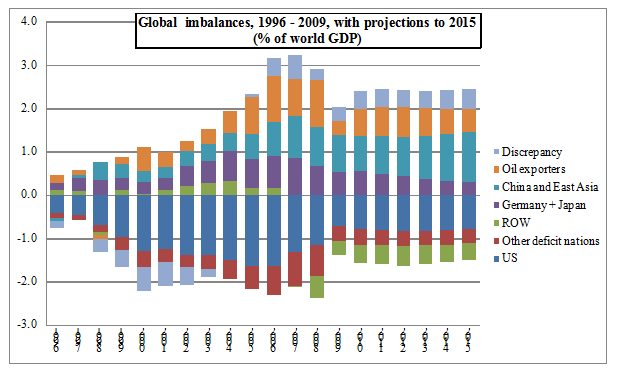
Suominenfig1

This week, I explained the issue of imbalances in my classes, as well as the general failure of the Seoul G-20. For all the talk of Korean ‘leadership’ at the G-20, it fizzled. Instead of leading by example to actually push through a deal, Korea ethnocentrically took the G-20 as an opportunity to grandstand to the world that “Koreans are great.” So self-congratulatory G-20 concerts took the place of any real leadership on the most obvious thing Korea could have done – finish the US-Korea free trade agreement (FTA) – to help unwind those imbalances. Instead, President Lee choose to sink the FTA at the behest of rabidly protectionist, consumer-punishing Korean auto and agricultural interests. So, with no help from Korea’s ‘world leadership,’ global imbalances have worsened this year.

So let’s go over this once again – with economic logic in the place of raw nationalism.

1. In a closed system, like world trade, some one needs to buy stuff. Everyone cannot export; everyone cannot run a permanent trade surplus; it is mathematically impossible. We cannot export to the moon or God. There must be global demand somewhere, and for much of the last two decades, the US was that anchor – so much so that we even re-packaged the business term  ‘buyer of last resort’ to apply to the US. So, as my students protested, it is true that the US government and consumers, as well as many EU countries, went wild in the last decade with their credit cards and created their own debt problems. But it is also true that without their demand, Asia and the Germans would have nowhere to export to. Now that the US and many other places are deeply in debt, it is obviously time to return the favor. The old exporters should become new importers in order to restore some balance to the system. ‘Diffuse reciprocity’ in trade is a basic requirement, in order that no one feels too much like they are being rooked by the other side. Without rough balancing over time, political disruption ensues (think Greece this year). This threatens the whole system in the long-term. Why is the Korean media too myopic to not see that?

2. The near permanent trade surpluses (above graph) in Asia are not, NOT, natural. It is mathematically all but impossible that a free-trade environment would return a situation where Korea, Japan, China and Germany would run 30 years of trade surpluses while the US ran corresponding deficits in the hundreds of billions USD. Why is this nearly impossible? Because the currency of such super-exporters would go up and up as their exports went up and up. In laymen’s terms, if the whole world wants to buy your stuff (Japanese cars, Korean TVs, Chinese everything), then the whole world needs more and more of your currency to buy all those amazing exports. So all those foreigners buying your stuff exchange their currencies for your currency. All this bidding to buy your currency (so they can buy your exports) means that the price of your currency goes up and up. So if you are permanently exporting more than importing, your currency should be permanently rocketing to the moon as foreigners scramble to buy it. Of course this has not happened. If you look at east Asian currencies, they all are pretty soft against the dollar, frequently moving downward. This is mathematically impossible to square with a permanent trade surplus. The only possible explanation is currency interventions to keep their currencies undervalued. In other words, cheating. And this is in fact well documented. China’s currency is pegged at a ridiculously low value to the dollar (estimates rage around 40-50% undervaluation!), and the Koreans and Japanese regularly ‘sterilize’ their currencies’ appreciation through massive dollar purchases. The Korean central bank’s euphemism for such raw mercantilism is ‘fine-tuning.’

3. Trade must be a two-way street in the medium-term, or the permanent deficit countries will eventually revolt. Here the Korean media is totally unhelpful with its nationalist and short-termist thinking that Korea’s success requires a surplus. This is also logically incorrect. There is no especial value to piling up dollars. Foreign currency cannot be spent in another country, so why stockpile hundreds of billions of dollars, or in China’s case, trillions, of someone else’s currency? If you don’t spend it back by importing, then at some point your export targets run out of money. And this is precisely what has happened in the great recession. The importers of yore are broke, and they need some of their dollars recycled back as export sales. But if you politically refuse to countenance a trade deficit by buying imports from your trade partners, then eventually you anger them: you are trade manipulator, and you provoke trade conflicts. Japan learned this the hard way. Its currency and trade gaming lead to two US backlashes – first when the US broke the Bretton Woods system and inflated in the 1970s, and then again the 1980s with the Plaza Accord. And this is what the Fed’s current quantitative easing is today. The US, unable to convince the surplus countries (esp. China) to import for the collective good of the system, is going to force them to do so, or they will see the value of their dollar reserves evaporate in inflation. Quantitative easing is a declaration of war by the Fed on the People’s Bank of China. This is extremely risky for everyone, as it throws the dollar’s reliability in the air, but it shows you just how head-in-the-sand obstinate the surplus countries are. In order to maintain short-term trade surpluses, they risk the inflation of the very currency they have stockpiled.

That Hysterical ‘Chinese Professor’ Ad from the 2010 Election Campaign

China’s own Heinrich von Treitschke!


This is a great ad. Anyone with an interest in Asian security should see it. Not only is it a great inside joke if you are in this area, it also does a great job capturing the American public’s angst about China’s rise. And quite honestly, it’s basically correct. We are spending our way into oblivion, and the Chinese are (deservedly) laughing as we fall into the abyss of our own making. We are doing this to ourselves – and Chinese elites are studying past hegemonies – so the scenario presented in the ad is, in fact, credible. Plus, it’s nice to see a professor presented in the US media who actually looks serious and authoritative instead of the usual Fox Network tropes that we’re pointy-headed, irrelevant Marxists who have affairs with our students. Now if only that professor image could include Americans…

There is some grumbling that the ad is racist. A friend in the field suggested it replaces the bogus Japanese threat 20 years ago with a Chinese one today. But I don’t really see that myself. The concern of the ad is not the ‘yellow-peril,’ but American foolishness, and the Chinese are presented rather well actually. The students look serious, civil, and healthy, while the prof behaves and talks like he actually knows wth he is talking about. Contrast that with typically condescending or idiotic portraits of academics in the US media – think about the ridiculous professor sequence from last year’s Transformers 2, e.g. At least this guy actually moves and speaks the way we really do in class. Ok, well, maybe he is a little more like Heinrich von Treitschke than most of us are, but still, he looks like a pretty good lecturer. Think of him as the Chinese Leo Strauss or something. LOL. I imagine that his class would be pretty fun to take. Fallows’ treatment of the ad is worth a look too.

More seriously, the ad is right on target actually in its basic claim. American errors and profligacy are the makers’ real targets; it is not ‘Asia-baiting,’ although it may feel that way initially. If it gets Americans to think more seriously about the looming debt crisis and the seriousness of the Chinese challenge, so much the better. Certainly the Tea Party, for all its sturm and drang, has neither the guts nor focus to say anything meaningful about the US response to Asia – another one of its many failures of seriousness. Nor does anyone in official Washington really know how to rein the $1.3 T budget deficit – funded, incidentally, by massive borrowing from China – without huge tax increases and spending cuts. (Quick note: It’s mathematically impossible!, which is why no one has any idea.) So if we must scare Americans into budgetary seriousness by noting that China is breathing down our neck (which they are starting to), then so much the better.

Finally, it is worth noting that China is a much more serious long-term threat than Japan ever was. China is 10 times larger in population (and 4 times larger than the US), and it is not democratic. So while I wouldn’t want yellow-baiting, ads like this that prick America’s unipolar daydream are useful actually.

Japan is an EU Country Trapped in Asia

japan_us_flag

The Council of Foreign Relations blog, Asia Unbound, is quite good. If you don’t read it, you probably should before you read my stuff. To be sure, CFR is establishment; indeed, it is the very definition of the foreign policy establishment in the US. So it is not exactly the font of challenging new ideas. But still, they are linked into power in way that lonely academic bloggers will never be. And this week’s bit on Japan really got me thinking about how Japan is basically stuck with the American alliance indefinitely, whether they like it or not.

Recall a year ago when the LDP got whipped in the election, that there was lots of talk about how Hatoyama was going to create distance between Japan and the US, how this was a new dawn in the relationship, how the Japanese left would be so much more prickly with the US than the old boys network of the LDP. I was fairly skeptical of this at the time, and I think the recent flap with China over the islands has done a lot to confirm that skepticism.

Japan really has nowhere else to go but the US. It is stuck with us, primarily because it is geographically fixed in a neighborhood where it has no friends. And this opens all sorts of room for the US to push and bully Japan, which leads to regular Japanese outbursts that Japan needs to be independent of the US. (For the most famous, read this.) In fact, Japan is like a post-modern EU country in the wrong place. It should be comfortably ensconced in a post-national intergovernmental framework like the EU, where it could promptly forget about history and defense spending, and worry about how to care for its rapidly aging population – like Germany is morphing into ‘Greater Switzerland.’ But it’s not. Instead, Japan is trapped in modernist-nationalist-historical Asia, surrounded by states that don’t trust it and who want a lot from it that it doesn’t really want to give (historical apologies, imports, engagement, development aid, territorial compromises).

Consider that Japan, like China or Russia, has no friends or allies (save the US), and lots of semi-hostile neighbors:

Russia: Neither side has much interest in the other. There is an island dispute that has blocked normalization for decades. And, of course, Russia has been an erratic partner for just about everyone, not just Japan, since the end of the Cold War. So there is nothing to gain there.

Korea: There is also an island dispute with South Korea, over which even North Korea (!) has supported the SK position. NK kidnapped Japanese citizens in the 70s, and this has remained a permanent fixture in Japanese politics. For the North, Japan is high-up on the hit list; the North has launched missiles over it. Relations with the South are possibly even worse. S Koreans are intensely japanophic. The island dispute (Dokdo) rouses extraordinary passions here. Finally, of course, both Koreas are furious with Japan over its invasion and colonization from 1910-1945 and feel that Japan has never properly apologized.  Given how much S Korea and Japan share – democracy, concern over China’s rise, a US alliance, fear of NK, Confucian-Buddhist culture – they should should be natural allies, but Koreans will tell you with a straight face that Japan wants to invade it again. So forget that.

China: Yet another island dispute plagues the relationship from the start. And like Korea, so does history. The Japanese were even harsher in China than they were in Korea. The Rape of Nanking was brutality on par with the Nazis, and the Japanese used biological warfare against the Chinese as well. As the CFR post linked above notes, anti-Japanese street protests are becoming a regular part of Chinese politics now. A Sino-Japanese reconciliation would require astonishing, Willy Brandt-style statesmanship that the immobilist Japanese political system is wholly incapable of delivering.

Southeast Asia/India: Things get a little easier here, if only because it is further afield. But the ASEAN states too suffered under Japan in WWII, and like China and Korea, don’t feel that Japan has engaged in the appropriate historical reckoning. Only India is a possible serious Asian ally of the future because of mutual concern for China and the lack of historical-territorial problems.

Bonus problem – Economic Decline: As if this unhappy neighborhood weren’t trouble enough, add in Japan’s bizarre economic malaise. When China, Korea and the Soviet Union/Russia were a mess a generation ago, Japan could strut in Asia, but now these competitors are closing the gap while Japan stagnates. That just makes all the frictions that much harder to manage. China is so big, it can afford to miff the neighbors, but Japan no longer has this luxury.

In short, a weakening Japan so infuriates it neighborhood, that the US is all its got left. Given Japan’s paucity of options, the US has lots of room to bully and push Japan. But it must ultimately give in, because it’s position in Asia alone would be terrible – isolated, suspected, friendless. So bad is Japan’s position, that the US could effectively bring down the Hatoyama administration over something as minor as Futenma.

This is not meant to be an endorsement of US wedge politics against Japan. But it should certainly explain why its 20-year old complaint about US dominance has led to nothing, just like Gaulle’s petulant withdrawal from NATO ended in ignominy when the French finally gave up on ‘expectionalism’ and rejoined last year. It’s nice to be two oceans away from the competitions of Eurasia…

Nobel: Occasionally Reminding China about Human Rights is still Good

Nobel

By now everyone one knows that Liu Xaibao won the Nobel Peace Prize. He is a human rights and democracy activist rotting in a Chinese prison, along with so many others, for laughable, ‘only-in-a-dictatorship’ crimes like ‘insulting the state and national dignity.’ He is most famous in the West for starting the ‘Charter 08,’ probably the most important liberal outburst from Chinese civil society in this decade (and a nice counterpoint to the ‘national humiliation’ nationalism otherwise showcased by the Chinese Internet). Predictably China was acerbic; it threatened Norway (!), because, of course, we all fear Norway rising and its rogue unilateralism. It is worth noting that the Norwegian government does not assign the prize; the independent Nobel Foundation does.

The flap tells us a few things:

1. I am not sure if we should laugh about the Norwegian threat (threatening the Green Nordics who give lots of development aid, have a globally envied living standard, and no military – lol) or lament (Chinese bullying now extends to NATO – yikes). But the Chinese overresponse fits its recent behavior in the South China Sea and toward Japan (as well as NK, I bet; it’s just behind the scenes, so we don’t see it), as well as its now system-threatening monetary interventions and downright bizarre head-in-the-sand denials about the Cheonan sinking. Now it is ok for rising powers to be tvetchy. We expect that. But if the Chinese keep up the bullying, then lots of westerners (think the Kagans) who can’t wait to label China a threat (in part because so many have predicted it) will claim that Chinese foreign policy has taken a major, and nasty, turn. For a long time, China’s claim to a ‘peaceful rise’ rested on its ‘Good Neighbors Policy.’ As Dave Kang has pointed out for years to the ‘China threat’ school, China has generally sought good relations with its neighbors. It has (previously at least) tried to settle border disputes peacefully (most importantly with Vietnam) and has generally sought to be a good institutional player in all those various East Asian semi-organizations like the EAS, ARF or the Six-Party Talks. US business lobby has generally used this to defend engagement with China, in an important pushback against the US military, especially the navy, which is both nervous (a possible peer competitor to break the Pacific-as-American-lake) and secretly hopeful (at last a symmetrical contestant we can understand! unlike all these noxious terrorists against whom our super-cool aircraft carriers are useless). In short, if the Chinese aren’t careful and step back here a bit in the next few months, they could find themselves seriously ringed in. Quick Prediction: the Chinese aren’t stupid. Unlike OBL, they don’t want to take on the whole world. They will pull back, and in six months we will be talking once again about the ‘unpredictable swings in Chinese foreign policy.’

2. I am pleased to see this issue back in discussion, after a decade of quiet. Everyone recalls what a big issue this was in the 1990s. I remember Jay Leno even once had a Chinese-American who had been arrested there on his show. And human rights (and labor) was the big stumbling block behind permanent most favored nation status for China under Clinton. Of course no one wants a war or another cold war, but it is also clear that western engagement can’t just be all flattering and desperate (please keep buying US bonds). Sometimes we need to push them hard on political change too. This is an obvious danger of mixed or contradictory signals – we want to work with you, but we will antagonize you too. But in fact, we do want both. When western governments push for change, it sends the Chinese off the deep end; hence neither Hillary nor Timothy Geithner challenge China on liberalization much anymore. In the end, Google too gave-in (rather disappointing that actually). But western NGOs like Nobel or Amnesty International can also send the other message – that our values are important, that we are genuinely uncomfortable dealing with dictatorships even if we don’t want a cold war, etc. So I think flaps like this, of the earlier Google one, are useful. They tell China that they are limits and expectations – mild, to be sure – that it will lighten up a little on the nationalism and repression. In short, after one experience with a superpower that stepped all over its people and bullied the neighborhood, no one wants to go through that all over again. And the Nobel reminds the CCP leadership of this.

3. Finally, after last year’s ridiculous Nobel choice, this year’s was smart and helps restore the Peace Prize’ good name. In fact, I bet the Foundation figured that after such a light, gauzy choice for Obama, credibility demanded a really tough choice this year. And few human rights cases are harder than China. Like most observers, I applaud the choice, but I am also glad, because I think the prize is a useful weapon in the struggle for human rights and liberalism. It shows up the glaring failures of places like Burma, apartheid South Africa, and China, and tells their elites that the West isn’t always looking the other way for business contracts. So here, here to the Foundation for such a strong choice. My quick choice for next year: Morgan Tsvangirai.

China, Japan, and these Fights over Islands

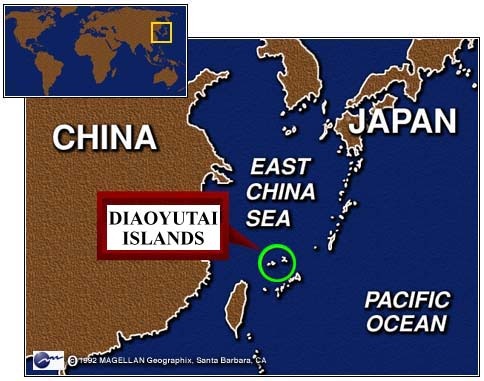
diaoyut


There has been lots of good commentary recently over the China-Japan flap about the fishing captain. (Start here and here.) I tend to agree that China is setting itself back 5 to 10 years with the neighbors, and that this is the somewhat predictable behavior of a ‘rising’ state. Just about everyone expects China’s appetites to grow as its power grows. It is reasonable to expect China to get pushier in its backyard as it grows, just as the US did in Latin America in the late 19th century. I have just a few extra thoughts:

1. All these left over island disputes leave China (and Japan, Korea, Russia, and ASEAN) with lots of friction points. Just last week, the Japanese told the Russians not to visit their disputed islands either. The standard liberal internationalist answer would be to create some joint committee (indeed, boundary demarcation is one of the few things the World Court does well) to iron out the details. But this has never really happened out here, as it has in other places, like South America, where geography also created confusion. (In SA, it was the highest peaks of the Andes that made the lines unclear.) But in Asia, I have the sneaking suspicion that these island/sea disputes never get resolved in part, because domestic elites don’t really care that much; indeed they may like having them around once in awhile for patriotic rallying purposes. They serve an unremarked domestic utility: These disputes are low cost. They can simply be ignored when necessary. A few rocks here or there have no real economic value; according to UNCLOS, if the rocks are uninhabitable without external provision (ie, food and potable water must be transported in), then possession of the islands has no impact on the claims to the surrounding water either. That is why fishermen so frequently seem to spark these flaps; the seas are wide open to everyone. But because these conflicts-in-waiting are always still hanging around, they can be turned on and off at will – whenever domestic leaders need a rally-round-the-flag effect. This is probably especially useful for deeply illegitimate regimes like China or Russia, or in Japan with its endless rotation of governments in search of credibility. In this, I am reminded of the oft-made accusation that Israel’s Arab neighbors don’t really want the Palestinian-Israeli conflict resolved, because it is a nice deflector of public unhappiness at home.

2. One unremarked deep cause of these flaps is Japan’s slow erosion. Most of the excitement focuses on rising China. But just as important is the steady decline of Japan. If Japan were still rising, as it was until the 1990s, the competition here would be quite different – two rising powers side by side (like India and China). But in the western Pacific, China is walking away with the game because both the US and Japan are in decline, and ASEAN remains in its perpetual disorganized dither. This would create space for China, even if it weren’t booming. But it is, hence doubling the power shift. In fact, this is the weakest Japan has been vis China since the Opium War upended China-Japan relations 170 years ago. This is the most important Asian balance of power shift since the West arrived in East Asia. We are moving back toward the 18th C (not the 19th), when China was dominant in the neighborhood.

3. The Chinese leadership is increasingly boxed in by nationalized opinion. 20 years of patriotic reeducation on the national humiliation has created an unhappy nationalistic youth in China with prestige grudges against Japan and the US. As China gets wealthier and more connected, it will become harder and harder for the CCP to avoid dealing with this, and these island fights are a useful outlet, per point 1 above.

4. China will have a harder time carving out a backyard than the US did. Latin America has been weak for centuries and the rest of the world was far way, so there was an easy vacuum for the US to fill. In Asia, China is next to India, Japan, South Korea, and, a bit further out, Australia. All of them have a much better capacity to push back than Mexico, Argentina, or Brazil ever did. (PS: The Economist says the Monroe Doctrine is dead now. I don’t buy it.)