My ‘Diplomat’ Essay on whether these Youth Protests will Spread to Asia’s Democracies

Brazil

Here is a re-post of my July contribution to the Diplomat web magazine. It expands on a brief observation I made a few weeks ago – that a lot Asian democracies have the same characteristics that seem to have driven people into the streets in Brazil and Turkey.

Here is the best critical response I’ve gotten so far. In brief, it argues that my conditions for the revolts are so widely drawn, that arguably lots of states could see these kinds of revolts. That is a good point. And many of the commenters that the Diplomat said something similar – that Cambodia, Malaysia, and Thailand should also have been included in my piece as possibilities. I singled out India, the Philippines, and South Korea. I’m not a big expert in the area of modernization and contestation, so thoughtful comments would be great. Here we go:

Continue reading

My ‘Korea Times’ Op-Ed on what Korea Needs from its New Prez: Liberalization

ParkBefore President Park’s inauguration, the Korea Times asked me to participate in a forum of ‘foreign experts’ (don’t laugh too hard) on her incipient presidency. We were asked to make one direct suggestion for the new president. Here is the section at the KT website. I know several of the authors, and some of the op-eds are pretty good (too many are shameless pandering though). Unfortunately, my accepted submission was not published in this section, published after the inauguration, and edited far too heavily. (They never told me why; maybe this.)

Anyway, below is the original version of the op-ed, where I basically argue that Korean democracy is becoming a Seoul-based oligarchy of wealthy, similarly-schooled, intermarrying business and political elites  – basically the dark side of Kangnam style. Someone in Korean politics needs to turn this around, or under-40s in this country are going to ‘drop out’ Timothy Leary-style. There’s a quiet crisis of youth alienation brewing, but no one in ‘Kangnam world’ seems to care.

Continue reading

Admit it: South Korean President Lee Myung-Bak Was Pretty Good

PD*26038004

So President Lee has been out of office for a bit now, and the retrospection will begin soon. And while he left with really low approval ratings, I always thought that was pretty unfair. I am pretty sure history will be kinder to him than the SK public was during his tenure. Particularly the growing critique on the South Korea left that current President Park Geun-Hye’s many staffing gaffes means she is out of her depth also suggests that LMB was at least ready and professionalized enough for the responsibilities of the office. The essay below is a longer version of an op-ed I wrote for the JoongAng Daily.

In passing, I should say that yes, I am aware that this is the sort of column that drives folks like Glenn Greenwald, whom I really admire, up the wall. If you’re convinced, like my students, that I’m a conservative pretending to be a moderate, here’s your evidence. Call it shameless right-wing hackery, sycophantic shilling for the powerful, craven attention-seeking, but it’s also true: Lee Myung Bak was a lot better than most Koreans give him credit for and is probably Korea’s best president in its democratic history.

Continue reading

My ‘Newsweek Japan’ Cover Story on the post-1979 ‘Asian Peace’ & Economic Miracle

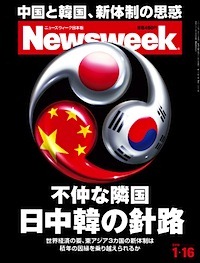
Newsweek 3rd coverNewsweek Japan asked me to write an introductory essay for its January 16 special issue on tension in Northeast Asia (cover story to the left). I should have put this up 4 months ago, but I forgot and the arguments are still valid. Anyway, here is the link in Japanese, but I thought it would be useful to publish the original, untranslated version as well. (If you actually want the Japanese language version, email me for it please.)

The essay argues that Northeast Asia has benefited enormously from an ‘Asian peace’ in the last 35 years. All the remarkable growth in China and South Korea (as well as India and Southeast Asia) would not have happened without it. So fighting over some empty rocks (Liancourt Rocks, Pinnacle Islands) is a terrible idea. And for political scientists, the current Sino-Japanese tension is a good test of the hypothesis that economic interdependence brings peace. It’s fascinating to watch China especially try to figure out just how much economic gain to forego in pushing Japan over the Pinnacle Islands.

This was intended for their print edition, so there are no hyperlinks included in the text. Here we go:

“1979 was an important year in modern East Asia. It captures two of the region’s most important trends. It was the year of both the last serious military conflict between two East Asian countries – a Sino-Vietnamese border war – and the start of China’s capitalist modernization under Deng Xiaoping. These moments usefully frame the following thirty-four years: much of Asia has gotten substantially wealthier, and no major conflicts have broken out to upset that upward economic swing. This magnificent regional achievement has catapulted Asia, particularly East Asia, into the center of world politics.

Continue reading

Final Iraq Post – from the Archives: My 2007 Essay in Support of the Iraq Surge

iraq_multiple_fatality_bombings_by_type

Back when I was at Ohio State University in graduate school, I was solicited by a friend to write for a start-up journal in political science, the OSU Journal of Politics and International Affairs. My essay is no longer findable through their website – their archive doesn’t go back to the first issue – but my essay at the time was on the surge debate. Given that I’ve been talking about Iraq for the last month here, I thought I’d put this up; it’s not available elsewhere anymore. This is the unaltered text from the spring 2007. I feel like I did pretty well actually. I still agree with most of what I wrote 6 years ago in the midst of the war’s worst days:

One Last Chance in Iraq for a Sustainable War on Terror

The sense that the United States is losing the war (or more precisely, the peace) in Iraq is palpable. The cable news networks are filled with images of burning cars and markets. The Bush administration seems almost paralyzed – reciting only bromides about freedom and democracy as the long-predicted post-sovereignty civil war seems already to have begun. New York Times pundits like Paul Krugman and Thomas Friedman increasing see a negotiated, half-and-half, ‘at-least-its-better-than-Saddam’ outcome as the most likely scenario. Centrist/liberal supporters of the war, like the Economist and the New Republic are publishing a flurry of criticism that we are ‘losing the peace’ despite having won the war. Even conservatives like the Wall Street Journal and the Weekly Standard, stalwart defenders of the war, have backed away from higher hopes of a democratic, liberal Iraq which the President outlined.

But the growing Iraqi withdrawal debate is wrong-headed. The pullout mooted by such diverse figures as Senator Charles Hagel, Jon Stewart, and Cindy Sheehan would be catastrophic, and our growing national fantasy with its imminence is hazardous. It creates an unreal expectation that ignores the probable post-withdrawal bloodbath, emboldens the insurgents to hang tough, gives false comfort to military families especially, and tempts the Democrats to abdicate responsible policy input for cheap political shots.

Continue reading

Iraq 10 Years Later (3): Why the Neocon Theory behind the War Failed

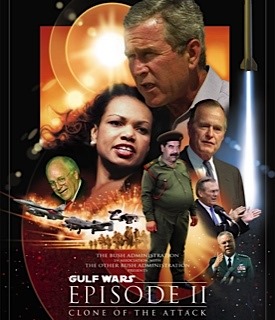
gulf_war_poster1

Here are part one and two of this post.

The arguments below expand on my second recent JoongAng Daily op-ed on the Iraq war.

My first post on the Iraq War asked if academic IR had any responsibility to slow the march to war.

The second tried to formulate what the   neoconservative theory of the war was, because many of us, in retrospect of a conflict gone so badly, desperately want to un-remember that there really was a logic to the war, that it was at least somewhat intellectually defensible, and that a lot of us believed it. We may want to retroactively exculpate ourselves by suggesting it was just W the cowboy acting ridiculous, or a neocon hijacking of the policy process, or Halliburton oil imperialism, and all the other reasons so popular on the left. And some of that is true of course.

But it ducks the crucial point that the war was popular until it flew wildly off-the-rails, which in turn revealed the staggering incompetence of the Bush administration to act on the neocon logic the country had embraced by March 2003. In short, I argued that the Iraq invasion was not about WMD, preemption, or democracy, although that rationale was played up in the wake of the failure to find WMD. The real neocon goal was to scare the daylights out of the Arabs and their elites by punching one of their worst regimes in the face, thereby showing what was coming to rest of the region unless it cleaned up its act, i.e., crack down on salafism and liberalize so as to defuse the cultural extremism that lead to 9/11. (Read Ajami saying in January 2003 that the war is ‘to modernize the Arabs;’ that’s about as a good a pre-war summary of this logic as you’ll get.)

So what went wrong?

Continue reading

My Comments to al Jazeera TV on Park GH’s Inauguration as SK Prez


Despite the fact that Donald Rumsfeld supposedly wanted to bomb al Jazeera during the Iraq War as a jihadi propaganda machine, I have to say I find it a pretty good news source. It’s got a great documentary hustle that lazy incumbents like CNN don’t, and its Middle East coverage is far more balanced and fair than most Americans think.

Anyway, the vid is my quick thoughts on Park Geun Hye’s inauguration as South Korea’s new president. The quick sum: she can’t follow through on making Korea ‘happier’ unless she takes on the vested interests, especially the chaebol, central to her political coalition. I don’t think she can do that, and, honestly, I’m not even sure she wants to. So I would not expect anything big at home in her term; the right, the elderly, and business in Korea like the status quo, and they’re the ones that put her in office. And certainly, the social democratic policies of ‘economic democratization’ kicked around last year won’t happen meaningfully. That’s my prediction at least. I’ll have more in a few days when my contribution to a foreign ‘Korea analyst’ forum on PGH is published in the Korea Times.

For my previous TV appearances, go here.

USC-CSIS Conference on Korean Unification (2): ‘One Country, Two Systems’ will not happen

CSIS Korea ProjectHere is part one of this post. The following will make more sense if you start there.

I noted that I am participating, today in Seoul (attend if you can), in a USC-CSIS project on Korean unification. This is the final ‘phase’ of their Korea Project on unification.

I thought I would post my thoughts on the USC-CSIS Phase II report (available here) which provided all sorts of suggestions for reconstruction. It’s required reading if your area is Korea and NK, but I actually disagree with a fair number of the analogies to Iraq and Afghanistan. I think Germany is a better model for what will happen here, and I think a ‘one country, two systems’ arrangement like in greater China is nearly impossible given the extraordinary deep ideological divide, which is also existentially necessary for NK to demonstrate why it must be a seperate, poorer Korean state. So it’s either implosion or stalemate.

Anyway, the rest of my thoughts are after the jump. Having read the CSIS report is not a prerequisite to understanding my arguments, but it would help.

Continue reading

USC/CSIS Conference on Korean Unification (1): it will cost WAY more than people think

Cha_Challenges__110The University of Southern California Korean Studies Institute and the Center for Strategic and International Studies are running a joint Korea Project: Planning for the Long Term (pic to the left). CSIS will hold the last of three conferences in this project at the Asan Institute on January 21st next week. If you are in Seoul, you should go. The agenda looks pretty good. (Contact the Asan Institute.) I’d like to thank USC and CSIS for soliciting my participation..

The January 21 conference is actually the last meeting of the Project. The first meeting asked Korea area experts to look at unification; the second meeting asked functional experts to do the same. This upcoming third meeting will look at regional impacts from unification. I will comment on papers from Russia and Japan. I will put up my thoughts on those papers after the Phase III conference, but for now, I thought I would post my comments on the Phase II conference (by the functional experts).

Basically I argue that  Germany is a better model for what will happen here than either the occupations of Iraq or Afghanistan, or LDCs in transition. Also I don’t buy for one second that NK will enter into a meaningful ‘one country, two systems’ arrangement like in greater China. DPRK change meaningful enough to permit a federation would be so far-reaching, that it would inevitably raise the question why the DPRK  exists at all. Ideological change is an existential threat to the regime: why be a poorer version of SK if you’re in a federation with SK? why not just join up? This is the logic that undid the GDR. So it’s either implosion or stalemate IMO.

Here is the final CSIS report on Phase II (a must-read if you want to research unification); my gloss on that follows the jump. (Here is the much shorter Phase I report.)

Continue reading

Korean Foreign Policy Year in Review 2012: So Many Grievances… (UPDATED in response)

dodko

(I updated/lengthened the last section, after the jump, to respond to some of the criticisms made.)

Daniel Tudor, the Korean correspondent of the Economist (full disclosure: we are friends), just wrote a book on South Korea where he argues that Korea, despite all its success, is a discontented society. This is exactly right. (Here is a good review of the book.) Despite growing rapidly in just a generation, and capturing some global profile with things like ‘Gangnam Style’ or well-known products like Samsung gizmos, Koreans continue to have wildly unrealistic expectations of global interest in their small, linguistically unique (and difficult to learn) country culturally similar to enormous China. This generates constant geopolitical disappointment, per Tudor, and outsized sensitivities over foreign criticism – e.g., the widespread urban legend here that no Korean has yet won a Nobel Prize, because the committee is staffed by anti-Korean racists, or read this.

Four events in 2012 really seemed to capture the chip on the national shoulder, which ideally would serve to recommend a little modesty instead of yet more nationalistic grievance (but that won’t happen):

The Olympics: Some KOC official said on TV that Korea needs to ‘improve its Olympic diplomacy’ (whatever that means), even though it won a huge haul of medals for a country so small. India has more than 1 in 7 of the people on the planet, while Korea has .007%, but I guess the fifth highest pull of golds and ninth highest overall was a conspiracy of the Anti-Korean Olympics or  something. What is it with the endless chip on the shoulder? As Evan Ramstad put it, Korean officials once again had to come off sounding arriviste and aggrieved, rather than balanced and modern:

“Even so, a government sports official could be counted upon to again declare that South Korea was at last among the world’s great nations instead of recognizing that it has been there for awhile now. Second Vice Culture Minister Kim Yong-hwan was quoted in local media saying the performance in London meant that South Korea could “join the ranks of advanced nations in terms of sports and culture” and “has leapt into a higher level not only in the field of sports but also in culture and arts.”

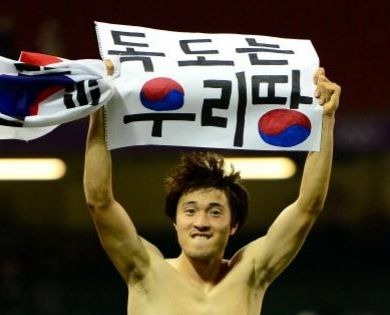
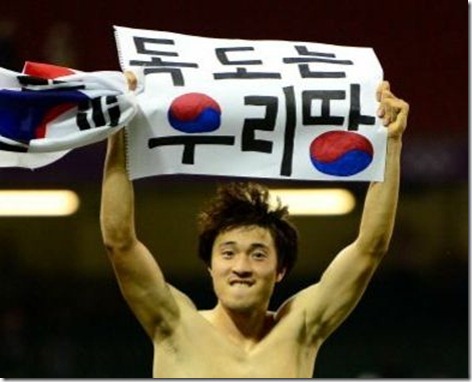
And we had to spoil the Olympics too, with tiresome Dokdo posturing too (pic above).  That the placard violated the apolitical Olympic spirit is obvoious, but no major Korean figure came forward to denounce that action. *Sigh*

Continue reading