Apocalypse in Asia (2): Yet Another Idiot Video Portrayal of Academia…

No one in academia talks this way to undergraduates…


In this website’s continuing tradition of reducing difficult issues to ridiculous YouTube videos (here, here, here ), the above is a nice follow-up to my previous post on teaching the Apocalypse in Asia. Didn’t you know that American academics regularly berate their students’ beliefs, plot against Christians on campus, and openly criticize students’ parents to their faces? Enjoy the above for the ideology, but maybe the director should sit in on an actual class sometime…

Back in the 1990s, I worked for moderate Republicans and donated to GOP candidates; my 1996 vote for Bob Dole for president is still the most heartfelt vote I ever cast. So I still get the occasional right-wing email, and none better than this recent one pitching the movie above:

Fellow Patriot–

I wanted to forward this message about The Genesis Code, the conservative movie of the year! It deals with some important conservative issues that deserve to be discussed: the intersection of faith and science, the right to life, and discrimination against people of faith in American higher education.

When paleontology student Kerry Wells is told by an academic advisor that she’ll need to choose between her faith and her career in academia, she begins a search for truth that will touch the hearts and minds of everyone around her.

Despite the fact that university studies are purported to be a marketplace of intellectual diversity, Kerry’s constant inquiries in class and involvement in Christian campus ministry lead the faculty to consider her unfit for a life of science. Can her determination and academic talents overcome the department’s prejudice against religion?

For the actual website, try here. To be fair, I have not yet seen the film.

For Asian readers, I post this stuff once in awhile just so you have a sense of where the bizarre US stuff you see in the news comes from. I get lots of questions out here like, wth Palin is about, what is up with loopy Tea party, why do Americans think Obama is Hitler, etc. I have warned before that the American Right’s extreme reaction to Obama’s election is delegitimizing America’s global leadership. Why would anyone follow the US when 1 in 3 Americans think Obama is a Kenyan imposter or something? Not only is all the paranoia unnerving in itself, but it has real foreign policy consequences – namely that the rest of the world – which US conservatives claim we lead – thinks we are batty. The above vid is yet another demonstration of the kind of creationist idiocy that Asian science institutions simply would not tolerate.

I also feel compelled to note the unbelievably ridiculous portrait of academia yet again on display in film. That Chinese professor ad (plus Dr. Strangelove, Wargames, and Fail Safe) got people thinking we are fascists; network TV shows show us regularly sleeping with our students; Indiana Jones and Michael Crichton make us into skilled gunmen and adventurers; Bret Easton Ellis thinks we’re lazy druggies (also sleeping with our students); Michael Bay apparently thinks we can rant out authoritarian sexual innuendo without students/faculty noticing or caring;  the Social Network treats us as behind-the-curve prigs; in Animal House, we’re tedious ballonheads; Tom Clancy turns us into lefty traitors; and of course the absent-minded professor is a stock character across media. In the Christian apocalyptica genre, we are written in as postmodern stalinists responsible for tyrannizing our conservative students (while secreting pining to sleep with them presumably) and de-Christianizing America.

Yet none of this even close to accurate; I am still waiting for a movie with professors who actually look and talk like what I know. I’ve been in academia for more than decade and my father’s been in it for 40 years, and I can’t think of one good movie that actually shows what professors really do and how we really interact with our students. Sure, individual professors do dumb things, but I challenge anyone to find quantitative data to support the classical stereotypes listed above, much less the Christian right view that university is some kind of liberal concentration camp. The portrayal of the professor in the media is so routinely inaccurate, I feel compelled to say something, especially to the Christian righties who are convinced we’re tenured atheists stripping patriotism and faith from students. To see what we really do, in all its boring, nerdy scholasticism, take a look at the sort of dry, Tylenol-PM-in-print articles that fill the Chronicle of Higher Education.

The vast majority of our time is spent in fairly mundane office work – meetings, grading, research. Most of the professors I have known take this stuff reasonably seriously, and come to work on time and dressed properly to do their jobs with no more or less level of commitment than other knowledge workers. Yet almost no movie portrayals of academia actually show this; the most realistic portrait of higher education I have seen in the last few years in a film was in Knowing. I have never known a colleague who slept with a student or schemed against them, lost his a glasses on his forehead, got in wild adventures in the field, or fought ideological wars against student groups. The latter can get you in a lot of trouble, as students have grievance recourses the above vid clearly doesn’t show.

Very rarely do we get students coming to our office to simply to talk about ideas and life and what not; the Kerry character described in the third quoted paragraph is extremely rare. Far more common student behavior, and real issues that universities grapple with, are illustrated here or here. When students do come to see us, it is usually some need or grievance: grades (why did I get an F even though I never bought the book?), attendance (can I get the last 4 weeks of classnotes?), recommendation letters (how can I get into Yale on 2.5 GPA?). And we certainly don’t get into personal criticisms and harsh career counseling like in the vid above. The professor’s behavior is shockingly unprofessional, and I dare the director to find real evidence that this is common.

My point is that, yes, we are usually secularist, not Christian, and cosmopolitan, not nationalist. But students almost never come to our classes to fight for God and nation against us. Their needs and concerns are far more banal and everyday. Far more of our interaction with students is coaching them through hard material (I know you loathe the book, but Wikipedia is not really a substitute), trying to professionalize them (you can’t just cut class for a week or two and expect a bailout), begging and pleading with them to read (cliff notes are a high school gimmick you have to give up now), encouraging them to study and not just party away the four years (even though we did that too). It’s a lot more about management, mentoring and helping than about ideology. And if students raise their hand to discuss God and evolution, our response is to rejoice that students want to participate on a meaningful, exciting topic, not to stomp on them like some KGB of atheists.

So please, before yet another insulting, idiot, ideological, or conspiratorial portrayal of academia, someone make a movie that actually looks like college. That would be a real ‘revelation’…
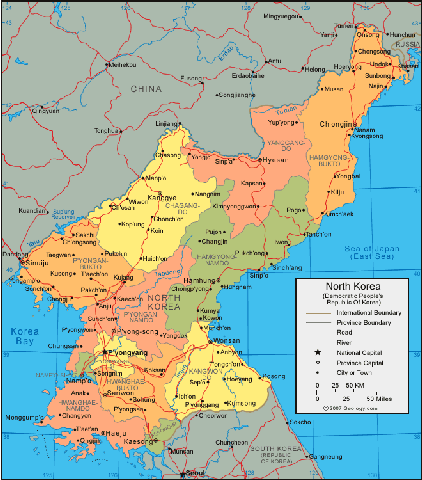

Post-Unification De-population of North Korea?

north-korea-map

PNU’s Institute of Social Science Research had a good speaker this week, demographer Berhard Koppen of Landau-Koblenz University in Germany. His talk, “Demographic Change and Immigration in Germany since Unification,” focused on the population impacts of German unification. As you can imagine, the Koreans study the German model (although not as much as you’d think), because they wonder what unification will look like – how much, how long, how disruptive, etc.

Koppen laid out a lot of good demographic data on just how extreme the population shifts from east to west inside Germany have been. I don’t have all the numbers in front of me, but it was pretty striking. In the most underdeveloped parts of the old German Democratic Republic (GDR), the population drop was more than 40% in two decades! In toto, the old GDR is 20% below its old population, despite the move of the capital to Berlin. So bad is it, that many east German communities have had to bulldoze housing, because it has simply sat unused for more than a decade (this, in country with one of the highest population densities in the world).

I have written about the geopolitics of Korean unification before. In short, they are not good, because China is much stronger than the USSR was in the German case. SK is weaker than was the Federal Republic of Germany (FRG). The US is also relatively weaker. And NK is far worse off than the GDR, which was regularly touted as the most advanced socialist state. All this forebodes that China’s role in unification will be much greater than the Soviet Union’s. As Koppen put it, the wealthy FRG could effectively ‘buy’ unification from the bankrupt USSR. China today though is ‘rising,’ and given the NK borders China, its interest and influence in the issue are correspondingly greater. As I wrote a year, China will structure any final status Korean deal much more than most people think right now (and the Chinese were sure to tell me that in Beijing earlier this year).

If this doesn’t scare South Koreans enough, Koppen’s data quieted the room. When I asked about the comparison with Korea, and what Koreans should expect, he could only foresee that a sudden border opening would lead to a huge southward flow – maybe 6 million people in the first few years. The differences between east and west Germany were much smaller than NK-SK, yet look at how much population flight has been happened there. One can only imagine how bad it would be here – a 40% depopulation of NK (9 out of 23 million), perhaps? Where would they be housed, how would they be supported, what would they do all day? The questions are endless.

Koppen closed by arguing that a slow federation of North and South would be better than the lightning unification of a sudden border opening as in the German case. Koppen used the EU as a model for Korean unification (an interesting parallel I never considered). As the EU is gradually federating in stages, so might Korea. I have heard this line of reasoning before using a more Asian model – Hong Kong and mainland China. Like that arrangement, perhaps Korea can go through a ‘one country, two systems’ stage. So North Koreans would get temporary work and living permits in the South, while Southern business would be encouraged to go North, with the North reconceived as something like a massive enterprise zone.

I am skeptical for a number of reasons:

1. North Koreans are vastly poorer than not only east Germans, but any of the eastern EU members. The moral pressure to do more faster would be enormous. Paced unification would look like Southern niggardliness in the face of desperation and poverty. Note also, that Hong Kong is quite wealthy, as is surrounding Guangdong province. This helps mitigates the border pressure; the opposite would be the case in a united Korea.

2. The nationalism factor would make holding the North at arms length difficult and distasteful. If the Koreans are one minjoek, as they never cease to tell us expats here, then how can you justify, save unashamed selfishness, keeping Northerners out? It looks bad, and it would certainly encourage populist North Korean politicians to complain about Southern cheapness, etc.

3. Keeping the North in some kind of semi-national limbo would encourage Chinese meddling. Indeed, the slower the unification process goes, the more likely China and others are to stick their noses into it. Conversely, if unification speeds along as a chaotic mess, then even China will likely say, we want nothing to do with the catastrophe-in-the-making; you South Koreans figure it out. This sounds unfortunate – the more anarchic the reunification, the more likely it will be a Korean-only affair, but I think it is so.

4. And in fact, Korean unification is almost certainly going to be messy, rapid, and chaotic if not downright anarchic. If one looks at Germany, once the communist lid was removed, the desire for unification on the part of the east especially, but also the west, exploded and became like a freight train accelerating downhill. It was just unstoppable. Yes, there were all sorts of GDR intellectuals who wanted east Germany to become a unique space, neither capitalist nor communist, but somehow ‘more humane,’ and all that. But the huge bulk of the population wanted nothing to do with such academic airiness, a luxury for elites. Average east Germans wanted nationalism, unity, wholeness, an end to an awful, artificial historical division, and an immediate improvement in living standards. They just pushed aside all those both internally and externally (Thatcher and Mitterand especially) who wanted a paced process. Helmut Kohl led reunification as much as he was led by it. And even though the GDR was supposedly ‘advanced’,’ it turned out not to be at all. The state collapsed almost immediately, and realistically, there was no one to pick up the many, many pieces expect West Germany. I think this is by far the most likely scenario here too. Once North Korea slips, it will go lightning fast. It will be chaotic, unpredictable, with huge national emotions at play and populations on the move, and near anarchy in the North, given how thoroughly illegitimate the state there is. The only realistic way to get control over this nation-wide meltdown will be the immediate extension of SK constitutional authority across the whole peninsula. It will be messy, hugely expensive, and involve the dramatic depopulation of the North, but realistically, I don’t see serious alternatives given how much worse off NK is than Hong Kong, the GDR, or eastern Europe.

Cheonan Sinking Changes Nothing: Kor. Inst. of Defense Analysis (1)

menubar_toplogo

Another week, another North Korea conference. It amazes me just how much we (in Korean IR) talk about this issue. It is a never ending thrill-ride. And it is not just academics. I meet military, intelligence, even literature and photography experts (deciphering NK propaganda) from the US, SK, and Japan regularly. If you thought the GWoT created a defense-intel-IR gravy train in the the US, try Korea’s never ending circus on what to do about NK. It’s a cottage industry military-industrial-academic complex all of its own. Honestly, I wonder if we’ll all miss NK when she finally goes. Shamelessly, of course, I too am a part of that circus. Part of me understands obviously. The US doesn’t live next to the wackiest, more dangerous state on the planet. But still, I am amazed just how much of my time goes into this issue because of the simple fact of teaching IR in Korea.

So this week, the Korean Institute of Defense Analysis (KIDA) held its conference on what has changed since the sinking of the Cheonan in March. Here is my previous thinking on this. Here is the ROKG final report on it, clearly blaming NK. KIDA is a great institution, with really high-quality material and a super SSCI journal. So off I went to talk about this with the usual suspects of intel, military, diplomacy, academics, and the rest.

So now, 6 months out, tempers have cooled. No one is talking about air-strikes anymore. So what have we learned?

1. We didn’t learn much about NK. We already knew that NK is erratic, prone to savage, but limited outbursts, shamelessly denies everything, and uses external military-intel actions for internal in-fighting purposes. The tree-cutting incident, the cabinet bombing, the KAL bombing, and Cheonan sinking all show these characteristics, as well as the smaller incidents like the sub penetrations or Yellow Sea skirmishes.  So yes, the regime may be attributing this to the new boy-king, Kim Jong-Eun,for internal promotion purposes. But while that is important, it is not new. We didn’t see much we haven’t seen before.

2. Regarding the cause, we still don’t really know. I tend to agree that Jong-Eun (Kim III) is being given some accolades to establish him. But the larger structural cause is the steady factionalization common in late-stalinist systems. We saw internal jockeying among elites and interest groups in the USSR in the 80s, and in China in the early 70s. My read of the Cheonan sinking is that it is a message from the NK military to everyone else – the party and civilians in NK, including Kim III, the ROKG and military, the US, etc. – that it is a major, if not the central, actor to be reckoned with in peninsular affairs. There is no deal to be had without the KPA’s approval, and they will shoot up SK facilities every once in awhile to remind us all of that fact.

3. The Cheonan sinking told us more about SK than NK actually:

3a. We learned that SK has a very high threshold for NK pain; ie, that South Koreans don’t care much about NK and just don’t want to hear about it. There was no outburst of popular anger at NK. No call for air or naval strikes, much less war. Like the Chinese insistence that maybe the Cheonan just hit a rock or the Russian notion that it hit a mine, South Koreans too just want to put their head in the sand and not know the truth. Everyone just wanted it to go away as soon as possible. No one wants to recognize that NK did this, because it is so nasty, it screams for retaliation. Consider if Iran sank a US warship in the Gulf, or if Pakistan shot down an Indian jetfighter. The rhetoric would have been sharp and the responses swift. Here, nothing happened. No one, but for the SK military perhaps, wanted a strike-back. So it all just faded to black, and we are back to where we’ve always been – NK asking for aid, rumors about the 6 party-talks again, a focus on nukes, more talk of succession. The Cheonan changed nothing, because SK doesn’t it want it to.

3b. From this minimal willingness to risk escalation, we can conclude that SK has become a status quo power effectively in the peninsula, despite its formal (ie, constitutional) claim to the whole Korean landmass. SK has labored tremendously to build its consumer society-trading state, and it does not want that wrecked by NK. While most observers would say that NK has more to lose in a war – the regime leaders are terrified they will be hanged in the end – South Koreans clearly don’t see it that way. Instead they see their wealthy democracy getting trashed to save poor people they scarcely know, possibly including the use of nukes on their own soil. For this, they are willing to pay this price of a few Cheonans now and then. 6 months ago, most of us would have said something like the Cheonan would be a redline. But here we are over it with little change, so the question arises, just how far can NK go?

3c. We also learned how deep anti-Americanism runs in SK. To the astonishment of just about every mi-guk-in I know in Korea, something like 1/3 of Koreans believe the US sank the ship. And another third or so, think the sinking reveals the incompetence of the Lee administration. This just floors me. It tells me SK is so desperate to avoid escalation, they’ll believe anything. And how the Lee administration could realistically have been expected to defend against something like this is just beyond me. The case for NK blame is so obvious – yet so disruptive to regional stability – just about everyone – the SK public, the Russians, the Chinese – want to pretend otherwise, and NK denials dovetail perfectly.

4. Finally, the Cheonan tells us just how willfully unhelpful China and Russia really are. Russia’s primary foreign policy goal is to be perceived as a great power, because it can only barely claim that status now. Crises which get Russia invited to the top tables of world politics are therefore to be kept going as long as possible. Russia’s interest is the perpetuation of the stalemate, not its resolution. Regarding China, the news is even worse. When forced to choose between the two Koreas, China chose the North (foolishly); China refused to admit that the North sank the ship. This more clearly pushed NK into China’s embrace, making it ever more likely that China will keep the North alive for awhile yet, and that when unification does happen, China’s role will be more intrusive, including perhaps demands for a buffer zone or unified Korea’s finlandization.

Part 2 is here.

“Somebody’s Got To Stand Up to the Experts,” or Why US R&D Outsources to Asia

garden 

Now that I have worked in Asian education for awhile, one question I field again and again from Americans concerns why Asians seem to test so much better than non-Asian Americans. (How much better?: “an Asian American student must score a whopping 450 points higher on the combined math and verbal sections of the SAT to have the same chance of being admitted as an African American applicant.”) But the difficulties of Asian education – conformism, authoritarianism, rote-learning – are well-known and should close the gap, right? Increasingly, I think the culture in which the system is nested matters, and here too much of the US is downright wacky: Christian paranoia increasingly makes it hard for US teachers to do their job.

Nothing channels your standard issue, Bush-era Christianist lunacy like the title quotation from the 2010 Texas school board’s resistance to evolution in state textbooks: "somebody’s got to stand up to experts." Hah! That’s just classic: an educator saying, ‘Boy, all the readin’ and writin’ done wrecked yoh mind…’ Here’s the link. So we have an educator warning against too much education, insofar as deep education makes one an feared ‘expert’ in some area, like, oh, biology or physics. The irony of an educator declaiming ‘too much’ education is so rich, it would be comic if it weren’t so disturbing…

It’s the decline of western civilization here, folks. You wanna know why biotech jobs flee to Singapore and South Korea? You wanna know Asians outscore Americans time and again in science?

Well, if you treat science as an Islamo-liberal conspiracy to hide Obama’s Kenyan communist plot to impose evolution through Nazi-health care on God-fearing patriots rooted in the good earth of the heartland, then there you go. You think the Chinese or Indians are having science-stunting debates in which elected officials, not licensed experts, decide what ‘science’ is? They’d laugh you out of the room over here if you tried that.

Or how about the picture above, available here from the Creation ‘Museum’ in Kentucky? (Sorry, but  I had to put museum in quotes. I visited it last year – at $20 a ticket! – and it’s basically US Protestant creationism. They couldn’t even be ecumenical enough to include Catholics. What a hoot!) Anyway, the above pic is a recreation of the Garden of Eden. Find on the bottom, about one-third in from left, a penguin. Yes, I couldn’t believe that either when I first saw it in the museum, and it sure takes guts to even include the ‘Garden of Eden penguin’ in the museum’s advertising. Penguins were running around Mesopotamia 6000 years ago; it’s all about the ideology, baby!

If that doesn’t answer your question about US decline, I don’t know what will…

A ‘Diabetic Peace’ and the Militarization of Obesity

untitled

So it’s come to this… God, we’re pathetic.

Two former chairmen of the US Joint Chiefs of Staff have now stated that US obesity constitutes a national security crisis, and that dietary changes are a matter of military necessity. This scares me in so many ways, I am not even sure where to start. But it’s also darkly hysterical…

1. If you needed confirmation that the US is sliding into decline, here you go. Last year, on return to the US after a long break, I remember being stunned at just how fat so many Americans were. I asked, “How can you lead when half your people struggle to get off the sofa?” That was meant partially in jest, but it turns out the Chiefs agree with me. How creepy is that? If you want to see US exceptionalism, maybe it’s in the fact that we are fattest hegemon in the history of the great powers! Hah! But maybe if we can open up more MacDonald’s in the BRICs (Brazil, Russia, India, China), we can enjoy a global DIABETIC PEACE in place of a Democratic Peace. When we’re all as big as this woman, why worry about war?

2. Militarizing issues is not a healthy way for democracies to grapple with social problems. It suggests that a our political system is so broken that even something as serious as 40% obesity in the US (with 70% total overweight) can’t spur meaningful political action by the elected civilian leadership. Instead we need militarization to add a sheen of both crisis – the US Right especially will listen whenever the officer corps says something – and legitimacy – our politicians may be impossibly idiotic, but our military is still a respected institution. Think about the signals that that sends about fixing other big problems in America’s future, like debt reduction, financial reform, immigration reform, our response to Asia’s rise? Do all these problems need to be militarized before we will move on them? Must it always be a man in uniform who kicks us into action and shames politicians into compromise?

3. It is not good at all for liberalism and democracy that the military creep into increasing areas of domestic life, like diet and nutrition. This is not really the military’s fault. Although Rumsfeld was a genuine empire-builder, Gates has tried hard to reduce the sprawl. But frequently deficient public and private actors want to dump problems on the military, because it seems so efficient and commands such respect. Consider that Bush said after Katrina that the military will be used more in national disasters and that BP wants to buck the oil spill clean-up to the military. Do we want military-style regimentation of these sorts of non-military issues? Do we really want generals telling parents about food choices? But…

4. Are we really this lame and sallow and lazy, that we need our generals to tell us to control ourselves in this most basic manner of adulthood? And you wonder why rising Asia thinks Americans are ridiculous and childish. We can’t control our budget, we can’t even control our diet. Embarrassing…

More on Asian Multiculturalism: 5 Masters Theses to be Written

rman6645l 


If you don’t know anything about this topic, start here.  This is outside my normal area of interest – foreign relations – but I double majored in political theory in grad school, and PNU just had this big multiculturalism (MC)conference, so its on my mind. On MC specifically in Korea, my previous thoughts are here and here.

1. Northeast Asians (NEA – Chinese, Koreans, Japanese) strike me as quite nationalistic, and nationalism up here is still tied up in right-Hegelian, 19th century notions of blood and soil. In China, the Han race is the focus of the government’s newfound, post-communist nationalism. In Korea, it is only the racial unity of minjeok that has helped keep Korea independent all these centuries. In Japan, the Yamato race is so important that even ethnic Koreans living there for generations can’t get citizenship and there’s no immigration despite a contracting population. MC in NEA faces huge political opposition that the already existing multiculturalism of South and Southeast Asia (SEA) don’t face.

2. SEA is where the real action is on this question, and it is not all clear to me that it has been really successful. In the discussion of last week’s conference, I warned the other participants to look at the ethnic conflict that can come from multiculturalism – Malaysia, Indonesia, the Philippines. Japan saw this and decided to risk a general social decline from ageing and low births, rather than to chance renewal through immigration, because it might lead to ethnic conflict. Really successful MC is rare outside the 4 classic immigration countries (US, Canada, Australia, NZ), and SEA’s MC is more often associated with separatism and ethnic violence than with growth and social harmony.

3. I wonder sometimes how much MC is just an academic fad that Asian countries are mimicking, because they feel like it shows how modern they are if they worry about the same things that western intellectuals and societies do. I have a very deep suspicion that emulation from a desire for foreign respect plays a big role, because the central foreign policy goal for Asian elites is to be accepted by Western elites as equals. In order to be equals, they have to look like and act like equals. As the post-modernists would say, equality with the West will be created by performing as the West does. So Asian mimicry of the MC discourse of western political has nothing to do with functional utility of MC in Asia, and everything to do with capturing respect by acting as already respected  actors do. Besides the cloned MC discourse in Asia, here are two other examples of this emulation phenomenon:

3.a. Western clothes and music, for example, carry much of their cachet in Asia, because they signal modernity in cultures with long, old, highly conservative patriarchal traditions: in the New York and LA Asians see on TV, white people wear designer clothes and go to clubs (think Sex and the City or Friends). Hence if Asians do that too, they are also modern.

3.b. The Asian regionalism discourse in Asian IR is wholly abjured from the empirical reality of persistent Asian nationalism and talk-shop regional organizations. Asian organizations are many but shallow; they don’t actually integrate their members. Yet Asian elites talk about the integration of Asia, even though there is really no evidence for that. ASEAN is 2/3 the age of the EU, but has done maybe 10% of the integration work that the EU has done. Instead, the real explanation for the Asian regionalism discourse in Asian IR is mimicry out a desire to look modern: if the Europeans are regionalizing, and they keep telling us about it, then this is an important ‘modern’ or ‘civilized’ discourse we need to elaborate too, even if it is wholly fanciful and unempirical. (The same thing happened in Africa; the African Union cloned the EU explicitly to make Africa look more like European and hence ‘modern’ or ‘civilized.’ But like Asian regionalism, the AU has gone nowhere, because African citizens don’t actually want it.)

4. I am not convinced that Asians, especially in NEA, really want this. NEA states are in an interesting pre-MC position. That is, Japan, Korea and China (less so) have essentially ethnically homogenous populations that feel that they are a unique people represented by their own national states. MC, by contrast, assumes a universal-generic, non-ethnic state which umpires among different cultures doing their own thing; Canada is the best model of this. So a good question is whether NE Asians want that. The academic discourse may say they should (otherwise they are racist), or that it will happen whether they want it to or not. But that is scholasticism and elitist arrogance. There is a critical democratic choice question that MC routinely avoids in claiming, simply, that MC is inevitable. The better question is whether citizens want their countries to multiculturalize. And I think the answer to that is pretty obviously ‘no’ in most places. I dare say most French would – if offered the choice strictly on its own merits – prefer a France without its Muslim population; Americans would likely say the same thing about the illegal Hispanic population. Hence for ‘pure’ Asian states, the question is whether their demos actually want to open the doors when so many other countries have come to regret it.

5. The big difference between the US debate on immigration and the of Asia (and Europe) is over legality. The US shows its far greater willingness to multiculturalize insofar as it willingly accepts lots of legal immigrants ever year. It strikes me as amazing that resistance to illegal immigration would be read as racism, but that is how far along the US is on the MC route. By contrast Asians are still debating the value of legal immigration. Illegal immigration is not tolerated and punished swiftly with uncontroversial, widely-accepted deportation.

AZ’s Immigration Law is Only ‘Harsh’ if You’ve Never Lived Abroad

74863546CS061_Would_Be_Immi

Last week’s big PNU conference on multiculturalism in Korea got me thinking about the new Arizona immigration law that allows police to demand valid identity paper on reasonable suspicion.

As with so many other debates in the US, the new one on Arizona’s ‘racist’ immigration law is ridiculously uniformed by practice in other places. Usually this iconic American ignorance of the rest of the world rebounds to the disadvantage of the US Right. Conservatives, absolutely bedazzled by American exceptionalism, refuse to see how Bushism alienated the world and forced Americans travelling to say they were from Canada. But on illegal immigration, it is really the US Left that is benighted, willfully refusing to see the rule of law problem of 10-20 million undocumented people running about. For example, Chait will tell you how your concern for about unlawful migration is really just racism. How cynically, smugly condescending of the race-obsessed American Left to share its moralism with you racists thinking about law and documentation.

I have lived in other countries for 6 years and counting (about 1/6 of my life), and I simply accept it as routine that I can be stopped by the police and demanded for ID. In Germany, I had to have my ID card at all times; in Russia, I had to carry my passport at all times (rather risky, that). In Korea, I must carry my alien ID card at all times too. I do, and I certainly don’t howl and complain about it. I get asked for it, as well as a copy of my visa, all the time – in hospitals, on the internet, by government officials, cops, etc. Since when did non-citizens carrying proper ID become ‘racist tyranny’? Do US liberals really believe that? Do we really want 15 million illegals running around the US without documentation?

I went through the legal immigration process; let them do it too. Yes, it is a pain. Yes, I pay the Korean government a lot of money for some silly stamps, and I wait forever in some stuffy room for a bored bureaucrat to glare at me. But it’s not ‘orwellian racial profiling.’ Come on already. You’re a guest in someone else’s house. You know the rules are going to be a little tougher. And you should accept that, because you choose to go there. That is their system. You must respect it; you can always leave.

Ultimately, immigrants are guests, and it is our responsibility to follow our hosts’ rules. If you don’t like those rules you – a guest – don’t have the moral standing to criticize. We immigrants take what the residents dish out. It’s their system to set, not ours. And it is extraordinary bad faith to name-call our hosts racists. That is offensive to very people we want to allow us in the door. It’s both stupid and rude.

If you think the US rules are burdensome or racist, try living in Asia or Europe! Dual citizenship is nearly impossible. The Korean government makes me renew my visa every year – even though I am long-term employed resident foreigner with property, education, and all that. They make money off the foreigner population by requiring annual visa renewals, but it is also a way to check up on us that we aren’t screwing around too much.

So where in god’s name did ILLEGAL immigrants in the US get the gumption to expect they shouldn’t have to demonstrate who they are to the lawful authorities? If anything the moral posture should be reversed. Illegal immigrants should bend over backward in thankfulness that Americans are so tolerant they even look the other way on rampant illegality. If I were a publicly known illegal immigrant in SK, I would last about 5 minutes before being shoved onto a plane. If that constitutes ‘racism’ and a ‘police state,’ then you can understand why the Tea Party movement hates the government. By law the government is supposed to deport illegal immigrants. Illegal immigration is a misdemeanor, and repeated attempts are a felony. Yet 15 million people function everyday outside the basic rule of law. That is not ‘victory against racism;’ it is a massive failure of the US justice system.

The heart of the US Left’s critique of Bush – which I accept – is that he violated the rule of law with torture. But that means the Left, and America’s Hispanics, must acknowledge the same on this question. If you want different immigration laws, then change them through the policy process. But the current regime of ‘purposive unenforcement’ is incompatible with political order.

I shudder to say it, but the US Right is correct on this one.

The Normalization of Torture, and, oh yeah, Obama is Probably the Anti-Christ…

TownhallFeb2010b225x200

I stumbled across this advertisement at http://townhall.com/.

When I first saw this ad, I was just speechless. Isn’t this image downright TERRIFYING? : ‘Yeah, I’d rather be hanging out with the Khmer Rouge and breaking US law. Maybe then I can drown my victim in our nice family pool behind me; it’s all good fun. Then after that, I’ll get a slushy or hit mall for some new shoes.’ Good lord. On a t-shirt no less!

Can you imagine the moral bankruptcy of someone who would wear a casual clothing item declaiming a desire to torture? This is the sort of outfit that guy who tried to blow up the IRS would wear.

And who makes these shirts? Shouldn’t the FBI be investigating this company, ‘http://thoseshirts.com/’? If you go the website, thoseshirts.com claims this to be humor. I’m just floored that torture debate is now so normalized that it can be a conservative punch line: ‘Hey dude, it’s totally hysterical that we make those Muslims guys vomit all over themselves at Guantanamo. Far out!’ 

Consider this counterfactual: If some Muslim walked around the mall with a shirt saying ‘I’d rather be on jihad,’ wouldn’t you call flip out and call the police?

Just in case you still don’t know that waterboarding is torture and that torture is a felony, click here and  here and follow all the copious links provided. If you want the full bore academic treatment explaining why US ‘enhanced interrogation’ is really torture, read this. The point is that we must stop deluding ourselves that is stuff is not a massive human rights violation.

Honestly, I wonder sometimes if the American right realizes what its post-9/11, post-Obama freak-out/meltdown/plunge into the abyss is doing to America’s reputation in the world. If those Tea Partiers could spend just 3 months in another country, I think they’d be shocked and then hugely embarrassed at the disdain and loathing imagery like this t-shirt provokes about the US. I see it all the time when I travel in Asia. The same people who are the most dogmatic that America is the greatest country on earth are the market for ‘pro-torture products’ like this. But you can’t have both. You can’t loudly insist on America’s unrivaled awesomeness and world-historic greatness while simultaneously undercutting the evidence of that by torturing foreigners. We can’t be the only superpower if everyone hates us.

Bonus Tea-Party Freak Out Moment: After health care, 25% of Republicans think Obama might be the Antichrist. This is not conservatism anymore; this is becoming nihilism…

Stand with “South Park” vs Sharia Orwellianism

SouthPark

By now you know that not even “South Park” is immune from salafism’s insistence on terrifying and alieanting the rest of the world. You may love or hate the show, but the defense of free-speech is a central values breakpoint between liberal modernity and reaction, between the best traditions of the West and the worst of Gulf Islam. This is an important part of the battle of ideas in the GWoT, as is defending the Salman Rushdie, Ayaan Hirsi Ali, and the Mohammed cartoonists in Denmark. Ali, herself a terrible victim of this paranoia, has a nice summary of the explicit free-speech threat of Muslims exporting sharia onto non-Muslims.

Everyone with a blog should do as Jon Stewart did on April 22 and explicitly defend the right of free speech, especially the right to ridicule and mock religion. Religions as a body of thought deserve as much scrutiny as any another paradigm, intellectual system, or philosophy. And religion certainly needs this criticism if it is not just to be superstition and received ascientific silliness, repackaged as ‘time-honored tradition,’ and codified by some book written a long time, then repackaged as ‘divine revelation.’  Even the faithful know this in their heart of hearts. Consider this counterfactual: if your friend told you that snakes could talk, that people came back from the dead, or that bushes burned without disintegrating, wouldn’t you be pretty incredulous – unless you heard it at Sunday school? I never had a teacher in my Catholic grade school who could answer that one, which was a pretty big let down.

If you don’t know the story of Augustine’s conversion to Christianity, it is an object lesson in this healthy interchange between religion and criticism. Read the Confessions for the whole story, but the short version is that the young Augustine found Christianity ridiculously primitive, intellectually soft, and superstitious. Trained in Greek philosophy and the high Latin of the great Roman authors, he found the writing of the New Testament poor and unconvincing. The story of how Augustine still came to Christianity and helped drag Christianity into a meaningful interaction with Greek philosophy is intellectual gripping, spiritually provocative, and more likely to convince you of Christianity’s veracity than any of the Palin-esque, family values TV preachers who masquerade today as authorities on Christianity. (If you want a 20th century version of this back-and-forth, read about CS Lewis and JRR Tolkein’s lengthy discussions of Christianity.)

The point is that religions, most especially today Gulf Islam (and American evangelical Christianity), desperate need their Nietzsches, South Parks, Hirsi Alis, and Christoper Hitchens to force them to stay up to par. Defending “South Park” is not just about free speech. It’s also about the larger point made by the New Atheists in the last 10 years: that religion must find a way to live in a the modern, plural, ‘impure’ multicultural, scientific, democratic world. If it can’t, if it simply lashes out to demonize (Benedict XVI) or butcher (salafism) its opponents, then trained people will never take it seriously. And that is the greatest ‘disrespect’ the faithful should really fear – when even the mildly educated think you’re like the Raelians or something – simply ridiculous and unworthy of meaningful consideration.

Addendum: It should be noted that the Islamic prohibition against imagery of Muhammad is far less totalist than the Gulf Sunni salafists would have you think. Shi’ites don’t care a whit, and Southeast Asian Sunnism was pretty lenient on this too until Saudi oil money and clerics start bringing the ‘pure’ (i.e., ‘arid-as-the-Gulf-desert’) version of Islam in the last generation. ISLAM DOES NOT HAVE BE MONOPOLIZED BY THE JIHADIS.

Does US Health Care Reform Have Any Diplomatic Impact?

obama_healthcare1

It’s well known that domestic political failures/successes impact foreign policy-making ‘capital.’ This is especially so for the US president, because the US foreign policy-making process includes the legislative branch far more than in other democracies (much less in dictatorships). In other words, the US Congress intervenes a lot more in US foreign policy-making than the parliaments of other countries do, so presidents need more than the usual amount of congressional support to act overseas. You see this in lots of ways: Congress routinely derails trade deals, intervenes in US aid planning (to avoid abortion funding, or to support Israel, eg), pushes unsought weapons-systems on the Pentagon, demands recognition for preferred foreign constituencies (Armenians, Cuban exiles, Christians in China and the Middle East), etc. So the connection between ObamaCare’s passage and the general ability of Obama to push Congress to follow him later on foreign policy is real.

(Addendum: In European and Asian democracies, the legislature is rather deeply excluded; the executive branch runs the whole show. The logic is that when the country acts abroad, it should speak with one voice, and only the executive branch – the president or prime minister –can actually aggregate all the diverse interests in the country into that one voice.  Parliaments cannot do this realistically, as they are so fragmented among competing parties and egos.)

Mead argues that ObamaCare’s failure would have ‘crippled his presidency.’

1. Not really. Health care is such an overwhelmingly internal, domestic issue, I don’t think the specific foreign policy benefits are that high. States pursue all sorts of different health care strategies, and their linkage with specific foreign policy issues is minimal. ObamaCare won’t provide any dividends abroad on the burning immediate issues of US foreign policy, like Israeli settlements, Afghan or Mexican corruption, China’s currency, Iraqi elections, etc.

But it does send some oblique signals:

2. It does bring the US into line with the OECD norm that when countries get rich enough, they are supposed to provide near-universal health care as a basic gesture of ‘social justice.’ One in six Americans didn’t have health insurance, and any American travelling abroad has probably tried, awkwardly, to explain that one away to skeptical interlocutors from other OECD states.

So in this way ObamaCare pulls the US toward the global normative consensus of what a good society looks like; it helps make the US look ‘civilized.’ It aids Obama’s stated goal to return the US to moral authority after W and restock its soft power. It therefore helps the US shame and criticize illiberal states more effectively, because it is less vulnerable to hypocrisy charges. (The US embrace of gun ownership and the death penalty, e.g., make the US a less compelling advocate of the rule of law and state restraint. The US move toward torture similarly undermines the US as an opponent of it.)

3. It does signal that the US will have a harder and harder time maintaining a huge defense posture. The more the welfare state grows, however noble the cause, the more its spending will eat into defense and diplomacy spending

4. It does improve Obama’s domestic political capital and general standing as a powerful POTUS who can get things done. This will increase his leverage in Congress, and perhaps with democratic leaders overseas too. He should be able to more successfully push controversial foreign policy initiatives through Congress, like the Korean-US trade deal or a tougher line on Israel. Reputation and prestige matter in IR, and looking like a winner helps bluff others.