Economist 2012 Conference on Korea: Foreign Ownership in Korea

970x224_v2%20NEW%20date

Each year in September, the Economist holds a conference on the Korea economy (a part of its Bellwether series on Asian economies). They invite me to come, and then I try to write up my thoughts on it in the JoongAng Daily as an op-ed. Each year, unfortunately, we seem to argue about the same things – a proper, untweaked float of the won, and the openness of the Korean economy to foreign products and owners. Here are my thoughts from 2010 and 2011. I was so busy in the last few months on this site with the US election and other stuff, that I didn’t get a chance to reprint the JAI op-ed. But I like it, so here is the link, and here is the text itself:

“Last week the Economist magazine held its annual conference on Korea’s economy. This series is rapidly becoming the most important regular discussion in Korea for Korea’s foreign investors. Last year in these pages, I was critical of the Korean speakers’ response to foreign concerns. This year was an improvement. The finance minister particularly fielded a tough question about foreign investors’ rights in Korea in the wake of the Lone Star debacle. To his credit, he admitted what many already know from that case – that the Korean public is deeply ambivalent about substantial foreign profit-taking and ownership of major Korean assets.

Continue reading

Samsung, Apple, and Intellectual Property in Korea – UPDATE: Saenuri drops Reform of Chaebol Corporate Governance *sigh*

Korea-Russia-440x293

UPDATE: This story couldn’t be more perfectly timed for argument I make in this post. (H/t to Zach Keck.) This one sentence captures a lot of what is wrong with the political economy in Korea: “Compelling conglomerates to unwind their intricate cross shareholdings would ‘expose companies to hostile foreign takeovers,’ Park Geun Hye told reporters.”

Wow. So globalization is for ‘foreigners’ but not for us. We should be allowed to capture 20% of the US or EU auto market, but we don’t want anything like GM buying Daewoo or Lonestar-KEB ever again on our own turf. Foreigners should be excluded from Korea’s biggest firms, even though those firms are hugely dependent on foreign sales and Korea’s growth generally is dependent on foreigners’ willingness to run near-permanent trade deficits with Korea. Talk about biting the hand that feeds you. The sheer selfishness and xenophobia of that line is shocking. And I don’t believe for a second that that is really Park’s own belief. She used to support greater reform, and Korean conservatives are the most neoliberal element in Korean life (President Lee pushed through the FTAs, e.g.). That sentiment almost certainly reflects pressure from the chaebol families on the hoped-for winner to back-off the ‘economic democratization’ rhetoric. So if you ever wonder why foreigners think Korea is mercantilist or where the ‘Korea discount’ comes from, here you go.

—————————–

It’s been a few months since the nasty Apple-Samsung battle led to a record lawsuit victory over Samsung in California. The Korean national response was downright vitriolic, but hopefully tempers have cooled enough that some reflections on how Korea can avoid this kind of stuff in the future are useful. I am displeased to say that Korean media turned down the following op-ed, but happy to note that The Diplomat was interested and posted this on Friday. The point of the media is not to flatter and tell us what we want to hear (see: the US media in 2002 on Iraq) but to challenges us to think beyond our prejudices. I am once again grateful to Zachary Keck, the assistant editor at the The Diplomat, for his interest in my work. So here we go:

“The bruising Apple-Samsung fight raises major intellectual property rights (IPR) issues that Korea and Asian economies generally are ill-prepared for. Unless the concerns raised by the Samsung-Apple scrap are resolved, Korea should expect regular trade friction with major partners and regular accusations of copying and cheating. As wealthy countries, including now Korea, move away from manufacturing and further into services and information, the need for innovative Korean firms will only grow. Neither Korea’s corporate structure – dominated by mega-oligopolies with strong disincentives to innovate – nor education system – overwhelmed by rote learning and plagiarism – position Korea well for the future.

Continue reading

More on Abusing America’s ‘Exorbitant Privilege’: How Long can the US Borrow to Sustain Hegemony – up to a 100% Debt-to-GDP ratio?

85448_Dollar-Hegemony-by-Luojie-China-Daily-China-515x335

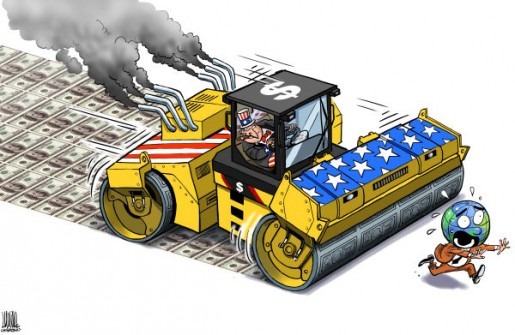
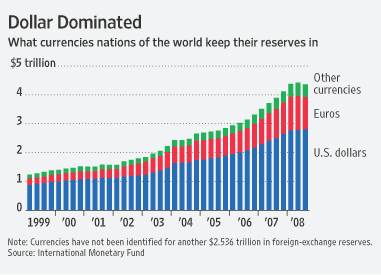
As part of a now lengthy chain (one, two, three, four) on US allies and the likelihood of US retrenchment (hat-tip to Andrew Sullivan for referencing this chain of posts yet again), I argued that American hegemony, despite America’s huge debt and deficit, is more financially stable than almost anyone expected. Because foreigners’ appetite for dollars seems unquenchable and because we print the global reserve currency, borrow in it, and face no serious reserve challengers (the euro and RMB maybe, see below), US can exploit this ‘exorbitant privilege’ far worse than anyone ever thought.

For example, I think almost everyone expected the bond-market to turn against the US in the last decade given: exploding debt and deficits, huge welfare state expansions like Medicare part D and ObamaCare, the expensive and financially-unplanned GWoT, China’s relentless ascent, the Great Recession, and two rounds of quantitative easing. Wow – that’s a helluva list. Despite all that, interest rates and inflation are low, because we can exploit (and have) that exorbitant privilege. Stein’s Law says there must be a limit, but I think almost everyone is amazed at just how deep confidence in the dollar goes.

More simply put, all this means is that foreigners so want dollars, that America can just print more and more dollars without consequent inflation, and borrow from foreigners a lot cheaply (because they want those dollars so badly). This means America can borrow and/or just print huge amounts of money at very low interest and inflation rates. That is ‘exorbitant,’ because no one else can do that without Greece-style financial trouble. We can borrow at low interest rates (the rate on the US ten-year bond is around 1.5% right now) and print lots of money (the recent quantitative easings, e.g.) without suffering like so many others who over-borrow and run the printing press. Barry Eichengreen’s book on this is helpful if you don’t quite get it.

Vikash Yadav gave such good commentary on this tangle over at Duck of Minerva, that I have reposted our full debate on US borrowing and hegemony below. Warning: it gets fairly wonky, so please be sure to read the OP. Also, further IPE are comments wanted. Specifically, someone tell me please when the US will finally hit the ‘soaring’ inflation and interest rates regularly predicted by deficit hawks at the WSJ or CNBC? This is what Romney means when he says we will become Greece, but I just don’t see any evidence of that. Does anyone have a good guess on the timeline for exploiting the exorbitant privilege? When does it finally give way? When do foreigners turn against us in the bond market? As I said in the OP, I think it (super cheap US borrowing) has gone on already far longer than anyone expected. But I also think that a 100% debt-to-GDP ratio might be the bond-market turning point. That is a pretty big psychological benchmark.

So here is our debate on this:

Continue reading

More on US Allies: America’s ‘Exorbitant Privilege’ means it can borrow to Sustain Hegemony Longer than Anyone Ever Expected

P1-AP194B_CHINA_NS_20090323190818

This post expands ideas which were published in my recent JoongAng Daily op-ed.

Two of my posts this week (one, two) on hypothetical retrenchment under Ron Paul got a lot of traffic and comments. Hat-tips go to Andrew Sullivan and Stephen Walt for citing me; if you don’t read Walt and Sullivan already, you should. Given the large numbers of comments, both here and elsewhere, I thought I would try to capture some of the concerns generally. This post focuses on the surprisingly low likelihood of retrenchment; a second, in a few days, will look at specific countries mentioned by commenters.

The OP was intended as an emergency exercise if the US were to face a truly significant crisis that forced retrenchment. The purpose was to ask who are the most important US allies and commitments if we were forced to choose. Right now, the US is not choosing. We are all over the place; if anything, we are taking on more commitments (Iraq, Afghanistan, Pakistan, Yemen, the Asian pivot). As I tried to say in the second post, I don’t think we are about to pull out of Japan or Egypt, but if we get to the point where we really can’t afford globe-spanning hegemony anymore, it would be help to try to prioritize what is genuinely strategically necessary, from what are ‘extras.’ One doesn’t hear this much, except for Ron Paul, whose debate performances motivated the post.

On this point, I should say that the bifurcation of the OP into two parts was not to indicate the those in part 2 should get the axe; it was just a matter of convenience. The point of the OP was to try to force a ranking – who is more important to the US than who? This is why I tried to limit the listees to a conventional ‘top 10.’ To go beyond that tight focus, would get us back into the global alliance sprawl the US is in now.

The above point raises the next, obvious question about whether we are therefore getting to a point of forced US retrenchment. There is a whole declinist literature that emphasizes long-term US problems, like atrocious public finances, too many wars, bad public schools, political gridlock, rising anti-Americanism in the world, etc. Zakaria’s ‘post-American world’ captures are lot of this, and apparently the Chinese believe the US is in decline too. Probably the best I can think of at the moment is Gideon Rachman’s take.

I go back and forth on this myself. The economist in me finds it hard to imagine how the US can borrow $1-1.5T a year and stay on top. We’re borrowing around 9% (!) of GDP per annum, and the IMF calculates America’s debt-to-GDP ratio is 100% already (if you include state debts; it’s 75% now at just the federal level.) I wonder how we can fight so many wars without national exhaustion and diversion of investment from domestic priorities like infrastructure or health care. Signal markers in the decline and fall of empires are heavy borrowing and lots of wars which sounds a lot like us, no?

Continue reading

Korea 1997 & the Greece mess today

Flag-Pins-South-Korea-Greece

Here is a good article on Korea and other near-defaulters or defaulters, and what lessons they might have Greece now. Greece can in fact recover if it leaves the euro, and increasingly, I think both it will and it should. However, one important element Greece should not pass up, is using the crisis to force discipline on the parts of the economy that caused the currency run to begin with. The Korean government was partially able to discipline the out-of-control chaebol who had caused the crisis by wildly over-borrowing on Wall Street in the mid-90s. Koreans hate to hear it, but their political economy got substantially cleaner and less corrupt because of the 1997 brush with default. Greece should do the same; it should not leave the euro just so it can go back to its bad old ways. That would be a catastrophe and turn Greece into a prototypical Middle Eastern patronage state.

Continue reading

The US will not ‘Pivot’ much to Asia (3): We can’t afford it

Pesident-Obama-China-001

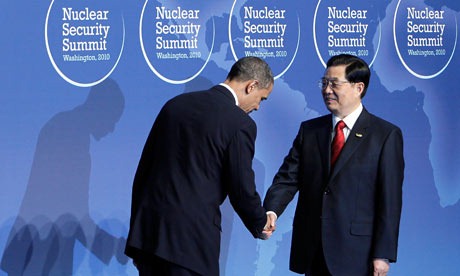
Please read parts one and two first, where I argued that there is no constituency in the US for the pivot, and that Asia is so culturally distant from the US, that Americans are unlikely to care enough to sustain the pivot. But we also don’t really need to pivot, nor do we have the money for it:

3. The Middle East is characterized by so many nondemocracies that the US must be heavily invested (at least to meet current US goals – oil, Israel, counterterrorism). Katzenstein noted this; America has no strong subordinate anchor-state in the region (like Germany in Europe and Japan in Asia). This is why the GOP particularly emphasizes an enduring, semi-imperial presence in the Gulf. Besides tiny Israel, we don’t have the friends necessary for things like the dual containment (Iran and Iraq) of the 90s, and or the Iraq war of the 2000s. So we have to do it all ourselves.

By contrast in Asia, we have lots of allies and semi-friends who are strong and functional – Japan, Australia, Korea, and Taiwan most obviously – with improving relations with India and Vietnam too. Now, if we are smart – or maybe just because we are broke – we can push a lot of the costs of our goals onto them. Specifically, much of the pivot has been assumed to be targeted at China. But why should we encircle, contain, or otherwise provoke China, when the frontline states should be it doing it first? In other words, we don’t have to pivot toward Asia unless China threatens to invade everybody, because places like India, Korea, and Japan will work hard to build and maintain a multipolar equilibrium. They don’t want to be dominated by China, and they will suffer a lot more than we will if China becomes the regional hegemon. So we can hover in the background, offshore, over the horizon, as we always have. Given the strength of liberal democracy in Asia (unlike the ME), there is no need for us to be there in strength.

Continue reading

Economist Magazine Conf. on Korea (2): Import Competition Needed!

south-korea-gdp-annual-growth-rate

Part one is here, where I argued that Korea is too mercantilist-corporatist and that Korean consumers carry the costs of that statism with their 155% household debt-to-income ratio. I published an op-ed based on these posts also, at the JoongAng Daily here.

b. When the idea of Korean banks functioning globally arose, the Korean speakers argued for a mega-bank so that Korea could ‘compete’ and support its MNCs overseas. Again the idea that Korea as entity must compete against other states and ‘their’ MNCs is a fundamentally mercantilist notion. Korea is not competing against anyone, in the liberal view. Firms compete, and consumers, as rational buyers weighing quality against cost, should not buy ‘nationalistically.’ No one said anything like this: that Korea’s banks should simply evolve as they pursue profitability and if some of them M&A into a mega-bank, then ok. Instead, the state officials (not private bankers) were saying Korea needed a ‘mega-bank.’ Sounds an awful lot like another flag-carrying national champion, like Samsung, or Air France, with lots of cheap government capital and buddies in the bureaucracy, no? One of the Economist hosts thankfully had the temerity to call this a ‘vanity project.’ Hah! That was the most insightful line of the day.

c. Next up was was the limits on foreign penetration into the Korean bond market. Preventing foreigners from buying your debt is a classic form of financial mercantilism. The Japanese have been doing this for years in order to retain the yen as an autonomous domestic policy tool. This is why Japan’s debt-to-GDP ratio is the highest in the world, but its bond rating stays high – all that debt is ‘in-house.’ The Japanese refused to internationalize the yen, because that means foreigners, especially Wall Street and the IMF, get a bigger say in how you run your economy. Witness the Greece meltdown today, and the increasing usurpation of Greek economic autonomy by Germany, the ECB, and the IMF, because so many foreigners own Greek debt. Nationalist-statist Asians would never permit that level of internationalization. They are too obsessed with sovereignty to resolve the ‘trilemma’ with Friedman’s ‘golden straightjacket.’ The Chinese also do this – selling bonds to domestic firms and banks at ridiculously low interest (so treating Chinese depositors as a slush fund for cheap capital) and preventing the RMB from off-shoring. And Korea does it too. It has repeatedly been kept off the World Government Bond Index, because of its ‘macroprudential capital controls’ – a euphemism for the ROKG’s closure of the kimchi bond market when too many foreigners started buying them because the won is undervalued.

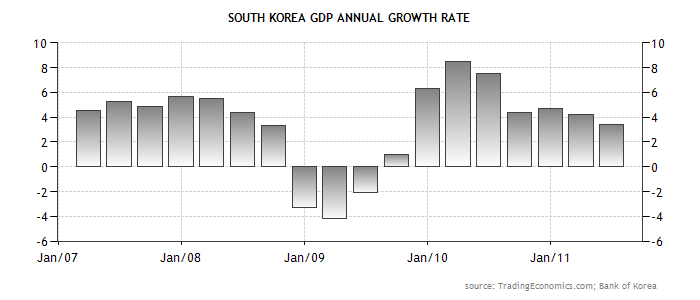
d. Another missed opportunity was inflation. Korean inflation is now over 5%! That is twice the Bank of Korea’s (BoK) target. There is strong suspicion that this is coming from ROKG F/X ‘fine-tuning’ – pardon me – ‘smoothing.’ Among other things, Korean consumer spending is not exploding and so pushing up prices. In fact, it is the opposite, because Korea’s consumer debt (155% of income) is one of the highest in the world. Nor is the BoK monetizing Korea’s debt, another fairly typical inflation-accelerator. Korea’s debt and deficit are low and under control. This suggests that F/X fine-tuning/smoothing/whatever you want to call competitive devaluation (ie, buying dollars and selling won) is what is driving up the money supply. Yet the speakers told us that inflation had to be balanced against growth, i.e., don’t expect an big interest rate hike. This sentiment makes sense in the low-growth US or euro-zone, but not 4%-growth-a-year Korea. So Korean consumers once again get the shaft with a depreciating currency coupled with crushing personal debt. Tell me again that Korea is not a corporate oligarchy punishing consumer and SMEs to reward mega-exporters?

In the end, the back-and-forth was too congenial, allowing too many of the speakers to spin and duck hard issues. Last year I thought the questioners pushed Korean officials a lot harder. It was disappointing this time, maybe because the officialdom level was higher this time. Who wants to publicly challenge the finance minister? Last year was indirectly revealing for the way Korean officials bobbed-and-weaved to avoid answering hard questions about capital controls. This signaled pretty clearly that they were in fact competitively devaluing the won.

This year, no one really tried much. I pushed a bit. I asked a troublesome question – does the Korean government sterilize the won’s appreciation at the behest of Korea’s big exporters? (The right answer is yes.) I have written about this before (here and here), and variants of this question were asked last year too. But my official didn’t try hard. It was spin; he didn’t even make reference to the chaebol in his answer, even though lots of people in the room were convinced (because variants of my questions popped up all day) that they they are the ones pulling the F/X strings to keep export prices low. But no one answered it really. In fact, not one Korean speaker even used the word chaebol the whole day, which left me bemused and disappointed.

The most courageous question came from a Korean who asked a panel point-blank if Korea had the creativity and openness to foreigners necessary to really grasp globalization. This is a major issue; I argued last year that cultural hesitation, not technical or ideological barriers, is the real hurdle to the internationalization of the won. Yet none of the Korean panelists even blinked. A fog of silly disconfirmations about the creation of Hanguel or the (supposed) global popularity of K-pop and Korean food were thrown out to suggest Korean is a creative open economy. Yawn. At that point I overheard the Economist guys talking about how the same issues come up year and again regarding international finance and Korea, but nothing seems to happen. Exactly.

Economist Magazine Conference on Korea 1: Not Quite an Open Economy

images_thumb

The ideas in this post and the next expand on the arguments made in my recent JoongAng Daily op-ed.

Every year the Economist runs a series of conferences on the political economy of Asia. If you are in this part of the world, you should probably go if you can. Here is the link for this year’s on Korea, and here is my review of last year’s. I thank the Economist‘s East Asia staff for inviting me. They are generous enough to realize that academics could never find the $1000 door fee. Sigh. It’s fairly embarrassing to the profession that we have to be comp’d in order to get into these sorts of things. And it is a good reminder that when it comes to the real world and stuff that matters (ie, money), professors scarcely matter. 😦 As with last year, I found it ‘maturing’ to sit in a room with very wealthy people, in very nice suits, focused on the very serious business of making lots of money. ‘Plutonomy’ is pretty imposing.

The Korean line this year from the officials present, including the finance minister, was that Korea is a “small and open economy.” This is manifestly untrue, by OECD standards of openness, and it was disheartening to see so little honesty about how deeply intertwined the Korean government is in the economy. The people from Moody’s in the lobby were even handing out a report about Korea’s ‘public policy banks.’ There is a lengthy political economy literature on Korean statism, and for those who like the idea of state intervention in the economy, Korea is a widely used example. Korea is better defined as small and corporatist, with latter deployed to overcome the former. Korea is sharply divided economy with tight but large conglomerate bloc at the top (the chaebol) overawing the rest of the economy. These firms get such generous access to the state, and its budget and moral approval, that Korea, Inc. is more liberal corporatism than liberalism. And Korean consumers, with debt at 155% of household income (one of the highest ratios in the world), pay out the nose to prop of this oligarchy.

Industrial policy is a reflex here; I see it all the time. Every time I ask my students about some change in the Korean economy, their first response is to say the government should do this or that about it. I get paper after paper about how the government should spend on this or that critical or strategic industry, or how Korea must outcompete Japan, or how the Korean government should ‘lead/guide/administer/direct/run’ the economy. I almost never get liberals in my classes, although to be fair, when I get Japanese and Chinese students, they talk the same way. Korean academics at conferences here are similar. I almost never hear the run-of-the-mill liberal notion that the economy should simply evolve as it will, without direction from the state. When I tell my students that the American car industry deserves to take a beating for making poor vehicles, they look bewildered. When I tell them that Apple should have pounded Samsung in the smart phone wars, except that the ROKG kept the iPhone out with NTBs for 2 years, they tell me that was a good thing. When I tell my students that the jeonse security deposit system doesn’t exist in the US, and that even lower middle class Americans can afford to move out during college, they are amazed. (The jeonse system is one of the most regressive, upwardly redistributive, oligarchy-reinforcing,  middle class-crushing elements of the Korean economy.) And indeed you could see the mercantilist reflex all over the conference, even though no one wanted to say it.

a. When the issue of exchange rates came up, the same division as last year of foreigners vs. Koreans arose. The Korean speakers all defended the interventionist notion that Korea had to ‘compete’ with yen and the dollar, and should value the won against them. That pegging like this is in fact exchange rate manipulation (as the Japanese FinMin said last week) was simply not admitted. That is it unnatural for Korea’s economy to grow faster than the US and Japan while the won does not appreciate meaningfully against their currencies was unanswered. I saw Bernie Lo on MSNBC a few weeks ago note that Korea has grown 4x faster than the US in the last 2 years, but the currency has appreciate by just 10% or so. Wow; that’s so unnatural, it can’t possibly be explained without targeted intervention. Not one speaker defended the liberal notion that Korea’s currency should simply float; in fact, I am not sure I even heard the word ‘liberal’ or ‘float’ the whole day. Last year, the euphemism for such competitive devaluation was ‘fine-tuning;’ this year it was ‘smoothing.’

b. When the idea of Korean banks functioning globally arose, the Korean speakers argued for a mega-bank so that Korea could ‘compete’ and support its MNCs overseas. Again the idea that Korea as entity must compete against other states and ‘their’ MNCs is a fundamentally mercantilist notion. Korea is not competing against anyone, in the liberal view. Firms compete, and consumers, as rational buyers weighing quality against cost, should not buy ‘nationalistically.’ No one said anything like this: that Korea’s banks should simply evolve as they pursue profitability, and if some of them M&A into a mega-bank, then ok. Instead, the state officials (not private bankers) were saying Korea needed a ‘mega-bank.’ Sounds an awful lot like another flag-carrying national champion, like Samsung, or Air France, with lots of cheap government capital and buddies in the bureaucracy, no? One of the Economist hosts thankfully had the temerity to call this a ‘vanity project.’ Hah! That was the most insightful line of the day.

Part two of this post is here.

Unleash the ‘Animal Spirits’ of Korea’s Small & Medium Enterprises

chaebol

The Financial Times had an important story over the weekend decrying the emergence of a two-tiered economy in Korea, and it is getting some play in Korea. Koreans are loathe to admit this (don’t criticize the team to foreigners), but any outsider can see this almost immediately here, and just about every non-Korean social scientist I know in-country agrees that this is a huge problem.

By two-tiered I mean the enormous concentration of market power and political access concentrated in the largest 200 hundred or so Korean companies, while small and medium enterprises (SMEs) struggle to find credit, and Korean households pile up debt (now at 150% of income). Non-Koreans will recognize such brands as Samsung, Hyundai, or LG, but others include widely visible names in Korea like SK or Posco. Like Japan’s infamous keiretsu, Korean mega-companies often sprawl into many different sectors, building cross-sectoral conglomerates (the Korean word is chaebol). SK, e.g., owns a telecom service, gas station chain, and real estate distributor. The chaebol have become so massive, that they enjoy many distinctly unearned, oligopolistic benefits of size.

1. They are ‘too big to fail.’ Chaebol in trouble can usually go to the government for help, as many did in the Asian Financial Crisis (AFC). In the 1997 IMF bailout of Korea, the big IMF condition was breaking the chaebol into smaller, more competitive, less openly oligopolistic firms. The chaebol have fought this ever since, often using bribery and political connections, to re-scale the commanding heights. Even Korea’s ‘reformist’ administrations – Kim Dae Jung and Roh Moo Hyun (1997-2007) – got tarred with scandal for taking bags of cash from Korea’s biggest companies. By contrast, Korea’s small and medium enterprises have no such informal political safety net. Anyone walking down the same street in Korea for more than a year or two can see the dramatic merry-go-round of small businesses here. Korea is filled with mom-and-pop stores just one or two bad months away from bankruptcy.

2. Size means political influence. It should surprise absolutely no one that the sheer bulk of the chaebol gives them inordinate, collusive political influence. The most obvious mark of this is the pardons extended to top chaebol officials convicted of a crime. More important is the informal pressure of the government on Korean banks to loan to the biggest firms at generous rates. The not only encourages recklessness at the top, it squeezes Korea’s SME’s at the bottom. Perhaps most scandalous of all, the chaebol were able to terrify the Korean state and taxpayer into picking up the bill of the Korean AFC. The Korean AFC was not caused by reckless sovereign or household borrowing. It was the chaebol, who then, mirabile dictu, dumped their debt onto the state, which ultimately forced the government to approach the IMF. Koreans traditionally blame the IMF for the crisis, but it was in fact, because the Korean state, terrified of the consequences, ‘generously’ nationalized the debt of Korea’s corporate sector. In truth, I suspect the Korean government was bullied by the wealthiest corporate heads in 1997 talking about what will happen to Korea if the government doesn’t give them the money immediately – a shakedown.

3. Cross-sectoral holdings allow a firm to leverage success in one sector for success in another. Even within a sector, Korea is often oligopolistic. The telecom industry is dominated by just two providers (SK and KT – a duopoly), resulting in exorbitantly expensive IT/long distance rates. These sorts of oligopolistic effects are well-known. Yet worse is the regular invasion of wholly unrelated sectors, in which the market power of one sector is used to push into other. The best know example of this to westerners is Microsoft. For more than a decade, MS used its power in operating systems (Windows) and office software (MS Office) as leverage to crush rivals in other areas where MS was weaker – browsers (Netscape), instant messaging (ICQ), media players (WinAmp), etc. In Korea, it is vastly more predatory and oligopolistic, as the chaebol often expand into areas wildly unconnected to each other, a practice that can only be explained by extraordinarily weak anti-trust enforcement, regulatory ‘looking away,’ and the political connections to give an unstated veneer of approval. Even Adam Smith rejected excessive concentration (monopolies, duopolies, oligopolies), and I can think of not credible market explanation whereby SK is the country’s biggest telco, real estate holder and gas station chain simultaneously. These outcomes are so blatantly political and ridiculous, that I am amazed Korea sees so little populism.

But corruption, scale, and political influence can’t be the only reason. Korea could elect genuine progressives to push through deconcentration. Even the Reagan administration broke up AT&T, right? And here is perhaps the most insidious element of the chaebol – they have convinced Koreans, a) that they are the flag-bearer toward the rest of the world, and b) that if they went through bankruptcy that Korea’s economy would implode.

a) Corporatized nationalism. Korea is a small place, bullied often by its neighbors, with a language no one learns, a culture that’s not easily distinguishable from China or Japan, and a nuclear lunatic running half the country. But as anyone living here for about 5 minutes can tell you, they are intensely nationalistic and absolutely determined that the rest of the world know who they are. That is why Yuna Kim is a legend here – not because she is a good skater, but because she brings the world’s attention to Korea. The chaebol have masterfully exploited that absolutely desperate craving for attention.

When the EU FTA was up for debate, the government ran commercials on TV showing smiling white people in European locales using Korean goods – helpfully pointed out as from Samsung, LG, etc. In trains, airports, bus terminals, on the government TV networks, etc, one sees an endless stream of government promotional commercials and videos showing dynamic-looking Korean businessmen talking up this or that Korean export product to someone who looks like a foreigner (i.e., a white guy in a suit). The Korean news gives you a regular diet of chaebol agit-prop, as the ups-and-downs of Samsung, SK, LG, Kia, etc are reported religiously. And the dream job of just about every Korean student I’ve ever had is to be a jet-setting corporate executive for Samsung. Koreans have routed their nationalism through their MNCs, and the chaebol take advantage of this to blackmail the state when necessary – particularly soft loans from the government.

b) Korea is Korea, Inc. is chaebol-land. Almost as bad is the widespread belief in Korea that if the chaebol are threatened, then somehow Korea will collapse. I see this all the time in conversations here. Despite all the above arguments for anti-trust action, my interlocutors inevitably retrench to fear – what would Korea look like if Posco went bankrupt? That Korean demand for the products Posco used to make would persist and therefore encourage new market entrants seems to arcane. That start-ups are often more efficient and more innovative (Facebook vs Microsoft) suggests even more unnerving change. That shaking up markets usually reduces consumer prices by forcing established winners to work harder is irrelevant: Koreans are ready to pay higher prices at home if that it what is required for Korea, Inc. to carry the Korean flag abroad. In the end, Korea must have national champions – not because they are champions, but because they are national. If Korea is a divided country of minor global importance (ie, no one cares about us politically), then we must have, economically, megacompanies to broadcast our national awesomeness. In the end, if Korea must be Korea, Inc. in order to get globally noticed, then its ok to be chaebol-land.

If this is depressing, there are obvious answers that do not require the government to forcibly to delimit some areas for the SMEs and some for chaebol, nor to beg the chaebol to be nice. And these would bring Korea into greater compliance with OECD norms and best practices on corporate governance:

1. Halt easy credit for the chaebol, while creating a pool of such capital for small business, modeled on the US Small Business Administration. The Korean SME sector is the most dynamic economic force in the country, taking huge risks to build neighborhood-enriching corner shops. This is far gutsier than mega-companies with lots of government buddies producing variants on the same product every year. The Korean Jeff Bezos or Mark Zuckerberg is out there, but I guarantee he is not a mid-level salary-man at Samsung. The government needs to unleash the ‘animal spirits’ of Koreans; access to bank credit on an equal playing field is the obvious place to start.

2. Enforce anti-trust law. Oligopolies create so many negative effects that even the conservative Reagan administration broke up AT&T and achieved a 70% reduction in long-distance rates. There is no possible economic justification for consumer-punishing cross-sectoral conglomerates. Western regulators would long ago have forced chaebol spin-offs. More firms means more competition, more innovation, and lower prices.

3. Stop sterilizing the won’s appreciation. ‘Fine-tuning’ is a laughable euphemism for forcing depreciation at the behest of chaebol exporters. It creates obvious costs – 5000 won for an import beer at HomePlus – for consumers. Korea’s inflation rate is now 4.2%; an easy way to return purchasing power to Korean consumers would be for the currency to rise.

Robert Gates’ Final Speech on US Defense Cuts

robert-gates2

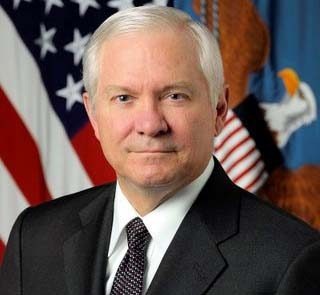
The Secretary of Defense is on his way out. To my mind, Gates was excellent, although, as Walt notes, coming after Donald Rumsfeld could make anyone look good. Gates, more than any SecDef since the end of the Cold War, has pushed the real ‘transformation’ of DoD – toward restraint and limits.

Readers will recall Secretary Rumsfeld’s original use of that term meant a smaller, lighter force that could intervene rapidly and globally to force local decisions on America’s terms. Afghanistan 2001 originally seemed like a model of this, but the bog-down of the war on terrorism has frozen the ‘revolution in military affairs.’ Rather it is Gates who has pushed the real change – nudging the US, specifically Beltway think-tank elites like Brookings or the American Enterprise Institute, to realize that the US can no longer afford the expansive globocop role we have become accustomed to in the ‘unipolar moment.’ Besides Walt, Fred Kaplan has been excellent on this.

Whoever comes after Gates will have a difficult time continuing this. There is a strong predilection in the Pentagon and on Capitol Hill for defense spending. It looks patriotic and exciting. Cutting it can be easily demagogued as ‘imperiling our national defense in an era of terrorism’ or something like that. Pentagon weapons procurement is notorious for placing bits and pieces of defense production in as many congressional districts as possible. This gives everyone a an economic and ‘patriotic’ stake in voting yet more cash to DoD. And the Navy and Air Force are genuinely terrified of a much-reduced role if the future use of American force becomes mini-interventions like Libya or (what was supposed to) Afghanistan. Watch for those parts of the force to hype the China threat (although I do think China containment, with a US supporting role, is probably inevitable).

Finally, it is simply undeniable that Americans sorta like ‘empire.’ We like the fact that we can go anywhere in the world and command a level of respect, because we are citizens of the ‘indispensible nation.’ Everyone uses the dollar and pays attention to the intricacies of our politics. (In Africa last summer, I got questioned regularly on Obama). No, I’m not saying we are the European caricature of global-strutting imperialist. But you only need to watch American film (or worse, video games) to see how attractive the idea of a big, bad-a—US is to Americans. We love the narrative of American exceptionalism; remember that George W Bush said ‘God has a special mission for America,’ and he got re-elected despite the Iraq War. You don’t have to be Noam Chomsky to think this; just live outside the US for a few years to see how ‘the rest’ think about us.

So Gates’ value, in the end, was seeing that the US simply cannot afford the neocon-liberal hawk synthesis in which the US use of force is a regular response to global problems. Even if you think America should be globobcop, America’s finances force the obvious question of whether we can. Historians regularly tell us that rising debt and long foreign wars are the death-knell of empires. Cut we must, or face a truly devastating melt-down at some point. It will take time for Americans to digest this reality, and Gates, with his huge personal prestige, started this process.

I say that quite aware that I supported NATO force against Gaddafi. (I would defend that position by noting that I argued for a super-light air intervention to stop a massacre. Beyond that, Libyans must achieve ‘regime change’ on their own.) I also say this with some trepidation, because part of me does think that unipolarity backed by US force, has made the world safer and the global economy function more easily. I worry too what a ‘post-American’ world will look like, especially if authoritarian China plays a much bigger role. While no fan of ‘empire,’ I will agree that this is unnerving.

But the larger concern of overstretch is now so apparent that Gates’ retrenchment position can either be, a) a choice now, in which we slowly retrench in order to better accommodate America’s fiscal mess and do so in a professional, ‘graceful’ manner, or b) forced on us later, when when we are genuinely broke because we continue to borrow $1-2 trillion dollars a year. Even America can’t do that forever, and cuts are coming whether we want them or not.

The Korean case has really forced my thinking about this, because Korea’s security is obviously dependent on a US commitment. Any war here will be bloody and expensive, far worse than the US post-Cold War wars in the Middle East. Americans are genuinely nervous about getting chain-ganged into a long conflict here. China, which holds around 1/4 of all US T-bills, would have an obvious incentive to stop buying if US Forces in Korea were suddenly marching toward the Yalu. And I can think of few uses of US force more noble than helping a democracy against the world’s last, worst stalinist tyranny. But that shouldn’t blind us to the obvious. Gates himself said, “any future defense secretary who advises the president to again send a big American land army into Asia or into the Middle East or Africa should ‘have his head examined.’” That should be a wake-up call.

Hence I have argued repeatedly here, especially for Korean readers, that Korea needs to be far more aggressive in preparing its own defense and imaging an East Asian alliance structure beyond simply a US guarantee. Korea should finally end the tiresome, endless Dokdo dispute with Japan, so that real joint decision-making on vastly greater issues like NK or China’s rise can begin. Korea should be looking further afield to other Asian democracies like India, Australia, and the Philippines. These are no substitute for the US of course, and the US isn’t simply going to leave tomorrow or next year. But the US will have to be further and further ‘over the horizon’ in the medium-term, barring some major turn-around of the US fiscus. Korea has the money and talent to fill in this gap, but first the recognition of US limits, pushed by no less than the US secretary of defense, needs to sink in – not just in Seoul, but in the whole US establishment in Korea, and in the Beltway think-tank industrial complex. I hope I am wrong…