US Alliance Commitment to Korea in the Age of Austerity: Big Cuts Loom

csis

So this week my university hosted a forum on the Korean-American alliance with Ralph Cossa and others from the Center for Strategic and International Studies. CSIS is the kind of center that anyone reading this blog would find useful, and Cossa is a great Asia hand. (For starters, try his chapter in this.)

The forum was informative, but too much of it passed what seems to me the growing mismatch between US alliance commitments around the world and US capabilities to meet them, what Paul Kennedy famously called ‘imperial overstretch.’ Most of the speakers reaffirmed the US commitment in direct, unambiguous terms – an expected response given NK’s exceptionally bad behavior last year. But to my mind analysts need to be more forthright admitting the great trouble the US will likely have defending Korea.

I have written on this before; consider the following data points of US ‘partial abandonment’ of SK:

1. US Forces in Korea (USFK) are now just 28,500 servicemen, the smallest number they have been in the history of the force. A large minority, so far as I can tell, are air and naval staff, not infantry. In short, the ground war – the hard, brutal slog of 1950-53 – will be born mostly by the SK army this time.

2. US tactical nuclear weapons were removed from Korea 20 years ago, after the Cold War. Given NK’s nuclear program, ROK elites have been hinting for the last few years that they might like to see them come back or at least discuss it. The US has rejected this.

3. The Combined Forces Command (CFC) is still scheduled to be abolished. CFC places wartime authority in Korea over both US and Korean forces in the hands of a US general. This is widely viewed in Korea as a signal of US commitment to SK defense. Originally it was to be abolished in 2012. Abolition has been moved to 2015, because of recent NK behavior, but CFC is still scheduled to go. The Koreans too have made noises about retaining this, but the US has held firm that it too will go.

4. US public opinion surveys from the Chicago Council of Global Affairs (2008, 2010) only find the 40-45% of American actually want to fight in SK if a war comes: “Americans also show an inclination to take a hands-off approach to confrontations between North and South Korea.” This should not surprise anyone, given the American exhaustion from the war on terror. Consider the Libya intervention (which I supported, to be transparent). This was mostly an inside-the-Beltway affairs (the ‘professor’s war’); US public opinion support for it is tepid. As a result, US involvement is very light. Obama is badly constrained by huge US public reticence to fight yet another big war – which is most certainly what a Korean conflict would be. Libya is far more likely to be the US model in Korea should another war break-out here, rather than a re-run of what happened 60 years ago.

5. USFK is being relocated away from the demilitarized zone to a city south of Seoul – Pyeongtaek. This strikes me as a critical data point, and one that Koreans most definitely worry about. Seoul is the obvious target in any serious war, so USFK’s placement between the KPA (NK People’s Army) and our ally’s capital signaled strong American commitment to SK, both reassuring SK and deterring NK. USFK, even when it was larger, was never enough to stop the 1.2 million-man KPA on the ground. Its role was basically a symbolic trip-wire. That is by stationing US forces in the likely combat zone, any combat would immediately pull in US soldiers, and likely result in battlefield casualties as well. Any US fatalities would have a catalytic effect on US public opinion regarding participation in an otherwise unwanted war. Emotionally provocative images of dead American servicemen would enrage America pubic opinion and so reinforce the US commitment to fight. The trip-wire ensured that the US would be ‘chain-ganged’ into any war in a ‘country far away about which we know little.’ People find this morally objectionable – and it is  – but that does not make it inaccurate.  Indeed NATO did the same during the Cold War. Multinational units were stationed along the West German border with East Germany and Czechoslovakia. If the Red Army crossed the line, initial casualties would be spread around the alliance in order to insure that all allies would have skin in the game. This would help ensure that allies in NATO’s backyard would stick to their commitment to fight. While I doubt that USFK planners are so callous as to open reason this way, it is clearly the case that US forces south of Seoul reduce American exposure, eliminate the immediate trip-wire/chain-gang effect, and give the White House ‘wiggle room’ it did not have before.

6. But even if all of the above were irrelevant, the real elephant in the room that casts doubt on all US alliance commitments (not just Korea) is the crushing national deficit and debt. The US is now borrowing $1.5 trillion per annum. This is the largest peacetime borrowing in US history (and only matched once – in WWII). It represents a staggering 10% of GDP. America’s publicly-held debt is now $9 trillion. These budget constraints will place major limits on any US use of force in the future. Again, the current Libya campaign should be seen as a model for what US war in the age of austerity will look like – hesitation, buck-passing to allies and international organizations, ‘leading from behind,’ no ‘boots on the ground,’ cost-efficient airpower, etc. The only way to close that massive $1.5T gap is to either cut spending or raise taxes (or inflate it away, I suppose – but who wants a re-run of the 1970s?). So long as the GOP remains firmly opposed to tax hikes, then spending must be cut. And no really believes $1.5T in cuts can be found without huge defense cuts. Social Security, Medicare, Medicaid (together: SS/M/M), Defense, plus interest on the debt, compose 80% of the budget. Interest payments cannot be cut obviously; we can’t just unilaterally stiff $9T of bondholders. Nor is there much saving to be found in the remaining 20% of ‘discretionary spending.’ That leaves just the ‘big four,’ as the Simpson-Bowles deficit reduction commission called them: Defense and SS/M/M. This is an absolutely classic example of the guns-vs-butter trade off. We can have a big defense budget or big entitlements (SS, Medicare, Medicaid), but we can’t have both. Consider that the entire US national security budget (Defense, Veterans Affairs, and the relevant parts of the Homeland Security and Energy Departments) costs about $1T. That means you could cut all US national security spending and still not balance the budget. Indeed, half a trillion dollars in deficit spending would still be left over. Just 5 or 6 years ago, when the Bush administration was running 4-500 billion dollar budget deficits, people fretted that such numbers were enormous. Now that would be progress. This budgetary mathematic all but mandates major US retrenchment, unless Americans are willing to dramatically lessen their entitlement expectations to make room for defense. And to no one’s surprise except the hawks I suppose, Americans do actually favor major defense cuts in order to save SS/M/M. Americans, if they must choose, want checks for grandma more than they want aircraft carriers. This is why Michael Mullen, the US Joint Chiefs of Staff Chairman, argued recently that the US budget deficit is now the single biggest threat to US national security. And the Sustainable Defense Task Force, organized by several members of Congress, does in fact recommend US cuts in Korea. (Read Kaplan at Slate.com for superb analysis on the approaching critical mass regarding defense spending.) The likelihood of major cuts in places where American really don’t want to be (Iraq, Afghanistan, Pakistan, Libya) and places American believe can afford their own defense (Western Europe, Japan, Korea) means that it is very likely that US forces will not be in these places in, say, 10-15 years. The money just isn’t there anymore…

In short, America’s accelerating sovereign debt crisis, much reduced force structure in Korea, and low public opinion support for more interventions, badly constrain our ability to meet our alliance commitments here, and many other places. This doesn’t mean we should get out; this is no personal endorsement one way or the other. But it does mean that probability of major US assistance on which Korea has built its security for two generations is diminishing fast. We need to be honest about that. Call it the end of empire, retrenchment, imperial overstretch, whatever; but US allies need to recognize this. The days of free-riding are just about over.
Another Hysterical Video about the Bail-Outs of the Great Recession

Don’t miss the Irish prime minister boozing at work…


This is pretty funny also. It is from the same company that made this one on China and the US.

A hat-tip once again to the Duck of Minerva.

I don’t know anything about the Chinese outfit that makes these, but it sure looks like the Chinese are getting a laugh out of our financial foolishness in the West. To be fair though, let them. They’ve earned their Schadenfreude, and we deserve the pain for our profligacy.

The Korea-US Free Trade Agreement Serves Korea more than the US – UPDATED

080107_p05_election

UPDATE (December 6, 2010): Just yesterday, the deal got a lot closer , but the comments below still hold, insofar as the US and Korean legislatures must now approve the deal, and legislatures are historically more protectionist than executives.

UPDATE II (December 7, 2010): This is why I would have voted for Lee Myung-Bak if I were a Korean. Well done! Lee has the wisdom to see the long-term benefit of the Korus FTA – keeping the US engaged in Korea at a time of Tea Party disdain for huge government, US imperial overstretch in Iraq and Afghanistan, record US debt and deficits, and increased NK truculence. So if Korean car-makers have to wait a year or two, wth difference does that make when you live next to the last, worst stalinist slave state? Get real; look at the bigger picture. Lee is light-years ahead of the SK left on Korea’s extreme geopolitical vulnerability – small, encircled by historical opponents, desperately in need of US power to maintain its autonomy in such a tough neighborhood. Generally I think he has been a good leader for Korea. And again this time. Good job, and shame on the US for leveraging Korea like this for concessions.

___________

Reflecting on the recent G-20, I think more and more that the continuing impasse on the Korus (Korea-US) FTA (free trade agreement) is the biggest disappointment. The impasse between deficit and surplus countries is a huge, long-term headache that will take years, perhaps even generational change, to break. A ‘culture of export’ grips especially the Asian exporters, where a trade surplus is viewed mercantilitistically as a national victory in a global competition and something not to be surrendered even if it jeopardizes the whole global trading framework. (For why that is both wrong and destructive, start here.) The FTA by contrast was more doable – the issues are smaller and easier, and the US and Korea are long-standing allies. But the US has insisted on re-negotiations, and President Lee dropped the ball on global leadership by caving to domestic protectionists. So now the whole thing is up in the air again. This jeopardizes Korea more than the US, but I am struck by how little of the Korean commentary sees the dramatic asymmetry of benefits toward Korea, as well as obvious national security linkage behind the deal.

1. As the image above makes clear, Korea is substantially smaller than the US. Demographically, Korea is 6.5 times smaller than the US. In GDP, it is 15 times smaller. In terms of sheer scale, opening the American door for Korea exports means far greater breadth of possible export reach than vice versa. In the same way that Mexican firms could suddenly operate across a huge North American expanse after NAFTA, tiny Korea should reap significantly greater rewards than US firms exporting to a smaller (and comparatively poorer) market with a strong history of nationalist buying and tacit import discrimination. Indeed, given that, I am surprised the American business community even cares that much.

2. Korean GDP per capita is about 75% of that of the US. Hence the convergence benefit of the FTA for Korea is quite clear. When economic entities at very different stages of wealth accumulation are put together in a free trade environment, the majority of the benefits accrue to the poorer of the two, as investment races to the location of highest return. Poorer economies catch-up, or ‘converge.’ This happened after the American South was forcefully reunited with the Union; it is happening again in Mexico after NAFTA and eastern Europe after EU accession. It is happening more generally in East Asia, as it has joined the WTO in the last 20 years. (By contrast, the US-Canada FTA of 1988 had little dramatic impact on either side, because they were already fairly similar.) In short, the biggest beneficiaries of free trade spaces are almost always the poorer states; rapid convergence is commonly understand as an ‘economic miracle’ (Germany in the 50s and 60s, Korea in the 70s and 80s). So US exporters will benefit at the margins in a small and poorer economy, but Korea’s benefits will be much greater.

3. The Korea market is far more closed than the US. Opening it up will create for greater disruption, therefore, for established winners like the chaebol (hence the general ambivalence of the Korean business community to the FTA), but the rewards to consumers here will be enormous. A wave of healthy competition from American imports will force Korea’s sluggish providers to ramp up services while bringing down Korea’s ridiculously high consumer prices. An obvious example is smart phones. Smart phone technology – available in the US for almost a decade – only came to Korea this year, because the Korean telco duopoly (KT and SK at 90% market share) had no incentive to make better phones and used their market power and government connections to block imports (particularly the Nokia, Apple, and Microsoft). Only the possibility that ‘backward’ China might get the i-Phone before ‘advanced’ Korea finally kicked the ROKG into facing down the duopoly and opening the door last year. And now suddenly, smart phones are the rage. [Yet I find that Koreans are so devoted to the success of the chaebol, that they seem unwilling to act as rational consumers pushing for more choice (imports) and lower prices (due to import competition). It was national prestige – that Korea should beat less advanced China – that finally got the i-Phone in. This is frustrating to no end as a consumer here – it would sure be nice if a bottle of Heinekin didn’t cost $2.50 in a grocery store. But the Korean media – also a massive corporate monster tied to government elites – have disseminated this myth that what is good for Samsung is good for Korea, and Koreans have drunk that agit-prop kool-aid to the dregs.)

4. Korea really needs to bolster the US alliance in the wake of the spiraling costs of the GWoT. Here is where Korean myopia is the worst, and where Korea is so badly served by its self-congratulatory, parochial media that doesn’t report on the rest of the world they way it needs to. Most Koreans are blithely unaware of their extreme geopolitical vulnerability, which I blame on a media relentlessly dedicated to overhyping Korea’s importance in world politics. The US is Korea’s most important ally – it’s only really. The US alliance backstops Korean security in what is a terrible geographic environment. Korea is small, divided, encircled by great powers, and has poor relations with all its neighbors. Without the US in the background, Korea would have lost the Dokdo squabble years ago, e.g. To make it worse, the US is burned out after two wars and a brutal recession. Only 41% of Americans now believe we should fight for Korea anymore. USFK has gotten smaller and smaller in last few decades, and it is repositioning itself away from the DMZ in order to avoid getting immediately pulled into any conflict. And there is a coming defense retrenchment in the US too, because US defense spending is simply incommensurate with the size of its budget deficit. I would be surprised if the US still has forces here by 2020, unless they are completely subsidized by the ROK. The national security case for the FTA strikes me as so obvious, that claiming US beef has BSE or that US cars are ‘low quality’ is just suicidally foolish.

Another Laugh-Riot Asian IR Video, on the Currency War

And you thought economics was the dismal science…


It is Thanksgiving week, so here is something light. If you aren’t watching Charlie Brown Thanksgiving, get to it. See you next week.

(Should you actually want to ruin your holiday with serious reading on this issue, my previous thoughts are here, here and here.)

Hat-tip to Daniel Nexon on Duck of Minerva for this one.

This is great, yet another clever inside joke for the field. Here a few thoughts:

1. This is yet more evidence that IR needs some kind of serious treatment of alternative media presentations of what we do. Movies, video games, and now videos like this or the Chinese professor ad, all bolster my growing belief that we are missing something by not seriously examining media and IR. Reading – what IR-types do all day, cause its all we did in grad school – is obviously competing with lots of other sources of information in our digital age. Anyone who has taught undergrads for more than a few months knows that they don’t like doing the reading, but they love digital media. In the same way we now teach more and more IR film courses, we more generally need to adapt our pedagogy to the multifarious ways our students absorb information. NB: This is not an argument to dumb-down the field with video; it is a pedagogical concern. IR grad programs will still be the chilling, totalist, never-exercise, read-all-day, live-on-cigarettes-and-microwavable-food boot camp for you brain.

2. I am impressed how much knowledge of detail the authors of the video assume. Insofar as this is meant for a general audience, that reflects a fair amount of economic literacy in your average Joe viewer. Consider all this insider jargon: ‘capitalism with Chinese characteristics,’  DoT Secretary Geithner is only referred to as ‘Timmy G,’ ‘reserve currency,’ ‘currency manipulator,’ the list of Chinese premiers, the joke that GM means ‘government motors,’ Argentina’s 2002 default/meltdown, ‘buyer of last resort,’ ‘dollar denomination.’ That is a nice compliment to how much about econ the general public has learned since the Great Recession broke.

3. Great jokes: Uncle Sam dances and fires a machine gun in the air as Obama wears ‘USA No. 1’ bling. Somehow they managed to build a rhyme with ‘capitalism with Chinese characteristics.’ Did anyone else notice that the Chinese panda looked like Panda from Tekken? Obama’s dog died from lead in the Chinese dog food, complete with a green cloud around the dog. Adding the macarena dance from the 1990s was superb. I am embarrassed to admit that I thought the macarena was pretty cool dances moves back in the 1990s golden age…

Asia’s Improved IMF Quotas — Wake Up! It’s not that Boring…

images

Here is a subject that could put anyone to sleep but is probably the best thing to come from the otherwise poor G-20 summit last week. The voting shares of the IMF were reweighted to reflect Asia’s expanding size in the global economy. Here is good write-up; for Asian self-congratulation, try this. This puts it in context for Korea.

The quota represents the percentage of control that a state has over IMF decisions. Big decisions are made by the IMF’s Board of Governors, the national representatives who collectively control the institution. On the Board, each country receives a weighted vote whose size (quota) is roughly in line with its national percentage of global GDP, crossed against the importance of exports to national GDP (its ‘openness,’ in IMF-speak). (The voting formula is ridiculously arcane for non-experts. There are endless proposals to reform it. Here it is in the words of the IMF itself.) In short, the bigger your quota, the more sway you have in IMF decisions (about loans, the creation of Special Drawing Rights, IMF responsibilities for the global economy, etc.). The biggest quotas, inevitably, belong to the US, Japan, and the Europeans. However, given Asia’s expansion of the last few decades, pressure is rising to re-weight the votes to Asia’s favor. In practice, that means giving China a bigger voice at the expense of the Europeans, who are resisting quite selfishly it must be said, for all their talk about cooperative global governance and multilateralism. US and Japanese shares will be scarcely affected. Korea’s share will reweighted a little bit as well (1.4% to 1.8%).

For Korea and other emergent economies’ share to get even bigger, they would need explosive growth like China’s, as well as a major demographic expansion. Neither will happen realistically. Globally speaking, Korea is just too small to have a much bigger quota, although a 0.4% jump is 30% quota expansion, which is actually pretty good. The really big quota fight is between China and the EU, with India coming down the pike as well. In short, global economic institutions are adjusting, albeit painfully, to the rise of Asia. The increasing equality of wealth between Asia, Europe, and North America means that the voting weights of each of those regions are slowly equilibrating.

States are sensitive about quota size, because it is a zero-sum game. If Korea gains .04%, that means some other state loses 0.4%. Hence the Fund can never be made large enough to make all feel confortable. Instead, control of the Fund will always be relative – if I have 0.0001 percent, then you do not have it. While global GDP expansion is positive sum, Board control of the IMF (and World Bank) Board is not. And inevitably, the size of a national quota is interpreted as a general sign of global clout and importance. One can see that in the Europeans’ strenuous efforts to delay and obfuscate the re-weighting, for they will lose in that process. It is like the veto rights of the permanent 5 members of the UN Security Council. That is widely considered as a signal of their great prestige, and even though the French and British empires are long gone, it is unrealistic to think that they will give up their P-5 status.

So Korea’s quota increase is good for Korea, in a small way, and it is just, insofar as Korea has grown more rapidly than the EU in the last few decades. But it is not really that important, because 1. Korea’s relations with the IMF are quite chilly anyway, and 2. Korea is simply too small economically and demographically at the global level. More interesting would be Korea’s ‘quota’ in the emerging Chiang Mai Initiative, which is like a local Asian version of the IMF.

Generally, we should be pleased that the IMF was able to evolve like this. The more it looks like the actual world economy, the more it can meaningfully intervene. Contrast that with the UN Security Council, frozen in time (1945), with three veto-wielding ‘great powers’ (Russia, France, and Britain) that are no ‘greater’ than a lot of other countries now. Unable to adapt – again, primarily because of European selfishness (France and Britain will not a agree to consolidate their veto into one for the EU) – the Security Council is sliding into irrelevance. If the IMF – the supposed global tyrant – can adapt, how about the UN?

Asian Myopia on the Imbalances – Deficit Importers will Revolt in Time…

Suominenfig1

This week, I explained the issue of imbalances in my classes, as well as the general failure of the Seoul G-20. For all the talk of Korean ‘leadership’ at the G-20, it fizzled. Instead of leading by example to actually push through a deal, Korea ethnocentrically took the G-20 as an opportunity to grandstand to the world that “Koreans are great.” So self-congratulatory G-20 concerts took the place of any real leadership on the most obvious thing Korea could have done – finish the US-Korea free trade agreement (FTA) – to help unwind those imbalances. Instead, President Lee choose to sink the FTA at the behest of rabidly protectionist, consumer-punishing Korean auto and agricultural interests. So, with no help from Korea’s ‘world leadership,’ global imbalances have worsened this year.

So let’s go over this once again – with economic logic in the place of raw nationalism.

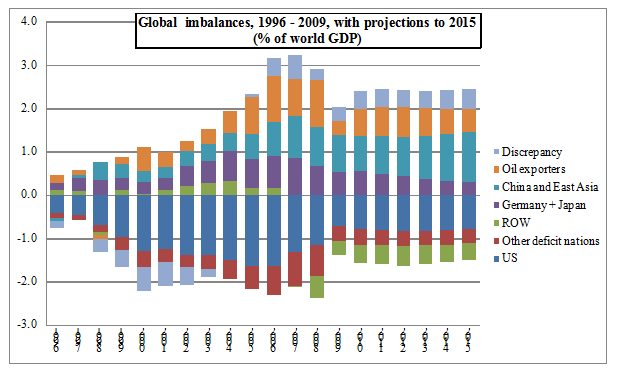
1. In a closed system, like world trade, some one needs to buy stuff. Everyone cannot export; everyone cannot run a permanent trade surplus; it is mathematically impossible. We cannot export to the moon or God. There must be global demand somewhere, and for much of the last two decades, the US was that anchor – so much so that we even re-packaged the business term  ‘buyer of last resort’ to apply to the US. So, as my students protested, it is true that the US government and consumers, as well as many EU countries, went wild in the last decade with their credit cards and created their own debt problems. But it is also true that without their demand, Asia and the Germans would have nowhere to export to. Now that the US and many other places are deeply in debt, it is obviously time to return the favor. The old exporters should become new importers in order to restore some balance to the system. ‘Diffuse reciprocity’ in trade is a basic requirement, in order that no one feels too much like they are being rooked by the other side. Without rough balancing over time, political disruption ensues (think Greece this year). This threatens the whole system in the long-term. Why is the Korean media too myopic to not see that?

2. The near permanent trade surpluses (above graph) in Asia are not, NOT, natural. It is mathematically all but impossible that a free-trade environment would return a situation where Korea, Japan, China and Germany would run 30 years of trade surpluses while the US ran corresponding deficits in the hundreds of billions USD. Why is this nearly impossible? Because the currency of such super-exporters would go up and up as their exports went up and up. In laymen’s terms, if the whole world wants to buy your stuff (Japanese cars, Korean TVs, Chinese everything), then the whole world needs more and more of your currency to buy all those amazing exports. So all those foreigners buying your stuff exchange their currencies for your currency. All this bidding to buy your currency (so they can buy your exports) means that the price of your currency goes up and up. So if you are permanently exporting more than importing, your currency should be permanently rocketing to the moon as foreigners scramble to buy it. Of course this has not happened. If you look at east Asian currencies, they all are pretty soft against the dollar, frequently moving downward. This is mathematically impossible to square with a permanent trade surplus. The only possible explanation is currency interventions to keep their currencies undervalued. In other words, cheating. And this is in fact well documented. China’s currency is pegged at a ridiculously low value to the dollar (estimates rage around 40-50% undervaluation!), and the Koreans and Japanese regularly ‘sterilize’ their currencies’ appreciation through massive dollar purchases. The Korean central bank’s euphemism for such raw mercantilism is ‘fine-tuning.’

3. Trade must be a two-way street in the medium-term, or the permanent deficit countries will eventually revolt. Here the Korean media is totally unhelpful with its nationalist and short-termist thinking that Korea’s success requires a surplus. This is also logically incorrect. There is no especial value to piling up dollars. Foreign currency cannot be spent in another country, so why stockpile hundreds of billions of dollars, or in China’s case, trillions, of someone else’s currency? If you don’t spend it back by importing, then at some point your export targets run out of money. And this is precisely what has happened in the great recession. The importers of yore are broke, and they need some of their dollars recycled back as export sales. But if you politically refuse to countenance a trade deficit by buying imports from your trade partners, then eventually you anger them: you are trade manipulator, and you provoke trade conflicts. Japan learned this the hard way. Its currency and trade gaming lead to two US backlashes – first when the US broke the Bretton Woods system and inflated in the 1970s, and then again the 1980s with the Plaza Accord. And this is what the Fed’s current quantitative easing is today. The US, unable to convince the surplus countries (esp. China) to import for the collective good of the system, is going to force them to do so, or they will see the value of their dollar reserves evaporate in inflation. Quantitative easing is a declaration of war by the Fed on the People’s Bank of China. This is extremely risky for everyone, as it throws the dollar’s reliability in the air, but it shows you just how head-in-the-sand obstinate the surplus countries are. In order to maintain short-term trade surpluses, they risk the inflation of the very currency they have stockpiled.

It’s the 1930s All Over Again…

currency

The increasing drift toward a ‘currency war’ should worry just about everyone. And it is remarkable given that we already went through this in the 1930s – a collective disaster for all involved, and which everyone realized afterwards was a huge error. Yet here are on the cusp of another round of beggar-thy-neighbor devaluation rounds as everyone seeks to export their way out of the recession.

In case you don’t know the history, start here. Just about everyone learns this story in Econ 101, but here is the quick version: The Great Depression struck in 1929, and everyone panicked. In that sort of adverse environment, everyone starts to save. This is individually rational, as savings represent a hedge against suddenly increased uncertainty about the future. You see that same thing today in the US as Americans are suddenly saving again to pay off their housing and credit card debt in order to get financially sounder. Unfortunately, as people save, they are not spending, and their spending ultimately creates jobs. When you buy stuff at Walmart, a whole slew of people got their jobs to bring you whatever it is that you just bought. This is the well-known paradox of thrift: while it is rational for you the individual to save ask a hedge against the future, if everyone does that, then our collective future gets that much worse because all that missing consumer spending (demand) eventually creates unemployment (less need for supply). Again, this is what is happening today in the US. As Americans retrench on their spending very suddenly and sharply (household savings rates have jumped something like 5% in 24 months), you get a consequent drop in the need for supply. That in turn means you don’t need so many workers to make that supply anymore, so people get fired. US unemployment has therefore suddenly spiked as savings rates spiked.

One good way out of this recessionary trap (high savings –> high unemployment –> worsening economy –> even more fear about the future –> more savings) is to export to others. If others buy your stuff, then you keep all the employment (to supply the foreigners’ demand), but your own consumer can still continue to save. It is a tempting way out that squares the mathematical circle in which, in a closed economy, savings must equal unemployment. But with exports, you can have your cake and eat it too; ie, the economists’ expression ‘export your way out of a recession.’ Now, a good way to make your exports cheaper is for your currency to be cheap against other currencies. Then your stuff is cheaper for foreigners to buy. It is therefore tempting for governments in recession to intervene artificially in currency markets to keep their currencies cheap, indeed maybe even undervalued (China today). Because a cheaper currency means cheaper exports means a quicker route out of recession. And in the 1930s, everybody tried to do this. But just like the paradox of thrift, if everyone tries to cheapen their currency, then no one’s currency becomes cheaper, and very quickly you can get a cycle of government-forced exchange rate devaluations across the board as everyone tries to get a price advantage over everyone else. We call this ‘beggar-thy-neighbor.’

It is now universally acknowledged by just about everyone (except Marxists I suppose) that this was a disaster that lengthened the Great Depression considerably. This intellectual consensus lies behind the creation of the IMF, and the IMF museum (next to the lobby in the Fund building) walks the visitor through this in excellent detail.

And now we are doing it all over again.

So much for learning from history and all that…

This time it is mostly Asians to blame. China, SK, and Japan all intervene regularly (‘fine-tuning’ they call it in SK) to keep their currencies lower than the market would otherwise say. China of course is the worst, and it is leading to some genuinely desperate policy ideas on what to do.

This leads me to two conclusions. First, it is evidence that global governance (GG) continues to fail. The G-20 squabbling over exchange rates so perfectly fits what we know states shouldn’t do, yet they are doing it anyway. This – along with the astonishing, ‘I-don’t-give-a-damn-what-the-world-thinks’ Bush unilateralism – tells me that GG was a dream of the 1990s that is fading fast. Second it tells me that the only answer is cultural change in Asian attitudes toward imports. For decades, a trade surplus (and if necessary, an undervalued currency) were not just natural outcomes of market processes, but an explicit statist-developmental goal wrapped in nationalism. A trade surplus is a mark of national pride and success in the world, and if Asian consumers must be punished with high prices and higher savings to get it, then so be it. In Korea, I see this ‘imports-are-bad’ everyday; contrast that with the American love of cheap Chinese stuff at Walmart. Given that barrier to Asian rebalancing is a cultural one – getting Asians to accept imports without mercantilist-nationalist distaste – that rebalancing is likely to take a long time. Culture changes slowly.

Asia’s ‘Culture of Export’ 2: The Case of Korean Mercantilism

P091004002

Part one is here. On the financial mercantilism rising in the wake of the Great Recession, go here.

Any foreigner living in Korea is bombarded with the notion of Korea globalizing. Its everywhere – both at the IR academic conferences, and in everyday life. The government-sponsored English agitprop network (Arirang) positively gushes about how cosmopolitan Korea is and how happy resident expats are to live here. Korean print media is constantly hyping this or that Korean star breaking into global attention. Yuna Kim in iceskating was last year’s rave; this year its Yong-Eun Yang the golfer. Korean films, we are told, have a worldwide audience, as does Korean pop music. Even Korean food they tell us, is poised for a global breakout. (I actually doubt all 3 claims; they are recycled endlessly like propaganda. In 32 years living in the US, I only saw 1 Korean movie – The Host – and never heard K-pop or saw a Korean restaurant. That hardly means they don’t exist in the US, but if they are as popular as the Korean government tells us, then I should have seen something.) And Koreans are downright obsessed with the numbers and kinds of foreigners living here, and multiculturalism is a raging debate right now in Korea.

Yet for some reason, this incipient globalization never seems to happen. And every once in awhile, you get a glimpse of the real story – the deep seated nationalism and the desire to have globalization occur on strictly Korean terms. Try here and here,  and note that the primary response to a trade deficit with Japan is the desire to reduce it through increasing self-sufficiency, a third worldist economic notion directly at odds with globalization.

This sorts of articles show you exactly the Korean ambivalence on globalization that prevents it from every attaining the global status it so desperately craves. I see this attitude all the time at conferences on the topic of Korean trade and IPE policy: exports are good, but imports are bad. For a raw, almost xenophobic, example of this mercantilist, illiberal spirit (trade surplus = health), try here.

So its great that Korea exports this or that to the world (food, cars, TVs), but Koreans clearly violate the spirit of the WTO by formally and informally discriminating (‘nationalist buying’) against imports. Koreans are downright desperate for global cultural recognition (endless stories on Korea’s ‘brand’ – whatever that means), but lots of knowledgeable people I know in academia still insist that Korea needs a positive current account and should mimic rather than import successful foreign products. Of course, you can’t have it both ways; you can’t demand ‘buy Korea’ from locals and then tell foreigners you are globalized.

Here a just a few examples. Imported goods are almost always far more costly in run-of-the mill stores. The best known stories are the 20-30% tariffs on cars imported into Korea. You’ve never seen as many Korean cars in the entire rest world as you do here in this one small market. Alcohol too has a extreme price differentials. A fifth of Jack Daniels costs $40 (see the picture above from my local grocery store)! Even something as mundane as scotch tape is hammered. Scotch brand transparent tape is 3 times the cost as the Korean brand. When I bought a TV, there was not even a discussion that I would buy a Sony or a Panasonic. They were a good 25% more costly, so of course, I bought the Samsung. And the cell phone sector too is overpriced, protected, and cartelized. Blackberry, Apple and Microsoft scarcely operate here. So forget about the easy compatibility of Windows Mobile or an I-phone.

This attitude is hardly specific to Korea. Lots of countries express a preference for mercantilism, and the everyday voter generally does not support free trade anywhere in the world. But economic nationalism is stronger in Korea than it was when I lived in Europe, and the cost differentials are more obvious and so extreme, there is no way they reflect just market pricing. Further, it jars badly with Korea’s constant repetition that it is globalizing. Because of course, globalization goes both ways. The flow of goods, people, ideas, etc. comes in and out. Little I have seen here or read in the literature or media suggests Koreans really want a lot of inbound traffic. Exports are great, but imports will probably bring swine flu. Incoming traffic is strictly controlled, especially of foreign people living here.

Asia’s ‘Culture of Export’ (1): Persistent, Politicized Asian Imbalancing

export_ship

Part 2 is here.

In my IPE class this week, we discussed the issue of global imbalances. (If you have no idea what this means, start reading Martin Wolf at the Financial Times.) I argued that it will take awhile to ‘unwind’ them, because Asians have acquired a cultural habit of saving and exporting. Imports are suspect, and a trade surplus has become a downright obsessive national goal out here rather than a natural, occasional imbalance in trade. Now this would be a laudable goal if East Asian states were highly indebted poor states, as in Africa and Latin America, but East Asia is sitting on close to $4 trillion in US debt stocks from two decades of single-minded stockpiling. If China didn’t run a trade surplus in a given year, it would provoke an existential political crisis in the Chinese Communist Party. This is just how deeply mercantilist Asia is. Korea’s trade balance is reported every month in the news, and it is frequently the leading story. The reporter’s spin is always congratulatory and nationalistic. The trade surplus is always reported as a major national-political goal, not a technical economic outcome. In Japan in the last month, the BOJ intervened to keep the yen down at the behest of major exporters, and it is threatening to do so again this week. There is your ‘culture of export.’ East Asians are politically opposed to running trade deficits. Trade surpluses are not economic outcomes; they are nationalistic, highly managed, artificially and purposefully-created political outcomes. This is a massive cultural hurdle to righting the global economy.

Asians desperately want the old system of high exports and high savings to continue, but it can’t because traditional global importers are leveraged to this hilt. But I genuinely believe Asia’s mercantilist elites will put their hands in the sand on this and simply refuse to play ball seriously in the medium-term and so prolong global unemployment. Exporting in Asia is not just a regular economic activity on par with consumption or government spending. Export has acquired a near-mythic status as a mark of national greatness and power. This is wildly mercantilist and unsustainable, but that won’t prevent Asian elites from trying anyway and dragging the globe into a long ‘savings glut’ recession.

In liberal trade theory, current account surpluses are natural outcomes of an unforeseen change in the desirability of a country’s exports. One year, a country’s exports may be suddenly very desirous. Recall that the first Playstation 3s were resold on Ebay for $1000+, so Japan got an export surge. This is ok, because when you exports surge, your currency, if it is floating, should surge too. Your stronger currency reflects that your stuff is in greater demand than you are demanding others’ stuff. The following year, as your stuff becomes more expensive due to your appreciated currency, your net exports over imports, your current account surplus, should recede. Broadly, your imports and exports should tend toward equilibrium, because the world is a closed system. So everybody is happy, because in the long-run, there should be – in fact, mathematically, there must be – equilibrium.

But this healthy process of circulating trade and currency got all gummed up in the last 15 years or so, and this is why the Great Recession is so brutal. In short, East Asia (and Germany) are big net exporters, and the US and peripheral Europe are big importers. If the exporters don’t buy stuff from the importers though – ‘recyle’ the importers’ currency back to them by buying stuff from them – then the importers eventually run out of money. This is ‘natural.’ Previous importers should pendle back to export, and vice versa. But that is not at all what happened.

Instead, running out money didn’t stop the Americans (or the Greeks) in the last decade. When the money ran out, we just borrowed more – and from the exporters. The average American burned through all his savings by around 2005 and went into debt; the US government of course was in debt too. So everyone was borrowing more and more, and Asian states, unwilling to import more, were super-willing to lend their savings back to Americans so that they could keep on buying. (The same thing happened within the euro-zone between the German exporter and the southern European importers.) Hence the ‘imbalance’ – importers piled up more and more debt borrowed from the exporters, and the exporters piled up more and more savings by lending and re-lending their profits back to the importers.

We piled up debt to buy more, while they lent us our own money back to us so we could keep buying. This bizarre, predatory symbiosis is why Ferguson coined the expression ‘Chimerica,’ and its unsustainability has now become evident for all to see. Resembling a ponzi-scheme by 2008, it all collapsed.

The big problem is that if the pre-Great Recession super exporters (above all, China) don’t start spending, not saving their foreign currency, then global consumer demand will collapse, because the erstwhile importers’ demand is much reduced. Indebted and overleveraged, the former consumers are now saving again. The problem is that all that US (particularly) consumption before created global demand which created jobs. Now that US demand has contracted dramatically. Without demand from consumers to buy stuff, companies don’t need as many laborers to make stuff, so they start firing people – unemployment.

So in brief, US demand imploded under debt, but Asians don’t really really want to substitute for that demand. They don’t want to go shopping, or rather their governments don’t want them to go to shopping, because the governments are trapped in a Spanish Habsburg mindset that they MUST run trade surpluses all the time. Getting Asian consumers, especially the Chinese, into the malls is the globe’s best hope for a fast recovery, but the cultural blowback from 40 years telling citizens to save as a national mission is a huge obstacle, as is the Chinese government’s adamant, infuriating refusal to encourage its citizens to shop.

Part 2 will be a case study of Korean mercantilism.

‘Economist’ Magazine Conference on South Korea

the-economist-logo

Like most of you, I have been reading the Economist off-and-on for 20 years. It, along with the Financial Times, is the most reliable journalism in English I think. I find it less partisan and noxious than most US journalism (or maybe I just agree with the classical liberal bent more). In any case, I got invited to its ‘Bellwether’ conference series on South Korea last week. Here are a few thoughts.

1. Bankers and financiers are a greater force for liberalization than I realized. I have the general IPE knowledge of Asian mercantilism, which I bemoan regularly here. But these guys really knew the details in depth, and they hammered the Korean policy-makers on this. This was an education. Among other things, I didn’t realize how much the Bank of Korea intervenes to ‘fine-tune’ the exchange rate or just how many gimmicky non-tariff barriers Korea uses to continue to protect its car industry. The ‘fine-tuning’ (nice euphemism that) is done at the behest of Korea’s biggest exporters – the chaebols in shipping, automobiles, and electronics. And it was quite amusing to watch the westerners at the event try to get the Koreans to admit that such gaming was in fact ‘capital controls,’ but the policy-makers ducked that one again and again. Being a political scientist focused on politics, I assumed the dirty work of pushing Asia toward liberalism fell mostly on the western bureaucrats who arrange FTAs. It was pleasing to see so many private sector people saying the same things that we say, only without all the theory.

2. Korea’s modernity. Nothing is a better marker of Korea’s modernity than a conference like this – filled with foreigners who want to make a lot of money! Having written my dissertation about the IMF and World Bank, I am accustomed to going to conferences on development, debt and similar travails. But here was a country that escaped from all that to be a good recipient of FDI, just as those institutions hope. (The World Bank calls former borrowers like Korea ‘graduates’ into private sector capital markets. Condescending?) 

3. Korea’s failed quest to be a ‘hub.’ For 10 years now, the ROKG has been trying to build up Seoul as an ‘international financial hub,’ and the session on this was downright self-congratulatory until I asked a question. I suppose academics exist to speak truth-to-power (which we don’t do usually – see Iraq). So I was pleased for a moment to be persona non grata on this, because I think it is wildly overhyped. The idea is that Seoul in Northeast Asia could become like Hong Kong (HK) is to China, or Singapore is to Southeast Asia – a bastion of modernity for international banks in a wild west region. There are some pretty obvious problems though:

3.a. Northeast Asia doesn’t really need hubs like Southeast Asia does, because Northeast Asia is already quite settled (but for NK) and developed. A ‘hub’ implies a surrounding piedmont that is less orderly or coherent, like Hong Kong to early 20th century China, or Singapore to ASEAN, but still worth penetrating. But there is no disorderly yet still accessible backyard up here: NK is closed; China is modernizing; and Japan is already modern. That leaves Russia’s extremely underpopulated Far East. Anyway, if there was such an opportunity, Tokyo would have grabbed it long ago. And this leads to the next problem…

3b. The hub market is Asia is already full – HK, Singapore, Shanghai, Tokyo. You can’t have too many hub or special economic zones, or they aren’t special anymore. So the first mover advantages are high and Seoul has come late to this party.

3c. North Korea. Seoul is 35 miles from the DMZ. This proximity makes it a city-hostage to the North. None of Seoul’s regional hub competitors have such a geopolitical backdrop. I find it hard to believe that big banks will locate their Asia HQs so close to such unpredictability. I can’t see Seoul competing among Asia’s biggest cities until the peninsular situation is resolved.

3d. Korea is still struggling with just how much it wants to multiculturalize, and until it accepts ‘diversity,’ it will be very difficult to get lots of middle-aged professional foreigners with families to reside here permanently (as in HK or Singapore). English is spread only thinly among the elite; getting a taxi is still a hassle. Foreign schools are insanely expensive here ($15-20k a year). The bureaucratic hassles of foreign life in Korea are endless – our national identity numbers are coded to mark us as foreigners, so shopping websites routinely block us. Cell phone companies still make it hard for foreigners to buy phones themselves (my Korean wife had to reserve our iPhone 4; Korea Telecom would not accept me). Tenant law is a nightmare (the courts tilt against us), as is contract law or getting a serious bank loan, like a mortgage or a car loan. In short, the primary hurdle for Korea to international/regional ‘hub’ status is not infrastructural, political, technical, etc., but cultural. Do they really want us here in large numbers, and are they prepared to really entrench the English bilinguism necessary to attract professionals, as has been the case in Singapore and NK for decades? The answer is still no.

4. Bankers, financiers and policy-makers find academics sort of a waste of time. There were 200 invitees, and among them only 5 academics. Given that I usually go only to academic conferences, I was out of my comfort zone – which of course is a good thing for most of us. I really began to see just how peripheral we are to, well, almost anything really important to these guys. This was quite a let down, and somewhat humiliating. Everyone was quite polite, but their skill sets were radically different, they had their fingers deeply on the pulse of policy in SK, and Asia, far better than I, and they speak their own CPA/MBA/Wall Street language that I really struggled with. My commentary seemed tiresomely abstract to them. I felt like a high school kid in a college class – out of my league and eventually cowed into silence from fear of looking like an idiot. Walt and Mead worry a lot about the ‘cult of irrelevance’ in political science, and nowhere in my recent experience did I perceive that as strongly as sitting in a room filled with serious people in expensive suits about the serious business of making money. What a contrast to the ridiculousness of so much academic theorizing! Conscious of this over the years, I have forced myself through econ textbooks and the Financial Times’ business coverage (a HUGE education that), but it was a healthy shot again my academic hubris to realize I didn’t understand 20% of what was said at this event. Even more humiliating was being told that most invitees must pay up to $2000 to attend these Bellwether conferences, but they invite academics gratis, because they assume we are broke. Good grief. 😦

5. Korea and Islamic finance? A couple of speakers mentioned this as a future expansion possibility for Korean banks. I found this downright off the wall. I suppose when there is big money involved, everything else fly out the window, and international private sector banking is far from my skill set. But the political scientist in me sees several huge hurdles. First, most obviously, Koreans know very little about Islam, and what they do know is generally negative stuff flowing from the GWoT. My students ask my astonishingly basic questions. The cultural distance is huge; Korea has less than 35k Muslims. Second, Korea is becoming more Christian, specifically more evangelical, and more closely aligned with the US in the GWoT. Third, the cultural fit of the sovereign wealth funds of the Gulf states make them the obvious choice for pious Muslims. If you were an devout Indonesian investor, what would really draw you to Korea of all places? I just don’t buy it all. Far more realistic would be a move into development financing in Southeast Asia without the cultural baggage. This is far closer to Korea’s own past and skills.