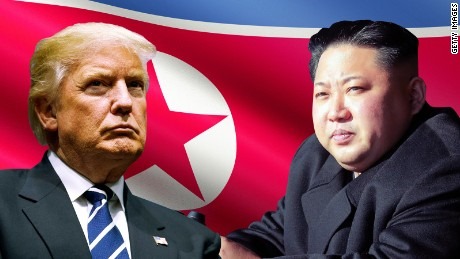
North Korea 2017: What Did We Learn? That We Can’t Bluster/Threaten Them into De-Nuclearization

170809143550-mobapp-trump-jungun-north-korea-flag-02-large-169

Sorry for the long hiatus. The holidays were pretty busy and exhausting.

This is a local re-post of something I wrote The National Interest late last year. I like these end-of-the-year retrospectives and predictions. So here is a look back at all the craziness around North Korea in 2017.

The most obvious new element is an American president talking to the world’s most dangerous state like a petulant man-child. Honestly, Trump just made everything worse, and his rhetoric almost certainly convinced the Kimist elite that going for nukes was wise.

The other big thing I think is how the debate over responding to North Korea is increasingly cutting out the doves. North Korea with nuclear weapons is such a scary prospect that it is side-lining engagers and powering the hawks in the debate. Increasingly the debate is an intra-mural one among the hawks, between moderates (where I’d put myself), who are wary of strikes and at least open to talks even though we know the Norks will gimmick them, and ultras like Trump or Nikki Haley who genuinely seem to want to strike. The real question in the US debate now is whether the moderate hawks, with an assist from the doves, can restrain the ultras from attacking North Korea this year.

The full essay follows the jump…

Continue reading

Separating China from North Korea is Worth South Korea’s Silence on the South China Sea

South China Sea

I got this map from here. Very useful. The article below was originally published at the Lowy Institute last week, here.

In short, I don’t mind too much that the Koreans aren’t engaged on the South China Sea freedom of navigation dispute, because keeping their mouths shut and schmoozing the Chinese is necessary to get China to finally cut North Korea loose, which in turn is the only way North Korea will ever collapse. This is why I have never thought much of the criticisms that President Park Geun-Hye is a ‘sinophile.’ If you were South Korea, you would be too. If you lived next to giant China, and they were permanently bailing out your mortal enemy, then sucking up to them (within limits) is a good idea. I am not a big fan of PGH, but she has really gotten the Beijing-Pyongyang nexus right that her predecessors did not. Let her keep flattering Xi Jinping.

So you say that SK is a US ally and they’re getting a free-ride on the US, and therefore they should be involved in the SCS. Fair enough, but think a few steps further out. Getting China to dump Pyongyang is way more valuable than a little more weight on the scales in the SCS. SK can’t add much there, but openly throwing in with the US and Japan on the SCS would push Beijing back to Pyongyang when PGH’s schmoozing and flattering of Xi Jinping has done so much to push them apart. That’s hugely valuable.

Remember that NK will not collapse until China cuts it off, and that NK’s collapse is vastly more valuable to everyone – US included – than one more minor voice in the SCS flap.

The full essay follows the jump.

Why ‘Women Cross the DMZ’ Was a Bad Idea: The Threat of Moral Equivalence

Gloria Steinem is in the middle with the sunglasses and yellow sash. To her left is Christine Ahn, the primary organizer.

I have to say that I am amazed at how controversial this ‘march’ across the Korean DMZ became. My essay below speculates on why this obscure event – which will almost certainly change nothing, because the geopolitical split between the Koreas is now deeply baked-in – nonetheless provoked a huge fight among Korea-watchers for the last month.

The march got coverage on CNN, the Washington Post, Foreign Policy, and a whole host of other places. A lot of the relevant links are in my essay below, but here are a few more, so you can make your own mind:

the ‘Women Cross DMZ’ website (watch the introductory video by Ahn on the homepage)

Christine Ahn and Gloria Steinem on Twitter 

Josh Stanton, arguably the march’s most vociferous critic

I also thought this recently published critique was a good one. The author writes, “ironically, the symbolic crossing has provoked a stark division between its few supporters and many more detractors.” That is my impression too. While march supporters were passionate, the backlash (of which my essay below is a part) struck me as greater and quite widespread.

Now Ahn says they are going to try again next year, so I guess we can we argue about this every year now. Hoorah!

The essay below the jump was first published here, for the Lowy Institute.

Continue reading