If Strauss-Kahn Resigns, How about an Asian to run the IMF this Time?

ap_dominique_strauss_kahn_jef_110516_main

I have no particular intelligence on the details of the Dominique Strauss-Kahn (DSK) case. I would only say what everyone would agree to: He should be investigated properly with due process and the assumption of innocence. (That we even need to say this in the US is now, unfortunately, necessary given the US flirtation with extra-judicial methods because of the war on terror.) That he was fleeing the US for his home country when he was arrested does not bode well; this is why he was denied bail. If he is found innocent, then he perhaps can stay on the job, unless this incident comes to be seen in a pattern of irresponsibility, even if formal guilt is not found. DSK was rebuked for an affair with an IMF staffer a few years ago, so perhaps this will tip him out, even if he is found innocent.

But any decision to retain him as IMF managing director (MD) should be based on the evidence, not because he has helped revive the IMF’s fortunes after a tough decade (because of heavy criticism of the IMF’s handling of the Asian Financial Crisis and globalization generally), nor because he has helped so much in the recent debt crisis, especially in Europe. I agree with both of those assessments, but they don’t really change the issue of whether or not he is personally responsible enough to complete his duties. It is also worth noting that infidelity is not a crime (DSK is married). The real issue is whether he tried to rape his alleged victim or not. If he did, he should obviously go. But the important distinction here is with the Clinton impeachment. If DSK’s wife can live with his libertinism, as Hillary Clinton was able to, then that is ultimately a personal issue. There is no need to import the ‘politics of personal destruction’ into the IMF. It is also worth noting that French politicians get far more leeway on personal indiscretions that US politicians. France’s longest serving modern president, Francois Mitterrand, had a love-child out of wedlock who was revealed after his death. Perhaps DSK never quite escaped that more tolerant expectation set.

My own sense is that, even if found innocent because it turns into ‘he-said-she-said,’ it will be hard for him to stay on. The images of him in handcuffs, being pulled off a plane, standing sullenly in a court will make it hard to keep him. Paul Wolfowitz too was forced out of the World Bank presidency several years back for a similar, less egregious, personal affair. My guess is that DSK will have to go too.

For my own previous writing on the Fund, broadly sympathetic to its role, try here or here.

The issue of his replacement brings up a long-standing dispute over the leadership of the Bank and Fund. Precedent says the Europeans pick the IMF MD, and the US picks the World Bank president. This logic was based on the, previously reasonably accurate, claim that the North Atlantic represented the core of the world economy. Of course, it was more than this; prestige has always played a huge role, particularly for the Europeans. Having the IMF sinecure helped buttress Europe’s self-image as important central to global governance.

But you hardly need to be an economist to know that Europe’s role, relative to that of the US and Asia, has been in decline for awhile. Decolonization generally reduced Europe’s global footprint. Decades of slow growth and declining military spending has vaulted the US past the EU in the transatlantic partnership. The seemingly endless inability of the Europeans to put the EU into good working order – the euro mess, the constitutional-institutional rube goldberg structure of the EU itself, the continuing inability of outsiders to know who ‘speaks’ for Europe – cripples an EU global role. Just about everyone outside Europe thinks that the EU should have one EU seat on the UN Security Council, not two for Britain and France. Henry Kissinger famously quipped that he did not know whom to call if he wanted to talk to Europe, and that question is still unresolved. And of course, the rise of Asia has relatively squeezed the EU more than the US. I was at a conference last year where I made this point, and the EU speaker could at best only respond that the EU was a ‘foreign aid superpower.’ If that is all you got, it is time to step aside and allow the ‘New Core,’ Asia, to have a crack at the top-table of world politics. And last year, when I was at an IMF conference in Korea, Asian questioners did in fact ask DSK this, and he was response was, yes, the MD after him should be an Asian.

Everyone knows that Asia’s weight in the global economy has grown dramatically in the last several decades. The IMF’s own voting quotas have been re-ordered to reflect this. Chinese, Japanese, and Indians have already been pretty high up in the managerial order in both the Bank and the Fund.

My own sense is that a Japanese banker would be an excellent choice. Japan is the most open and mature of the Asian economies. The Bank of Japan has been downright heroic in its battle against deflation for years now; it is vastly more serious about Japan’s economic problems that Japan’s politicians. The BoJ has tremendous skills on issues that dog IMF debtors, like government debt, the money supply, or slow growth. A Chinese might be a more controversial choice, one the US and EU might veto, because China is highly interventionist and still a formally communist country. If China would object to a Japanese, likely out of sheerly nationalist resentment, then what about a Korean, Indian or Singaporean?

In short, Asia’s time to run one of the two Bretton Woods Institutions has arrived. Europe’s economic claim to that leadership role is now much-reduced. The euro is a mess; EU economies are carrying huge debt burdens; the EU remains unable to find a common voice despite decades of waiting and endless speculation; and the last few Europeans to run the IMF have been been pretty meager – Rodrigo De Rato lasted just three years (2004-07) and used the position to jockey for political position at home in Spain; before him, Horst Koehler (2000-04) did the same.

In fact, the only argument to keep a European one more time, is based on Europe’s weakness, not its strength; that is, because the IMF’s most important work in the next few years will be in Europe, it should have a European. But this strikes me as too clever by half and yet another gimmick to keep Asia from its clearly-earned place to run these institutions occasionally. By any reasonable criteria, Asia is qualified – probably more qualified actually given Europe’s economic state today – to take the MD-ship. The inevitable arguments to be heard in the next few weeks about Europe’s ‘weight’ in the global economy will just be mask the real,  tribal and prestige-driven desire to hang onto the last shreds of influence in an increasingly ‘post-atlantic’ world.

The US Drawdown & National Debt Debate: AfPak, Korea, etc

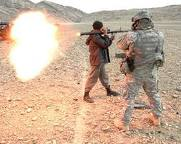
Afghanistan rocket

I’ve been thinking a lot recently about the scale of US commitments and how to reduce them so as to not bankrupt the US in the medium-term. I have gotten a fair amount of criticism that I don’t know what I am talking about, US warfighters are superlative, US forces in various places like Korea or Afghanistan augment US national security, pull-outs jeopardize our credibility, etc. Ok. I am learning like the rest of us on this. I agree that US commitments are sticky, and I have little doubt that US servicemen are professional enough to win conflicts in places like Korea and AfPak (Afghanistan & Pakistan), so long as we have the resources to stay.

Further, I will admit that a ‘post-American’ world is a little unnerving. I say this not as an American who likes ‘empire’ (I don’t), but more generally because I still do think, even post-Iraq, that US involvement generally makes the world a better place. The dollar and US engagement help keep the world economy open, and US force can sometimes be the last line against truly awful acts that shame the conscience. This is why I supported the Libya intervention, and this is why I hope the US can keep forces in Korea. A retrenched, bankrupted, and sullen America worries more than just Americans. To clarify to my critics, my concern is whether the US can support allies around the world, not if it should. I don’t want US Forces in Korea (USFK) to leave any more than anyone else. I can think of few more valuable uses of US force than to help defend a democracy against the last worst stalinist despotism on earth. I just wonder whether we can afford it.

I think we need to be a lot more honest about the huge defense cuts that will be required to balance the US budget. The US deficit ($1.5 trillion) is a staggering 10% of GDP and 35% of the budget; publicly-debt ($9T) is at 60% of US GDP ($15T); and the integrated national security budget (DoD, Veterans, relevant parts of Homeland Security and Energy) exceeds $1T. You hardly need to be an economist to think that this is unsustainable and smacks of imperial overstretch. For an expert run-down on the US budget mess, try here.

This gap could of course be filled with tax increases, but a central GOP policy commitment since roughly the Ford administration has been ‘no new taxes.’ Unless this changes dramatically – and the recent Ryan budget proposal showed no GOP movement on tax increases – this means that most of the $1.5T hole must be filled with spending cuts. My own sense is that allowing the Bush 2001 and 2003 tax cuts to sunset, as is current statute, plus tax reform and a carbon tax, could in fact generate a lot of new revenue at tolerable and intelligent levels of pain. This would reduce some of the pressure to cut defense (and all other US government programming). But without such new taxes, the $1.5T hole calls for huge cuts, and the axe would inevitably land on defense too, including US bases and commitments overseas.

I am genuinely agnostic on whether this is a good idea. Part of me thinks that wealthy US allies, especially Japan and Germany, free-ride. They should spend more so that we can spend less. But others have retorted that encouraging wealthy Asian allies like Korea and Japan to spend more could trigger an arms race in Asia that might also go nuclear. Barnett has a nice post on how Asian elites are aware of this and worry about a weak US. (On the other hand, there is not actually a lot of empirical evidence that denuclearization brings peace.)

In response to my commenters at Busan Haps on a US withdrawal from Korea, I wrote:

“America’s economic problems will likely compel the rebalancing all of you are thinking about. Importantly, even if the US wanted to stay and provide ‘extended deterrence’ as we have for 60 years, the dollars are not there for it.

Whether or not we should go is a different question. My sense is that Korea does actually try harder than many US allies. Korea spends 2.7% of GDP on defense. Germany and Japan spend around just 1%. The US spends close to 6%. But like Germany and Japan, Korea is now wealthy enough to spend a lot more. This raises the free-riding question you all worry about.

If Korea really wants USFK to stay no matter what, then the most likely way is for Korea to pay for ALL of the expense of USFK here. Right Korea and the US split the bill roughly so far as I can tell.

But I find great resistance to this thinking. My sense is that within the Beltway, there is strong elite consensus for the US remain committed around the world. ‘Empire’ seems to be a knack or a habit Americans have grown into. We like being a globally present superpower but are increasingly unable to afford it and unwilling to pay the taxes for it.

The question then is what do we do now? Cut entitlements (Medicare, Medicaid, Social Security) to make room for defense? Do we raise taxes enormously for all these things? Are do we retrench from our global posture so we spend less money?

Finally, there is a model for retrenchment. Britain slowly retreated from its empire in the 1950s and 60s. In some places it went very badly – South Asia and southern Africa especially. But this slowly brought British commitments back into line with British resources. The alternative for the US is to change nothing and risk an imperial crack-up – something like the USSR in 1989 or Austro-Hungary in 1914. That is my worry.”

Here are two good recent articles from the Wall Street Journal by Leslie Gelb and Max Boot on whether or not we can drawdown from Afghanistan and Pakistan (AfPak) post-bin Laden. I lean toward Gelb, but I think Boot makes some good points. Particularly, Boot notes that a US presence in Afghanistan made it possible to get OBL, because US forces were proximate. But Boot still sidesteps the debt issue. Both Beinart and the US JSC chairman call the debt the biggest threat to US national security. I am inclined to agree…

There’s No NATO ‘Crisis’: Muddling Through Libya is Good Enough

NATO Flag


Besides the much-needed debate on the limits of the responsibility to protect (R2P), the Libyan mess has also provoked some good discussion of what NATO is supposed to do now, 20 years after the Cold War. It is a good question actually. Western publics are so accustomed to it, we just don’t even consider it much (such public opinion inertia is one reason it is still around). Conversely, the Chinese, and Russians especially, continue to suspect it as a ‘bloc’ that might somehow be used for future containment of them. Here and here are good articles Libya as a NATO-breaking event – a distinct possibility, especially if there is a push to extend NATO intervention into other Arab Spring revolts. Here and here are two defenses, that still struggle to define NATO’s military role.

My own sense is that NATO would be better off just openly admitting that it is now western military club for the general promotion of democracy and liberalism when its members feel so compelled. It is basically that ‘league of democracies’ idea, the formal proposal of which failed a few years ago. I understand that this is terribly messy, and it sounds pretty open-ended. But like the evolution of the R2P concept, just because it is open-ended, doesn’t mean the alliance needs to act on every possible scenario. We are learning how this works; there is no rush. Like the evolution of R2P, a more general mission for NATO would allow the members to pick-and-choose where interest, values, capabilities. Such ‘selective action’ is well-shown in the current Libya operation.

Yes, the Cold War brought a level of clarity to world politics that we all, disturbingly, seem to miss. But trying to force NATO into old boxes – ie, looking for a Soviet-style threat that brings ‘mission clarity’ or ‘threat definition’ is a fool’s errand by now. We really ought to know that 20 years after the Wall fell, and god help us if we place China into the Soviet ‘enemy box.’ As I argued earlier, the mess of crises of the future will be mostly ‘third world brushfires’ that like Somalia, Kosovo, or Rwanda. This should hardly be news to anyone who has followed the emergence of COIN in US military thinking in the last decade.

Such third world crises  require different force postures among NATO allies, yes, but they are hardly a reason to dissolve or disdain NATO. The most obvious evidence for this is George W Bush’s dismissal of NATO assistance in Afghanistan and Iraq. Bush thought NATO too encumbering, sluggish, and political for the rapid action he sought. But then both operations went south, and the US has tried repeatedly to pull NATO in.

Anyone who follows NATO knows the endless ‘out-of-area’ discussion discussion: should NATO go out of its European area into places like Afghanistan? I have no definitive answer – probably, but selectively. But far more important is that NATO is working this out, albeit slowly. This is why I don’t understand the pundit contempt for NATO ‘dithering.’ What is the alternative? Do neo-cons, eg., really want the US do all this stuff alone, again? Didn’t we learn that hard lesson in the last decade? And to those who think NATO is just irrelevant, should we simply close it? NATO is the closest thing we have to a club of democracies. As such, it carries enormous moral weight in world politics, beyond the simple aggregate of its military capabilities (which are, to be sure, atrophying). Yes, NATO bickers incessantly, but any show of unanimity from organizations like the Shanghai Cooperation Organization or ASEAN is almost certainly farcical and repressed – a representation of solely elite, frequently dictatorial, views. By contrast, NATO, because it is democratic, signals far more credibly. So while it takes awhile for NATO to get its act together (dithering), it is vastly more meaningful when it does – even if partially, as in Libya. And NATO ‘interoperability’ reduces the coordination costs among the democracies. Finally, its existence is minimally costly. Members can still free-lance as the US did in Iraq and France just did in Ivory Coast. NATO does provide room for ‘coalitions of the willing.’

In sum, the costs of NATO are low – some meetings and a lot of hassle. But the benefits are high – a credible, somewhat united democratic voice in global affairs with enormous moral prestige, a functionally meaningful and capable alliance (unlike the ‘alliances’ between China and NK, or Russia and Belarus that look more like gangs than real alliances), and retained national room to maneuver.

So why complain about NATO so much? It is muddling through pretty well it seems to me. It is stumbling toward a new role to project democratic force on a selective basis. A more R2P focused NATO will re-assure China and Russia that they are not the alliance’ targets (even if they will call R2P ‘human rights imperialism’). What great benefit does anyone in the West (not just the US, but anyone) get if we close NATO?

The real problem with NATO is not the endlessly harped-on issue of its mission: I really can’t read anymore of these sorts of articles with variants of the title ‘the future of NATO.’ It should be blindingly obvious that in a messy post-Cold War, post-colonial world, NATO’s mission focus will correspondingly be unclear (beyond basic member security). But so is the mission of the UN, ASEAN, and maybe even the EU (!), so this is not uncommon in generalist, big-theme international organizations. The real issue is member capabilities – specifically the precipitous decline of the European democracies to project power independently of huge US intervention. The well-known ‘free-rider problem’ debilitates the alliance no matter what its mission. This is a problem in Asia too (although the SKs try harder than Japan, to be fair.) The real issue for NATO is not its irrelevance – in world of ‘brushfires,’ it will still have relevance as Libya just showed – it is the willingness of members to provide resources.

Turkey’s ‘neo-Ottoman’ Rise (3): Why I am Wrong…

turkish flag

This is the continuation of a Wikistrat (where I consult a bit) game scenario on Turkey’s economic and possibly military rise. Readers are counseled to start with parts one and two.

The following are responses to criticism, mostly that I didn’t flesh out the reasons why Turkey is likely to hold broadly western course:

1. Turkey’s rise unbalances the region more than I admit, and I don’t muster enough evidence.

My sense is that Turkey’s growth is pretty good, but I don’t see any particular reason that it should be labeled stratospheric or ‘neo-Ottoman’ or something like that. By the standards of a dysfunctional region – Greece, Iran, Syria, Egypt – it is great. But compared to the old and new cores, or even other middle powers, it is a middle power. Even compared to tiny Israel, Turkey is probably a generation behind in state-development, the translation of economic power into military capability, functional political parties, trustworthy courts, and the many other attributes of thick, cohesive, functional state-ness. The CIA lists Turkey’s growth in 2008 at 0.7%; 2009 at (negative) -4.7%; and 2010 at 7.3%. The IMF’s numbers are 2010: 7.8%; 2011: 3.6%. I don’t see that as revolutionary, nor justifying big rhetoric. However, if the argument is more limited, that Turkey will play a greater role in the Middle East and central Asia, I agree. The big losers will be Greece (further unbalanced competition), Israel (yet another headache) and Egypt and Iran (lost prestige as potential regional leaders).

Turkey faces tough structural constraints that do not really mark it out from other second-world risers. No talks about major Brazilian or South African shockwaves, so why is Turkey’s fairly standard modernization-developmentalist growth arc that much different? I am open-minded about this. My thinking is hardly set. I guess I am just not convinced yet.

Finally, my sense is that the tectonic plates of international politics move terribly slowly. Hence I note the stability of Turkey’s foreign policy. Really deep shifts take a long time, like East Asia’s rise, so I am not convinced that a decade or so of choppy albeit healthy growth, coupled pushy, semi-Islamist rhetoric is enough.

2. “The demographic growth in Turkey is all in populations less likely to be EU/West friendly, i.e, the eastern, more rural hinterlands. What’s Turkey’s motivation?”

I think the motivation is primarily economic. A significant turn from the West would reduce critical inward foreign direct investment flows and tourism dollars, and damage links that military and business cherish (easier visa rules; access to Wall Street, western universities, and the international financial institutions; etc.). Turkish elites are aware of this. Like most late, second world developers, Turkey needs continued access to old (West) & new (East Asia) Core dollars, markets, and technologies. This is why I originally said ‘neo-Ottoman’ rhetoric might be more justified in 20 years. For a comparison, look at Indonesia or Malaysia. They too have populations that rankle at Western dominance, want more international stature and maneuvering room, and have populist, entrepreneurial, Islamist politicians. But these tendencies have been held in check by the huge economic incentive of continuing, decent relations with OECD states. I see this in Turkey too – hence my list of institutions and relationships Turkey has retained.

Populism may work for electoral reasons, but does Turkey want to become Venezuela? Perhaps the the AKP (Justice and Welfare Party) really wants to push in this direction, but resistance from the revenue-generating (western and westernized) parts of the country would be strong. This is the counter to the eastern demographic growth you mention. Perhaps this is why Huntington referred to Turkey years ago as a ‘torn’ country. I did not think so much about the demographic evolution though. Point taken.

A second motive is national security. If Turkey drifts from the West, to whom will it go – Iran and Syria? If so, it faces balancing and isolation by some combination of Israel, the US and the EU, and possible exclusion from NATO and the WTO. I suppose Russia is a possible patron/ally/friend, but what does Russia gain? The reset is important for Russia, as well as WTO entry, and, most importantly, being perceived as a great power by the West. Siding with a semi-islamized, somewhat unpredictable ‘new Turkey’ might be useful to poke the West in the eye – certainly a Putin proclivity – but how much does it advance Russia’s great power pretension? Not much I think, but I admit this question requires more research. Next, Turkey might reach to Central Asia – hence the neo-Ottoman moniker I think. But again, how much is there to gain? Those regimes are terribly poor, with weak state apparatuses, and repressions that have alienated investors. The cost-benefit analysis of the ‘stans vs the core is quite one-sided IMO.

The best chances for a real turn would be some kind of alignment with the Shanghai Cooperation Organization (SCO) against the West. This would effectively split the new core, between China and the Asian democratic periphery. In so far as China has propped up some nasty regimes for the last decade or so, a genuinely independent Turkish line that alienated the old core could still find some succor with Sino-Russian assistance. This SCO strategy strikes me as far more viable than reaching out to local ME nasties like Iran or Syria. I will admit that I haven’t thought through this likelihood, but the SCO doesn’t seem so much like a club or alliance, but just a gang united by ‘anti-hegmonism.’ I am not sure if it represents a coherent enough alternative. But this too requires more scenario thinking.

Finally, I would say that my argument flows directly from Barnett’s general core-gap analysis. I believe it fits rather well actually. Late developers’ future is with the core. The gap represents what they are leaving behind, and what they so very often, so desperately don’t want to be perceived as in the eyes of global public opinion – backward, third-world, irrelevant. Maintaining those newly emergent links to the core – its money, trade, professionalism, geopolitical clout, and general seriousness – weighs heavily in the cost-benefit analysis and motivates important domestic actors – youth, business, military – who will resist populism.

BONUS: Here is the Wall Street Journal on ‘neo-Ottomanism,’ including Erdogan’s appalling refusal to support a no fly-zone over Libya.

Korean-German Unification Parallels (2): Differences

east_germany_flag_thumb1

old East German quip: what does GDR (German Democratic Republic) really mean? German District of Russia…


This is part two of a post exploring the similarities and differences of German unification (1989/90) with Korea’s probable future one. Part one explored the similarities of the two cases; Part three presents my conclusions. Here are the differences between these unifications:


Differences:

3.  Domestic

a. EG was much wealthier than NK is now. EG was the ‘leading’ economic performer of the east bloc. The USSR realized how central the German competition was to the overall Cold War competition, so EG was heavily subsidized. NK was never as important, because the cold war contest was never as stark in Asia as it was in Europe, so NK never got such big handouts. NK’s GDP/capita today is a crushing $1700; EG’s in 1989 was $10,000.

b. NK is not just a dictatorship; it is an Orwellian nightmare, more stalinist than even the Soviet Union or Albania ever were. East Germany was bad but never plumbed the depths of repression and madness like NK.  One of our faculty at my university works with NK defectors, and he notes how many of them have psychological trauma from life in NK. Fixing NK will not just be a huge pile of money; we know that. It is also going to require something akin to nation-wide psychiatric care for millions of mentally brutalized Winston Smiths. This will be an event unheard of in the annals of mental health; read here and here.

c. On just about every other benchmark conceivable, NK is worse off than EG: environmental management, infrastructure, labor productivity, health care, education, technology, etc, etc. The per person cost of Korean unification is likely to much higher, because NK is so much further behind in almost every way than EG was. Estimates of Korean unification could begin with these figures: in 20 years, WG has transferred $1.2 trillion euros to the roughly 16 million people of EG at the time of unification. Note than NK has more people (23 M) than east Germany, and those people are significantly poorer per person too ($10k vs 1.7k per capita). So that means the 1.2T euros figure is likely too low for the NK case. Note also that West Germany had around 60 M people in 1989; SK has 49 M today. WG’s 1989 GDP per capita was $25,000; in SK today, it is around $19,500. The arithmetic is punishing.

d. EG and Soviets did a good job deceiving the world that EG really was modern and advanced, just like the West. This is one reason why the WG government granted 1:1 currency convertibility to the GDR mark: almost everyone thought EG would have some reasonably competitive industries and sectors. Yet when WG finally got in there – when the West finally pulled the lid off –  almost everything was badly behind or unusable: the phone system had to be completely replaced, EG cars were a polluting environmental nightmare, laborers had no idea how to use computers or even basic office devices like photocopiers, infrastructure around the country still had World War II battle damage (that is no joke, I saw it), etc. So it’s likely that NK is much worse than we think it is. Even Bruce Cumings has admitted this. Yes, try to imagine that: NK, our customary endpoint of geopolitical awfulness, is probably hiding much worse than we know now. Once we see the NK gulags up close, I think we are going to see Nazi-style atrocities even the Taliban wouldn’t have tried.

e. SK is less politically prepared to carry the enormous stresses of unification – and not just the financial burden. The SK political system is flimsier than WG. Corruption is more regular; its parties are shallow and change names quickly; political unresponsiveness drives a street-protest culture and brawling in the National Assembly. For a state that came out of dictatorship less than a generation ago, SK is doing pretty well, but it clearly does not have the state capacity WG did in 1989, while it faces (points a & c above) a comparatively greater burden. Indeed, this is my greatest fear – the burdens of unification will simply overwhelm SK’s still maturing democracy and leave NK in some kind of semi-annexed limbo like the West Bank.

4. International

a. In 1989, the US was at peak of its postwar relative power. The USSR was in decline; China was still far off. This is the era of the ‘unipolar moment’ and the ‘end of history.’ Today the balance of forces is very different. The US is much weaker. Many think the US is in decline. All this makes it harder and harder for the US to support SK in any contest with China or NK over unification. It is likely that SK will have to do more of the work on its own, compared to the heavy intervention by the Bush 41 administration to support the WG position. The weakened American position means it will be easier for China to dictate its terms for unification (such as no US forces north of the current DMZ, or perhaps even no US forces at all).

b. In 1989, the USSR was a mess; today China is not. The GDR’s patron was imploding. It could no longer afford the contest with the US. The Soviet Union was trying to geopolitically retrench and to re-starts its moribund economy with perestroika and glasnost. The Soviets were getting desperate, and the east bloc – subsidized as it was – had become an albatross. Gorbachev was fumbling to control all the forces unleashed. China is the opposite. It is not overextended, but rather just beginning the international expansion that flows from its rising strength. It is feeling its oats and ready to give the US a run for its money in Asia at least. Tiananmen Square demonstrated a non-Gorbachevian willingness to roll out the tanks to maintain the one-party state, and there is no serious liberalizing force, in part because the Chinese population is being bought off with growth. So China is much more capable of carrying the NK albatross and ready to push its interests into Korea not pull out per Gorby.

Go to part three.

Korean-German Unification Parallels (1): Similarities

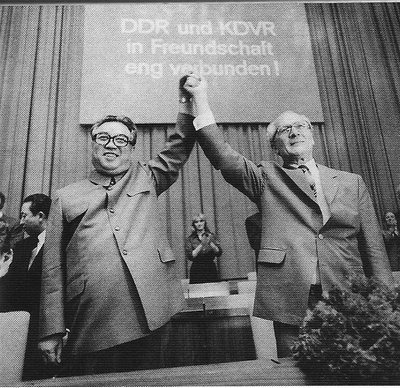
KIM_IL_SUNG_mit_HONECKER

Kim Il Sung and Erich Honecker: *sigh*, don’t you miss the golden days? —- no, me neither

(the placard reads: ‘GDR and DPRK tightly bound in friendship’ – for tyranny and poorly-made men’s wear)

Here is part two and part three.

Last week I ve participated in a scenario to map out possible futures of Kim Jong Il’s sudden death. My best guess is in my previous post – a military dictatorship with Kim III (Jong-Un) as a familial, yet much reduced, figurehead. But one idea that is always floating around in the background is that major regime junctures in the North might lead to break down and then unification. President Lee has taken recently to saying that SK should prepare for imminent unification, and one of my favorite NK experts thinks unification is likely in the next five years.  Does anyone else think this is likely, and why so (in the comments below, please)? I don’t see that actually.

Nevertheless, the most obvious parallel for trying to map Korean unification will work is the German case in 1989/90. I have written about this before, but the following compare and contrast is more complete. For Asian readers in search of a good walk-through of Germany’s experience with division, here is a good place to start.(FYI: I lived in Germany for 4 years in the early 90s and speak German. I recall debating this stuff a lot.)

Similarities  between the German and Korean divisions:

1. Domestic

a. Both nations were divided artificially. Both sides believe the ‘2 states, 1 people’ outcome is temporary. All 4 states face a permanent constitutional legitimacy crisis, because the obvious question is why these separated states exist at all. As such, all states divided by the Cold War were intensely competitive with the other. Outracing each other economically, militarily,  even at the Olympics, became central to proving who was the ‘real’ Korea, Germany, Vietnam, China, etc. Mutual coexistence is basically impossible; each has a limited time window to race the other into international legitimacy. As one or the other pulls away in global opinion – as it becomes ‘the’ Korea or ‘the’ Germany in places like airports or hotel signage, popular movies, CNN, etc. –  it will become ever harder to justify maintaining the division.

b. NK and EG (East Germany) are both communist with all the attendant problems of 20th century ‘real existing socialism.’ They are domestically illegitimate outside their own elites. Those elites are a corrupted ‘red bourgeoisie’ for whom regime ideology became a figleaf for oligarchy and luxury. Neither can produce anything close to the quality and quantity of goods necessary to keep their populations happy – populations further disenchanted by what they see on the other side. Both have a nasty secret police. They are both noticeably poorer than the westernized competitor, and this creates unending pressure on the government to change. All these factors create a disconsolate citizenry that would push out the regime if given the chance. Hence, any manner of internal democratization or liberalization would end the regime as we know it. In the end, both communist half-states had to seal off their borders to prevent exodus; they are national prisons.

c. Underperformance vis the westernized competitor slowly takes its toll internationally. The competitions led to hyper-militarization in the communist half, which only worsens the performance gap between both sides.  Perhaps the best marker of the communist failure after a few decades was that West Germany simply became Germany and South Korea just Korea. To indicate the communist half in everyday speech, one had to affix the directional adjective, the implication being that EG and NK were somehow dead-ends of history. By the 1980s, both NK and EG had effectively lost the race of point 1a above; SK and WG became Korea and Germany.

d. The westernized, ‘Free World’ half of the nation is a wealthy, functioning democracy that has otherwise joined the world – technologies, markets, and institutions (IMF, WTO, etc). This makes the communist half look even more like a basket case. Gradual but sustained wealth and demographic accumulation have dramatically altered the balance against the communist half. The free half also regularly receives communist refugees voting with their feet.


2. International

a. SK and WG are clearly supported by the US and its wealthy democratic allies. Both belong to American/democratic alliance system and enjoy the widespread moral legitimacy that comes from that. They are net contributors to their own defence, clearly outclassing the communist half strategically.

b. NK and EG are practically client states of a communist behemoth, on whom they are extremely dependent. The patron of both finds them troublesome and expensive. Both field an military based around obsolete WWII assumptions of massed infantry and armor formations. Neither can win a conflict with the other half; the economic gap compounds the military gap. The patron regularly debates the merits of cutting the client loose.

c. The neighborhood got used to the division and kinda likes it (especially Japan and France, although no one will say that publicly). There isn’t a lot of impetus from outsiders to end the split. Russia couldn’t care less if Korea unites. Like the French and British on Germany, the Japanese public will come around once they see it on TV. Once we see crying Koreans tearing down the barbwire fences of the DMZ, like we saw Germans hammering the Berlin Wall, no one will stand in its way. But until then, don’t expect anyone else to do much beyond pro forma boilerplate.

Go to part two.

Japan is an EU Country Trapped in Asia

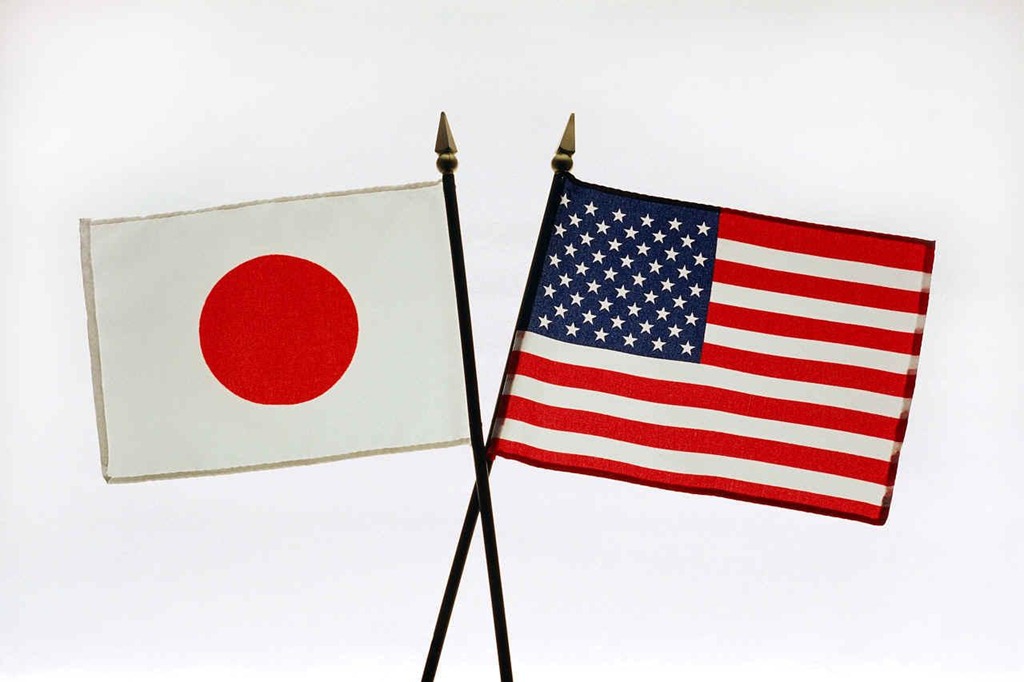
japan_us_flag

The Council of Foreign Relations blog, Asia Unbound, is quite good. If you don’t read it, you probably should before you read my stuff. To be sure, CFR is establishment; indeed, it is the very definition of the foreign policy establishment in the US. So it is not exactly the font of challenging new ideas. But still, they are linked into power in way that lonely academic bloggers will never be. And this week’s bit on Japan really got me thinking about how Japan is basically stuck with the American alliance indefinitely, whether they like it or not.

Recall a year ago when the LDP got whipped in the election, that there was lots of talk about how Hatoyama was going to create distance between Japan and the US, how this was a new dawn in the relationship, how the Japanese left would be so much more prickly with the US than the old boys network of the LDP. I was fairly skeptical of this at the time, and I think the recent flap with China over the islands has done a lot to confirm that skepticism.

Japan really has nowhere else to go but the US. It is stuck with us, primarily because it is geographically fixed in a neighborhood where it has no friends. And this opens all sorts of room for the US to push and bully Japan, which leads to regular Japanese outbursts that Japan needs to be independent of the US. (For the most famous, read this.) In fact, Japan is like a post-modern EU country in the wrong place. It should be comfortably ensconced in a post-national intergovernmental framework like the EU, where it could promptly forget about history and defense spending, and worry about how to care for its rapidly aging population – like Germany is morphing into ‘Greater Switzerland.’ But it’s not. Instead, Japan is trapped in modernist-nationalist-historical Asia, surrounded by states that don’t trust it and who want a lot from it that it doesn’t really want to give (historical apologies, imports, engagement, development aid, territorial compromises).

Consider that Japan, like China or Russia, has no friends or allies (save the US), and lots of semi-hostile neighbors:

Russia: Neither side has much interest in the other. There is an island dispute that has blocked normalization for decades. And, of course, Russia has been an erratic partner for just about everyone, not just Japan, since the end of the Cold War. So there is nothing to gain there.

Korea: There is also an island dispute with South Korea, over which even North Korea (!) has supported the SK position. NK kidnapped Japanese citizens in the 70s, and this has remained a permanent fixture in Japanese politics. For the North, Japan is high-up on the hit list; the North has launched missiles over it. Relations with the South are possibly even worse. S Koreans are intensely japanophic. The island dispute (Dokdo) rouses extraordinary passions here. Finally, of course, both Koreas are furious with Japan over its invasion and colonization from 1910-1945 and feel that Japan has never properly apologized.  Given how much S Korea and Japan share – democracy, concern over China’s rise, a US alliance, fear of NK, Confucian-Buddhist culture – they should should be natural allies, but Koreans will tell you with a straight face that Japan wants to invade it again. So forget that.

China: Yet another island dispute plagues the relationship from the start. And like Korea, so does history. The Japanese were even harsher in China than they were in Korea. The Rape of Nanking was brutality on par with the Nazis, and the Japanese used biological warfare against the Chinese as well. As the CFR post linked above notes, anti-Japanese street protests are becoming a regular part of Chinese politics now. A Sino-Japanese reconciliation would require astonishing, Willy Brandt-style statesmanship that the immobilist Japanese political system is wholly incapable of delivering.

Southeast Asia/India: Things get a little easier here, if only because it is further afield. But the ASEAN states too suffered under Japan in WWII, and like China and Korea, don’t feel that Japan has engaged in the appropriate historical reckoning. Only India is a possible serious Asian ally of the future because of mutual concern for China and the lack of historical-territorial problems.

Bonus problem – Economic Decline: As if this unhappy neighborhood weren’t trouble enough, add in Japan’s bizarre economic malaise. When China, Korea and the Soviet Union/Russia were a mess a generation ago, Japan could strut in Asia, but now these competitors are closing the gap while Japan stagnates. That just makes all the frictions that much harder to manage. China is so big, it can afford to miff the neighbors, but Japan no longer has this luxury.

In short, a weakening Japan so infuriates it neighborhood, that the US is all its got left. Given Japan’s paucity of options, the US has lots of room to bully and push Japan. But it must ultimately give in, because it’s position in Asia alone would be terrible – isolated, suspected, friendless. So bad is Japan’s position, that the US could effectively bring down the Hatoyama administration over something as minor as Futenma.

This is not meant to be an endorsement of US wedge politics against Japan. But it should certainly explain why its 20-year old complaint about US dominance has led to nothing, just like Gaulle’s petulant withdrawal from NATO ended in ignominy when the French finally gave up on ‘expectionalism’ and rejoined last year. It’s nice to be two oceans away from the competitions of Eurasia…

Sharia Orwellianism Update, or Why the GWoT Rolls on and on…

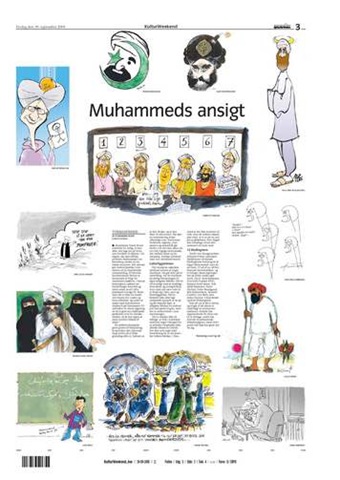
Yet another attack on a Mohammed cartoonist in Europe, complete with violent, alienated, unintegrated Muslim youth screaming ‘Allah akhbar’ at bewildered Europeans…


The relevant context is here and here.

This sorta stuff just makes my blood boil, because it lays so bare the splits between western liberalism and Middle Eastern salafism. This pretty much tells you why the war on terrorism continues, as does the West’s concern about Islam, despite Obama’s election. And it should make pretty clear why it is important to fight the GWoT and win it.

If you haven’t seen the original Mohammed cartoons, here they are. If you are ‘offended,’ then I am elated. Liberalism is good for you. I am proud to re-post them. Go surf someplace else…

Jyllands-Posten

Is there an EU Role in Asia? (2): Not Really… (plus thoughts on Greece)

asem6_logo01

Greece Addendum: I spoke at an EU conference yesterday, and I was amazed at how blithely the EU representatives glided by the Greek meltdown. If you read the coverage from the Economist or Financial Times, they make it sound like this is an existential crisis, but the Europhiles would have none of that. When I asked, I heard variants of the ‘it’s-too-big-fail’ argument: the euro is too important, Greece must and will be bailed out, the EU cannot fail. This strikes me as putting your head in the sand – denial rather than analysis.

Far too much of the EU’s supranationalism is reallyone country’s supranationalism paying for other countries’ nationalisms. That is, Germany pays for its historical guilt by paying for European unity heavily on its own. (Check this graphic to see just how much the Germans fork over.) This free-riding on German liberal guilt has pompously masqueraded as ‘transcending the nation-state.’ It is perilously close to fracture today, but I guess this can’t shake the Kantian-Europhilic elites that dominate the ‘eurocracy’ and its affiliated NGOs and universities. As I argued in paper (below), European regionalism is as much an article of faith as a testable empirical proposition, and this attitude has spread to Asia, where the regionalism discourse – in the face of persistent nationalism and talk-shop regional organizations – seems like an even greater fantastical flight of fancy.

For what its worth, I think the EU and the East Asian Community are both good ideas, but I think they are seen in too rosy a light too often. Nationalism is far more persistent, and a much deeper obstacle to regionalism than European-trained IR and foreign policy elites will admit. For good summaries of the big EU’s challenges, if not coming paralysis, try here and here.

Part 1 of this post is here. This post is intended to be a graphically summary of part 1’s argument.

Korea and the European Union have signed a free trade agreement, and the European Union is regularly a top five export market for Korea. Both sides are now exploring further dimensions to the relationship. Using a traditional list of state goals in foreign policy – national security, economic growth, prestige-seeking, and values-promotion – I examine the prospects for cooperation and integration in the future. What would either side gain by richer contact? I find that deeper engagement is unlikely. Most importantly, neither side is relevant to the basic security issues of the other. Specifically, the EU cannot assist Korea in its acute security dilemma, and ‘sovereigntist’ Korea does not share EU preferences for soft power, regionalization, and multilateral collective security. However, Korea is likely to pursue the relationship for cost-free prestige-taking. And the European Union will understand this ‘Asian bridge’ as a success for the promotion of liberal-democratic values in a non-European context. Pro-regionalist elites, most notably the ‘eurocracy,’ may pursue ‘inter-regional’ ties – such as ASEM (picture above) – for internal institutional reasons, but deep Korean attachment to the Westphalian state model will likely stymie such efforts.

Table 1 summarizes my findings:

Table 1.: EU-Korea Dyadic Benefits

 Foreign Policy Goal                                                      Benefits to each Player

  EU Korea
Security Minimal– no Korean power projection to Europe

– Korean irrelevance to Russia, GWoT/Islam, Southern & Eastern Europe

Minimal– No EU role in 6-Party Talks

– No EU global posture, esp. re: the DPRK

– Shared ambiguity on PRC

– EU irrelevance on Japan

Growth Welfare-Enhancement of FTA assumed Welfare-Enhancement of FTA assumed
Prestige Middling– Korea too small to meaningful raise EU’s global status

– Korea relationship serves eurocracy’s internal bureaucratic interest

High– large, ‘civilized’ EU raises Korea’s global profile
Values High– Korea as central example of universality of western values Minimal– low likelihood of the ‘Korean Wave’s’ success in the EU/West

Is there an EU Role in Asia? (1): EU-Korea Relations beyond just Trade

EU-Korea Flag

This entry is cross-posted at the excellent European Geostrategy. Leave comments there as well. Part 2 is here.

On May 6-7, 2010, the EU Center of the Pusan National University is holding a conference on EU-Korea relations. This is a good time to think about the EU’s relations in Asia, about which I have been pretty critical so far. Here is a summary of my paper. I intend to submit this for publication, so comments would be especially welcome. Email me if you want the whole thing.

In 2009, Korea and the EU signed an free trade agreement (FTA), and the EU is regularly a top five export market for Korea. Interest in future cooperation is high, however the research on which this post is based finds that deeper engagement is unlikely. Most importantly, neither side is relevant to the basic security issues of the other. Specifically, the EU cannot assist Korea in its acute security dilemma, and ‘sovereigntist’ Korea does not share EU preferences for soft power, regionalization, and multilateral collective security. However, Korea is likely to pursue the relationship for cost-free prestige-taking. And the EU will understand this ‘Asian bridge’ as a success for the promotion of liberal-democratic values in a non-European context. Europhile, pro-regionalist elites may pursue ‘inter-regional’ ties to bolster the European Comission (EC) within Europe, but deep Korean attachment to the Westphalian state model will stymie pan-regionalism.

Neither the EU nor Korea can meaningfully contribute to the other’s primary security challenges – a central pillar for deeper bilateral relations among states. As James Rodgers and Luis Simon note frequently, the EU lacks serious power projection far from the Continent. Its ‘loss of strength gradient’ toward East Asia is severe since the British retrenchment from east of Suez. The EU cannot meaningfully deter NK or China. EU land forces do not bolster US Forces in Korea. Although a participant in the Proliferation Security Initiative and the (now defunct) Agreed Framework, the EU plays no role in the new Six Party frame. Similarly, Korea is irrelevant to big EU security issues, such as the course of Russia, terrorism and the Middle East, or Eastern Europe’s stabilization. Their shared liberal democratic values place them broadly in the liberal security community of the democratic peace, but a more positive military contribution to either’s security is unlikely.

Both sides derive prestige from the relationship. Korea, small and peripheral to the global economy until recently, captures most of these benefits. A bilateral relationship with Europe flatters the Korean imagination of its stature in world politics. Instead of a half-country whose international image is dominated by a clownish rogue despot, Korea lusts for Europe’s status and rank. Its famous antiquities, high-profile tourism locations, rich history of art and culture – all nested in a wealthy, healthy, international society broadly at peace with itself – strongly attracts the Korean imagination.

A well-known, highly recognized ‘global player,’ the EU captures little direct prestige from Korea. However, the Korean partnership does benefit pro-European elites within the EU, most notably in the EC/EU bureaucracy. The ‘eurocracy,’ trapped in a decades-long turf-battle with the national bureaucracies, is likely to seize on the prestige of a direct EU-level relationship with a G-20 economy. This is ammunition against critics that the EU is simply a trade deal or that other states do not take it seriously. If the 2010 host of the G-20 summit takes the EU seriously enough to label it a ‘strategic partner,’ then the eurocracy gains in the intra-European conflict to establish the EU more soundly and eventually build a real Common Foreign and Security Policy.

Finally, the EU does reap psychological gains of domestic values validation. Korea is a great successes in the transplantation of liberal, democratic, Enlightenment values outside of the West; Korea is routinely touted a central case that these values not ‘western,’ but in fact universal. This excises the cultural-racial bite of the ‘Asian values’ and ‘human-rights imperialism’ arguments of Asian actors such as the Chinese Communist Party or Matathir Mohamad. Conversely, Korea will find little back-traffic, despite heroic efforts to export the ‘Korean Wave.’

The EU and Korea have an unremarkable relationship. Given the mutual irrelevance of one’s security to the other, it is easy to predict that no alliance is likely. The FTA is step forward, but ultimately one based solely on material utility. The EU also trades with Iran, and Korea has a ‘strategic partnership’ with Kazakhstan. This provides perspective on the mutual, post-FTA rhetoric of ‘strategic partners.’ A ‘friendly partner’ is a more credible assessment. The EU-Korea relationship will not mature into a meaningful bond to rival the more critical relations of either with the US, China, Japan, or Russia.

The EU’s preference for Asian regionalism will generate friction, although Korea will tolerate it in order to retain the huge prestige boost an EU relationship. Hence the greatest frustration will fall on the European side. Korea’s prestige gains are already achieved by the completion of the FTA and the ‘strategic partnership,’ and the EU cannot leverage a security contribution to the peninsula to push Korea into the East Asian Community (EAC) or Asia-Europe Meeting (ASEM). So long as Korea, and East Asia generally, remains committed to the ‘ASEAN Way’ of talk-shop intergovernmentalism, Kantian-Europhilic elites – pro-EU, pro-EAC, and pro-ASEM – are likely to find nationalist Korea, and Asia, a frustrating ‘inter-regional’ partner.